How to Support Your Girlfriend During Menstrual Cycle Phases

Master the 4 menstrual cycle phases to better support your girlfriend. Learn tactical tips to handle mood swings, fatigue, and energy shifts with ease.
The Proactive Partner’s Guide to the Menstrual Cycle Phases
Most men don’t realize that the arguments repeating every few weeks aren’t random chaos - they’re predictable biological events on a 28-day loop. Your girlfriend’s energy, mood, and social battery follow a hormonal fuel gauge that shifts every week, and you’ve been trying to navigate it blindfolded.
Here’s what changes when you understand the pattern: You stop walking on eggshells. You anticipate her needs before she has to ask. You plan dates that land perfectly instead of bombing. You become the partner who shows up exactly when she needs you, without the guesswork.
This guide gives you the tactical playbook to support your girlfriend through all four menstrual cycle phases - not just the period. By the end, you’ll understand why she’s up for a spontaneous road trip one week and wants to cancel plans the next, and you’ll know exactly how to respond.
Table of Contents
- The Why: Biology for Men
- Phase-by-Phase Support Matrix
- The "Never Say" List: Communication Scripts That Work
- The Period Kit Checklist
- The Luteal Phase Survival Guide: Your Early Warning System
- The Art of Not Walking on Eggshells
- Frequently Asked Questions
The Why: Biology for Men
Her energy levels aren’t random. They’re governed by a 28-day hormonal fuel gauge that most guys never learn to read.
VibeCheck App
Know what she needs. Before she has to say it.
Track her cycle, understand her phases, be the partner she deserves.
Download Free on iOS →Think of it like this: Your phone battery drains throughout the day, recharges overnight, and the cycle repeats. Her body runs on a similar pattern, except the "day" is four weeks long, and the fuel is hormones - primarily estrogen and progesterone.
During the first half of her cycle, estrogen rises. She’s got more energy, higher social tolerance, and increased confidence. This is the battery charging. During the second half, progesterone takes over, then both hormones crash right before her period. The battery drains fast, and her body enters conservation mode.
The serotonin crash is what catches most men off guard. When estrogen and progesterone drop in the week before her period, so does serotonin - the neurotransmitter that regulates mood, sleep, and emotional stability. She’s not "being dramatic." Her brain chemistry is in temporary withdrawal, similar to coming off caffeine cold turkey.
Understanding this removes 90% of the confusion. The mood swings, fatigue, and irritability you’re seeing aren’t personal attacks. They’re biological events, and they follow a predictable schedule.
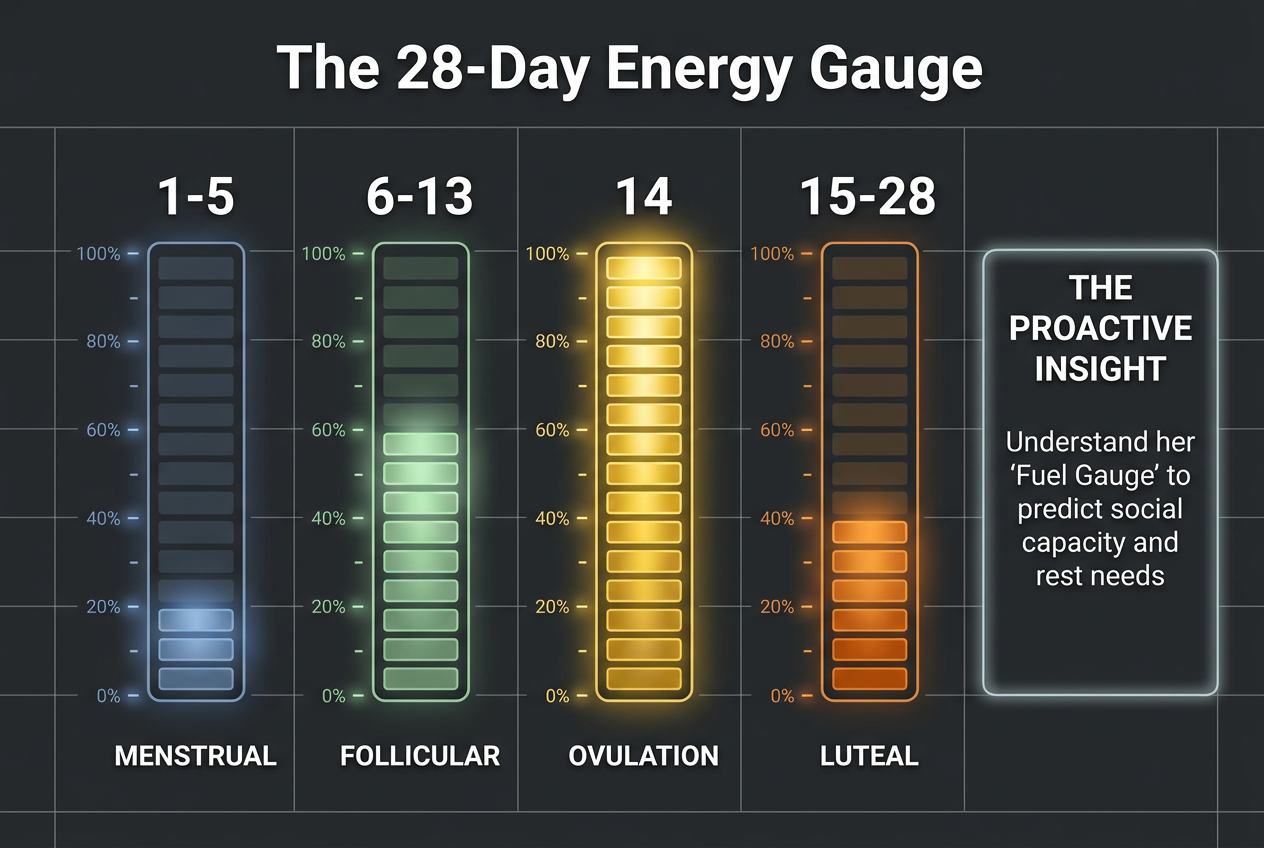 Understanding the 28-day hormonal fuel gauge helps you anticipate your partner’s energy levels and social battery before the month begins.
When you track her cycle, you’re not being invasive - you’re building a reference manual for her needs. You start to notice patterns: Week 1, she wants rest. Week 2, she wants adventure. Week 3, she’s at peak confidence. Week 4, she needs validation and low-pressure support.
VibeCheck’s period tracker for men alerts you three days before each phase shift, so you’re never blindsided by what’s coming next.
Phase-by-Phase Support Matrix
This is your tactical reference guide. If you see [Symptom], execute [Action]. No more guessing.
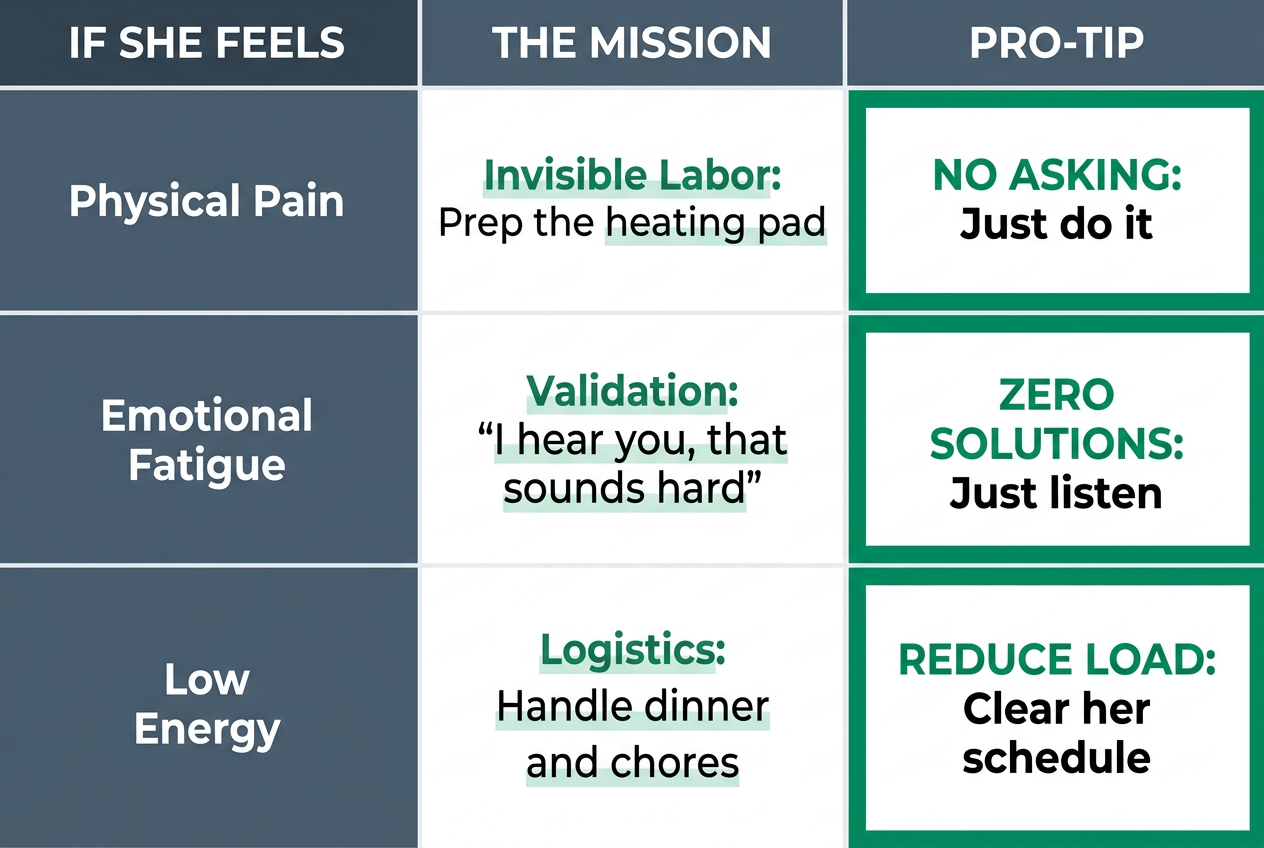 The Support Matrix: Transition from reactive questions to proactive missions by identifying symptoms and executing pre-planned support strategies.
Menstrual Phase (The Winter): Days 1-5
Her Biology: Estrogen and progesterone are at their lowest. Energy is depleted. Pain and inflammation are high. Her body is shedding the uterine lining, which creates cramping and fatigue.
What She Needs: Physical comfort and zero mental load. This is not the week to ask her to make decisions about dinner plans or weekend trips.
Your Mission:
- Pain Relief: Ibuprofen (Advil) or naproxen (Aleve) works better than acetaminophen (Tylenol) for menstrual cramps. Have it stocked before she asks.
- Heat Therapy: Heating pads or hot water bottles reduce cramping by increasing blood flow to the uterus. Keep one at your place.
- Zero Chores Policy: Handle laundry, dishes, and meal prep without asking if she needs help. The act of being asked creates work.
- Low-Key Quality Time: Binge a show together. Order her favorite takeout. Let her rest on the couch while you handle logistics.
What to Say:
- "I’ve got dinner tonight. What are you in the mood for?"
- "I’m running to the store - do you need anything?"
- "Take your time in the shower. I’ll clean up."
What to Avoid:
- Planning social events or double dates.
- Suggesting the gym or high-energy activities.
- Asking her to explain what’s wrong. She’s in pain - that’s what’s wrong.
Learn more tactical scripts in our guide on how to comfort your girlfriend during PMS.
Follicular Phase (The Spring): Days 6-13
Her Biology: Estrogen is rising fast. Energy levels climb. Mood improves. She’s more social, optimistic, and open to new experiences. This is the recharge phase.
What She Needs: Adventure, novelty, and shared experiences. She wants to plan the weekend trip, try the new restaurant, or explore the hiking trail.
Your Mission:
- Plan New Experiences: This is your window for spontaneous dates, day trips, or activities she’s been mentioning.
- Lean Into Her Energy: If she suggests something, say yes. Her social battery is full, and she wants to use it with you.
- Initiate Physical Touch: She’s more receptive to affection and intimacy. Morning sex, long hugs, and physical closeness feel natural during this phase.
- Support Her Projects: If she’s starting a new hobby or work project, be her cheerleader. Her motivation is high, and she wants to channel it.
What to Say:
- "You mentioned wanting to check out that new coffee shop - let’s go Saturday."
- "What’s one thing you’ve been wanting to do this month?"
- "I love seeing you this fired up about your project."
What to Avoid:
- Staying in every night. She wants out of the house.
- Ignoring her energy. Match her vibe - don’t bring her down.
For a deeper dive into supporting her during this phase, check out how to support your girlfriend during her follicular phase weekend.
Ovulation Phase (The Summer): Days 14-16
Her Biology: Estrogen peaks. Confidence, energy, and libido hit their highest point. She’s at her most magnetic and socially engaged. This phase only lasts 3-4 days, so timing matters.
What She Needs: Connection, validation, and presence. She wants to feel seen, desired, and prioritized. This is not the week to cancel plans or tune out.
Your Mission:
- Prioritize Quality Time: Clear your calendar. Be fully present. No half-attention while scrolling your phone.
- Physical Touch and Affection: Ovulation is her biological green light for intimacy. Initiate, but read her cues.
- Compliments That Land: Tell her specifically what you appreciate. "You look incredible tonight" hits harder than "You look nice."
- Adventure Dates: High-energy activities work well - concerts, festivals, road trips, or anything that creates shared memories.
What to Say:
- "I’ve been thinking about you all day."
- "You’re killing it with [specific thing she did]. I’m genuinely impressed."
- "Let’s make tonight just about us - no distractions."
What to Avoid:
- Criticism or conflict. She’ll remember it more intensely during this phase.
- Being distant or checked out. She’ll interpret it as disinterest.
Discover more strategies in our article on supporting your girlfriend during the ovulation phase.
Luteal Phase (The Fall/Storm): Days 17-28
Her Biology: Progesterone rises, then both estrogen and progesterone crash in the final week. This is the phase that causes the most relationship friction. Serotonin drops, energy depletes, and emotional sensitivity spikes. She’s not overreacting - her brain chemistry is destabilizing.
What She Needs: Validation, low-pressure support, and proactive help. Do not ask "What’s wrong?" or "How can I help?" Take action without making her manage you.
Your Mission:
- Validate Her Feelings: She’s not crazy. Her frustration, anxiety, or sadness is biochemically amplified. Acknowledge it without fixing it.
- Invisible Support: Handle chores, errands, and logistics before she notices they need doing. This is the phase where the mental load crushes her.
- Complex Carbs and Magnesium: Her body craves serotonin-boosting foods. Stock whole grains, sweet potatoes, and dark chocolate (70%+ cacao).
- Cancel Low-Priority Plans: If she’s not feeling social, don’t push it. Stay in and create a low-stress environment.
What to Say:
- "That sounds really frustrating. I’m sorry you’re dealing with that."
- "I handled [chore/task]. You don’t need to worry about it."
- "Do you want company, or do you need space right now?"
What to Avoid:
- "Are you on your period?" (Never. Ever.)
- "You’re overreacting." (Her emotions are amplified, not invalid.)
- Debates or heavy relationship conversations. Save them for Week 2.
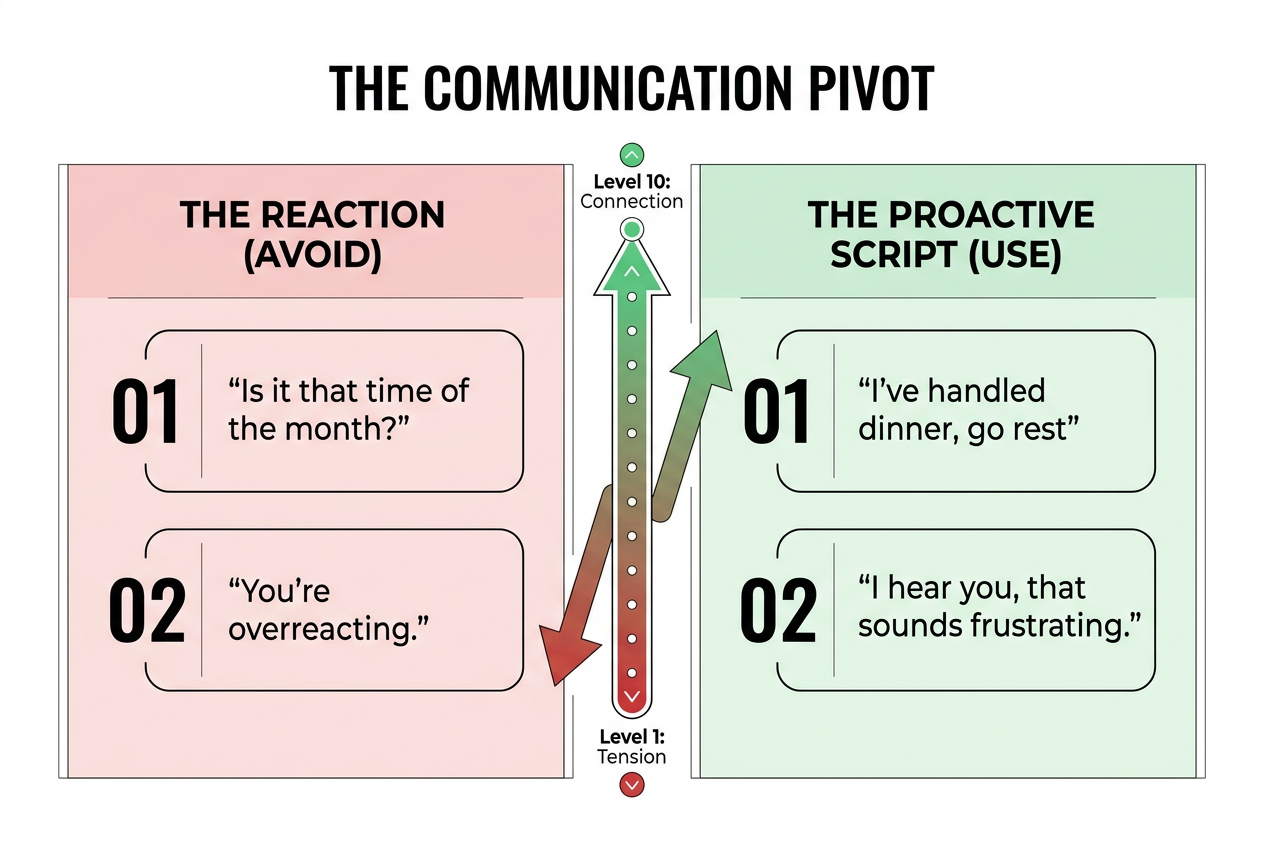 Effective communication during the luteal phase requires shifting from analytical questioning to empathetic validation and proactive action.
For a complete breakdown of this phase, read the boyfriend’s guide to the luteal phase.
The "Never Say" List: Communication Scripts That Work
Certain phrases detonate arguments instantly. Here’s what to avoid and what to say instead.
Never Say:
- "Is it that time of the month?"
- "You’re being irrational."
- "Calm down."
- "Why are you so emotional?"
- "It’s not that big of a deal."
Say Instead:
- "I hear you. That sounds really frustrating."
- "I can see this is affecting you. What can I do to make it easier?"
- "I’ve got this handled. Go rest."
- "You’re not overreacting. This makes sense."
- "I’m here. Let me know what you need."
The goal is to validate first, problem-solve second. During the luteal phase, her brain isn’t looking for solutions - it’s looking for acknowledgment. When you jump to fixing the problem, she hears "Your feelings are invalid and need correcting."
Validation sounds like:
- "That coworker sounds exhausting. I’d be frustrated too."
- "You’re handling a lot right now. That’s not easy."
- "I’m sorry you’re feeling this way."
After validation, if she wants help, she’ll ask. If she doesn’t, your job is done. You just gave her what she actually needed: to feel heard.
For more communication strategies, explore our guide on how to talk to your girlfriend during PMS.
The Period Kit Checklist
Being "mission ready" means having supplies stocked before she needs them. This eliminates the 11 PM pharmacy run and reduces her mental load.
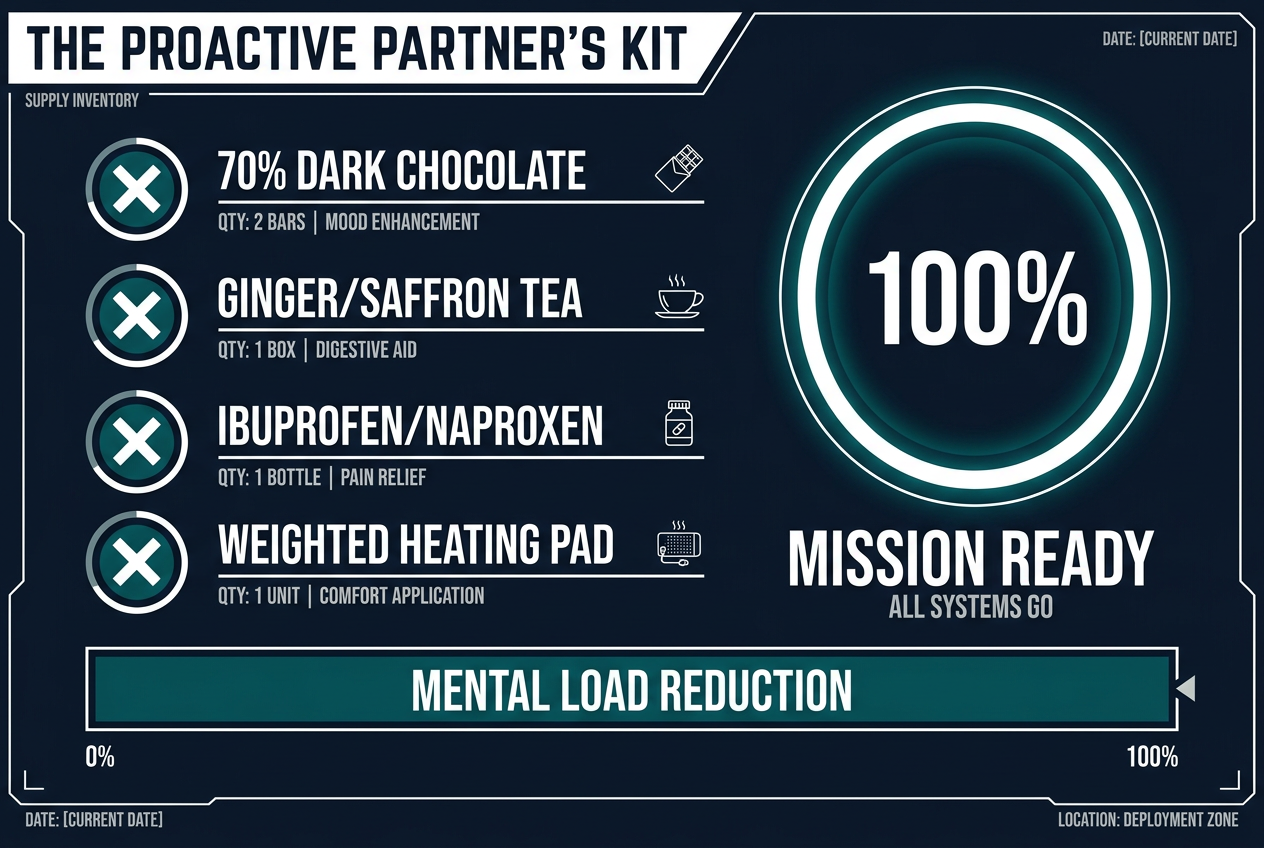 Being ’Mission Ready’ with a pre-stocked support kit eliminates the need for last-minute pharmacy runs and reduces your partner’s mental load.
Pain Relief:
- Ibuprofen (Advil) or Naproxen (Aleve) - 400-600mg as needed
- Heating pad or hot water bottle
- Lidocaine patches (if cramping is severe)
Nutrition and Mood Support:
- 70%+ dark chocolate (high in magnesium, which reduces cramps and boosts serotonin)
- Ginger tea (reduces inflammation and nausea)
- Saffron supplements (shown to reduce PMS mood symptoms in clinical studies)
- Complex carbs (whole grain crackers, sweet potatoes, oats)
Logistics:
- Her preferred menstrual products (tampons, pads, or menstrual cup) stashed at your place
- Extra underwear (in case of leaks)
- Comfortable loungewear or sweatpants
Comfort Items:
- Her favorite snack or takeout menu on speed dial
- A playlist or show you can binge together
- Fuzzy blankets or heating pads
The goal is to never have to ask "Do you need me to grab anything?" You already have it covered.
Discover more strategies in our article on what to do when your girlfriend is on her period.
The Luteal Phase Survival Guide: Your Early Warning System
The luteal phase (Days 17-28) is the most misunderstood part of the cycle. This is when progesterone rises, then crashes alongside estrogen in the final week before her period. The result: PMS.
PMS isn’t just physical cramps. It’s a serotonin crash that causes mood swings, irritability, anxiety, and fatigue. She’s not "moody for no reason." Her brain is going through a predictable chemical withdrawal.
The Early Warning Signs (Days 17-21):
- Subtle energy drop
- Increased appetite for carbs and sweets
- Slight irritability or impatience
- Social battery starts draining faster
The Storm Week (Days 22-28):
- Noticeable mood swings
- Heightened sensitivity to criticism
- Fatigue and low motivation
- Cravings intensify
- Physical symptoms: bloating, breast tenderness, cramping
Your Tactical Response:
- Week 3 (Days 17-21): Start shifting toward low-key plans. No high-pressure social events. Cook her favorite meals. Increase physical affection.
- Week 4 (Days 22-28): Activate full support mode. Handle chores without asking. Validate her emotions. Stock comfort food. Cancel non-essential plans.
The key is being proactive, not reactive. By the time she’s crying over a dog commercial, you should have already cleared her schedule, handled the dishes, and stocked her favorite snacks.
VibeCheck sends you alerts three days before her luteal phase starts, so you’re never caught off guard.
For more on navigating this phase, check out how to support your girlfriend during the luteal phase.
The Art of Not Walking on Eggshells
Here’s the fear most guys don’t admit: "If I acknowledge her cycle, she’ll think I’m being condescending."
The truth: She already knows her cycle affects her. She’s been living with it for years. What she doesn’t have is a partner who understands it without making her feel broken or "too much."
The line between supportive and patronizing comes down to framing.
Patronizing:
- "You’re just on your period. You’ll feel better in a few days."
- "This is just your hormones talking."
- "Don’t worry, it’s not a big deal."
Supportive:
- "I know this week is tough for you. I’ve got your back."
- "Your feelings make sense. Let me take some things off your plate."
- "I’m here. Let me know what you need."
You’re not dismissing her emotions or attributing everything to her cycle. You’re acknowledging that her biology makes this week harder, and you’re offering support without being asked.
The best partners don’t treat their girlfriend’s cycle like a liability. They treat it like intel - data that helps them show up better.
Ready to actually understand her?
Join thousands of men using VibeCheck to track her cycle and show up better every day.
Get VibeCheck FreeFrequently Asked Questions
How do I talk to my girlfriend about tracking her cycle without sounding weird?
Frame it as wanting to support her better, not manage her. Try: "I’ve been reading about how your cycle affects energy and mood, and I want to make sure I’m showing up the way you need. Would it be okay if I tracked your cycle so I can be more helpful during tough weeks?" Most women appreciate a partner who’s proactive, not reactive.
What if her cycle is irregular and I can’t predict her phases?
Irregular cycles are common, especially with stress, diet changes, or conditions like PCOS. Focus on recognizing patterns in her behavior instead of strict calendar tracking. If she’s more tired, craving carbs, or emotionally sensitive, you’re likely in the luteal phase. Over time, you’ll learn her personal cues. A period tracker app for men can help you log patterns even if her cycle isn’t textbook.
Is it okay to initiate sex during her period?
Ask her. Some women experience increased libido during menstruation due to hormonal shifts. Others feel uncomfortable due to pain or bloating. The key is making her feel safe to say no without guilt. If she’s open to it, lay down a towel, hop in the shower together, or keep it simple. Never pressure her, and never make her feel like her period is a problem for you.
How do I know which phase she’s in without asking?
Watch for behavioral cues. During the follicular phase (Week 2), she’s social, optimistic, and high energy. During ovulation (Week 3), she’s at peak confidence and libido. During the luteal phase (Week 4), she’s more introverted, craves comfort food, and may seem irritable or anxious. During menstruation (Week 1), she’s low energy and physically uncomfortable. Once you track a few cycles, the patterns become obvious.
What if she gets mad at me for bringing up her cycle?
Timing matters. Never bring it up during an argument or when she’s upset. Instead, have the conversation during her follicular phase (Week 2) when she’s more receptive and emotionally stable. Explain that you’re not trying to dismiss her feelings - you’re trying to understand her needs better. If she’s resistant, drop it. Some women aren’t comfortable with partners tracking their cycle, and that’s her boundary to set.
Can I use a period tracker app to improve our relationship?
Yes. Period tracker apps with partner modes give you real-time insights into her cycle phases, mood patterns, and symptom tracking. VibeCheck, for example, sends you daily support missions based on where she is in her cycle - things like "Suggest a low-key night in" or "Plan an adventure date." It removes the guesswork and gives you tactical actions to take.
What’s the difference between PMS and PMDD?
PMS (premenstrual syndrome) affects about 75% of menstruating women and includes mild to moderate symptoms like mood swings, bloating, and fatigue. PMDD (premenstrual dysphoric disorder) is a severe form of PMS that affects 3-8% of women and includes debilitating symptoms like depression, severe anxiety, and emotional dysregulation. If her symptoms interfere with work, relationships, or daily life, she should talk to a healthcare provider. PMDD is treatable with therapy, lifestyle changes, or medication.
How can I support her without making her feel like a burden?
The key is proactive action, not reactive questioning. Instead of asking "How can I help?" (which puts the labor on her), just handle the task. Cook dinner. Run the errand. Cancel the plans. Then tell her afterward: "I took care of it." This reduces her mental load and shows you’re thinking ahead. The best support is invisible - she shouldn’t have to ask for it.
Becoming a proactive partner isn’t about memorizing hormone charts or following rigid scripts. It’s about recognizing the pattern, anticipating her needs, and showing up exactly when she needs you - before she has to ask.
The men who master this don’t just reduce conflict. They build deeper trust, improve intimacy, and create relationships where both partners feel truly understood.
Ready to stop guessing and start leading? Download VibeCheck and turn her cycle into your tactical advantage. Get daily insights, support missions, and real-time alerts so you’re never caught off guard again.
Tags

Related Articles
Continue reading to deepen your understanding

How to Comfort Your Girlfriend During PMS: The Proactive Partner’s Guide
When the serotonin crash hits, your girlfriend isn’t just moody—her body is going through a chemical withdrawal. Learn how to provide proactive support without her having to ask.

Why Your Girlfriend’s Mood Changes Throughout the Month: The Four Seasons Framework
Does your girlfriend’s mood seem to shift for no reason? Discover the biological Four Seasons framework that explains her monthly cycle and how to be the partner she needs right now.

Support Your Girlfriend: Follicular Phase Weekend Guide
Discover how to support your girlfriend during her follicular phase weekend. Learn to match her high energy, plan the perfect dates, and build a stronger bond.

How to Comfort Your Girlfriend During PMS: The Ultimate Partner’s Guide
PMS doesn’t just affect her; it affects your relationship too. Learn how to navigate mood shifts and physical pain with empathy, validation, and practical support tactics.

How to Support Your Partner Through Period Mood Swings: A Practical Guide
Stop walking on eggshells. Learn the biological reasons behind hormonal shifts and get a practical playbook to support your partner through her cycle with empathy and ease.

The Boyfriend’s Guide to Her Cycle: Navigating Mood Swings and Energy Shifts
Understand the 28-day pattern behind her moods. This guide explains the four hormonal phases so you can stop walking on eggshells and start being the partner she actually needs.

How to Understand Girlfriend Hormonal Mood Swings
Stop taking it personally. Master the science behind her cycle, the 4-phase breakdown, and the best strategies to support her through hormonal mood swings.

A Boyfriend’s Guide to Supporting Your Girlfriend Through Hormonal Changes
Understanding her cycle isn’t about walking on eggshells; it’s about being a proactive partner. Learn how to navigate her monthly hormonal shifts and provide the exact support she needs.