What Does Creatine Do for Women Science-Backed Guide

Discover how creatine boosts energy, mood, and mental clarity for women throughout their cycle. Learn the science-backed benefits and how to support her today.
What Does Creatine Do for Women? The Science-Backed Guide for Supportive Partners
You've probably heard the term "creatine" thrown around at the gym, usually by guys chugging protein shakes and talking about their bench press. But here's what most men don't know: creatine isn't just another "bro supplement." For women, it's a completely different story - one that directly affects her energy, mood, mental clarity, and long-term health.
If your partner has been struggling with energy crashes, brain fog during certain weeks of the month, or feeling wiped out despite getting enough sleep, creatine might be the missing piece. This isn't about making her "bulky" or turning her into a bodybuilder. It's about understanding how her body works differently than yours and why she might need this supplement even more than you do.
This guide will show you exactly what creatine does for women, why the science backs it up, and how you can support her in making an informed decision. You'll learn the biological reasons behind the benefits, bust the most common myths, and get practical guidance on dosage and timing.
Table of Contents
- The Biological Gap: Why She Needs It More Than You
- Four Key Benefits That Impact Your Daily Life Together
- Myth-Busting for the Skeptical Partner
- The Partner Support Guide: How to Suggest It
- Creatine Benefits by Life Stage
- FAQ
The Biological Gap: Why She Needs It More Than You
BLUF: Women naturally store 70-80% less creatine than men, creating a significant biological energy gap that affects daily performance, cognitive function, and recovery.
VibeCheck App
Know what she needs. Before she has to say it.
Track her cycle, understand her phases, be the partner she deserves.
Download Free on iOS →Here's the thing most supplement companies won't tell you: women aren't just "smaller men." Their bodies process and store creatine completely differently, and it all comes down to hormones.
Research published in the Journal of the International Society of Sports Nutrition shows that women maintain creatine stores at roughly 70-80% lower levels than men. This isn't because they're eating less meat or working out less - it's a fundamental biological difference driven by estrogen and progesterone.
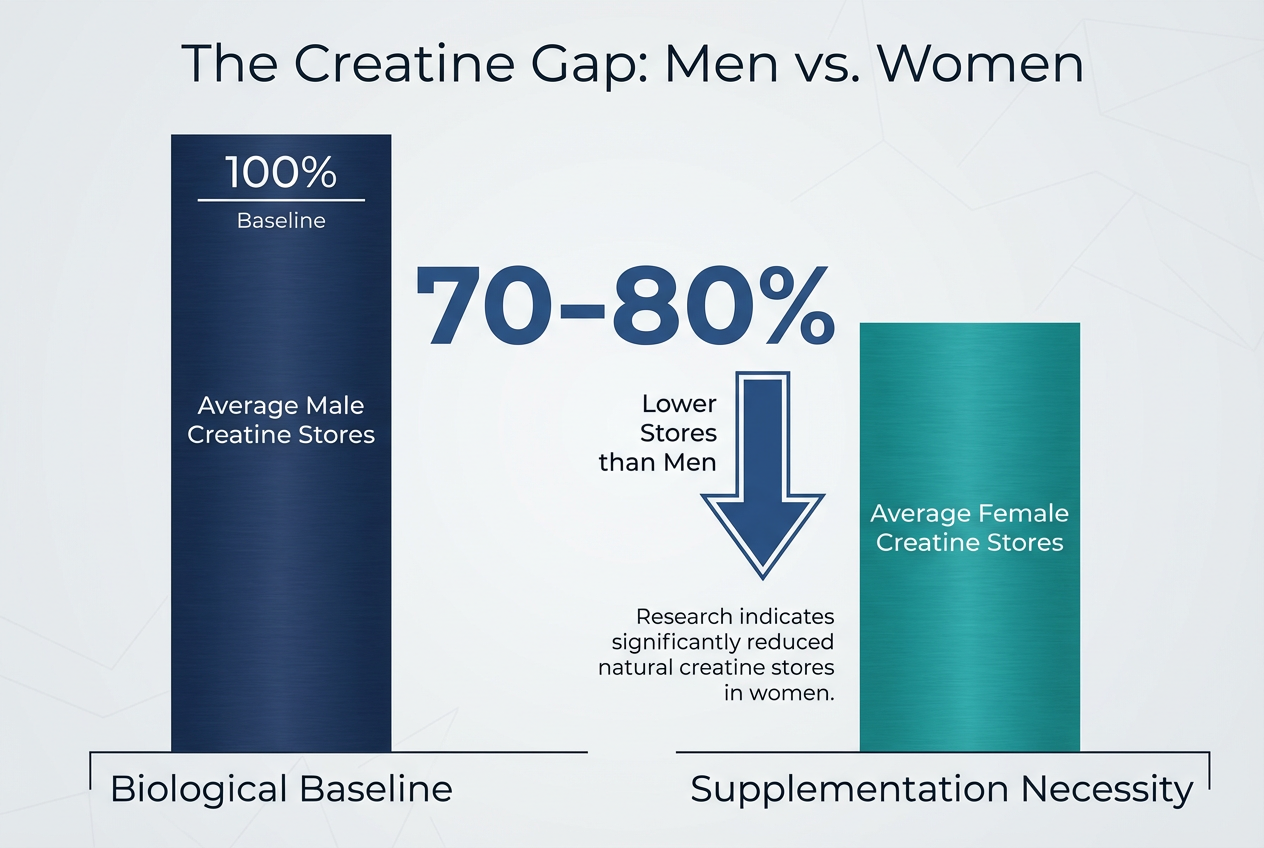 Women naturally maintain significantly lower creatine stores than men, making supplementation a vital tool for closing the biological energy gap.
Think of creatine as your body's emergency battery pack. When your muscles need quick energy - whether you're sprinting for the bus or doing a workout - creatine phosphate steps in to regenerate ATP (the cellular energy currency). When those stores are naturally lower, the battery dies faster.
Here's where it gets interesting for you as a partner: those hormonal fluctuations throughout her menstrual cycle directly impact how her body produces and uses creatine. During the luteal phase (the two weeks before her period), progesterone rises and can impair her body's natural creatine synthesis. This is exactly when she might be experiencing:
- Unexplained fatigue despite normal sleep
- Mental fog or difficulty concentrating
- Lower motivation for physical activity
- Increased irritability or mood sensitivity
Understanding how her hormonal cycle affects energy and mood can help you recognize when creatine supplementation could make a real difference. This isn't about "fixing" her - it's about understanding that she's working with a different biological blueprint.
The standard dietary sources of creatine (red meat, fish) provide about 1-2 grams per day for most people. But remember, she's starting from a lower baseline and facing hormonal fluctuations that you simply don't deal with. Supplementation bridges that gap.
Four Key Benefits That Impact Your Daily Life Together
BLUF: Creatine provides targeted benefits for energy resilience, mental clarity, bone health, and sleep recovery - all of which directly improve daily quality of life and relationship dynamics.
Energy Resilience During the Luteal Phase
You've probably noticed a pattern: some weeks she's unstoppable, hitting every workout and tackling projects with energy to spare. Other weeks, the same tasks feel like climbing a mountain. This isn't random.
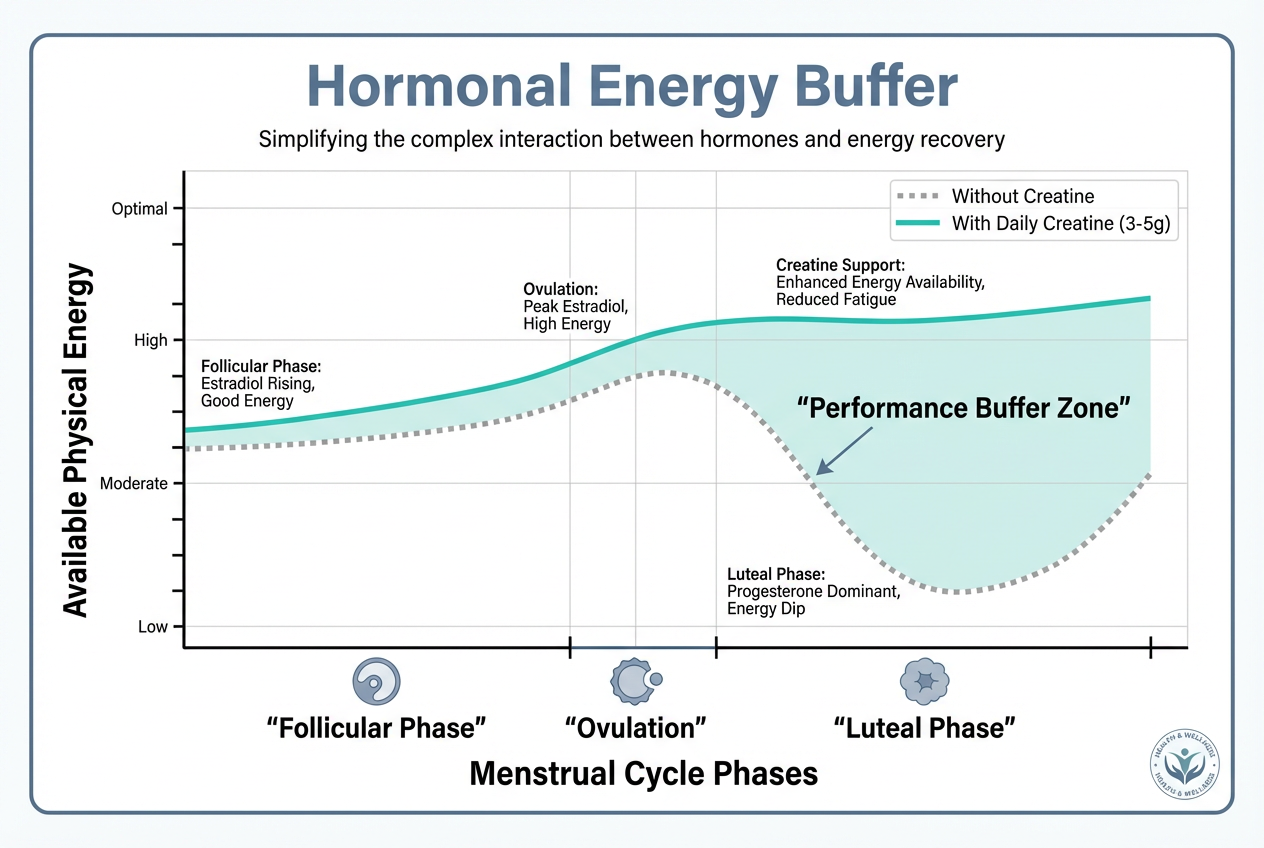 Daily creatine intake provides a critical energy buffer that helps women maintain consistent performance and mood during hormonal fluctuations in the luteal phase.
During the luteal phase, her body is working overtime. Progesterone spikes, body temperature rises slightly, and metabolic demands increase. Meanwhile, her natural creatine production takes a hit. Studies show that creatine supplementation can improve workout performance in women by 10-20%, but more importantly, it provides a steady energy baseline when her hormones are creating chaos.
Think of it like this: without supplementation, she's running on a battery that drains faster during certain weeks. With creatine, she has a buffer that keeps her functioning closer to her normal capacity. This means fewer cancelled plans, more consistent energy for the things you do together, and less of that "I don't know why I'm so exhausted" frustration.
Understanding her cycle phases and how to provide practical support during each one becomes much more effective when you recognize the biological factors at play.
The Anti-Brain Fog Tool
Here's something that surprised researchers: creatine's benefits for women extend far beyond the gym. Your brain uses about 20% of your body's total energy, and it relies heavily on creatine phosphate to maintain cognitive function.
Research published in Nutrients found that women who supplemented with creatine showed significant improvements in:
- Working memory tasks
- Processing speed
- Mental fatigue resistance
- Decision-making under stress
For your partner, this translates to clearer thinking during high-stress work periods, better focus during complex tasks, and less of that frustrating mental fog that can hit during hormonal fluctuations. If she's ever said something like "I just can't think straight today" during her luteal phase, this is partly why.
The cognitive benefits are especially pronounced during sleep deprivation. A study on sleep-deprived women found that creatine supplementation helped maintain cognitive performance even after a night of poor sleep - something that's particularly relevant for women dealing with insomnia related to their cycle or life stages like postpartum.
Bone and Muscle Integrity for Long-Term Health
This benefit is the ultimate long game, but it matters now. Women face a unique challenge: after menopause, declining estrogen levels accelerate bone density loss. The statistics are sobering - one in three women over 50 will experience an osteoporotic fracture.
Creatine works as an insurance policy. Research shows that when combined with resistance training, creatine supplementation:
- Increases bone mineral density
- Improves muscle mass preservation
- Enhances strength gains (critical for preventing falls later in life)
- Supports metabolic health
For younger women, this means building the strongest foundation possible before menopause hits. For women already in perimenopause or menopause, it means protecting what they have. Either way, you're looking at a supplement that pays dividends decades down the line.
Think about it: would you rather have a partner who maintains strength, independence, and bone health well into her 70s and 80s, or someone who becomes increasingly fragile? The interventions that matter happen now, not when problems already exist.
Sleep Deprivation Support
Let's be real: life doesn't always allow for perfect sleep. Work stress, travel, late nights, or just general insomnia can wreck her recovery. Here's where creatine shows up in an unexpected way.
Multiple studies demonstrate that creatine supplementation helps the brain maintain function during sleep deprivation. It won't replace actual sleep (nothing does), but it provides a buffer that helps her think more clearly and perform better when she hasn't gotten enough rest.
This is particularly relevant if she's dealing with cycle-related sleep disruptions. Many women experience worse sleep quality during their luteal phase due to elevated progesterone and body temperature. Having that extra cognitive support can make the difference between a frustrating, unproductive day and one where she can still function reasonably well.
Myth-Busting for the Skeptical Partner
BLUF: The three biggest creatine myths - that it causes bulky muscles, bloating, or kidney damage - are scientifically unfounded and stem from outdated bro-science rather than women's physiology.
Let's address the elephant in the room. If you're reading this thinking "but won't creatine make her look bulky?" you're not alone. This is the number one fear that stops women from trying creatine, and it's based on a fundamental misunderstanding of how female physiology works.
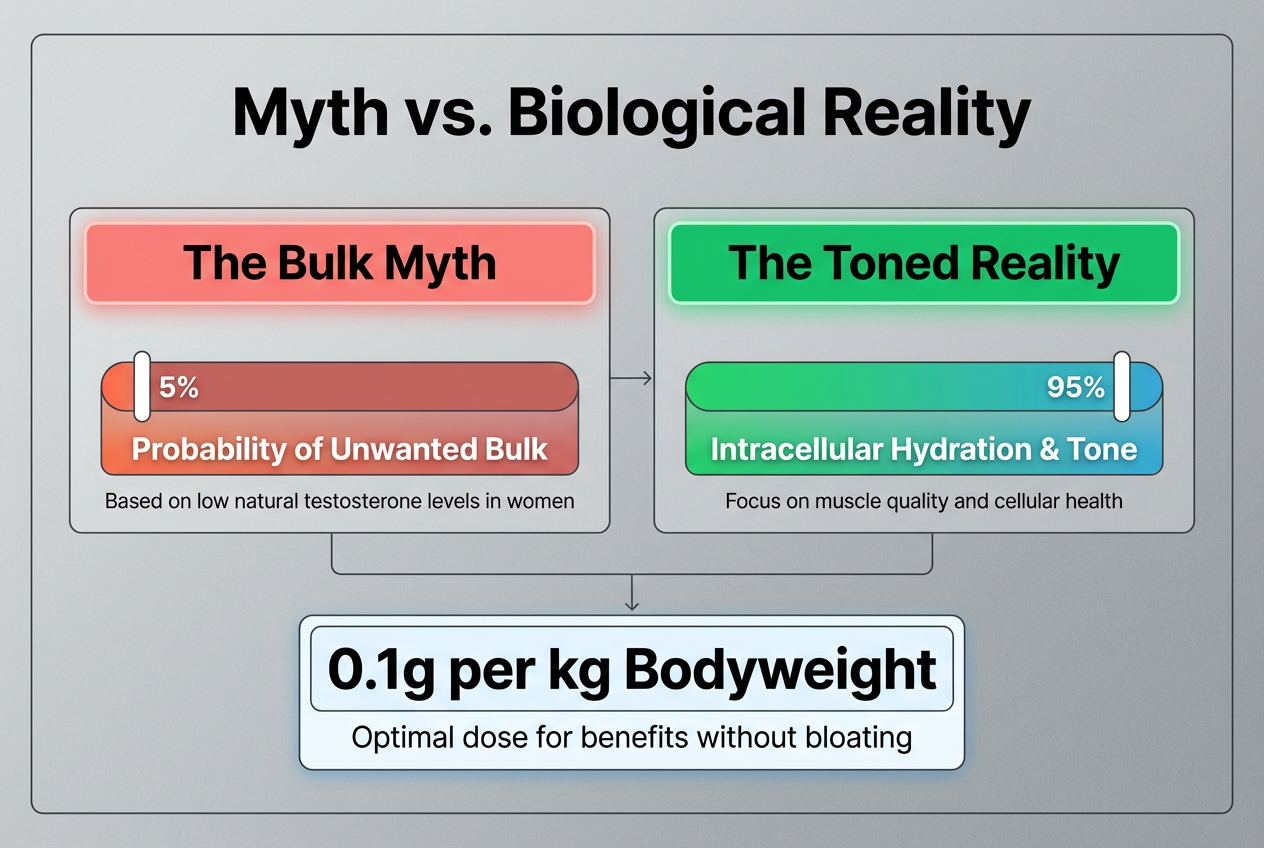 Scientific data proves that creatine promotes cellular hydration and muscle tone rather than 'bulking,' as women's physiology lacks the testosterone levels for rapid mass gains.
The "Hulk" Myth: She Won't Get Bulky
Here's the biological reality: building significant muscle mass requires testosterone. Lots of it. Women naturally produce 15-20 times less testosterone than men. Even male bodybuilders who take creatine don't suddenly "bulk up" from the supplement alone - it takes years of dedicated heavy lifting, precise nutrition, and often performance-enhancing drugs.
What creatine actually does is increase intracellular water content in muscle cells. This makes muscles look fuller and more toned, not bigger and bulky. Think of it like inflating a balloon slightly - it looks more defined, not massively larger.
The women you see who are genuinely "bulky" have spent years deliberately training for that look, eating in a caloric surplus, and likely have genetic advantages or pharmaceutical help. Your partner taking 3-5 grams of creatine daily while doing her normal workouts won't accidentally turn her into a bodybuilder any more than you'd accidentally become an Olympic sprinter by eating a banana.
The Bloat Myth: Understanding Water Weight
"But I heard creatine makes you gain weight!" Yes, and that's actually a good thing. Let me explain.
Creatine increases water retention inside muscle cells. This is intracellular hydration, which:
- Makes muscles look more toned and defined
- Improves cellular function and protein synthesis
- Has nothing to do with subcutaneous water retention (the bloating that makes you look puffy)
Most women experience a 2-4 pound weight increase in the first few weeks of supplementation. This freaks people out until they understand what's happening. That weight is hydrated muscle tissue, not fat, and it actually contributes to a leaner, more defined appearance.
The old "loading phase" protocol (20 grams per day for a week) can cause temporary bloating, but modern research shows you don't need to load at all. A consistent 3-5 grams daily achieves the same muscle saturation within 3-4 weeks without the uncomfortable water retention.
If she's concerned about the scale number, remind her that the mirror and how her clothes fit matter infinitely more than what the scale says. Those few pounds of intramuscular water are making her stronger and improving her physique, not making her fat.
The Kidney Myth: 20+ Years of Safety Data
This one needs to die. The myth that creatine damages kidneys comes from a misunderstanding of how kidney function is tested. Creatine is metabolized into creatinine, which shows up in kidney function tests. Higher creatinine levels can indicate kidney problems, so doctors sometimes panic when they see elevated levels in people taking creatine.
But here's what the research actually shows: over 20 years of studies, including long-term trials on athletes taking creatine for years, have found zero evidence of kidney damage in healthy individuals. The International Society of Sports Nutrition has explicitly stated that creatine monohydrate is safe for long-term use in healthy populations.
If your partner has pre-existing kidney disease, that's a different story - she should talk to her doctor. But for healthy women, this concern is unfounded. It's like worrying that drinking water will give you water poisoning. Technically possible if you do something extreme, but not a realistic concern with normal use.
The Partner Support Guide: How to Suggest It
BLUF: The best approach to suggesting creatine is sharing research rather than pushing products, focusing on her specific goals, and letting her make an informed decision without pressure.
Here's where a lot of guys mess up: they buy a giant tub of creatine, shove it in front of their partner, and say "you should take this." Don't do that. It comes across as controlling or implies you think she needs to change.
Instead, try this approach:
Share the Research
Send her this article or others like it. Frame it as "I came across this and thought it was interesting - did you know creatine works differently for women?" Let the information speak for itself. If she's dealing with energy issues, brain fog, or challenging workouts, she'll connect the dots herself.
You could also mention how tracking her cycle can help optimize supplement timing and make supplementation more effective.
Focus on Her Goals
What is she working toward? Better energy during the day? Improved workout performance? Mental clarity? Frame the conversation around how creatine supports those specific goals rather than making it about supplements in general.
"I know you've been frustrated with how tired you get during certain weeks. There's actually a biological reason for that, and some research suggests creatine might help even it out."
The Practical Details
If she decides to try it, here's what actually matters:
Dosage: 3-5 grams daily is the sweet spot for most women. More specifically, research suggests 0.1 grams per kilogram of body weight. For a 150-pound woman, that's roughly 7 grams, but most women do fine with 5 grams or less.
Skip the Loading Phase: The old protocol of taking 20 grams per day for a week isn't necessary and often causes bloating. Just take 3-5 grams consistently every day. It'll take 3-4 weeks to fully saturate muscles, but you avoid the uncomfortable water retention.
Type Matters: Stick with creatine monohydrate. It's the most researched form with the best safety profile. All the fancy branded versions (HCL, ethyl ester, buffered) haven't been shown to work better and often cost significantly more.
Third-Party Testing: Look for products with NSF Certified for Sport or Informed-Sport certification. This ensures the product actually contains what it claims and doesn't have banned substances or contaminants.
Timing: It doesn't really matter when she takes it. Some research suggests post-workout might have a slight edge, but consistency matters more than timing. Whatever time she'll remember to take it daily is the right time.
Mix It With: Creatine dissolves in pretty much anything. Water, coffee, smoothies, juice - whatever she prefers. It's mostly tasteless, though some people detect a slight grittiness if it's not fully dissolved.
What to Expect
Set realistic expectations. She won't feel a dramatic difference the first day. Benefits typically become noticeable within 2-4 weeks:
- Improved workout performance and faster recovery
- More consistent energy levels throughout her cycle
- Better mental clarity during typically foggy times
- Potentially easier time building or maintaining muscle
The key is consistency. Unlike pre-workout supplements where you feel an immediate effect, creatine works by gradually saturating muscle stores. Missing a day here and there won't ruin everything, but taking it daily is the goal.
Creatine Benefits by Life Stage
BLUF: Creatine provides distinct advantages during each phase of a woman's menstrual cycle and different life stages, from supporting peak performance to protecting against menopausal bone loss.
Understanding how creatine supports women across different biological phases helps you appreciate why it's not just a "fitness supplement" but a genuine health tool.
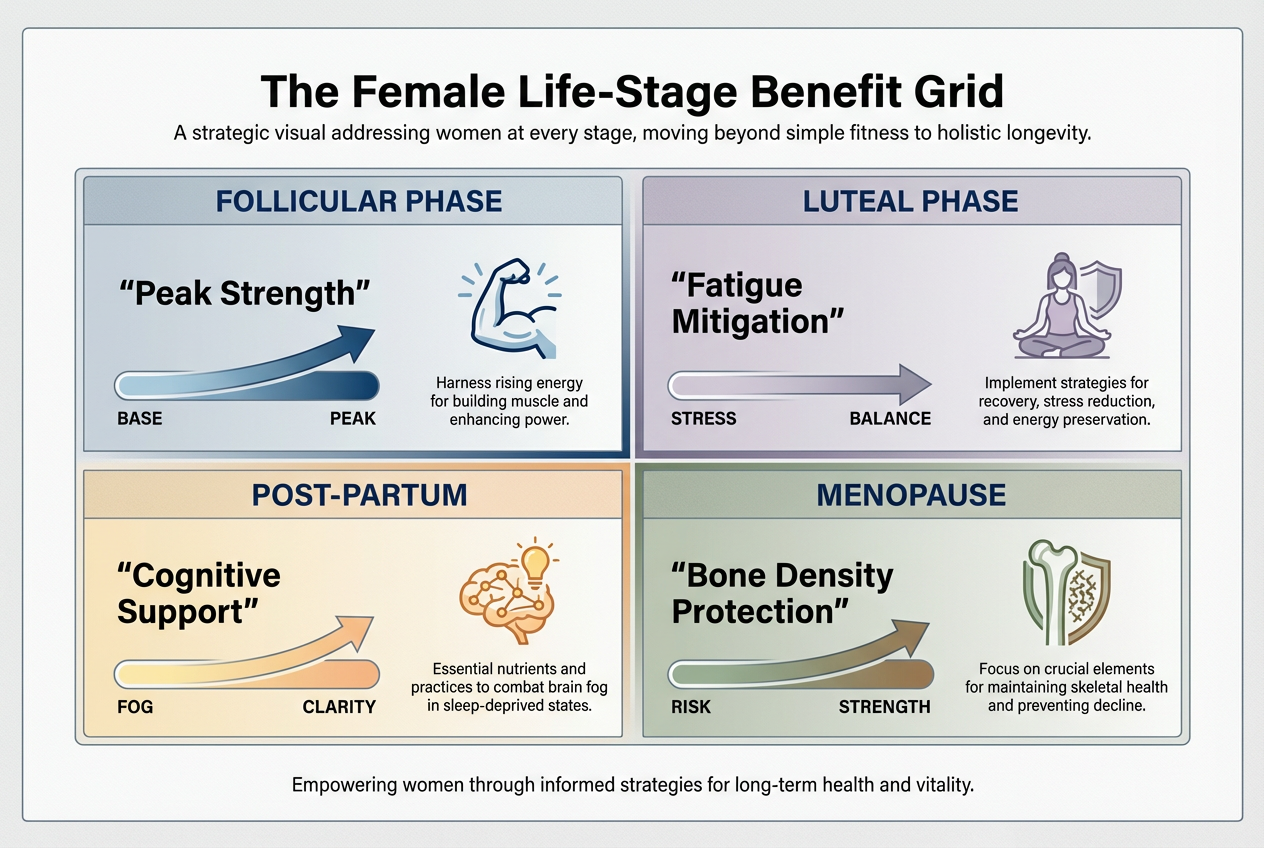 Creatine provides unique advantages across every stage of a woman's life, from supporting energy during the menstrual cycle to protecting bone density during menopause.
| Phase | Primary Benefit | Why It Matters |
|---|---|---|
| Follicular Phase (Days 1-14) | Peak Performance Support | Her estrogen is rising and energy is naturally higher. Creatine helps maximize strength gains and workout intensity during this optimal training window. |
| Luteal Phase (Days 15-28) | Fatigue Buffer & Mood Stabilization | Progesterone impairs natural creatine synthesis right when metabolic demands increase. Supplementation maintains energy and cognitive function during this challenging phase. |
| Pregnancy | Fetal Brain Development | Emerging research suggests creatine may support fetal neurological development, though pregnant women should consult their doctor before supplementing. |
| Postpartum | Cognitive Support & Recovery | Sleep deprivation and hormonal chaos make this period uniquely challenging. Creatine helps maintain mental clarity during "mom brain" and supports physical recovery. |
| Perimenopause | Hormone Transition Buffer | Fluctuating estrogen creates unpredictable energy levels. Creatine provides stability when her hormones are all over the place. |
| Post-Menopause | Bone Density & Muscle Preservation | With estrogen gone, bone loss accelerates dramatically. Creatine combined with resistance training is one of the most effective interventions for maintaining bone density and preventing fractures. |
What makes creatine particularly valuable is that it's not a one-size-fits-all solution that ignores female biology. The benefits actually align with the specific challenges women face at different life stages.
For younger women in their reproductive years, understanding how to sync support with their cycle phases can help them optimize when to push hard in workouts versus when to focus on recovery. Creatine acts as a stabilizing force that makes those natural fluctuations less extreme.
For women approaching or in menopause, the conversation shifts from performance to preservation. This is where creatine becomes truly important from a health perspective, not just a fitness one. The research on bone density preservation is compelling enough that some doctors are starting to recommend creatine alongside calcium and vitamin D.
The takeaway: creatine isn't just about helping her lift heavier weights or run faster. It's about providing biological support during times when her body is working against her natural energy production.
Ready to actually understand her?
Join thousands of men using VibeCheck to track her cycle and show up better every day.
FAQ
What is the best creatine dosage for women?
Most women benefit from 3-5 grams of creatine monohydrate daily. Research suggests 0.1 grams per kilogram of body weight as an optimal dose, which translates to about 7 grams for a 150-pound woman, though many women see full benefits at 5 grams or less. Unlike older protocols, you don't need a loading phase - just take the same amount every day. It takes 3-4 weeks to fully saturate muscle stores at this dose, but you avoid the bloating that comes with loading. Consistency matters more than timing, so take it whenever she'll remember it daily, whether that's with breakfast, post-workout, or before bed.
Will creatine make my girlfriend gain weight?
Yes, but not in the way you're worried about. Creatine causes a 2-4 pound increase in the first few weeks due to increased water retention inside muscle cells. This is intracellular hydration that makes muscles look more toned and defined, not subcutaneous water that causes puffiness or bloating. This weight is hydrated muscle tissue, not fat gain. The number on the scale goes up slightly, but her body composition actually improves - she'll look leaner and more defined. If she's concerned about scale weight, focus on how clothes fit and mirror progress rather than the number. That few pounds of muscle hydration is making her stronger and improving her physique.
Does creatine affect the menstrual cycle or hormones?
Creatine doesn't alter hormone levels or disrupt the menstrual cycle. However, a woman's natural hormone fluctuations do affect her creatine production and usage. During the luteal phase (the two weeks before her period), rising progesterone can impair the body's natural creatine synthesis exactly when metabolic demands are highest. This is why many women feel more fatigued during this phase. Supplementing with creatine provides a steady baseline that helps buffer against these natural energy dips without interfering with her hormonal cycle. It works with her biology rather than changing it. For women looking to optimize their supplementation timing, tracking cycle phases can help identify when creatine support is most beneficial.
Is creatine safe for women long-term?
Yes. Over 20 years of research, including long-term studies on athletes supplementing for years, shows creatine monohydrate is safe for healthy individuals. The International Society of Sports Nutrition explicitly states that creatine is safe for long-term use. The myth about kidney damage comes from a misunderstanding: creatine breaks down into creatinine, which shows up in kidney function tests, but this doesn't indicate actual kidney damage in healthy people. If your partner has pre-existing kidney disease, she should consult her doctor, but for healthy women, creatine is one of the most thoroughly researched and proven safe supplements available. The safety profile for women specifically has been well-established through numerous studies.
What type of creatine is best for women?
Creatine monohydrate is the gold standard. It's the most researched form with the strongest safety profile and best evidence for effectiveness. All the fancy marketed versions (creatine HCL, ethyl ester, buffered, etc.) haven't been shown to work better than monohydrate despite costing significantly more. Look for products with third-party certification like NSF Certified for Sport or Informed-Sport, which ensures the product contains what it claims without contaminants or banned substances. Avoid proprietary blends where you can't see exact creatine content. Plain, unflavored creatine monohydrate powder is the most cost-effective option and mixes easily into water, coffee, smoothies, or any beverage.
Can creatine help with brain fog during PMS?
Yes, this is one of creatine's underappreciated benefits for women. Your brain uses about 20% of your body's total energy and relies heavily on creatine phosphate for cognitive function. Research shows creatine supplementation improves working memory, processing speed, and mental fatigue resistance - all of which can be impaired during the luteal phase when progesterone is high and natural creatine synthesis is impaired. Multiple studies demonstrate that women who supplement with creatine show better cognitive performance during sleep deprivation and high-stress periods, both of which commonly occur during PMS. While it won't eliminate all PMS symptoms, many women report clearer thinking and less mental fog when they supplement consistently.
Should women take creatine on rest days?
Yes, absolutely. Creatine isn't a pre-workout supplement that you only take before exercise. It works by gradually saturating your muscle stores over time, which requires consistent daily intake. Taking creatine on rest days maintains those elevated muscle creatine levels that provide the performance and cognitive benefits. Missing occasional days won't undo all progress, but consistency is key for optimal results. Think of it like a daily vitamin rather than a workout-specific supplement. Whether she trains that day or not, her body still uses creatine for cellular energy production, brain function, and muscle maintenance. The 3-5 gram daily dose should continue seven days a week regardless of workout schedule.
How long does it take to see results from creatine?
With the standard 3-5 gram daily dose (no loading phase), most women notice benefits within 2-4 weeks as muscle stores gradually saturate. The timeline for different benefits varies: improved workout performance and recovery often appear first, within 2-3 weeks. More consistent energy levels throughout her cycle typically becomes noticeable after a full menstrual cycle (about 4 weeks) of consistent use. Cognitive benefits like reduced brain fog may be subtle but usually become apparent within 3-4 weeks. Physical changes like improved muscle tone take longer, typically 6-8 weeks combined with resistance training. The key is patience and consistency - creatine isn't a stimulant with immediate effects, but rather a foundational supplement that provides compounding benefits over time.
Tags

Related Articles
Continue reading to deepen your understanding

How to Understand Your Girlfriend’s Social Battery and Hormones
Does your girlfriend suddenly cancel plans or seem withdrawn? This guide explains how her cycle impacts her energy so you can support her like a pro.

How Your Girlfriend’s Emotional Needs Change During Her Cycle
Does your girlfriend’s mood seem unpredictable? Learn how her emotional needs shift on a biological loop and how to support her through every phase of her cycle.

What to Buy When Your Girlfriend Has Hormone Cravings: A Support Guide
Stop wondering what to pick up at the store. This guide explains the science behind cycle cravings and provides a specific list of foods and comfort items she needs.

Your Girlfriend’s Mood Shifts Throughout the Month, Explained
Ever wonder why her energy and moods change so drastically each week? Understand the four hormonal phases and how to be the partner she needs during every stage of her cycle.

How to Support Your Girlfriend When She’s Crying Because of Hormones
Watching her cry when hormones hit can feel overwhelming. Learn the biological why behind the tears and use these proven scripts to provide the support she actually needs right now.

How to Help Your Girlfriend with Hormonal Mood Swings Without Arguing
Understand her cycle and learn tactical scripts to handle tension. This guide shows you how to support her through hormonal shifts without getting into unnecessary fights.

When to Feed Your Girlfriend: Understanding Hangry Hormones
Does your girlfriend get irritable when she hasn’t eaten? It’s not just in her head. Learn why hormones cause hanger and the specific times her body needs more fuel.

The Boyfriend’s Guide to Supporting Your Partner Through PMS
If your partner is suddenly irritable and exhausted, it’s biology, not you. Learn about the luteal phase and how to provide meaningful support without walking on eggshells.