A Man's Guide to Improve Communication in Relationship and Build Deeper Trust
Discover science-backed tips to improve communication in relationship, understand her perspective, and build a deeper, lasting connection.
If you really want to improve communication in your relationship, you've got to understand one core principle: it’s not about talking more. It’s about connecting with quality. The real goal is to move past the endless, shallow back and forth and start having conversations that actually build trust and make you both feel understood.
This means you need to learn not just what to say, but also how and, just as importantly, when to say it.
Why 'Just Talking More' Is Not the Answer

Ever been on the receiving end of "We need to communicate more"? It’s one of the most common pieces of relationship advice for men, but honestly, it’s vague and pretty useless on its own. If you’re already talking every single day but still feel like you’re on different planets, the issue isn't the amount of talking. It’s the quality of the connection.
Think about it. Does this sound familiar? You get home and ask a simple, "How was your day?" She fires back a one word answer: "Fine." You probe a little, trying to get more, and before you know it, you're knee deep in an argument about something completely unrelated that happened last week.
This happens because the real issue isn't being discussed. The conversation is missing context and any real emotional connection, so it just spins out of control.
If you've been there, you're not alone. A staggering 65% of couples point to poor communication as the biggest problem in their relationship. It's a massive source of frustration that can make it feel like you’re speaking two completely different languages. If you want to dive deeper, you can read the full research about these relationship statistics to see just how common this is.
The key to breaking this cycle isn't just to fill the air with more words. It’s about learning to hear what's not being said.
Understanding the Unspoken Context
Here’s something most guys miss: men and women often come at communication from completely different angles. This isn’t just some old school stereotype. It’s rooted in real hormonal and neurological differences.
Generally speaking:
- Men communicate to solve problems and find solutions.
- Women communicate to build connection and feel understood.
Neither of these is right or wrong. They’re just different.
This is where the wires get crossed. When she comes to you with a problem, your first instinct is probably to jump into "fix it" mode. But a lot of the time, she's not looking for a solution. She just wants you to listen and validate what she's feeling. She’s searching for empathy, and you're handing her a five step action plan. The result? You both walk away feeling completely unheard and frustrated.
The goal isn't to fundamentally change who you are. It's to add a new tool to your kit: the ability to understand her communication style and respond in a way that truly connects.
Bridging this gap takes more than just good intentions. It requires real, practical strategies. It's about learning to listen for the emotion hiding behind her words and realizing that timing is everything. For instance, her energy levels and readiness for a deep conversation can fluctuate throughout the month.
Being aware of these patterns isn't about walking on eggshells. It's about being a smarter, more supportive partner. It’s about showing up at the right time, in the right way.
This is where a tool like VibeCheck can give you a playbook. It helps you understand the crucial context behind the conversation, so you can start having better talks, not just more of them.
The Real Meaning of Active Listening
Listening is probably your biggest superpower when you want to improve communication in a relationship, but honestly, most of us get it wrong. We think listening just means staying quiet until it’s our turn to talk. Real listening, or what’s often called active listening, is a totally different game. It’s about making your partner feel genuinely seen and heard.
It’s not about being a silent statue while she talks. It's about engaging with what she’s saying on a level that goes deeper than just the surface words. Your goal isn’t to fix her problem in sixty seconds flat. Your goal is to understand the feeling behind the problem.
From Hearing to Understanding
Making the switch from just hearing the words to actively listening involves a few small, but incredibly powerful, moves. It all starts with showing you're locked in.
This means putting your phone down. Seriously, screen down and out of sight. Turn your body to face her. Make eye contact. These simple nonverbal cues send a massive signal: "You have my full attention right now, and nothing else matters."
Next, you can bring in one of the most effective techniques I've ever seen work: reflective listening. This is where you gently repeat back what you heard, but in your own words. It proves you're not just waiting for a pause to jump in. You're actually processing what she's saying.
The whole point of reflecting isn't to prove you heard the words. It's to confirm you understood the emotion. This single shift can stop countless arguments before they even start.
For example, she comes home stressed about work. Instead of immediately jumping in with, "You should just tell your boss no," try something like this: "Okay, so it sounds like you’re feeling completely overwhelmed at work because your team isn't pulling their weight."
See the difference? The first is a solution. The second is validation. One shuts the conversation down, while the other invites her to share more.
Simple Swaps for Big Results
Making this change can feel a bit awkward at first, I get it. But it gets so much easier with practice. Think of it like learning a new skill.
Here’s a quick reference guide to help you transform your listening habits. See what builds connection versus what accidentally creates distance.
Active Listening Do's and Don'ts
| Do This to Build Connection | Avoid This to Prevent Distance |
|---|---|
| Validate her feelings first. Say things like, "That sounds incredibly frustrating" or "I can see why you'd be upset." | Jump straight to solutions. Don't immediately try to fix the problem without acknowledging her feelings about it. |
| Ask open ended questions. Use questions that start with "How" or "What" to encourage her to share more, like, "What's the hardest part about that for you?" | Ask "Why" questions. These can sometimes sound accusatory, like "Why did you do that?" which puts her on the defensive. |
| Summarize what you heard. Briefly recap the main points to show you were paying attention and to check for understanding. | Interrupt with your own story. Avoid turning the conversation back to yourself with a "Yeah, that happened to me once..." story. |
This isn't about you suddenly becoming her therapist. It’s about you becoming a better teammate. You’re showing her you’re in it with her, ready to understand her world before you try to offer any input.
This approach builds a foundation of trust that makes every other part of your relationship stronger and more connected. Learning how to be more emotionally available is a huge part of this process, and it helps create that safe space where you both can truly open up.
Choosing the Right Moment for Big Conversations
Timing is everything. It can be the difference between a productive chat and a pointless fight. You could have the most well thought out, perfectly worded point, but if you launch into it the second she walks in the door after a nightmare day, you’ve already lost. To truly improve communication in your relationship, you have to become a master of timing.
This isn't about walking on eggshells or putting off tough topics forever. It's about being strategic. It’s about recognizing that her energy, mood, and even how receptive she is to big ideas aren't random. They're often tied to her natural biological rhythms.
Tune Into Her Rhythms
A woman's hormonal cycle influences way more than just her period. It has a real impact on her energy levels, social battery, and even her general outlook. You don't need a PhD in endocrinology to get this. You just need to be a more thoughtful partner.
For example, there are times in her cycle when estrogen and testosterone are higher, often boosting her energy and optimism. This might be the perfect window to bring up a big, exciting plan, like a vacation or a major financial goal. The conversation is far more likely to feel collaborative and exciting then.
On the other hand, when progesterone is high and energy tends to dip, she might be more inward focused and introspective. That’s not a bad time. It’s just a different time. It's better suited for quiet connection and support, not for dropping a bombshell about your career plans.
Understanding this helps you approach conversations as a team. You could even bring it up directly: "Hey, I'm really trying to be a better partner, and I want to make sure we talk about important stuff when we’re both feeling up for it. I'm learning that your energy can shift, and I want to be in sync with that."
This journey is made simpler when you have the right tools. The visual below breaks down the core path to better understanding in any conversation, moving from just hearing words to truly connecting.
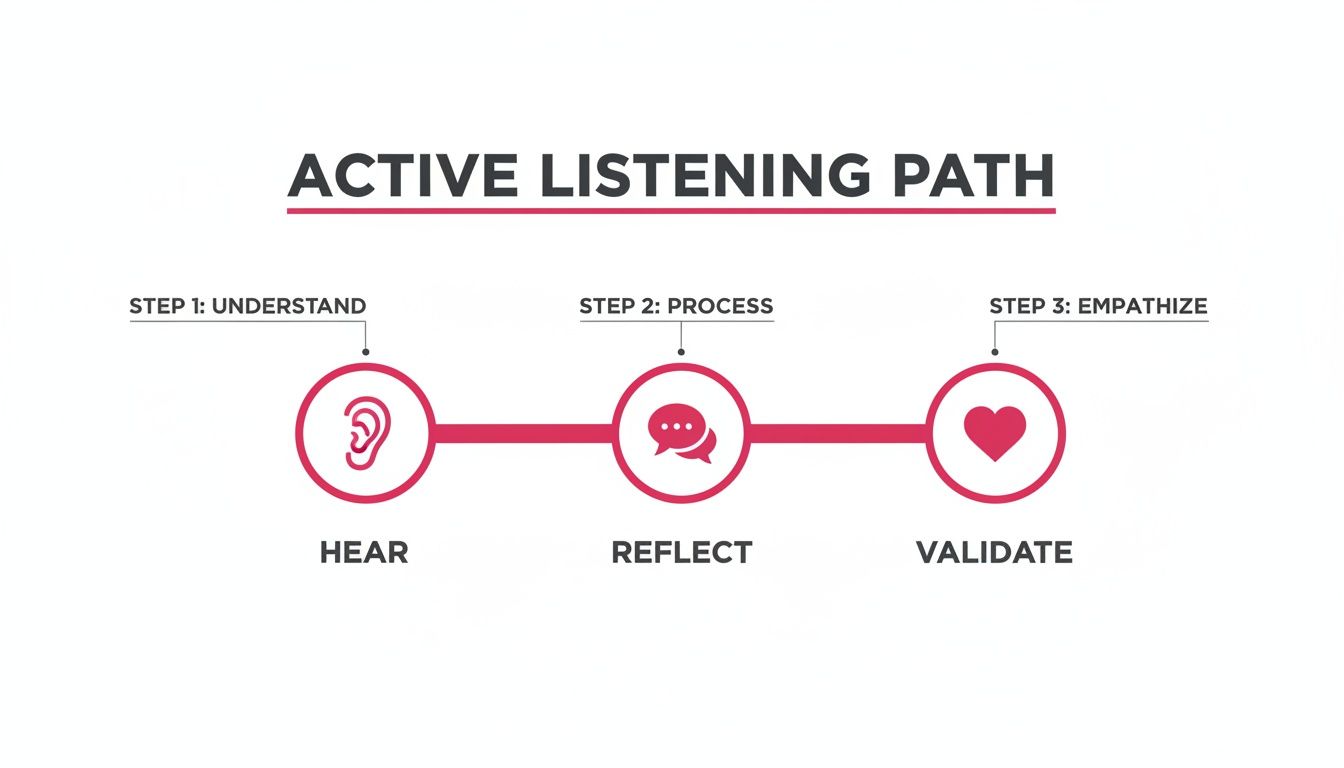
This simple path—Hear, Reflect, Validate—is the foundation for making your partner feel understood, no matter what you're discussing.
The Modern Challenge of Connection
It turns out, this whole timing thing is a real struggle for modern couples. Recent data shows that a whopping 84% of Gen Z daters crave deeper connections but are running into a major 'Communication Gap,' which makes them hesitant to dive into meaningful talks. It highlights a real desire for intimacy that's often blocked by simply not knowing how or when to start the conversation. You can read more about these dating trends and see just how common this challenge is.
The ultimate goal isn't to perfectly predict her mood. It's to be thoughtful enough to consider her reality before you start a big conversation. It’s a powerful way of showing you care.
This is where a tool like VibeCheck, the relationship app for men, can be a game changer. It helps take the guesswork out of the equation by giving you a simple heads up, helping you find the best moments to connect and tackle important topics together as a true team.
How to Navigate Conflict Without a Blowup
Let’s be real for a second. Arguments happen. The fantasy of a perfect couple that never disagrees is just that. A fantasy. Every single healthy, long term relationship has conflict.
The difference between a couple that makes it and one that doesn't isn't the absence of fights. It's how they navigate them when they pop up.
Damaging blowups don't have to be your default setting. You can actually learn to handle disagreements in a way that brings you closer, not tears you apart. It starts by shifting your goal from "winning the fight" to "solving the problem together."
The Power of "I" Over "You"
Want to know the fastest way to turn a minor issue into a major battle? Start your sentences with the word "you."
Think about how it lands. When you say, "You never listen to me," or "You always leave a mess," you're not just making an observation. You're putting her on the defensive. Her walls go up, and the conversation is no longer about the issue at hand. It's now about her defending herself.
And just like that, you're not solving anything.
Here’s a simple, game changing tweak: reframe your point using an "I" statement. This shifts the focus to your feelings, which is a fact she can’t argue with. It's your experience.
-
Instead of: "You’re not listening to me."
-
Try this: "I feel unheard when I'm trying to talk about my day."
-
Instead of: "You always make a mess in here."
-
Try this: "I feel stressed out when the kitchen is cluttered."
This isn't about being passive or weak. It's about being strategic. You're communicating your needs without making her the villain. That small change creates an opening for her to help you solve the problem. For more on this, our guide on how to improve marriage communication has a ton of other practical language swaps you can use.
Call a Strategic Timeout
Sometimes, even with the best intentions, a conversation gets hot. Voices rise, a sarcastic tone creeps in, and you can both feel yourselves gearing up for a fight. When you hit that point, the smartest thing you can do is hit pause.
I'm not talking about storming out of the room or deploying the silent treatment. A strategic timeout is a tool you both agree on before you need it. Come up with a simple word or phrase—like "pause" or "timeout"—that either of you can use to signal things are getting unproductive.
The crucial part is agreeing on a specific time to return to the conversation. Try saying something like, "Look, I'm getting too wound up to think straight. Can we take 20 minutes to cool off and then try again?"
This isn't about avoiding the issue. It’s about giving you both a chance to get some air and come back ready to find a solution, not just score points. It shows maturity and respect, and frankly, it builds a massive amount of trust.
How VibeCheck Makes You a More Attuned Partner

All the communication theory in the world doesn't mean a thing if you can't put it into practice when it counts. This is where the rubber meets the road. Where you go from knowing what to do to actually doing it. It’s how you become the partner who just seems to get it, the one who shows up in the right way at the right time.
And that's exactly what VibeCheck is designed to help you do. Forget thinking of it as just another calendar or tracker. This is a tool built to turn complex hormonal science into simple, actionable insights you can use every single day to improve communication in your relationship.
Making Empathy Practical
Instead of just spitting out data, VibeCheck gives you a simple heads up. Think of it as getting a quick briefing before you start your day so you’re prepared to be the partner she actually needs in that moment.
For instance, you might get a notification that says something like:
- "Her energy is likely lower today. It’s a great time to offer to handle dinner or suggest a quiet night in."
- "She might be feeling more adventurous this week. Perfect for planning a fun date night or a weekend trip."
This isn't about mind reading. It’s about being thoughtful. It’s about having a clue so you can be proactive instead of reactive, stopping misunderstandings before they even have a chance to start.
You’re not just tracking a cycle. You’re learning her unique rhythm, which allows you to lead with empathy and make connection feel effortless.
This is how you turn good intentions into meaningful actions she can see and feel. We go into more detail on this in our deep dive on how VibeCheck delivers these kinds of relationship insights for men.
A Playbook Built for You Both
Here’s the thing. VibeCheck actually gets smarter over time. The app learns from your shared history, taking note of what works for your specific relationship. It remembers the gestures that landed well and the conversation prompts that led to real connection, creating a personalized playbook just for you.
Let's say you note that a quiet walk after dinner really helped de-stress her during a tough week. The app will remember that. The next time a similar pattern pops up, VibeCheck might just suggest it again.
This focus on practical empathy is incredibly powerful. And it matters more than ever. Recent data shows a massive 72% of people rank emotional intelligence as more important than physical looks in a partner. Communication skills aren't just a "nice to have". They're a top attraction.
VibeCheck is built to sharpen this exact skill. It takes the guesswork out of being an attuned, present partner. It gives you the context you need to build a stronger, more connected relationship. One small, thoughtful action at a time. It’s not just an app. It's your ally in building a partnership that truly thrives.
Frequently Asked Questions
What if she thinks it's weird that I want to talk about her cycle?
This is a big one, and it's a completely fair question. The last thing you want is for her to feel like you're trying to track her or put her in a box. It’s all about the approach. Your goal is to frame this as an act of partnership. You're learning to be a better teammate for her. Instead of a clinical, "I want to track your period," try a more collaborative angle. Something like, "Hey, I'm trying to be more in tune with you and our life together. I've been learning about how energy and moods can shift, and I just want to understand your world better so I can be a more supportive partner." When you position it as your effort to show up for her, it changes everything. It becomes about your desire to connect, not your desire to monitor.How can I bring up something serious without it blowing up?
Timing and tone. Get those two things right, and you're halfway there. You can't just drop a bomb on her when she’s stressed, tired, or walking in the door from a long day. That’s a recipe for disaster. Pick a neutral time when you’re both calm and can actually connect without distractions. A quiet evening on the couch, a walk—find that space. Then, ask for permission. It's a simple sign of respect that goes a long way. "Hey, is now a good time to talk about something that's been on my mind?" When you start the conversation, lead with your own feelings using an "I" statement. For instance, "**I've been feeling a little concerned about our budget lately**" is a world away from "You're spending way too much money." The first one invites a conversation; the second one starts a fight.I hear everything she says, but she still says I don't listen. What gives?
This is probably the single most common frustration we hear from men. And it's a classic communication mismatch. When she says you're not "listening," she's not questioning your hearing. She's saying she doesn't feel **understood**. What she’s really looking for is an emotional connection to what she’s saying. Your instinct might be to jump straight into problem solving mode. But nine times out of ten, that's not what she needs in that moment. Before offering a single piece of advice, try validating the emotion. A simple, "Wow, that sounds incredibly frustrating," or "I can see why you'd be so upset about that," is often more powerful than a ten point action plan. It proves you're on her team and that you get it.Ready to stop guessing and start connecting? VibeCheck is the daily playbook that helps you understand her world and build the kind of partnership you both want.
Tags

Related Articles
Continue reading to deepen your understanding

Why Your Girlfriend Needs Different Communication Styles During Her Cycle
Stop wondering why your conversations feel like a minefield one week and a breeze the next. Use biology to understand her changing needs and adapt your style.

When Your Girlfriend Gets Withdrawn Before Her Period
If she suddenly pulls away, it is usually biology, not you. Learn why your girlfriend gets distant before her period and use these tactical scripts to help her during the luteal phase.

How to Respond When Your Girlfriend Needs Space During Her Period
If she’s suddenly sending one-word texts or pulling away, it’s likely not about you. Learn the science of the luteal phase and how to support her without feeling rejected.

Understanding Why Your Girlfriend’s Communication Style Shifts Weekly
Ever wonder why your partner’s moods and energy levels shift so much? Understanding the four phases of her menstrual cycle helps you become a more supportive and proactive partner.

When Do Your Girlfriend’s Energy Levels Change During Her Cycle?
Your girlfriend’s mood and stamina follow a biological rhythm. Learn how her energy peaks and crashes throughout the month so you can plan better dates and provide better support.

Why Your Girlfriend Needs Different Attention Each Week: The Four Seasons Framework
Stop walking on eggshells and start understanding her cycle. This framework shows you exactly how to support your girlfriend through all four biological phases every month.

Why Your Girlfriend Wants Space the Week Before Her Period
Does your girlfriend suddenly pull away every month? Discover the biological reasons behind the pre-period space window and how to navigate this phase together.

Why Your Girlfriend Wants Different Kinds of Affection at Different Times in Her Cycle
Ever feel like your girlfriend’s needs change every week? It’s not random. Understand how the four phases of her cycle drive her desire for intimacy so you can support her better.