How to Be a Better Boyfriend Advice 2026 Essential Guide
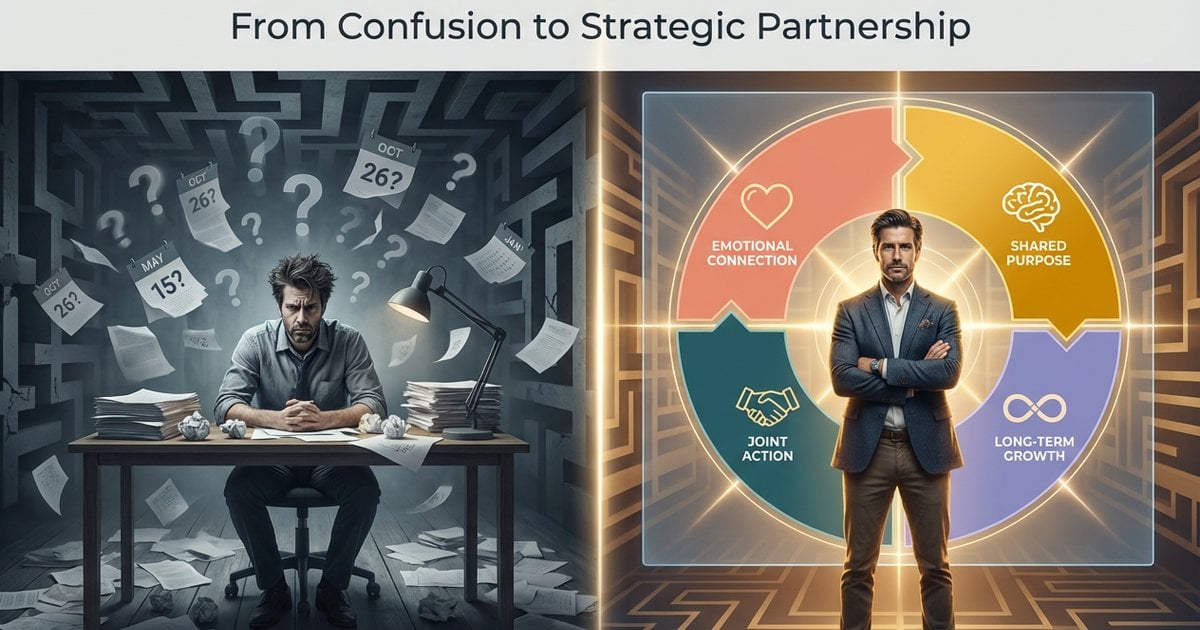
Stop guessing and master your relationship. Learn how to understand girlfriend patterns with this 2026 guide. Get practical relationship advice for men now.
How to Be a Better Boyfriend in 2026: The Biological Playbook Every Man Needs
You're here because something isn't clicking. Maybe it's those arguments that come out of nowhere. Maybe she's pulling away and you can't figure out why. Or maybe you're tired of feeling like you're guessing your way through the relationship.
Here's what nobody tells you: Being a good boyfriend in 2026 isn't about grand gestures or memorizing advice from some dating guru. It's about understanding the biological operating system your partner runs on and learning to work with it, not against it.
This guide gives you the framework. Not theories. Not platitudes. A tactical roadmap that turns relationship friction into fluid connection.
Table of Contents
- The 2026 Relationship Landscape: Why Generic Advice Doesn't Work Anymore
- The Biological Roadmap: Understanding Her Four Seasons
- Modern Communication Rules for 2026
- The VibeCheck Method: Automate Empathy Without Being a Human Calendar
- From Theory to Practice: Your Week-by-Week Action Plan
- FAQ for the Skeptical Boyfriend
The 2026 Relationship Landscape: Why Generic Advice Doesn't Work Anymore
BLUF: Modern relationships demand intentional awareness over autopilot behavior. Generic "be nice" advice fails because it ignores biological timing and digital-age pitfalls that create distance.
Dating in 2026 looks nothing like it did even three years ago. We're seeing what relationship researchers call the "Deep Dating" shift. People aren't looking for someone who checks boxes anymore. They're looking for someone who can build a sustainable partnership in a world full of distractions.
The problem? Most relationship advice still operates like it's 2015. "Listen more." "Be supportive." "Communicate better." All true. All useless without context.
Here's what changed:
App Fatigue is Real. The endless swipe culture taught a generation that relationships are disposable. If you're reading this, you've likely moved past that phase. You're in something real. But that means the stakes are different. There's no reset button. No "next match" to fall back on.
Digital Ick is Everywhere. Low-effort texting. Checking your phone during dinner. Using AI to write your anniversary message. These micro-behaviors kill intimacy faster than any argument. Your partner can feel when you're phoning it in, literally and figuratively.
Intentionality is the New Currency. Being a "good guy" is the baseline now. To stand out as a partner, you need to understand timing. When to push for growth. When to provide comfort. When to step back and let her lead.
That timing isn't random. It follows a predictable pattern that runs on roughly a 28-day cycle. Most guys ignore this pattern and wonder why they keep stepping on landmines.
The smartest partners in 2026 treat relationships like a system to optimize, not a feeling to chase. They use biological data the way athletes use performance metrics. That's what separates reactive boyfriends from proactive partners.
The Biological Roadmap: Understanding Her Four Seasons
BLUF: Your partner's menstrual cycle creates four distinct phases (Winter, Spring, Summer, Autumn), each with different energy levels, communication styles, and support needs. Master these seasons and you'll never walk on eggshells again.
Think of her cycle like weather patterns. You wouldn't plan a beach day during a thunderstorm. You wouldn't suggest indoor activities on the first sunny day of spring. The same logic applies here.
Her hormones create four distinct seasons, each lasting about a week. Understanding these phases isn't about "managing her mood." It's about having a roadmap that tells you when to plan date nights, when to handle serious conversations, and when to just order takeout and disappear into the couch.
 Understand the four biological seasons to transform from a standard partner into a proactive 'Superpower' boyfriend who anticipates needs before they are even spoken.
Here's your complete breakdown:
Winter (Menstrual Phase): Days 1-7
What's Happening: Estrogen and progesterone hit rock bottom. Her body is shedding the uterine lining. Energy levels tank. Social battery drains fast.
What She Needs: Comfort without crowding. Acts of service without being asked.
Your Playbook:
- Handle household tasks proactively. Do the dishes. Take out the trash. Don't wait for a request.
- Offer heating pads, her favorite comfort food, or a foot rub without expecting anything in return.
- Keep social plans light. If friends invite you both out, give her an easy exit strategy.
- Don't take reduced physical affection personally. Her body is literally working overtime right now.
- Ask: "What would make today easier?" Not: "What's wrong?"
What to Avoid:
- Suggesting intense workouts or high-energy activities
- Planning big social gatherings at your place
- Starting conversations about relationship problems or future plans
- Complaining about reduced intimacy
This is your "Acts of Service" week. Show up by removing friction from her day, not by demanding attention.
Spring (Follicular Phase): Days 8-13
What's Happening: Estrogen starts climbing. Energy rebounds. Mood lifts. She's more open to novelty and adventure.
What She Needs: New experiences. Forward momentum. Your enthusiasm.
Your Playbook:
- Plan that new restaurant you've been talking about. Try the rock climbing gym. Book the weekend trip.
- Pitch ideas for the future. This is your window for "what if we..." conversations.
- Bring sexual creativity. She's more likely to be receptive to trying something new.
- Support her personal projects. If she mentions wanting to start something, encourage it now.
- Ask: "What sounds fun this weekend?" Not: "Want to just stay in?"
What to Avoid:
- Falling into routine date patterns
- Being passive about planning
- Suggesting she "take it easy" when she's energized
- Missing the green light for intimacy
This is your "Adventure" week. Match her rising energy with enthusiasm and new experiences. For deeper insights on timing these connection moments, check out the VibeCheck Partner Playbook.
Summer (Ovulatory Phase): Days 14-17
What's Happening: Peak estrogen. Highest energy and confidence. Maximum social engagement. Biologically, this is when fertility peaks, which affects communication styles and connection desires.
What She Needs: Deep connection. Big conversations. You at your best.
Your Playbook:
- Schedule important relationship talks now. This is your window for DTR (define the relationship), future planning, or addressing concerns.
- Bring your A-game to dates. She's noticing details more acutely right now.
- Increase physical affection. Hold hands in public. Make eye contact during conversations.
- Meet her friends or family if that's on the radar. She's more socially confident and wants to integrate you.
- Ask: "Where do you see us in six months?" Not: "We're good, right?"
What to Avoid:
- Half-hearted effort on dates
- Canceling plans or showing up distracted
- Being emotionally unavailable during her peak connection window
- Missing opportunities for deeper intimacy
This is your "Peak Connection" week. Don't waste it. This phase is when relationships either deepen or reveal cracks.
Autumn (Luteal Phase): Days 18-28
What's Happening: Progesterone dominates. Energy shifts inward. She becomes more sensitive to imbalances in the relationship. The infamous PMS window.
What She Needs: Patience. Proactive support. Zero defensiveness.
Your Playbook:
- Enter the "No-Defensiveness Zone." If she brings up something that bugs her, listen without immediately explaining yourself.
- Handle chores before she asks. Notice what needs doing and just do it.
- Reduce social demands. Don't invite friends over without checking first.
- Validate feelings without trying to fix them. "That sounds frustrating" beats "here's what you should do."
- Ask: "How can I support you today?" Not: "Why are you being sensitive?"
What to Avoid:
- Suggesting big social events or trips
- Getting defensive when she expresses frustration
- Dismissing concerns as "hormones" or "overthinking"
- Adding to her mental load with requests
This is your "Proactive Support" week. The relationship friction you experience here usually isn't about you. It's about unmet needs that compound during lower energy phases. For tactical guidance on reducing this friction, explore relationship advice focused on cycle syncing.
The 7-7-7 Rule: Seven days of fertility awareness (ovulatory phase) matters, but what really builds relationships is consistent support across all 28 days.
Modern Communication Rules for 2026
BLUF: Modern communication requires intentionality over automation. Replace digital shortcuts with deliberate habits like the 6-second kiss, closed-loop conversations, and emotionally-aware texting to build lasting intimacy.
You can know every phase of her cycle and still fail at communication. Because in 2026, how you communicate matters as much as what you communicate.
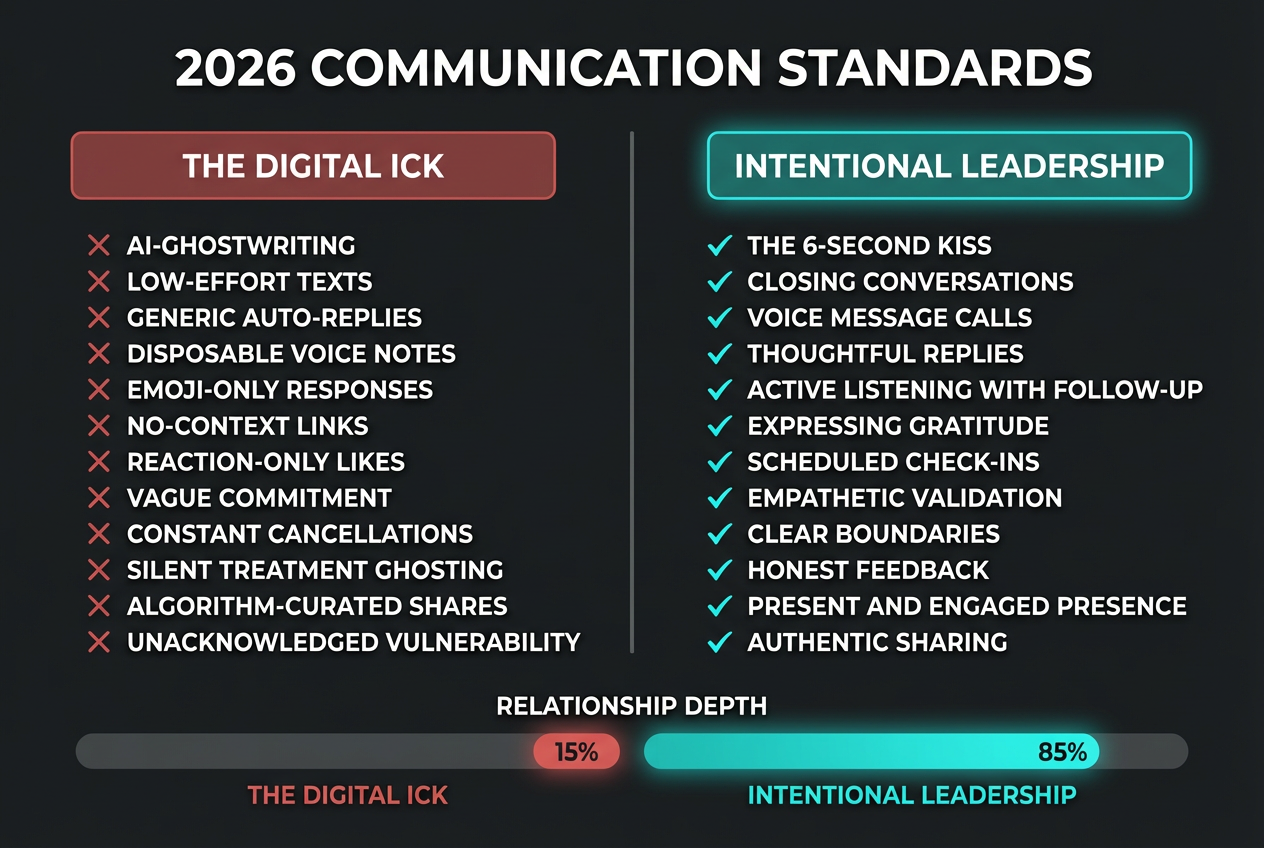 Move beyond the 'Digital Ick' by replacing automated, low-effort communication with intentional habits like the 6-second kiss to build lasting intimacy and trust.
The 6-Second Kiss
Most guys treat greetings and goodbyes like transactions. Quick peck on the lips, out the door. That's a mistake.
A six-second kiss does something different. It forces presence. You can't phone in six seconds. Your brain shifts from "completing the task" to "connecting with this person."
How to implement:
- When you get home, don't immediately launch into your day. Stop. Make eye contact. Kiss for six full seconds.
- Before bed, same thing. Not as a prelude to sex. As a standalone moment of connection.
- Count it out in your head the first few times until it becomes natural.
She'll notice within three days.
Close the Loop on Every Conversation
The number one complaint women have about communication? "He never follows up."
You have a big talk. She shares something important. You listen. Then... nothing. The conversation just evaporates.
How to implement:
- If she mentions something stressful at work, ask about it the next day: "How did that meeting go?"
- If she's excited about a personal project, check in on progress a week later.
- After emotional conversations, revisit them. "I've been thinking about what you said last week. How are you feeling about it now?"
This isn't about fixing problems. It's about proving you retain information about her life.
Text Like You're Adding Value, Not Checking a Box
Most guys text like they're sending GPS coordinates. "Running late." "On my way." "K."
That's functional, not connective. Women text like they're maintaining relationship threads. You don't have to match her volume, but you need to match her intentionality.
How to implement:
- Add context: "Running 10 minutes late, traffic is brutal. Want me to grab coffee on the way?"
- Reference earlier conversations: "Saw this article about that artist you mentioned. Made me think of you."
- Use voice messages occasionally. Hearing your actual voice creates more connection than text ever will.
- Never use AI to ghostwrite relationship texts. She can tell. It feels hollow.
The difference between "good morning" and "good morning, hope your presentation goes well today" is negligible in effort but massive in impact.
The Digital Boundary Agreement
Have an actual conversation about phone use. Most couples never do this explicitly, then resent each other for violating unspoken expectations.
Questions to discuss:
- Is it okay to be on phones while we eat dinner together?
- What's the phone policy in bed?
- How quickly do we expect responses to texts during work hours?
- Are there apps or accounts we'd rather keep private, or are we open about everything?
There's no universal right answer. What matters is explicit agreement. If you're looking for tools to help with timing and communication awareness, period tracker apps designed for boyfriends can provide structured support.
The VibeCheck Method: Automate Empathy Without Being a Human Calendar
BLUF: Use cycle tracking apps designed for partners to get daily context about her phase, energy levels, and needs without awkward conversations or mental calendar management.
Let's address the obvious tension: Tracking your partner's cycle can feel weird. Clinical. Maybe even invasive.
Here's the reframe: You already track things that matter to you. Your workout schedule. Your fantasy football lineup. Your favorite team's game calendar. You track these because having the information makes you more effective.
The same applies here.
The VibeCheck method isn't about surveillance. It's about having context that helps you provide better support. Think of it like a weather app. You don't control the weather, but knowing it's going to rain helps you bring an umbrella.
How It Works
Modern cycle tracking apps designed for partners (like VibeCheck, Relatio, or couple-focused features in Flo) give you:
- Phase notifications: "She's entering her luteal phase. Energy may be lower this week."
- Suggested actions: "Good week for: quiet nights in, comfort food, handling chores proactively."
- What to avoid: "Skip: planning big social events, starting heavy conversations."
You're not guessing. You're not asking invasive questions. You open the app and get your daily briefing.
The Setup Conversation
Don't just download an app and start tracking without talking to her. That's creepy.
How to bring it up: "I've been reading about how much hormones affect energy and mood throughout the month. I want to be better at supporting you during tougher weeks. Would you be open to sharing your cycle info with me through an app? I think it would help me be more aware of when to step up."
Most women respond positively to this because:
- You're framing it as wanting to support her better
- You're admitting you don't already know everything
- You're asking permission rather than assuming
If she's hesitant, don't push. Ask what would make her comfortable. Maybe she shares just the phase (follicular, luteal) without specific dates. Maybe she gives you a verbal heads-up instead. The goal is context, not control.
Using the Data Without Being Weird
Once you have access:
- Don't weaponize it. Never say "you're just upset because you're in your luteal phase." That's the fastest way to lose trust.
- Act on insights quietly. If the app says energy will be low this week, handle more chores without announcing "I'm doing this because you're in your luteal phase."
- Let her lead conversations about her cycle. If she wants to talk about it, engage. If she doesn't, just use the info to inform your actions.
The best use of cycle awareness is invisible. She just notices you're more attuned to her needs without knowing exactly why. For a deeper dive into making this approach work seamlessly, explore the complete VibeCheck partner cycle guide.
From Theory to Practice: Your Week-by-Week Action Plan
BLUF: Turn biological awareness into daily habits with this four-week implementation plan that builds relationship skills progressively while matching her cycle phases.
Knowing the theory means nothing if you don't implement it. Here's your practical roadmap for the next 28 days.
Week 1: Winter (Menstrual) - The Observation Phase
Primary Goal: Notice patterns without trying to fix anything.
Daily Actions:
- Check in once per day: "How are you feeling today?" Just listen to the answer.
- Handle one household task unprompted every day. Dishes, laundry, groceries, something she normally tracks.
- Reduce social demands. If plans come up, give her veto power without pressure.
What You're Learning: What specific support she needs during low-energy phases. Does she want company or solitude? Does she prefer comfort food or healthy options? You're gathering data.
Week 2: Spring (Follicular) - The Engagement Phase
Primary Goal: Match her rising energy with enthusiasm.
Daily Actions:
- Suggest one new activity this week. Doesn't have to be elaborate. New coffee shop. Different hiking trail. Cooking a recipe you've never tried.
- Initiate physical affection more than usual. Hand-holding during walks. Spontaneous hugs.
- Bring up something you've been wanting to try together: "I've been thinking we should check out that pottery class."
What You're Learning: What kinds of novelty she responds to. Adventure dates? Intellectual stimulation? Creative projects? Cultural experiences?
Week 3: Summer (Ovulatory) - The Connection Phase
Primary Goal: Deepen the relationship during peak connection window.
Daily Actions:
- Have one meaningful conversation about the future. Where you see the relationship going. Goals you're both working toward.
- Plan your best date of the month. Put real thought into it. Make reservations. Dress well. Be fully present.
- Express appreciation specifically: "I love how you handled that situation with your friend. It showed real emotional intelligence."
What You're Learning: How she responds to vulnerability and deeper sharing. What relationship topics she wants to explore. Where she sees potential growth areas.
Week 4: Autumn (Luteal) - The Support Phase
Primary Goal: Provide proactive support without defensiveness.
Daily Actions:
- Enter every conversation assuming positive intent. If she expresses frustration, your first response is "Tell me more" not "But I..."
- Notice and address small annoyances before they compound. That pile of mail that's been sitting there for a week? Handle it.
- Create low-pressure evenings. Have easy dinner options ready. Don't suggest activities that require significant energy output.
What You're Learning: What specific things frustrate her during this phase. What support looks like to her. How to stay calm when she's processing emotions.
The Monthly Review
At the end of 28 days, have a brief conversation: "I've been trying to pay more attention to supporting you throughout the month. What's working? What could I do differently?"
This isn't a performance review. It's a calibration conversation. The goal is continuous improvement, not perfection.
Repeat this cycle for three months. By month three, these behaviors become automatic. You won't need to think about which phase she's in because you'll naturally attune to energy shifts.
FAQ for the Skeptical Boyfriend
Is tracking my girlfriend's cycle controlling or invasive?
Only if you do it without her knowledge or use the information manipulatively. When done transparently and with her consent, cycle tracking is a support tool, not a surveillance mechanism. The key is framing: "I want to better understand how to support you" versus "I need to track your hormones." One is partnership. The other is paternalistic. Have an explicit conversation about boundaries. She controls what information she shares and when. If you're considering apps for this, compare the best period tracker apps for couples to find one that feels right for both of you.
What if she doesn't want me to know about her cycle?
Respect that boundary completely. Not every woman wants to share cycle information, and that's valid. You can still implement 90% of this advice by paying attention to patterns. After a few months, you'll notice: "Every few weeks, she seems more social and energetic" or "There's a stretch where she prefers quiet nights in." You don't need exact dates to be observant. Let her lead on how much information she's comfortable sharing.
Isn't this just an excuse for mood swings?
No. This is the trap most guys fall into. Hormones influence mood and energy, but they don't excuse poor behavior from either of you. The point isn't to dismiss legitimate concerns as "just hormones." The point is to provide better support during physiologically challenging times. If she expresses frustration during her luteal phase, don't think "she's being hormonal." Think "her tolerance for imbalance is lower right now, so this issue probably matters." Then address the actual issue.
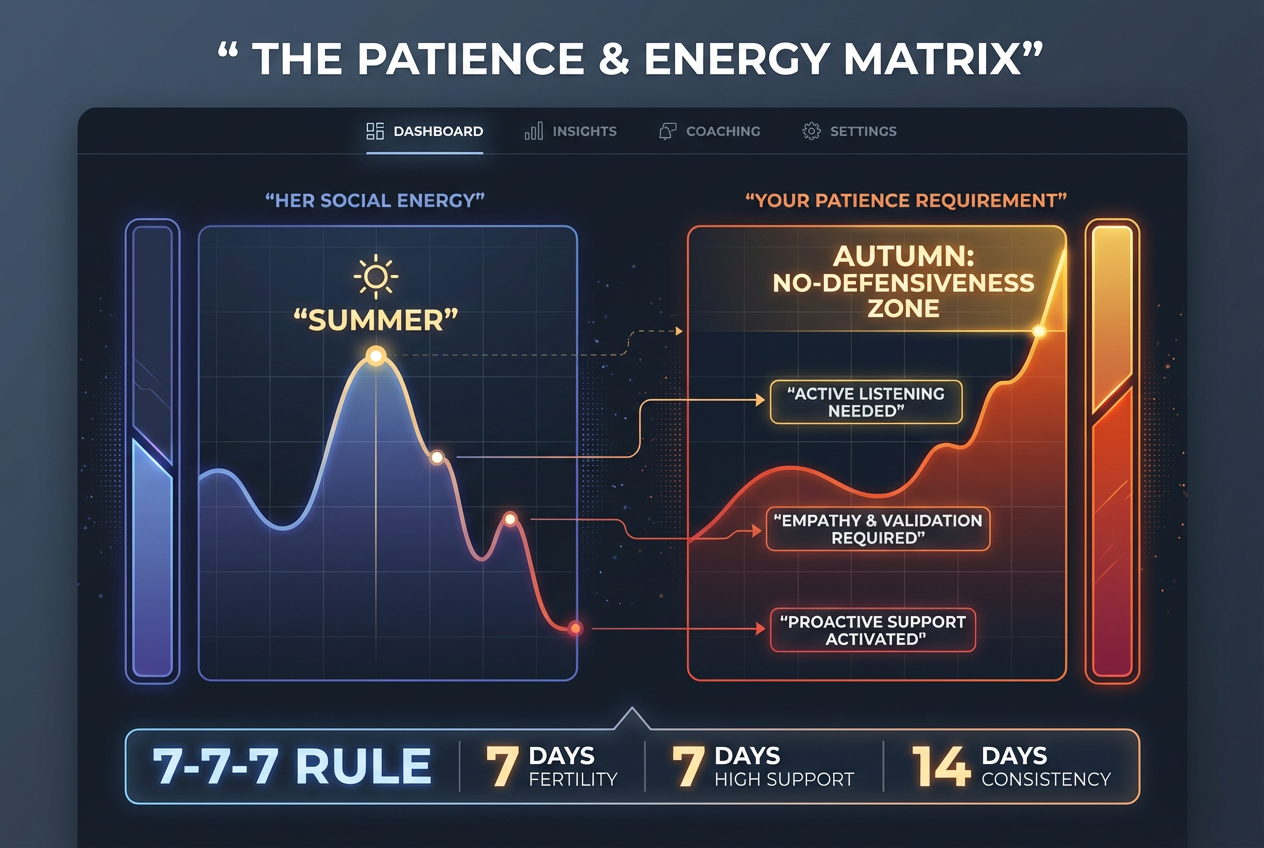 Use this patience and energy matrix to identify the 'No-Defensiveness Zone,' ensuring you remain a calm, supportive anchor during your partner's lowest energy phases.
How do I bring this up without sounding condescending?
Lead with curiosity, not expertise. Say: "I've been learning about how hormones affect mood and energy. I realized I don't know much about how this plays out for you. Would you be open to talking about it?" Notice what you're NOT saying: "I read about PMS so I understand why you get upset now" or "Let me explain your cycle to you." You're asking to learn, not offering to teach. That's the difference.
What if we're trying to conceive?
Cycle awareness becomes even more important here, but the focus shifts. The ovulatory phase matters for conception timing, obviously. But the entire cycle matters for reducing stress and supporting the trying-to-conceive process. Use the follicular phase to discuss logistics and testing. Use the luteal phase (the two-week wait) to provide extra emotional support. Use the menstrual phase to regroup if the cycle wasn't successful. Cycle awareness helps you pace the emotional marathon of conception attempts.
Does this work for women on birth control?
Partly. Hormonal birth control suppresses the natural cycle, so the four-season pattern won't apply the same way. But women on birth control still experience energy fluctuations, stress responses, and emotional needs. The communication principles (6-second kiss, closing conversation loops, intentional texting) still apply universally. If she's on continuous birth control without a withdrawal bleed, focus more on stress cycles and life event patterns than biological phases.
How do I handle it when she says "I'm fine" but clearly isn't?
"I'm fine" is rarely about dishonesty. It's usually about one of three things: (1) She doesn't have the energy to explain right now, (2) She's not sure you'll respond supportively, or (3) She's testing whether you'll notice without being told. Your move: "Okay. I'm here if you want to talk about it." Then demonstrate through actions that you're paying attention. Handle a chore without being asked. Bring her favorite snack. Create space for her to open up without pressuring her. Most importantly, when she does open up, don't immediately try to fix it. Just listen.
What's the difference between being supportive and being a doormat?
Supporting your partner doesn't mean abandoning your own needs. The biological roadmap tells you when to lean in with extra support, but it doesn't erase your boundaries. If you need alone time, say that. If you disagree with something, voice it respectfully. The difference is timing and tone. During her luteal phase, you might handle disagreements more gently and pick your battles carefully. But you still have battles to pick. Being a supportive partner means considering her state while maintaining your authenticity, not erasing yourself.
Can I use this information in arguments?
Absolutely not in the way you're thinking. Never say "You're just upset because of your cycle." That's dismissive and will backfire spectacularly. However, you can use cycle awareness to adjust your conflict approach. If you notice tension building during her luteal phase, you might: (1) Be extra careful not to be defensive, (2) Acknowledge her feelings more explicitly, (3) Suggest tabling big decisions until next week if emotions are running high. You're not using cycle information as a weapon. You're using it as a context that helps you respond more skillfully. For more on navigating this territory, the tactical boyfriend relationship advice guide offers specific conflict de-escalation strategies.
Being a better boyfriend in 2026 isn't about perfection. It's about intentionality. It's about replacing guesswork with awareness, autopilot behavior with deliberate action, and reactive responses with proactive support.
The biological roadmap gives you the playbook. The communication rules give you the skills. The implementation plan gives you the structure.
What you do with it determines whether your relationship stays good or becomes exceptional.
Start with Week 1. Notice patterns. Build from there. Three months from now, you won't recognize the relationship you're in because you won't recognize the partner you've become.
That's the promise of biological awareness. Not that she'll change. That you will.
Tags

Related Articles
Continue reading to deepen your understanding
How Hormones Affect Mood: A Guide for Men in Relationships
A supportive guide for men asking how hormones affect mood. Learn the science and get practical advice to better understand and support your partner.
A Man's Guide to Connection: Relationship Advice Based on Cycle
Get practical relationship advice based on cycle science. Learn how to understand her moods, reduce conflict, and build a stronger, more connected partnership.

How to Be a Better Boyfriend Advice 2026 Essential Guide
Stop guessing and master your relationship. Learn how to understand girlfriend patterns with this 2026 guide. Get practical relationship advice for men now.

How to Text Your Girlfriend During Different Cycle Phases: The Complete Guide
Ever send a text that landed like a grenade? Align your communication with her biological rhythm to reduce conflict by 58% and become the partner she actually wants to talk to.

How to Talk to Your Girlfriend During the Follicular Phase: The Relationship Power Window
Most men miss the best window for deep conversations. Learn why the follicular phase is the green light for big decisions and how to handle difficult topics with 72% more success.

How to Predict Girlfriend Mood Swings by Cycle (2026)
Learning how to predict girlfriend mood swings by cycle reduces relationship friction by 58% using this tactical four-phase hormonal support system now.

How to Plan Romantic Gestures by Menstrual Phase: A Tactical Playbook for Men
Stop guessing what your partner needs. Align your efforts with her biological calendar to show up with the right romantic gesture at exactly the right time for better connection.

How to Help Your Girlfriend During Ovulation Week: A Partner’s Playbook
Has she suddenly hit peak energy? That’s her biological summer. Learn how to navigate her cycle and support her social and creative spikes during ovulation week.