How to Support Your Girlfriend Through Period Mood Swings: A Man’s Guide

Does your relationship hit a wall every month? Understand the biological steep drop window and learn exactly how to provide the right support when your partner needs it most.
How to Help Your Girlfriend During Period Mood Swings: The Complete Playbook for Men
Most men hit the same wall around day 23 of her cycle. She's quiet, irritable, or suddenly snaps over something that felt minor yesterday. You ask what's wrong. She says "nothing" in a way that clearly means something. You try to help. It gets worse. Not because you don't care - because no one taught you what's actually happening underneath the surface.
The window between day 21 and day 28 is when estrogen and progesterone levels drop steeply, triggering a cascade of neurochemical changes that affect mood, energy, pain threshold, and stress response. By the time most couples address the resulting friction, they've had the same unresolved argument 40+ times in different forms, and what started as a communication gap has become a trust problem. A 2024 study in the Journal of Affective Disorders found that severe premenstrual disorders are associated with significantly higher rates of relationship disruption and divorce - not because the symptoms are insurmountable, but because partners don't know how to respond proactively.
Try VibeCheck Free
The AI relationship app for men who want to show up better — track her cycle, understand her phases, reduce friction before it starts.
What follows is the complete tactical playbook - what's driving the pattern, why the standard advice fails, and what actually works instead. You'll learn how to recognize the "steep drop" window 3-5 days before her period starts, what specific logistical and emotional support makes a measurable difference, and how to communicate in ways that de-escalate tension rather than amplify it. This isn't about walking on eggshells. It's about understanding the biological reality so you can show up as a partner instead of a spectator.
Key Takeaways
- Estrogen and progesterone levels drop steeply 3 to 4 days before menstruation, triggering mood swings in the "steep drop window" that affects 90% of women to some degree.
- Premenstrual Dysphoric Disorder (PMDD), a severe form of PMS, affects 3% to 8% of women and requires clinical intervention, not just lifestyle adjustments.
- The phrase "Is it your period?" is the single most counterproductive question you can ask - it dismisses her experience and shuts down communication.
- Evidence-based support includes magnesium-rich foods, saffron supplementation (30mg/day), and taking over the "mental load" of household logistics during the luteal phase.
- Shared cycle tracking increases relationship satisfaction by creating predictability and allowing both partners to prepare for high-friction windows proactively.
Most of this gets easier when you can see the shift coming. Our shortlist of the best period trackers for boyfriends covers the apps built for partners — then come back for the playbook below.
Table of Contents
- The Science of the Shift: Understanding the Steep Drop
- PMS vs. PMDD: When to Seek Professional Help
- Why Does My Girlfriend Get So Angry on Her Period?
- The Luteal Phase Grocery List: What to Buy Before the Window Hits
- The Communication Playbook: What to Say & What to Avoid
- How to Calm Your Girlfriend Down When She's on Her Period
- Tracking as a Team: Why Shared Awareness Changes the Game
- When It's More Than PMS: Red Flags and Next Steps
- Frequently Asked Questions
VibeCheck App
Know what she needs. Before she has to say it.
Track her cycle, understand her phases, be the partner she deserves.
Download Free on iOS →The Science of the Shift: Understanding the Steep Drop
The mood swings happening 3 to 5 days before her period aren't "in her head" - they're the result of a measurable biological event called the luteal phase crash, where both estrogen and progesterone drop by 40-50% within 72 hours. This hormonal freefall triggers a chain reaction: serotonin (the mood stabilizer) drops, prostaglandins (inflammatory compounds) spike, and cortisol (the stress hormone) becomes harder to regulate. The result is a narrower emotional bandwidth, heightened pain sensitivity, and reduced capacity to handle minor irritations that wouldn't register during other parts of the cycle.
Here's what actually happens in the final week before menstruation. Around day 21 of a typical 28-day cycle, the corpus luteum (the structure that produces progesterone after ovulation) begins to break down because pregnancy didn't occur. Progesterone production plummets. Estrogen, which had been rising again after ovulation, also drops sharply. According to research published by Hormona, this "steep drop" window - roughly 3 to 4 days before bleeding starts - is when symptoms peak. The brain is chemically different during this window. Lower estrogen means less serotonin production. Lower progesterone means less GABA (the calming neurotransmitter). The body is, neurologically, more reactive.
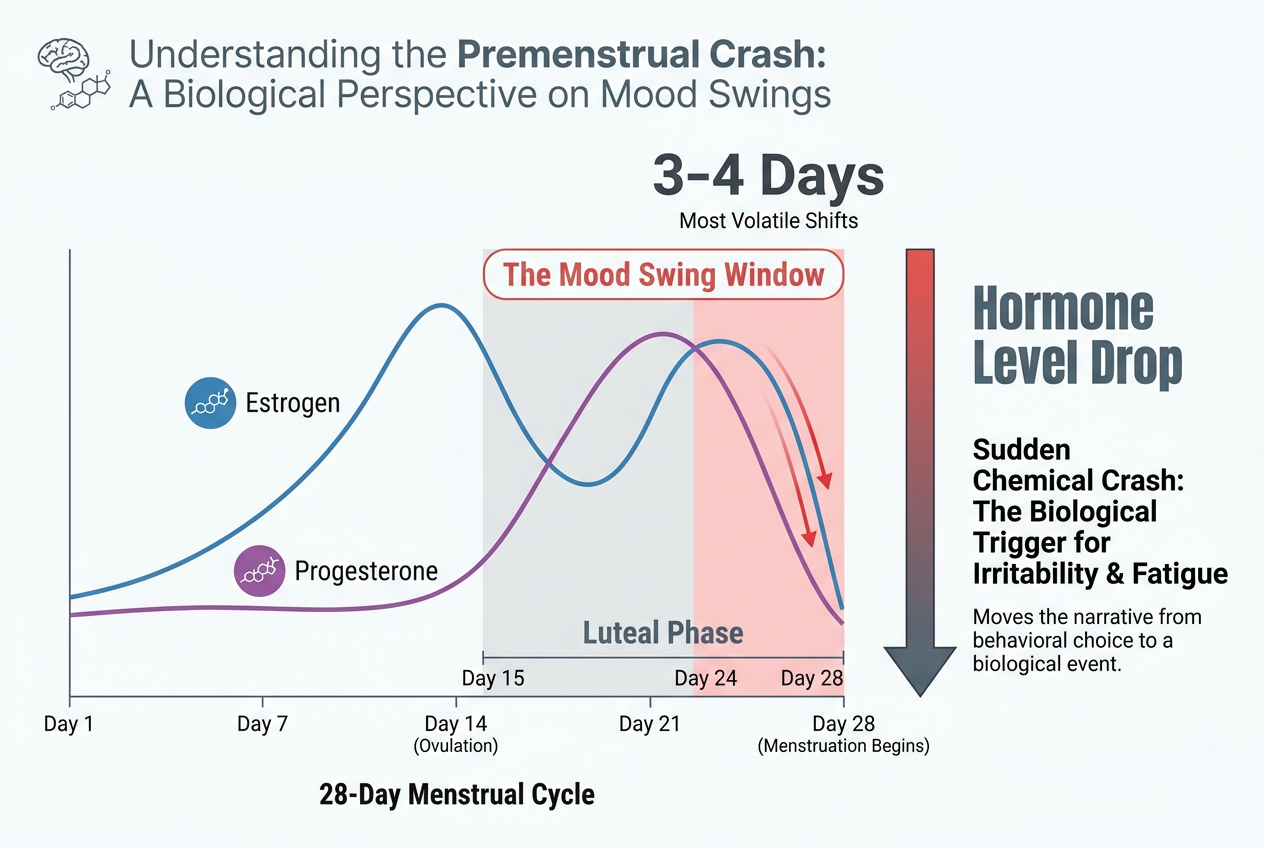 Understanding the biological 'Steep Drop' helps partners recognize that mood shifts are driven by rapid hormonal changes occurring 3 to 4 days before menstruation begins.
This isn't a universal experience with universal severity. A 2021 meta-analysis in BMC Women's Health found that 47.8% of women worldwide report moderate to severe premenstrual symptoms, while the Office on Women's Health (2024) reports that 90% experience some degree of premenstrual change. The spectrum ranges from mild fatigue and food cravings to intense mood swings, debilitating cramps, and depressive episodes. For most women, the symptoms are manageable but real. For a smaller percentage - those with PMDD - the symptoms are severe enough to disrupt daily functioning.
What this means for you: the mood shifts you're seeing aren't character flaws, manipulation, or overreaction. They're a predictable physiological response to a predictable hormonal event. The key to helping isn't controlling the biology - it's recognizing the window when it's happening and adjusting your approach accordingly. When you understand that her stress response is chemically amplified during this window, the question shifts from "Why is she acting like this?" to "What can I do to reduce additional friction during a high-reactivity period?"
PMS vs. PMDD: When to Seek Professional Help
Standard premenstrual syndrome (PMS) involves physical and emotional symptoms that are uncomfortable but manageable - bloating, mild mood swings, fatigue, food cravings, breast tenderness. Premenstrual Dysphoric Disorder (PMDD) is a distinct clinical condition characterized by severe depressive symptoms, intense irritability, anxiety, and emotional volatility that significantly impair daily functioning. The difference isn't just degree - it's a qualitative shift in how the luteal phase affects her mental health and ability to operate normally.
According to Psych Central (2021), PMDD affects 3% to 8% of menstruating people. The symptoms typically begin 7 to 10 days before menstruation and resolve within a few days after bleeding starts. What separates PMDD from PMS is the severity and the functional impairment. Women with PMDD describe feeling "out of control," experiencing suicidal ideation, having intense rage or hopelessness, and being unable to manage work, relationships, or daily responsibilities during the luteal phase. These aren't exaggerations - they're diagnostic criteria recognized by the DSM-5 (the clinical manual used to diagnose mental health conditions).
| Symptom Category | PMS (Mild to Moderate) | PMDD (Severe) |
|---|---|---|
| Mood changes | Irritability, mild sadness, tension | Severe depression, intense anger, hopelessness, or suicidal thoughts |
| Anxiety | Mild nervousness or restlessness | Panic attacks, intense anxiety, feeling "on edge" constantly |
| Physical symptoms | Bloating, breast tenderness, headaches | Severe pain, fatigue so intense it prevents normal activity |
| Functional impact | Minor disruption to routine | Significant impairment in work, relationships, or self-care |
| Duration | 3-7 days before period | 7-10 days before period, symptoms more intense |
| Treatment needs | Lifestyle changes, OTC pain relief | Often requires SSRIs, hormonal treatment, or therapy |
The clinical distinction matters because PMDD requires medical intervention, not just lifestyle adjustments. If your girlfriend experiences severe mood swings that include thoughts of self-harm, intense rage that feels disproportionate even to her, or depressive episodes that make basic functioning difficult, she's likely dealing with PMDD, not standard PMS. A 2024 study in the Journal of Affective Disorders found that severe premenstrual disorders are associated with significantly higher rates of relationship disruption - not because the relationship is doomed, but because untreated PMDD creates a cycle of conflict and emotional exhaustion that erodes trust over time.
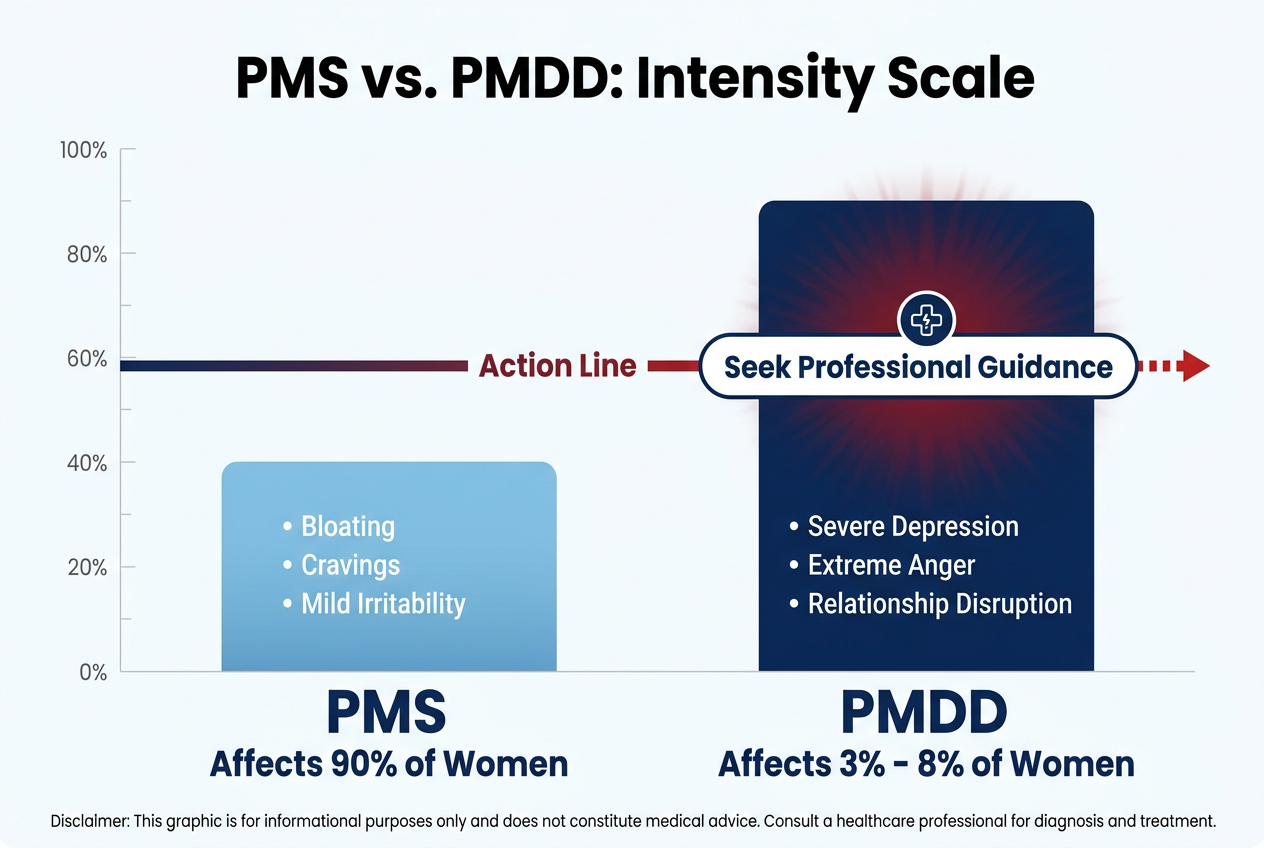 While 90% of women experience PMS, PMDD is a more severe condition affecting up to 8% of people. Recognizing this distinction is vital for long-term relationship health.
How to bring it up: don't diagnose her yourself, but you can create an opening for the conversation. Choose a moment during the follicular phase (the week after her period ends, when energy and mood are typically higher) and frame it around support, not criticism. Try: "I've noticed the week before your period is really hard for you. I want to help, and I've been reading about PMDD - it's a medical thing that affects some people and sounds like what you're describing. Would you be open to talking to a doctor about it?" If she's been tracking symptoms or already suspects something is off, this can be the push she needs to seek clinical help. If she dismisses it, don't force the issue - but keep an eye on patterns. If the symptoms worsen or she mentions feeling hopeless, suicidal, or out of control, that's a red flag that requires professional intervention.
Why Does My Girlfriend Get So Angry on Her Period?
The anger isn't random - it's a biological stress response amplified by a narrower emotional threshold during the luteal phase and early menstruation. When estrogen and progesterone drop, serotonin production decreases, making it harder to regulate mood. At the same time, prostaglandins (the compounds that trigger uterine contractions and inflammation) spike, causing physical pain that raises baseline stress. Cortisol, the stress hormone, becomes harder to control. Minor irritations that she'd normally brush off - a dish left in the sink, an off-hand comment, a plan that changes last minute - now hit harder because her brain's capacity to absorb small stressors is chemically reduced.
According to the American College of Obstetricians and Gynecologists (2021), over 50% of women report painful periods (dysmenorrhea) at some point in their lives. Pain is not abstract - it directly impacts mood, patience, and emotional regulation. Imagine having a low-grade headache and cramping that won't go away while also dealing with fatigue, bloating, and a hormonal environment that makes you more emotionally reactive. Now add a partner who doesn't seem to notice, doesn't adjust, or asks "Is it your period?" when you express frustration. That's the setup for anger.
Here's the other factor most men miss: the luteal phase (the two weeks before her period) is also when the "mental load" of managing logistics, planning, and decision-making feels heavier. She's dealing with brain fog, fatigue, and physical discomfort while still trying to manage the same responsibilities. If you're not stepping in proactively to reduce that load, the resentment compounds. A 2014 study in the Journal of Men's Health found that men's behavior toward partners is often negatively influenced by "biomedical misconceptions" - the belief that period symptoms are exaggerated or imaginary. This dismissal doesn't just frustrate her - it actively increases conflict because she feels unseen during a window when she's already struggling.
What you need to understand: the anger is rarely about the trigger itself. It's about the accumulation of physical discomfort, emotional reactivity, and the perception that she's managing it alone. When she snaps over something small, she's not overreacting to that one thing - she's reacting to the fact that she's been in pain, exhausted, and hormonally destabilized for days, and the small thing is the final input her nervous system can't absorb.
How to respond in the moment: don't defend, explain, or minimize. Say: "I hear you. What do you need right now?" If she says "nothing," don't push - but follow up with action. Take something off her plate. Handle dinner. Do the task she mentioned earlier in the week that you forgot about. The goal is to reduce inputs, not add more. If the anger escalates and she says something hurtful, you can address it later - during the follicular phase when emotions are more stable - but in the heat of the luteal window, your job is de-escalation, not resolution. Understanding how hormones affect relationships gives you the framework to separate the biology from the behavior without dismissing her experience.
The Luteal Phase Grocery List: What to Buy Before the Window Hits
Proactive support starts with logistics. The luteal phase grocery list is a tactical checklist of science-backed items that address the physical and emotional symptoms of PMS and the early days of menstruation. This isn't about guessing what she wants - it's about showing up with the specific things that measurably reduce discomfort, support mood stability, and signal that you're paying attention to her needs before she has to ask.
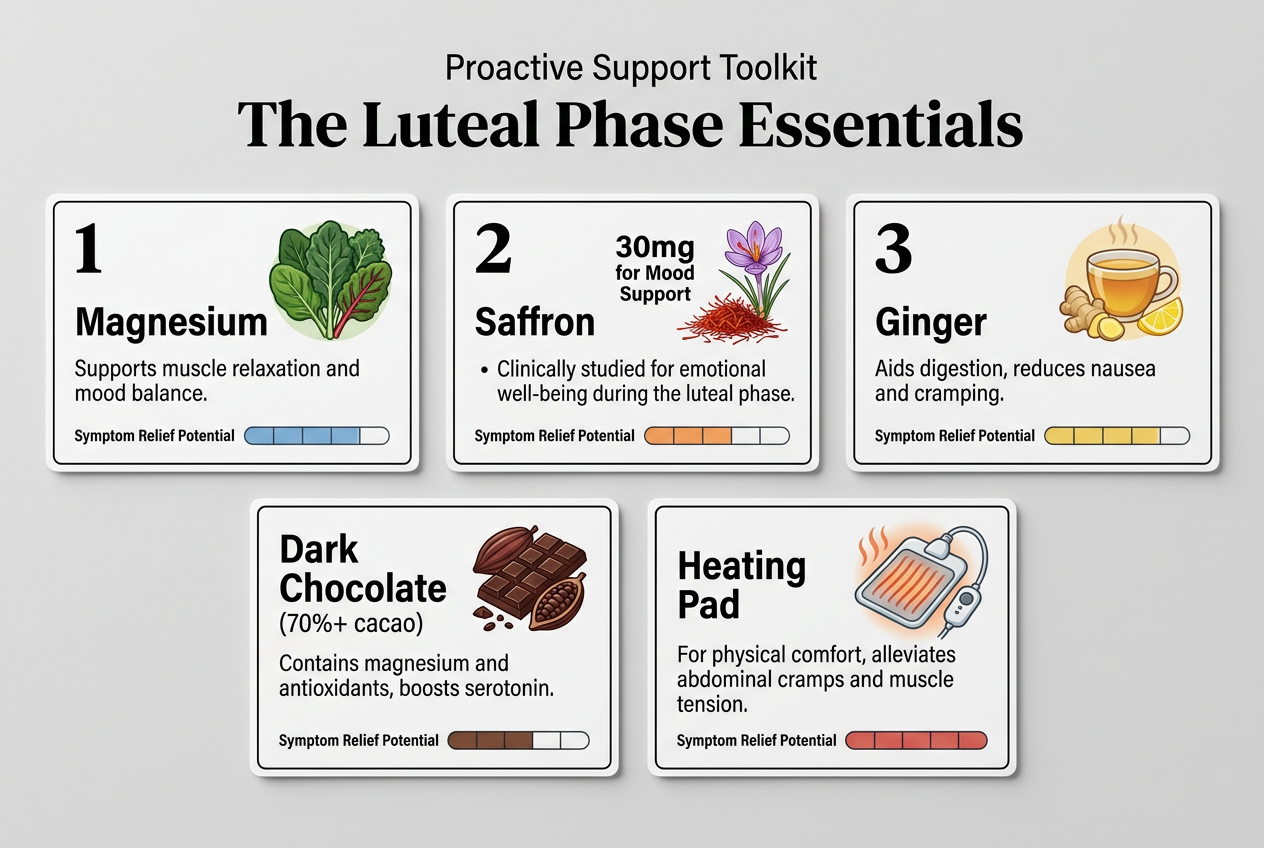 Transform your support strategy with this science-backed grocery list. Items like saffron and magnesium are clinically shown to reduce mood severity and physical discomfort.
Research published in the Korean Journal of Family Medicine (2025) found that saffron supplementation at 30mg per day effectively reduces both mood symptoms and physical pain associated with PMS. Ginger has anti-inflammatory properties that help reduce prostaglandin-driven cramping. Magnesium supports serotonin production and reduces muscle tension, which is why magnesium-rich foods (dark chocolate, leafy greens, nuts, avocados) are consistently recommended for luteal phase support. Dark chocolate specifically combines magnesium with small amounts of caffeine and theobromine, which can improve mood without the crash of high-sugar snacks.
| Item | Why It Works | When to Use It |
|---|---|---|
| Dark chocolate (70%+ cacao) | High in magnesium, supports serotonin production, satisfies cravings without sugar crash | Days 21-28 (luteal phase) and days 1-3 (early period) |
| Magnesium supplement (400mg) | Reduces muscle cramps, supports mood regulation, improves sleep quality | Start day 21, continue through menstruation |
| Saffron (30mg capsules) | Clinically shown to reduce mood swings and irritability in PMS and PMDD | Days 21-28 (take daily during luteal phase) |
| Ginger tea or fresh ginger | Anti-inflammatory, reduces cramping and nausea, settles digestive discomfort | Days 1-5 (menstruation) and as needed for cramps |
| Heating pad or hot water bottle | Reduces uterine cramping through heat therapy, provides immediate physical relief | Days 1-5 (menstruation) or whenever cramping occurs |
| Leafy greens (spinach, kale) | High in magnesium and iron, combats fatigue and supports mood stability | Days 21-28 and days 1-7 (to replenish iron loss) |
| Herbal tea (chamomile, peppermint) | Calming, reduces bloating and digestive discomfort, supports relaxation | Days 21-28 (luteal phase) and days 1-5 (menstruation) |
| Avocados | Rich in healthy fats and magnesium, stabilizes blood sugar and energy | Days 21-28 (luteal phase) |
Here's how to execute: around day 18-20 of her cycle (if you're tracking together, or if you know her period is due in 7-10 days), do a grocery run. Stock the fridge with dark chocolate, leafy greens, avocados. Buy or make ginger tea. Get a quality heating pad if you don't already have one - the reusable gel packs or electric heating pads both work. If she's open to supplements, pick up magnesium glycinate (400mg) and saffron capsules (30mg). Don't present this as a grand gesture or expect praise - just have the items available when the window hits.
The psychological impact of this move is as important as the physical support. When she opens the cabinet and sees the ginger tea you bought three days before she needed it, or when you hand her the heating pad before she asks, it signals that you're thinking ahead, that you understand the pattern, and that you're willing to take concrete action to help. That's the difference between reactive support (responding after she's already struggling) and proactive support (reducing the burden before it compounds). For more on how to anticipate her needs during different phases, see the guide on understanding your partner's cycle.
The Communication Playbook: What to Say & What to Avoid
The single biggest communication mistake men make during the luteal and menstrual window is asking "Is it your period?" This question - no matter how well-intentioned - reads as dismissive because it implies that her feelings are hormonally invalid rather than a legitimate response to a real situation. Even if the hormonal shift is amplifying her reaction, the underlying concern is usually real. Dismissing it as "just PMS" shuts down the conversation and confirms her suspicion that you don't actually care about what's bothering her.
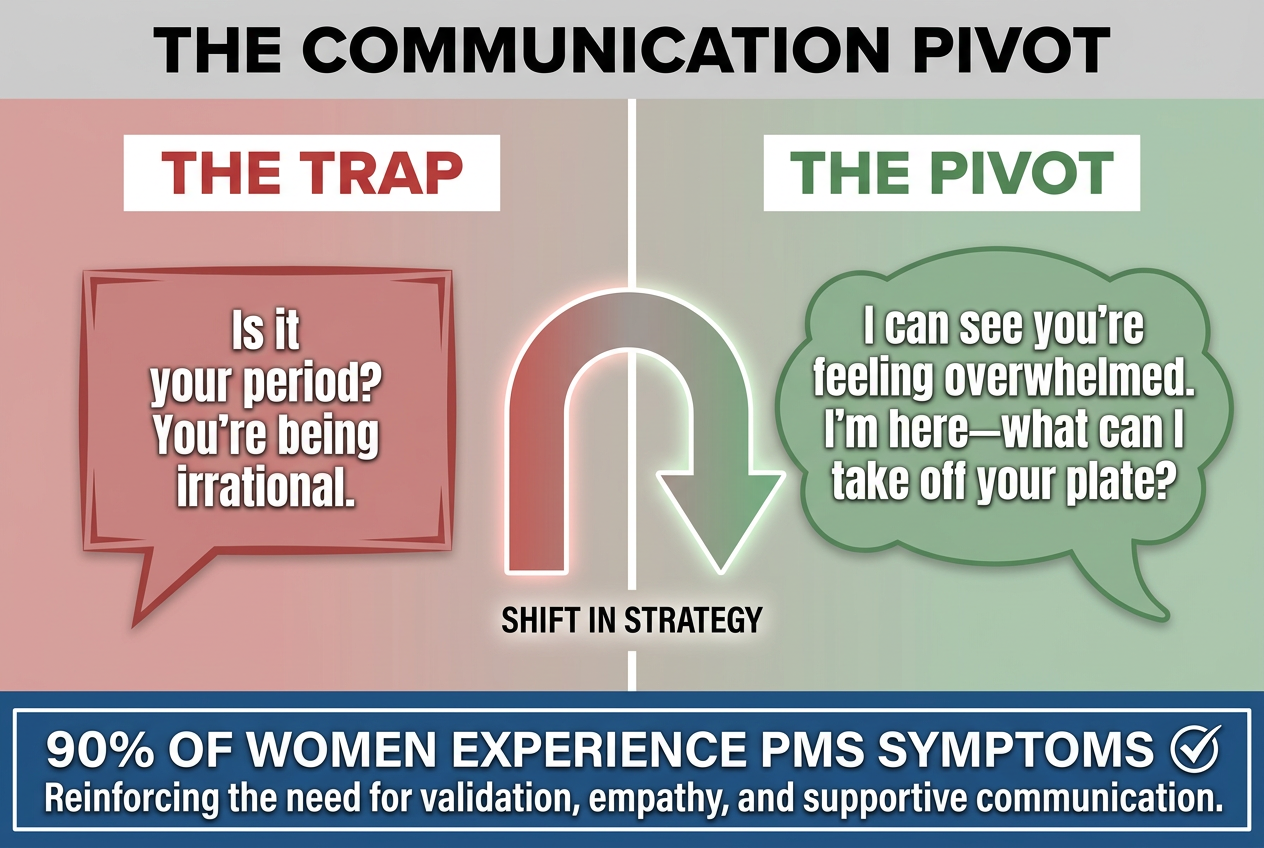 Strategic communication pivots help de-escalate tension by replacing dismissive questions with validating statements that address the underlying physical and emotional stress of the cycle.
Here's the tactical pivot: replace attribution with validation. Instead of questioning why she's upset, acknowledge that she's upset and ask what would help. The table below shows the trap (what not to say), the pivot (what to say instead), and why the pivot works.
| The Trap (What Not to Say) | The Pivot (What to Say Instead) | Why the Pivot Works |
|---|---|---|
| "Is it your period?" | "You seem stressed. What's going on?" | Opens the door without dismissing the emotion or attributing it to biology |
| "You're overreacting." | "I hear you. That sounds frustrating." | Validates her experience instead of minimizing it |
| "You were fine yesterday." | "What can I do to help right now?" | Focuses on action, not comparison or logic |
| "It's not that big of a deal." | "I can see this is important to you." | Acknowledges her perspective without debating the severity |
| "Why are you so emotional?" | "I want to understand. Can you walk me through it?" | Invites conversation instead of shutting it down with judgment |
| "You're being irrational." | "I know you're dealing with a lot right now." | Recognizes the context (physical discomfort, hormonal stress) without dismissing her logic |
The script that consistently works: "I hear you. What do you need right now?" This question does three things. First, it validates that she's experiencing something real. Second, it shifts the focus from debating whether she should feel a certain way to addressing what would actually help. Third, it gives her agency - she gets to name what support looks like instead of you guessing and getting it wrong.
Sometimes she'll say "I don't know" or "nothing." That's fine. Don't push. Instead, follow up with action: "I'm going to handle dinner tonight. You don't need to do anything." or "I'm taking care of the laundry this weekend so you don't have to think about it." The goal isn't to extract a specific answer - it's to reduce the number of decisions and tasks she has to manage while her emotional bandwidth is narrower.
One more critical rule: never bring up the cycle during an argument. If she's upset about something and you say "Is this because of your period?" you've just escalated the conflict because you've shifted from addressing her concern to dismissing it as hormonal. If you need to discuss cycle-related patterns - like recurring arguments during the luteal phase - have that conversation during the follicular phase (the week after her period ends) when emotions are stable and she has the bandwidth to discuss it constructively. For more on cycle-aware communication timing, check out the article on how to talk to your girlfriend during the follicular phase.
How to Calm Your Girlfriend Down When She's on Her Period
You can't "calm her down" by talking her out of the emotional or physical discomfort - but you can de-escalate tension by reducing inputs, validating her experience, and creating space for her to regulate without added pressure. The goal isn't to fix her mood. It's to remove friction so her nervous system can stabilize on its own.
Start by removing decision-making load. During the luteal phase and menstruation, brain fog and fatigue are common. Every decision - even small ones like "What do you want for dinner?" - feels heavier. Instead of asking open-ended questions, make the call yourself. Say: "I'm ordering Thai food. Do you want your usual or should I get you something else?" This reduces the decision to a binary choice instead of an open field. Better yet: "I'm handling dinner. You don't need to think about it." Same principle applies to household logistics. Don't ask if she wants you to clean the kitchen - just clean it. Don't ask if she needs anything from the store - check the list, go, come back.
Physical comfort is non-negotiable. If she's dealing with cramps, offer the heating pad before she asks. If she's fatigued, suggest she rest while you handle whatever task is pending. If she's bloated or uncomfortable, don't comment on her appearance or eating habits - just make sure the environment is low-pressure. One partner described this as "shrinking the world" - during the high-discomfort days, reduce stimulation, reduce decisions, reduce the need for her to perform or manage anything beyond what she's already dealing with.
Here's what de-escalation looks like in practice. She snaps at you over something small. You feel defensive. Instead of defending, responding, or explaining, you pause. You say: "I hear you. I'm sorry that's frustrating." Then you ask: "What would help right now?" or you just take action without waiting for an answer. You handle the task she mentioned. You don't bring up the tone she used or argue about whether the trigger was proportional. You recognize that she's operating with a narrower stress threshold and you adjust accordingly.
What doesn't work: logic, debate, or trying to "solve" the emotional state with reasoning. Telling her "There's no reason to be upset about that" or "You're taking this too seriously" will backfire because it dismisses the experience. The luteal and menstrual window is not a time for processing conflict or having difficult conversations. Save those for the follicular phase. Right now, your only job is to reduce friction and show up with the physical and logistical support that makes the window more tolerable.
If you're in a long-distance relationship and can't provide hands-on support, the same principles apply remotely. Send her favorite food via delivery. Text her during the window: "I know this week is rough. I'm thinking about you." Don't ask her to explain what's wrong or engage in a heavy conversation. Just acknowledge the difficulty and follow up with something tangible - a surprise delivery, handling a shared task remotely, or just giving her space without making her feel guilty about it. For more on remote support strategies, see the guide on long-distance relationship communication tips.
Tracking as a Team: Why Shared Awareness Changes the Game
Shared cycle tracking transforms the relationship dynamic from reactive guesswork to proactive partnership. When both partners know where she is in the cycle, you can anticipate high-friction windows, plan logistics around energy levels, and adjust communication strategies based on hormonal context. The data becomes a shared reference point instead of a source of conflict.
The most effective tracking setup is one where you have visibility into her cycle without requiring her to manually update you every time something changes. Apps designed for partner tracking - like VibeCheck, Selin, or shared tracking features in apps like Flo - allow you to see cycle phases, symptom patterns, and predicted start dates without her needing to explain or remind you. This removes the burden of education from her shoulders. She's not teaching you the cycle every month. You're learning the pattern yourself and adjusting proactively.
Here's what shared tracking enables in practice. You know she's entering the luteal phase (around day 21). You adjust your expectations for the week. You don't plan a difficult conversation or a high-stress social event during the "steep drop" window (days 24-28). You stock the fridge with magnesium-rich foods and ginger tea before she asks. You handle more of the household logistics without being prompted. When her period starts, you're not surprised by the mood shift or the physical discomfort - you've been preparing for it for the past week.
The data also helps you identify patterns that might require medical attention. If her luteal phase is consistently shorter than 10 days, that's a potential fertility or hormonal issue worth discussing with a doctor. If symptoms are getting progressively worse over time, that could signal PMDD or another underlying condition. Tracking gives you the evidence base to have that conversation constructively instead of relying on memory or perception. For more on cycle tracking as a relationship tool, see the article on period tracker for couples.
How to introduce the idea: frame it around support, not surveillance. Don't say "I want to track your period so I know when you're going to be difficult." Say: "I want to understand your cycle better so I can support you more effectively. Would you be open to sharing access to your tracker so I can see when you're in the luteal phase and adjust accordingly?" If she's hesitant, start with a manual check-in: "Can you let me know when your period is expected so I can plan around it?" Once she sees that you're using the information to help rather than to judge or predict behavior, the resistance typically drops.
The best part of shared tracking: it removes the stigma. The cycle stops being a taboo subject and becomes a neutral, predictable biological pattern that both partners work with instead of against. You're not tiptoeing around "that time of the month." You're strategically planning around a known high-stress window and adjusting your behavior to match. That shift - from avoidance to active partnership - is what separates couples who struggle with cycle-related conflict from couples who navigate it smoothly. If you're comparing tracking options, the guide to best period tracker apps for boyfriends breaks down which platforms are built specifically for partner support.
When It's More Than PMS: Red Flags and Next Steps
If your girlfriend's symptoms go beyond typical PMS and include severe depression, suicidal thoughts, intense rage, debilitating physical pain, or symptoms that last most of the month (not just the luteal phase), she may be dealing with PMDD, endometriosis, or another underlying condition that requires medical intervention. Recognizing the red flags early and encouraging her to seek professional help can prevent the condition from worsening and reduce the relationship strain that comes from untreated chronic symptoms.
Red flags that signal it's time to see a doctor:
- Severe mood swings that include suicidal ideation or self-harm thoughts - this is a hallmark of PMDD and requires immediate clinical attention, often treated with SSRIs or hormonal therapy
- Physical pain so intense it prevents normal activity - cramping, pelvic pain, or back pain that doesn't respond to over-the-counter pain relief could indicate endometriosis or fibroids
- Symptoms that last more than two weeks per month - if the "bad days" outnumber the "good days," the issue may extend beyond standard PMS into a chronic hormonal or mood disorder
- Rapid worsening of symptoms over time - if the luteal phase symptoms are getting progressively more severe with each cycle, that's a sign that the underlying cause needs medical evaluation
- Symptoms that don't resolve with standard interventions - if magnesium, saffron, lifestyle adjustments, and supportive communication aren't making a dent, the issue is likely clinical, not lifestyle-based
How to bring it up without sounding like you're diagnosing her: choose a moment during the follicular phase (the week after her period ends, when her mood and energy are stable). Frame it around shared concern, not criticism. Try: "I've noticed the week before your period is really hard for you, and it seems like it's getting worse. I care about you and I want to help, but I think this might be something a doctor could address. Would you be open to talking to someone about it?" If she's already mentioned that the symptoms feel unbearable or out of control, use that as the entry point: "You said last month that you felt like you couldn't control the rage. That sounds like PMDD, which is a real medical condition. Can we look into treatment options together?"
The clinical options for PMDD and severe PMS include SSRIs (antidepressants taken either continuously or just during the luteal phase), hormonal birth control to stabilize the cycle and reduce the hormonal swings, cognitive behavioral therapy (CBT) to address the depressive and anxiety symptoms, and in some cases, nutritional or supplement-based interventions under medical supervision. For women dealing with endometriosis or fibroids, the treatment path may include imaging (ultrasound or MRI), pain management, or surgical intervention depending on severity.
Your role in this process: support her decision, go with her to the appointment if she wants the backup, and don't pressure her to pursue treatment she's not comfortable with. If she's hesitant to see a doctor, you can offer to help her research options, find a provider who specializes in PMDD or reproductive health, or just listen when she talks through her concerns. The goal is to make the path to help as low-friction as possible, not to force her into treatment she's not ready for.
One final note: if she does get a PMDD or endometriosis diagnosis, your job doesn't end. Treatment helps, but it doesn't erase the condition. You'll still need to track the cycle, adjust your approach during high-stress windows, and provide the logistical and emotional support outlined in this guide. The difference is that with treatment, the severity of symptoms decreases, which reduces the relationship friction and makes the manageable parts of the cycle easier to navigate together. For more on supporting a partner through chronic cycle-related conditions, see the article on how to support your partner during her period.
Ready to actually understand her?
Join thousands of men using VibeCheck to track her cycle and show up better every day.
Want the shortcut? See how the best relationship advice apps for men stack up on the things that matter here — timing, prompts, and knowing what to actually say.
Frequently Asked Questions
How to handle girlfriend mood swings during periods?
Handle girlfriend mood swings during periods by reducing logistical load, validating her emotions without dismissing them, and creating space for her to regulate without added pressure. Stock magnesium-rich foods and ginger tea before the luteal phase starts (around day 21), take over household tasks proactively, and avoid asking "Is it your period?" when she's upset. Research shows that saffron supplementation at 30mg per day and magnesium reduce mood severity during PMS. The key is shifting from reactive support (responding after she's struggling) to proactive support (anticipating the high-friction window and adjusting before it hits). Use shared cycle tracking to identify when she's entering the luteal phase so you can prepare. During arguments, don't debate or minimize - say "I hear you. What do you need right now?" and follow up with action, not logic.
What causes period mood swings?
Period mood swings are caused by a steep drop in estrogen and progesterone levels 3 to 4 days before menstruation, which reduces serotonin (the mood stabilizer) and increases cortisol (the stress hormone). Lower serotonin makes emotional regulation harder. Higher cortisol amplifies stress responses. Prostaglandins, the inflammatory compounds that trigger uterine contractions, spike during menstruation and cause physical pain that further narrows emotional bandwidth. According to the Office on Women's Health (2024), 90% of women experience some degree of premenstrual change, ranging from mild irritability to severe mood swings. For 3% to 8% of women, the mood changes are severe enough to qualify as Premenstrual Dysphoric Disorder (PMDD), which requires clinical treatment. Understanding the biological cause helps partners recognize that mood swings aren't character flaws - they're a predictable hormonal response.
How to calm your girlfriend down when she's on her period?
Calm your girlfriend down when she's on her period by reducing inputs, not adding logic or debate. Offer physical comfort (heating pad, ginger tea, dark chocolate) before she asks, take over decision-making and household tasks without prompting, and validate her emotions instead of dismissing them. Say "I hear you. What do you need right now?" instead of "You're overreacting." If she's cramping, hand her the heating pad and handle whatever task is pending so she can rest. If she's irritable, don't engage in difficult conversations or debates - save those for the follicular phase when her emotional bandwidth is wider. Research published in BMC Women's Health (2021) shows that 47.8% of women report moderate to severe premenstrual symptoms, which means physical discomfort is real, not imagined. Your job is to shrink the world during the high-discomfort days: reduce stimulation, reduce tasks, reduce the need for her to perform or manage anything beyond what she's already dealing with.
Why does my girlfriend get so angry on her period?
Your girlfriend gets angry on her period because pain, fatigue, and hormonal shifts reduce her capacity to absorb minor stressors that wouldn't register during other phases. Estrogen and progesterone drop sharply 3 to 4 days before menstruation, lowering serotonin and making emotional regulation harder. Prostaglandins cause cramping and inflammation, which increases baseline stress. Over 50% of women report painful periods (dysmenorrhea), according to the American College of Obstetricians and Gynecologists (2021), and pain directly impacts mood, patience, and stress tolerance. The anger is rarely about the trigger itself - it's about the accumulation of physical discomfort, hormonal reactivity, and the perception that she's managing it alone. A 2014 study in the Journal of Men's Health found that men's dismissive behavior toward partners (attributing symptoms to exaggeration or mood) actively increases conflict. What she needs is not logic or debate, but validation, logistical support, and space to regulate without added pressure.
How to fix mood swings during period?
You can't "fix" mood swings during period because they're driven by hormonal changes that are part of the menstrual cycle, but you can reduce their severity with science-backed interventions and proactive support. Saffron supplementation at 30mg per day reduces mood swings and irritability, according to research in the Korean Journal of Family Medicine (2025). Magnesium (400mg per day) supports serotonin production and reduces muscle tension. Ginger tea and anti-inflammatory foods reduce cramping and bloating. Shared cycle tracking allows you to anticipate the "steep drop" window (days 24-28) and adjust your approach before symptoms peak. For severe mood swings that include suicidal thoughts, intense rage, or functional impairment, professional treatment is required - PMDD is a clinical condition treated with SSRIs, hormonal therapy, or cognitive behavioral therapy. The goal isn't eliminating mood swings entirely, but creating a support system that reduces their impact on the relationship and helps her manage symptoms more effectively.
What should I not say to my girlfriend when she's on her period?
Never say "Is it your period?" when your girlfriend is upset - this dismisses her emotions as hormonally invalid instead of addressing the actual concern. Avoid "You're overreacting," "It's not that big of a deal," "You were fine yesterday," or "Why are you so emotional?" These phrases minimize her experience and shut down communication. A 2014 study in the Journal of Men's Health found that biomedical misconceptions (the belief that period symptoms are exaggerated) actively increase relationship conflict because partners feel unseen and dismissed. Instead of questioning why she feels a certain way, validate that she's upset and ask what would help: "I hear you. What do you need right now?" Don't bring up the cycle during an argument - if you need to discuss cycle-related patterns, have that conversation during the follicular phase (the week after her period ends) when emotions are stable. The goal is de-escalation, not debate.
Can stress make period mood swings worse?
Yes, stress significantly worsens period mood swings because cortisol (the stress hormone) is already harder to regulate during the luteal phase when estrogen and progesterone drop. High cortisol amplifies irritability, anxiety, and emotional reactivity, which compounds the hormonal shifts that are already narrowing emotional bandwidth. Stress can also delay or disrupt the menstrual cycle itself, creating unpredictability that adds another layer of frustration. Reducing external stressors during the luteal phase - by taking over household logistics, minimizing conflict, and creating space for rest - helps mitigate the severity of mood swings. Shared cycle tracking allows you to identify when she's entering the high-stress window so you can adjust your approach proactively. For more on how stress impacts the cycle, see the article on can stress delay your period.
How long do period mood swings last?
Period mood swings typically last 3 to 7 days before menstruation begins and resolve within 2 to 3 days after bleeding starts, though the exact duration varies by individual and cycle length. The "steep drop" window - when estrogen and progesterone plummet most sharply - occurs roughly 3 to 4 days before the period starts, according to research by Hormona (2026). For women with Premenstrual Dysphoric Disorder (PMDD), symptoms can begin 7 to 10 days before menstruation and may be more severe. Tracking the cycle allows you to identify when the high-reactivity window hits and when it resolves, which helps you adjust your approach and avoid scheduling difficult conversations or high-stress events during that period. If mood swings last more than two weeks per month or don't resolve after menstruation starts, that's a red flag for a potential hormonal imbalance or PMDD, and medical evaluation is recommended.
The difference between couples who navigate cycle-related conflict smoothly and couples who fight about it every month comes down to one thing: whether you treat the cycle as an enemy or as predictable data. You can't change the biology. You can't eliminate the hormonal swings. But you can learn the pattern, adjust your approach during the high-friction windows, and show up as a partner who reduces the load instead of adding to it. That's not walking on eggshells - it's strategic, proactive support based on understanding what's actually happening underneath the surface. The cycle isn't the problem. How you respond to it is.
Tags

Related Articles
Continue reading to deepen your understanding

How to Understand Your Girlfriend’s Social Battery and Hormones
Does your girlfriend suddenly cancel plans or seem withdrawn? This guide explains how her cycle impacts her energy so you can support her like a pro.

How Your Girlfriend’s Emotional Needs Change During Her Cycle
Does your girlfriend’s mood seem unpredictable? Learn how her emotional needs shift on a biological loop and how to support her through every phase of her cycle.

What to Buy When Your Girlfriend Has Hormone Cravings: A Support Guide
Stop wondering what to pick up at the store. This guide explains the science behind cycle cravings and provides a specific list of foods and comfort items she needs.

Your Girlfriend’s Mood Shifts Throughout the Month, Explained
Ever wonder why her energy and moods change so drastically each week? Understand the four hormonal phases and how to be the partner she needs during every stage of her cycle.

How to Support Your Girlfriend When She’s Crying Because of Hormones
Watching her cry when hormones hit can feel overwhelming. Learn the biological why behind the tears and use these proven scripts to provide the support she actually needs right now.

How to Help Your Girlfriend with Hormonal Mood Swings Without Arguing
Understand her cycle and learn tactical scripts to handle tension. This guide shows you how to support her through hormonal shifts without getting into unnecessary fights.

When to Feed Your Girlfriend: Understanding Hangry Hormones
Does your girlfriend get irritable when she hasn’t eaten? It’s not just in her head. Learn why hormones cause hanger and the specific times her body needs more fuel.

The Boyfriend’s Guide to Supporting Your Partner Through PMS
If your partner is suddenly irritable and exhausted, it’s biology, not you. Learn about the luteal phase and how to provide meaningful support without walking on eggshells.