How to Plan Dates Based on Menstrual Cycle (2026)

Improve your relationship by matching dates to her cycle. Learn the Four Seasons framework to sync with her energy, mood, and social battery every month.
The Partner’s Cheat Sheet: How to Plan Dates Based on Her Menstrual Cycle
You planned the perfect date. Reservations at her favorite restaurant, tickets to that show she mentioned, the whole nine yards. But when the night arrives, she’s exhausted, irritable, and would rather be anywhere but a crowded venue. You’re confused. She’s frustrated. And you’re both wondering what went wrong.
Here’s what most men don’t realize: her body runs on a 28-day biological rhythm that directly impacts her energy, mood, and social battery. Understanding this rhythm isn’t about "managing moods" or walking on eggshells. It’s about matching your relationship strategy to her biological reality so you stop planning rock concerts during her lowest-energy week and cozy movie nights during her peak social phase.
This guide breaks down the science of cycle-based date planning using the Four Seasons framework - a simple metaphor that turns complex hormonal shifts into actionable relationship intelligence. By the end, you’ll know exactly when to plan adventure dates, when to keep things low-key, and how to stop the "unexplained fights" that happen when you miss her biological cues.
Table of Contents
- Why Her Cycle Matters for Date Planning
- The Four Seasons Framework
- The Phase-by-Phase Date Playbook
- The Luteal Phase Survival Guide
- How to Start This Conversation
- Common Mistakes to Avoid
- Tools and Apps That Help
- Frequently Asked Questions
Why Her Cycle Matters for Date Planning
Your partner’s menstrual cycle affects her 100% of the time, not just during her period. Research shows that hormonal fluctuations throughout the month influence energy levels, social desire, pain tolerance, and even food preferences. One in seven women is menstruating right now, which means millions of couples are navigating these biological shifts without a roadmap.
VibeCheck App
Know what she needs. Before she has to say it.
Track her cycle, understand her phases, be the partner she deserves.
Download Free on iOS →The cycle isn’t a problem to solve. It’s a rhythm to sync with.
Think of it like this: you wouldn’t plan a marathon after pulling an all-nighter. Your body has natural energy peaks and valleys, and so does hers - except her pattern repeats monthly instead of daily. When you ignore these patterns, you’re essentially rolling the dice on date night success.
Most relationship conflicts during "that week" aren’t about the unwashed dish or forgotten errand. They’re about biological sensitivity colliding with poor timing. When progesterone peaks during the luteal phase, her body is literally more sensitive to stress, noise, and perceived criticism. That same comment that would bounce off her during the follicular phase can feel like a personal attack during the luteal phase.
Understanding this isn’t about making excuses. It’s about strategic empathy - knowing when her biological state makes certain activities feel like a gift versus a burden.
The Four Seasons Framework
The most successful content about cycle tracking uses a simple metaphor: Four Seasons. This framework translates complex hormonal shifts into intuitive language that anyone can understand and remember.
Winter (Menstrual Phase, Days 1-5): Her body is shedding the uterine lining. Estrogen and progesterone are at their lowest. Think of this as hibernation mode - lower energy, more introspective, craving comfort and warmth.
Spring (Follicular Phase, Days 6-13): Estrogen is rising rapidly. Her body is preparing for ovulation. This is new-beginnings energy - optimistic, social, open to novelty and learning. Her brain is literally more receptive to new experiences during this phase.
Summer (Ovulatory Phase, Days 14-17): Peak estrogen. Maximum energy, confidence, and social desire. This is her biological "showtime" - radiant, flirty, high tolerance for activity and stimulation.
Autumn (Luteal Phase, Days 18-28): Progesterone dominates. Her body is preparing for either pregnancy or menstruation. Energy winds down, sensitivity increases, comfort-seeking behavior ramps up. This is the phase where most relationship friction occurs if you don’t adjust your approach.
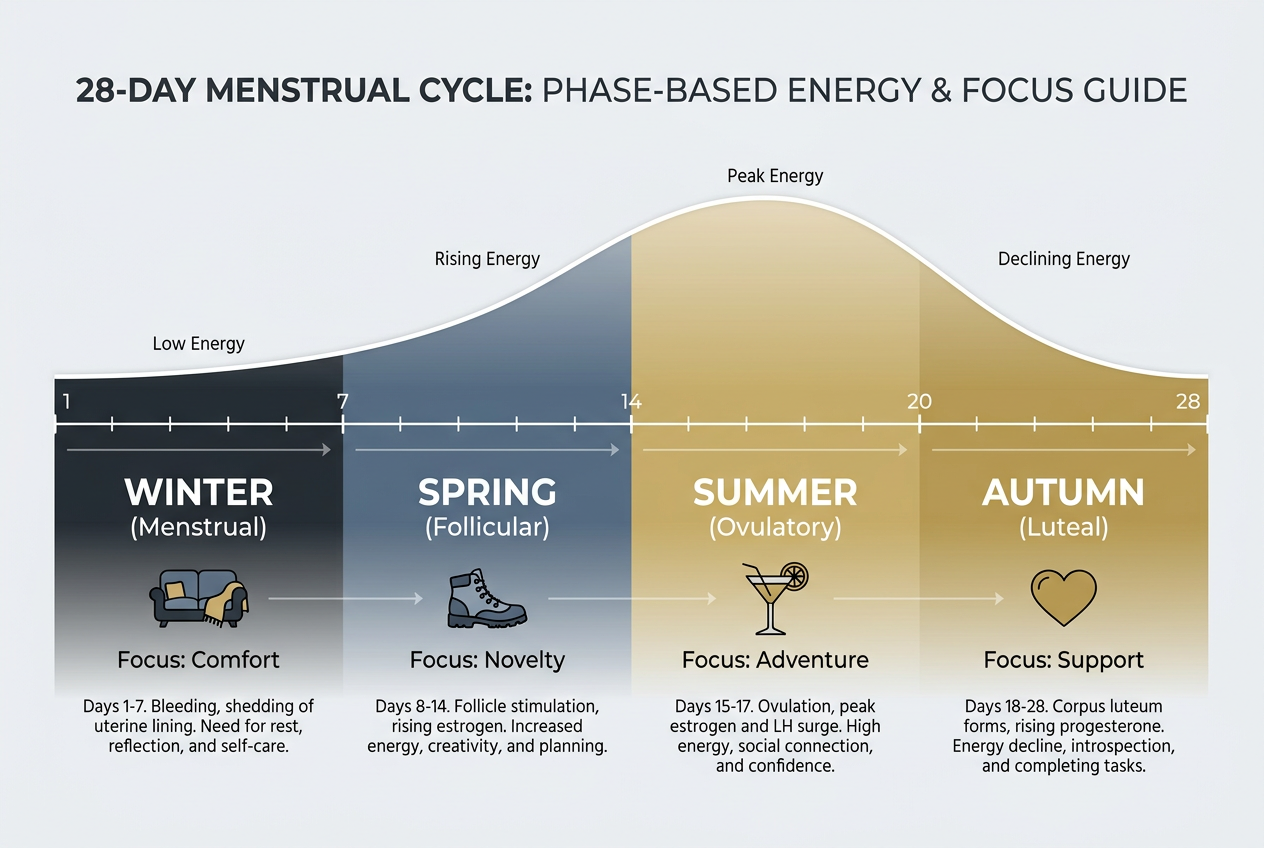
Each season has its own vibe, and trying to force a Summer activity during a Winter phase is like dragging someone camping in a blizzard. It might technically be possible, but why fight nature when you can work with it?
The Phase-by-Phase Date Playbook
Here’s your tactical guide to planning dates that match her biological reality. This isn’t about limiting your options - it’s about timing them right.
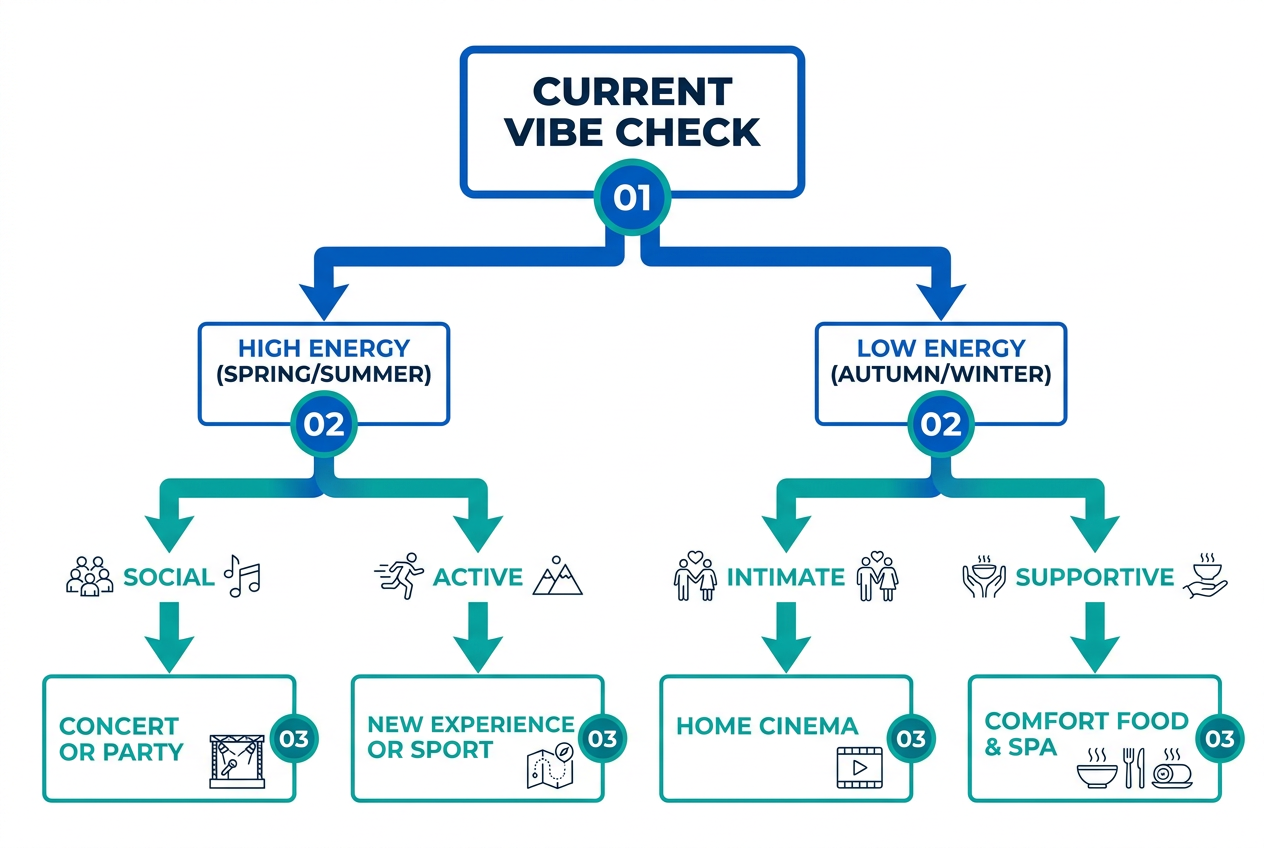
Winter (Menstrual Phase, Days 1-5)
Her Physical State: Cramping, lower back pain, fatigue, possible headaches. Energy is at monthly low. Body is literally breaking down tissue and expelling it.
Her Emotional State: Introspective, less socially motivated, craving solitude or low-key companionship. Not interested in performance or "being on."
The Perfect Date: The Home Spa. Think movie marathon with heavy blankets, her favorite takeout delivered, minimal movement required. A candlelit bath you draw for her. Heating pad already warmed before she asks.
Activity Examples:
- Order in from her comfort-food restaurant
- Queue up her favorite comfort shows (nothing stressful or intense)
- Gentle massage focused on lower back and legs
- Early bedtime with no pressure for conversation
The Pro Move: Bring pain relief supplies before she asks. Have ibuprofen, a heating pad, and her preferred menstrual products already stocked. Show you planned for her comfort without making it weird or clinical.
What to Avoid: High-energy activities, loud environments, anything requiring tight clothing or extended time away from a bathroom, late nights.
Spring (Follicular Phase, Days 6-13)
Her Physical State: Rising energy as estrogen climbs. Better mood stability, increased motivation, higher pain tolerance. Her brain is literally producing more serotonin during this phase.
Her Emotional State: Optimistic, curious, open to new experiences. This is her "yes" season - she’s more likely to try new restaurants, activities, or social events.
The Perfect Date: The Learning Experience. Cooking class, museum exhibit, new hiking trail, bookstore browsing followed by coffee. Anything that engages her brain and offers novelty.
Activity Examples:
- Take a pottery or painting class together
- Explore a neighborhood you’ve never visited
- Try a cuisine neither of you has experienced
- Attend a lecture or workshop on a shared interest
- Plan a day hike with a scenic payoff
The Pro Move: Plan a surprise. Her openness to novelty is highest during this phase, so that spontaneous road trip or surprise reservation will land better now than during other phases. Her reward centers are more active when estrogen is rising.
What to Avoid: Repetitive dates you’ve done a dozen times. This is not the phase for your "usual spot" - capitalize on her openness to new experiences.
If you’re tracking her cycle and want to maximize date success, understanding how to support your girlfriend during different cycle phases gives you the complete tactical framework.
Summer (Ovulatory Phase, Days 14-17)
Her Physical State: Peak energy. Maximum estrogen. Radiant skin, higher libido, increased confidence. Her body is biologically primed for connection and attraction during these 3-4 days.
Her Emotional State: Social, extroverted, high tolerance for stimulation and activity. This is "main character energy" - she feels her best and most confident.
The Perfect Date: The Night Out. Dancing, concerts, fancy multi-course dinner, anywhere with energy and atmosphere. She has the social battery and physical stamina for ambitious plans.
Activity Examples:
- Dress-up dinner at that restaurant you’ve been saving for
- Live music venue or concert
- Late-night dancing (she’ll actually want to stay out past 10pm)
- Group social activity with other couples
- Active date like rock climbing, kayaking, or beach volleyball
The Pro Move: Be extra affectionate and give specific compliments. Her estrogen peak makes her more receptive to positive attention. This is when "you look incredible tonight" will mean the most because she actually feels incredible.
What to Avoid: Low-key, isolated dates. You’re wasting her peak social energy if you’re suggesting Netflix on the couch during Summer. Save that for Winter.
Research shows that understanding when to approach for intimacy based on cycle phases significantly reduces rejection and increases connection. Learn more about timing intimacy with her cycle.
Autumn (Luteal Phase, Days 18-28)
Her Physical State: Progesterone dominates. Bloating, breast tenderness, headaches, fatigue returning. Body is preparing for menstruation. Sleep quality often decreases.
Her Emotional State: Anxious, sensitive to criticism, prone to overwhelm. This is the phase where small annoyances feel bigger and emotional bandwidth is limited. Not a mood problem - a biological reality.
The Perfect Date: The Comfort Date. Early coffee date and sunset drive, creative craft activity at home, farmers market followed by cooking together. Emphasis on calm, supportive, low-pressure environments.
Activity Examples:
- Morning coffee and pastries at a quiet cafe
- Gentle yoga class or nature walk
- Cooking a comfort meal together at home
- Art project or puzzle that allows conversation without pressure
- Sunset viewing from a peaceful spot (car optional)
The Pro Move: Validate her feelings without trying to solve them. When she says "I feel bloated and ugly," your only correct response is "I’m sorry you feel that way. I think you’re beautiful and I’m here if you need anything." Do not attempt logic. Do not suggest solutions. Just validate.
What to Avoid: Busy, loud, overstimulating environments. Long days requiring sustained energy. Any activity where she’ll feel "on display." Never, ever ask "Is it that time of the month?" when she’s frustrated.
For a complete tactical guide to the luteal phase, including specific scripts for the most common situations, check out our luteal phase survival guide.
The Luteal Phase Survival Guide: When Everything Feels Hard
Let’s be direct: the luteal phase is where most relationship friction occurs. Progesterone peaks during this 10-12 day window, and with it comes increased sensitivity, lower frustration tolerance, and what feels like disproportionate reactions to minor issues.
This isn’t your partner being "difficult." It’s her nervous system responding to a real biological shift. Progesterone affects GABA receptors in the brain, the same neurotransmitter system targeted by anti-anxiety medication. When progesterone drops suddenly (right before her period), it’s similar to withdrawing from a mild sedative.
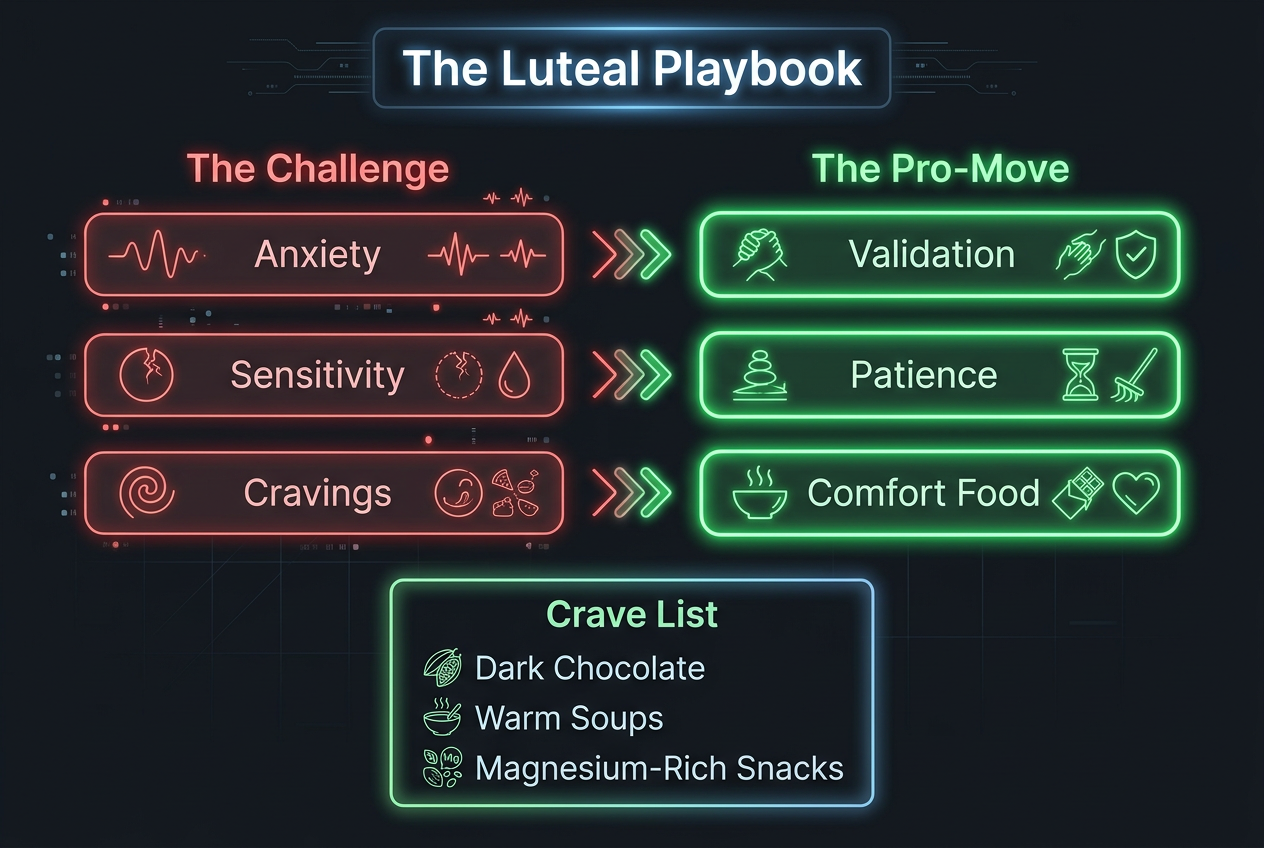
The Validation-First Strategy
During the luteal phase, your default response to any frustration should be validation before solutions. Her emotional experience is heightened, and what she needs most is to feel heard, not fixed.
Wrong Response: "That doesn’t seem like a big deal. Just tell your boss you need an extension."
Right Response: "That sounds really stressful. I can see why you’re frustrated. What would help right now?"
The difference? The second response acknowledges her emotional reality without minimizing it. Solutions can come later, if she asks for them.
High-Crave Foods That Actually Help
Her body has increased nutritional needs during the luteal phase. Cravings aren’t random - they’re often her body seeking nutrients it needs for hormone production and regulation.
Dark Chocolate: Rich in magnesium, which drops during the luteal phase. Magnesium deficiency worsens PMS symptoms. Dark chocolate (70% cacao or higher) provides both magnesium and a dopamine boost.
Nuts and Seeds: Almonds, walnuts, pumpkin seeds, and sunflower seeds are all high in magnesium, healthy fats, and vitamin E. Keep a quality trail mix stocked.
Warm Soups and Stews: Comfort and nutrition combined. Bone broth is particularly helpful - high in minerals and easy to digest when her digestive system is slower (progesterone slows gut motility).
Complex Carbs: Sweet potatoes, oatmeal, whole grain bread. These help stabilize blood sugar, which is more volatile during the luteal phase due to insulin resistance that naturally increases.
Iron-Rich Foods: Red meat, spinach, lentils. Especially important in the late luteal phase as her body prepares for menstruation and potential blood loss.
The "I Feel Ugly" Script
One of the most common luteal phase moments: she expresses feeling bloated, fat, or ugly. This is caused by water retention (progesterone causes the body to retain 3-5 pounds of water), actual bloating (slower digestion), and breast swelling.
Your response needs to be immediate validation with zero problem-solving.
What to Say: "I’m sorry you’re feeling that way. I think you’re beautiful, and I love you regardless of what your body is doing today. What would make you feel more comfortable right now?"
What NOT to Say:
- "You’re not bloated" (dismisses her physical reality)
- "You look fine to me" (minimizes her experience)
- "It’s just water weight" (technically true, emotionally useless)
- Any suggestion about diet or exercise (absolutely not)
The goal is emotional support, not correction. Her perception is her reality in that moment, and arguing with it will only create distance.
Many men struggle with knowing what to say when their girlfriend has PMS. The tactical scripts in that guide cover the exact language that reduces conflict and increases connection during high-sensitivity phases.
The Touch Question
Some women crave physical affection during the luteal phase. Others want minimal touching because of breast tenderness and skin sensitivity. Ask directly: "Are you in a touch mood or a space mood today?"
This simple question shows awareness without making assumptions, and it gives her permission to state her needs clearly without worrying about disappointing you.
How to Start This Conversation Without It Being Weird
You’re convinced that cycle-syncing your date planning makes sense. Now you need to bring it up without sounding like you’ve been creepily researching menstruation or trying to "manage" her.
The Direct Approach (Recommended)
"I read something interesting about how different parts of the month can be more exhausting or energizing. I want to make sure I’m planning dates that match your energy instead of dragging you to a concert when you’d rather be on the couch. Do you track your cycle? Would it help if I had a heads-up on what kind of week you’re in?"
This frames it as consideration and care, not surveillance. You’re offering to adjust to her needs, not asking her to explain her biology.
The Post-Conflict Approach
If you’ve recently had a bad date or argument during what was probably her luteal phase, use it as a learning moment.
"I’ve been thinking about last weekend when I planned that whole day trip and you were exhausted. I realized I might not be paying attention to your energy patterns. Could we sync up on your cycle so I can plan better? I don’t want to keep suggesting things that feel like too much."
This approach acknowledges past mistakes and frames cycle awareness as problem-solving, which men naturally respond well to.
The App Suggestion
If she already uses a period tracker, ask if there’s a partner mode you can enable. Apps like VibeCheck are specifically built for men who want to understand their partner’s cycle and get actionable date suggestions.
"I saw there’s an app that gives partners a heads-up on energy levels throughout the month. Would you be comfortable if I used something like that so I can be more supportive?"
The key phrase is "so I can be more supportive," not "so I can predict your moods." One sounds like partnership, the other sounds like control.
What If She Says No?
Respect it. Some women find cycle tracking empowering, others find it invasive. If she declines, focus instead on paying attention to her stated needs in real-time.
"No problem. Can we agree that if you’re having a low-energy day, you’ll tell me and I’ll adjust plans? I want to be flexible, not pushy."
This keeps the goal (better date planning) without requiring cycle data.
Common Mistakes to Avoid
Even with the best intentions, men make predictable errors when trying to incorporate cycle awareness into relationship dynamics.
Mistake 1: Using the Cycle as an Excuse or Weapon
Never, ever say "You’re just being sensitive because you’re in your luteal phase" during an argument. Even if it’s technically true, it invalidates her experience and turns biological awareness into a dismissal tactic.
The cycle explains patterns; it doesn’t excuse poor behavior on your part or invalidate her legitimate concerns.
Mistake 2: Treating It Like a Rigid Schedule
Not every woman has a perfect 28-day cycle. Stress, travel, diet changes, and life disruptions can shift timing. Use the framework as a guide, not an absolute prediction.
If you planned a high-energy date assuming she’s in her follicular phase but she’s exhausted, adjust in the moment. Say "Want to switch this to a quiet night instead?" without explaining that your spreadsheet says she should be energetic right now.
Mistake 3: Mentioning It in Front of Others
Cycle awareness is intimate information. Never reference her phase in front of friends, family, or coworkers. Even if you mean well, it’s mortifying and crosses a privacy boundary.
Mistake 4: Expecting a Medal
You don’t get special credit for basic consideration. Adjusting your date plans to her energy levels is what thoughtful partners do, not an extraordinary act deserving of praise.
Do it because it makes your relationship better, not because you want recognition as "the guy who tracks his girlfriend’s period."
Mistake 5: Ignoring Everything Else
Her cycle is one factor in her mood and energy, but it’s not the only factor. Work stress, family issues, health concerns, and sleep quality all matter. If she’s exhausted during what should be her high-energy phase, ask what else is going on rather than assuming the cycle is wrong.
Men who successfully integrate cycle awareness into their relationship advice strategy report significantly fewer conflicts and stronger emotional connection.
Tools and Apps That Help
Tracking her cycle doesn’t mean asking her every week "Where are you in your cycle?" The right tools make this seamless and non-intrusive.
VibeCheck: Built for Men Who Want to Lead, Not Guess
VibeCheck is specifically designed for men in committed relationships who want cycle-based relationship guidance. Unlike apps built for women that offer a "partner mode" as an afterthought, VibeCheck starts with the male partner’s perspective.
What It Does:
- Daily relationship missions based on her cycle phase
- Mood prediction and energy forecasting
- Specific date suggestions matched to her biological state
- Communication scripts for high-friction phases
- Privacy-first design (she controls what you see)
Why It’s Different: Most period trackers tell you when she’s menstruating. VibeCheck tells you what to do about it. The app translates cycle data into actionable relationship intelligence - "She’s in her late luteal phase; plan a low-key date and stock her favorite comfort food."
Clue Connect & Flo for Partners: Female-First Apps with Partner Features
Both Clue and Flo are primarily built for women but offer partner access. She tracks her cycle in the main app, and you can view relevant information through a connected partner account.
Pros: Comprehensive tracking, medically accurate, free basic versions.
Cons: The insights are clinical, not relationship-focused. You’ll see "Luteal Phase, Day 5" but won’t get guidance on what that means for date planning or communication.
If you’re comparing options, our detailed guide to the best period trackers for men breaks down features, privacy policies, and which apps actually help you be a better partner versus just showing you data.
Manual Tracking: The Calendar Method
If apps aren’t your style, use a shared calendar or personal notes app.
What to Track:
- Day 1 of her period (when bleeding starts)
- Approximate phase based on day count
- Notable patterns ("always tired around Day 23," "high energy Days 8-15")
Color Coding System:
- Blue for Winter (Menstrual)
- Green for Spring (Follicular)
- Yellow for Summer (Ovulatory)
- Orange for Autumn (Luteal)
Add notes about what worked well or poorly for date planning during each phase. Over 3-4 months, you’ll see clear patterns.
Ready to actually understand her?
Join thousands of men using VibeCheck to track her cycle and show up better every day.
Frequently Asked Questions
What if her cycle is irregular?
Many women have cycles that vary from 25-35 days, especially during high-stress periods or life transitions. Focus on relative patterns rather than exact day counts. If she typically has 7-10 high-energy days after her period ends, plan accordingly, even if the exact calendar dates shift month to month.
Apps like VibeCheck use adaptive algorithms that adjust to irregular cycles rather than assuming a perfect 28-day pattern.
How do I suggest cycle-based date planning without sounding controlling?
Frame it as you adapting to her needs, not her needing to explain herself to you. Say "I want to plan dates that match your energy" instead of "I need to track your cycle." The goal is supporting her, not monitoring her.
If she’s hesitant, start small. Ask "Are you in a high-energy mood or a rest mood this weekend?" without mentioning cycles at all. Once she sees you adjusting plans to her stated needs, she may be more open to sharing cycle information.
Does this mean we can’t do anything spontaneous?
Not at all. Cycle awareness is about probability, not rigid rules. If she’s in her Winter phase but genuinely excited about concert tickets, go for it. Use her stated enthusiasm as your guide.
The framework exists to prevent you from planning ambitious dates during low-energy phases without realizing it. Spontaneity works when it matches her current state, which you’ll get better at reading over time.
What if she doesn’t want me tracking her cycle?
Respect it completely. Some women find cycle awareness empowering, others find it invasive. Focus instead on being responsive to her stated needs in real-time.
Pay attention to patterns even without cycle data. If she consistently wants quiet nights during certain weeks and social activities during others, adjust your planning accordingly. The goal is supporting her, not requiring her to share biological data.
For more guidance on respecting boundaries while staying supportive, see our article on how to understand what your girlfriend needs.
How accurate is the Four Seasons framework?
The framework is based on established endocrinology research showing hormonal patterns throughout the menstrual cycle. However, individual experiences vary significantly based on genetics, stress, health conditions, and lifestyle factors.
Treat it as a starting hypothesis, not an absolute truth. Use the framework to guide your planning, then adjust based on her actual feedback. After 2-3 cycles, you’ll have enough data to customize the approach to her specific patterns.
Can tracking her cycle help with intimacy timing?
Yes. Research shows that libido naturally peaks during the ovulatory phase (Summer) for most women when estrogen is highest. However, desire is complex and influenced by emotional connection, stress levels, and relationship quality beyond just hormones.
Use cycle awareness as one factor in understanding her libido patterns, not as a prescription for when to initiate. Emotional attunement and communication matter far more than hitting a specific biological window. Our complete guide to timing intimacy with her cycle covers this in tactical detail.
What about women on hormonal birth control?
Hormonal birth control (pills, IUDs, implants) suppresses the natural hormone fluctuations described in this guide. Women on hormonal contraception don’t experience the same dramatic shifts in estrogen and progesterone throughout the month.
However, they may still have energy and mood patterns based on synthetic hormone levels in their birth control method. Ask her if she notices cyclical patterns even on birth control, and adjust your approach based on her lived experience rather than the standard cycle framework.
How do I know which phase she’s in right now?
If she tracks her cycle in an app, ask for partner access. Apps like VibeCheck, Clue, and Flo all offer sharing features. Alternatively, count forward from the first day of her last period:
- Days 1-5: Winter (Menstrual)
- Days 6-13: Spring (Follicular)
- Days 14-17: Summer (Ovulatory)
- Days 18-28: Autumn (Luteal)
Her cycle length may vary, so adjust the timeline accordingly. A 32-day cycle means each phase is proportionally longer; a 25-day cycle means each phase is shorter.
What’s the best app for partners who want to understand cycles?
VibeCheck is purpose-built for men who want cycle-based relationship guidance, not just data. Unlike female-focused apps with partner modes bolted on, VibeCheck starts with your perspective and translates cycle information into specific actions.
For a complete comparison, check our detailed breakdown of the best period tracker apps for boyfriends, which compares features, privacy, and practical usefulness across eight leading apps.
Understanding your partner’s cycle isn’t about predicting her mood or managing her biology. It’s about syncing your relationship strategy with her natural rhythms so you stop planning summer activities during her winter and wondering why it didn’t work out. Master the Four Seasons framework, adjust your date planning accordingly, and watch relationship friction decrease while connection deepens.
The men who get this right don’t treat it as a cheat code for manipulation. They treat it as basic respect for biological reality, the same way you wouldn’t schedule an important meeting for 3am because you know human energy doesn’t work that way. Her cycle is her body’s natural schedule. Learn it, respect it, and plan accordingly.
Tags

Related Articles
Continue reading to deepen your understanding

How to Give Your Girlfriend Reassurance During Ovulation Week
Is your girlfriend suddenly questioning everything during her cycle? Understand the estrogen crash and learn how to provide the tactical support she needs to feel secure and loved.

When to Give Her Space vs. When to Stay Close: Your Phase-by-Phase Guide
Your girlfriend’s need for closeness isn’t random. Understanding how her 28-day biological rhythm affects her energy helps you time your support perfectly across all four phases.

Your Girlfriend’s 28-Day Relationship Manual: How to Support Her Through Every Phase
Understanding her menstrual cycle transforms you from a guy walking on eggshells into a strategic partner who knows exactly what support to offer and when.

When Your Girlfriend Goes Distant During the Luteal Phase: The Partner’s Tactical Guide
Does your girlfriend pull away or go quiet right before her period? Understand the biological reason for her withdrawal and how you can support her without making it worse.

The Strategic Partner’s Guide to Ovulation Energy Surge Date Ideas
Is your girlfriend suddenly full of energy and ready for adventure? It’s likely her ovulation surge. Use this guide to plan dates that match her peak confidence and social drive.

How to Plan a Surprise for Your Girlfriend During Her Follicular Phase
Stop fighting her hormones and start working with them. Use this guide to time your surprises perfectly with her biological clock for better reactions and maximum joy.

How to Comfort Your Girlfriend During Ovulation Mood Swings: The Partner’s Tactical Guide
Is your partner suddenly irritable mid-cycle? It is likely an estrogen crash. Use these tactical tips to navigate her ovulation mood swings with empathy.

What to Expect: Understanding Your Girlfriend’s Emotional Changes During Ovulation
Ever wonder why your girlfriend’s energy shifts mid-cycle? Her mood, confidence, and social drive are driven by hormonal surges that you can track to provide better support.