Couples Counseling for Long Distance Relationships That Works
Discover how couples counseling for long distance relationships can bridge the gap. Get practical strategies to improve communication and strengthen your bond.
Yes, it absolutely works. Couples counseling for long distance relationships isn't just a thing you can do. It's an incredibly effective tool. It carves out a dedicated space for you and your partner to work through the unique communication snags and emotional hurdles that physical miles create. It's how you stay deeply connected and build a relationship that's tough enough to handle the distance. Ready to see how it can help you? VibeCheck is the relationship app for men who want to get in sync with their partner.
Why Long Distance Relationships Need a Different Toolkit
Living apart from your partner isn’t just a logistical puzzle. It’s an entirely different relationship dynamic, and it demands its own unique set of tools to thrive. When you're in the same city, you have the built in advantages of physical presence, spontaneous hangouts, and the simple rhythm of a shared daily life. Those natural connection points just aren't there when you're long distance.
This absence creates some specific hurdles. You might be juggling schedules across different time zones, where even a simple "good morning" text arrives at the wrong time. Then there’s that low grade anxiety that can creep in when your entire relationship lives on a screen. You can't read your partner's body language or offer a quick hug to defuse tension. It's precisely why a different, more intentional approach is so critical.
This diagram breaks down how the specific challenges of distance can be managed with the right support system.
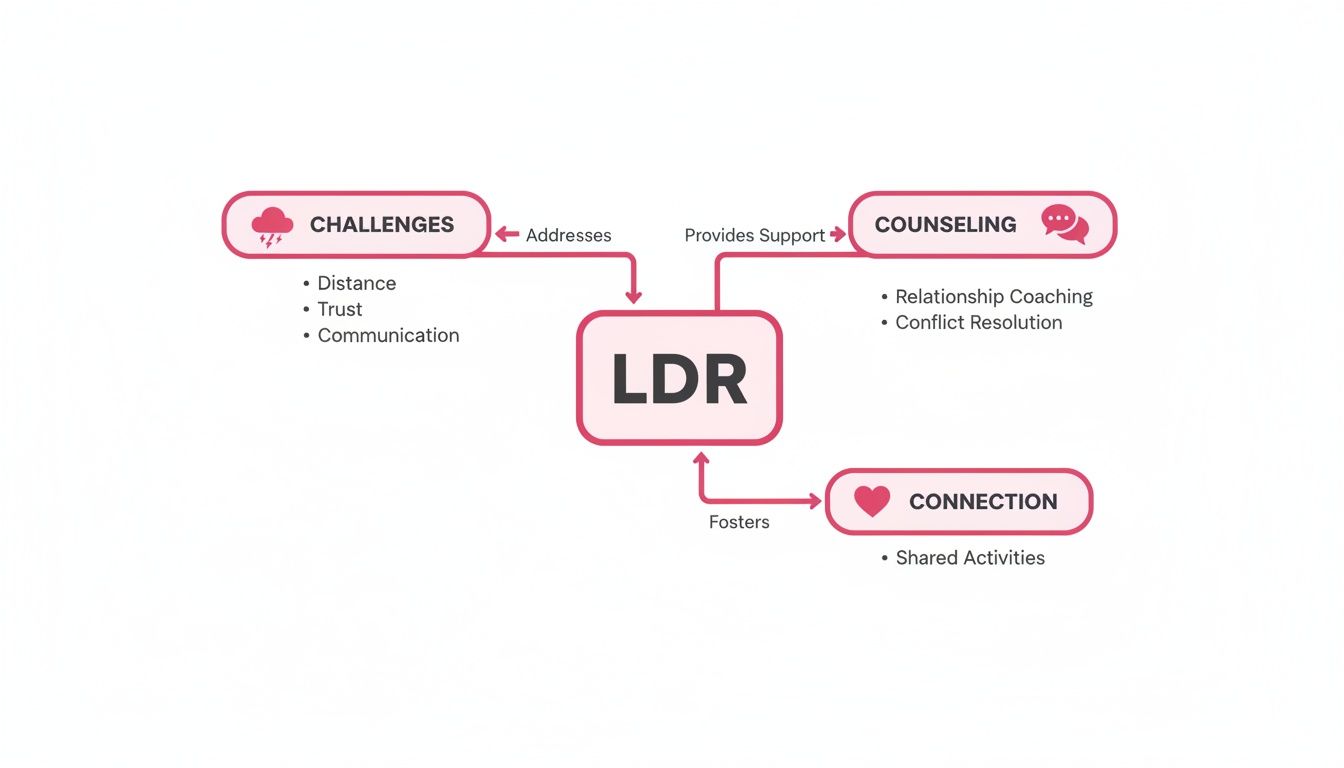
As you can see, issues like miscommunication and loneliness aren't dead ends. They can be actively addressed through intentional connection strategies and professional guidance. For more on building a strong foundation, check out our guide on relationship advice for men.
Moving Beyond Basic Updates
Bringing a therapist into the picture isn't a sign that your relationship is failing. Far from it. It’s about being proactive and smart about the challenge ahead. I often tell my clients to think of it this way: if you were training for a marathon, you’d hire a coach. A long distance relationship is an endurance event of its own, and a therapist is the coach who can give you a proven game plan.
A common misconception is that distance is an automatic dealbreaker. But the real challenge isn't the miles themselves. It's the lack of tools to navigate them. Proactive support changes the game entirely.
The goal is to elevate your conversations beyond the routine "How was your day?" check ins. You want to cultivate deep, meaningful discussions that actually build intimacy, despite the miles. For many partners, learning how to be more emotionally available is a new skill, and counseling provides a safe space to practice and make those conversations feel more natural.
Navigating a long distance relationship means confronting specific stressors that don't typically affect co located couples. Here’s a look at how these challenges manifest and where counseling can step in to provide targeted solutions.
Common LDR Challenges and How Counseling Helps
| LDR Challenge | Impact on Relationship | How Counseling Provides a Solution |
|---|---|---|
| Communication Breakdowns | Tone is easily misread over text. Conversations lack depth and become purely logistical. | Teaches structured communication techniques (e.g., active listening, "I" statements) specifically adapted for video calls and text. |
| Loneliness and Isolation | Partners can feel disconnected and alone, even while in a committed relationship. | Creates a dedicated "together" space and helps couples develop rituals of connection that bridge the physical gap. |
| Trust and Insecurity | Lack of physical presence can fuel jealousy, anxiety, and assumptions about a partner's life. | Facilitates open conversations about fears and boundaries, helping to rebuild and reinforce trust through transparency. |
| Differing Expectations | Mismatched ideas about communication frequency, future plans, or visit schedules lead to conflict. | Helps couples articulate and align their expectations, creating a shared vision and a concrete plan for the future. |
| Time Zone and Schedule Conflicts | Logistical issues create frustration and limit opportunities for quality time. | Provides strategies for intentional scheduling, maximizing connection during available windows and managing frustration. |
This framework shows that for every common LDR pain point, there's a therapeutic strategy ready to address it, turning obstacles into opportunities for growth.
Building a Resilient Connection
The good news? All this intentional work really does pay off. Research from sources like eharmony.com has shown that around 58% of long distance relationships succeed, busting the myth that they're all doomed from the start.
Couples counseling is a massive factor in boosting that success rate. It strengthens the very foundations of trust and communication that get tested most when you're apart.
Ultimately, getting professional guidance for your long distance relationship turns the physical distance from an obstacle into a shared project. It gives you and your partner the skills to not just survive the time apart, but to build a stronger, more resilient connection because of it. You learn how to fight for the relationship, together.
Finding a Therapist Who Understands the Distance
Let's be honest. Not every therapist is equipped to handle the unique pressures of a long distance relationship. Finding the right person is about so much more than just matching schedules.
You need someone who gets it. Someone who understands your challenges aren't just about communication, but about creating intimacy and rebuilding trust across miles and time zones. This isn't your standard relationship tune up. It requires a specific expertise.
Think of it like hiring a specialist. You wouldn't see a podiatrist for a heart condition. Likewise, you need a therapist who truly specializes in couples counseling for long distance relationships.
Where to Even Begin Looking
The internet is your best friend here, but you need to know where to look. A generic "couples therapist" search is going to be overwhelming and, frankly, unhelpful.
Start with online directories that have robust filtering options. Websites like Psychology Today or GoodTherapy are excellent starting points. You can filter by "couples counseling" and "online therapy" to immediately narrow the field.
Another game changer to look for is a PsyPact credential. This is an agreement that allows licensed psychologists to practice teletherapy across state lines. For a long distance couple in different states, this dramatically expands your pool of qualified professionals.
Key Questions for Your First Call
Most therapists offer a free 15 minute consultation call. Use it. This is your chance to interview them, so don't be shy about asking direct questions. This isn't rude. It's smart.
Here are a few questions I always recommend asking:
- "What's your specific experience with long distance couples?" You're listening for them to mention things like time zone management, the strain of infrequent physical contact, and navigating uncertainty about the future.
- "How do you create a strong connection with a couple through a screen?" A good virtual therapist will have a clear answer here, talking about specific techniques they use to make online sessions feel as present and effective as in person ones.
- "Are you licensed to see both of us in our respective states?" This is a non negotiable logistical question. You need a clear "yes" before you move forward.
- "What's your approach to helping couples bridge the physical gap?" Listen for practical strategies, not just vague promises about "improving communication."
Your goal on this call is simple. You need to figure out if this person not only has the right credentials but also genuinely understands your reality. You should feel heard and understood, even in a quick introductory chat.
Making the Final Decision Together
Once you've talked to a few potential therapists, the final decision has to be a joint one. It is absolutely crucial that both you and your partner feel comfortable and confident in your choice.
Talk about the cost, the session scheduling, and even the video platform they use. A clunky, unreliable system will only add to your frustration. Making sure everything aligns for both of you is the first real step.
Taking the time to find the right guide for your journey makes couples counseling for long distance relationships feel less like a chore and more like a powerful, strategic investment in your future together.
Making Your Virtual Sessions Actually Work
Alright, so you’ve found a therapist who understands the unique challenges of a long distance relationship. That’s a huge first step, so pat yourselves on the back. But getting real results from online therapy is about more than just showing up to a video call.
To make couples counseling for long distance relationships truly effective, you have to treat each session with the same focus and intention as an in person meeting. The aim isn't just to be present. It's to build a space where you and your partner can be vulnerable, focused, and truly connect, even with miles of screen between you. A little prep work makes all the difference.
Setting the Stage for Success
Before you even start thinking about what to discuss, you have to get the logistics right. A choppy Wi Fi signal or a roommate wandering into the frame can completely derail a deep, sensitive conversation. This is about more than technology. It's about creating a secure, private bubble for your relationship to do the necessary work.
Here are a few things that are absolutely non negotiable:
- Find Your Private Space: You each need a room with a door you can close, where you know you won't be interrupted. Your car, a home office, or even your bedroom can work, as long as you've made it clear to others that you're off limits for the hour.
- Do a Quick Tech Check: About 5 minutes before your session starts, test your internet connection, camera, and microphone. Nothing kills the momentum (or wastes your money) like spending the first ten minutes troubleshooting a bad connection.
- Eliminate Distractions: Put your phone on silent and move it out of arm's reach. Close every other tab on your computer. Your partner and your therapist deserve your undivided attention, and frankly, so does your relationship.
Think of it this way: you’re building a temporary, digital therapy room. Just like a physical office, it has to be quiet, confidential, and free from interruptions to feel safe. Setting this boundary signals to your brain that this time is sacred and important.
The Mental Warmup
Once your physical spaces are sorted, the real prep work begins. Just logging on and waiting for the therapist to kick things off isn't going to cut it. I’ve seen firsthand that the most productive sessions happen when both partners arrive with a shared sense of purpose.
This requires a quick chat with your partner before the session.
This pre session huddle doesn’t need to be long. A 10 minute call or a quick text exchange is often enough. The idea is simply to align on what you both want to get out of the time. You could ask each other things like, "What's one thing that’s been on your mind that you really want to talk through today?" or "What feels most pressing for us to tackle this week?"
Taking this one small step completely shifts the dynamic. It turns the session from a reactive, sometimes awkward meeting into a proactive strategy session for your relationship. You'll be amazed at how this simple warmup can lead to much deeper, more focused conversations from the moment you start. To get daily prompts and insights that help you connect, try out the VibeCheck app for men.
Communication Skills You Will Actually Use

Good counseling is so much more than a designated time to vent. It gives you a real toolbox of communication skills tailored for the specific hurdles you face when you're miles apart. This isn’t about just talking more. It's about learning how to make every single conversation count. A crucial skill when you can't just reach out and squeeze their hand to smooth things over.
One of the first things a therapist will probably work on with you is getting past those surface level check ins. It's incredibly easy to fall into the "How was your day?" routine that doesn't actually tell you anything. Counseling helps you build intentional, structured conversations that foster genuine intimacy.
Structured Check Ins That Build Closeness
A good therapist can introduce you to simple frameworks that build a much deeper connection. This often means carving out specific, dedicated times for more than just a quick catch up. Think of these not just as calls, but as protected moments to share something that truly matters.
Here’s what that might look like in the real world:
- Weekly Wins and Worries: You could set aside 30 minutes every Sunday to share one high point and one low point from the week. This simple ritual ensures you’re clued into what's really happening in each other’s worlds, not just the polished highlight reel.
- Question Prompts: Your therapist might suggest using a shared list of thought provoking questions to kickstart a conversation. It can feel a little structured at first, but it quickly gets you talking about hopes, fears, and memories instead of just running through your to do lists.
These small, consistent rituals create a reliable source of connection, making your partner feel seen and understood, even from hundreds of miles away. It's all part of learning how to improve marriage communication with purpose.
Handling Conflict Without Being in the Same Room
Let's be honest. Disagreeing over a video call is hard. You can’t reach out and hold their hand to signal that you’re still on the same team. This is precisely where couples counseling for long distance relationships can be a game changer.
A therapist will teach you how to de-escalate a conflict when you're not in the same physical space. You'll work on skills like active listening through a screen, validating their feelings even when you disagree, and, most importantly, knowing when to hit pause on a heated talk before it spirals out of control.
It's not about avoiding fights. It's about learning how to fight fairly and productively, so that disagreements actually bring you closer instead of driving a wedge between you.
Getting Aligned on the Future
A huge source of stress in any LDR is the uncertainty about what comes next. A skilled counselor acts as a neutral guide, helping you both get on the same page and creating a safe space to ask the big, scary questions.
This is your chance to really talk through timelines for closing the distance, individual career goals, and what you both need to feel secure in the relationship. Having these conversations with a professional mediator takes the pressure off and helps you build a concrete, shared plan. Getting this alignment can dramatically lower the background anxiety that so often hums beneath the surface of a long distance relationship.
And the data backs this up. One study highlighted that consistent counseling is a top factor for LDR success, showing a 73% success rate among couples who use it. You can read more about these findings on long distance relationships and anxiety to see just how powerful professional support can be.
How VibeCheck Helps You Stay Connected Between Sessions
Therapy sessions are powerful, but let’s be real. The real work, the stuff that builds a rock solid connection, happens in all those moments between your appointments. That's when the distance can really start to feel like a problem again, and it's precisely where a tool like VibeCheck becomes essential.
Think of it as your secret weapon for staying tuned in to your partner's emotional and hormonal cycles, even when you're thousands of miles apart. Imagine getting a simple heads up that tomorrow might be a lower energy day for her, or that she might need some extra reassurance this week. That’s the kind of insight that’s almost impossible to guess from a few time zones away. With VibeCheck, you're not just guessing. You're using our science backed period tracker for partners to understand her better.
This awareness isn't about reading her mind. It’s about using science backed insights to ask better questions and show up as the supportive, clued in partner she needs you to be.
Turning Insight Into Action
VibeCheck takes the abstract concepts you discuss in therapy and helps you apply them in real time. Instead of just talking about being more supportive, you get daily prompts that make it easy to follow through.
For example, the app might suggest:
- A specific conversation starter: Forget the generic "How was your day?" You might get a prompt to ask about something specific you know she’s been looking forward to.
- An ideal date night idea: Even from a distance, it can suggest planning a virtual movie night or ordering her favorite takeout, timed perfectly for when she’s most likely to appreciate it.
- A heads up on sensitive days: You could get a gentle reminder that her energy might be low, suggesting you offer extra patience and support.
This proactive approach makes her feel seen and deeply understood, which is one of the biggest challenges in any long distance relationship. It helps bridge the empathy gap created by the miles.
Closing the Emotional Distance
Emotional and sexual dissatisfaction can really take a toll when you're far apart. In fact, one report found that 72% of people feel emotionally distant from their partner when they're not physically together. Therapy is crucial, but VibeCheck works alongside it to reinforce that connection day to day.
It’s about replacing guesswork with genuine understanding. When you have context for her mood or energy levels, your support becomes so much more meaningful and effective.
Instead of flying blind, you’re using real data to strengthen your bond. VibeCheck helps you translate what you’re learning in couples counseling for long distance relationships into small, consistent daily actions that make a huge difference. By understanding the "why" behind her feelings, you can learn how VibeCheck provides relationship insights for men and become the partner who just gets it.
Got Questions About Long Distance Couples Counseling?
Jumping into counseling when you’re miles apart naturally brings up some very real, practical questions. It’s smart to get a handle on the logistics before you commit. We've seen these same questions pop up time and again, so let’s get you some straight answers.
How Do We Find a Therapist Who Can Legally See Us in Two Different States?
This is probably the biggest hurdle for LDR couples. The licensing laws can be a real headache. Your best move is to look for a therapist who is part of PsyPact. This is an agreement between states that allows licensed psychologists to practice teletherapy across state lines, which massively expands your options.
A good place to start is a directory like Psychology Today, where you can filter by license. Find a few therapists licensed in one of your states, then simply ask them during a consultation if they have the credentials to work with your partner in the other. They’ll know right away if it’s possible.
Is Online Couples Counseling as Effective as Seeing Someone in Person?
Honestly, for most couples, it’s just as good. Study after study has shown that when it comes to talk therapy, the results from teletherapy are right on par with in person sessions. The real secret sauce isn't whether you're on a couch or a screen. It's your commitment to the work and finding a therapist you both click with.
For long distance couples, online counseling isn't just a good option. It's often the only option. And it's always a better choice than just letting distance related issues fester.
At the end of the day, what you get out of it depends entirely on what you and your partner put into it.
What if My Partner Is Hesitant to Start Counseling?
This is a delicate conversation. The key is to present it as a team effort, not an accusation or an ultimatum. Frame it as a proactive way to strengthen your bond against the unique challenges of being long distance. You’re not saying "we're broken." You're saying "let's protect what we have."
Try approaching it as "us against the problem," with the "problem" being the distance itself, not one another. You could offer to do the research together or suggest booking a single, no strings attached consultation with a therapist just to test the waters and see how it feels.
What’s the Typical Cost for Long Distance Couples Counseling?
The price tag can swing pretty widely based on the therapist's location, credentials, and experience. On average, you can expect to pay somewhere between $100 and $250 per session. But don't let that initial number put you off.
Many therapists offer sliding scale fees based on your income, so always ask if that’s an option. And don't forget to check your insurance. A growing number of health plans are covering couples teletherapy, which can make a huge difference in what you actually pay.
How can we bridge the emotional gap between therapy sessions?
Therapy provides the roadmap, but daily habits build the road. Between sessions, use a tool like VibeCheck to stay in sync. Understanding her hormonal cycle gives you context for her energy levels and emotional state. This isn't about 'fixing' anything. It's about showing up with empathy and a deeper understanding, which makes every interaction, text, and call more meaningful.
What are some practical tips for a successful first online session?
Beyond the tech check, agree on one or two key goals for the session beforehand. Just a quick text exchange like, "Hey, I'd really like to talk about how we handle disagreements about our future plans." This gets you both on the same page and helps the therapist dive right into what matters most, making that first hour incredibly productive.
Ready to build a stronger connection, even from a distance? VibeCheck gives you the science backed insights to understand your partner better and show up for her in the ways that matter most. Learn how VibeCheck can help you and your partner thrive.
Tags

Related Articles
Continue reading to deepen your understanding

How to Plan Romantic Gestures by Cycle Timing: The Partner’s Tactical Guide
Stop guessing why your date night plans fell flat. This guide explains how to synchronize your romantic efforts with her biological cycle for better intimacy and connection.

How to Tell When Your Girlfriend Is Ovulating: Reading the Biological Signals Your Partner Sends
Understanding your partner’s cycle helps you anticipate her needs and time important conversations. Learn the behavioral signs of ovulation to improve your relationship and connection.

Understanding Your Girlfriend’s Words of Affirmation Cycle: A Partner’s Guide
Ever feel like your compliments land wrong? Her need for words of affirmation isn’t random—it follows a biological rhythm. Learn how to match your support to her internal hormonal seasons.

The Partner’s Guide to the Luteal Phase: What It Is and How to Support Her
Stop walking on eggshells. Understand the biological changes of the luteal phase so you can support your partner through mood shifts and fatigue with empathy.

How to Plan Valentine’s Day Around Your Girlfriend’s Cycle
Does your romantic plan clash with her biological rhythm? Learn how to adjust your date night to her specific cycle phase so she feels comfortable and truly cared for this year.

The Strategic Partner’s Guide to Planning an Engagement Around Her Cycle
Don’t leave your proposal to chance. Learn how her biological rhythm impacts emotional receptivity and how to align your big question with the phase where she feels her best.

How to Plan Weekend Trips Around Your Girlfriend’s Cycle: A Tactical Guide
Stop booking trips that end in friction. Learn how to map weekend travel to her biological phases to reduce friction by 41% and maximize your time together.

How to Plan Engagement Around Girlfriend Cycle Timing
Master how to plan engagement around girlfriend cycle timing to leverage an 800% estrogen spike and ensure a joyous yes with our 4-phase tactical guide.