The Science-Backed Relationship Insights Men Actually Need
VibeCheck is the AI relationship app built for men. Stay in sync with her cycle, understand her moods, and be a better partner every day. Available on iOS.
The Science-Backed Relationship Insights Men Actually Need
Here’s something most relationship advice gets wrong: telling men to "communicate better" or "be more vulnerable" without explaining why their brain resists these actions during conflict. You’re not broken for wanting to withdraw during an argument. Your nervous system is doing exactly what evolution designed it to do.
These relationship insights for men combine what psychology research proves works with a tool therapists rarely mention: understanding the biological patterns that affect your partner’s mood and communication needs. No generic advice. No "just listen more" platitudes. Just specific, actionable strategies backed by science - plus the modern tools that make them easier to apply.
Why Most Relationship Advice Fails Men
Traditional relationship advice tells you what to do without addressing what makes it difficult. "Stop fixing and start listening" sounds simple until your partner comes home upset and every instinct screams at you to solve the problem.
The gap between knowing what healthy relationships require and actually executing those behaviors is where most men struggle. That’s not a character flaw. It’s a physiological reality researchers have documented extensively.
The Male Nervous System Under Stress
When conflict escalates, men experience something researchers call Diffuse Physiological Arousal (DPA). Your heart rate spikes above 100 beats per minute. Stress hormones flood your system. Blood flow redirects from your prefrontal cortex (the part that handles complex reasoning and empathy) to your amygdala (the fight-or-flight center).
In this state, you literally cannot process emotional nuance the way you normally would. The Gottman Institute’s research shows men take longer to recover from DPA than women - an average of 20 minutes compared to less than 10. This explains why you might need to "step away" during arguments while she wants to "talk it through right now."
Neither response is wrong. They’re just different biological realities that require different strategies.
The Cost of Poor Relationship Skills
Ignoring these patterns creates predictable problems:
- Arguments that escalate because you withdraw exactly when she needs engagement
- Resentment on both sides - she feels abandoned, you feel attacked
- The slow erosion of emotional intimacy as you both retreat to defensive positions
- Increased conflict frequency because small issues never get resolved, they accumulate
Research from the University of Washington shows that couples who don’t address these communication patterns see relationship satisfaction decline by 50% within three years. The good news? The same research proves specific interventions work.
Understanding the Biology of Male Bonding
Before we get into communication tactics, understanding what drives male attachment behaviors gives you context for why certain relationship dynamics feel natural while others require conscious effort.
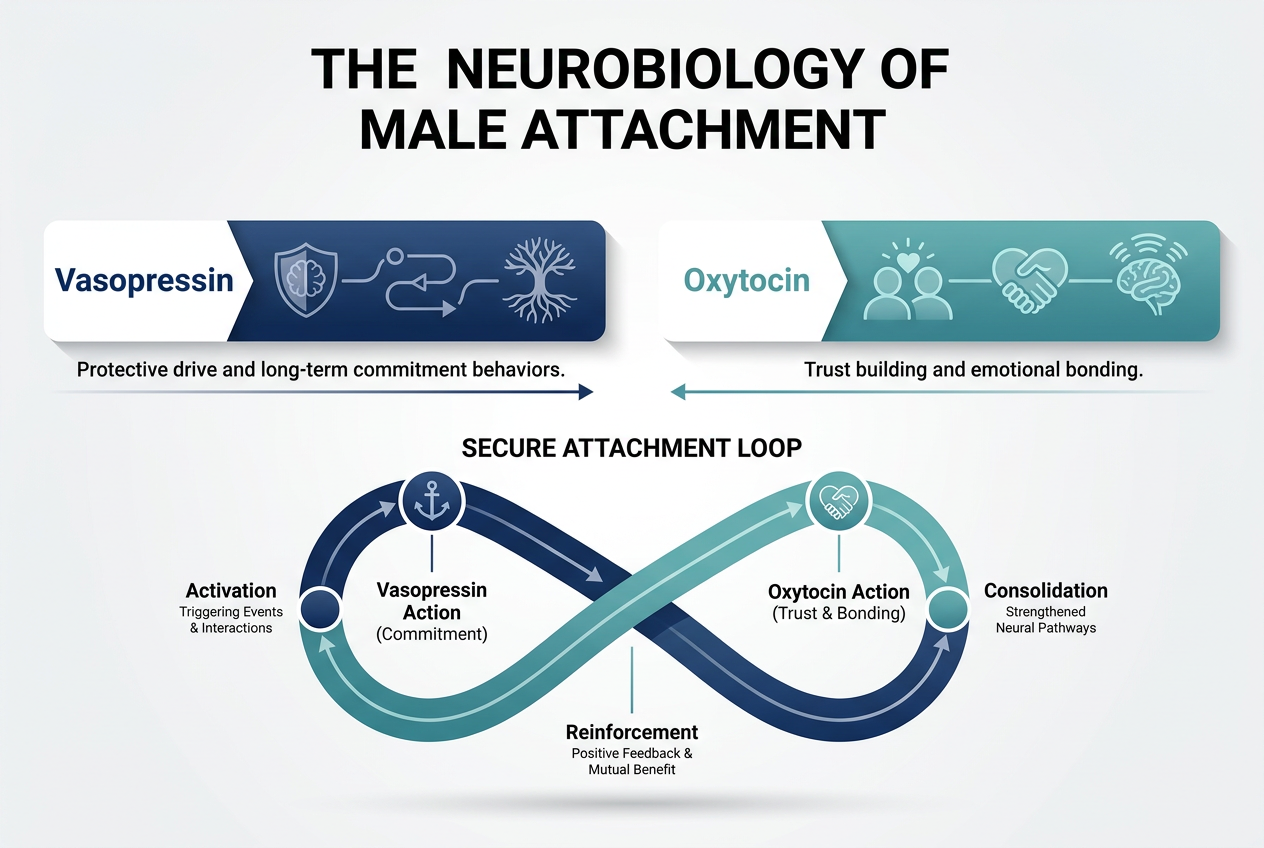
Understanding the biological drivers of male bonding, specifically how Vasopressin and Oxytocin influence long-term commitment and protective instincts in modern relationships.
Vasopressin: The Commitment Hormone
While oxytocin gets all the press as the "bonding hormone," vasopressin plays a specifically crucial role in male pair-bonding. This neuropeptide drives:
Territorial behavior. That protective instinct you feel toward your partner isn’t just cultural conditioning - it’s vasopressin triggering mate-guarding behaviors that evolution selected for over millions of years.
Long-term attachment. Studies on prairie voles (one of the few monogamous mammal species) show that blocking vasopressin receptors prevents males from forming pair bonds, even after mating. The same neurological pathway exists in humans.
Provider instincts. The drive to ensure your partner’s security and comfort stems partly from vasopressin activation in specific brain regions.
Here’s what matters for your relationship: vasopressin responses get triggered by specific cues. Physical intimacy, shared experiences that require teamwork, and successfully meeting your partner’s needs all increase vasopressin binding in attachment-related brain regions.
This means you can intentionally strengthen your attachment by creating situations that activate this biological system - something we’ll cover in the actionable strategies section.
The Oxytocin Factor
Men produce less oxytocin during social bonding than women, but it plays an equally important role in relationship satisfaction. Where oxytocin differs for men:
It gets released primarily during physical intimacy and goal achievement rather than conversation. This is why many men feel most connected to their partners during sex or after completing a shared project, while women often feel closest during deep conversation.
Understanding this difference prevents mismatched expectations. When she wants to "connect" through talking and you want to connect through doing something together, neither approach is superior. They’re complementary bonding styles that reflect different neurochemical profiles.
Breaking Through Communication Barriers
Most relationship conflict stems from a handful of predictable communication breakdowns. Fix these patterns and you eliminate 80% of unnecessary arguments.
Why You Shut Down During Conflict
Remember that DPA response we discussed? It’s not just physical stress. Your body is protecting you from what it perceives as a threat by triggering the same defensive mechanisms your ancestors used when facing predators.
The problem: your partner isn’t a predator. She’s someone who needs emotional engagement precisely when your nervous system is pushing you toward withdrawal.
This creates what researchers call the "demand-withdraw" pattern. She escalates her emotional intensity trying to get through to you. You withdraw further to manage your stress. She interprets your withdrawal as rejection. You interpret her intensity as aggression. The cycle amplifies until someone explodes or someone gives up.
Breaking this pattern requires understanding it’s happening and implementing specific circuit-breakers.
The Fixer Mentality Trap
Your instinct to solve problems serves you well in most contexts. At work, fixing things earns respect and advancement. Among friends, offering solutions demonstrates competence and support.
In romantic relationships, this same instinct often backfires spectacularly.
When she comes home frustrated about her coworker and you immediately offer three solutions, you think you’re being helpful. She hears: "Your emotions are a problem I need to fix so they stop affecting me."
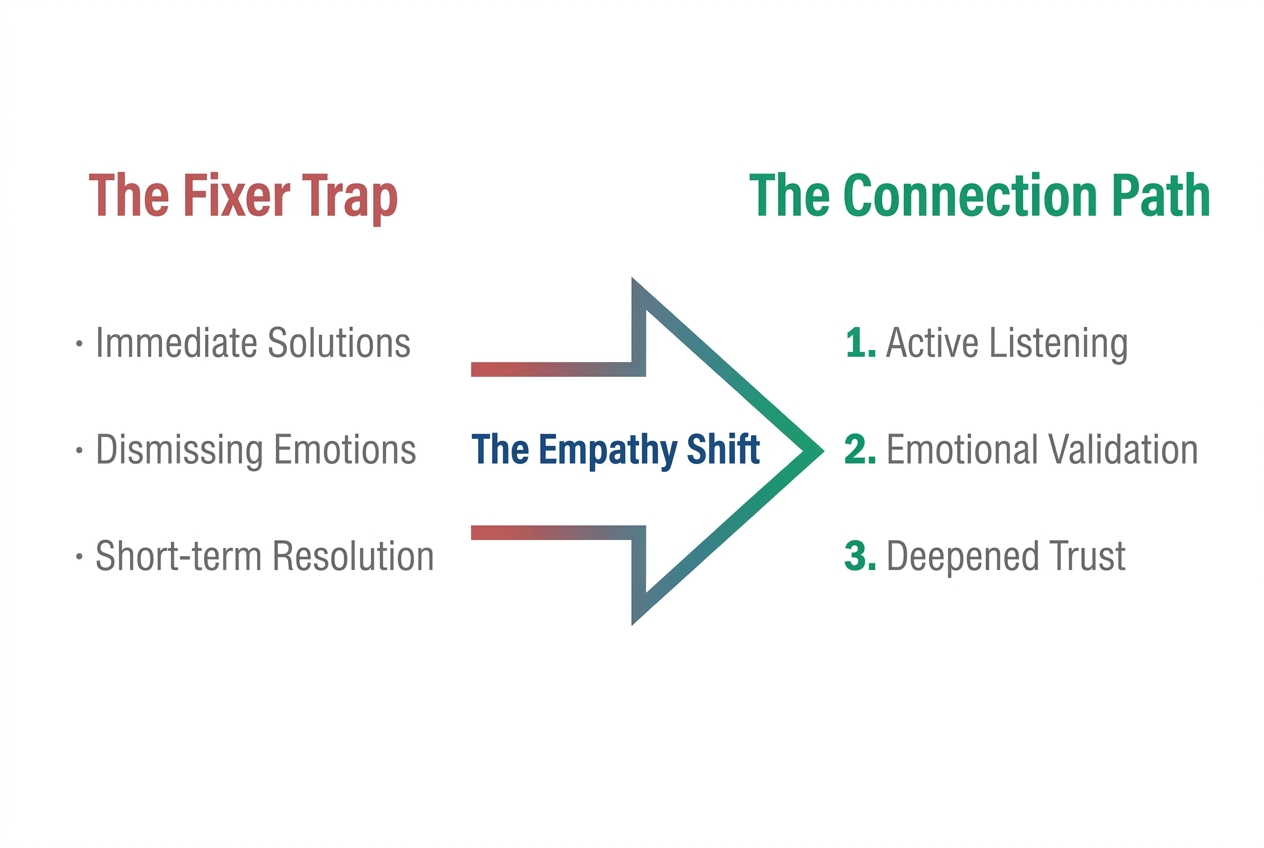
Transitioning from a ’fixer’ mentality to an empathetic approach allows men to build deeper emotional safety and avoid common communication breakdowns with partners.
Here’s the critical distinction: she’s not always asking you to solve anything. Sometimes emotional processing requires externalization - talking through feelings to understand them, not to eliminate them.
The Script That Actually Works
When she’s venting, use this framework:
First, ask: "Do you want to vent, or do you want solutions?"
If she wants to vent, your job is simpler than you think. Use these three response types:
Validation: "That sounds incredibly frustrating." Not agreement with her perspective necessarily, just acknowledgment that her feelings are real.
Curiosity: "What happened next?" or "How did that make you feel?" This shows engagement without trying to control the narrative.
Empathy: "I’d be upset too if that happened to me." You’re mirroring her emotional state, which helps her feel understood.
Notice what’s absent? Solutions, devil’s advocate arguments, comparisons to similar situations, or any suggestion that she should feel differently than she does.
If she wants solutions, then your fixer instinct has permission to activate. The key is not suppressing that instinct - it’s channeling it appropriately.
Active Listening Without the Therapy Speak
"Active listening" sounds like corporate training jargon because that’s exactly where it came from. But the underlying technique works if you strip away the awkward implementation.
Real active listening for men means:
Pausing before responding. Count to three after she finishes speaking. This microsecond gap prevents you from formulating your response while she’s still talking, which means you actually hear what she said rather than what you expected her to say.
Reflecting content and emotion. "So you felt overlooked when your boss didn’t acknowledge your project in the meeting." You’re not parroting her words back robotically. You’re demonstrating you understood both the situation and its emotional impact.
Avoiding the word ’but.’ Every sentence with "I understand, but..." negates whatever came before the ’but.’ Replace it with ’and’ to acknowledge multiple truths simultaneously: "I understand you’re frustrated, and I know you’ll figure out how to handle this."
This isn’t therapy speak. It’s strategic communication that defuses defensive reactions and builds emotional safety.
Understanding Her: The Biological Edge Most Men Miss
Here’s the relationship advantage almost no one talks about: the biological patterns that affect your partner’s mood, energy, and communication needs are predictable. Understanding them gives you timing intelligence that transforms how you navigate daily interactions.
How the Menstrual Cycle Affects Mood and Communication
Hormonal fluctuations don’t cause personality changes, but they do modulate neurotransmitter systems that affect stress tolerance, emotional sensitivity, and conflict threshold. Think of it like ambient temperature - you’re the same person whether it’s 40 degrees or 90 degrees outside, but your comfort level and irritability change.
The cycle breaks into four phases, each with distinct characteristics:
Menstrual Phase (Days 1-5): Energy drops. Pain and fatigue lower stress tolerance. This isn’t the time to bring up relationship issues that require lengthy discussion. Better use of this phase: low-key connection through presence rather than conversation. Offering comfort without expectation.
Follicular Phase (Days 6-14): Rising estrogen increases serotonin and dopamine. Energy rebounds. Mood stabilizes. Social motivation increases. This is your window for difficult conversations, planning activities that require coordination, or discussing relationship goals. She’s most likely to engage constructively.
Ovulatory Phase (Days 15-17): Peak estrogen and testosterone. Confidence and social energy hit monthly highs. Physical intimacy drives often increase. She’s maximally receptive to novelty and adventure. Plan date nights or try new experiences during this window.
Luteal Phase (Days 18-28): Progesterone rises, then both estrogen and progesterone crash if pregnancy doesn’t occur. The week before her period, serotonin drops by up to 30%. This is the physiological basis for premenstrual dysphoric shifts in some women. Small annoyances feel disproportionately large. Conflict threshold drops significantly.
Understanding these patterns isn’t about dismissing emotions as "just hormones." It’s about recognizing that the same conversation attempted in the follicular phase might go smoothly, while the identical conversation in the late luteal phase could trigger a fight.
Cycle-Aware Communication Strategies
Here’s how to operationalize this knowledge without being condescending:
Track patterns. Notice when conflicts cluster in the month. If arguments concentrate in the week before her period, that’s not coincidence - it’s biology affecting stress response thresholds. This knowledge helps you adjust timing and tone during predictably sensitive windows.
Adjust expectations. During the late luteal phase, don’t expect enthusiastic engagement with complex planning. Focus on present-moment connection instead. Save the "where should we go for vacation?" discussion for the follicular phase when she has bandwidth for future-focused thinking.
Increase support proactively. Don’t wait for her to ask. Small gestures of care during the menstrual and late luteal phases - handling dinner, suggesting she rest, taking over a typically shared responsibility - build enormous goodwill because you’re anticipating needs rather than reacting to requests.
Never weaponize this information. The fastest way to destroy trust is saying "Are you on your period?" during an argument. If she’s upset, her emotions are valid regardless of hormonal context. Your knowledge of her cycle should inform your approach and empathy level, never become ammunition to dismiss her feelings.
The Modern Tool That Tracks This For You
Manually tracking cycle phases and adjusting communication strategies requires more executive function than most men have bandwidth for daily. This is where cycle-tracking technology creates practical advantages.
Apps that monitor hormonal patterns and send alerts about upcoming phase shifts essentially automate the emotional intelligence labor. You get notifications: "Energy may be lower this week" or "Good time for important conversations." No guesswork. No mentally calculating cycle days. Just actionable timing intelligence delivered automatically.
VibeCheck takes this concept further by combining cycle tracking with relationship-specific guidance. Instead of just knowing which phase she’s in, you get suggested actions, conversation scripts, and date ideas matched to current hormonal patterns and her individual preferences. It’s like having a relationship coach in your pocket who knows both of you and the science behind relationship dynamics.
Your Emotional Needs (Yes, You Have Them)
The stereotype that men don’t have emotional needs, or that male emotional needs begin and end with sex, damages relationships by creating false expectations on both sides.
Men absolutely have emotional needs. They just manifest differently and often get expressed through different channels than verbal disclosure.
Validation and Respect
When relationship advice tells men to be more vulnerable, it often skips over the prerequisite: you need to feel safe enough to be vulnerable. That safety comes from consistent validation and respect.
What validation looks like for men: Acknowledgment of effort, not just outcomes. Recognition that you’re trying, even when you mess up. Appreciation for the invisible labor you contribute - the late-night planning, the emotional regulation you do to avoid dumping stress on her, the career compromises you make.
Many men report feeling taken for granted when their contributions get treated as baseline expectations rather than appreciated efforts. The solution isn’t keeping score. It’s both partners actively noticing and verbalizing what the other does.
What respect means practically: Your perspective getting weighted equally in decisions. Your need for downtime or solitary processing being honored without guilt trips. Not being dismissed as "less evolved" emotionally just because you process feelings through action rather than conversation.
Physical Intimacy as Emotional Connection
Yes, men connect emotionally through physical intimacy. This isn’t shallow or purely sexual. For many men, physical touch is the primary language of emotional safety and connection.
Research from the Kinsey Institute shows men are more likely to report feeling "loved" after physical intimacy, while women are more likely to report feeling loved after conversation. Neither is wrong. They’re complementary expression styles.
Problems arise when frequency mismatches create resentment. She doesn’t realize that physical intimacy is how you feel emotionally connected, so less frequent sex makes you feel emotionally distant, which makes you less emotionally available, which makes her less interested in physical intimacy. It’s a feedback loop.
The fix: explicit conversation about what physical intimacy means to you emotionally, not just physically. Help her understand it’s not about getting off - it’s about feeling close to her in a way that words don’t fully accomplish for you.
The Need to Be Needed
Men derive significant relationship satisfaction from feeling capable and needed. This isn’t toxic masculinity or patriarchal programming. It’s linked to the vasopressin-driven provider instinct we discussed earlier.
When you successfully meet your partner’s needs - whether that’s fixing something, solving a problem, or providing emotional support - your brain releases dopamine and reinforces pair-bonding circuits. You feel connected and purposeful.
The modern challenge: women’s increasing independence means they objectively need men less for survival. This is progress. But it creates psychological ambiguity for men whose sense of relationship value was traditionally tied to being needed.
The solution isn’t her pretending to need rescuing. It’s redefining what "being needed" means. Emotional availability, partnership, shared decision-making, and co-creating a life together - these are legitimate needs. Frame your contribution in those terms rather than outdated provider models.
Conflict Resolution Tools for Men
Arguments are inevitable. Destructive conflict patterns are optional. These tools prevent the common male mistakes that turn disagreements into relationship damage.
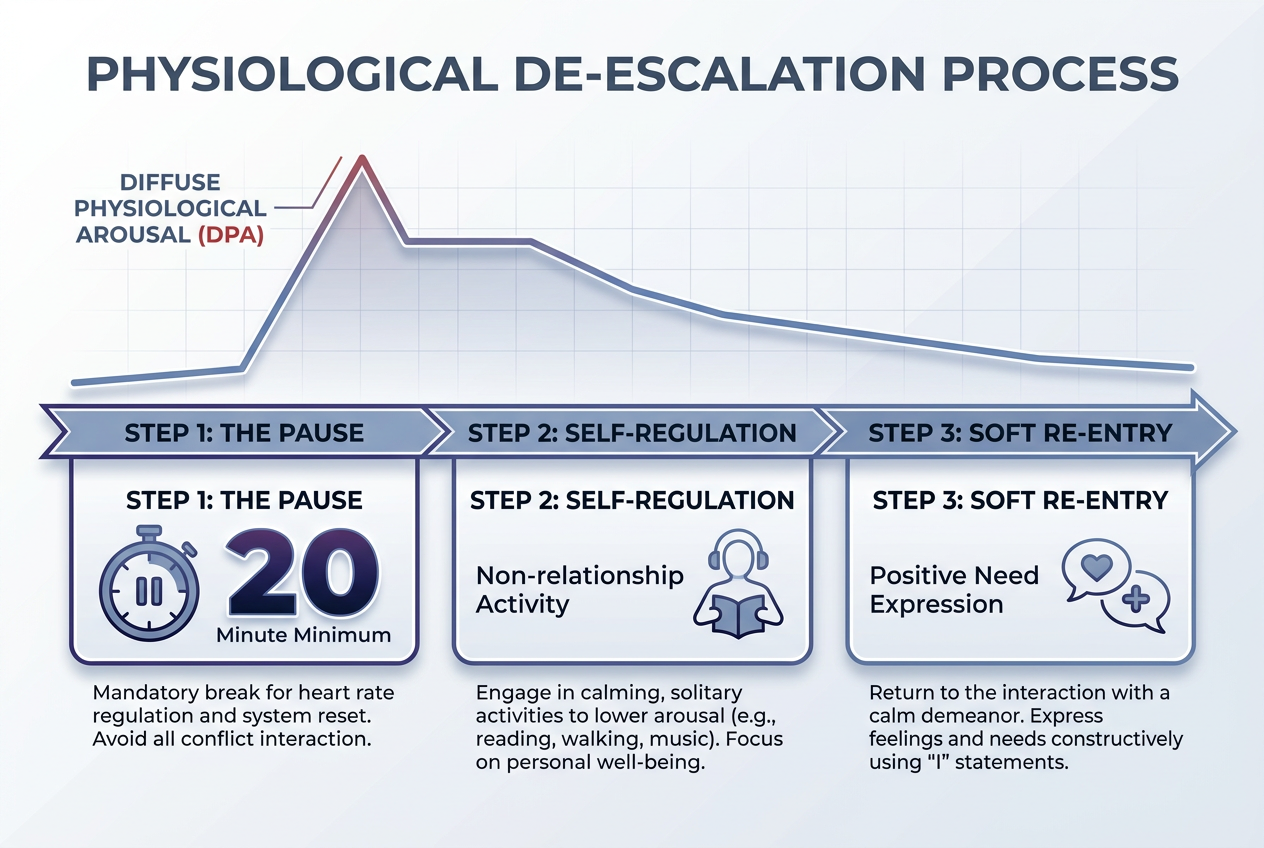
Utilizing a structured 20-minute time-out allows the male nervous system to reset, preventing the ’stonewalling’ effect and enabling more productive conflict resolution.
The 20-Minute Timeout Rule
Remember DPA? Once your heart rate exceeds 100 BPM, productive conversation becomes physiologically impossible. You need time to recover before continuing.
The research-backed solution: request a 20-minute timeout when you feel flooded.
Critical implementation rules:
Ask explicitly. Don’t just walk away. Say: "I’m feeling too activated to discuss this productively. I need 20 minutes to calm down, then I promise we’ll continue this conversation."
Don’t ruminate. Don’t spend the timeout mentally rehearsing your arguments or cataloging her faults. That keeps your heart rate elevated. Instead, do something genuinely distracting - walk, listen to music, engage your hands with a task.
Return as promised. If you ask for 20 minutes, be back in 20 minutes ready to reengage. Breaking this promise destroys trust in the process.
Use it legitimately. The timeout is for physiological recovery, not strategic avoidance of difficult topics. If you invoke it every time she wants to discuss something uncomfortable, you’re abusing the tool.
This simple intervention reduces destructive conflict by up to 70% according to Gottman’s research. It works because it addresses the biological reality rather than pretending willpower alone can overcome a flooded nervous system.
Repair Attempts That Actually Work
Repair attempts are the phrases or actions that break tension during conflict. They’re essential because no matter how skilled you become at communication, emotions will sometimes escalate beyond control.
Effective repair attempts for men:
Humor (used carefully). A well-timed, non-dismissive joke can defuse tension: "Can we start this conversation over? I’m going to step back outside and come in again." Only works if you’re both capable of laughing and it doesn’t minimize legitimate concerns.
Affection. Physical touch - holding hands, a brief hug - activates oxytocin and literally calms both nervous systems. If she’s receptive (read her body language), physical connection can reset the emotional tone.
Taking responsibility. "You’re right, I shouldn’t have said that" or "I’m being defensive and that’s not fair to you." This isn’t submission. It’s modeling the accountability you want reciprocated.
Explicitly naming the pattern. "We’re doing that thing where we both get stuck defending our position. Can we step back?" Awareness of the pattern sometimes breaks its hold.
The key variable: repair attempts only work if you’re both willing to receive them. If she’s so angry she bats away your hand when you reach for hers, respect that and give space. If you’re so activated you can’t acknowledge any validity in her perspective, you need more recovery time.
De-escalation for High-Stress Moments
When conflict feels like it’s approaching nuclear, these emergency interventions prevent permanent damage:
Validate first, defend later. Your instinct when accused is immediate rebuttal. Resist that for 30 seconds. Instead: "I hear you saying you felt dismissed when I checked my phone during your story." Only after validation should you add your perspective.
Lower your volume deliberately. If she’s yelling and you match volume, escalation continues. If you intentionally speak more quietly, her nervous system often recalibrates downward to hear you. This only works if your quiet tone conveys respect, not condescension.
Name your emotional state. "I’m feeling attacked right now and I’m about to say something I’ll regret" is vulnerable honesty that can interrupt the cycle. She needs to know what’s happening internally for you.
Ask what she needs. Sometimes the fastest de-escalation is direct: "What do you need from me right now?" You might be arguing about logistics when what she actually needs is reassurance that you still care.
The 15 Most Powerful Relationship Insights for Men
These insights combine research findings with practical application. Each one addresses a specific relationship challenge men commonly face.
Insight 1: Her Emotions Are Data, Not Problems to Fix
When she expresses difficult emotions, she’s not malfunctioning. She’s processing information. Your job isn’t repair - it’s reception.
Application: Next time she’s upset, resist the urge to eliminate her discomfort. Instead, think "What is this emotion telling her, and how can I support her processing it?"
Insight 2: Silence Reads as Rejection
What feels like thoughtful processing time to you often registers as withdrawal or rejection to her. The solution isn’t constant chatter - it’s transparency about internal states.
Application: When you need to go quiet to think, say so: "Give me a second to process what you just said." This tiny narration prevents misinterpretation.
Insight 3: Timing Matters More Than Most Men Realize
The same request will land completely differently depending on her stress level, energy, and hormonal phase. Strategic timing eliminates unnecessary conflict.
Application: Notice when she’s most receptive to different types of conversations. Difficult topics? Follicular phase. Spontaneous plans? Ovulation. Need cooperation on logistics? Not late luteal phase.
Insight 4: Small Consistent Actions Beat Grand Gestures
Valentine’s Day flowers don’t compensate for 364 days of inattention. Daily micro-gestures of care build exponentially more goodwill.
Application: One small unprompted act daily: making coffee before she wakes, texting appreciation mid-day, handling a chore she normally does. Consistency matters more than magnitude.
Insight 5: Your Attention Is the Most Valuable Resource You Offer
In a world of infinite distractions, undivided attention has become the ultimate scarcity. Phone down, eye contact maintained, presence offered - this builds intimacy more effectively than elaborate date plans.
Application: 20 minutes daily of full-presence conversation with zero devices. Not discussing logistics. Just connecting.
Insight 6: She Needs to Feel Chosen, Not Just Loved
Commitment creates security. But continued choosing creates desire. The difference: love is status quo, choosing is active preference.
Application: Periodically verbalize what you appreciate specifically about her and why you’d choose her again: "I love how you handled that situation with your mom. It reminded me why I’m with someone so emotionally intelligent."
Insight 7: Defensiveness is Relationship Poison
Nothing shuts down productive conversation faster than reflexive defensiveness. Even when you’re right, leading with defense makes resolution impossible.
Application: Notice your internal "yes, but..." response. Before speaking it, pause and find something valid in her concern first. Defend later, validate immediately.
Insight 8: You Can’t Logic Someone Out of Feelings
Emotions don’t respond to rational argument. Trying to convince her she shouldn’t feel what she feels creates more conflict, not less.
Application: When tempted to explain why her feelings are "irrational," remember: feelings are always valid as subjective experience, even when the interpretation might be incorrect. Address interpretation after validating emotion.
Insight 9: Asking Questions Shows More Care Than Giving Advice
Questions demonstrate genuine curiosity about her experience. Advice (unless requested) often communicates "I know better than you."
Application: Replace "Have you tried..." with "What have you already tried?" or "What do you think would help?"
Insight 10: Apologies Without "But" Hit Differently
"I’m sorry, but you also..." isn’t an apology. It’s a defense with an apology prefix. Real apologies take full responsibility for your contribution without diluting it with the other person’s faults.
Application: When apologizing, period after "I’m sorry for [specific action]." Full stop. Her contributions to the conflict can be discussed later in a separate conversation.
Insight 11: Physical Affection Outside the Bedroom Matters
Non-sexual touch - hand-holding, hugs, casual physical proximity - builds oxytocin and connection. When the only touch she receives is sexual initiation, intimacy deteriorates.
Application: Initiate physical affection with zero expectation it will lead to sex. Kiss her goodbye before work. Hold her hand during the movie. Touch her lower back when passing in the kitchen. Frequency matters.
Insight 12: Compliments About Who She Is Beat Compliments About How She Looks
Physical compliments are nice. Character compliments build respect and lasting attraction.
Application: Replace "You look beautiful tonight" with "I appreciate how patient you were with that difficult customer" or "The way you handled your sister’s drama was impressive."
Insight 13: Fighting Fair Means No Character Attacks
In conflict, critique actions, never character. "You’re being selfish" attacks identity and triggers defensiveness. "When you made plans without checking with me first, I felt deprioritized" addresses behavior.
Application: Before speaking in conflict, mentally screen your words. Does this attack who she is or what she did? Reframe character attacks as behavior observations.
Insight 14: Shared Experiences Create Connection More Than Shared Space
Parallel existence (both home but on devices) doesn’t build intimacy. Shared focus on an external third thing does.
Application: Weekly shared activity that requires joint attention: cooking together, hiking, project collaboration, learning something new as a team. The connection comes from synchronized engagement.
Insight 15: Relationship Maintenance is Easier Than Relationship Repair
Prevention costs less than treatment in relationships exactly like health. Daily small investments in connection prevent major conflicts.
Application: Daily check-in questions: "What was the hardest part of your day?" or "What can I do to make tomorrow easier for you?" Five minutes of proactive care prevents hours of conflict repair.
Red Flags You’re Ignoring
Most relationship problems announce themselves long before they explode. These early warning signs require immediate attention.
Emotional Withdrawal
If you notice yourself caring less about her daily experiences, feeling relieved when she’s busy so you don’t have to engage, or experiencing time with her as obligation rather than pleasure, your attachment is eroding.
Why it matters: Emotional withdrawal is often unilateral relationship termination before the formal breakup. You’ve checked out mentally while still physically present.
What to do: Schedule uninterrupted time together immediately. Reconnection requires intentional effort when drift has occurred. If resentment has accumulated too heavily to reconnect alone, involve a relationship therapist before the detachment becomes permanent.
Defensive Communication Patterns
Do you automatically explain, justify, or deflect whenever she raises concerns? Does every piece of feedback feel like an attack?
Why it matters: Defensiveness prevents all relationship growth. If you can’t receive feedback without immediate rebuttal, problems compound because nothing gets addressed.
What to do: Practice the pause. When feedback triggers defensiveness, count to five before responding. Ask yourself: "Is there any validity to her concern, even 10%?" Start there. Defensiveness diminishes as emotional safety increases - both need work simultaneously.
Neglecting Her Emotional Needs
If you can’t name three specific emotional needs your partner has, you probably aren’t meeting them. Physical presence without emotional attunement creates lonely relationships.
Why it matters: Unmet emotional needs accumulate as resentment. Eventually that resentment reaches a threshold where she stops expressing needs because she’s given up on you meeting them.
What to do: Ask directly: "What are your emotional needs in this relationship?" Then ask: "On a scale of 1-10, how well do you feel I’m meeting each one?" The conversation will be uncomfortable. Have it anyway.
Frequently Asked Questions
What are the emotional needs of men in relationships?
Men’s primary emotional needs in relationships include validation and respect for their efforts, physical intimacy as emotional connection (not just sexual release), feeling needed and capable, emotional safety to be vulnerable without judgment, and autonomy balanced with partnership.
Men also need appreciation expressed explicitly - preferably through acknowledgment of specific actions rather than generic praise. Unlike the stereotype that men don’t need emotional connection, research shows men experience the same relationship satisfaction from emotional intimacy as women, but often express and receive that intimacy through physical touch and shared activities rather than primarily through conversation.
What is the 3-6-9 rule in relationships?
The 3-6-9 rule is a dating guideline suggesting waiting 3 days after a first date to contact someone, 6 dates before becoming exclusive, and 9 months before considering moving in together.
However, this "rule" has no research backing. It’s dating folklore that attempts to create universal timelines for relationship progression. Real relationships develop at individual paces based on compatibility, attachment styles, communication quality, and life circumstances. Better than following arbitrary timelines: communicate openly about expectations and pace, respect each other’s need for both connection and space, and let the relationship develop organically based on actual compatibility rather than prescribed schedules.
What is the 7-7-7 rule for couples?
The 7-7-7 rule suggests couples should go on a date every 7 days, take a weekend getaway every 7 weeks, and plan a full week vacation every 7 months to maintain relationship vitality.
The principle behind this rule makes sense: regular quality time creates connection. But the specific timing is arbitrary. What actually matters is consistent shared experiences that break routine. For some couples that’s weekly date nights. For others it’s spontaneous daily connection moments. Research shows relationship satisfaction correlates with novel shared experiences more than frequency or duration. One memorable adventure quarterly may matter more than weekly routine dates.
Adapt the principle to your specific relationship needs and constraints rather than following prescriptive numbers.
What are the 5 P’s of a man in a relationship?
Different relationship coaches define the 5 P’s differently, but common versions include: Protect (create physical and emotional safety), Provide (contribute resources and stability), Preside (offer leadership and direction), Procreate (fulfill reproductive partnership when applicable), and Pray/Partner (spiritual leadership or equal partnership).
Modern application requires reframing these beyond traditional gender roles. Protection now includes emotional safety and respect for boundaries. Provision includes emotional labor, not just financial. Partnership replaces presiding in healthy relationships where decisions are collaborative.
The underlying concept - that men need purposeful contribution to relationship functioning - has validity. But the specific 5 P’s framework originates from religious relationship teaching and may not resonate with secular or egalitarian couples. Focus on what your specific partner needs from you rather than abstract categories.
How can men improve communication with their partner?
Men improve relationship communication through five specific practices:
First, ask whether she wants solutions or support before offering either. Most communication breakdowns occur when you solve problems she’s processing emotionally.
Second, practice validation before adding your perspective. Even 30 seconds of "That sounds frustrating" before explaining your viewpoint reduces defensiveness dramatically.
Third, increase transparency about internal states. When you need processing time, say so explicitly rather than going silent without explanation.
Fourth, schedule regular check-ins (daily or weekly) dedicated to relationship topics, not just logistics. This prevents small issues from accumulating.
Fifth, learn your partner’s specific communication preferences through direct conversation. Some women want immediate processing. Others need space before discussing emotional topics. Ask rather than assume.
Technology like VibeCheck can help by prompting these practices automatically, especially when hormonal patterns affect communication receptivity.
Why do men shut down during arguments?
Men shut down during arguments due to a physiological stress response called Diffuse Physiological Arousal (DPA). When conflict escalates, male heart rate increases rapidly - often exceeding 100 beats per minute - triggering a flood of stress hormones that redirect blood flow away from the prefrontal cortex (responsible for complex reasoning and emotional processing) toward the amygdala (the fight-or-flight response center).
In this state, continuing productive conversation becomes physiologically difficult. The shutdown (called "stonewalling" in relationship research) is often an unconscious protective mechanism, not a deliberate punishment or manipulation tactic.
Research shows men take approximately 20 minutes to recover from DPA, compared to less than 10 minutes for women on average. This biological difference creates the common pattern where she wants to "talk it through now" while he needs to "take a break."
The solution isn’t fighting through the shutdown - it’s recognizing when DPA is occurring and implementing structured breaks that allow the nervous system to reset before continuing difficult conversations.
What is the 3-3-3 rule in relationship psychology?
The 3-3-3 rule is an anxiety management technique adapted for relationships. In its original form for anxiety, you name 3 things you see, 3 things you hear, and move 3 body parts to ground yourself in the present moment.
For relationships, some coaches adapt it as: 3 things you appreciate about your partner daily, 3 topics you discuss beyond logistics weekly, and 3 compliments you offer your partner weekly.
This isn’t a clinically established relationship framework - it’s a memory device for maintaining consistent appreciation and communication. The value is in the principle: regular, explicit appreciation and varied conversation topics prevent relationships from becoming purely functional partnerships that lack emotional intimacy.
Better than following this specific formula: develop your own consistent habits of appreciation and non-transactional communication that fit your relationship’s natural rhythm.
Tools for the Modern Man
Understanding relationship psychology is valuable. Applying it consistently while managing work, stress, and daily life is the real challenge.
This is where relationship technology shifts from nice-to-have to essential. You don’t need another list of communication tips you’ll forget during actual conflict. You need systems that automate the relationship intelligence work so you can focus on execution.
How VibeCheck Turns Insights Into Action
VibeCheck operationalizes everything we’ve covered in this article through three core features:
Timing intelligence: The app tracks your partner’s menstrual cycle and delivers phase-specific guidance automatically. When she’s entering the late luteal phase with decreased stress tolerance, you get alerts: "Energy may be lower this week - good time for extra patience and support" plus specific suggestions for what that support looks like.
You’re not calculating cycle days mentally or trying to remember which phase means what. The system handles that and translates it into actionable daily guidance.
Personalized scripts: Instead of generic advice to "communicate better," you get specific conversation starters, text message templates, and response scripts based on where she is in her cycle and what situations you’re navigating.
Example: During the follicular phase, the app might suggest: "Tonight’s a good time to discuss vacation planning. Try: ’You’ve seemed energized lately - want to brainstorm where we should go this summer?’"
During the late luteal phase, it might recommend: "Skip complex planning this week. Focus on present-moment connection. Tonight: Order her favorite takeout without asking. Text: ’Handling dinner tonight - you’ve had a full week.’"
Memory that scales: The app learns from your feedback on what works specifically for your relationship. Over time, recommendations become increasingly customized based on patterns unique to you and your partner.
It remembers key dates, her preferences, what worked last month in similar situations. You benefit from relationship intelligence that compounds rather than starting from scratch every day.
The Competitive Advantage
Most men know what healthy relationships require in theory. The gap is execution - remembering to apply relationship skills during stress, tracking patterns consistently, adjusting timing strategically.
VibeCheck closes that execution gap by functioning as an external support system that prompts the right actions at the right times. You show up prepared rather than reactive.
Download VibeCheck for iOS and get science-backed relationship guidance delivered daily in under 60 seconds. The app combines cycle tracking, mood insights, and personalized action items so you can be the partner she needs without the guesswork.
Your Next Steps
Relationship skills aren’t innate. They’re learnable, practicable, and improvable with the right systems.
Start with three commitments:
First, implement one communication tool immediately. Pick the 20-minute timeout rule or the "solutions vs. support" question framework. Practice it this week until it becomes reflexive.
Second, track one pattern in your relationship. Notice when conflicts occur in the month. Observe when she seems most energized versus depleted. Data reveals what reactive emotion obscures.
Third, establish one daily connection ritual. Twenty minutes of undivided attention with devices away. Or one specific compliment daily about who she is, not just how she looks. Small consistent actions compound into relationship transformation.
These insights work - but only if you apply them. Knowledge without implementation is entertainment, not growth.
Want these practices prompted automatically based on your partner’s specific patterns? That’s what VibeCheck does. It’s relationship coaching that adapts to your life, delivered when you need it.
Better relationships aren’t built on dramatic gestures or perfect communication. They’re built on consistent small actions informed by understanding. You have the understanding now. Build the consistency next.
Tags

Related Articles
Continue reading to deepen your understanding

How to Understand Your Girlfriend’s Social Battery and Hormones
Does your girlfriend suddenly cancel plans or seem withdrawn? This guide explains how her cycle impacts her energy so you can support her like a pro.

How Your Girlfriend’s Emotional Needs Change During Her Cycle
Does your girlfriend’s mood seem unpredictable? Learn how her emotional needs shift on a biological loop and how to support her through every phase of her cycle.

What to Buy When Your Girlfriend Has Hormone Cravings: A Support Guide
Stop wondering what to pick up at the store. This guide explains the science behind cycle cravings and provides a specific list of foods and comfort items she needs.

Your Girlfriend’s Mood Shifts Throughout the Month, Explained
Ever wonder why her energy and moods change so drastically each week? Understand the four hormonal phases and how to be the partner she needs during every stage of her cycle.

How to Support Your Girlfriend When She’s Crying Because of Hormones
Watching her cry when hormones hit can feel overwhelming. Learn the biological why behind the tears and use these proven scripts to provide the support she actually needs right now.

How to Help Your Girlfriend with Hormonal Mood Swings Without Arguing
Understand her cycle and learn tactical scripts to handle tension. This guide shows you how to support her through hormonal shifts without getting into unnecessary fights.

When to Feed Your Girlfriend: Understanding Hangry Hormones
Does your girlfriend get irritable when she hasn’t eaten? It’s not just in her head. Learn why hormones cause hanger and the specific times her body needs more fuel.

The Boyfriend’s Guide to Supporting Your Partner Through PMS
If your partner is suddenly irritable and exhausted, it’s biology, not you. Learn about the luteal phase and how to provide meaningful support without walking on eggshells.