Period Tracker for Couples: Top Apps for Better Support

Stop guessing and start supporting. Compare the best period tracker for couples to improve cycle awareness, reduce friction, and build a stronger bond.
The Best Period Tracker for Couples: Stop Guessing, Start Supporting
You've been there. Everything's fine, then suddenly you've said the wrong thing, suggested the wrong activity, or asked a question at precisely the wrong moment. Your partner snaps, you're confused, and hours later you're both exhausted from an argument that came out of nowhere.
What if you could see those moments coming?
That's exactly what period trackers for couples do. But here's the thing: most of these apps weren't built for you. They were built for her, with dense medical jargon and a UI designed for someone who's been tracking their cycle since high school. You need something different - a translation layer that converts raw biological data into actual, actionable intelligence.
This guide breaks down exactly which apps work for different relationship dynamics, how to use cycle awareness without being weird about it, and what to actually do with the information once you have it. No medical textbooks, no cringe, just practical tools that reduce conflict and help you become the partner she doesn't have to explain everything to.
Table of Contents
- Why Most Couples Get Period Tracking Wrong
- The Four-Phase Cycle Cheat Sheet for Partners
- Top 5 Period Trackers for Couples
- How to Actually Use Cycle Data Without Being Weird
- Privacy and Ethics: The Non-Negotiables
- Frequently Asked Questions
Why Most Couples Get Period Tracking Wrong
The problem isn't that men don't care - it's that women are exhausted from explaining the same biological patterns every single month while men feel blindsided by mood shifts they can't predict or understand.
Here's what actually happens: She tracks her cycle religiously using Flo or Clue. She knows when she'll be tired, when she'll want social time, when she needs space. But you don't have access to that calendar, so you're operating blind. You suggest a weekend hike during her menstrual phase when she has zero energy. You start a serious conversation about finances three days before her period when she's already dealing with hormonal sensitivity. You plan a quiet night in during her follicular phase when she actually wants to go out.
The disconnect creates friction. She feels like you're not paying attention. You feel like you can't win.
According to Flo's internal research, 60% of users report that their partner's lack of cycle knowledge directly affects relationship satisfaction. Meanwhile, 53% of women say their emotional bond would be significantly stronger if their partner understood their hormonal patterns.
Period trackers for couples aren't about medical surveillance. They're about closing the information gap so she doesn't have to do the emotional labor of explaining why she needs different things at different times. The right app gives you a framework for anticipation instead of reaction.
But here's where most couples screw up: they download an app, connect their accounts, and then nothing changes. The man sees dates on a calendar but has no idea what to do with that information. The woman now has the added mental load of wondering if her partner is judging her cycle data.
The apps that work best for couples do three things:
- Translate medical terminology into relationship context (not "luteal phase" but "low social battery week")
- Provide specific actionable suggestions (not "hormones shifting" but "great time to suggest a low-key movie night")
- Respect privacy boundaries (she controls what you see and when)
Before we compare specific apps, you need to understand what you're actually tracking. The medical details matter less than the practical patterns.
The Four-Phase Cycle Cheat Sheet for Partners
The menstrual cycle has four distinct phases, each with predictable energy levels, emotional states, and relationship needs - learning these patterns lets you provide support before she has to ask for it.
Most guys think the period itself is the only thing that matters. Wrong. The period (menstruation) is just one phase out of four, and each phase has different implications for how you show up as a partner.
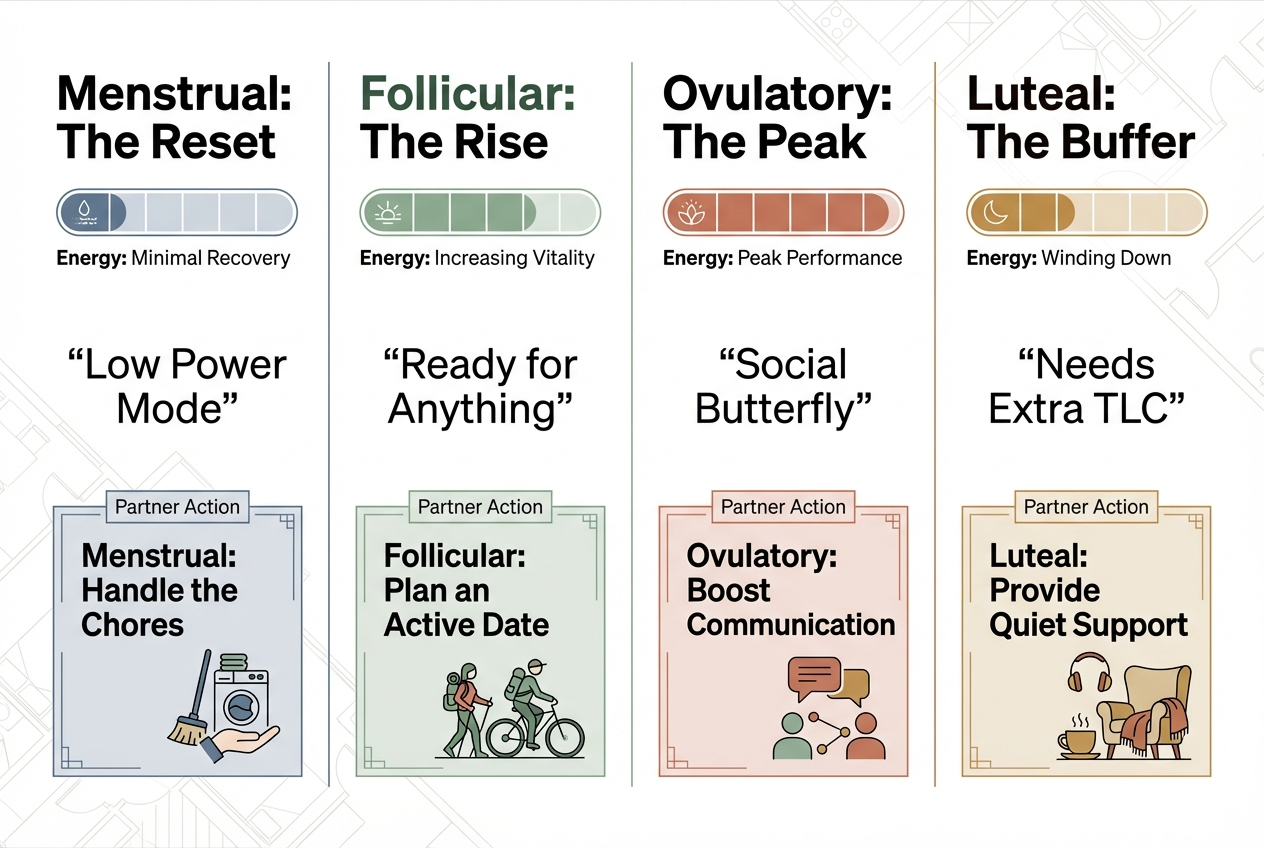 Transform medical data into supportive action by understanding the four cycle phases and how they influence your partner's energy and needs each month.
Phase 1: Menstrual Phase (Days 1-5)
The Low Power Mode
Hormone levels drop sharply. Energy is low. Social battery is depleted. This is the phase where she needs practical support more than emotional conversations.
What This Means for You:
- Take over the heavy chores without being asked
- Stock comfort foods (whatever her preference is - some want chocolate, others want salty snacks)
- Suggest low-energy activities (watching TV on the couch beats a 10-mile hike)
- Don't schedule intense social obligations if you can avoid it
- Physical touch might be less welcome than usual - ask, don't assume
Avoid: Suggesting lifestyle changes, having "where is this relationship going" conversations, planning high-energy dates.
Phase 2: Follicular Phase (Days 6-14)
The Up-Swing
Estrogen rises. Energy increases. Mood generally improves. This is when she's most open to new activities, social events, and planning for the future.
What This Means for You:
- This is your window for trying new restaurants or planning weekend trips
- Great time for deeper conversations or tackling relationship issues
- She's more likely to want social time with friends
- Higher libido often kicks in here
- Productivity is high - if you need to collaborate on household projects, do it now
Avoid: Assuming every week will feel like this one. It won't.
Phase 3: Ovulatory Phase (Days 15-17)
The Peak
Estrogen and testosterone peak. This is the highest-energy point in the cycle. Confidence is up, social desire is up, and yes, fertility is at its highest.
What This Means for You:
- She's more likely to want to go out, see people, and be active
- Communication tends to be clearer and more direct
- If you're trying to conceive, this is the window
- If you're not trying to conceive, be extra mindful about protection
- Great time for relationship connection and quality time
Avoid: Taking this energy level as the permanent baseline. It's a three-day window, not a lifestyle.
Phase 4: Luteal Phase (Days 18-28)
The Danger Zone
Progesterone rises and then crashes. This is where PMS symptoms show up. Energy declines. Sensitivity increases. Small things feel bigger than they are.
What This Means for You:
- Don't start arguments about things that aren't urgent
- Avoid criticism or nitpicking (it will land harder than you intend)
- Extra patience with emotional reactions
- She might need more alone time than usual
- This isn't the week to suggest she "try a new gym routine" or "cut back on spending"
Avoid: Saying "are you on your period?" when she's upset. Obviously. Also avoid making big relationship decisions during this phase - wait a week and see if the issue still feels as intense.
The value of a relationship advice men cycle syncing approach isn't about controlling or predicting her behavior. It's about recognizing patterns so you can reduce unnecessary friction and show up with the right kind of support at the right time.
Top 5 Period Trackers for Couples
Different couples need different tools - some want medical-grade data and deep health insights, others need simple actionable coaching without the clinical jargon.
Not all tracking apps are designed for shared use. Some were built for fertility planning, others for symptom tracking, and a few are explicitly designed to help clueless partners figure out what's happening. Here's how they stack up.
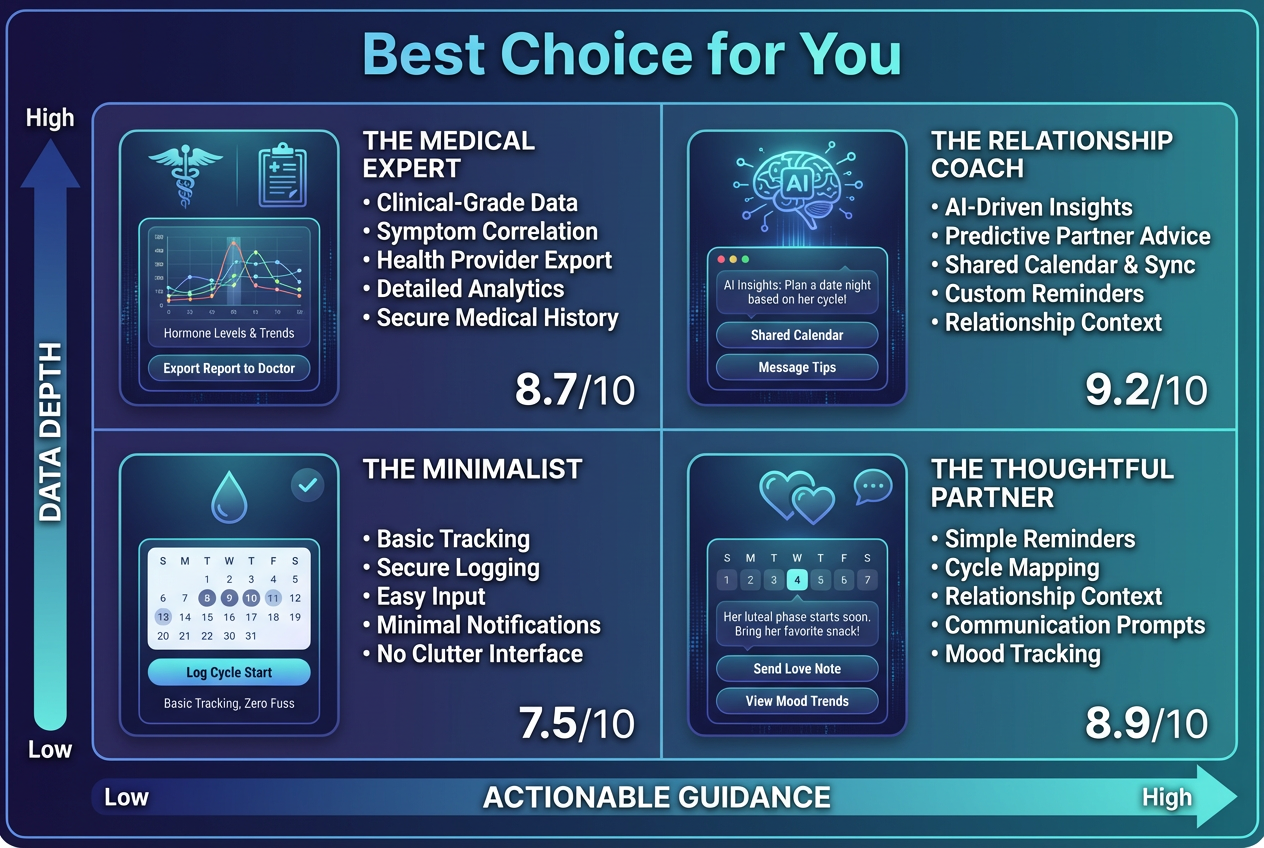 Not all tracking apps are built the same. Use this framework to decide if you need deep medical data or actionable, daily relationship coaching.
1. VibeCheck: The Male-First AI Coach
Best for: Guys who want direct, no-nonsense coaching without needing their partner to download anything.
VibeCheck is different from every other app on this list because it doesn't require your partner to share her existing tracker or download another app. You input basic cycle information (or sync with her existing tracker if she's willing), and the app uses AI to give you daily relationship intelligence.
Instead of saying "luteal phase," it tells you "low social battery day - suggest Netflix instead of dinner party." Instead of medical terminology, it gives you missions: pick up her favorite snacks, handle dinner tonight, don't suggest reorganizing the garage.
Key Features:
- AI-powered relationship coaching tailored to cycle phase
- Daily notifications with specific supportive actions
- No requirement for her to download another app
- Tracks patterns over time to improve suggestions
- Privacy-first (you control what data you input)
Pricing: Free basic version, premium features $4.99/month
Who It's For: Guys who want practical coaching without diving into medical details. If you're the type who wants to know "what do I actually do with this information," VibeCheck is built for you.
Learn more about how the VibeCheck app works for relationship timing and support.
2. Flo for Partners: The Medical Expert
Best for: Couples who want deep health insights and educational content.
Flo is the biggest name in period tracking, and their partner mode is comprehensive. When your partner shares access, you get detailed cycle predictions, educational articles, and video content explaining what's happening hormonally at each phase.
The strength here is authority. Flo has a massive library of medically-reviewed content, quizzes to test your cycle knowledge, and in-app tools for fertility planning. The weakness is that it can feel overwhelming if you just want simple guidance.
Key Features:
- Extensive medical library and video content
- Accurate predictions based on millions of users' data
- Symptom tracking and health insights
- Partner mode with customizable sharing settings
- Fertility window calculations
Pricing: Free with ads, Flo Premium $9.99/month (includes partner features)
Who It's For: Couples actively trying to conceive or those who want deep medical understanding. If she's already using Flo, adding partner mode is seamless.
3. Clue Connect: The Minimalist
Best for: Couples who want clean, science-based tracking without extra fluff.
Clue has a reputation for being the most science-focused tracker on the market. No pastel pink UI, no euphemisms, just clear data visualization. Clue Connect lets partners share cycle information with a simple invite link.
The downside: Clue doesn't hold your hand. You get the cycle calendar and symptom data, but you don't get daily tips or relationship coaching. You're expected to figure out what to do with the information yourself.
Key Features:
- Clean, gender-neutral interface
- Science-based predictions with no "wellness woo"
- Simple sharing via invite code
- Detailed symptom tracking
- Works well for non-binary or gender-diverse couples
Pricing: Free basic version, Clue Plus $9.99/month
Who It's For: Analytical types who want raw data without coaching. If you're comfortable doing your own research and applying insights independently, Clue is solid.
4. Stardust: The Social Experience
Best for: Couples who want a fun, community-driven approach with astrology elements.
Stardust combines cycle tracking with astrology and social features. If that sounds ridiculous, hear me out - it's actually one of the more engaging apps for couples because it frames cycle phases in terms of energy and personality rather than medical jargon.
The "partner mode" includes daily insights that feel less clinical and more like relationship horoscopes. Some guys find this approach way more accessible than reading about progesterone levels.
Key Features:
- Astrology-based personality insights tied to cycle phases
- Social feed where users share experiences (anonymous)
- Daily "vibe" updates for partners
- Community support and advice
- Fun, engaging UI that doesn't feel medical
Pricing: Free with limited features, premium $4.99/month
Who It's For: Couples who want something lighter and more social. If she's into astrology and you're willing to lean into that framework, Stardust makes cycle tracking feel less clinical.
5. Selin: The Thoughtful Gesture Reminder
Best for: Guys who need basic reminders for supportive actions.
Selin is deliberately simple. It sends you notifications to buy flowers, stock chocolate, or pick up condoms based on cycle phase. That's basically it. No deep health insights, no medical education - just practical prompts.
The UI is basic, and the app hasn't been updated as frequently as competitors, but for guys who genuinely just need to be reminded to do thoughtful things, it works.
Key Features:
- Custom reminders for gifts, snacks, and contraception
- Simple calendar view
- No overwhelming medical data
- One-time setup, passive notifications
- Works independently without her needing the app
Pricing: Free with ads, premium $2.99/month
Who It's For: Guys who are new to cycle awareness and just want basic actionable prompts without complexity.
If you want the tactical breakdown of period tracker app men actually use to improve relationships, the truth is that VibeCheck and Selin dominate the "male-first" category while Flo and Clue are better for couples who want joint health management.
How to Actually Use Cycle Data Without Being Weird
The app gives you information, but using it wrong creates more problems than it solves - here's how to apply cycle awareness without turning into a creepy data-obsessed partner.
Getting access to cycle data is step one. Not being an asshole about it is step two.
The Right Way to Ask for Access
Don't: "Hey, can I track your period so I know when you're going to be crazy?"
Do: "I've been reading about cycle phases and realized I could probably be more supportive if I understood what's happening hormonally each week. Would you be open to sharing your tracker or letting me know where you're at in your cycle? Totally your call, and you can change your mind anytime."
The key is positioning this as a tool for you to become a better partner, not as surveillance of her body. She needs to feel in control of what you see and when.
What to Do With the Data
Once you have access, here's the framework:
Use it for anticipation, not accusation.
Good: "I noticed you're in your luteal phase, so I grabbed groceries and handled dinner tonight."
Bad: "You're just upset because you're about to start your period."
Use it for planning, not control.
Good: "Next weekend is your follicular phase - want to finally try that new restaurant?"
Bad: "We can't go to the party this weekend because you'll be on your period."
Use it for support, not judgment.
Good: "I saw you're dealing with cramps today - want me to grab a heating pad?"
Bad: "You're always tired during this week."
The Invisible Support Protocol
The best use of cycle data is invisible support - taking action without needing credit or acknowledgment. That means:
- Doing the heavy chores without mentioning why
- Stocking her favorite comfort foods before she asks
- Adjusting your own expectations for social energy or emotional availability
- Being patient with emotional reactions without pointing out hormones
The period tracker boyfriends guide approach is about reducing her mental load, not adding to it by making her manage your new cycle-tracking obsession.
When to Talk About the Cycle (and When to Shut Up)
Talk about it: During her follicular or ovulatory phases, when she has energy and openness for conversation. Ask how she's feeling, what support looks like for her, and if the tracking approach is actually helpful.
Don't talk about it: During arguments, when she's upset, or as an excuse for why you didn't do something. "I didn't think you'd want to go because of your cycle" is not a valid excuse - ask her what she wants instead of assuming.
If She Says It's Not Helping
Some women don't want their partners tracking their cycles. Some feel surveilled, some feel reduced to their biology, some just don't find it useful. If she tells you it's not working, believe her and drop it.
The goal is to reduce friction, not create a new source of tension.
Privacy and Ethics: The Non-Negotiables
Sharing cycle data requires trust - violate that trust by weaponizing the information or sharing it with others, and you've destroyed the foundation of your relationship.
Let's be blunt: if you use cycle information against her in an argument, you're done. If you tell your friends "she's PMSing," you're done. If you treat her like a science experiment instead of a human being, you're done.
Here are the hard rules:
Rule 1: Never Use Cycle Data to Dismiss Her Feelings
Her emotions are real regardless of where she is in her cycle. Hormones might amplify feelings, but they don't create them out of nothing. If she's upset about something during her luteal phase, the underlying issue is still real - it just might feel more intense than it would during another phase.
Saying "you're just hormonal" is the fastest way to communicate that you don't take her seriously.
Rule 2: Never Share Her Cycle Data With Anyone
Not your friends, not your family, not the guys at the gym. Her menstrual cycle is private health information. Joking about it, complaining about it, or using it to explain her behavior to others is a massive violation of trust.
Rule 3: She Controls Access, Always
If she wants to stop sharing her tracker, she stops. No questions, no guilt trips, no "but I thought this was helping." Her body, her data, her choice.
Rule 4: Don't Track Her Without Permission
Some guys think they can secretly track their partner's cycle based on observed patterns. Don't. That's creepy and controlling, not supportive.
Rule 5: Understand the Surveillance Risk
Period tracking apps have been in the news for privacy concerns, particularly around data sharing with third parties and potential legal implications (especially in states with restrictive abortion laws). Make sure whatever app you use has strong privacy policies and doesn't sell data.
If she's concerned about surveillance, consider apps with local data storage or end-to-end encryption. VibeCheck and Clue both have strong privacy reputations.
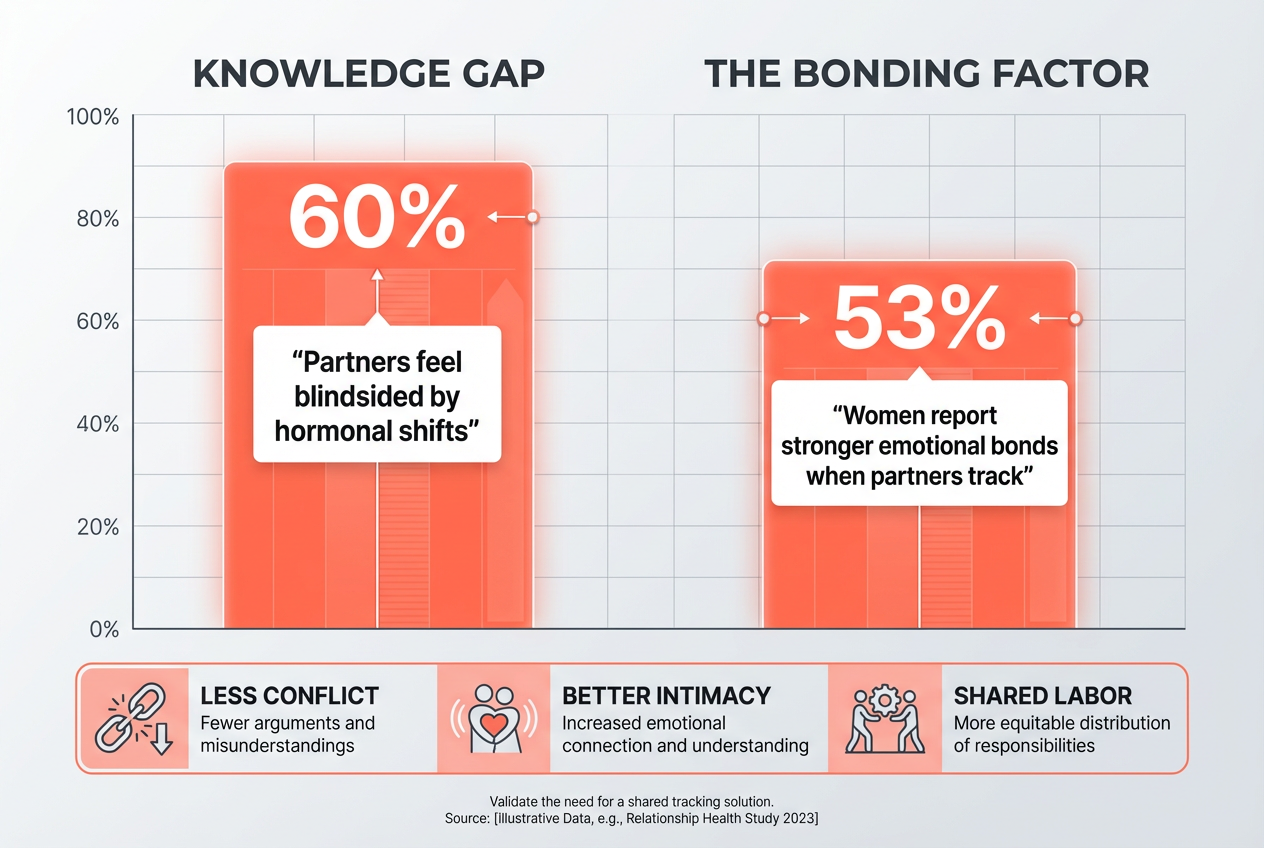 Statistics show that closing the knowledge gap regarding cycle health leads to significantly higher relationship satisfaction and stronger emotional connections.
The difference between being a supportive partner and a controlling one comes down to intent and execution. Use cycle data to reduce her burden, not to monitor or manage her.
For more tactical relationship intelligence approaches, check out the VibeCheck partner cycle guide that focuses on becoming proactive instead of reactive.
The Bottom Line
Period trackers for couples work when they reduce friction and increase understanding. They fail when they become another thing she has to manage or when you turn into a hormone detective instead of a supportive partner.
The best apps translate medical data into actionable relationship intelligence. VibeCheck excels at giving guys specific daily missions without requiring deep medical knowledge. Flo provides comprehensive health insights for couples managing fertility. Clue offers clean, science-based tracking without fluff. Stardust makes cycle awareness fun and social. Selin keeps it simple with thoughtful reminders.
But the app is just a tool. What matters is how you use it. Anticipate needs instead of reacting to problems. Support her without needing credit. Respect privacy boundaries absolutely. And remember that cycle awareness is about partnership, not control.
You don't need to become an expert in reproductive endocrinology. You just need to recognize patterns, adjust your expectations, and show up with the right kind of support at the right time. That's what separates the 1% partners from everyone else.
Frequently Asked Questions
What is the best period tracker for couples to use together?
The best period tracker depends on what you need. VibeCheck is ideal for guys who want AI-powered relationship coaching without medical jargon. Flo for Partners works best for couples who want deep health insights and are managing fertility. Clue Connect is perfect for analytically-minded couples who prefer science-based tracking without extra coaching. Choose based on whether you want actionable daily guidance (VibeCheck), comprehensive health data (Flo), or clean minimalist tracking (Clue).
Can I add my boyfriend to my Flo account?
Yes, Flo offers a Partner Mode feature that lets you share cycle information with your boyfriend through an invite system. You control what information he can see and can revoke access at any time. The partner sees cycle phase predictions and educational content but not every symptom detail unless you choose to share it. This feature is included in Flo Premium, which costs $9.99 per month.
How do I use a period tracker without being weird about it?
Use cycle data for anticipation, not accusation. Take supportive actions like handling chores or stocking comfort foods without making a big announcement about why. Never use cycle information to dismiss her feelings or explain away valid concerns. Ask for permission before accessing her data, let her control what you see, and focus on reducing her mental load rather than monitoring her biology. The boyfriend relationship advice cycle approach is about invisible support, not performance.
Is there a period tracker specifically designed for men?
Yes, VibeCheck is specifically designed for male partners and doesn't require your girlfriend or wife to download another app. You input basic cycle information (or sync with her existing tracker if she agrees), and the app provides daily relationship coaching and actionable missions based on cycle phase. Selin is another male-focused option that sends reminders for supportive actions. Both apps translate medical cycle data into practical relationship guidance without requiring you to learn endocrinology.
Are period tracking apps safe for couples to share?
Privacy and security vary by app. Clue and VibeCheck have strong privacy policies with end-to-end encryption options. Flo has faced privacy scrutiny in the past but has improved data protection measures. Always review the privacy policy before sharing sensitive health data. Make sure your partner controls access and can revoke it anytime. Never share her cycle information with third parties, and understand that in some legal jurisdictions, cycle tracking data could potentially be subpoenaed. Choose apps that store data locally or use encryption when possible.
What should I do during each phase of my partner's cycle?
During the menstrual phase (days 1-5), focus on practical support like handling chores and providing comfort foods. During the follicular phase (days 6-14), plan active dates and tackle relationship conversations when her energy is high. During the ovulatory phase (days 15-17), lean into social activities and quality time together. During the luteal phase (days 18-28), exercise extra patience, avoid starting arguments, and give her space when needed. For a detailed breakdown, check out the VibeCheck partner cycle playbook that maps specific actions to each phase.
How accurate are period tracker predictions for planning?
Period tracker accuracy depends on cycle regularity and data input consistency. Apps like Flo and Clue use algorithms trained on millions of cycles and typically predict periods within 1-2 days for users with regular cycles. Accuracy improves over time as the app learns individual patterns. However, cycles can shift due to stress, illness, travel, or hormonal changes, so predictions are guidelines, not guarantees. Never rely solely on app predictions for contraception - use actual birth control methods.
What if my partner doesn't want me tracking her cycle?
Respect her decision completely. Some women feel surveilled or reduced to their biology when partners track their cycles. Others worry about privacy or don't find the approach helpful. If she says no, drop it without guilt-tripping or pushing. You can still be a supportive partner by paying attention to her communication, asking what she needs, and responding to her stated preferences. Cycle tracking is a tool, not a requirement for being a good partner.
Tags

Related Articles
Continue reading to deepen your understanding

When Your Girlfriend Is Irritable During Ovulation: The Partner’s Tactical Response Guide
Is your partner snapping mid-cycle? Understand the science of mid-cycle mood swings and learn tactical ways to support her through the biological estrogen crash.

Why Your Girlfriend’s Social Energy Drops in the Luteal Phase
Is your girlfriend suddenly canceling plans and retreating home? It isn’t personal; it’s biology. Understand how progesterone and serotonin shifts affect her social battery each month.

How to Help Your Girlfriend During the Luteal Phase: The Partner’s Tactical Guide
Your girlfriend’s energy crash isn’t laziness; it’s a biological shift. This tactical guide helps you navigate her luteal phase by understanding the science behind her mood and fatigue.

Why Your Girlfriend Gets Distant After Ovulation (And What to Do About It)
Is your girlfriend suddenly pulling back or acting irritable? It might be her cycle. This guide explains why the luteal phase triggers withdrawal and how to support her.

Supporting Your Girlfriend Through the Luteal Phase
When hormone levels crash before her period, your partner’s brain enters a high-alert state. Learn how to provide the security she needs with tactical scripts and empathy.

How to Give Your Girlfriend Reassurance During Ovulation Week
Is your girlfriend suddenly questioning everything during her cycle? Understand the estrogen crash and learn how to provide the tactical support she needs to feel secure and loved.

When to Give Her Space vs. When to Stay Close: Your Phase-by-Phase Guide
Your girlfriend’s need for closeness isn’t random. Understanding how her 28-day biological rhythm affects her energy helps you time your support perfectly across all four phases.

Your Girlfriend’s 28-Day Relationship Manual: How to Support Her Through Every Phase
Understanding her menstrual cycle transforms you from a guy walking on eggshells into a strategic partner who knows exactly what support to offer and when.