Boyfriend Guide to Menstrual Cycle Phases & Support
Learn how to navigate the four menstrual cycle phases with this essential guide for men. Improve communication, reduce friction, and provide proactive support.
The Boyfriend’s Field Manual: Mastering Your Partner’s Four Cycle Phases
Most guys don’t realize their relationship operates on a 28-day biological calendar. You’re planning date nights, initiating difficult conversations, and trying to understand why Tuesday’s mood feels nothing like Saturday’s vibe - all while missing the hormonal blueprint that explains everything.
Your partner’s menstrual cycle isn’t just about one week of cramps. It’s a four-phase system that creates predictable shifts in energy, communication style, social battery, and physical comfort. When you understand this rhythm, you stop walking on eggshells and start providing the exact support she needs before she has to ask for it.
This isn’t about tracking her period to avoid arguments. It’s about upgrading your relationship intelligence so you can match her biological seasons with the right gestures, conversations, and logistics. Think of it as learning the playbook instead of guessing the game plan every single day.
Knowing which phase she is in changes what actually helps. Start with our shortlist of the best period trackers for boyfriends, then work through the guide below.
Table of Contents
- Why Understanding Her Cycle Is Your Relationship Superpower
- The Science Behind the Four Phases
- Phase 1: The Menstrual Phase (Days 1-5) - The Cleanup Crew
- Phase 2: The Follicular Phase (Days 6-14) - The Energizer Bunny
- Phase 3: The Ovulation Phase (Days 14-17) - The Love Goddess
- Phase 4: The Luteal Phase (Days 18-28) - The Emotional Rollercoaster
- The Boyfriend’s Period Kit: Your Shopping List
- How to Track Without Being Weird
- Consistency Beats Perfection
- Frequently Asked Questions
Why Understanding Her Cycle Is Your Relationship Superpower
Here’s the truth nobody tells you: 88% of women experience physical discomfort during their cycle, and hormonal shifts affect mood, energy, and communication needs every single week. If you’re reacting to these changes instead of anticipating them, you’re always one step behind.
VibeCheck App
Know what she needs. Before she has to say it.
Track her cycle, understand her phases, be the partner she deserves.
Download Free on iOS →Think about the last argument that seemed to come out of nowhere. Or the weekend plans that suddenly felt exhausting to her. Or the night you tried to initiate intimacy and got shut down without explanation. Chances are, her cycle phase had everything to do with the response you got.
When you understand the four phases, you gain three major advantages:
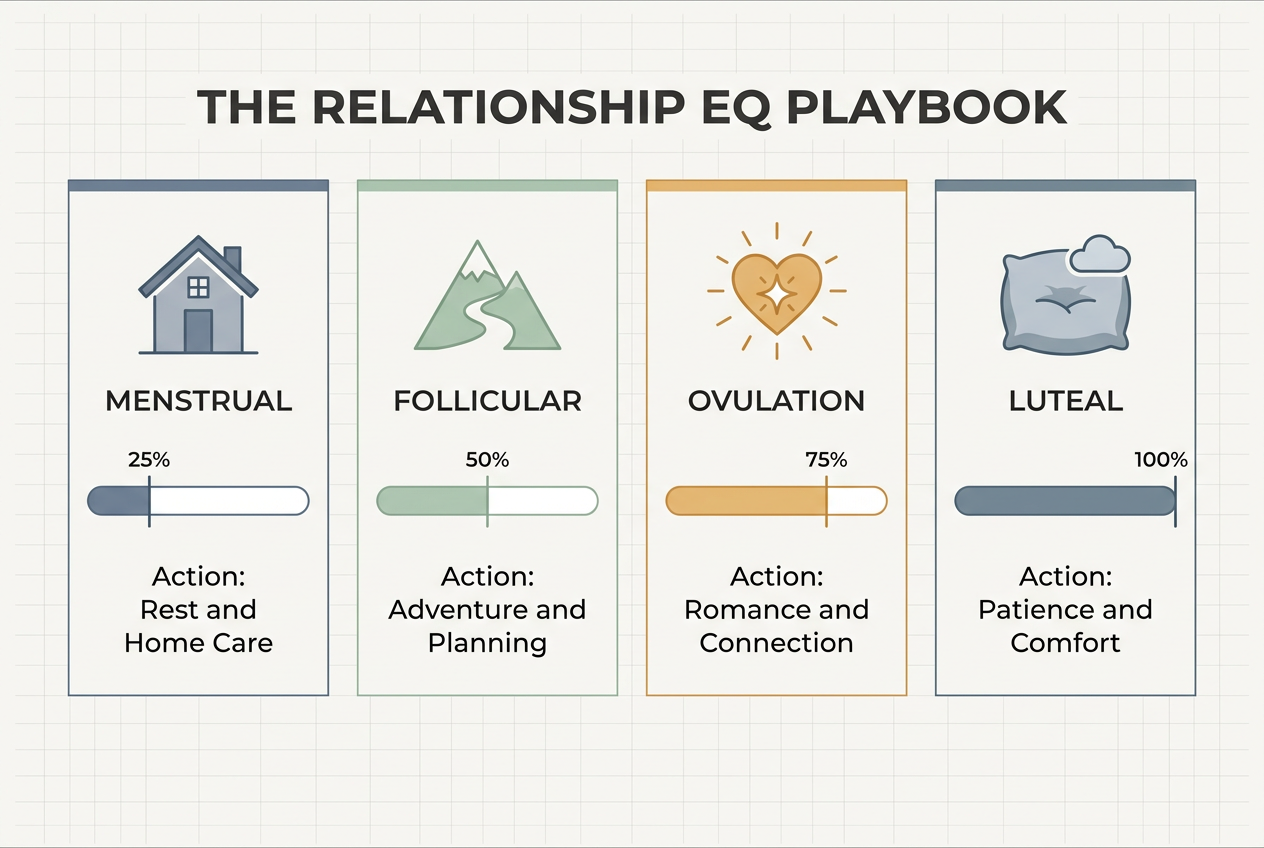
Strategic timing. You’ll know when to schedule the serious relationship talk (follicular phase), when to plan the adventurous date (ovulation phase), and when to just handle the dishes without being asked (menstrual phase).
Predictive support. Instead of waiting for her to say "I need space" or "I’m exhausted," you’ll recognize the biological signals and adjust your approach automatically. This makes you the partner who gets her without needing a manual every time.
Reduced friction. Most relationship tension comes from mismatched expectations. She needs low-key comfort, you’re planning a social outing. She’s craving connection, you’re giving her space. Cycle awareness eliminates 90% of this guesswork.
This isn’t about becoming her doctor. It’s about recognizing patterns the same way you’d learn her coffee order or her work schedule. The cycle is just another rhythm in her life, and understanding it makes you a dramatically better partner.
The Science Behind the Four Phases
Before we get tactical, you need the biological foundation. Her menstrual cycle is controlled by four hormones: estrogen, progesterone, luteinizing hormone (LH), and follicle-stimulating hormone (FSH). These hormones don’t stay constant. They rise and fall in specific patterns across four phases, creating predictable shifts in how she feels, what she needs, and how she communicates.
The average cycle lasts 28-32 days, but it can vary by up to 8 days depending on stress, travel, sleep quality, and health factors. This means her "Day 1" might not always land on the same calendar date each month, so you’ll need to track the actual cycle, not just guess based on last month’s timing.
Here’s the four-phase breakdown:
Phase 1: Menstrual (Days 1-5). Estrogen and progesterone are at their lowest. She’s losing blood, her body is resetting, and energy levels drop significantly. This is the "rest and recover" phase.
Phase 2: Follicular (Days 6-14). Estrogen starts climbing. Her body is preparing to release an egg, so she gets a natural energy boost. Mood improves, skin glows, and she’s more social and adventurous.
Phase 3: Ovulation (Days 14-17). Estrogen peaks, and luteinizing hormone surges to trigger egg release. This is her biological "peak fertility" window, which means higher libido, increased confidence, and maximum social energy.
Phase 4: Luteal (Days 18-28). Progesterone dominates while estrogen fluctuates. Her body is preparing for either pregnancy or menstruation. This phase brings bloating, irritability, food cravings, and the infamous PMS symptoms before estrogen and progesterone both crash, restarting the cycle.
Each phase has a distinct hormonal signature, and those hormones directly affect neurotransmitters like serotonin and dopamine. That’s why her mood, energy, and stress tolerance shift so dramatically across the month. It’s not random, and it’s definitely not something she can control by "thinking positive."
Understanding this biological rhythm is the foundation for everything that follows. Let’s break down what each phase actually looks like in your relationship.
Phase 1: The Menstrual Phase (Days 1-5) - The Cleanup Crew
Day 1 starts when her period begins. This is the phase most guys know about because it’s the most visible, but most still get the support strategy wrong. She’s not just dealing with cramps. Her body is shedding the uterine lining, which creates physical pain, low energy, brain fog, and emotional exhaustion.
The Science: Estrogen and progesterone are at rock bottom. Prostaglandins (the compounds that cause uterine contractions) are elevated, which is why cramps feel like her body is fighting itself. Blood loss can lead to low iron, which compounds the fatigue. On top of that, serotonin levels drop, making her more prone to "the blahs" or mild depressive feelings.
The Vibes: Low energy, physical discomfort, increased need for rest, irritability from pain, and a strong desire to stay home and avoid social obligations. She’s not being dramatic. She’s running a biological marathon while trying to function normally.
Your Hero Move: Take over the invisible labor. Don’t wait for her to ask. Do the dishes, handle the laundry, pick up takeout, and clear her evening schedule so she can rest. The key is being proactive without making a big deal about it. She doesn’t want a medal for you doing basic tasks, she wants the tasks handled so she can focus on managing physical pain.
The Script: "I’ve got dinner and the kitchen tonight. You just find a movie." Or: "I’m running errands later, anything you need stocked up?" These scripts remove decision-making from her plate, which is just as valuable as removing physical tasks.
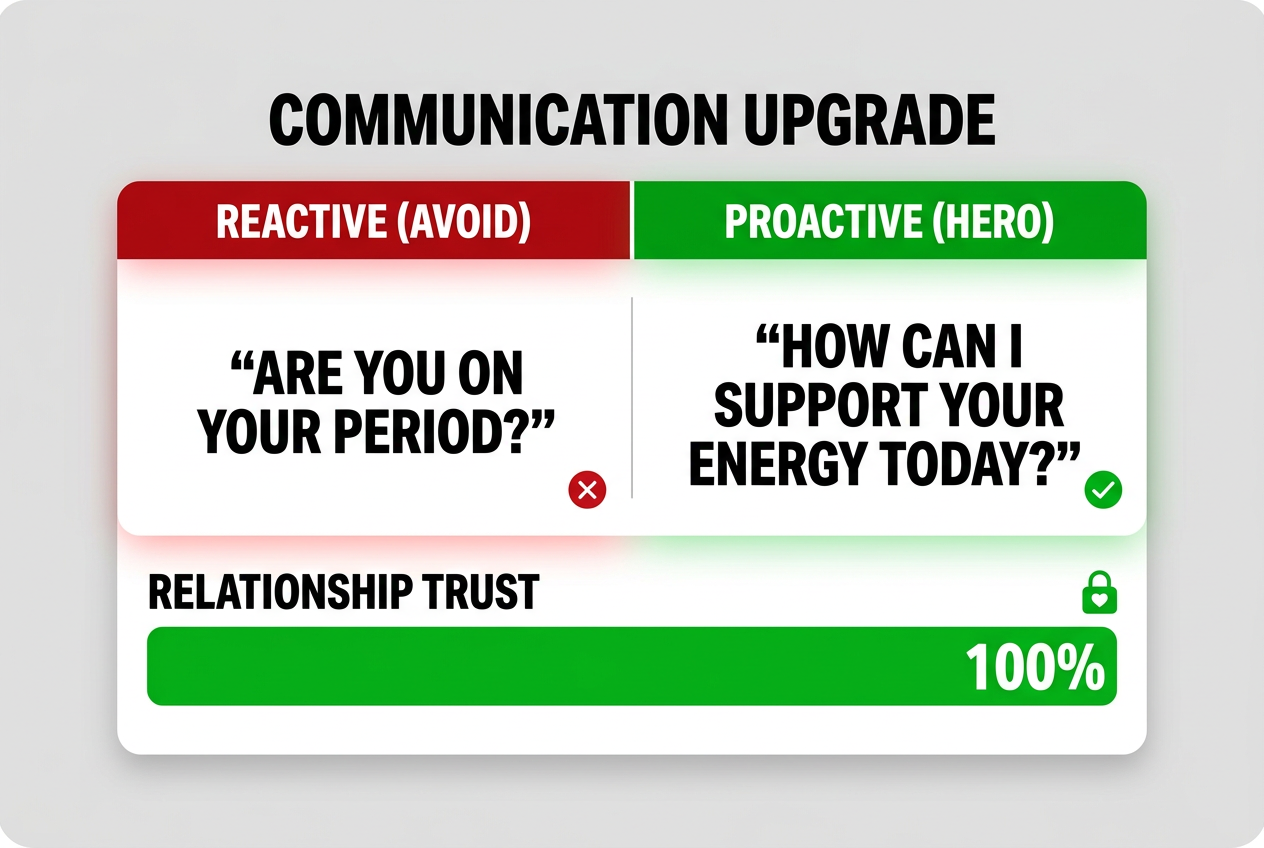
What NOT to Do: Don’t ask if she’s on her period when she’s irritable. Don’t suggest she’s overreacting to pain. Don’t plan high-energy activities or schedule difficult conversations during this phase. And definitely don’t make jokes about PMS or hormones.
Logistical Hero Moves:
- Keep a heating pad or hot water bottle ready without her needing to ask
- Stock Midol or ibuprofen in an easy-to-reach spot
- Have dark chocolate, salty snacks, and comfort food options available
- Offer to run a bath or set up a cozy couch setup with blankets and her favorite shows
- Handle any chores that require bending, lifting, or standing for long periods
This phase is about comfort, rest, and reducing her cognitive load. You’re not trying to fix her or cheer her up. You’re creating a low-friction environment where she can recover without having to manage anyone else’s needs.
If you want a deeper breakdown of how to support your partner during this phase, check out our guide on how to help your girlfriend during her menstrual phase.
Phase 2: The Follicular Phase (Days 6-14) - The Energizer Bunny
Once her period ends, estrogen starts its climb, and everything shifts. This is the phase where she feels most like herself. Energy returns, mood stabilizes, and she’s open to new experiences, social plans, and ambitious projects.
The Science: Estrogen rises steadily, which boosts serotonin and dopamine. Her skin clears up, her body retains less water, and she feels physically lighter. Cognitively, she’s sharper and more creative. This is the phase where her brain is primed for problem-solving, planning, and trying new things.
The Vibes: High energy, optimism, social motivation, and a strong desire to connect with you and others. She’s more likely to say yes to spontaneous plans, tackle difficult conversations, and feel excited about the future. Think of this as her "Power Phase."
Your Hero Move: Plan the big stuff. This is the time for the adventurous date, the challenging hike, the dinner party with friends, or the serious relationship conversation you’ve been postponing. She has the emotional bandwidth and energy to engage fully, so use this window wisely.
The Script: "You seem to have great energy today. Want to finally try that hiking trail?" Or: "I’ve been thinking about our summer plans. Let’s map something out this week."
What NOT to Do: Don’t waste this phase on low-energy couch time. Don’t avoid important conversations because you’re nervous. She’s in the best headspace to handle complex topics, so bring them up now instead of waiting until the luteal phase when everything feels heavier.
Tactical Date Ideas:
- Outdoor adventures (hiking, biking, rock climbing)
- Social events (concerts, group dinners, parties)
- Trying a new restaurant or activity together
- Planning future trips or big projects
- Having the "where is this going" or "let’s talk about our goals" conversation
This phase is your green light for ambition and connection. She’s operating at peak capacity, so match that energy. Don’t let the week slip by with Netflix and takeout. She’ll appreciate the effort to plan something memorable.
For more on how to support your girlfriend during this phase, read our guide on how to help your girlfriend during the follicular phase.
Phase 3: The Ovulation Phase (Days 14-17) - The Love Goddess
Ovulation is the biological peak. This 3-4 day window is when her body releases an egg, and every system is optimized for connection, attraction, and social engagement. If you’ve ever noticed her suddenly glowing, more flirty, or radiating confidence, this is why.
The Science: Estrogen hits its maximum, and luteinizing hormone (LH) surges to trigger ovulation. Testosterone also rises slightly, which boosts libido. Her body is literally designed to attract a partner during this phase, so she’ll feel more confident, look more attractive (studies show men rate women as more beautiful during ovulation), and crave intimacy.
The Vibes: Peak energy, high libido, social confidence, and a strong desire for romance and physical connection. She’s more likely to initiate intimacy, dress up, and feel excited about date nights. This is her "Radiance Phase."
Your Hero Move: Up the romance. Compliments land harder during this phase because she’s already feeling attractive. Plan a proper date night, not just dinner on the couch. Notice her appearance, give her genuine compliments, and create opportunities for physical connection.
The Script: "You look incredible today. Let’s do a proper date night." Or: "I love how confident you’ve been lately. Let’s celebrate that."
What NOT to Do: Don’t take this phase for granted or assume she’ll always feel this way. Don’t skip the romance because "she’s already in a good mood." And don’t miss the intimacy window by being passive or distracted.
Strategic Relationship Moves:
- Plan a romantic date (candlelit dinner, live music, scenic drive)
- Initiate physical affection more often (hand-holding, cuddling, kissing)
- Give her specific, genuine compliments about her appearance or energy
- Suggest activities that involve physical closeness (dancing, massage, intimacy)
- Be present and engaged, not distracted by work or screens
This is the phase where your effort gets the highest return. She’s biologically primed to connect with you, so make it count. If you’ve been thinking about deepening physical intimacy or having a romantic gesture planned, this is the time to execute.
For more on how to support your girlfriend during this phase, check out our guide on what to do when your girlfriend is ovulating.
Phase 4: The Luteal Phase (Days 18-28) - The Emotional Rollercoaster
This is the phase that causes the most relationship friction. After ovulation, progesterone dominates while estrogen fluctuates wildly. Her body is preparing for either pregnancy or menstruation, and if pregnancy doesn’t happen, both hormones crash hard in the final days before her period starts. This creates PMS: irritability, bloating, food cravings, anxiety, and emotional sensitivity.
The Science: Progesterone rises to prepare the uterine lining. If no pregnancy occurs, progesterone and estrogen both plummet around Day 25-28, triggering the physical and emotional symptoms most guys associate with "that time of the month." Serotonin drops, stress hormones rise, and her body retains water, which causes bloating and discomfort.
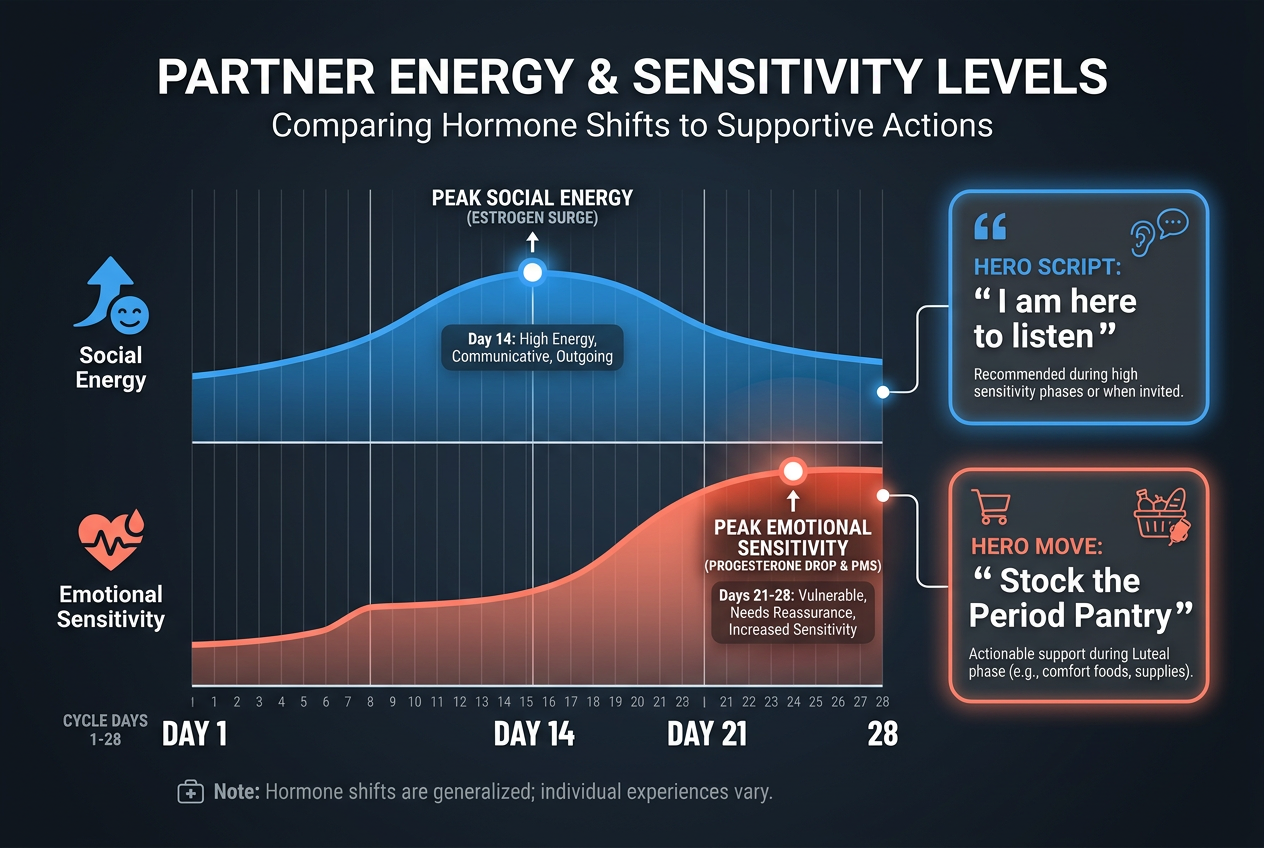
The Vibes: Bloating, breast tenderness, irritability, brain fog, heightened emotional sensitivity, and food cravings (especially for salty or sweet foods). She’s more likely to feel overwhelmed, cry more easily, or snap at minor inconveniences. Think of this as her "Sensitivity Phase."
Your Hero Move: The "Comfort First" approach. This is not the time for logic or problem-solving. She doesn’t need you to fix anything. She needs you to validate her feelings, reduce her stress load, and create a low-pressure environment. Stock the "Period Pantry" with her favorite snacks, handle household tasks without being asked, and give her the space to vent without offering unsolicited advice.
The Script: "I’m here if you want to vent, or I can just be quiet nearby. Which one do you need?" Or: "You’ve had a rough day. Let me handle dinner and cleanup."
What NOT to Do: Don’t tell her she’s overreacting. Don’t blame her mood on hormones in a dismissive way ("Are you PMSing?"). Don’t pick fights or bring up heavy relationship topics during this phase. And don’t take her irritability personally. It’s not about you.
Tactical Support Moves:
- Keep dark chocolate, salty snacks, and her favorite comfort foods stocked
- Offer to run errands or handle chores without waiting for her to ask
- Create quiet, low-stress evenings (no pressure to socialize or be "on")
- Validate her feelings without trying to fix them ("That sounds frustrating" instead of "Here’s how to solve it")
- Give her space if she needs it, but stay available if she wants to talk
This is the phase where most guys fail because they try to logic their way through an emotional situation. Your job is not to solve her problems or cheer her up. Your job is to be a steady, supportive presence while her hormones stabilize.
For a deeper breakdown of how to support your girlfriend during the luteal phase, check out our guide on what to do when your girlfriend has PMS.
The Boyfriend’s Period Kit: Your Shopping List
If you want to be a 1% partner, you need supplies ready before she needs them. This is the difference between reactive support ("I’ll grab tampons when she asks") and proactive support ("I already have everything stocked").
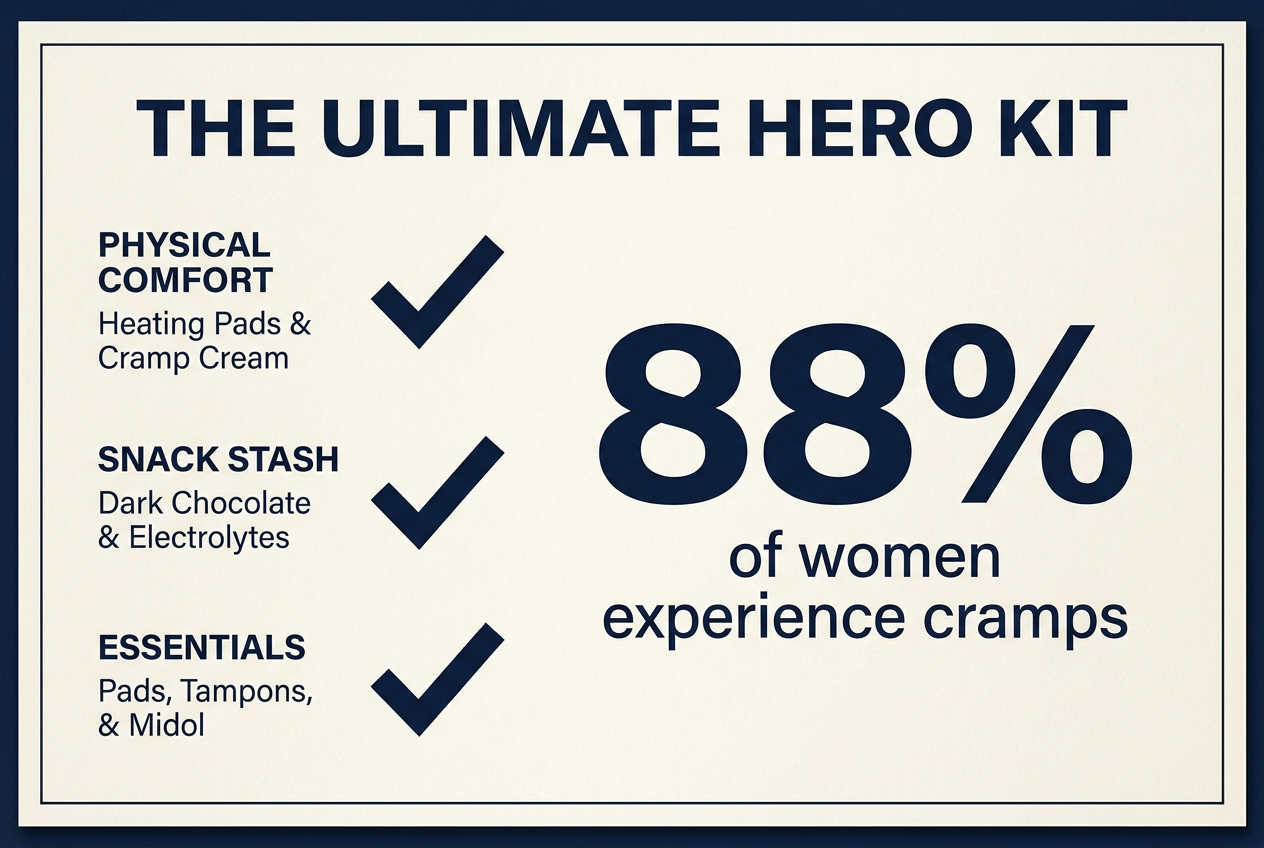
For Your Home:
- Tampons and pads (ask her preferred brand and absorbency level)
- Heating pad or microwavable heat pack
- Midol or ibuprofen (check which she prefers)
- Dark chocolate (at least 70% cocoa for magnesium)
- Salty snacks (chips, pretzels, popcorn)
- Herbal tea (ginger or chamomile for cramps)
- Extra toilet paper (always)
- Comfortable loungewear or a soft blanket
For Your Car:
- Travel pack of tampons or pads
- Wet wipes or tissues
- Portable phone charger
- Emergency snacks (granola bars, trail mix)
- Bottle of water
For Her Bag (if she’s staying over):
- Small pouch with tampons, pads, and wipes
- Travel-size pain reliever
- Lip balm and hand lotion (her skin can get dry during her period)
Why This Matters: 1 in 7 women are on their period right now. That means your partner will spend roughly 2,500 days of her life menstruating. If you’re unprepared every single month, you’re making her life harder instead of easier. Stock the supplies once, and you’ll never have the "Can you run to the store?" emergency again.
How to Track Without Being Weird
Here’s the problem: most guys either don’t track at all (and miss every pattern) or track in a way that feels invasive and creepy. The goal is permission-based tracking that helps you provide better support, not surveillance that makes her feel monitored.
Step 1: Ask for Permission
Don’t secretly track her cycle. That’s weird. Instead, frame it as a partnership tool: "I’ve been learning about how your cycle affects your energy and mood. Would it help if I kept track so I can support you better? I’m not trying to predict your moods, I just want to know when to plan the big date versus when to give you space."
Most women will appreciate this because it shows you care enough to learn her rhythm. If she says no, respect it and don’t push.
Step 2: Use a Couple-Friendly App
Some apps are designed specifically for partners. VibeCheck, for example, translates cycle phases into actionable missions for men. You get notifications like "She’s entering her luteal phase, stock comfort snacks" or "Ovulation starts tomorrow, plan something romantic."
Other options include Clue with partner mode, Flo for Partners, or a shared calendar where she logs her cycle and you can see the phases. The key is finding a tool that works for both of you without requiring her to do extra work.
Step 3: Track Actions, Not Moods
Never use the app to say "You’re acting this way because you’re on your period." That’s weaponizing data. Instead, use it to guide your own behavior: "She’s in the luteal phase, so I’ll handle dinner tonight" or "It’s her follicular phase, I’ll suggest that hiking trip we’ve been talking about."
The cycle is a tool for you to adjust your support, not a weapon to explain away her feelings.
Step 4: Keep It Between You Two
Don’t share her cycle data with friends, family, or anyone else. This is private information, and violating that trust will destroy the partnership dynamic you’re trying to build.
For more on how to track your partner’s cycle respectfully, check out our guide on how to track your girlfriend’s cycle.
Consistency Beats Perfection
Here’s the truth: every woman’s cycle is different. Some women have 25-day cycles, others have 35-day cycles. Some women barely notice their period, others are bedridden with pain. Some women get PMS symptoms for two weeks, others get them for two days.
The framework in this guide is a starting point, not a rigid script. Your job is to learn her specific patterns, which means paying attention over multiple cycles. Track what works and what doesn’t. Notice when she has the most energy, when she’s most sensitive, and when she needs the most support.
You won’t get it right every time. You’ll suggest a hike during her luteal phase and she’ll decline. You’ll forget to stock chocolate and she’ll have to ask. That’s fine. The goal isn’t perfection. The goal is consistency.
Show up with effort month after month. Adjust your approach based on her feedback. Keep learning her rhythm instead of assuming you already know it. That’s what separates a good partner from a great one.
The menstrual cycle isn’t an obstacle to your relationship. It’s a roadmap. When you understand the four phases, you stop reacting to her moods and start anticipating her needs. You stop walking on eggshells and start providing the exact support she needs before she has to ask for it.
That’s the difference between guessing and knowing. And it’s the difference between a good relationship and a great one.
Ready to actually understand her?
Join thousands of men using VibeCheck to track her cycle and show up better every day.
Not sure which app actually helps with any of this? We put the best relationship advice apps for men side by side — what each one costs, and what each one is genuinely good at.
Frequently Asked Questions
What is the best way to ask my partner about tracking her cycle?
Frame it as a partnership tool, not a monitoring system. Say something like: "I’ve been learning about how your cycle affects your energy and mood. Would it help if I kept track so I can support you better?" Emphasize that you want to anticipate her needs, not predict or control her moods. Most women will appreciate this approach because it shows genuine care.
How long does each phase of the menstrual cycle last?
The menstrual phase typically lasts 3-7 days (average 5 days). The follicular phase runs from Day 6 to Day 14. Ovulation lasts 3-4 days around Day 14-17. The luteal phase spans Day 18 to Day 28. However, these are averages. Your partner’s cycle might be shorter or longer, and the phase lengths can vary month to month based on stress, sleep, health, and other factors.
What should I avoid saying during the luteal phase?
Never say "Are you on your period?" or "You’re being hormonal." Avoid dismissive phrases like "You’re overreacting" or "It’s not that bad." Don’t offer unsolicited advice or try to logic your way through her emotions. Instead, use validating scripts like "That sounds frustrating" or "I’m here if you want to talk." The goal is to acknowledge her feelings without minimizing them.
How can I tell which phase my partner is in without asking?
Look for energy and mood patterns. During the menstrual phase, she’ll likely be low-energy and want to stay home. The follicular phase brings higher energy and social motivation. Ovulation creates peak confidence and higher libido. The luteal phase brings irritability, bloating, and food cravings. Over 2-3 cycles, you’ll start recognizing these patterns without needing to ask.
What are the most important supplies to keep stocked?
At minimum, keep tampons or pads (her preferred brand), a heating pad, Midol or ibuprofen, dark chocolate, salty snacks, and extra toilet paper. For bonus points, add herbal tea, comfortable loungewear, and wet wipes. Keep a travel pack of tampons and pads in your car for emergencies. The goal is to eliminate the "Can you run to the store?" stress moment.
Should I plan dates differently based on her cycle?
Yes. During the follicular phase (Days 6-14), plan adventurous or social dates like hiking, concerts, or dinner parties. During ovulation (Days 14-17), focus on romantic, intimate dates like candlelit dinners or scenic drives. During the luteal phase (Days 18-28), stick to low-key dates like movie nights at home or quiet dinners. During the menstrual phase (Days 1-5), skip plans entirely and focus on comfort and rest.
What if my partner’s cycle is irregular?
Irregular cycles are common, especially during times of stress, illness, or major life changes. If her cycle varies by more than 8 days month-to-month, focus on tracking the actual start date of her period (Day 1) and counting forward from there. Over time, you’ll notice patterns even if the calendar dates aren’t consistent. If her cycle is extremely unpredictable, she may want to talk to a doctor to rule out underlying health issues.
How do I handle PMS symptoms without making her feel worse?
Focus on reducing her stress load, not fixing her mood. Handle chores without being asked. Stock her favorite comfort foods. Offer to listen without giving advice. Create a low-pressure environment where she doesn’t have to perform or manage anyone else’s needs. Your job is to be a steady, supportive presence while her hormones stabilize, not to cheer her up or solve her problems.
Tags

Related Articles
Continue reading to deepen your understanding

Your Girlfriend’s 28-Day Relationship Manual: How to Support Her Through Every Phase
Understanding her menstrual cycle transforms you from a guy walking on eggshells into a strategic partner who knows exactly what support to offer and when.

When Your Girlfriend Goes Distant During the Luteal Phase: The Partner’s Tactical Guide
Does your girlfriend pull away or go quiet right before her period? Understand the biological reason for her withdrawal and how you can support her without making it worse.

The Strategic Partner’s Guide to Ovulation Energy Surge Date Ideas
Is your girlfriend suddenly full of energy and ready for adventure? It’s likely her ovulation surge. Use this guide to plan dates that match her peak confidence and social drive.

How to Plan a Surprise for Your Girlfriend During Her Follicular Phase
Stop fighting her hormones and start working with them. Use this guide to time your surprises perfectly with her biological clock for better reactions and maximum joy.

How to Comfort Your Girlfriend During Ovulation Mood Swings: The Partner’s Tactical Guide
Is your partner suddenly irritable mid-cycle? It is likely an estrogen crash. Use these tactical tips to navigate her ovulation mood swings with empathy.

What to Expect: Understanding Your Girlfriend’s Emotional Changes During Ovulation
Ever wonder why your girlfriend’s energy shifts mid-cycle? Her mood, confidence, and social drive are driven by hormonal surges that you can track to provide better support.

How to Comfort Your Girlfriend During Ovulation Bloating Naturally
Is your partner feeling puffy mid-cycle? Help her feel better with this guide to understanding ovulation discomfort and using gentle, natural remedies to ease her physical symptoms.

How to Comfort Your Girlfriend During Ovulation Cramps
Seeing your partner in pain during the peak of her cycle can be confusing. Use this guide to provide physical relief and emotional support for mid-cycle ovulation cramps.