Why Your Girlfriend’s Mood Changes Throughout the Month: The Four Seasons Framework

Does your girlfriend’s mood seem to shift for no reason? Discover the biological Four Seasons framework that explains her monthly cycle and how to be the partner she needs right now.
Why Your Girlfriend’s Mood Changes Throughout the Month: The Four Seasons Framework
Picture this: last Tuesday, she was all energy - planning a weekend trip, laughing at your jokes, suggesting you finally tackle that DIY project. Today, she’s withdrawn. Your usual banter gets clipped responses. That plan you were excited about? "I don’t know, maybe we should just stay in."
You’re not imagining it. And no, you didn’t do anything wrong.
Your girlfriend operates on a 28-day biological cycle that creates predictable shifts in her energy, mood, brain chemistry, and social needs. Most men treat this like unpredictable weather - something to endure. Elite partners treat it like a forecast - something to prepare for.
This isn’t about "dealing with mood swings." It’s about understanding the biological rhythm that governs roughly 25% of the human population and learning to sync your support to her actual needs instead of guessing.
VibeCheck App
Know what she needs. Before she has to say it.
Track her cycle, understand her phases, be the partner she deserves.
Download Free on iOS →The payoff? Fewer arguments. Better timing. Deeper connection. And the quiet confidence that comes from knowing exactly what kind of partner she needs today.
Table of Contents
- The Real Reason Her Mood Changes (It’s Not You)
- The Four Seasons Framework: Your Complete Playbook
- The Science Behind the Mood Shifts
- What Not to Do: Common Mistakes That Make It Worse
- The Cheat Code: Stop Guessing and Start Tracking
- Frequently Asked Questions
The Real Reason Her Mood Changes (It’s Not You)
Here’s the biological reality: 1 in 7 women is menstruating at any given moment. That means roughly 800 million women globally are navigating hormonal shifts that directly affect serotonin production, energy levels, sleep quality, and stress resilience.
Your girlfriend’s monthly cycle isn’t a bug - it’s a feature. And once you understand the pattern, you’ll stop taking her shifts personally.
The Hormone-Mood Connection
Two primary hormones drive the cycle:
Estrogen rises and falls in waves throughout the month. When it’s high, her brain produces more serotonin - the neurotransmitter responsible for mood stability, optimism, and social energy. When estrogen drops, serotonin goes with it.
Progesterone peaks in the second half of the cycle. While it supports reproductive health, it also acts as a sedative on the brain. High progesterone can create brain fog, fatigue, and a lower threshold for stress.
Think of it this way: her brain chemistry isn’t constant. It runs on a biological schedule that creates natural "high performance" windows and "recovery" windows. She’s not flaky or inconsistent - she’s responding to real neurochemical shifts.
The mistake most men make is treating every day like it should feel the same to her. That’s like expecting an athlete to PR every single workout. Elite coaches understand periodization. Elite partners understand her cycle.
The Four Seasons Framework: Your Complete Playbook
Stop thinking about her cycle as "The Period vs. Not the Period." That binary framing misses three other distinct phases - each with its own biology, mood signature, and support requirements.
Here’s the framework that turns guesswork into strategy:
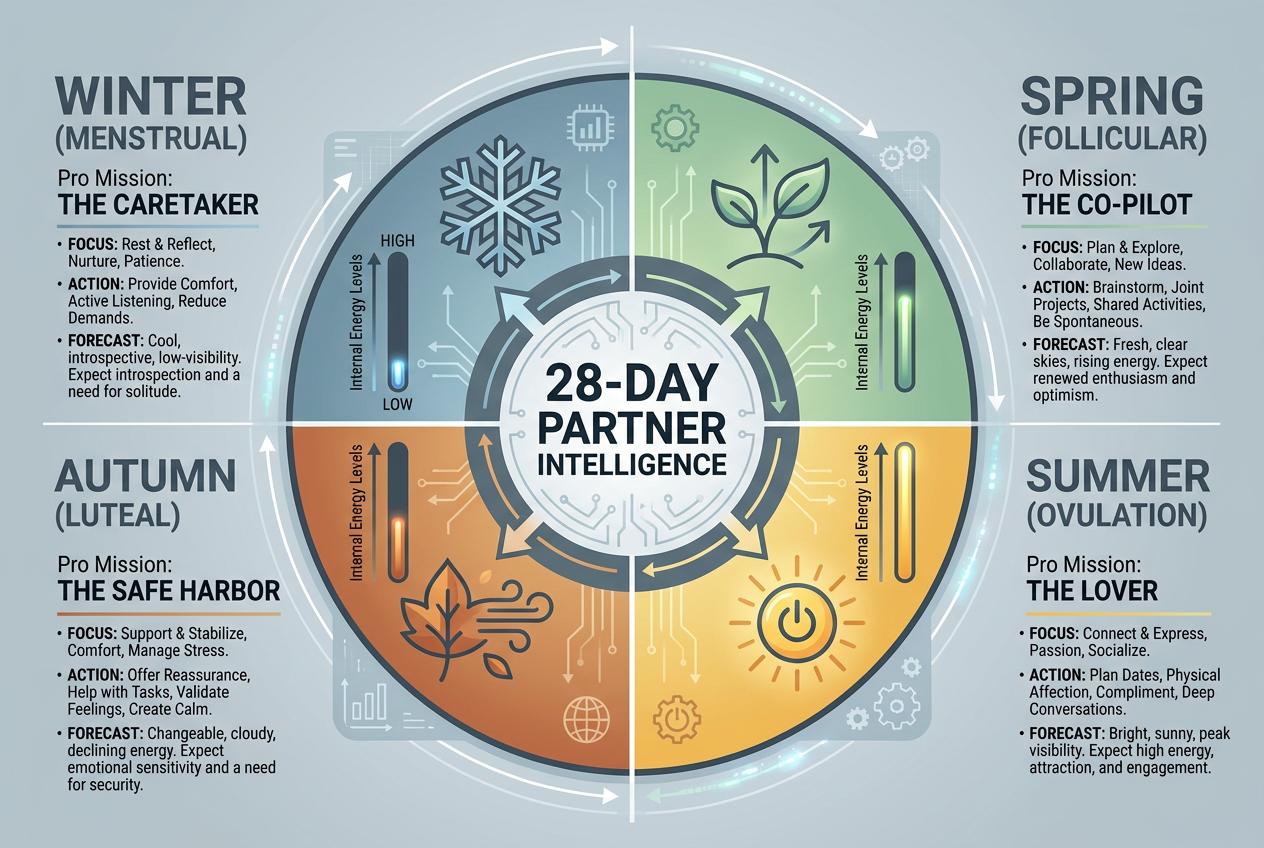 Understanding the four seasons of her cycle allows you to transition from reactive guessing to proactive relationship intelligence and better support.
Winter: The Menstrual Phase (Days 1-7)
Biology: Estrogen and progesterone have both crashed. Her uterus is shedding its lining, which means cramping, low energy, and often physical pain.
Her Experience: Low energy. Need for rest. Social battery depleted. She may want physical closeness but also space to recover. Think "hibernation mode."
Your Mission: The Caretaker
- Handle the logistics: meals, errands, household tasks she normally manages
- Bring heat (heating pad, hot water bottle, warm bath)
- Stock comfort foods and pain relief without being asked
- Don’t expect high social energy or enthusiasm for new plans
- Physical touch: gentle, non-sexual, comforting
What to say: "I’ve got dinner covered tonight. What sounds good?" or "Do you need anything from the store?"
What not to say: "Are you feeling better yet?" or "Want to go out tonight?"
Learn more tactical communication scripts in our guide on how to talk to your girlfriend during PMS.
Spring: The Follicular Phase (Days 8-14)
Biology: Estrogen is rising. Serotonin production increases. Testosterone begins its climb. Her brain is optimized for learning, creativity, and social connection.
Her Experience: High energy. Increased confidence. Social bloom. This is her "yes" window - she’s more likely to try new things, engage in deep conversations, and feel optimistic about plans.
Your Mission: The Co-Pilot
- Plan dates that require energy (hiking, concerts, travel)
- Tackle household projects together
- Have those important conversations you’ve been putting off
- Match her energy - this is the time for adventure and novelty
- Be present for deeper emotional connection
What to say: "Want to finally check out that restaurant?" or "I was thinking we could plan that trip - are you up for it?"
What not to say: Nothing. Just don’t waste this window by defaulting to routine.
If you want to optimize your date planning around her cycle, check out our guide on how to plan dates around girlfriend cycle phases.
Summer: Ovulation (Days 15-17)
Biology: Estrogen and testosterone peak. This is her biological "high summer" - the three-day window where evolutionary biology wants her to be attractive, confident, and sexually receptive.
Her Experience: Peak confidence. High libido. Maximum "glow." She may receive more attention from others (including other men). Her body language is more open. She feels at her best.
Your Mission: The Lover
- Prioritize physical intimacy - her libido is naturally elevated
- Give genuine compliments (appearance, energy, presence)
- Be romantic without being transactional
- Show up as your best self - this is when she’s most attracted to confidence and presence
- Don’t take for granted that she’s "always like this"
What to say: "You look amazing today" or "I love when you’re this energized."
What not to say: Comments that diminish her confidence or anything that reads as jealousy about attention from others.
Want to understand how to navigate this phase for better intimacy? Read our guide on libido and ovulation.
Autumn: The Luteal Phase (Days 18-28)
Biology: Progesterone rises, then crashes. Estrogen drops sharply. Serotonin follows. This is "storm week" - the phase most men associate with PMS. Sleep quality decreases. Stress resilience drops. The brain becomes hypersensitive to perceived rejection or criticism.
Her Experience: Increased irritability. Anxiety. Sensitivity to stress. Physical symptoms (bloating, breast tenderness, fatigue). She may need alone time. Small annoyances feel larger. Her threshold for bullshit is at zero.
Your Mission: The Safe Harbor
- Listen without fixing - she doesn’t need solutions, she needs validation
- Absorb conflict without escalating - her irritability isn’t personal
- Give space when requested without withdrawing affection
- Handle small stressors before they compound
- Buy the chocolate (seriously)
What to say: "That sounds really frustrating" or "What do you need from me right now?"
What not to say: "You’re overreacting" or "Is it that time of the month?"
For a tactical breakdown of this phase, read our boyfriend guide to the luteal phase.
The Science Behind the Mood Shifts
If you’re the kind of person who needs to understand the "why" before you buy in, here’s the biology:
The Estrogen-Serotonin Link
Estrogen doesn’t just regulate reproductive function - it also acts as a catalyst for serotonin production in the brain. When estrogen levels drop (particularly in the late luteal phase), serotonin production decreases with it.
Serotonin regulates:
- Mood stability
- Sleep quality
- Stress response
- Social confidence
This isn’t "in her head." It’s measurable brain chemistry. The week before her period, her brain is operating with less of the neurotransmitter that keeps humans calm and optimistic.
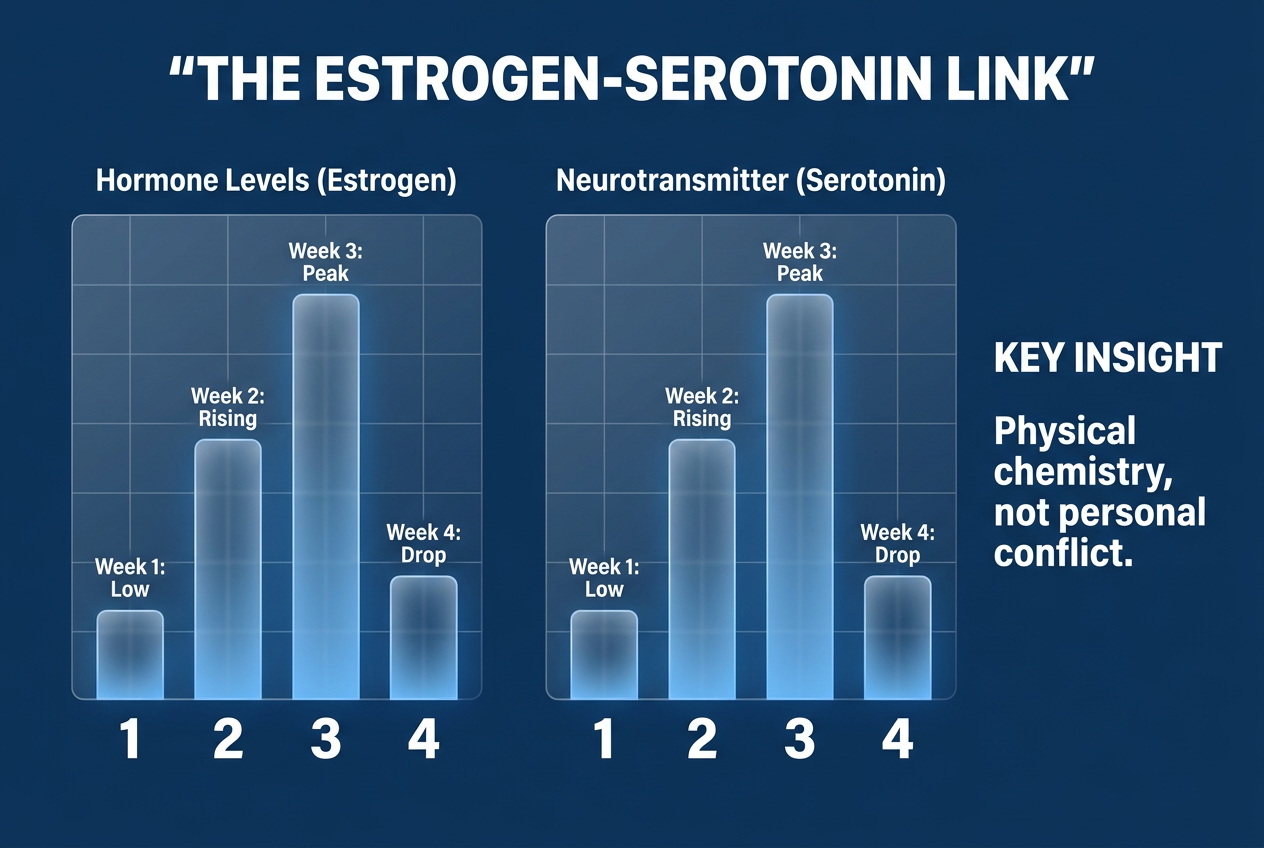 When estrogen levels drop in the final week, serotonin follows, creating a biological ’storm’ that affects mood, sleep, and stress resilience.
Brain Fog and Sleep Disruption
Progesterone, which peaks during the luteal phase, is metabolized into allopregnanolone - a compound that acts on GABA receptors in the brain. While GABA is generally calming, the rapid rise and fall of allopregnanolone can disrupt sleep architecture.
Poor sleep compounds everything: irritability, emotional regulation, stress resilience. She’s not choosing to be short-tempered. She’s running on a biological deficit.
Pain and Prostaglandins
During menstruation, the body produces prostaglandins - chemicals that cause the uterus to contract and expel its lining. High prostaglandin levels create cramping that can range from mild discomfort to debilitating pain.
Some women also experience prostaglandin-related symptoms like nausea, diarrhea, and headaches. It’s not "just cramps." It’s a full-body inflammatory response.
For more on how to support her during this phase, check out how to help your girlfriend during period mood swings.
What Not to Do: Common Mistakes That Make It Worse
Let’s get tactical about what blows up relationships during her cycle:
Never Ask: "Is It That Time of the Month?"
Even if you’re right, this question does three things:
- Dismisses her feelings as purely hormonal (they’re not - hormones amplify real issues)
- Makes her feel reduced to her biology
- Guarantees you will not get laid for the next week
Alternative: "You seem stressed. What’s going on?" or "How can I help?"
Don’t Try to "Fix" Everything
Men are problem-solvers. That’s valuable in many contexts. During her luteal phase, it’s often counterproductive.
She doesn’t need you to solve the work issue, the family drama, or the logistics problem. She needs you to witness her frustration without making her feel like she’s failing because she hasn’t solved it herself.
Bad response: "Have you tried just talking to your boss about it?"
Good response: "That sounds really frustrating. Your boss is putting you in an impossible position."
For more on validation-based communication, read our guide on what to say when your girlfriend has PMS.
Don’t Take It Personally
The hardest part for men: her irritability during the luteal phase isn’t about you. It’s about a brain that’s hypersensitive to stress and operating with less emotional buffer than usual.
That doesn’t mean you’re a punching bag. But it does mean you need to differentiate between:
- Real relationship issues that require discussion
- Hormonal amplification of minor annoyances that will resolve on their own
If she’s upset about something on Day 25, table the serious conversation until Day 10. See if it still feels urgent when her brain chemistry has normalized.
Don’t Weaponize Her Cycle
Never use her cycle as an excuse to dismiss legitimate concerns. "You’re just saying that because you’re PMSing" is relationship poison.
Her cycle may amplify existing issues, but it doesn’t create them out of nothing. If she’s consistently bringing up the same complaint - regardless of cycle phase - that’s a you problem, not a hormone problem.
The Cheat Code: Stop Guessing and Start Tracking
Here’s the truth: you can read every article on menstrual cycles and still fail at execution because you don’t know where she is in the cycle right now.
Most men operate on a 30-day delay: "Oh, that’s why last week was rough - she was about to start her period." That’s an autopsy, not a strategy.
The cheat code is shared tracking - using an app or calendar that gives you proactive visibility into her cycle so you can adjust your behavior before the storm hits.
Why Shared Tracking Works
For her: She doesn’t have to warn you, explain herself, or feel like she’s "complaining" about her biology. You just know.
For you: You get a daily notification like "She’s entering her luteal phase" and can adjust your expectations, communication style, and support accordingly.
For the relationship: Friction decreases. You stop walking on eggshells because you’re no longer guessing. She feels seen without having to advocate for herself.
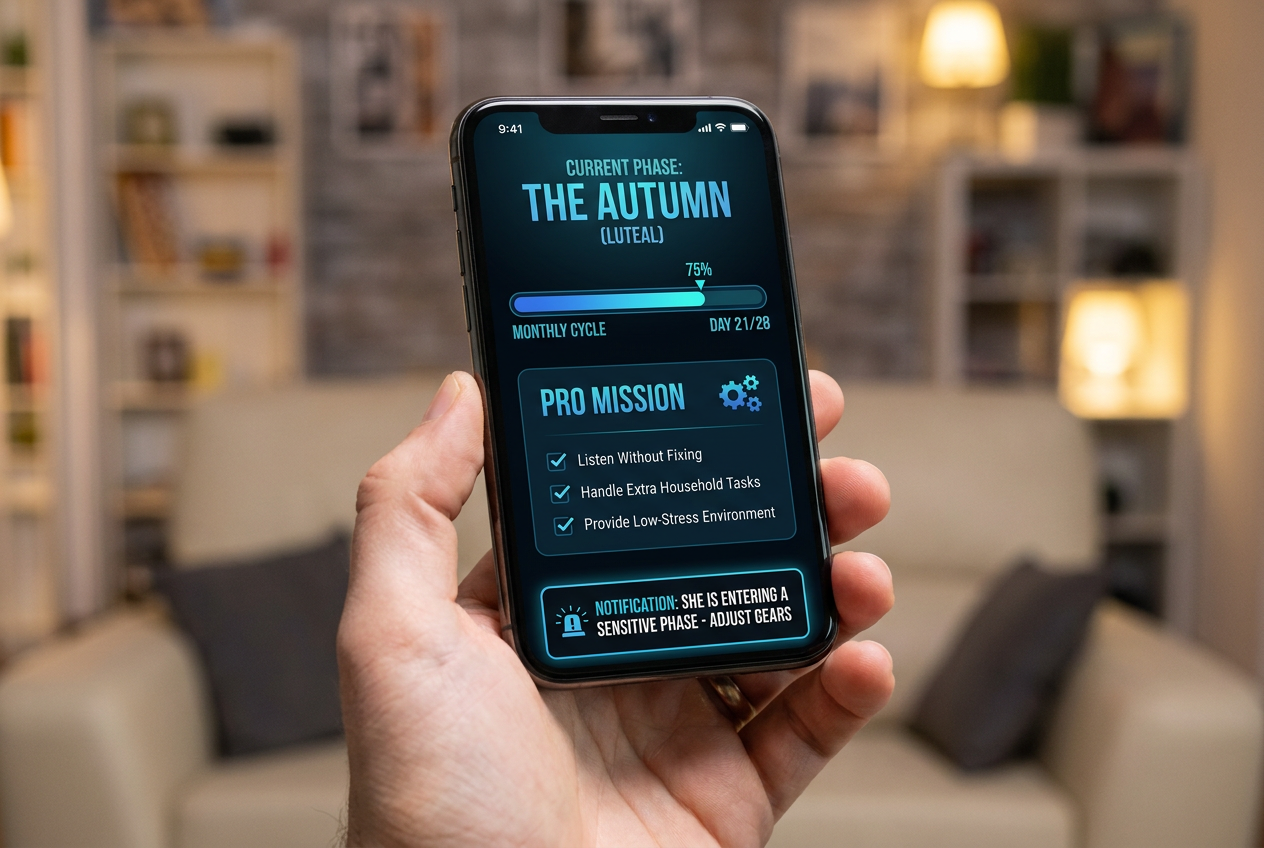 Using shared tracking tools removes the guessing game, providing you with a daily roadmap to be the partner she needs without her having to ask.
How to Start Using a Period Tracker as a Partner
Have the conversation: "I want to understand your cycle better so I can be a better partner. Would you be open to sharing your tracker with me?"
Choose the right tool: Look for apps designed for partners, not just women tracking fertility. Features that matter:
- Partner notifications
- Mood and symptom logging she can share
- Phase descriptions written for men
- Daily "missions" or tips based on her current phase
Set daily reminders: Check the app every morning. It takes 30 seconds and gives you the context you need for the entire day.
Act on the information: The tracker is useless if you don’t adjust your behavior. If it says she’s in her luteal phase, don’t pick a fight about the dishes. If it says she’s ovulating, plan something romantic.
For a deep comparison of the best tracking tools built for partners, check out our guide on the best period tracker apps for men.
The VibeCheck Advantage
Unlike generic period trackers designed for women, VibeCheck is built specifically for men in relationships. Instead of just telling you "she’s in her follicular phase," it gives you:
- Daily missions: Specific actions to take based on where she is in her cycle
- Communication scripts: What to say (and what not to say) in each phase
- Mood predictions: What to expect so you’re never blindsided
- Conflict alerts: Warnings when a fight is more likely due to biology, not relationship issues
It’s the difference between a weather app that says "rain" and one that says "bring an umbrella and leave 10 minutes early."
Explore how tracking works in practice with our period calculator tool.
Ready to actually understand her?
Join thousands of men using VibeCheck to track her cycle and show up better every day.
Frequently Asked Questions
Why does my girlfriend get so moody before her period?
The week before her period (the luteal phase), estrogen and serotonin levels drop sharply. Serotonin is the brain chemical responsible for mood stability, optimism, and stress resilience. With less serotonin, her brain is more reactive to stress, more sensitive to perceived criticism, and less able to regulate emotions. It’s not a character flaw - it’s measurable neurochemistry. Progesterone also peaks and then crashes during this phase, disrupting sleep quality and compounding irritability.
How long does PMS last?
PMS (premenstrual syndrome) typically lasts 5-10 days before menstruation begins. For most women, symptoms start around Day 20-22 of a 28-day cycle and resolve within 1-2 days of bleeding starting. However, severity and duration vary significantly. Some women experience minimal symptoms; others deal with debilitating mood swings, anxiety, and physical pain. If her symptoms consistently last longer than 10 days or severely disrupt daily life, she may have PMDD (premenstrual dysphoric disorder) and should consult a healthcare provider.
Is it normal to argue more with my girlfriend at certain times of the month?
Yes. Research shows that relationship conflict increases during the luteal phase (the 10 days before her period). This isn’t because "women are irrational" - it’s because her brain has less serotonin to buffer stress and frustration. Small annoyances that she’d normally let slide feel larger. The key is understanding that real issues may exist, but they’re amplified by biology. If she brings up the same concern consistently across multiple cycles, it’s a relationship issue. If it only surfaces during the luteal phase, it’s likely hormonal amplification of a minor irritant.
What can I do to help my girlfriend during her period?
Practical support makes the biggest difference. Handle household tasks without being asked. Stock comfort items (heating pad, pain relief, her preferred snacks). Give physical affection that’s comforting, not sexual. Don’t expect high energy or enthusiasm for new plans - her body is running a biological marathon. Most importantly, don’t minimize her pain. Cramps aren’t "just discomfort" - they’re caused by prostaglandins creating uterine contractions that can be as intense as labor pains. Read our detailed guide on supporting your girlfriend during her period.
Should I track my girlfriend’s period?
Yes - with her permission and involvement. Tracking her cycle gives you predictive intelligence: you’ll know when to plan high-energy dates (follicular/ovulation) and when to stay home (menstrual/late luteal). It removes the guessing game and allows you to be proactive instead of reactive. The key is using a partner-focused tracker that translates cycle data into actionable support, not just dates on a calendar. Apps like VibeCheck give you daily missions based on her phase so you know exactly how to show up.
Can stress make her period come early or change her mood even more?
Absolutely. Chronic stress disrupts the hypothalamic-pituitary-adrenal (HPA) axis, which regulates hormone production. High cortisol (the stress hormone) can suppress estrogen and progesterone, causing irregular cycles, early periods, or more severe PMS symptoms. If your girlfriend is under significant stress - work deadlines, family issues, major life changes - her cycle-related mood shifts will likely intensify. Your role: reduce external stressors where possible (take tasks off her plate) and be an emotional safe harbor during her luteal phase.
Why is my girlfriend so energetic and happy sometimes but withdrawn other times?
You’re observing the four seasons of her cycle. During the follicular phase and ovulation (Days 8-17), rising estrogen and testosterone create high energy, confidence, and social openness. During the menstrual phase (Days 1-7), hormone levels crash and her body needs rest. During the luteal phase (Days 18-28), progesterone’s sedative effects and dropping estrogen create lower energy and mood. She’s not inconsistent - her biology is cycling through natural performance and recovery windows. Match your expectations and support to where she is in the cycle.
How can I tell which phase of her cycle she’s in without asking?
Look for observable patterns: Menstrual (Days 1-7): Lower energy, need for rest, possible physical discomfort. Follicular (Days 8-14): High energy, social engagement, openness to plans. Ovulation (Days 15-17): Peak confidence, high libido, physical "glow." Luteal (Days 18-28): Gradual energy decline, increased irritability, sensitivity to stress, possible physical symptoms like bloating. You can also use a shared tracking app for precise phase information. Our guide on how to tell which cycle phase your girlfriend is in breaks down the visual and behavioral cues.
What’s the difference between PMS and PMDD?
PMS (premenstrual syndrome) causes mood swings, irritability, fatigue, and physical symptoms in the week before menstruation. It’s uncomfortable but doesn’t severely impair daily function. PMDD (premenstrual dysphoric disorder) is a severe form affecting 3-8% of women. Symptoms include debilitating depression, anxiety, anger, and sometimes suicidal thoughts. PMDD requires medical treatment - often SSRIs or hormonal interventions. If your girlfriend’s symptoms consistently interfere with work, social life, or safety, encourage her to see a healthcare provider. PMDD is not "bad PMS" - it’s a distinct disorder.
The bottom line: Your girlfriend’s mood changes throughout the month because her brain chemistry changes throughout the month. Once you understand the pattern, you stop taking her shifts personally and start showing up as the partner she actually needs - not the one you think she should need.
Stop guessing. Start tracking. And watch your relationship move from reactive friction to proactive connection.
Ready to become the partner who just gets it? Download VibeCheck and get your first week of cycle-based relationship intelligence free.
Tags

Related Articles
Continue reading to deepen your understanding

How to Understand Your Girlfriend’s Social Battery and Hormones
Does your girlfriend suddenly cancel plans or seem withdrawn? This guide explains how her cycle impacts her energy so you can support her like a pro.

How Your Girlfriend’s Emotional Needs Change During Her Cycle
Does your girlfriend’s mood seem unpredictable? Learn how her emotional needs shift on a biological loop and how to support her through every phase of her cycle.

What to Buy When Your Girlfriend Has Hormone Cravings: A Support Guide
Stop wondering what to pick up at the store. This guide explains the science behind cycle cravings and provides a specific list of foods and comfort items she needs.

Your Girlfriend’s Mood Shifts Throughout the Month, Explained
Ever wonder why her energy and moods change so drastically each week? Understand the four hormonal phases and how to be the partner she needs during every stage of her cycle.

How to Support Your Girlfriend When She’s Crying Because of Hormones
Watching her cry when hormones hit can feel overwhelming. Learn the biological why behind the tears and use these proven scripts to provide the support she actually needs right now.

How to Help Your Girlfriend with Hormonal Mood Swings Without Arguing
Understand her cycle and learn tactical scripts to handle tension. This guide shows you how to support her through hormonal shifts without getting into unnecessary fights.

When to Feed Your Girlfriend: Understanding Hangry Hormones
Does your girlfriend get irritable when she hasn’t eaten? It’s not just in her head. Learn why hormones cause hanger and the specific times her body needs more fuel.

The Boyfriend’s Guide to Supporting Your Partner Through PMS
If your partner is suddenly irritable and exhausted, it’s biology, not you. Learn about the luteal phase and how to provide meaningful support without walking on eggshells.