How to Help Your Girlfriend During Ovulation Week: A Partner’s Playbook

Has she suddenly hit peak energy? That’s her biological summer. Learn how to navigate her cycle and support her social and creative spikes during ovulation week.
The Partner's Playbook: How to Help Your Girlfriend During Ovulation Week
You've noticed the shift. Her energy spikes, her plans multiply, and she seems more radiant than usual. The social calendar fills up fast. She's signing up for a new class, reorganizing the apartment, and somehow managing to look like she slept 10 hours when she only got six.
Welcome to ovulation week - the biological "summer" of her menstrual cycle. While most relationship content focuses on managing PMS or period symptoms, this seven-day window is when your partner is operating at peak performance. The question isn't how to "handle" this phase. It's how to keep up with it.
This guide will teach you to recognize the biological markers of ovulation, understand what's happening in her body, and use strategic support to amplify her natural energy rather than just survive it.
Table of Contents
- The Biological Summer: What Ovulation Actually Is
- The Glow Checklist: How to Spot Ovulation
- The Partner Playbook: Four Strategic Pillars
- The Masculinity Question: Addressing the Research
- Common Mistakes Partners Make
- The Ovulation Pain Exception: When She Needs Physical Support
- Frequently Asked Questions
The Biological Summer: What Ovulation Actually Is
Ovulation is the three-to-five-day window when estrogen peaks and testosterone temporarily surges in women. Think of it as her body's version of a pre-game warmup - except the game is every social, creative, and physical opportunity in front of her.
VibeCheck App
Know what she needs. Before she has to say it.
Track her cycle, understand her phases, be the partner she deserves.
Download Free on iOS →Here's what's happening biologically:
Estrogen climbs to its monthly peak. This hormone sharpens cognitive function, boosts energy levels, and increases social motivation. Her brain is literally wired to be more outgoing right now.
Testosterone spikes briefly. This drives increased libido, competitive energy, and physical confidence. She's not imagining the extra gym motivation.
Cortisol regulation improves. Stress feels more manageable during this phase. The overwhelm that defines other parts of her cycle temporarily lifts.
The result? She's energized, decisive, socially magnetic, and more likely to take initiative on projects she's been putting off. Researchers have even measured the physical changes - her voice pitch increases by an average of 20 Hz during ovulation, a shift that makes her sound more animated in conversations.
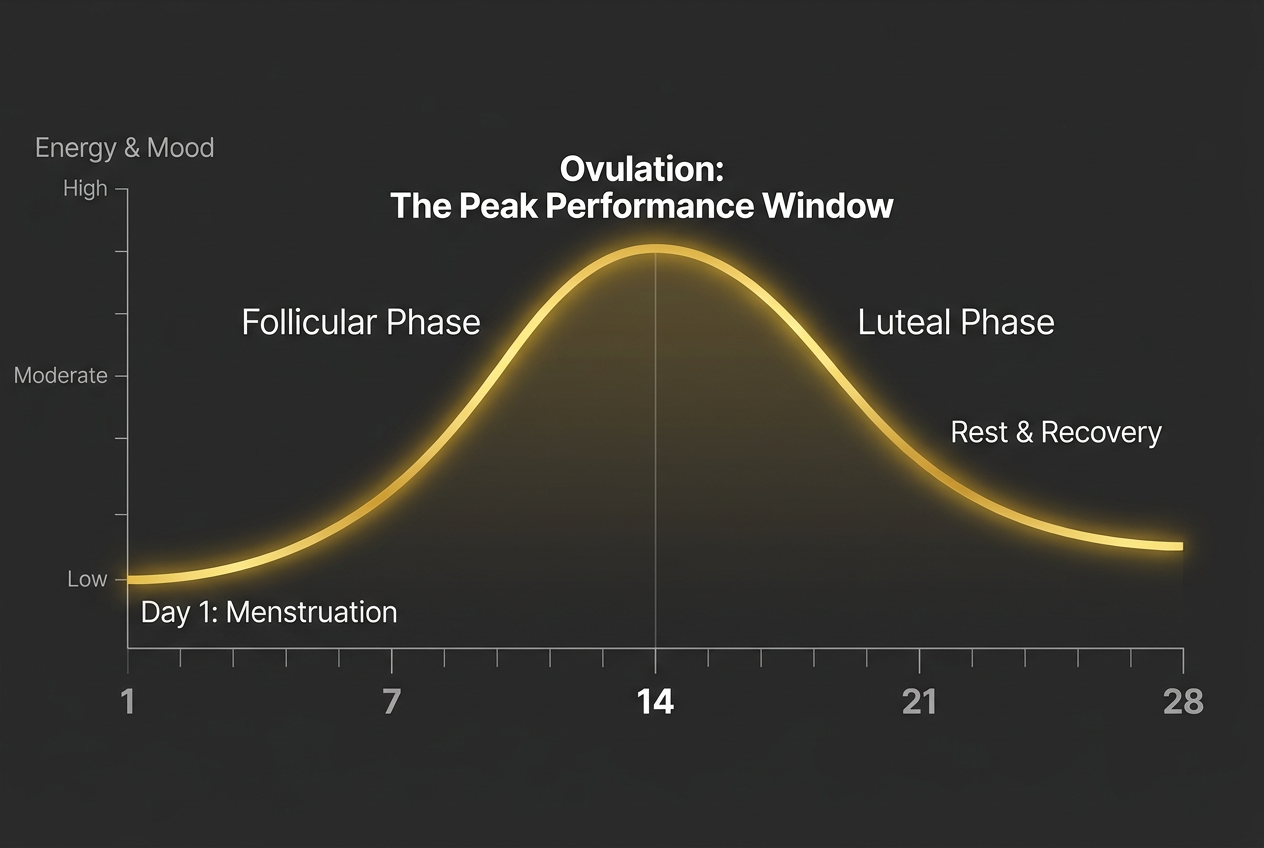 Understanding the biological summer: This energy map highlights how ovulation serves as a peak performance window, characterized by high social energy and mental sharpness.
This isn't about fertility tracking or trying to conceive. It's about understanding when your partner's biological rhythm creates a natural window for connection, adventure, and productivity.
The Glow Checklist: How to Spot Ovulation
You won't need a calendar app if you know what to look for. These are the physical and behavioral markers that signal she's in her ovulation window:
Physical Signs
Her skin looks clearer. Estrogen improves skin elasticity and reduces inflammation. You might notice she's not covering up as much or seems more confident in photos.
She pays more attention to appearance. This isn't vanity - it's biology. Research shows women unconsciously invest more effort in their appearance during ovulation. The new outfit, the different hairstyle, the extra attention to detail? That's hormones at work.
Her voice sounds higher and more animated. The 20 Hz pitch increase is subtle but real. She might sound more enthusiastic or expressive than usual.
Increased body temperature. This is a medical marker tracked by fertility apps, but you might notice she kicks off the covers more often or prefers cooler room temperatures.
Behavioral Shifts
High social battery. She's up for group hangouts, initiating plans with friends, and has the energy for back-to-back commitments. The introvert in your relationship temporarily becomes an extrovert.
Mental sharpness. Complex work projects feel easier. She's solving problems faster and thinking more strategically. Studies show spatial reasoning and verbal fluency both improve during this phase.
Increased libido. This is the most obvious marker for most couples. Her interest in physical intimacy rises naturally due to the testosterone spike.
"Feral" energy. Some partners describe this as restlessness or a need to be doing something productive. She's not anxious - she's just operating at a higher baseline.
The Mittelschmerz Exception
About 20% of women experience "Mittelschmerz" - a sharp, cramping pain on one side of the lower abdomen when the ovary releases an egg. If your partner is in this group, ovulation won't feel like pure energy. She'll need different support.
What helps:
- Heat therapy (heating pad on lower abdomen)
- Light stretching or walking to improve blood flow
- Validation that the pain is real and temporary
- Offering to handle physically demanding tasks
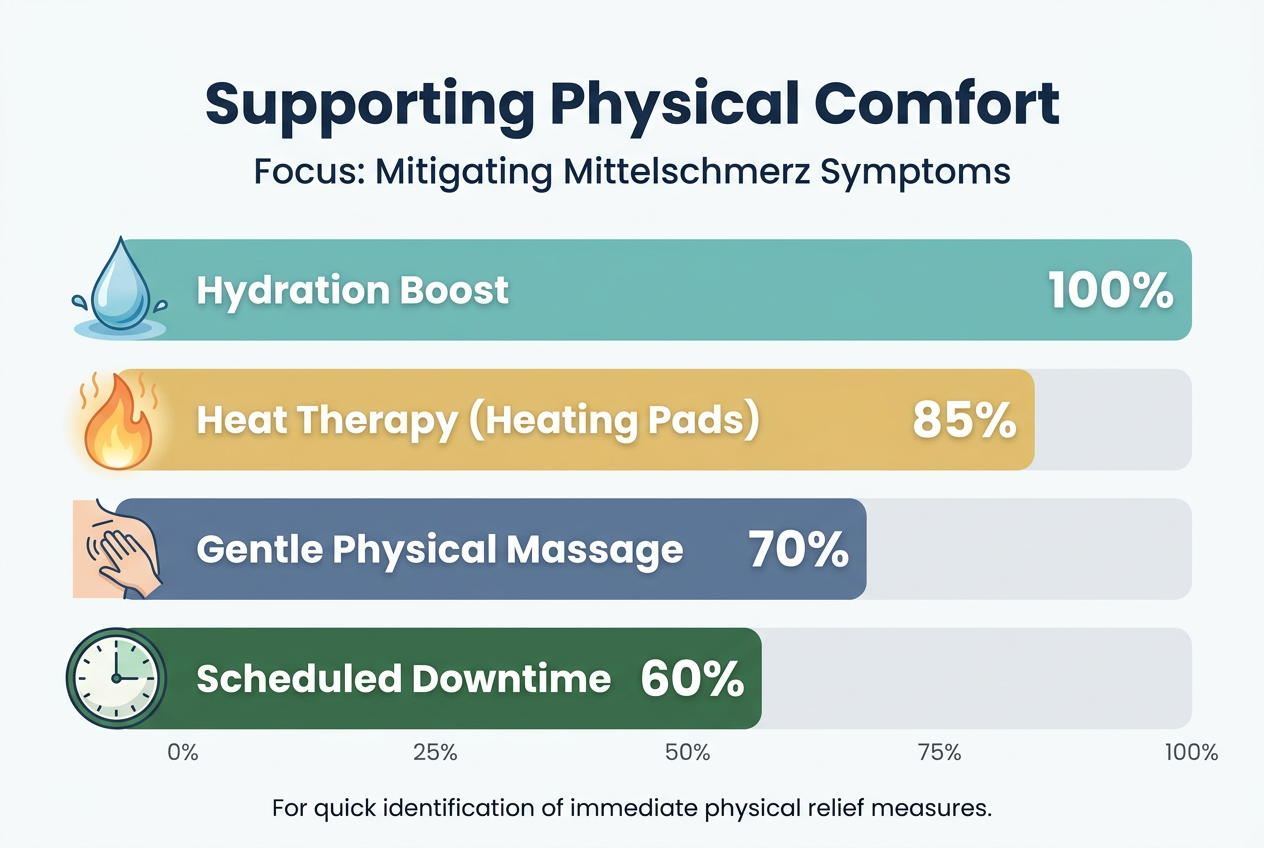 Physical support priorities: When ovulation pain or Mittelschmerz occurs, these targeted actions provide the most effective relief and comfort for your partner.
If she experiences severe pain, prolonged discomfort, or symptoms that interfere with daily life, this warrants a conversation with her doctor. Mittelschmerz should be temporary and manageable.
The Partner Playbook: Four Strategic Pillars
This phase requires active participation, not passive observation. Here's how to match her energy and become the partner who amplifies her natural momentum.
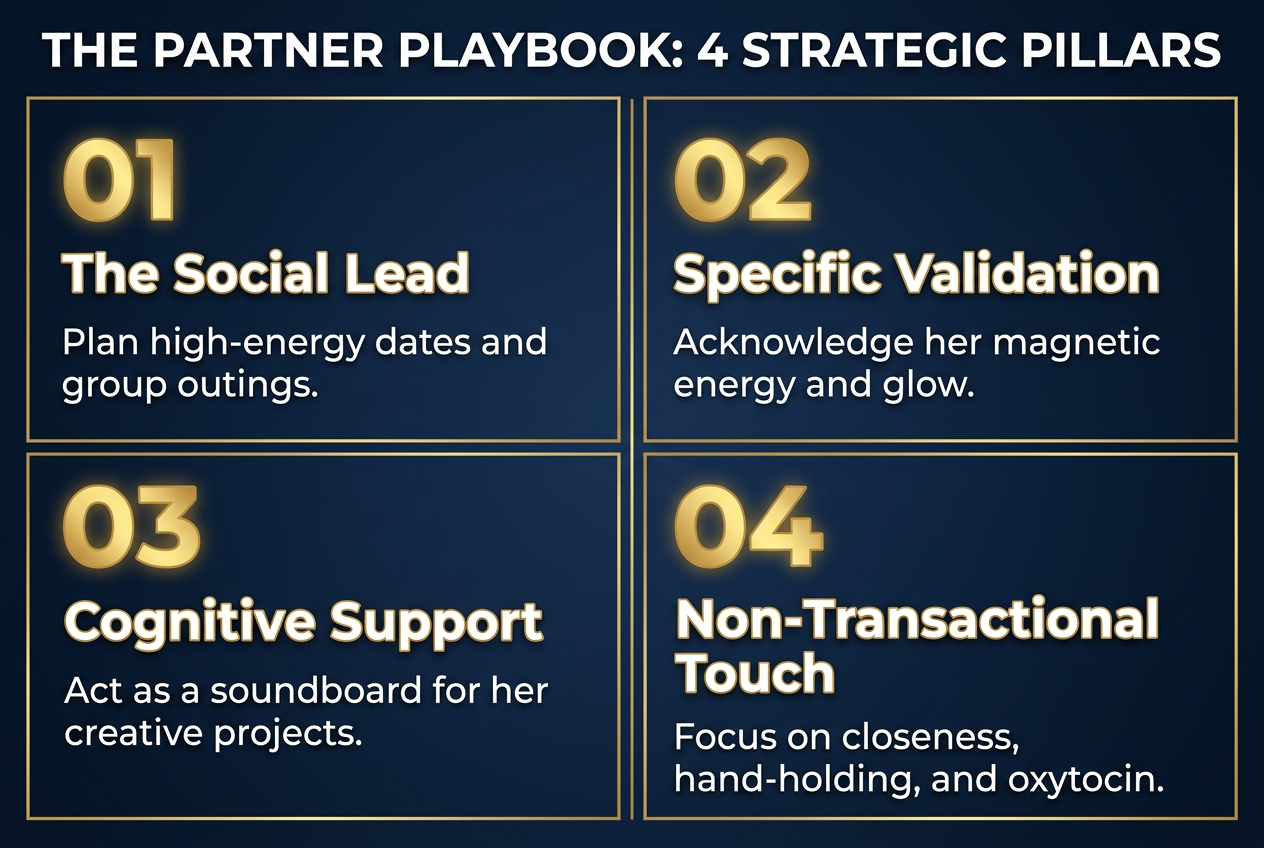 The four pillars of partner support: A strategic framework for transitioning from passive observation to active amplification of your partner's highest energy week.
Pillar 1: The Social Lead
Ovulation week is "big date" season. Her social battery is charged and she's looking for experiences, not quiet nights in.
What this looks like in practice:
Book the concert tickets she mentioned last month. Suggest the group hangout with friends she's been too tired to organize. Take her to the new restaurant that requires a reservation. This is the week she'll say yes to trying the dance class, going to the networking event, or checking out that pop-up market.
The key is taking initiative. Don't ask "What do you want to do?" when her energy is high. Present options: "I grabbed tickets to the comedy show Friday or we could check out that new rooftop bar - which sounds better?"
Script: "You seem like you've got a ton of energy this week. Want to finally try that escape room you bookmarked?"
Pillar 2: Specific Validation
Generic compliments fall flat during ovulation. She knows she looks good - her body is telling her that. The validation she needs is specific and observational.
What works:
- "You have so much energy today, it's magnetic."
- "That presentation you gave was sharp - you were on fire."
- "I noticed you've been crushing your workouts this week."
What doesn't work:
- "You look nice" (too vague)
- "You're always beautiful" (dismisses the specific shift she's feeling)
- Over-the-top compliments that feel disconnected from reality
The goal is to acknowledge the peak without making her feel like a science experiment. You're noticing her strengths, not tracking her ovulation on a spreadsheet.
If you want a structured approach to understanding her complete cycle, the boyfriend's guide to her menstrual cycle phases breaks down all four windows.
Pillar 3: The Creativity Soundboard
Estrogen sharpens problem-solving and boosts creative thinking. This is the week she's most likely to tackle the side project, reorganize her career strategy, or finally start that thing she's been planning.
Your job isn't to manage her ambitions - it's to be the soundboard who takes them seriously.
Tactical support:
- Ask follow-up questions about her projects instead of just nodding
- Offer to handle logistics that free up her mental space (grocery run, dinner planning)
- Validate her ideas without immediately pointing out obstacles
- Be the person who says "That sounds ambitious - what's the first step?"
Script: "You mentioned wanting to redesign your portfolio. If you want to work on that this weekend, I can handle the errands so you have uninterrupted time."
This isn't about becoming her assistant. It's about recognizing when she's operating at peak capacity and removing friction so she can execute.
Pillar 4: Non-Transactional Touch
Oxytocin - the bonding hormone - is more easily triggered during ovulation. Physical touch carries more emotional weight this week, which means your approach to intimacy matters.
High-value actions:
- Hand-holding during walks
- Sustained eye contact during conversations
- Physical closeness without an agenda
- Initiating affection that doesn't immediately lead to sex
The mistake: Treating ovulation like guaranteed intimacy week. Her increased libido doesn't mean she's always in the mood - it means she's more receptive when the context is right. Pressuring her or making transactional comments ("You're ovulating, so...") will backfire fast.
The partner who understands this focuses on building oxytocin through consistent, low-pressure connection. The sex that happens during this phase is a byproduct of feeling seen and appreciated, not an obligation she owes you for tracking her cycle.
For more guidance on reading her signals throughout the month, check out our article on how to tell which cycle phase your girlfriend is in.
The Masculinity Question: Addressing the Research
You've probably seen the TikToks or Reddit threads claiming women prefer "more masculine" men during ovulation. The science behind this is real but misunderstood.
What the Research Actually Says
Studies show women rate stereotypically masculine facial features (strong jawline, facial symmetry) as more attractive during ovulation. Some research also suggests women unconsciously seek partners who display confidence, decisiveness, and status cues during this phase.
What this doesn't mean: You need to suddenly act like an alpha-male caricature. Overcompensating by becoming overly dominant, dismissive, or aggressive will repel her faster than anything else.
What Actually Works
Be decisive. When she asks where you want to eat, don't say "I don't care." Pick the restaurant. This isn't about dominance - it's about reducing decision fatigue when she's already operating at full capacity.
Maintain eye contact. Present, focused attention signals confidence. Put your phone down during conversations. Show up fully when she's talking.
Take initiative on practical tasks. Handle the car maintenance, book the weekend plans, or deal with the household task she mentioned. Leadership isn't about being "in charge" - it's about removing friction from her life.
Don't announce you're tracking her cycle. The moment you say "I know you're ovulating" is the moment this entire strategy becomes creepy. Keep the awareness invisible. She doesn't need to know you're calibrating your support based on her hormones.
The real insight here isn't about "masculine traits." It's about showing up as the most capable, attentive version of yourself when she's at her best. That means matching her energy, not trying to dominate it.
To better navigate her mood shifts throughout the entire month, read why your girlfriend's mood changes throughout the month.
Common Mistakes Partners Make
Even well-intentioned partners sabotage themselves during ovulation. Here are the patterns to avoid:
The Tracker Reveal
The mistake: Casually mentioning "I see you're ovulating" or referencing her cycle in front of others.
Why it backfires: It makes her feel like you're monitoring her body instead of understanding her as a person. The biology should inform your actions invisibly - not become a conversation topic.
The fix: Keep your cycle awareness private. She shouldn't feel like she's being studied.
The Transactional Error
The mistake: Expecting sex because she's ovulating or making comments like "I thought you'd be in the mood this week."
Why it backfires: Her increased libido is biological, but her actual desire is still tied to emotional connection and context. Treating ovulation as a sexual obligation destroys the trust that makes intimacy possible.
The fix: Focus on connection first. The physical intimacy follows naturally when she feels seen and appreciated.
The Invalidation
The mistake: Using biology to dismiss her feelings. "You're just ovulating, you'll feel different next week."
Why it backfires: Even if hormones are influencing her mood, her emotions are still real and valid in the moment. Dismissing them as "just hormones" is condescending and guarantees conflict.
The fix: Validate first, contextualize later. If she's excited about a new project, support it now. If it fades in two weeks, that's a separate conversation.
The Energy Mismatch
The mistake: Suggesting quiet, low-energy activities when she's clearly operating at peak capacity.
Why it backfires: She wants to maximize this high-energy window. Proposing a movie night when she's ready to conquer the world feels like you're not paying attention.
The fix: Match her energy. If she's fired up about plans, lean in. Save the quiet nights for the luteal phase when her energy naturally drops.
The Ovulation Pain Exception: When She Needs Physical Support
Not every woman experiences ovulation as pure energy. For the 20% who feel Mittelschmerz, this phase requires physical support, not adventure planning.
What Mittelschmerz Feels Like
Sharp, cramping pain on one side of the lower abdomen that lasts anywhere from a few minutes to 24 hours. It can feel like a sudden stab or a persistent ache. Some women also experience light spotting or bloating.
The pain occurs when the ovary releases an egg. It's usually mild and temporary, but it's real.
How to Support Her Through It
Heat therapy. A heating pad on her lower abdomen reduces cramping by improving blood flow. Offer to grab it without making her ask.
Light movement. Gentle walking or stretching can ease the discomfort. Suggest a slow walk around the neighborhood if she's up for it.
Validation. Acknowledge the pain is real. Don't minimize it by saying "It's just ovulation."
Take over physical tasks. If she needs to rest, handle the grocery run, meal prep, or other physically demanding tasks.
Script: "I know you're dealing with ovulation pain. Want me to handle dinner so you can rest with the heating pad?"
If the pain is severe, lasts longer than 24 hours, or comes with heavy bleeding, fever, or nausea, she should talk to her doctor. Ovulation pain should be manageable - if it's interfering with daily life, there might be an underlying issue like endometriosis or ovarian cysts.
For more insight into supporting her during different phases, explore our guide on how to comfort your girlfriend during PMS.
Using VibeCheck to Track Her Cycle
Most period tracker apps are built for women trying to conceive. VibeCheck is built for partners who want to understand their girlfriend's biological rhythm without making it weird.
Here's what makes it different:
Daily relationship insights. Instead of fertility predictions, you get tactical advice on what kind of support she needs today based on her cycle phase.
Mood and energy tracking. You'll know when she's hitting peak performance (ovulation) versus when she needs quiet space (luteal phase).
Communication scripts. The app suggests specific phrases and approaches that work for each phase. No more guessing what to say when her mood shifts.
Privacy-focused. Her cycle data stays between you. No selling information to third parties, no intrusive ads, no awkward notifications that expose what you're tracking.
If you're serious about becoming the partner who understands her rhythm, VibeCheck's period tracker for men gives you the framework to do it right.
Ready to actually understand her?
Join thousands of men using VibeCheck to track her cycle and show up better every day.
Frequently Asked Questions
Does birth control stop the ovulation "glow"?
Yes. Hormonal birth control (pills, IUDs, implants, shots) suppresses ovulation by keeping hormone levels artificially flat. Women on birth control don't experience the natural estrogen and testosterone peaks that create the high-energy ovulation window.
This doesn't mean she won't have good days - it just means her energy and mood won't follow the predictable four-phase pattern. If your partner is on birth control and you're trying to understand her cycle, focus on external factors like stress, sleep, and workload instead of hormonal phases.
How long does ovulation actually last?
The biological event - the release of an egg - happens in a single moment. But the elevated estrogen and testosterone that create the "ovulation effect" last about three to five days. This window typically occurs around day 12 to 16 of a 28-day cycle, though every woman's timing is slightly different.
You'll notice the energy spike builds gradually, peaks for two to three days, and then tapers off as progesterone starts to rise during the luteal phase.
What if she gets "ovulation rage"?
Rare, but possible. Some women experience irritability or mood swings during ovulation if estrogen spikes too quickly or if they're sensitive to the testosterone surge. This is less common than PMS but can happen.
If your partner experiences this, the same validation principles apply: acknowledge her feelings without dismissing them as "just hormones." The irritability is real, even if it's hormonally driven.
Script: "I can tell you're frustrated. What do you need from me right now?"
If ovulation consistently brings negative mood shifts, she should talk to her doctor. This can be a sign of estrogen dominance or other hormonal imbalances that are worth investigating.
Can I track her cycle without it being creepy?
Yes, but only if you keep it invisible. The moment she feels monitored or studied, the dynamic shifts from supportive to invasive.
Do this:
- Use a private app like VibeCheck that doesn't send notifications to her phone
- Adjust your support based on what you observe (her energy, mood, behavior) rather than announcing "the app says you're ovulating"
- Keep the biological context in your head - don't make it a topic of conversation
Don't do this:
- Tell her friends or family that you track her cycle
- Make comments like "You're in your follicular phase, so you should be happy"
- Use cycle tracking to justify your behavior ("I knew you'd be moody this week")
The goal is to become more attuned to her needs, not to make her feel like a science experiment.
What if we're not trying to conceive? Is this guide still relevant?
Absolutely. The ovulation window affects energy, mood, and behavior regardless of whether pregnancy is the goal. Most cycle-focused content assumes you're tracking fertility, but this phase is about relationship optimization - not conception.
If you're child-free or not planning to have kids anytime soon, understanding ovulation still gives you a tactical advantage. You'll know when she's most open to new experiences, when her social battery is charged, and when physical intimacy is most likely to feel natural and connected.
Should I suggest she track her cycle?
Only if she's already interested. Don't push cycle tracking as a solution to relationship friction or mood swings. That makes it feel like you're blaming her biology instead of learning to work with it.
If she's already tracking her cycle and open to sharing, great - you can sync your support to her data. If she's not interested, you can still observe behavioral and physical cues without relying on an app.
Script (if she's open to it): "I've been learning about how hormones affect energy and mood. If you're comfortable sharing your cycle timing, I can do a better job supporting you."
How do I bring this up without sounding like I'm blaming hormones?
Frame it as wanting to be a better partner, not as "fixing" her mood.
What works: "I've noticed you have more energy certain weeks and seem more stressed other weeks. I want to understand your rhythm so I can show up better."
What doesn't work: "Your mood swings are hard to deal with. Can you track your cycle so I know when to avoid you?"
The difference is intent. If you're genuinely curious about how to support her, that comes across. If you're looking for a way to blame her emotions on biology, she'll sense that immediately.
Is there a way to predict when she'll be ovulating without asking?
Observational cues are your best bet. Watch for the physical and behavioral markers outlined earlier - increased energy, higher social engagement, clearer skin, and a shift toward adventurous plans.
Most women with regular cycles ovulate 12 to 16 days before their next period. If her cycle is consistent, you can count backward from her period to estimate ovulation. But this only works if her cycle is predictable.
For irregular cycles or if you want precise tracking, apps like VibeCheck's period calculator can help you predict timing based on her past cycles.
The Final Play
Ovulation week is your partner operating at her biological best - higher energy, sharper thinking, stronger social drive. The men who understand this don't just "handle" the week. They lean into it, match her momentum, and use the window to build deeper connection.
This isn't about becoming a cycle-tracking expert or treating her like a biology experiment. It's about paying attention to patterns, calibrating your support to her needs, and showing up as the partner who amplifies her strengths instead of just managing her lows.
Master the four pillars - social leadership, specific validation, creative support, and non-transactional touch - and you'll stop guessing what she needs. You'll start anticipating it.
If you want a tactical framework that turns cycle awareness into daily actions, VibeCheck gives you exactly that. Real insights, zero awkwardness, and the playbook to become the partner who gets it.
Tags

Related Articles
Continue reading to deepen your understanding

Your Girlfriend Is Withdrawn During Ovulation? What It Actually Means and How to Respond
Is your girlfriend suddenly distant mid-cycle? This guide covers the biological causes of ovulation withdrawal and how to support her with an invisible framework.

When Your Girlfriend Is Sensitive to Criticism During the Luteal Phase: The Partner’s Science-Based Action Guide
Does your partner react intensely to feedback right before her period? Understand the biology behind luteal phase rejection sensitivity and learn how to communicate effectively.

How to Give Your Girlfriend Reassurance During the Follicular Phase: A Partner’s Tactical Guide
Is your girlfriend feeling vulnerable after her period? Learn why the early follicular phase causes emotional lows and how you can provide the specific reassurance she needs to feel secure.

Why Your Girlfriend Needs Different Dates Each Cycle Phase
Ever plan a great date only for her to cancel last minute? Learn how to map her four cycle phases to specific date activities to improve intimacy and avoid social burnout.

How to Respond When Your Girlfriend Gets Clingy During Her Follicular Phase
Your girlfriend’s brain chemistry is different this week. Rising estrogen levels cause social drive to peak. Here is how to respond to her need for connection effectively.

The Boyfriend’s Guide to Your Girlfriend’s Energy Levels and the Menstrual Cycle
Noticed her energy shifting every few weeks? Stop guessing and start supporting. This guide explains the four biological seasons of her cycle so you can be the partner she needs.

Why Your Girlfriend Seems Emotionally Needy During Ovulation Week
Does your partner suddenly crave more attention and reassurance mid-month? It is not insecurity—it is biology. Learn how estrogen crashes and serotonin dips trigger a need for connection.

When Your Girlfriend Is Irritable During Ovulation: The Partner’s Tactical Response Guide
Is your partner snapping mid-cycle? Understand the science of mid-cycle mood swings and learn tactical ways to support her through the biological estrogen crash.