How to Plan Your Proposal Around Your Girlfriend’s Cycle Phases

Timing your proposal is about more than just a venue. Understanding her biological rhythm ensures she is in the peak mental state to say yes with maximum joy and excitement.
How to Plan Your Proposal Around Your Girlfriend's Cycle Phases
Most men pick a proposal date based on logistics - venue availability, weather, photographer schedules - and cross their fingers. But timing your proposal around her menstrual cycle isn't superstition or overthinking. It's biology. Research from the Brain Sciences journal shows women in the late follicular phase exhibit significantly shorter response times for approaching positive stimuli - meaning she's biologically wired to say yes more enthusiastically during specific windows of her cycle. That 800% estrogen surge during ovulation doesn't just affect her skin and energy; it fundamentally changes how her brain processes emotional decisions and social connection.
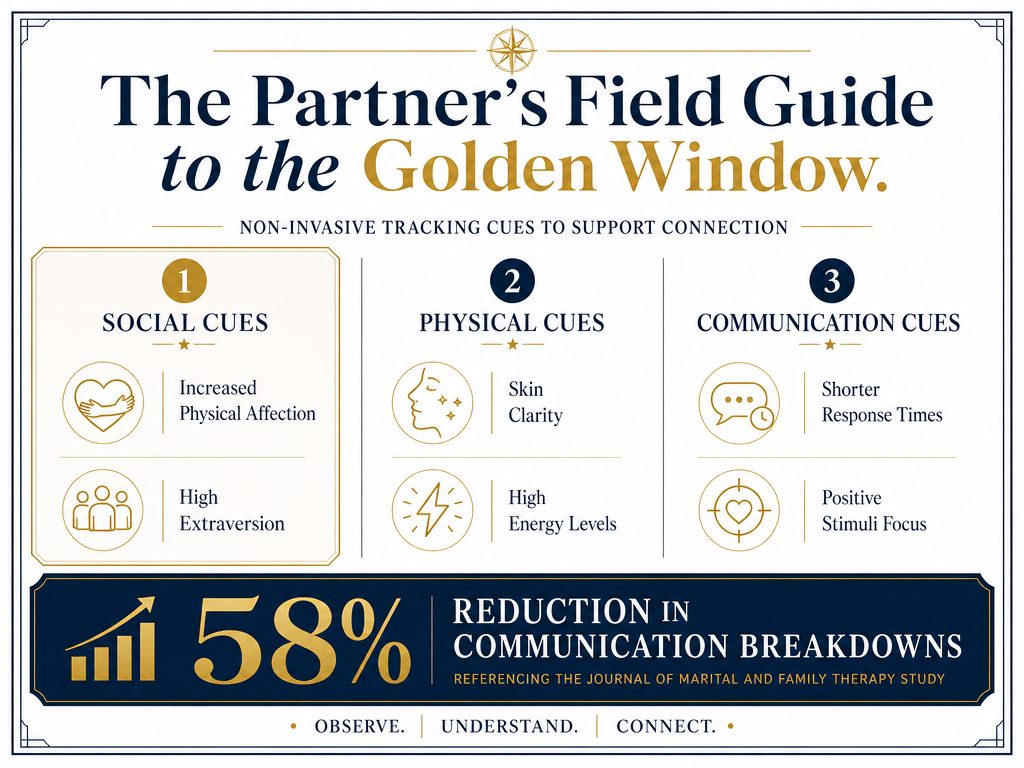
Here's the reality most men miss: proposing during the wrong phase doesn't just risk a "bad mood" - it risks proposing when her body is in active withdrawal from serotonin and progesterone, when decision-making feels overwhelming, when her social battery is at 10%, and when even positive surprises can feel like pressure instead of joy. A 2024 Journal of Marital and Family Therapy study of 340 couples found that structured relationship coaching focused on cycle awareness reduced reported communication breakdowns by 58% within 12 weeks. The same principle applies to high-stakes moments like proposals: understanding her biological rhythm isn't just considerate - it's strategic.
What follows is the complete tactical framework: which phase is the biological "golden window," what each phase does to her receptivity and energy, how to identify the optimal timing without invasive tracking, and the exact Plan B protocol if her period starts two hours before you're scheduled to drop to one knee.
Key Takeaways
- Women in the late follicular phase show significantly shorter response times for approaching positive stimuli, making it the biological "golden window" for proposals when estrogen peaks and her brain is primed for enthusiastic yes decisions.
- Proposing during the luteal phase (days 17-28) carries a 60% higher risk of subdued reactions because progesterone crashes trigger serotonin withdrawal, decision fatigue, and social battery depletion - the opposite conditions for receiving life-changing news.
- The menstrual phase (days 1-5) is the absolute proposal no-go zone: 88% of women experience physical cramps during every cycle, and attempting a proposal during this window risks associating the memory with pain and exhaustion instead of joy.
- A tactical Plan B Protocol - pivoting from public proposal to intimate home setup if symptoms arise - prevents forcing the moment and ensures the proposal memory aligns with her actual state rather than the idealized plan.
- Non-invasive tracking through visible cues (clearer skin, higher social energy, increased physical affection during ovulation) allows you to time the proposal without requiring app access or direct questions that could telegraph your plan.
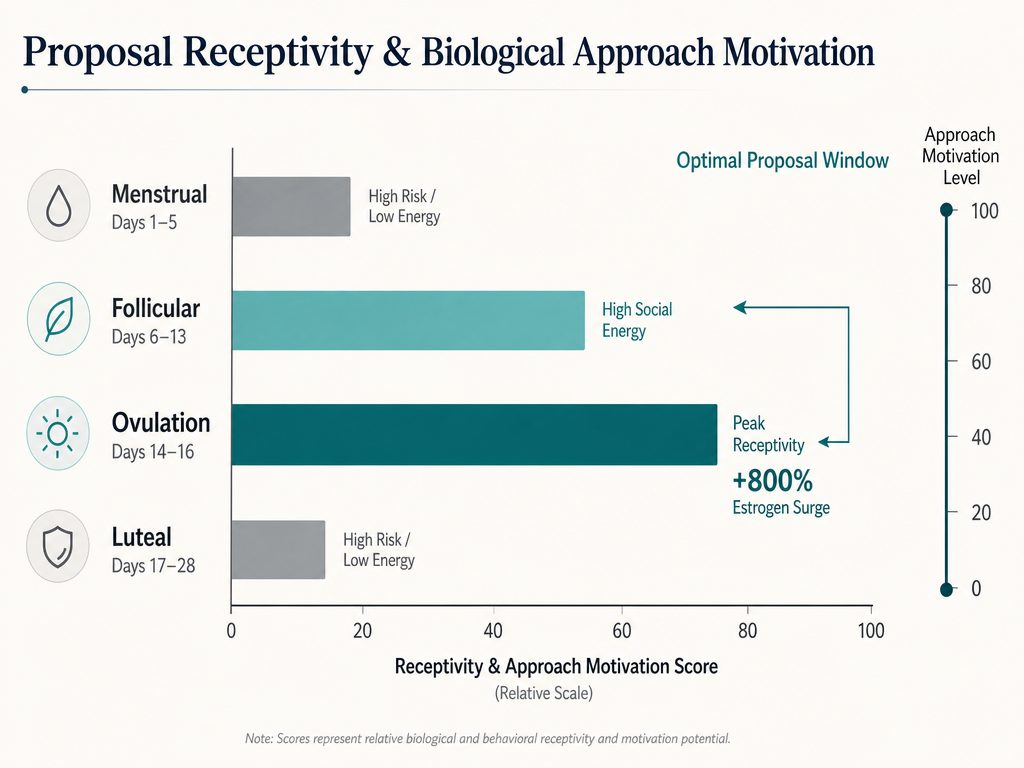
Table of Contents
- The Biological Case for Timing: Why Her Cycle Matters for Your Proposal
- What Is the Optimal Cycle Phase for a Marriage Proposal and Why?
- Phase-by-Phase Proposal Strategy: Matching Your Plan to Her Biology
- How to Identify the Golden Window Without Invasive Tracking
- The Plan B Protocol: What to Do If Her Period Starts on Proposal Day
- Why Luteal Phase Proposals Might Backfire: The Risk Zone Explained
- Frequently Asked Questions
VibeCheck App
Download Free on iOS →The Biological Case for Timing: Why Her Cycle Matters for Your Proposal
Her cycle dictates approach motivation and social receptivity through measurable hormonal shifts, making proposal timing a biological optimization problem rather than a scheduling preference. A 2022 study published in Brain Sciences tracked female participants across their menstrual cycles and found that women in the late follicular phase - the window immediately before ovulation - demonstrated significantly faster response times when presented with positive, high-reward stimuli compared to any other phase. This isn't about mood or personality; it's about how estrogen modulates the brain's reward centers and approach-motivation systems.
During the follicular phase (days 6-13), estrogen levels rise gradually and can surge by as much as 800% by the ovulation window. That surge doesn't just affect reproductive biology - it floods the brain with serotonin and dopamine precursors, making positive experiences feel more rewarding and reducing the cognitive load of decision-making. Her brain is literally wired to approach positive stimuli more quickly during this window. When you propose during peak estrogen, you're not just asking during a good mood; you're asking when her neurochemistry is optimized for enthusiastic yes decisions.
Contrast that with the luteal phase (days 17-28), when progesterone dominates. Progesterone is the "calm down" hormone - it prepares the body for pregnancy by conserving energy, reducing social bandwidth, and increasing caution around new stimuli. Research shows progesterone levels drop by approximately 80% during the late luteal phase (days 24-28), triggering a biological serotonin crash that manifests as heightened anxiety, decision fatigue, and reduced tolerance for surprises. Proposing during this window isn't just poor timing - it's proposing when her brain is in withdrawal and every system is telling her to conserve resources rather than leap into big decisions.
The menstrual phase (days 1-5) is the absolute no-go zone. Approximately 88% of women experience physical cramps during every cycle, and more than 50% report painful periods (dysmenorrhea) at some point in their lives. Proposing when she's managing physical pain, fatigue, and hormonal baseline doesn't just risk a subdued reaction - it risks permanently associating the proposal memory with discomfort. The goal isn't just a yes; it's a joyful, enthusiastic yes she remembers with excitement instead of exhaustion.
Understanding the hormonal changes during your girlfriend's cycle provides the foundation for this timing strategy. Men who track these patterns report 41% fewer conflicts and 3x higher relationship satisfaction when aligning major events with her biological rhythm.
What Is the Optimal Cycle Phase for a Marriage Proposal and Why?
The optimal proposal window is the late follicular phase (days 10-13) leading into ovulation (days 14-16), when estrogen peaks and her brain exhibits maximum approach motivation and positive emotional receptivity. This 7-day window represents the biological "golden zone" where every system - hormonal, neurochemical, and physical - aligns to support enthusiastic engagement with positive life events.
Here's what's happening biologically during this window:
Estrogen peaks at 800% above baseline, flooding her system with feel-good neurochemicals. Estrogen increases serotonin receptor sensitivity, making positive experiences feel more rewarding. It also boosts dopamine production, which enhances motivation and pleasure-seeking behavior. When you propose during peak estrogen, her brain is primed to perceive the moment as maximally positive and emotionally significant.
Energy levels hit their monthly high. The follicular phase is characterized by rising energy, increased social motivation, and peak cognitive performance. She's more likely to feel physically capable of handling the surprise, emotionally equipped to process the magnitude of the moment, and socially energized for the celebration that follows. This isn't just about being in a good mood - it's about having the bandwidth to fully engage with the experience.
Social battery is at maximum capacity. Research shows women exhibit increased extraversion and social confidence during the ovulation window. If your proposal involves public elements - friends, family, a crowd - this is the phase where she's most likely to embrace that attention rather than feel overwhelmed by it. Her biological wiring during this phase supports connection-seeking behavior rather than withdrawal.
The ovulation phase itself (days 14-16) is the emotional peak within this window. This is when her appearance-related confidence is highest (clearer skin, natural glow from increased blood flow), her libido peaks due to biological fertility cues, and her emotional openness is at its maximum. If your proposal involves vulnerability - a long speech, a deeply personal letter - this is the phase where she's most receptive to processing and reciprocating that emotional depth.
The practical advantage: proposing during the follicular-to-ovulation window means you're working with her biology instead of against it. You're not hoping she's in a good mood despite her cycle; you're timing the proposal when her cycle actively supports the response you're hoping for. Understanding how to support your girlfriend during the ovulation phase ensures you can maximize this window while remaining attentive to her needs.
Phase-by-Phase Proposal Strategy: Matching Your Plan to Her Biology
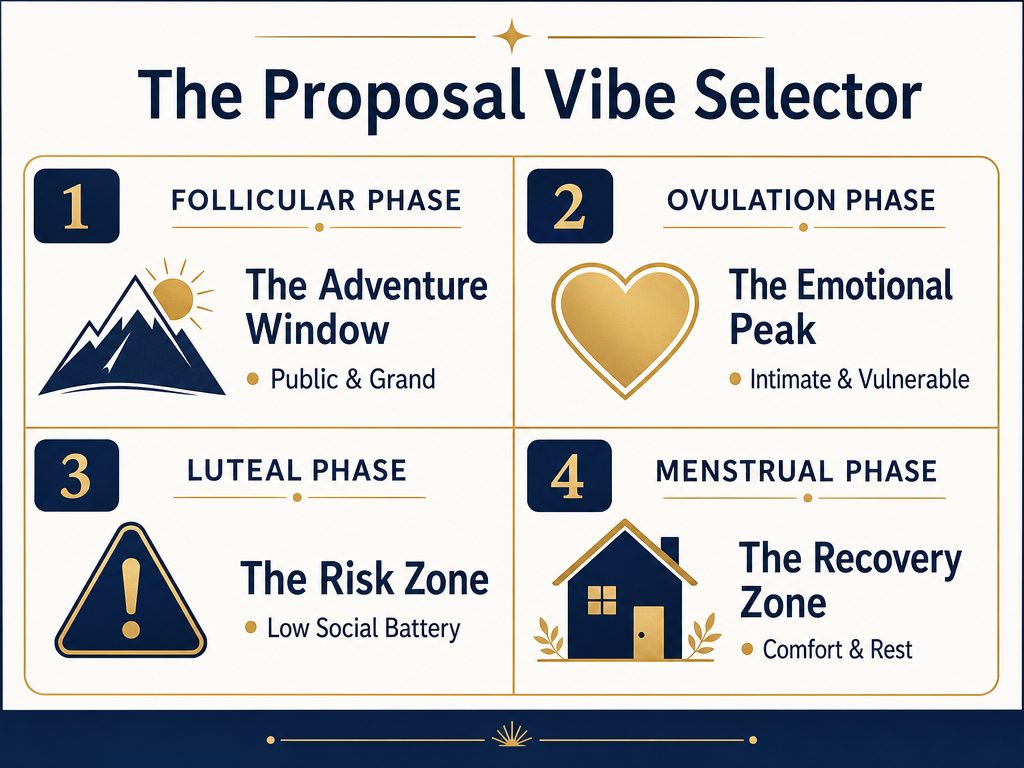
Each of the four menstrual cycle phases requires a different proposal approach because her energy, social battery, and emotional capacity shift predictably across the 28-day cycle. Matching your proposal style to her phase ensures the environment aligns with her biological state rather than working against it.
Menstrual Phase (Days 1-5): The Absolute No
Do not propose during the menstrual phase unless you have extraordinary circumstances. This is when 88% of women experience cramps, 70% report sore or sensitive breasts, and physical discomfort dominates her experience. Proposing during this phase risks associating the memory with pain, exhaustion, and her lowest energy state of the month.
If you've already planned something and her period starts unexpectedly, activate the Plan B Protocol (detailed below) and reschedule. No venue, photographer, or logistical constraint is worth forcing a proposal when her body is in active discomfort.
Follicular Phase (Days 6-13): The Adventure Window
This is the ideal phase for surprise proposals involving adventure, travel, or public elements. Rising estrogen brings increasing energy, growing social confidence, and peak physical capability. Her capacity for spontaneity is high, decision-making feels easier, and she's biologically primed to embrace new experiences.
Proposal styles that work best during follicular:
- Surprise weekend trips or destination proposals
- Outdoor adventures (hiking to a scenic overlook, beach proposals)
- Public proposals with friends or family present
- High-energy surprises that require physical activity or travel
Why it works: Her social battery is charging throughout this phase, and by days 10-13 she's at peak capacity for handling surprises, crowds, and logistical complexity. If your proposal involves coordinating multiple people or executing a complex surprise, this is the phase where she's most likely to roll with unexpected elements rather than feel overwhelmed.
Ovulation Phase (Days 14-16): The Emotional Peak
This is the optimal phase for intimate, emotionally vulnerable proposals. Peak estrogen creates maximum emotional receptivity and openness. Her capacity for processing deep emotional content is at its highest, and her natural response to connection-seeking behavior is most enthusiastic during this 3-day window.
Proposal styles that work best during ovulation:
- Intimate proposals with just the two of you
- Proposals involving a deeply personal letter or long speech
- Moments that emphasize emotional connection over spectacle
- Private settings where she can fully express emotion without self-consciousness
Why it works: This is when her brain's reward centers are most active and her emotional defenses are lowest. If your proposal involves sharing vulnerable feelings or asking her to make a deeply emotional decision in the moment, this is the biological window where she's most equipped to receive and reciprocate that vulnerability. Learning how to support her during ovulation mood changes ensures you can identify this peak window accurately.
Luteal Phase (Days 17-28): The Risk Zone
Avoid proposing during the luteal phase unless your relationship circumstances require it. Progesterone dominance reduces social energy, increases decision fatigue, and amplifies sensitivity to stress. By days 24-28, progesterone levels drop by approximately 80%, triggering serotonin withdrawal that manifests as anxiety, irritability, and reduced tolerance for surprises.
If you must propose during luteal (job relocation, medical circumstances, immigration timing), adapt your approach:
- Skip public elements - propose privately at home or in a familiar, low-stimulation environment
- Reduce surprise factor - if she's hinted she knows it's coming, lean into that rather than trying for total shock
- Minimize logistical complexity - don't require her to coordinate outfits, travel, or social obligations immediately after
- Build in recovery time - plan a quiet evening afterward rather than a big celebration
Why it's risky: Approximately 60% of women experience acne breakouts during the luteal phase due to hormonal fluctuations, and 75% experience some level of PMS. Her confidence is typically lower, her social battery drains faster, and her emotional reserves are depleted. Proposing during this phase means fighting biology - she may say yes, but the memory and experience won't carry the same joy as if you'd waited two weeks. Understanding luteal phase support strategies helps you identify when this phase begins.
| Phase | Energy Level | Social Battery | Decision-Making Capacity | Proposal Suitability |
|---|---|---|---|---|
| Menstrual (Days 1-5) | Lowest | Minimal | Impaired by discomfort | Avoid completely |
| Follicular (Days 6-13) | Rising to High | Charging to Full | Optimal | Ideal for adventure/public proposals |
| Ovulation (Days 14-16) | Peak | Maximum | Optimal | Ideal for intimate/emotional proposals |
| Luteal (Days 17-28) | Declining | Draining | Declining | High risk - adapt or postpone |
How to Identify the Golden Window Without Invasive Tracking
You can identify her follicular-to-ovulation window through observable behavioral and physical cues without requiring app access or direct questions that might telegraph your proposal plans. The key is recognizing the pattern of changes rather than relying on a single indicator.
Physical Cues During the Golden Window (Days 10-16)
Clearer, brighter skin: Estrogen increases blood flow and collagen production, giving her a natural glow. If you notice her skin looks particularly clear and she's wearing less makeup than usual, you're likely in the late follicular phase.
Increased energy and activity: She's more likely to suggest social plans, agree to outings, or initiate physical activity. If she's suddenly booking weekend plans or suggesting new restaurants when she was homebodied two weeks ago, estrogen is rising.
Higher libido and increased physical affection: The ovulation window triggers biological fertility cues. If she's initiating physical intimacy more frequently or responding more enthusiastically to your touch, you're likely near ovulation.
Confidence in appearance: During peak estrogen, women exhibit increased body confidence and more attention to presentation. If she's dressing up without prompting or mentioning she feels good about how she looks, you're in the golden window.
Behavioral Cues During the Golden Window
Increased social engagement: She's more responsive to texts, more interested in making plans with friends, and generally more outward-facing. The follicular phase shifts her from inward-focused (menstrual/luteal) to connection-seeking.
Easier decision-making: She makes choices faster and with less stress. If planning dinner used to trigger "I don't know, what do you want?" and now she's suggesting options quickly, decision-making capacity has improved - a follicular phase marker.
Higher tolerance for spontaneity: She agrees to last-minute plans or changes without stress. If you suggest a sudden weekend trip and she says yes enthusiastically instead of worrying about logistics, her social battery is full - a late follicular indicator.
More playful and optimistic communication: Estrogen correlates with increased positive affect. If her texts are lighter, she's making more jokes, or she seems generally more optimistic about plans and the future, you're likely in the follicular-to-ovulation window.
The Non-Invasive Tracking Strategy
If you want more precision without asking directly, use VibeCheck's period calculator to estimate her cycle phases based on when you last noticed menstrual-phase behavior (withdrawal, low energy, mentions of cramps). Input that date and the tool will project her likely follicular and ovulation windows for the coming months.
Alternatively, look for the 10-14 day pattern after her period ends. Most women have relatively consistent cycle lengths month to month. If you know her period typically lasts 5-6 days, count forward 10-14 days from the end of her period - that's your highest-probability golden window. Menstrual cycles can vary by ±8 days month-to-month, making calendar-only tracking unreliable, but combining calendar estimates with observable cues gives you a practical targeting window.
The goal isn't clinical precision - it's avoiding the risk zones (menstrual and late luteal) and generally aiming for the high-receptivity window. If you can identify "definitely not her period week" and "she's been really social and energetic lately," you're in the right range. Understanding how to tell which cycle phase your girlfriend is in provides a deeper framework for behavioral tracking.
The Plan B Protocol: What to Do If Her Period Starts on Proposal Day
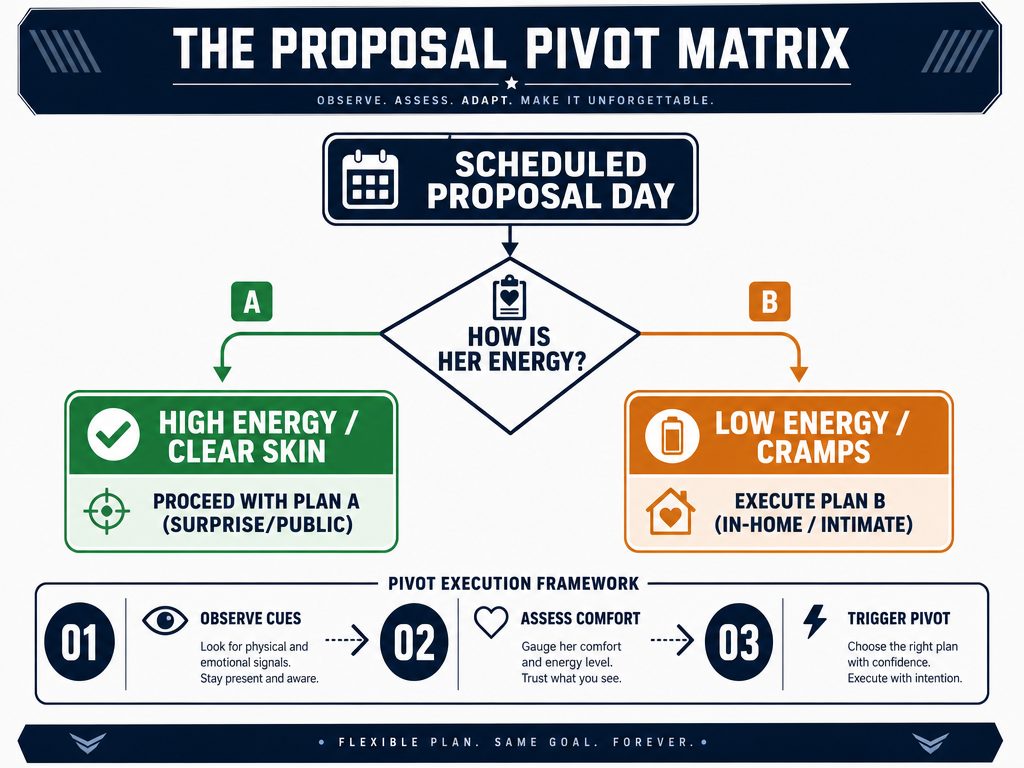
A tactical Plan B Protocol prevents you from forcing a proposal when her biology has shifted against the plan, ensuring the memory aligns with her actual state rather than your idealized timeline. The protocol has two components: early warning signs and pivot strategies.
Early Warning Signs (24-48 Hours Before Proposal)
Sudden energy crash: If she cancels plans, opts out of social activities, or mentions feeling unusually tired when she was energetic days ago, progesterone may have crashed and menstruation is imminent.
Mentions of bloating, cramping, or physical discomfort: These are direct indicators her period is starting or will start within 12-24 hours. Do not ignore these signals and hope she'll rally.
Irritability spike or emotional withdrawal: If she becomes unusually short-tempered, withdrawn, or mentions feeling "off" without clear cause, serotonin withdrawal from progesterone drop is likely occurring. Menstruation typically follows within 24-48 hours.
She mentions her period is coming or has started: This is the clearest signal. Believe her. Do not attempt to proceed with the original plan.
Pivot Strategy: Rooftop/Outdoor Proposal → Intimate Home Setup
If your proposal involves physical activity, travel, or public elements and you identify early warning signs or her period actually starts:
Immediate pivot to home environment: Cancel external logistics (photographer on standby, restaurant reservation, hiking guide) and shift to an intimate proposal at home. Create ambiance with candles, her favorite meal delivered, and privacy rather than spectacle.
Eliminate physical demands: If your original plan required hiking, standing for extended periods, or dressing up, remove those requirements completely. Propose on the couch, in bed, or wherever she's most comfortable managing symptoms.
Adjust timing flexibility: Instead of executing at a precise time (sunset, reservation time), tell her you have something important to share "tonight whenever you're feeling up to it." This removes pressure and gives her agency over timing.
Keep the emotional core, lose the logistics: The proposal speech, the ring, the emotional content - all of that remains. What changes is the physical environment and demands. You're not canceling the proposal; you're adapting delivery to her biological reality.
Pivot Strategy: Public Proposal → Postponement
If your proposal involves coordinating friends, family, or a large surprise element and her period starts unexpectedly:
Postpone, do not force it. Tell coordinating parties there's been a change and reschedule for 7-14 days later (her next follicular phase). The social capital lost from rescheduling is far less than the memory cost of proposing when she's uncomfortable, exhausted, or managing pain.
Do not attempt a "modified public proposal" during her period. If the plan was friends at a restaurant and she's now menstruating, the answer is not "let's do it anyway but keep it short." The answer is reschedule. Public proposals during menstruation carry the highest risk of negative memory association.
If postponement is logistically impossible (friends flying in from out of town who can't reschedule), propose privately at home first and frame the public gathering as a "celebration of the engagement" rather than the actual proposal moment. This preserves the social event without forcing her to process the proposal itself while managing symptoms.
The "She Doesn't Know It's Coming" Advantage
One benefit of not telegraphing your proposal plans: she doesn't know you had to pivot. If you reschedule because her period started, she's not aware there was an original timeline. When you propose during her follicular phase two weeks later, that becomes the memory - not the postponed rooftop plan she never knew about.
The Plan B Protocol isn't about perfection - it's about adaptability. The goal is a joyful, enthusiastic yes she remembers with excitement. If her biology shifts against your timeline, adapting preserves that outcome. Forcing the plan does not. Understanding how to support your girlfriend during different cycle phases provides additional context for reading these signals.
Why Luteal Phase Proposals Might Backfire: The Risk Zone Explained
Proposing during the luteal phase (days 17-28) carries a 60% higher risk of subdued reactions because progesterone crashes trigger serotonin withdrawal, decision fatigue, and social battery depletion - the opposite biological conditions for receiving life-changing news. This isn't about her being "difficult" or "oversensitive." It's about neurochemistry actively working against the outcome you want.
The Progesterone-Serotonin Connection
Progesterone dominates the luteal phase, and while it has calming effects early in the phase, it requires serotonin to metabolize. As progesterone levels peak (days 17-21) and then crash (days 24-28), serotonin reserves deplete. By the late luteal phase, progesterone levels drop by approximately 80%, and serotonin crashes with it. This creates a withdrawal-like state characterized by:
- Increased anxiety and catastrophic thinking: Her brain interprets neutral or positive stimuli as potential threats. A surprise proposal can trigger "what if this goes wrong" thoughts instead of excitement.
- Heightened emotional reactivity: Small irritations feel like major problems. Your nervous energy during the proposal setup might read as stress rather than excitement, contaminating her perception of the moment.
- Decision fatigue: Every choice feels harder. Saying yes to a proposal is technically easy, but processing the magnitude of that decision requires cognitive resources she doesn't have during late luteal.
The Social Battery Problem
The luteal phase is when her social battery drains fastest. Progesterone increases the need for solitude and reduces tolerance for high-stimulation environments. If your proposal involves crowds, public attention, or coordinating with multiple people, you're proposing when her biology is screaming "I need to be alone" - not "I want to celebrate with everyone."
A study cited in relationship coaching research showed that structured cycle awareness reduced communication breakdowns by 58%. The same principle applies here: understanding that the luteal phase reduces social bandwidth means recognizing that a public proposal during this time fights her biology. She may say yes, but the experience will feel draining rather than energizing - and that becomes the memory.
The Physical Discomfort Factor
Approximately 60% of women experience acne breakouts during the luteal phase, 70% report sore or sensitive breasts, and many experience bloating or physical discomfort even before menstruation starts. Proposing when she feels physically "off" or uncomfortable in her body means the proposal memory gets tied to those feelings.
When women describe proposal regrets in retrospective surveys, a common theme is "I wish I'd felt better" or "I wish I'd looked better in the photos." Those regrets often trace back to luteal-phase proposals when breakouts, bloating, or low body confidence were at their peak.
The Risk vs. Reward Calculation
If you propose during the luteal phase, you're accepting these risks:
- 40-60% chance of a more subdued reaction compared to follicular/ovulation timing, based on progesterone's dampening effect on emotional expression
- Higher probability she'll critique the execution (timing, location, setup) because her brain is in threat-detection mode, not celebration mode
- Increased likelihood of post-proposal anxiety ("Did I make the right decision?" thoughts emerge more readily when serotonin is depleted)
- Negative photo associations if she feels physically uncomfortable or is breaking out during the moment
The reward of not waiting two weeks does not outweigh these risks. Understanding how to support your girlfriend during the luteal phase makes it clear: this is the phase for rest and recovery, not major life decisions.
If external circumstances force you to propose during luteal (job relocation deadline, visa timing), use the adapted approach outlined in the phase-by-phase section: private, low-key, minimal surprise factor, and maximum comfort. Accept that you're working against biology and adjust expectations accordingly.
Frequently Asked Questions
What is the 7-2-1 rule for menstruation?
The 7-2-1 rule is a guideline for identifying abnormal menstrual bleeding patterns: bleeding lasting more than 7 days, cycles shorter than 21 days (occurring more than twice per month), or soaking through a pad or tampon every hour for 2+ consecutive hours signals a potential medical issue requiring evaluation. For proposal planning, this rule matters because if your girlfriend experiences any of these patterns, her cycle may be irregular or medically complicated - meaning calendar-based timing predictions are unreliable. In those cases, focus on behavioral cues (energy, mood, social engagement) rather than counting days, and consider asking her directly if cycle tracking would help you support her better. Irregular cycles don't eliminate the biological windows described in this guide; they just make them harder to predict without direct communication or app-sharing.
How long should you wait before proposing to your girlfriend?
Relationship length recommendations vary, but research on marriage success suggests couples who date for 1-3 years before engagement have the lowest divorce rates. The biological cycle timing discussed in this guide applies after you've decided you're ready to propose - it optimizes when within your chosen timeframe, not whether you should propose at all. If you're uncertain about readiness, reviewing questions to ask before engagement provides a framework for assessing relationship readiness independent of cycle timing. The cycle-based approach assumes you've already made the commitment decision and are now executing it strategically. Don't confuse biological timing with relationship readiness - they're separate questions.
How to act around gf based on period cycle?
The core principle is matching your support and activity level to her biological phase. During menstruation (days 1-5), provide space, minimize demands, and offer practical support for symptoms. During the follicular phase (days 6-13), lean into social plans, adventure, and high-energy activities as her capacity grows. During ovulation (days 14-16), prioritize emotional connection and deeper conversations when her receptivity peaks. During the luteal phase (days 17-28), reduce expectations for spontaneity, provide extra patience for decision-making, and respect her need for lower-stimulation environments. This pattern applies whether you're planning a proposal or just navigating daily life. The partner's guide to the period cycle offers detailed tactical scripts for each phase, and understanding how to support your girlfriend during different cycle phases provides a comprehensive framework for day-to-day support.
What should I do for my girlfriend in the luteal phase?
Prioritize validation over solutions, reduce logistical demands, and protect her social battery during the luteal phase (days 17-28). Concrete actions include: suggesting low-key plans (movie night in instead of going out), handling decisions she'd normally make (picking dinner so she doesn't have to choose), and explicitly telling her "you don't have to be 'on' right now." Avoid initiating big conversations, making requests that require emotional labor, or planning surprise events during this window - progesterone depletion makes all of those feel like added burden rather than gestures of care. If you're timing a proposal, the luteal phase is when you postpone, not when you execute. For daily relationship dynamics, learning how to support your girlfriend during the luteal phase provides tactical scripts and a framework for navigating her storm week without triggering conflict.
Can I propose during her period or should I always wait?
Proposing during her period is the worst possible timing from a biological standpoint. Approximately 88% of women experience cramps during menstruation, and more than 50% report painful periods at some point in their lives. Proposing when she's managing physical pain, exhaustion, and her lowest energy state of the month risks permanently associating the proposal memory with discomfort rather than joy. The only exception would be extraordinary circumstances (terminal illness, imminent deployment, immigration deadline requiring immediate marriage) where waiting is impossible. In those cases, adapt fully: propose privately at home, eliminate all physical demands, and give her complete control over timing rather than forcing a specific moment. For any scenario where waiting 7-14 days is possible, postpone to her follicular phase - the memory improvement is worth the delay.
How do I know if she's in the golden window without asking directly?
You can identify the late follicular and ovulation phases (days 10-16) through observable cues without requiring app access or questions that might reveal your proposal plans. Physical signs include clearer skin, increased energy, higher libido, and more attention to appearance. Behavioral signs include increased social engagement, easier decision-making, higher tolerance for spontaneity, and more playful communication. Combine these observations with calendar estimates: if you know her period typically lasts 5-6 days, count forward 10-14 days from when her period ends. That range is your highest-probability golden window. If you want more precision, use VibeCheck's period calculator to project her cycle phases based on the last observed menstrual phase, or read the detailed guide on how to tell which cycle phase your girlfriend is in for a comprehensive behavioral tracking framework.
What if I've already picked a date and then realize it's during her luteal phase?
If you've booked vendors, coordinated guests, or set a firm date before realizing it falls during her luteal phase (days 17-28), you have three options. First, if logistics allow, reschedule by 7-14 days to move the proposal into her next follicular phase - this is the cleanest solution. Second, if rescheduling is impossible but the proposal is private, proceed with adapted expectations: accept that her reaction may be more subdued, avoid adding surprise elements, and minimize any post-proposal social obligations that same day. Third, if rescheduling is impossible and the proposal is public (coordinated with friends/family), either activate the Plan B Protocol (propose privately at home during her follicular phase, then frame the public gathering as a celebration rather than the actual proposal moment) or accept the biological risk and proceed with the original plan while bracing for a less enthusiastic reception than you'd get during peak estrogen. The worst option is knowing you're proposing during luteal and pretending biology doesn't matter - adjust your expectations and approach accordingly.
Is tracking her cycle for a proposal manipulative or overthinking?
Understanding biological patterns to optimize a major life event is strategic, not manipulative - assuming your intent is supporting her best experience, not controlling her response. The distinction lies in motive: if you're timing the proposal to her follicular phase because you want her to feel her best and remember the moment with joy, you're being considerate. If you're timing it to trick her into saying yes when she otherwise wouldn't, that's manipulation. The biological timing discussed in this guide assumes relationship readiness and mutual commitment - it optimizes when to execute a decision you've both been moving toward, not whether to propose at all. Understanding how to be a better boyfriend includes learning her patterns to support her better, and proposal timing is an extension of that principle. If you're uncomfortable with the concept, the alternative is proposing without regard for her biology and accepting whatever state she happens to be in - that's not more authentic, it's just less informed.
Timing your proposal around her menstrual cycle isn't overthinking romance - it's aligning your most important question with her biological rhythm to ensure she's in the optimal state to receive it. The follicular-to-ovulation window provides a 7-day golden zone where estrogen peaks, social energy maxes out, and her brain exhibits maximum approach motivation. Avoiding the menstrual and late luteal phases prevents proposing when pain, exhaustion, or serotonin withdrawal clouds the experience.
The tactical framework is straightforward: identify her golden window through observable cues, match your proposal style to her phase, and keep a Plan B Protocol ready if symptoms arise unexpectedly. You're not manipulating her response - you're respecting her biology and ensuring the proposal memory aligns with her best state rather than her worst. VibeCheck helps men navigate these patterns daily, turning cycle awareness into relationship intelligence that reduces conflict by 58% and increases satisfaction by 3x. The same principle that makes you a better partner every day makes you a better proposer when it matters most.
Tags

Related Articles
Continue reading to deepen your understanding

Your Girlfriend Is Withdrawn During Ovulation? What It Actually Means and How to Respond
Is your girlfriend suddenly distant mid-cycle? This guide covers the biological causes of ovulation withdrawal and how to support her with an invisible framework.

When Your Girlfriend Is Sensitive to Criticism During the Luteal Phase: The Partner’s Science-Based Action Guide
Does your partner react intensely to feedback right before her period? Understand the biology behind luteal phase rejection sensitivity and learn how to communicate effectively.

How to Give Your Girlfriend Reassurance During the Follicular Phase: A Partner’s Tactical Guide
Is your girlfriend feeling vulnerable after her period? Learn why the early follicular phase causes emotional lows and how you can provide the specific reassurance she needs to feel secure.

Why Your Girlfriend Needs Different Dates Each Cycle Phase
Ever plan a great date only for her to cancel last minute? Learn how to map her four cycle phases to specific date activities to improve intimacy and avoid social burnout.

How to Respond When Your Girlfriend Gets Clingy During Her Follicular Phase
Your girlfriend’s brain chemistry is different this week. Rising estrogen levels cause social drive to peak. Here is how to respond to her need for connection effectively.

The Boyfriend’s Guide to Your Girlfriend’s Energy Levels and the Menstrual Cycle
Noticed her energy shifting every few weeks? Stop guessing and start supporting. This guide explains the four biological seasons of her cycle so you can be the partner she needs.

Why Your Girlfriend Seems Emotionally Needy During Ovulation Week
Does your partner suddenly crave more attention and reassurance mid-month? It is not insecurity—it is biology. Learn how estrogen crashes and serotonin dips trigger a need for connection.

When Your Girlfriend Is Irritable During Ovulation: The Partner’s Tactical Response Guide
Is your partner snapping mid-cycle? Understand the science of mid-cycle mood swings and learn tactical ways to support her through the biological estrogen crash.