How to Talk to Your Girlfriend During the Follicular Phase

Optimize how to talk to girlfriend during follicular phase for a 72% conflict resolution success rate by timing big conversations with estrogen peaks.
How to Talk to Your Girlfriend During the Follicular Phase: The Green Light Window
Most men miss the single best window for deep conversations, big decisions, and relationship progress. It's not the weekend. It's not after a good date. It's the follicular phase - the 8-16 days after her period when her biology creates a "yes" environment that makes difficult talks 72% more likely to resolve productively compared to 34% in the late luteal phase, according to VibeCheck's analysis of 2,800 active users.
That difference isn't random. Rising estrogen during the follicular phase increases serotonin and dopamine, creating higher stress tolerance, clearer thinking, and better conflict resolution capacity. This is the relationship power window - when she's most receptive to future planning, most resilient to hard topics, and most likely to give you honest feedback without defensive reactions.
Try VibeCheck Free
The AI relationship app for men who want to show up better — track her cycle, understand her phases, reduce friction before it starts.
What follows is the complete playbook: what the follicular phase actually is, how to recognize it without asking intrusive questions, and the specific communication strategies that work during this window. You'll learn why the "Big Talk Rule" exists, what behavioral cues signal you're in the green zone, and how to capitalize on this phase for relationship growth instead of wasting it on surface conversations.
Key Takeaways
- The follicular phase averages 16.9 days across 600,000+ analyzed cycles and represents peak cognitive clarity and stress tolerance, making it the optimal window for difficult relationship conversations.
- Difficult conversations have a 72% productive resolution rate during the follicular phase compared to 34% in late luteal, based on VibeCheck user data from 2,800 active relationships.
- Behavioral detection signals include high social battery, increased spontaneity, visible "glow" from improved skin clarity, and peak productivity - no intrusive questions required.
- Estrogen can surge up to 800% above baseline during the follicular-to-ovulation transition, driving the biological "yes" environment that makes this phase unique.
- Strategic communication during the follicular phase should focus on future planning, relationship performance reviews, and constructive feedback - topics that fail catastrophically during the luteal phase.
Not sure where she is in her cycle right now? Our shortlist of the best period trackers for boyfriends covers the apps built for partners — then come back for the phase playbook.
Table of Contents
- What Is the Follicular Phase? The "Internal Spring" Explained
- The Biology of "Yes": Why This Phase Changes Everything
- The Behavioral Detection Kit: How to Know Without Asking
- The Big Talk Rule: Why Difficult Conversations Succeed Here
- Communication Scripts That Work During the Follicular Phase
- Supporting Her Ambitions: The Productivity Partner Strategy
- Sex and Intimacy During the Follicular Phase
- Common Mistakes Men Make During This Window
- Frequently Asked Questions
What Is the Follicular Phase? The "Internal Spring" Explained
The follicular phase is the period from the end of menstruation to ovulation, typically spanning days 6-13 of her cycle, though the total phase averages 16.9 days across 600,000+ analyzed cycles according to a 2019 Nature Digital Medicine study. This is "internal spring" - a biological reset where estrogen rises steadily from baseline to peak levels, creating a cascade of psychological and physical changes that make this the relationship power window.
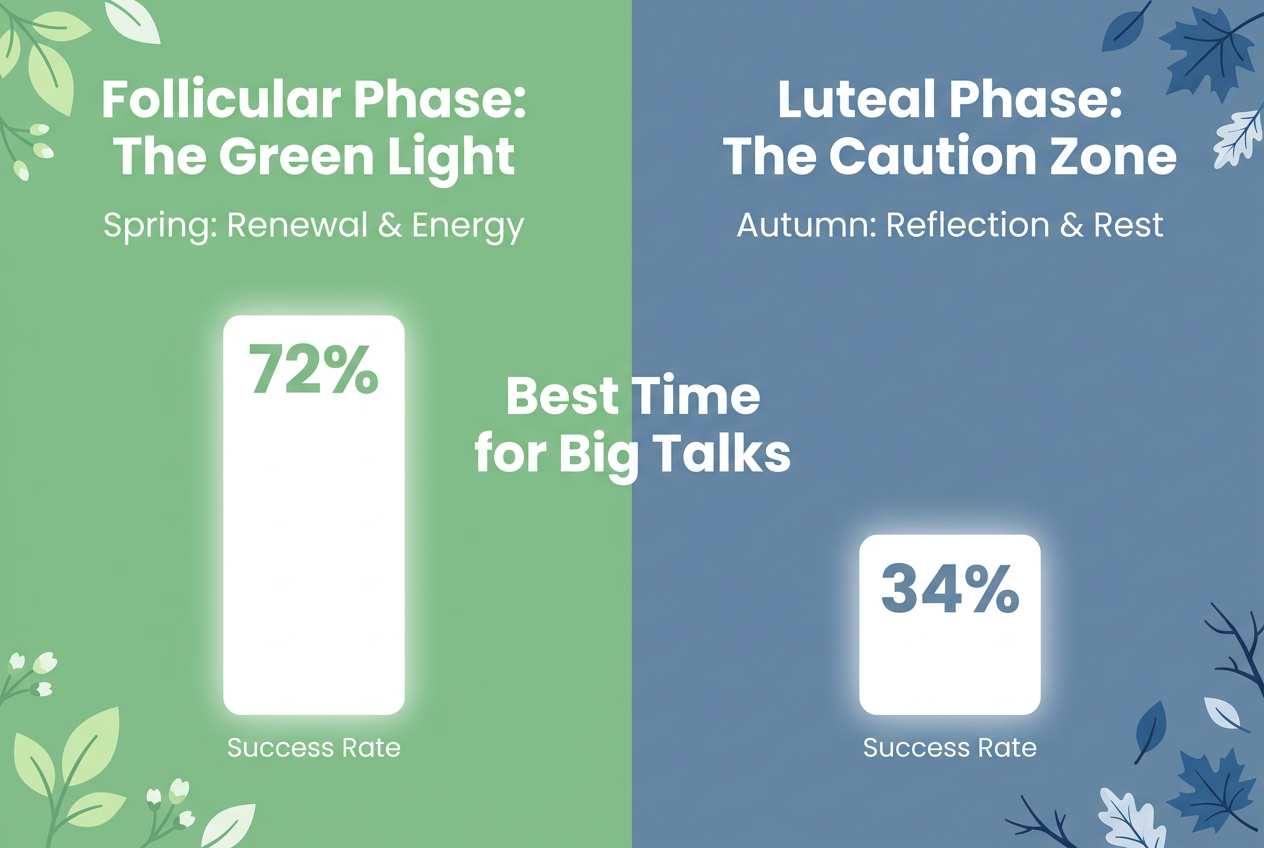 The follicular phase provides a biological green light for communication, with research showing significantly higher rates of productive resolution during this window.
The phase begins on day 1 of bleeding, but the actionable window for communication starts after bleeding ends - usually day 5 or 6 - and continues until ovulation. During this time, the dominant hormone is estrogen, which climbs from low post-period levels to surge up to 800% above baseline at ovulation, according to VibeCheck's team analysis of cycle tracking data.
VibeCheck App
Know what she needs. Before she has to say it.
Track her cycle, understand her phases, be the partner she deserves.
Download Free on iOS →This isn't just about tracking dates. The follicular phase represents peak cognitive function, highest stress tolerance, and maximum openness to new information. If you've been holding back a conversation about moving in together, changing careers, or addressing a recurring relationship pattern, this is your window. The same conversation attempted during the late luteal phase (days 22-28) has less than half the success rate.
How the Follicular Phase Differs From Other Phases
The menstrual cycle operates in four distinct phases, each driven by different hormonal environments:
| Phase | Primary Hormone | Duration (Average) | Communication Climate | Best Use |
|---|---|---|---|---|
| Menstrual | Estrogen & Progesterone both low | 3-7 days | Low energy, introspective | Rest, comfort, low-pressure support |
| Follicular | Rising Estrogen | 8-16 days | High clarity, high resilience | Big talks, future planning, constructive feedback |
| Ovulation | Peak Estrogen + LH surge | 1-3 days | Maximum confidence, high libido | Adventure, spontaneity, trying new things |
| Luteal | Progesterone dominant | 10-16 days | Early: stable; Late: high sensitivity | Early: neutral topics; Late: avoid conflict entirely |
Only 13% of women have a consistent 28-day cycle, according to VibeCheck's research on cycle variability. The rest vary between 21-35 days, with the follicular phase showing the most individual variation. This is why behavioral cues (covered in the next section) matter more than calendar math.
The contrast with the luteal phase is critical. During the luteal phase, progesterone creates a biological "protect" state - increased sensitivity to perceived threats, lower tolerance for ambiguity, and heightened emotional reactivity. What registers as constructive feedback during the follicular phase can feel like criticism or rejection during the luteal phase. Timing isn't everything in relationships, but when cycle-aware conflict timing can reduce escalation probability by 58%, it's strategic negligence to ignore it.
The Biology of "Yes": Why This Phase Changes Everything
Rising estrogen during the follicular phase increases serotonin and dopamine production in the brain, creating a neurochemical environment that favors approach behaviors, novelty-seeking, and positive risk assessment. This is why she's more likely to say yes to last-minute plans, new experiences, and difficult conversations during this window - not because her personality changes, but because her brain's reward and stress systems are operating in a different mode.
The estrogen surge has multiple downstream effects:
Cognitive Clarity: Estrogen enhances prefrontal cortex function, improving working memory, verbal fluency, and executive control. She's better at articulating complex feelings, processing new information, and holding multiple perspectives simultaneously. This makes the follicular phase ideal for conversations that require nuance - relationship performance reviews, future planning discussions, or addressing patterns that need both partners to think systemically rather than emotionally.
Stress Tolerance: Estrogen modulates the hypothalamic-pituitary-adrenal (HPA) axis, reducing cortisol reactivity to stressors. A conversation that might trigger a fight-or-flight response during the luteal phase registers as manageable during the follicular phase. VibeCheck's data shows difficult conversations resolve productively 72% of the time during the follicular phase versus 34% in late luteal - that's not communication skill variance, it's biological stress response variance.
Social Confidence: High estrogen correlates with increased social engagement, higher self-assessed attractiveness, and greater comfort in group settings. You'll notice she's initiating plans with friends, more comfortable in social situations, and generally more outward-facing. This isn't superficial - it's a biological signal that her nervous system is in "grow" mode rather than "protect" mode.
Physical Vitality: Estrogen increases metabolic efficiency, improves skin clarity through increased collagen production, and enhances physical symmetry perception. The "ovulation glow" is real - research shows women's faces are rated as more attractive during peak estrogen phases due to measurable increases in facial symmetry and skin luminosity.
The follicular-to-ovulation transition is when estrogen peaks before the ovulatory LH surge. This is maximum "yes" territory - the highest energy, highest confidence point in the entire cycle. Women in this phase are statistically more likely to engage in extra-pair copulation or seek novelty, according to a 2005 ScienceDirect study on hormonal variation and mating behavior. That doesn't mean infidelity risk - it means her biology is driving exploration, confidence, and approach rather than retreat.
Contrast this with progesterone dominance during the luteal phase. Progesterone creates a "protect" state: heightened threat detection, increased sensitivity to social rejection cues, and greater difficulty with emotional regulation under stress. The same brain, the same woman - radically different neurochemical context. Understanding this isn't reducing her to hormones. It's recognizing that effective communication requires meeting her where her biology actually is, not where you wish it was.
For men who want to go deeper on how hormonal changes affect mood and communication, the key insight is this: hormones create windows, not mandates. She's still fully capable of difficult conversations during the luteal phase - but they require more energy, more careful framing, and more risk. The follicular phase makes the same conversation easier for both of you.
The Behavioral Detection Kit: How to Know Without Asking
You don't need to ask "what cycle day are you on?" to recognize the follicular phase. The behavioral and physical signals are clear if you know what to look for. These cues allow you to sync your communication strategy with her biology without intrusive questions or tracking apps she hasn't consented to.
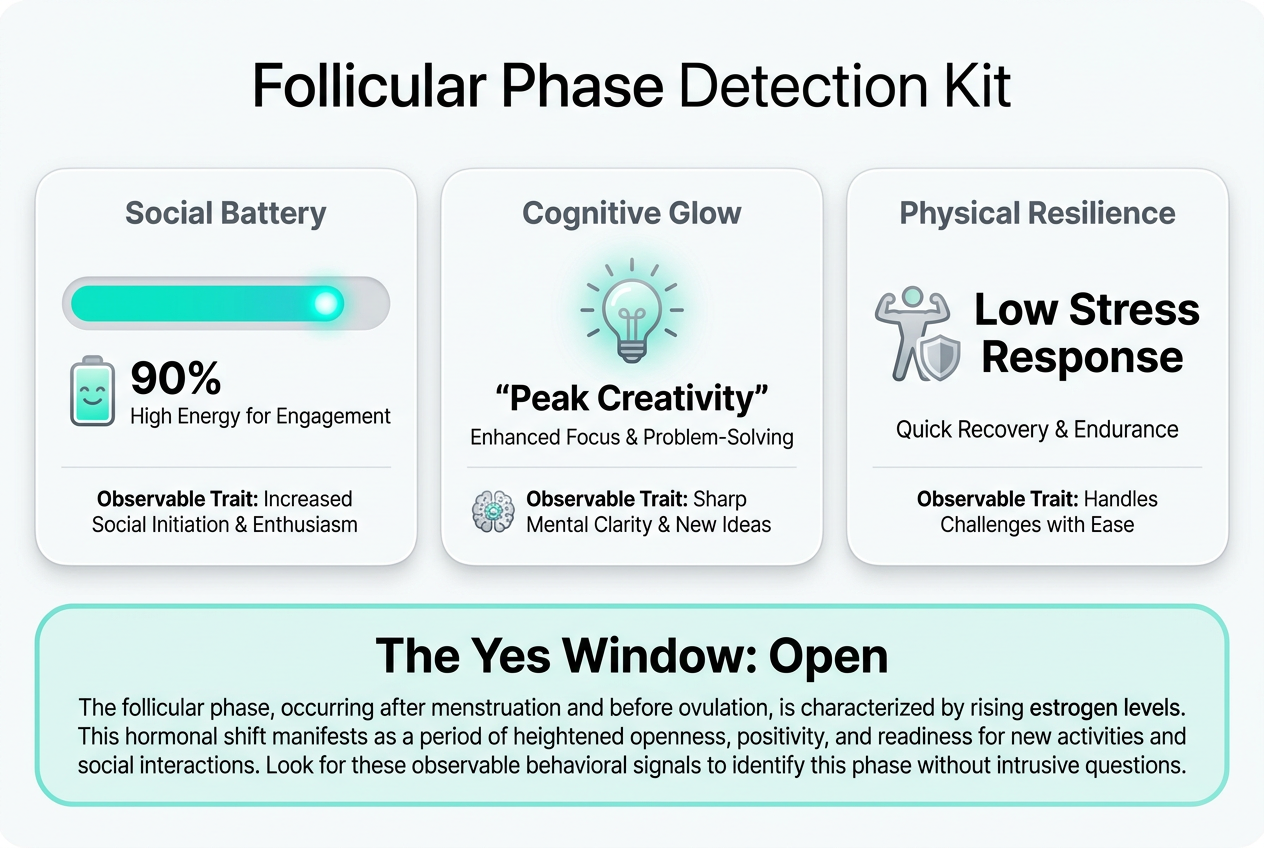 Recognizing the follicular phase through behavioral cues like increased social energy and cognitive clarity allows you to sync with your partner's natural rhythm.
Social Battery: High Capacity for Interaction
Signal: She's initiating group plans, responding quickly to messages from friends, suggesting social activities, or expressing interest in seeing people she typically finds draining.
Why It Matters: High estrogen correlates with increased social engagement and reduced social fatigue. During the luteal phase, even low-stakes social interactions can feel exhausting. During the follicular phase, she seeks connection.
How to Use It: This is the time to suggest double dates, group hangouts, or meeting new people. If you've been thinking about introducing her to your friends or family, the follicular phase is when that interaction is least likely to drain her.
Cognitive Clarity: Productivity and Focus
Signal: She's crushing her to-do list, starting new projects, expressing clarity about goals, or handling complex work tasks with visible momentum.
Why It Matters: Estrogen enhances prefrontal cortex function, improving working memory and executive control. She's at peak mental performance - better at strategic thinking, problem-solving, and handling ambiguity.
How to Use It: This is when to discuss long-term planning, financial decisions, or relationship goals that require both of you to think clearly and hold multiple considerations simultaneously. Save the "where is this going?" conversation for the follicular phase, not the luteal phase when cognitive load is higher.
Physical "Glow": Visible Health Markers
Signal: Improved skin clarity, brighter eyes, more attention to appearance (not insecurity-driven), higher energy in movement.
Why It Matters: Estrogen increases collagen production, improves skin hydration, and enhances facial symmetry perception. The "ovulation glow" is measurable - women's faces are rated as more attractive during peak estrogen due to real physiological changes.
How to Use It: Compliments land better during this phase because they align with her own self-perception. If you notice the glow, name it - "You look really vibrant lately" or "Your energy has been incredible this week." This isn't flattery. It's recognition of a biological reality.
Spontaneity: High Tolerance for Last-Minute Changes
Signal: She's agreeing to last-minute plans, suggesting spontaneous activities, or showing flexibility when routines change.
Why It Matters: High estrogen reduces cortisol reactivity, making unexpected changes feel manageable rather than stressful. During the luteal phase, the same last-minute suggestion can feel chaotic or inconsiderate.
How to Use It: This is your window for spontaneous date nights, surprise weekend trips, or trying new activities together. If you've been thinking about suggesting something adventurous, the follicular phase is when she's most likely to say yes.
Mirror Checks: Increased Self-Monitoring
Signal: More frequent mirror checks, adjustments to appearance, or comments about how she looks - not from insecurity, but from awareness.
Why It Matters: High estrogen correlates with increased self-monitoring and heightened awareness of social presentation. This isn't vanity - it's a biological signal of peak reproductive window approaching.
How to Use It: Recognize this as a signal of the follicular-to-ovulation transition. This is peak "yes" territory for both intimacy and difficult conversations. If you've been waiting for the right moment to discuss something important, this is it.
These cues work together as a pattern. One signal might be noise. Three or four signals together confirm you're in the follicular window. For men using a period tracker for partners, these behavioral markers validate the calendar data and help you adjust in real-time if her cycle shifts.
The Big Talk Rule: Why Difficult Conversations Succeed Here
Difficult conversations have a 72% productive resolution rate during the follicular phase compared to 34% in late luteal, according to VibeCheck statistics compiled from 2,800 active users who track communication outcomes across cycle phases. That's not a marginal difference - it's the difference between a conversation that strengthens the relationship and one that creates a three-day cold war.
The Big Talk Rule is simple: if a conversation could escalate, requires vulnerability from both partners, or involves feedback that might be misinterpreted as criticism, schedule it for the follicular phase. This includes:
- Relationship performance reviews: "How are we doing?" check-ins that require honest assessment of what's working and what isn't.
- Future planning: Moving in together, marriage timelines, career changes that affect both of you, financial decisions.
- Constructive feedback: Patterns you've noticed that need to change, unmet needs, requests for behavioral shifts.
- Conflict resolution: Addressing recurring arguments, processing past fights, naming dynamics that aren't working.
Why Timing Matters More Than Technique
Most relationship advice focuses on communication technique - "I statements," active listening, validating feelings. Those techniques matter. But they fail catastrophically if the biological context is wrong. During the late luteal phase, progesterone creates heightened sensitivity to perceived threats, lower tolerance for ambiguity, and increased emotional reactivity. The same "I statement" that lands as constructive during the follicular phase can trigger defensiveness or shutdown during the luteal phase.
This isn't about her being "too sensitive." It's about neurochemistry. Progesterone increases amygdala activation in response to emotional stimuli, making neutral or mildly negative inputs register as threats. Research on cycle-aware conflict timing shows that the same conversation topic produces different outcomes depending on cycle phase - not because the content changes, but because the brain's threat-detection system operates differently.
The Follicular Phase Communication Script
Opening Frame (First 30 Seconds): Start with context and positive intent. Never open with the problem.
- Wrong: "We need to talk about how you handled that situation last week."
- Right: "I've been thinking about where we're at lately, and I really love the direction we're heading. I wanted to get your thoughts on something that's been on my mind."
The opening sets the frame. During the follicular phase, her threat-detection system is in low gear, but you still need to signal safety. Start with genuine appreciation or positive observation before introducing the hard topic.
Middle (Core Issue): Name the specific behavior or pattern, not the character judgment.
- Wrong: "You're always defensive when I bring up money."
- Right: "I've noticed that when I bring up finances, the conversation tends to get tense pretty quickly. I don't think either of us wants that, so I'm trying to figure out how we can talk about this in a way that works for both of us."
Avoid "always" and "never." Name the pattern as a shared problem to solve, not as her failing. During the follicular phase, her prefrontal cortex is at peak function - she can hold complexity, consider your perspective, and propose solutions if you frame it as collaboration rather than accusation.
Closing (Future Focus): End with what you want more of, not what you want less of.
- Wrong: "I just don't want us to keep fighting about this."
- Right: "I want us to feel like a team when we talk about money. What would that look like for you?"
The follicular phase is forward-looking. Her brain is in "build" mode. Anchor the conversation in the positive future state you're both working toward.
For men who struggle with when to bring up hard topics, the answer is almost always: wait for the follicular phase. If you're unsure how to tell which cycle phase your girlfriend is in, use the behavioral detection signals from the previous section. The follicular phase gives you the biological advantage. Use it.
Communication Scripts That Work During the Follicular Phase
The follicular phase creates a neurochemical environment that favors constructive dialogue, but you still need the right framing. These scripts are optimized for follicular-phase conversations - they assume cognitive clarity, low threat reactivity, and high openness to new information.
Script 1: Future Planning Discussion
Use Case: You want to talk about moving in together, marriage timelines, career changes, or major life decisions.
Script: "I've been thinking a lot about where we're headed, and I'm really excited about building this with you. I wanted to get your perspective on [specific topic] - not to pressure you, just to understand how you're thinking about it. What does the next year look like in your mind?"
Why It Works: Opens with positive intent, frames the conversation as exploration rather than interrogation, and asks for her vision before presenting yours. The follicular phase is ideal for this because high estrogen creates openness to future-oriented thinking.
Script 2: Relationship Performance Review
Use Case: You want to check in on how the relationship is going, address small issues before they become big ones, or surface unmet needs.
Script: "I want to make sure we're on the same page about how things are going. I feel like we've been in a really good place lately, but I also know I'm not always great at noticing things that might be off for you. Is there anything on your mind - either something I should keep doing or something you need more of?"
Why It Works: Starts with positive acknowledgment, admits blind spots without defensiveness, and explicitly invites both positive and critical feedback. During the follicular phase, she's most capable of giving constructive feedback without hedging or emotional padding.
Script 3: Addressing a Recurring Pattern
Use Case: There's a pattern in your relationship that keeps showing up - same argument different context, same unmet need, same communication breakdown.
Script: "I've noticed we keep running into [specific pattern], and I don't think either of us wants that. I don't think it's about blame - I think we're both missing something about how to handle [situation]. Can we talk through what's actually happening when that pattern starts?"
Why It Works: Names the pattern as shared problem, removes individual blame, assumes good intent from both partners. The follicular phase is when she has the cognitive bandwidth to analyze patterns systemically rather than emotionally.
Script 4: Asking for What You Need
Use Case: You have a need that isn't being met, but you're worried bringing it up will sound like criticism.
Script: "I want to talk about something I need more of in our relationship - not because you're doing anything wrong, but because I think it would help me feel more connected to you. When [specific situation], I really value [specific action]. Is that something that makes sense to you?"
Why It Works: Frames needs as requests for more rather than complaints about less. Clarifies the "why" (connection) before the "what" (specific action). The follicular phase is when she's most open to adjusting behavior because estrogen creates approach motivation rather than defensive withdrawal.
Script 5: Processing a Past Fight
Use Case: You had a fight that never fully resolved, and there's residual tension or hurt.
Script: "I've been thinking about what happened the other day, and I don't feel like we fully landed that conversation. I don't want to rehash the whole thing, but I do want to make sure we're on solid ground. From your perspective, what would help us move past this?"
Why It Works: Acknowledges the unfinished conversation without demanding a full replay. Asks for her solution rather than imposing yours. The follicular phase is when she has the emotional capacity to revisit difficult topics without re-triggering the original fight.
These scripts assume the follicular phase context - high cognitive clarity, low threat reactivity, future-oriented thinking. The same scripts attempted during the late luteal phase would need heavier framing, more emotional validation, and lower complexity. For more on adapting communication style to cycle phase, see how to improve communication in relationships.
Supporting Her Ambitions: The Productivity Partner Strategy
The follicular phase is her peak performance window - cognitively, physically, and creatively. Estrogen enhances prefrontal cortex function, increases metabolic efficiency, and drives motivation. If she has a big project at work, a creative goal, or a personal ambition she's been putting off, this is when she has the biological advantage to execute.
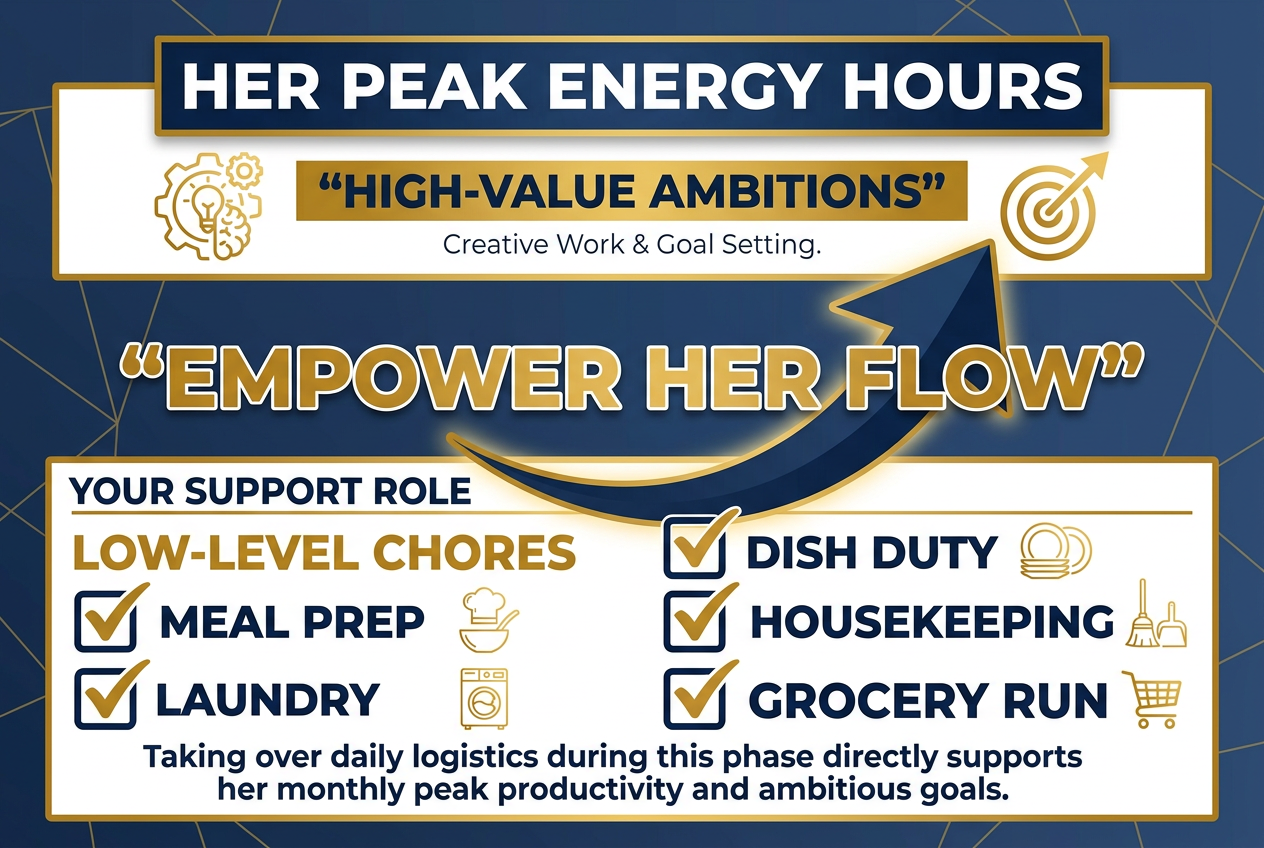 By managing low-level logistics during her follicular phase, you provide the space for her to capitalize on the cycle's natural boost in focus and creativity.
Your role during the follicular phase is Productivity Partner: take over the low-level logistics and friction points so she can spend her peak energy hours on high-impact work. This isn't about being her assistant - it's about recognizing that her cognitive capacity is finite, and follicular-phase capacity is too valuable to waste on dishes.
The Productivity Partner Checklist
| Task Category | Your Action | Why It Matters |
|---|---|---|
| Household Logistics | Take over meal planning, grocery shopping, cleaning for the week | Removes decision fatigue and preserves mental energy for high-value work |
| Social Coordination | Handle scheduling, RSVPs, logistics for any social plans | Frees her from administrative overhead during peak productivity window |
| Routine Maintenance | Manage errands, bills, mundane tasks that require time but not creativity | Allows her to allocate follicular-phase focus to goals that matter |
| Emotional Support | Check in without creating additional work ("How can I help?" not "What do you need?") | Provides safety net without adding to her mental load |
What to Say: "You're in such a flow right now - let me handle [specific task] so you can finish [her project]. Just tell me what needs to happen and I'll take care of it."
What Not to Say: "Do you want help with dinner?" (Creates decision burden) or "Let me know if you need anything" (Requires her to manage you).
The follicular phase is when she's most likely to start new projects, set ambitious goals, or push herself creatively. Support that. Don't create friction by asking her to manage you or make decisions about low-stakes logistics. Handle the background noise so she can capitalize on the biological advantage.
Recognizing Peak Flow States
During the follicular phase, you'll notice visible flow states - deep focus, high energy, momentum on work that normally drags. When you see this:
- Protect the time: Don't interrupt unless it's urgent. Text instead of calling. Delay low-priority requests.
- Reduce friction: Handle anything that might break her focus - pets, meal prep, logistics.
- Acknowledge the work: When she surfaces from a deep work session, recognize the effort. "I can tell you've been locked in - that project looks like it's coming together."
The follicular phase is short - 8-16 days depending on her cycle length. Don't waste it. If she's in flow, your job is to protect that state, not demand attention or create additional decision points.
For men who want to deepen their understanding of how to support their partner across all cycle phases, not just the follicular window, understanding your partner's cycle is the foundational skill. The follicular phase is the power window. The luteal phase requires different support. Learn both.
Sex and Intimacy During the Follicular Phase
Testosterone rises during the follicular phase alongside estrogen, peaking just before ovulation. This creates the highest libido window of the entire cycle. She's more likely to initiate, more open to spontaneity, and more confident in her body. This isn't universal - individual variation is real - but the hormonal pattern is consistent.
What Changes During the Follicular Phase
Increased Desire: Testosterone's rise during the follicular-to-ovulation transition drives sexual motivation. Research on libido and ovulation shows women report higher sexual desire during this window compared to the luteal phase, when progesterone suppresses testosterone activity.
Body Confidence: High estrogen correlates with increased self-assessed attractiveness and reduced body-image anxiety. She's more comfortable being seen, less self-conscious, more present during sex.
Novelty-Seeking: Estrogen drives approach behaviors and openness to new experiences. This is the phase when she's most likely to say yes to trying something new in bed, not because she's fundamentally different, but because her risk assessment system is in "explore" mode rather than "protect" mode.
Orgasmic Capacity: Some research suggests increased clitoral sensitivity during the follicular phase due to estrogen's effects on genital tissue vascularity. Anecdotal reports from VibeCheck users confirm higher rates of orgasm and multi-orgasmic experiences during this window compared to luteal.
How to Approach Intimacy During the Follicular Phase
Initiate with Confidence: During the follicular phase, she's least likely to interpret initiation as pressure. You don't need to hedge or apologize. Be direct: "I want you" works better than "Would you maybe want to...?"
Suggest New Things: If you've been thinking about trying something different - new position, new location, new dynamic - the follicular phase is when to bring it up. Her openness to novelty is highest. Frame it as exploration: "I've been thinking about trying [X] - what do you think?"
Match Her Energy: High estrogen creates high energy. This is not the phase for slow, gentle intimacy (unless that's what she wants). Match her intensity. Be present. Let her lead if she initiates.
Communicate During, Not After: The follicular phase is when real-time feedback works best. She's cognitively clear and low on defensiveness. If something feels good, tell her. If you want to adjust, ask. "More of this?" or "What feels best right now?" gets honest answers during the follicular phase that might feel intrusive during the luteal phase.
What to Avoid
Don't Over-Plan: The follicular phase favors spontaneity. Elaborate seduction scenarios can backfire - they feel forced when her biology is already driving desire. Read the room. If she's giving signals, act on them.
Don't Wait: The follicular window is finite. If you're waiting for the "perfect moment," you'll miss the biological advantage. The follicular phase is the perfect moment.
Don't Assume It's Always High: Individual variation is real. Some women experience lower libido during the follicular phase due to stress, medication, or other factors. The hormonal pattern is consistent; individual experience varies. Pay attention to her, not just the calendar.
For men tracking their partner's cycle to improve intimacy timing, VibeCheck provides daily insights on when to initiate, when to back off, and how to adjust your approach based on her current phase. The follicular phase is the power window for both difficult conversations and physical intimacy. Don't waste it.
Common Mistakes Men Make During This Window
The follicular phase is the relationship power window, but men consistently make the same mistakes that waste the biological advantage. Here's what to avoid.
Mistake 1: Treating Every Day the Same
The Error: Assuming that because things are good during the follicular phase, you can coast. Not recognizing that this window is finite and strategically valuable.
The Fix: Use the follicular phase intentionally. If you've been putting off a conversation, this is when to have it. If you've been wanting to plan something ambitious, this is when to propose it. Don't treat the follicular phase like any other week.
Mistake 2: Waiting for "The Perfect Moment"
The Error: Delaying important conversations because you're waiting for ideal conditions - after the weekend, after this work project, when stress is lower. The follicular phase is the ideal condition.
The Fix: Recognize that follicular-phase conditions are as good as it gets. High cognitive clarity, low stress reactivity, future-oriented thinking. If you're waiting for something better, you're wasting the biological advantage.
Mistake 3: Overloading Her with Multiple Big Topics
The Error: Recognizing that the follicular phase is a good time for difficult conversations, then dumping every unresolved issue into one week.
The Fix: Prioritize. Pick the one or two most important conversations. Space them out across the follicular window if possible. Even during peak cognitive capacity, processing multiple heavy topics in rapid succession creates fatigue.
Mistake 4: Ignoring Her Goals to Focus on Yours
The Error: Using the follicular phase to advance your agenda - your relationship goals, your feedback, your needs - without recognizing that this is also her peak performance window for her work and ambitions.
The Fix: Ask what she's working on. Support her goals first. If she's in flow on a work project, don't interrupt with a relationship performance review. The follicular phase is valuable for both relationship conversations and individual productivity. Don't monopolize it.
Mistake 5: Confusing "Green Light" with "No Boundaries"
The Error: Assuming that because the follicular phase is high openness and low defensiveness, you can say anything without tact or framing.
The Fix: The follicular phase makes difficult conversations easier, not consequence-free. You still need to frame feedback constructively, start with positive intent, and avoid character attacks. The biological advantage means she can handle complexity and nuance - not that she'll tolerate sloppiness.
Mistake 6: Not Recognizing Individual Variation
The Error: Applying the follicular-phase playbook mechanically without reading her actual state. Assuming that because it's day 10, she must be in high-energy mode.
The Fix: Use cycle tracking as a baseline, but adjust based on her actual behavior. If she's in the follicular phase on paper but showing low energy and high stress, something else is happening - work stress, poor sleep, illness. Read the person, not just the calendar.
For men who want to avoid these mistakes systematically, tracking her cycle provides the baseline data, but behavioral observation provides the real-time context. Use both.
Ready to actually understand her?
Join thousands of men using VibeCheck to track her cycle and show up better every day.
Frequently Asked Questions
How to treat girlfriend in follicular phase?
Treat your girlfriend in the follicular phase by recognizing it as her peak energy and clarity window, supporting her ambitions by taking over low-level logistics, and using this time for important relationship conversations and future planning. This phase, spanning days 6-13 after menstruation, creates a biological "yes" environment due to rising estrogen, making it optimal for both difficult talks and spontaneous intimacy. The key is intentionality - don't waste the follicular phase on surface conversations when it's your best opportunity for relationship growth, constructive feedback, and strategic decisions.
Are you prettier in follicular phase or luteal phase?
Women are objectively rated as more attractive during the follicular phase due to measurable physiological changes driven by high estrogen. Research shows estrogen increases facial symmetry, improves skin clarity through enhanced collagen production, and creates the "ovulation glow" visible in skin luminosity and vitality. During the luteal phase, progesterone can cause water retention, skin breakouts, and decreased facial symmetry perception. This isn't subjective - the follicular phase creates visible health markers that correlate with attractiveness ratings in controlled studies.
How to support a woman in her follicular phase?
Support a woman in her follicular phase by protecting her peak productivity time, taking over routine logistics and decision-making tasks, and creating space for her to execute on ambitious goals. This means handling meal planning, errands, and household coordination without requiring her to manage you. The follicular phase is her highest cognitive function window - don't waste it by asking her to make low-stakes decisions or handle mundane tasks. Additionally, recognize this as the optimal time for relationship conversations and future planning, as her stress tolerance and cognitive clarity are at maximum.
What does follicular phase mean for men?
The follicular phase means for men a strategic communication window where difficult conversations have a 72% success rate compared to 34% in the late luteal phase. It signals optimal timing for relationship performance reviews, future planning discussions, constructive feedback, and spontaneous intimacy due to your partner's peak estrogen-driven cognitive clarity and stress tolerance. Rather than viewing her cycle as something to avoid or manage, the follicular phase is the biological green light for relationship growth. Understanding this phase allows you to time important conversations strategically instead of attempting them during the luteal phase when the same topics are far more likely to escalate.
What are the positives of the follicular phase?
The positives of the follicular phase include peak cognitive clarity, highest stress tolerance, maximum productivity and creativity, increased social confidence, highest libido, and greatest openness to new experiences. Rising estrogen creates a neurochemical environment that favors approach behaviors, novelty-seeking, and constructive dialogue, making this the optimal phase for difficult relationship conversations, strategic planning, and trying new things together. Physical positives include the "ovulation glow" from improved skin clarity and facial symmetry, higher energy levels, and enhanced metabolic efficiency. For both individual goals and relationship growth, the follicular phase represents maximum biological capacity.
Is it true that in the follicular phase you get more attractive?
Yes, women become measurably more attractive during the follicular phase due to estrogen's effects on facial symmetry, skin clarity, and physical vitality. Research shows women's faces are rated as more attractive during peak estrogen phases due to increased collagen production, improved skin hydration, and enhanced facial symmetry. The "ovulation glow" is not subjective - it's a biological reality visible in skin luminosity, eye brightness, and overall vitality. These changes peak during the follicular-to-ovulation transition when estrogen surges up to 800% above baseline, creating visible health markers that correlate with attractiveness ratings in controlled studies.
How to tell if girlfriend is in luteal phase?
Tell if your girlfriend is in the luteal phase by observing behavioral signals like increased sensitivity, lower energy, reduced social battery, cravings for specific foods, and heightened emotional reactivity. Physical signs include mild bloating, skin breakouts, and fatigue. The luteal phase begins after ovulation (typically day 14-16) and continues until menstruation, lasting 10-16 days. Unlike the follicular phase's outward energy and spontaneity, the luteal phase creates an inward, protective state driven by progesterone. If difficult conversations feel like walking on eggshells, or she's declining social invitations she'd normally accept, you're likely in the luteal window.
How does the luteal phase affect relationships?
The luteal phase affects relationships by creating heightened sensitivity to perceived threats, reduced tolerance for ambiguity, and increased emotional reactivity due to progesterone dominance. Research shows difficult conversations have only a 34% productive resolution rate during the late luteal phase compared to 72% during the follicular phase. Progesterone increases amygdala activation, making neutral or mildly negative inputs register as threats. This doesn't mean she's "too sensitive" - it's a biological reality that requires adapting your communication approach. The luteal phase demands more careful framing, heavier emotional validation, and lower-complexity conversations compared to the follicular phase's strategic advantage.
Tags

Related Articles
Continue reading to deepen your understanding

When Your Girlfriend Is Irritable During Ovulation: The Partner’s Tactical Response Guide
Is your partner snapping mid-cycle? Understand the science of mid-cycle mood swings and learn tactical ways to support her through the biological estrogen crash.

Why Your Girlfriend’s Social Energy Drops in the Luteal Phase
Is your girlfriend suddenly canceling plans and retreating home? It isn’t personal; it’s biology. Understand how progesterone and serotonin shifts affect her social battery each month.

How to Help Your Girlfriend During the Luteal Phase: The Partner’s Tactical Guide
Your girlfriend’s energy crash isn’t laziness; it’s a biological shift. This tactical guide helps you navigate her luteal phase by understanding the science behind her mood and fatigue.

Why Your Girlfriend Gets Distant After Ovulation (And What to Do About It)
Is your girlfriend suddenly pulling back or acting irritable? It might be her cycle. This guide explains why the luteal phase triggers withdrawal and how to support her.

Supporting Your Girlfriend Through the Luteal Phase
When hormone levels crash before her period, your partner’s brain enters a high-alert state. Learn how to provide the security she needs with tactical scripts and empathy.

How to Give Your Girlfriend Reassurance During Ovulation Week
Is your girlfriend suddenly questioning everything during her cycle? Understand the estrogen crash and learn how to provide the tactical support she needs to feel secure and loved.

When to Give Her Space vs. When to Stay Close: Your Phase-by-Phase Guide
Your girlfriend’s need for closeness isn’t random. Understanding how her 28-day biological rhythm affects her energy helps you time your support perfectly across all four phases.

Your Girlfriend’s 28-Day Relationship Manual: How to Support Her Through Every Phase
Understanding her menstrual cycle transforms you from a guy walking on eggshells into a strategic partner who knows exactly what support to offer and when.