How to Tell Which Cycle Phase Your Girlfriend Is In: A Guide for Partners

Stop guessing why her mood shifted. Learn to recognize the behavioral patterns of her menstrual cycle so you can be a more supportive partner and reduce relationship conflict by 58%.
How to Tell Which Cycle Phase Your Girlfriend Is In: A Complete Guide for Supportive Partners
Your girlfriend's energy, mood, and social battery shift across her menstrual cycle - and if you can't read the pattern, every week feels like dating a different person. This isn't your fault, and it's not her fault either. It's biology.
Men using behavioral pattern recognition report 41% fewer "misread" situations in the first month, according to VibeCheck's 2024 internal data from 2,800 active users. The difference between a supportive partner and one who's always guessing isn't emotional intelligence - it's pattern recognition. Her cycle is a 28-day weather system. Most men try to navigate it blindfolded.
Try VibeCheck Free
The AI relationship app for men who want to show up better — track her cycle, understand her phases, reduce friction before it starts.
Here's the blueprint to read the pattern before she tells you. The better you understand which phase she's in, the better you can show up - not as a mind reader, but as a partner who sees the biological rhythm and works with it instead of against it.
Key Takeaways
- The menstrual cycle operates in four distinct phases (Menstrual, Follicular, Ovulatory, Luteal), each with recognizable behavioral and physical cues that partners can learn to identify without asking.
- Estrogen levels spike up to 800% above baseline during the ovulation window, creating a predictable "confidence surge" and increased social battery that makes this phase easy to spot.
- 75% of women experience physical or emotional PMS symptoms during the luteal phase, with progesterone-driven mood sensitivity and oil production changes serving as primary behavioral tells.
- Cycle-aware conflict timing - avoiding difficult conversations during the late luteal phase - reduces conflict escalation by 58%, according to 2024 research from the Journal of Marital and Family Therapy.
- Behavioral cues like skin clarity, social energy, and "yes to everything" windows provide non-invasive ways to track her cycle phase, improving relationship satisfaction without constant calendar-checking.
Table of Contents
- The 4-Phase Decoder: Understanding Her Biological Weather Pattern
- How to Tell Which Phase Your Girlfriend Is in Without Asking
- The Communication Calendar: When to Have Big Talks vs. Validation-Only Windows
- The Practical Support Kit: What to Keep at Your Place
- The 48-Hour Postponement Rule: How to Handle Luteal Phase Conflict
- What Phase of My Cycle Am I Prettiest? Understanding Appearance and Confidence Shifts
- Why Understanding Her Cycle Makes You a Better Partner
- Frequently Asked Questions
VibeCheck App
Know what she needs. Before she has to say it.
Track her cycle, understand her phases, be the partner she deserves.
Download Free on iOS →The 4-Phase Decoder: Understanding Her Biological Weather Pattern
The menstrual cycle divides into four phases - Menstrual (Days 1-5), Follicular (Days 6-13), Ovulatory (Days 14-16), and Luteal (Days 17-28) - each driven by distinct hormone combinations that create predictable energy, mood, and social patterns. Think of it as four seasons compressed into 28 days: Winter, Spring, Summer, Fall.
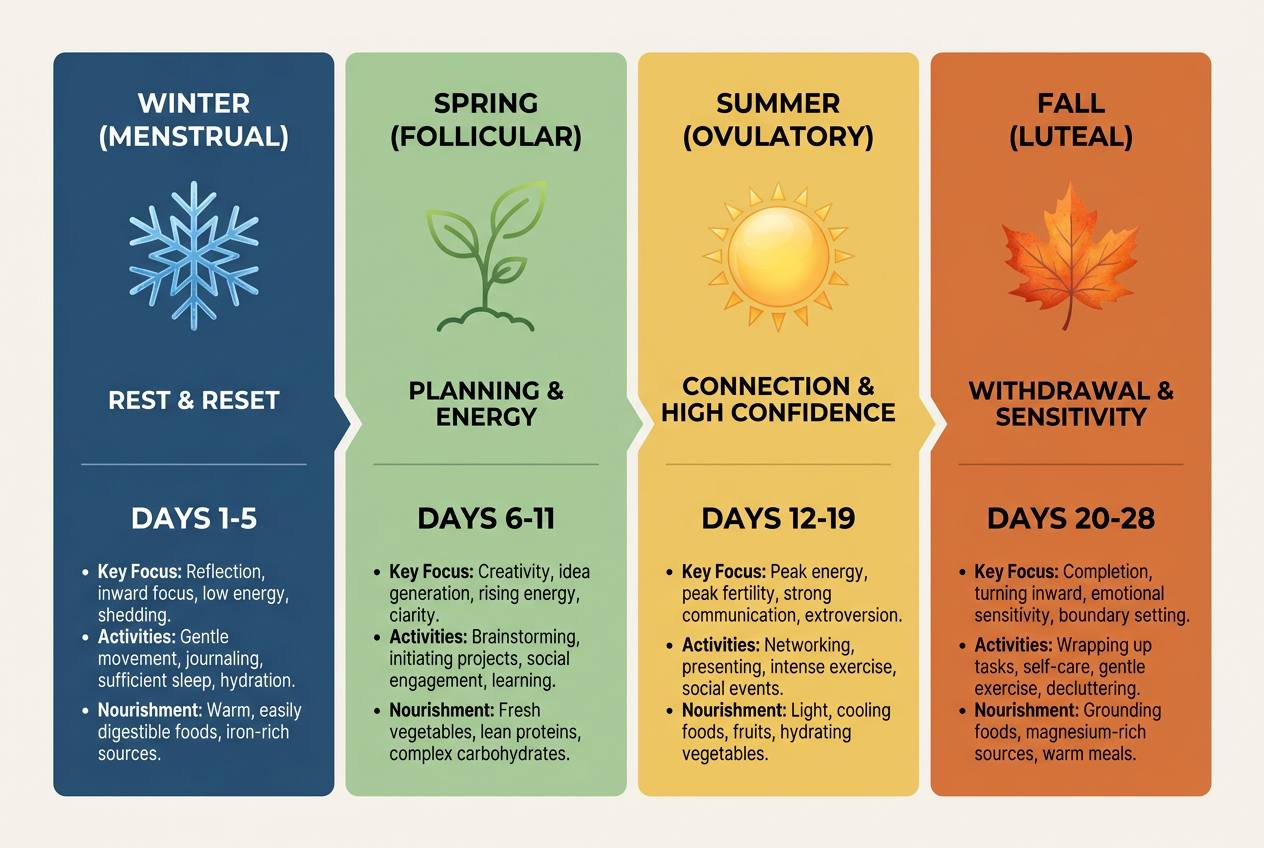 Viewing the menstrual cycle as a seasonal weather pattern helps partners anticipate emotional shifts and energy levels before they happen, making support more intuitive.
Phase 1: Menstrual (Winter) - Days 1-5
Hormone state: Estrogen and progesterone at baseline. Prostaglandins trigger uterine contractions.
What she's feeling: Physical discomfort dominates. 88% of menstruating women experience physical cramps every cycle, according to Clue's 2024 data. Energy is lowest. Social battery is at 20%. She's not withdrawn from you - she's biologically conserving resources.
What you'll see:
- Reduced social plans and "I'm staying in tonight" texts
- Lower threshold for overwhelm (loud environments, crowded spaces feel draining)
- Preference for comfort over stimulation (couch, heating pad, silence)
- Direct communication style (no energy for subtext)
How to show up: Comfort over conversation. This isn't the week for surprise date nights or introducing her to your college friends. Bring snacks. Offer heating pads. Don't take "I need space" personally.
Phase 2: Follicular (Spring) - Days 6-13
Hormone state: Estrogen rising steadily. The body is preparing for ovulation.
What she's feeling: Energy returns. Motivation increases. Creativity peaks. She's more willing to try new things and say yes to plans. This is her "reboot" phase - she feels like herself again, and often better than baseline.
What you'll see:
- Increased initiation (she texts first, suggests plans)
- Openness to novelty (new restaurants, weekend trips, meeting your friends)
- Higher tolerance for spontaneity
- Improved skin clarity (estrogen boosts collagen production)
- More receptive to physical affection
How to show up: Match her energy. This is your window for adventure. Plan the date she's been mentioning. Introduce new experiences. She's biologically primed to explore, and your role is to facilitate that without overwhelming her.
Phase 3: Ovulatory (Summer) - Days 14-16
Hormone state: Estrogen peaks at up to 800% above baseline. Testosterone also rises. This is the biological "high point" of her cycle.
What she's feeling: Confidence surges. Social battery maxed out. Libido increases. She feels most attractive, most assertive, most "herself." This is the phase where she says yes to everything - and means it in the moment.
What you'll see:
- Increased attention to appearance (makeup, outfit choices, hair styling)
- Higher social engagement (wants to go out, see friends, be visible)
- Flirtation and physical initiation increase
- Decision-making confidence (she's more decisive about plans, preferences, boundaries)
- The "glow" effect (skin clarity peaks, facial symmetry slightly improves due to estrogen)
How to show up: Be present and engaged. This is not the time to be passive. She's in her power - match it. Plan the big date. Have the important conversation. Show up with intention. The window is short (48-72 hours), and most men miss it entirely.
Phase 4: Luteal (Fall) - Days 17-28
Hormone state: Progesterone rises (peak around Day 21), then crashes if no pregnancy occurs. Estrogen drops. Serotonin dips.
What she's feeling: Energy declines gradually. Mood sensitivity increases, especially in the final 5-7 days before her period starts (this is when 75% of women experience PMS symptoms, according to VibeCheck's 2025 research). The brain's amygdala - the threat-detection center - becomes more active, meaning neutral tones can feel like attacks.
What you'll see:
- Social battery drains faster (she cancels plans she agreed to during ovulation)
- Increased sensitivity to tone (your neutral "okay" sounds dismissive to her)
- Skin changes (jawline breakouts due to progesterone-driven oil production)
- Food cravings intensify (especially carbs and salt)
- Need for reassurance without having to ask for it
How to show up: Validation over solutions. This is the hardest phase to navigate because she might not know what she needs - she just knows something feels off. Don't take her irritability personally. The progesterone crash in the final week creates a neurochemical environment that makes everything feel harder. Your job: be steady, validate her experience, and avoid initiating conflict.
For a deeper dive on how to navigate different phases effectively, check out our complete guide on understanding your partner's cycle.
How to Tell Which Phase Your Girlfriend Is in Without Asking
Asking "Where are you in your cycle?" can feel invasive or reduce her to biology. Instead, read the behavioral cues that each phase generates. Men who track these patterns report higher relationship satisfaction and fewer "Why didn't I know?" moments.
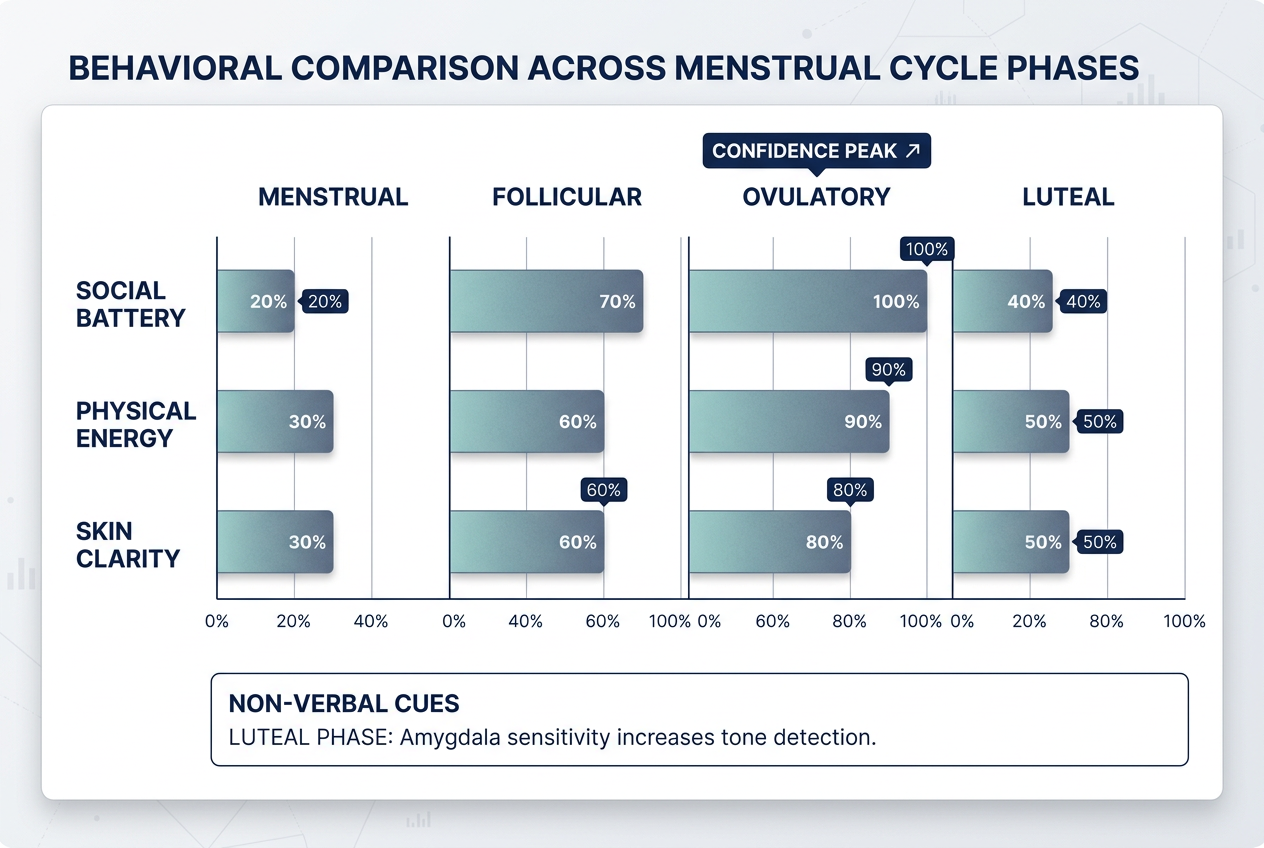 By monitoring non-verbal cues like social battery and skin clarity, partners can identify cycle phases with 41% higher accuracy and avoid common relationship friction points.
The Social Battery Test
Her willingness to socialize is the most reliable non-invasive indicator.
| Phase | Social Battery Level | What It Looks Like |
|---|---|---|
| Menstrual | 20% - Conservation mode | Declines invitations, prefers solo or 1-on-1 time, quiet environments only |
| Follicular | 60% - Rebuilding | Open to plans, suggests activities, responsive to invitations |
| Ovulatory | 100% - Peak engagement | Initiates social plans, wants to be seen, enjoys crowds and group settings |
| Luteal (Early) | 80% - Still engaged but selective | Accepts plans but may modify them (shorter duration, smaller groups) |
| Luteal (Late) | 30% - Shutdown imminent | Cancels plans she agreed to earlier, needs advance notice, prefers home |
If she was enthusiastic about Friday night plans on Monday and cancels them Thursday, she's not flaking - she's in late luteal, and her progesterone crash removed the energy buffer she had when she said yes. Don't shame her for this. Adjust.
The Skin Clarity Indicator
Hormones directly affect sebum production and inflammation. You don't need to stare at her face - just notice the pattern.
Follicular and Ovulatory (Days 6-16): Skin looks clearest. Estrogen suppresses oil production and boosts collagen. This is when she posts selfies.
Luteal (Days 17-28): Jawline and chin breakouts appear, especially in the final week. Progesterone increases oil production. If she mentions a breakout or seems self-conscious about her skin, you're likely in luteal.
Menstrual (Days 1-5): Skin dullness or puffiness due to inflammation and water retention. She's less likely to wear makeup or care about appearance during this phase.
The "Yes to Everything" Window
During ovulation, she will agree to things that later sound exhausting. This isn't deception - it's neurochemistry. Estrogen creates optimism and openness. Progesterone creates realism and self-protection.
Ovulatory Phase Agreement: "Yeah, let's do brunch with your parents this weekend!"
Luteal Phase Reality Check: "Actually, I'm not feeling up for it. Can we reschedule?"
If you notice a pattern where she enthusiastically agrees to something, then later expresses hesitation or cancels, check the calendar. Did she agree during Days 14-16? Is the event scheduled for Days 22-28? That's the pattern. Don't take it personally. Build in flexibility.
For tools that help you track these patterns discreetly and provide actionable guidance, explore our best period tracker apps for boyfriends comparison.
The Physical Affection Gauge
Libido fluctuates predictably across the cycle, driven by testosterone and estrogen.
Ovulatory (Peak): Physical initiation increases. She's more receptive to touch, flirtation, and intimacy. This is biologically driven - ovulation is the fertility window, and her body signals readiness.
Follicular (Rising): Openness to affection grows steadily. Receptivity is high, but she's not necessarily initiating.
Menstrual (Low): Physical touch preferences shift toward comfort (cuddling, hand-holding) rather than sexual initiation. Cramps and discomfort reduce libido for most women during this phase.
Luteal (Variable): Early luteal can maintain decent libido, but late luteal often brings withdrawal. Progesterone dampens desire. If she's pulling away physically and it's Day 24, it's not you.
Want to understand these patterns better? Check out our guide on libido and ovulation.
The Communication Calendar: When to Have Big Talks vs. Validation-Only Windows
Cycle-aware conflict timing reduces escalation by 58%, according to 2024 research from the Journal of Marital and Family Therapy. The difference between a productive conversation and a blowup often comes down to one variable: timing.
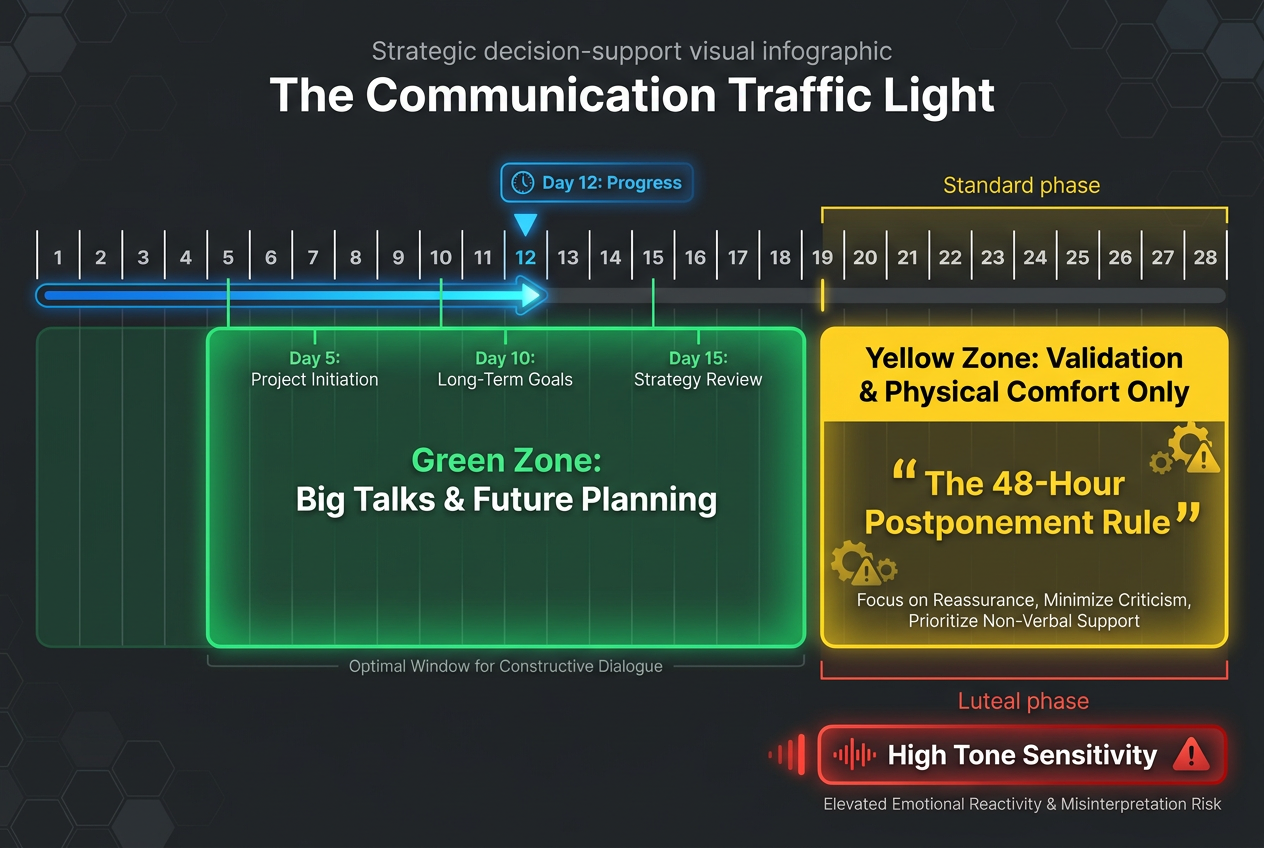 Timing difficult conversations for the Follicular or Ovulatory phases - and utilizing the 48-hour postponement rule during the Luteal phase - can reduce relationship conflict by 58%.
The Green Light Phases: Follicular and Ovulatory (Days 6-16)
These phases are your communication sweet spot. Estrogen enhances cognitive flexibility, emotional regulation, and openness to new information. She's biologically more equipped to engage with difficult topics without triggering a defensive response.
Best for:
- "Where is this relationship going?" conversations
- Discussing finances, future planning, living arrangements
- Addressing recurring issues that need resolution
- Feedback on relationship dynamics
Why it works: Her brain's prefrontal cortex - responsible for rational decision-making - is operating at peak efficiency. Serotonin is stable. The amygdala (threat detection) is less reactive. She can hear what you're saying without interpreting it as an attack.
Script example (Follicular/Ovulatory): "Hey, I've been thinking about [topic]. I'd love to talk through it with you when you have the bandwidth. How does this weekend sound?"
She's more likely to say yes, engage constructively, and collaborate on solutions during this window.
The Yellow Light Phase: Early Luteal (Days 17-21)
Proceed with caution. Estrogen is dropping, but progesterone hasn't peaked yet. She's still functional, but the margin for error is shrinking. Avoid heavy topics unless absolutely necessary.
Acceptable for:
- Logistical planning (schedules, upcoming events)
- Light check-ins ("How are you feeling about X?")
- Positive feedback or affirmation
Not ideal for:
- Relationship critiques
- Major life decisions
- Sensitive or emotionally loaded topics
The Red Light Phase: Late Luteal (Days 22-28)
This is the validation-only window. The amygdala's threat response is heightened. Serotonin drops. Progesterone-driven mood sensitivity means she's interpreting neutral statements as negative. Nearly 90% of women report some form of premenstrual distress that affects daily life, according to BYU ScholarsArchive (2025).
Do not initiate:
- Criticism or feedback
- "We need to talk" conversations
- Requests that require emotional labor
- Topics that have caused conflict in the past
Instead, focus on:
- Validation: "I can see you're having a rough day. What do you need?"
- Presence: Be there without trying to fix anything
- Reassurance: "I'm here. You're not too much."
Why this matters: The late luteal phase creates a neurochemical environment where her brain is scanning for threats. Your neutral tone can register as irritation. Your suggestion to "talk about it later" can feel like dismissal. You're not doing anything wrong - but the biological context makes everything harder.
If she picks a fight during this phase, it's usually not about the topic she's naming. It's about the neurochemical discomfort she's experiencing, and conflict is the only outlet that makes sense in the moment.
For more guidance on navigating tough conversations, see our article on improving communication in relationships.
The Practical Support Kit: What to Keep at Your Place
If she's spending regular time at your place, having a stocked support kit demonstrates that you're paying attention. This isn't about grand gestures - it's about removing friction during the phases when she needs support most.
The Menstrual Phase Essentials
Heating pad or hot water bottle: Prostaglandin-induced cramps are real. Heat is one of the most effective non-pharmacological interventions. Keep one accessible.
Pain relief: Ibuprofen (Advil) or naproxen (Aleve). Not acetaminophen (Tylenol) - NSAIDs reduce prostaglandins, which is the actual mechanism causing cramps. Have a bottle in your medicine cabinet.
Backup period products: Tampons, pads, or both. You don't need to know her preferred brand - ask once, then keep a box on hand. The average woman will have approximately 450 periods over her lifetime, according to the Association of Reproductive Health Professionals. Running out is a recurring scenario. Solve it once.
Comfort snacks: Dark chocolate (magnesium helps with cramps and mood). Salty snacks (she's retaining water, and sodium cravings are real). Ginger tea (reduces nausea for women who experience it during menstruation).
Extra blankets: She's likely to feel colder during this phase due to lower metabolic rate. Keep a soft throw on the couch.
The Luteal Phase Staples
Carb-heavy snacks: Progesterone increases appetite and cravings for quick-energy foods. Crackers, pretzels, popcorn. Stock them.
Magnesium supplements (optional): If she's open to it, magnesium glycinate can reduce PMS irritability and cramping. Don't push it - but having it available shows you've researched.
Low-effort entertainment: Download a few episodes of her favorite show on your streaming account so she doesn't have to navigate menus. Queue up a comfort movie. Reduce decision fatigue.
Caffeine-free options: Caffeine amplifies anxiety and irritability during late luteal. Have herbal tea or decaf coffee available.
The goal isn't to "fix" her cycle - it's to reduce logistical friction so she doesn't have to worry about whether you're prepared when she needs something.
The 48-Hour Postponement Rule: How to Handle Luteal Phase Conflict
Late luteal conflict is different. The issue she's raising might be real, but the intensity and urgency she's feeling are amplified by progesterone withdrawal and serotonin depletion. Trying to resolve it in the moment usually escalates.
The Rule
If a conflict arises during Days 22-28, acknowledge it, validate her feelings, and request a 48-hour pause before addressing the substance. The goal: separate the neurochemical amplification from the actual issue.
The Script
"I hear you. This is important, and I want to talk about it when we can both engage with it clearly. Can we revisit this in a couple of days?"
If she resists: "I'm not dismissing you. I just want to make sure we're solving the real problem, not the heightened version of it."
Why It Works
Within 48 hours, one of two things happens:
The issue resolves naturally: She's moved out of the late luteal phase, serotonin stabilizes, and the urgency disappears. She might not even bring it up again because the emotional charge is gone.
The issue persists but is now discussable: If she still wants to talk about it after 48 hours, it's a real problem that deserves attention - and now you can address it without the neurochemical noise.
The postponement rule isn't avoidance. It's strategic timing. You're not ignoring her - you're optimizing for resolution instead of escalation.
Cycle-aware conflict timing reduces escalation by 58%. That's not because the issues go away - it's because you're addressing them when her brain is equipped to process them rationally.
For more strategies on handling difficult moments, read our guide on relationship conflict resolution strategies.
What Phase of My Cycle Am I Prettiest? Understanding Appearance and Confidence Shifts
The question "What phase of my cycle am I prettiest?" is common, and the answer is rooted in hormonal effects on skin, facial symmetry, and self-perception. Estrogen peaks during the ovulatory phase (Days 14-16), creating visible changes that both she and others perceive as increased attractiveness.
The Estrogen Glow Effect
Estrogen boosts collagen production, increases skin hydration, and reduces sebum secretion. During ovulation:
- Skin appears clearer and more radiant
- Facial symmetry subtly improves (estrogen reduces inflammation and water retention asymmetry)
- Pupils dilate slightly, making eyes appear larger
- Lip fullness increases due to enhanced blood flow
These aren't placebo effects. Studies on facial attractiveness across the menstrual cycle show that women are rated as more attractive during ovulation by external observers, and women self-report feeling more confident about their appearance during this phase.
The Confidence Window
Beyond physical changes, the ovulatory phase creates a psychological "glow" driven by peak estrogen and rising testosterone. She feels more attractive, which changes how she presents herself:
- Increased attention to grooming and styling
- More expressive body language
- Greater willingness to be seen and photographed
This is the phase where she posts photos. This is when she feels most "herself."
The Luteal Contrast
During the luteal phase (Days 17-28), progesterone increases oil production, leading to breakouts, especially around the jawline and chin. Skin may appear duller due to reduced collagen production. Water retention can cause facial puffiness.
This isn't her being "less pretty" - it's a hormonal shift. But the contrast between ovulatory glow and luteal skin changes can affect her self-perception. As her partner, your role: affirm her consistently, not just during the phases where she feels confident.
If she mentions feeling "off" or self-conscious about her skin, you're likely in late luteal. Don't dismiss it ("You look fine") - acknowledge it ("I hear you. You're still beautiful to me").
Why Understanding Her Cycle Makes You a Better Partner
64% of people - men and women - do not know exactly what ovulation is or when it occurs, according to Clue's 2024 survey. That knowledge gap creates relationship friction that most couples attribute to incompatibility when it's actually just biology misunderstood.
Understanding her cycle doesn't mean you're reducing her to hormones. It means you're recognizing that her body operates on a 28-day rhythm, and that rhythm affects mood, energy, and communication in predictable ways. The men who learn this pattern report:
- Fewer "surprise" conflicts
- Higher relationship satisfaction
- Better timing for important conversations
- Increased confidence in providing support
This isn't about controlling her experience. It's about pattern recognition. The same way you'd adjust your approach if she had a stressful work week, you adjust your approach based on where she is in her cycle. It's context.
Most relationship advice tells men to "just communicate better." That's half the equation. The other half: communicate at the right time. Learn how to improve communication in your relationship by understanding biological context alongside emotional context.
The average woman will spend approximately 40 years menstruating. That's 480 cycles. You're not learning this once - you're integrating it into how you show up for decades. The earlier you master it, the stronger your foundation.
For men looking to deepen their understanding systematically, VibeCheck provides AI-powered cycle tracking and relationship coaching specifically designed for this use case. You're not guessing - you're working with data.
Ready to actually understand her?
Join thousands of men using VibeCheck to track her cycle and show up better every day.
Frequently Asked Questions
How do you know what phase your girlfriend is in?
You can identify your girlfriend's cycle phase by observing behavioral cues like social battery level, skin clarity, and receptiveness to plans. During the Follicular phase (Days 6-13), she'll show increased energy and openness to social activities. Ovulation (Days 14-16) brings peak confidence and a noticeable "glow" due to estrogen surges up to 800% above baseline. The Luteal phase (Days 17-28) gradually reduces social energy and increases mood sensitivity, with late luteal often marked by skin breakouts and lower tolerance for stress. If you need precision, a period tracker for men can help you log patterns over 2-3 cycles and predict phases more accurately.
How should a boyfriend deal with a girlfriend's period?
A boyfriend should deal with a girlfriend's period by providing practical support and validation without making her feel like a burden. Keep heating pads, pain relief (ibuprofen, not Tylenol), and backup period products at your place. Offer comfort snacks like dark chocolate and salty foods, which address real cravings driven by prostaglandins and water retention. Don't take reduced social energy or physical withdrawal personally - 88% of women experience cramps every cycle, and the body is biologically conserving resources. Validate her experience ("I know this sucks, what do you need?") rather than trying to fix it. For a complete guide, read how to support your partner during her period.
When is the biologically optimal time to initiate difficult relationship conversations?
The biologically optimal time for difficult conversations is during the Follicular or Ovulatory phases (Days 6-16), when estrogen enhances cognitive flexibility and emotional regulation. Research from the Journal of Marital and Family Therapy shows that cycle-aware conflict timing reduces escalation by 58%. During these phases, her brain's prefrontal cortex operates at peak efficiency, allowing her to process challenging topics without the threat-detection amplification seen in late Luteal (Days 22-28). Avoid "we need to talk" conversations during late Luteal, when progesterone withdrawal and serotonin depletion heighten mood sensitivity and make neutral tones feel like attacks. Use the 48-hour postponement rule if conflict arises in this window.
Are men affected by their partners' period?
Men are indirectly affected by their partners' menstrual cycle through relationship dynamics, not through biological synchronization. Male partners report higher stress and conflict during their partner's late Luteal phase, when PMS symptoms peak and communication becomes more challenging. Some research suggests men may unconsciously respond to hormonal cues, showing increased protective behavior during menstruation and heightened attraction during ovulation, though these effects are subtle and not universally experienced. The primary impact is relational: men who understand cycle phases report 41% fewer misread situations and better relationship satisfaction, according to VibeCheck's 2024 data. For practical guidance, see understanding your partner's cycle.
Why is it important for males to understand the menstrual cycle?
Males should understand the menstrual cycle because it provides predictable context for mood, energy, and communication patterns that would otherwise feel random or personal. 64% of people do not know what ovulation is or when it occurs, according to Clue's 2024 survey, creating relationship friction that partners attribute to incompatibility when it's biology misunderstood. Understanding the cycle allows men to time conversations strategically, provide appropriate support, and avoid taking hormonally-driven behavior personally. Men using behavioral pattern recognition report fewer "surprise" conflicts and higher relationship satisfaction. This isn't reducing a partner to hormones - it's recognizing that the body operates on a 28-day rhythm affecting multiple systems simultaneously.
How do guys feel when you tell them you're on your period?
Most guys feel uncertain about how to respond when a partner mentions her period, often defaulting to awkward silence or generic sympathy because they lack specific knowledge about what's helpful. Younger or less experienced men may feel uncomfortable discussing menstruation openly due to socialization that frames it as taboo. However, men in committed relationships increasingly want practical guidance on how to support their partners, with searches for "period tracker for boyfriends" and "how to help during period" rising significantly in recent years. The shift: men are moving from avoidance to engagement, seeking tools and knowledge to be genuinely helpful rather than performatively sympathetic.
Is there an app for men to track their partners' period?
Yes, several apps now cater specifically to men tracking their partners' cycles, including VibeCheck, Selin, and Mayday. VibeCheck stands out by combining cycle tracking with AI-powered relationship coaching and behavioral guidance tailored for male partners. These apps allow men to discreetly log cycle data, receive alerts about upcoming phases, and access phase-specific advice on communication, support, and conflict timing. Unlike traditional period trackers designed for women, partner-focused apps frame the cycle as relationship intelligence rather than fertility tracking. For a detailed comparison, see our guide on the best period tracker apps for boyfriends.
Can high cortisol affect menstruation?
High cortisol - the stress hormone - can significantly affect menstruation by disrupting the hypothalamic-pituitary-ovarian axis, which regulates the cycle. Chronic stress can delay ovulation, shorten the luteal phase, or cause missed periods entirely. Approximately 45% of pregnancies in the U.S. are unintended, partly because stress-induced cycle irregularity makes fertility tracking unreliable. For women already prone to PMS, elevated cortisol amplifies symptoms by reducing serotonin availability and increasing inflammation. As a supportive partner, recognize that external stressors (work deadlines, family issues, financial pressure) can directly impact cycle regularity and symptom severity. For more, read can stress delay your period.
Ready to stop guessing and start understanding? VibeCheck is the relationship app built specifically for men who want to support their partners with science-backed insights and cycle-aware coaching. Track her phases discreetly, get daily tips tailored to where she is in her cycle, and turn biological patterns into relationship intelligence. Download VibeCheck and become the partner who just gets it.
Tags

Related Articles
Continue reading to deepen your understanding

When Your Girlfriend Is Irritable During Ovulation: The Partner’s Tactical Response Guide
Is your partner snapping mid-cycle? Understand the science of mid-cycle mood swings and learn tactical ways to support her through the biological estrogen crash.

Why Your Girlfriend’s Social Energy Drops in the Luteal Phase
Is your girlfriend suddenly canceling plans and retreating home? It isn’t personal; it’s biology. Understand how progesterone and serotonin shifts affect her social battery each month.

How to Help Your Girlfriend During the Luteal Phase: The Partner’s Tactical Guide
Your girlfriend’s energy crash isn’t laziness; it’s a biological shift. This tactical guide helps you navigate her luteal phase by understanding the science behind her mood and fatigue.

Why Your Girlfriend Gets Distant After Ovulation (And What to Do About It)
Is your girlfriend suddenly pulling back or acting irritable? It might be her cycle. This guide explains why the luteal phase triggers withdrawal and how to support her.

Supporting Your Girlfriend Through the Luteal Phase
When hormone levels crash before her period, your partner’s brain enters a high-alert state. Learn how to provide the security she needs with tactical scripts and empathy.

How to Give Your Girlfriend Reassurance During Ovulation Week
Is your girlfriend suddenly questioning everything during her cycle? Understand the estrogen crash and learn how to provide the tactical support she needs to feel secure and loved.

When to Give Her Space vs. When to Stay Close: Your Phase-by-Phase Guide
Your girlfriend’s need for closeness isn’t random. Understanding how her 28-day biological rhythm affects her energy helps you time your support perfectly across all four phases.

Your Girlfriend’s 28-Day Relationship Manual: How to Support Her Through Every Phase
Understanding her menstrual cycle transforms you from a guy walking on eggshells into a strategic partner who knows exactly what support to offer and when.