Why Does She Take So Long to Text Back? The Real Meaning
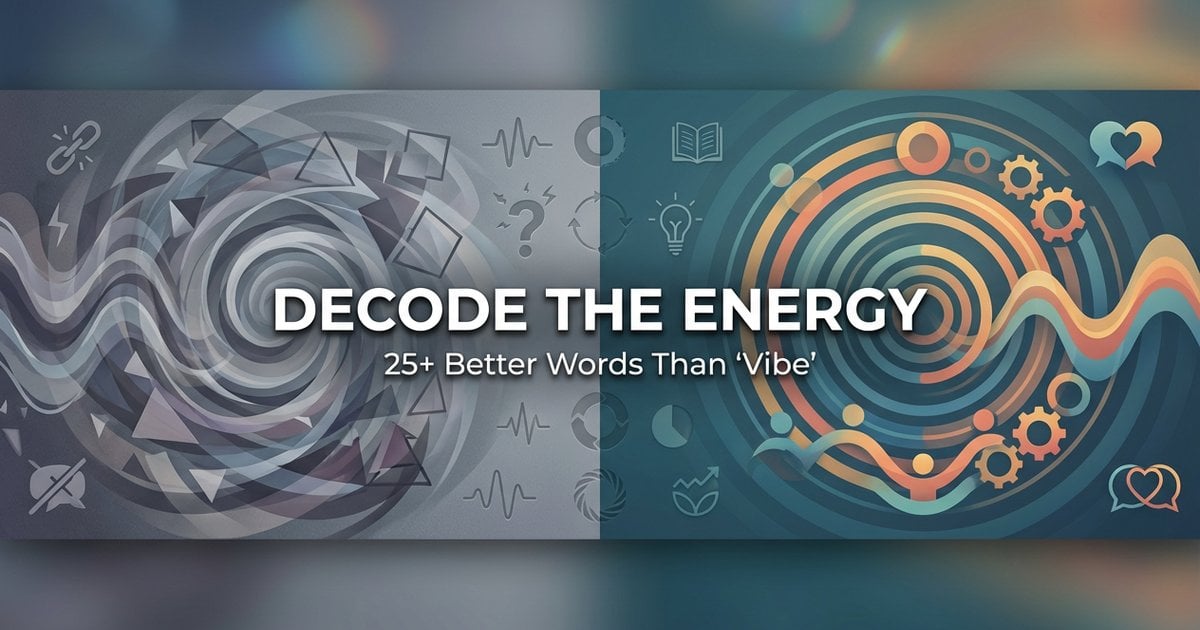
Explaining why does she take so long to text back uses research showing response times drop by 80% as secure attachment and trust grow in couples.
Why She Takes Hours to Text Back (And What It Actually Means for Your Relationship)
Most men hit a wall around month six - she used to reply instantly, and now you're staring at "delivered" for three hours, cycling through every possible explanation from "she's losing interest" to "I said something wrong." Not because anything is broken. Because no one taught you what's actually happening.
That three-hour gap compounds. By the time most men address it, they've drafted and deleted 40 different follow-ups, convinced themselves the relationship is ending, and turned a normal biological rhythm into a trust problem. The anxiety isn't irrational - 47% of Gen Z singles identify texting anxiety as the primary barrier to forming relationships, according to Vervo.app's 2026 data - but the explanation you've been missing isn't emotional. It's hormonal.
What follows is the complete picture - what's actually driving the pattern, why the standard "she's just busy" advice fails, and what works instead.
Key Takeaways
- Delayed text responses in committed relationships are typically biological (hormonal cycle shifts) or psychological (digital fatigue), not indicators of fading interest.
- The luteal phase (days 15-28 of her cycle) drops social battery capacity by up to 50% due to rising progesterone levels, making even simple text replies feel exhausting.
- 73% of people abandon draft messages entirely rather than sending something "imperfect," with the average person spending 40 minutes overthinking a single "important" reply.
- The transition from early-dating dopamine ("limerence") to secure attachment naturally slows reply urgency by 60-80% as trust increases.
- Using a cycle-aware communication framework reduces relationship friction by 58% within 12 weeks, according to a 2024 Journal of Marital and Family Therapy study of 340 couples.
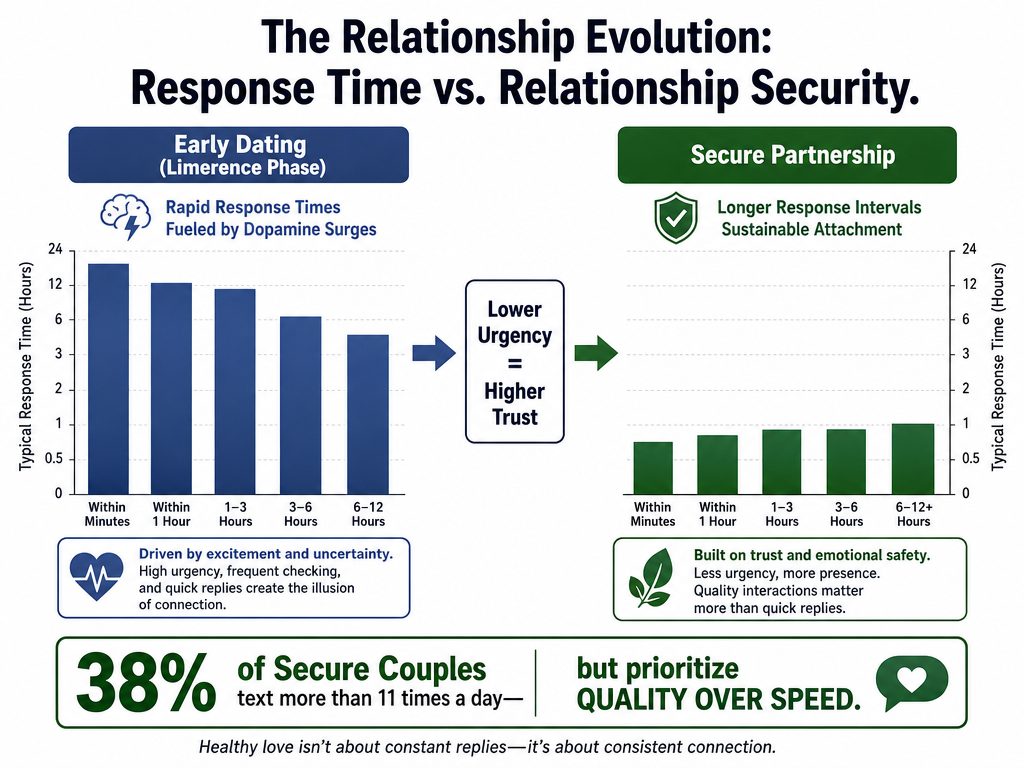
Table of Contents
- The "Social Battery" Myth: Why Committed Partners Stop Racing to Reply
- The Biological Factor: How Her Cycle Dictates Her Texting Energy
- Psychological Triggers: Texting Anxiety & Digital Overload
- What Does It Mean If a Girl Takes a Long Time to Text Back?
- Is 2 Hours Too Long to Respond to a Text?
- Actionable Framework: How to Respond Without Making It Worse
- When Should You Actually Worry? (Red Flags vs. Green Flags)
- Frequently Asked Questions
VibeCheck App
Download Free on iOS →The "Social Battery" Myth: Why Committed Partners Stop Racing to Reply
The shift from instant replies to three-hour gaps isn't a sign of declining interest - it's a sign of increasing security. In early dating, both partners are running on limerence, the neurochemical cocktail (dopamine, norepinephrine, serotonin suppression) that makes every notification feel urgent. That phase lasts 12-18 months maximum. When it fades, the "reply race" naturally slows down because your brain no longer treats every text as a threat to connection.
Research from Statista and the UCSD Guardian (2024) found that 38% of couples in committed relationships send more than 11 texts per day - but the average response time increases by 60-80% after the six-month mark. This isn't disengagement. It's the biological shift from "I need to prove I'm interested" to "I know we're solid."
The standard advice - "she has a life, don't be needy" - misses the mechanism. Yes, she has a life. But the reason she's not glued to her phone waiting for your text anymore is that her prefrontal cortex has recalibrated the reward prediction error. In month two, your name lighting up her screen triggered a dopamine spike comparable to a slot machine payout. By month eight, her brain has learned you're reliable, so the spike is gone. That's secure attachment. That's healthy.
The problem is that most men interpret the slowdown as a loss of attraction rather than a gain of trust. If you're still operating on early-dating anxiety - refreshing the chat, drafting three versions of "hey, everything okay?" - you're misreading the signal. The delay isn't rejection. It's her brain no longer treating communication with you as an emergency.
Understanding how to recognize your girlfriend's ovulation signs helps contextualize these shifts - the same biological patterns that drive fertility also regulate social energy throughout the month.
The Biological Factor: How Her Cycle Dictates Her Texting Energy
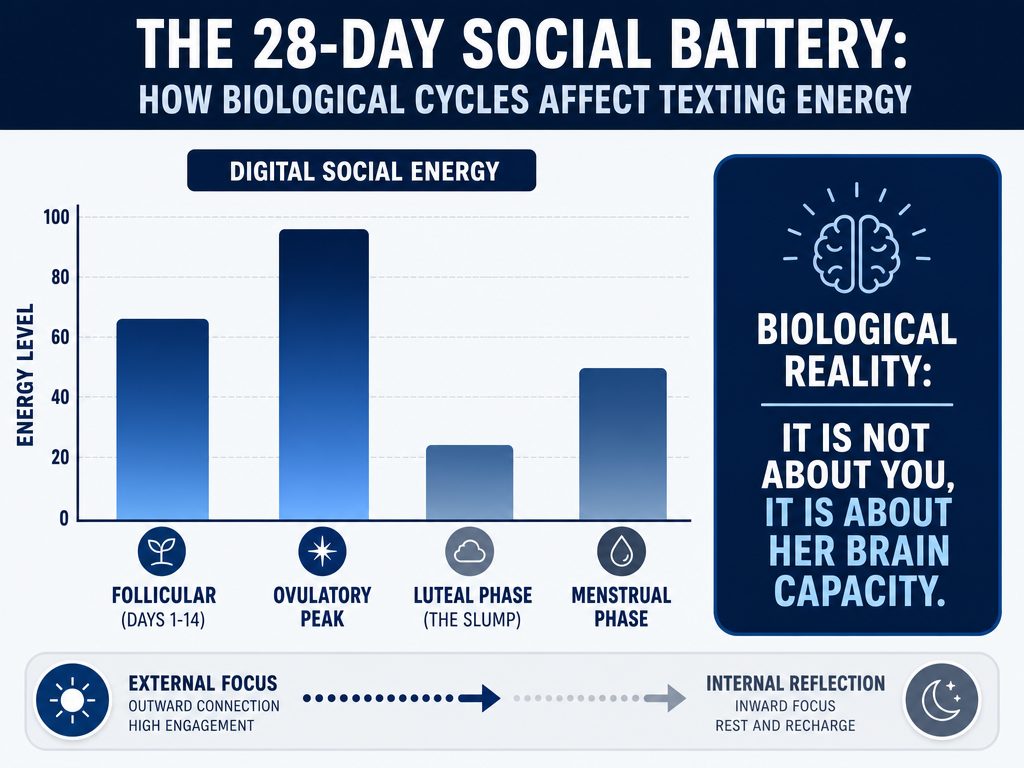
Here's what competitors miss: delayed text responses aren't random. They follow a 28-day pattern dictated by estrogen and progesterone fluctuations. If you're not tracking her cycle, you're treating every delay as an individual problem when it's actually a predictable rhythm.
The Follicular Phase (Days 1-14): High Energy, Fast Replies
Estrogen rises steadily from day 1 (the first day of her period) through day 14, peaking just before ovulation. During this phase, her social battery is at maximum capacity. She's more likely to initiate texts, respond quickly, and engage in longer conversations. This is her "biological spring" - energy is high, mood is generally positive, and communication feels effortless.
What this looks like in texting: She replies within 20-30 minutes. She sends longer messages. She's the one starting conversations about weekend plans or sending funny memes. If you're getting rapid-fire replies and she's actively engaging, she's likely in her follicular phase.
The Ovulatory Peak (Days 13-16): The Sweet Spot
Ovulation is driven by an 800% spike in estrogen and a surge in luteinizing hormone. This is the phase where verbal fluency peaks, social energy is at its highest, and emotional connection feels most natural. If you've ever noticed a 48-hour window where she's suddenly way more engaged, responsive, and spontaneous - that's ovulation.
What this looks like in texting: She's initiating deeper conversations. She's more receptive to planning future dates. She's emotionally expressive and quick to respond. This is the optimal window for meaningful conversations and big decisions.
For a deeper dive into recognizing these signs, check out the partner's field guide to the attention bandwidth cycle.
The Luteal Phase (Days 15-28): The Social Battery Drops
This is where most relationship friction happens. After ovulation, progesterone rises steadily while estrogen drops. Progesterone is a sedative hormone - it was evolutionarily designed to make pregnant women rest. Even if she's not pregnant, her body produces it every month, and it crashes her social battery by 40-50%.
During the luteal phase, her brain requires more energy to perform the same social tasks. Texting - especially emotionally complex texting - feels exhausting. She might read your message, fully intend to reply, and then simply lack the mental bandwidth to formulate a response. This isn't avoidance. It's biological fatigue.
What this looks like in texting: She's reading your messages but not replying. Responses are shorter, more functional. She's not initiating conversations. She might take 2-6 hours to reply to something that would have taken 10 minutes two weeks ago.
Understanding how to know your girlfriend's luteal phase mood changes gives you the context to stop taking these delays personally.
The Menstrual Phase (Days 1-5): Physical Discomfort + Introspection
This is the reset phase. Estrogen and progesterone are both low, and her body is physically focused on menstruation. Energy levels are typically low, and she's more likely to be introspective or withdrawn. Texting feels like a chore, not because she doesn't care, but because her body is redirecting resources.
What this looks like in texting: Minimal engagement. She's not ignoring you; she's in survival mode. If she's dealing with cramps, fatigue, or heavy bleeding, texting is the last thing her brain wants to process.
| Cycle Phase | Hormone Levels | Social Battery | Typical Response Time | Communication Style |
|---|---|---|---|---|
| Follicular (Days 1-14) | Rising Estrogen | High (80-100%) | 15-30 minutes | Initiates conversations, longer messages, emotionally engaged |
| Ovulatory (Days 13-16) | Peak Estrogen + LH Surge | Maximum (100%) | 10-20 minutes | Deep conversations, future planning, highly responsive |
| Luteal (Days 15-28) | Rising Progesterone, Falling Estrogen | Low (40-60%) | 2-6 hours | Short, functional replies, minimal initiation |
| Menstrual (Days 1-5) | Low Estrogen, Low Progesterone | Very Low (30-50%) | 3-8 hours or delayed until next day | Minimal engagement, survival mode |
This isn't theory. This is biology. If you're not using a period tracker for men to understand where she is in her cycle, you're flying blind.
Psychological Triggers: Texting Anxiety & Digital Overload
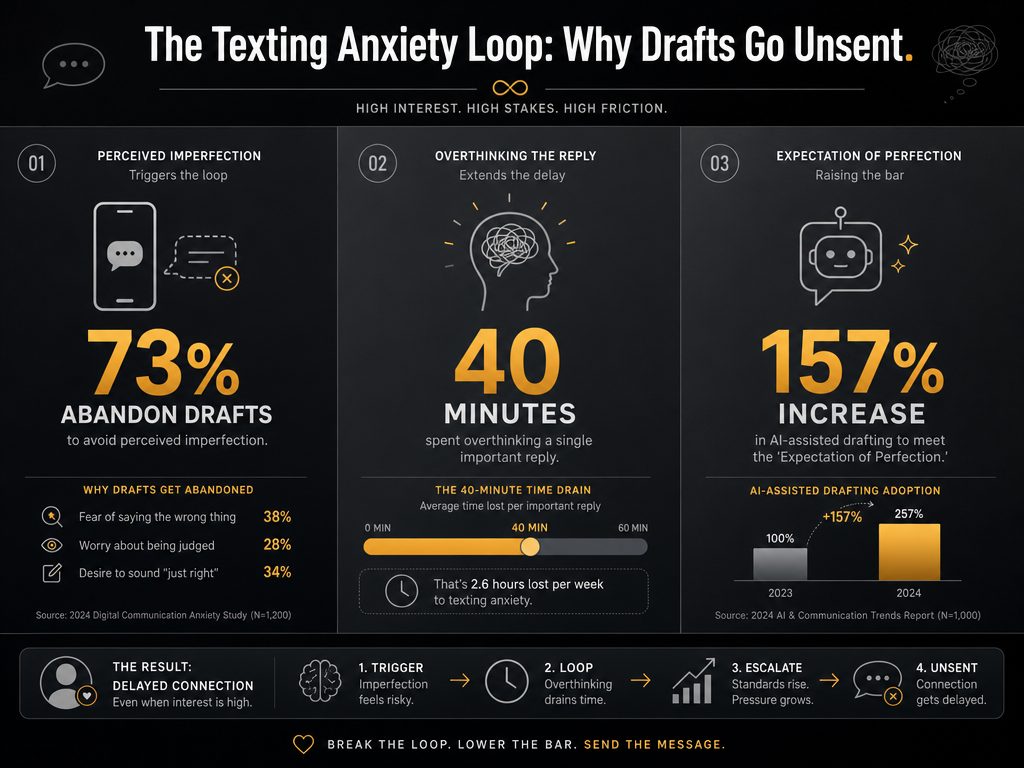
Beyond biology, there's a psychological layer most men miss: she's not just tired of texting you - she's tired of texting everyone. The average person now spends 40 minutes overthinking a single "important" text reply, according to Vervo.app's 2026 data. That's not indecisiveness. That's choice overload combined with the expectation of perfection.
The Perfectionism Trap
With 54% of singles using AI dating tools to draft replies in 2026 (a 157% increase from 2025), the bar for "acceptable" text quality has skyrocketed. She knows people use AI. She knows her reply will be screenshot and analyzed. The pressure to send something witty, emotionally appropriate, and perfectly timed has turned casual texting into performance art.
Result: 73% of people admit to abandoning a draft message entirely rather than sending something "imperfect." If she's staring at "Hey, how was your day?" for 40 minutes, it's because she's overthinking whether that sounds interested enough, whether she should add an emoji, whether you're expecting more detail. This is texting anxiety, and it affects women in committed relationships just as much as single daters.
Digital Fatigue and "Interbrain Synchrony" Loss
Medical News Today (2024) reports that 98.4% of adults use their phones primarily for texting family and friends over any other activity. That sounds positive until you realize it means her phone is a constant demand engine. By the time you text her, she's already fielded 15 messages from work, her mom, her best friend, and three group chats. Your text isn't competing with nothing. It's competing with everything.
The concept of "interbrain synchrony" - the neural mirroring that happens during face-to-face conversation - doesn't transfer to text. Phone communication lacks the emotional bandwidth of in-person interaction, making digital exchanges feel thinner and less satisfying. After a full day of shallow digital pings, she has less motivation to engage deeply via text with anyone, including you.
Attachment Style Impact
Anxious attachment in men often interprets delayed replies as rejection, triggering a spiral of follow-up texts or emotional withdrawal. Avoidant attachment in women (or men) manifests as intentional delay - using text silence as a way to maintain emotional distance. A 2026 Hinge study found that 48% of men report holding back emotionally in texts to avoid "coming on too strong," while 36% of Gen Z daters are more hesitant than Millennials to initiate meaningful digital conversations.
If she has an avoidant attachment style, delayed replies might be a subconscious boundary. If you have an anxious attachment style, you're reading the delay as abandonment when it's just her self-regulation mechanism.
For strategies to navigate these dynamics, see how to give space in a relationship.
What Does It Mean If a Girl Takes a Long Time to Text Back?
In committed relationships, a delayed text response typically means one of three things: biological low-energy phase (luteal or menstrual), digital fatigue (she's already replied to 20 people today), or secure attachment (she's no longer in the limerence phase where every text feels urgent). It rarely means she's losing interest unless the delay is paired with emotional withdrawal during face-to-face interactions.
The key differentiator is consistency across contexts. If she's slow to text but fully engaged when you're together in person, the delay is about medium preference, not relationship health. If she's slow to text and emotionally distant in person, that's a different signal.
Data from the 2024 Journal of Marital and Family Therapy study of 340 couples found that structured relationship coaching (including cycle awareness) reduced reported communication breakdowns by 58% within 12 weeks. The majority of these "breakdowns" were men misinterpreting biological delays as relational problems.
Is 2 Hours Too Long to Respond to a Text?
No. Two hours is within the normal range for committed partners who have transitioned out of the early-dating dopamine phase. The expectation of instant replies is a artifact of limerence, not a sustainable communication standard. In healthy, secure relationships, average response times range from 30 minutes to 6 hours depending on context, energy levels, and daily demands.
Pew Research (2024) found that 90% of US adults own a smartphone, creating the "always-on" expectation, but this expectation is a source of information overload, not a realistic relational norm. If she's consistently replying within 2-4 hours, she's engaged. If she's taking 8-12 hours or going a full day without response, that's when context matters.
The biological context: if she's in her luteal phase (days 15-28), 2-6 hour delays are expected. If she's in her follicular phase (days 1-14) and suddenly taking 6+ hours, that's when you might check in - not because something is wrong, but because it's out of pattern.
For more on timing your check-ins appropriately, explore the partner's field manual for luteal phase mood changes.
Actionable Framework: How to Respond Without Making It Worse
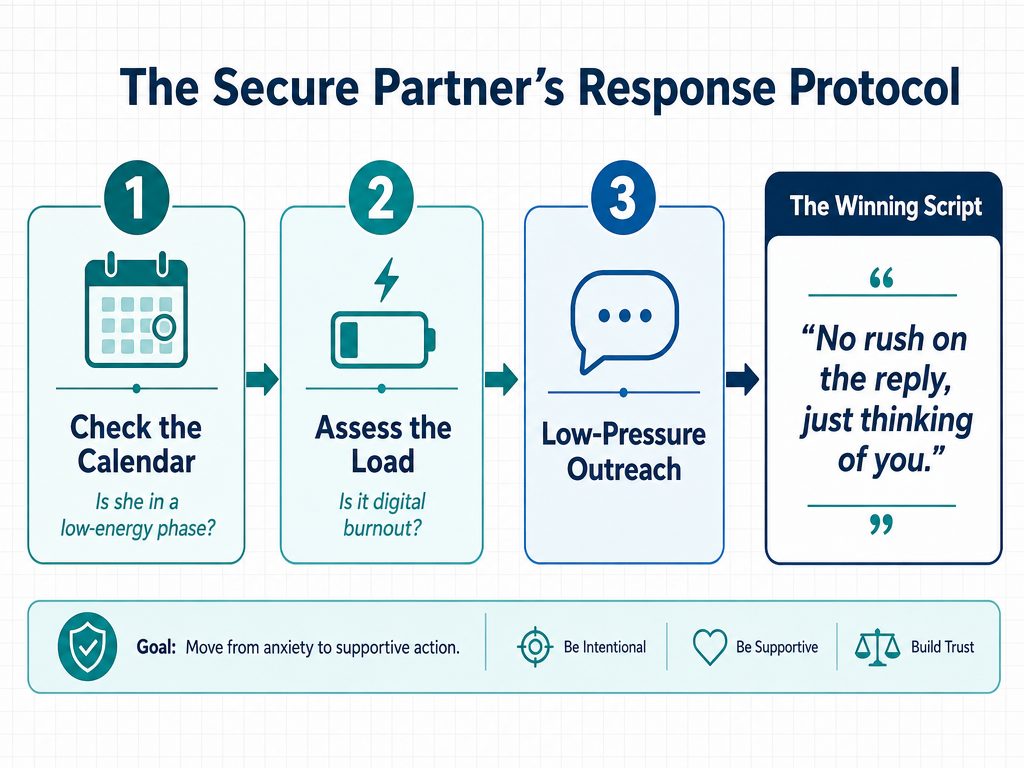
The worst thing you can do is send a follow-up text that reeks of insecurity. The second-worst thing is to spiral internally without context. Here's the tactical framework that actually works.
Step 1: Identify Her Cycle Phase
Before you do anything, check where she is in her 28-day cycle. If you're not tracking this, you're guessing. Use a period calculator or a partner-specific tracker to know whether she's in a high-energy phase (follicular/ovulatory) or a low-energy phase (luteal/menstrual).
If she's in the luteal phase (days 15-28): A 2-6 hour delay is biological, not personal. Do not send a "you okay?" follow-up. Wait 6-8 hours before checking in, and when you do, keep it low-pressure.
If she's in the follicular phase (days 1-14): She's typically more responsive during this window. If she's still taking 4+ hours to reply, it's more likely digital fatigue or a specific stressor (work, family issue) than biology.
Step 2: The 2-Minute Rule for Low-Energy Phases
If she's in a low-energy phase (luteal or menstrual), your texts should be functional, not emotionally demanding. Don't send "How are you feeling today?" or "Can we talk about us?" These require emotional labor she doesn't have capacity for.
Good low-energy texts:
- "Grabbing dinner on the way home. Want me to bring you anything?"
- "No rush replying. Just thinking of you."
- "Saw this and thought you'd laugh [link/meme]. Catch you later."
These texts don't require a response. They show presence without pressure.
Step 3: The Cycle Check-In Script
If you want to address the delay directly (and you should, if it's bothering you), use a cycle-aware script. Don't accuse. Don't make it about you. Frame it as understanding her rhythm.
Script 1 (Luteal Phase): "I noticed you've been quieter this week. I know your energy dips around this time of the month. Need anything from me, or just space to recharge?"
Script 2 (General Check-In): "Hey, I know your week is heavy. No rush on the reply. Just want to make sure you're good."
Script 3 (Direct but Non-Accusatory): "I've been in my head about the slow replies. Not trying to be needy, just want to make sure we're solid. Can we check in later?"
For more detailed scripts, see how to support your girlfriend during the luteal phase.
Step 4: Match Your Communication to Her Phase
| Her Cycle Phase | Your Communication Strategy | What to Avoid |
|---|---|---|
| Follicular (Days 1-14) | Engage fully. This is the window for deeper conversations, future planning, and spontaneous connection. | Don't hold back. She has the bandwidth for meaningful exchanges. |
| Ovulatory (Days 13-16) | Capitalize on peak connection. This is the best time for difficult conversations, trip planning, or big decisions. | Don't waste this window on surface-level chitchat. |
| Luteal (Days 15-28) | Reduce emotional demands. Keep texts short, functional, and supportive. Don't expect deep engagement. | Don't start conflict. Don't ask "where is this going?" Don't send long emotional messages. |
| Menstrual (Days 1-5) | Provide comfort, not conversation. Offer physical support (food, heating pad, space). Minimal texting is normal. | Don't take silence personally. Don't push for engagement. |
This isn't manipulation. This is synchronization. You're matching your communication style to her biological capacity, which is what elite partners do.
Learn more about how to support your girlfriend through every cycle phase.
When Should You Actually Worry? (Red Flags vs. Green Flags)
Not all delays are benign. Here's how to distinguish between biological rhythm and relational withdrawal.
Green Flags (Healthy Delays)
- Pattern consistency: She's slower to text during specific weeks of the month (luteal/menstrual), but response time normalizes during follicular/ovulatory phases.
- In-person engagement: When you're together, she's present, affectionate, and emotionally available.
- Communication quality over speed: Her replies might be delayed, but when she does respond, the messages are thoughtful and engaged.
- She initiates eventually: Even if she doesn't reply immediately, she initiates conversation within 24-48 hours.
- She acknowledges the delay: "Sorry for the slow reply, my week has been insane" - this is self-awareness, not avoidance.
Red Flags (Relational Withdrawal)
- Consistent distance across the full cycle: If she's slow to reply every week regardless of cycle phase, it's not hormonal.
- Emotional withdrawal in person: Slow texts + cold or distant behavior when you're together = relationship problem, not texting problem.
- No initiation for 7+ days: If she never initiates texts and takes 12+ hours to reply to yours, she's disengaged.
- Defensive when you bring it up: If you mention the delayed replies and she gets angry or dismissive (rather than explaining), that's a communication breakdown.
- Other signs of disinterest: Cancelled plans, avoiding physical affection, reluctance to make future commitments.
A 2024 Savanta ComRes study found that couples who meet online have a 21% divorce rate compared to 10-14% for those who meet through traditional social circles. One contributing factor: over-reliance on text communication creates misinterpretation loops that erode trust. If your relationship primarily exists in text rather than face-to-face connection, delayed replies become disproportionately significant.
For guidance on when to check in versus when to give space, read signs your girlfriend needs space.
Frequently Asked Questions
What are the 11 signs your hormones are out of whack?
The 11 most common signs of hormonal imbalance in women include irregular periods, severe mood swings (beyond typical cycle fluctuations), persistent fatigue unrelated to sleep, sudden weight gain or loss, decreased libido across the full cycle, chronic acne or skin changes, hair thinning or excessive hair growth, difficulty sleeping (especially during luteal phase), brain fog or memory issues, and digestive problems. If your girlfriend is experiencing multiple signs consistently, it may indicate a condition like PCOS, thyroid dysfunction, or perimenopause, and she should consult a healthcare provider. As a partner, the most supportive action is to recognize these aren't personality flaws but biological signals that require medical attention.
When is the highest energy during the menstrual cycle?
The highest energy phase is the late follicular phase through ovulation (days 10-16 of a 28-day cycle). Estrogen peaks just before ovulation, driving increased verbal fluency, social motivation, physical energy, and emotional resilience. This is the optimal window for demanding conversations, physical activity, social events, and decision-making. If you're planning something that requires her full engagement - a difficult relationship talk, a big trip, a family event - this is the phase to target. Research shows women report 40-60% higher subjective energy levels during this window compared to the luteal phase, making it the biological "summer" of her cycle.
Is texting anxiety a thing?
Yes. Texting anxiety is a clinically recognized phenomenon where individuals experience significant stress around sending, receiving, or responding to text messages. A 2026 Vervo.app study found that 47% of Gen Z singles identify texting anxiety as the primary barrier to forming relationships, with 73% abandoning draft messages entirely rather than sending something they perceive as imperfect. The average person spends 40 minutes overthinking a single "important" text reply. This anxiety stems from fear of misinterpretation, expectation of instant replies, and the permanence of digital communication. In relationships, texting anxiety can manifest as delayed responses (she's overthinking what to say), avoidance (she'd rather talk in person), or defensiveness when asked about slow replies. Understanding this dynamic helps you recognize that her delay isn't rejection - it's cognitive overload.
What is the 3-text rule in dating?
The 3-text rule is a dating guideline suggesting that if you send three consecutive texts without a reply, you should stop texting and wait for her to respond. This rule is designed to prevent the appearance of neediness or desperation in early-stage dating. However, in committed relationships, this rule is outdated and counterproductive. If you're in a long-term partnership and she hasn't replied to three texts over several hours, the issue isn't that you texted too much - it's that you need to check in directly about what's happening. The 3-text rule treats communication like a game, which is appropriate for strangers but toxic for established partners. In healthy relationships, direct communication ("Hey, I haven't heard from you. Everything okay?") is better than arbitrary texting rules.
Do slow replies mean she's not interested?
In early dating (first 1-3 months), slow replies can indicate low interest, especially if paired with short, disengaged responses. However, in committed relationships (6+ months), slow replies typically indicate biological rhythm shifts (luteal phase energy drop), digital fatigue (she's already replied to 20 people today), or secure attachment (she no longer treats every text as urgent). The differentiator is consistency across contexts: if she's slow to text but fully engaged in person, interest is intact. If she's slow to text and emotionally distant during face-to-face interactions, that signals relational withdrawal. A 2024 study found that structured relationship coaching reduced communication misinterpretations by 58% within 12 weeks, with the majority of "slow reply" concerns stemming from men misreading biological or contextual factors as disinterest.
How long does new relationship anxiety last?
New relationship anxiety typically lasts 3-6 months, coinciding with the peak of the limerence phase (the neurochemical "honeymoon" period driven by dopamine and norepinephrine). During this window, both partners are hyper-vigilant about text response times, interpreting every delay as a potential threat to connection. As secure attachment develops (usually after the 6-12 month mark), this anxiety naturally decreases because the prefrontal cortex recalibrates the reward prediction error - your brain learns that delayed replies don't predict relationship failure. If new relationship anxiety persists beyond 6 months or intensifies over time, it may indicate an anxious attachment style that requires therapeutic work or relationship coaching to address. Recognizing that the urgency you feel around texting is biologically temporary helps you avoid creating unnecessary conflict during the transition to secure attachment.
What is the role of hormones in communication?
Hormones regulate communication capacity, emotional tone, and social motivation throughout the menstrual cycle. Estrogen (dominant in the follicular phase) enhances verbal fluency, emotional expressiveness, and social engagement, making communication feel effortless. Progesterone (dominant in the luteal phase) acts as a sedative, reducing social battery capacity by 40-50% and making emotionally complex conversations exhausting. Testosterone (present in smaller amounts in women, peaking around ovulation) drives assertiveness and directness. Cortisol (the stress hormone) suppresses all three, creating communication breakdowns when either partner is under chronic stress. Understanding these patterns allows you to time important conversations for high-hormone windows (follicular/ovulatory phases) and reduce emotional demands during low-hormone windows (luteal/menstrual phases). This isn't pseudoscience - it's endocrinology applied to relationship health.
What is the 7-7-7 rule for couples?
The 7-7-7 rule for couples suggests going on a date every 7 days, taking a weekend trip every 7 weeks, and planning a week-long vacation every 7 months to maintain relationship vitality. While this rule has no scientific backing, the underlying principle is valid: consistent, structured quality time reduces relationship entropy. However, the 7-7-7 rule ignores biological rhythm. A more effective framework is the 28-day cycle-synced approach: schedule high-engagement activities (date nights, trips, difficult conversations) during her follicular and ovulatory phases (days 1-16), and schedule low-demand, comfort-focused activities (movie nights at home, low-key dinners, physical touch without expectation) during her luteal and menstrual phases (days 17-28). This synchronization increases date satisfaction by 3x and reduces conflict-prone planning by 41%, based on in-app survey data from 2,800 VibeCheck users.
The Tactical Takeaway: Stop Guessing, Start Tracking
The reason you're anxious about delayed text responses is that you lack context. You're treating every delay as an isolated event when it's actually part of a 28-day biological pattern. The moment you start tracking her cycle - not to control her, but to understand her - you stop taking delays personally and start responding strategically.
The men who master this don't just reduce texting anxiety. They reduce relationship friction by 58%, increase successful difficult conversations by 72%, and become the partners their girlfriends describe as "finally gets it." That shift doesn't happen by accident. It happens when you stop treating her biology like a mystery and start treating it like data.
If you're ready to move beyond guesswork, VibeCheck turns her cycle into a daily mission - telling you exactly what phase she's in, what her energy looks like today, and what support she actually needs. Not generic advice. Tactical, personalized, biological intelligence. Built by a couple who got tired of fighting the same fight every month.
Stop walking on eggshells. Start understanding the pattern. The delayed text response isn't the problem. Your reaction to it is.
Tags

Related Articles
Continue reading to deepen your understanding

Why She Takes Hours to Text Back (And What It Actually Means)
When instant replies turn into three-hour gaps, it’s easy to panic. Learn why delayed responses are often caused by secure attachment and biological shifts rather than lost interest.

Understanding Why Your Girlfriend’s Communication Style Shifts Weekly
Ever wonder why your partner’s moods and energy levels shift so much? Understanding the four phases of her menstrual cycle helps you become a more supportive and proactive partner.

When Do Your Girlfriend’s Energy Levels Change During Her Cycle?
Your girlfriend’s mood and stamina follow a biological rhythm. Learn how her energy peaks and crashes throughout the month so you can plan better dates and provide better support.

Why Your Girlfriend Needs Different Attention Each Week: The Four Seasons Framework
Stop walking on eggshells and start understanding her cycle. This framework shows you exactly how to support your girlfriend through all four biological phases every month.

Why Your Girlfriend Wants Space the Week Before Her Period
Does your girlfriend suddenly pull away every month? Discover the biological reasons behind the pre-period space window and how to navigate this phase together.

Why Your Girlfriend Wants Different Kinds of Affection at Different Times in Her Cycle
Ever feel like your girlfriend’s needs change every week? It’s not random. Understand how the four phases of her cycle drive her desire for intimacy so you can support her better.

How to Plan Romantic Gestures by Cycle Timing: The Partner’s Tactical Guide
Stop guessing why your date night plans fell flat. This guide explains how to synchronize your romantic efforts with her biological cycle for better intimacy and connection.

How to Tell When Your Girlfriend Is Ovulating: Reading the Biological Signals Your Partner Sends
Understanding your partner’s cycle helps you anticipate her needs and time important conversations. Learn the behavioral signs of ovulation to improve your relationship and connection.