How to Apologize to Girlfriend After Fight Timing (2026)

Master how to apologize to girlfriend after fight timing using the 20-60 minute biological rule to bypass emotional flooding and ensure deep resolution.
How to Apologize to Your Girlfriend After a Fight: The Bio-Intelligent Timing Guide
Most men hit the same wall after a fight: you know you need to apologize, but every time you try, it gets worse instead of better. Not because your apology is bad. Because your timing is.
The issue compounds fast. The research shows 54% of couples report that their disagreements "often or always" become hurtful, and 75% of couples struggle with communication challenges in their daily interactions. When you apologize at the wrong moment, you're not fixing the conflict - you're adding another layer to it. By the time most relationships address the pattern, they've had the same argument 40+ times in different forms, and what started as a timing problem has become a trust collapse.
What follows isn't a generic "how to say sorry" guide. This is the complete tactical brief on the biological window for repair - what's actually happening in her nervous system during and after conflict, why the standard "give her space" advice leaves out the critical biological variables, and the specific timing protocol that turns a failed apology into actual resolution.
Key Takeaways
- The autonomic nervous system requires at least 20 to 60 minutes to return to baseline after a fight, making immediate apologies physiologically ineffective according to River North Counseling research.
- Reaction times for resolving emotional conflict increase significantly during the luteal phase compared to the follicular phase, based on 2013 PMC research showing p = 0.001 significance.
- 69% of relationship problems are fundamentally unsolvable personality differences rather than temporary lapses, meaning your apology should focus on repair, not resolution, per the Gottman Institute.
- Only 13.3% of individuals feel "fully comfortable" expressing emotional needs to their partner, which means your apology timing must account for both biological and psychological safety windows.
- 79% of men report apologizing even when they believe they're right purely to prioritize harmony, but mistimed apologies create more friction than silence.
Table of Contents
- The 20-60 Minute Rule: Nervous System Basics
- What Is Emotional Flooding and Why Does It Kill Apologies?
- The Biological Clock: Cycle-Synced Repair Protocol
- When Is the Best Day of the Month for a Difficult Conversation?
- How Long Should I Wait to Apologize After a Fight?
- Logic vs. Empathy: Choosing Your Apology Style
- The 3-Day Rule vs. The Hormonal Reality
- What to Actually Say When You Apologize
- Frequently Asked Questions
The 20-60 Minute Rule: Nervous System Basics
Your body cannot process an apology while it's still in fight-or-flight mode. River North Counseling research confirms that the autonomic nervous system requires at least 20 to 60 minutes to return to baseline after a heated argument. During that window, adrenaline and cortisol are still flooding the bloodstream, heart rate is elevated, and the prefrontal cortex - the part of the brain responsible for rational thought and empathy - is essentially offline.
This is why apologizing immediately after a fight feels like throwing gasoline on a fire. She's not rejecting your apology because she's being difficult. She's rejecting it because her biology won't let her hear it yet.
VibeCheck App
Download Free on iOS →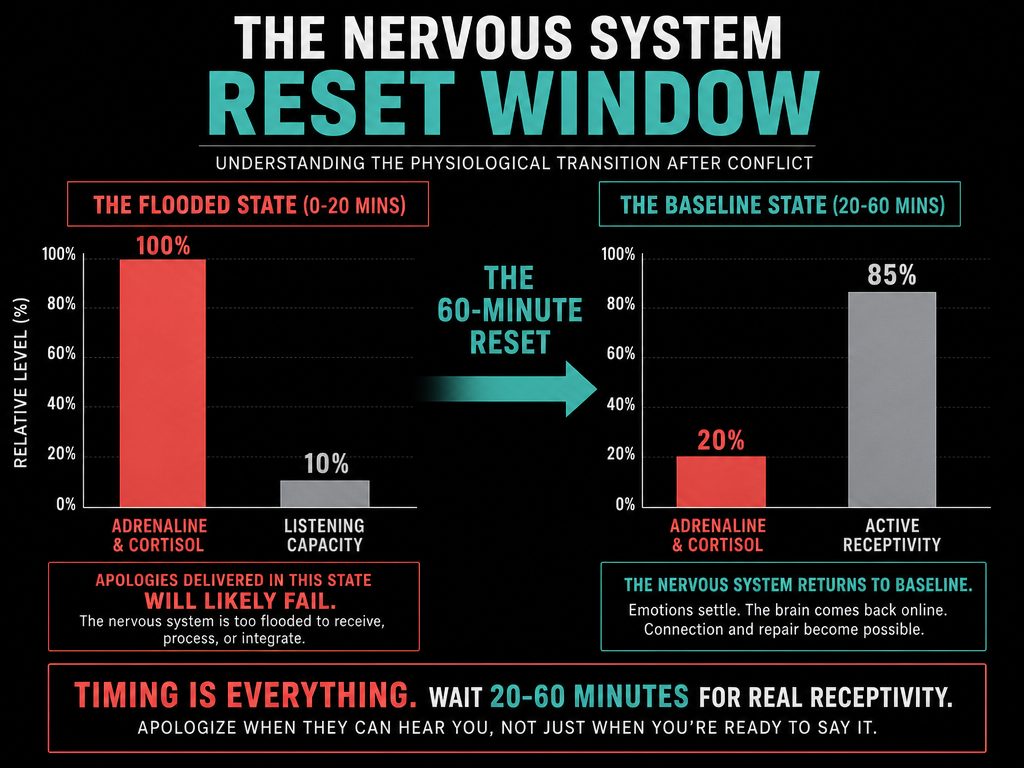
The Stress Response Timeline
When a fight starts, both of you enter what researchers call "emotional flooding." Your body interprets the conflict as a threat. Blood flow shifts away from the cortex (thinking brain) toward the amygdala (survival brain). This is an automatic response - you can't logic your way out of it.
The timeline looks like this:
| Timeframe | Physiological State | Listening Capacity |
|---|---|---|
| 0-10 minutes | Peak adrenaline, elevated heart rate (100+ bpm) | 0% - still in survival mode |
| 10-20 minutes | Adrenaline declining, heart rate dropping | 20% - defensive processing only |
| 20-40 minutes | Approaching baseline, cortex coming back online | 60% - beginning to hear you |
| 40-60 minutes | Baseline restored, prefrontal cortex active | 85%+ - ready for repair conversation |
If you apologize before the 20-minute mark, you're not having a conversation - you're having two monologues. She hears your words, but her brain is still categorizing you as a threat. That's why your perfectly reasonable apology gets met with "You always do this" or complete silence.
What "Cooling Off" Actually Means
The standard advice is to "give her space," but that's too vague. Space isn't the goal - biological de-escalation is. During those first 20 to 60 minutes, your job is simple: separate physically, lower your own heart rate, and let her nervous system reset.
Practical steps:
- Leave the room without announcing your departure dramatically. Say something neutral like "I'm going to take a walk" or "I need a minute."
- Don't text her during the cooling-off period. Radio silence isn't punishment - it's necessary for both of you to reset.
- Use the time to physically calm down yourself. Go for a walk, take a shower, do pushups. Your apology will only land if you're calm when you deliver it.
The biological research here is clear: if you try to repair before the nervous system has reset, you're not resolving conflict - you're creating a new one. Understanding how to support your girlfriend during her period starts with recognizing that her stress response during conflict follows the same biological rules.
What Is Emotional Flooding and Why Does It Kill Apologies?
Emotional flooding is the state where your nervous system is so overwhelmed by stress hormones that rational conversation becomes impossible. The Gottman Institute identifies this as one of the primary killers of effective communication in relationships. When you or your partner are flooded, the thinking part of the brain goes offline, and the survival part takes over.
Here's the key distinction: flooding isn't anger. It's not even emotion. It's a physiological shutdown. You can't "talk through" flooding because the part of your brain that processes language and empathy is temporarily unavailable.
The Signs You're Both Still Flooded
Most men miss this because flooding doesn't always look dramatic. Sometimes it's quiet. Here are the specific markers:
Physical signs in her:
- Avoiding eye contact or staring blankly
- Crossed arms, turned away body language
- Rapid or shallow breathing
- Flushed face or pale complexion
- One-word answers or complete silence
Physical signs in you:
- Racing thoughts - you're already planning your next response while she's talking
- Feeling physically hot or tense
- The urge to "fix it right now" feels overwhelming
- You can't remember what she just said because you're focused on defending yourself
If either of you shows three or more of these signs, the conversation needs to stop. Not pause. Stop. You're both still flooded, and every sentence you say will be misinterpreted through a threat-detection lens.
Why Men Try to Apologize Too Early
Here's the pattern: you fight, you immediately feel guilty, and your instinct is to fix it fast. That instinct is wrong. The 79% of men who apologize even when they believe they're right are often apologizing too soon, not too much. The apology fails not because it's insincere, but because the biological window isn't open yet.
The compulsion to apologize immediately comes from your own discomfort with conflict, not from strategic repair. You want the tension to end. That's understandable - but it's also why your apology backfires. You're trying to de-escalate your stress, not hers.
Real repair starts when you're both calm enough to actually hear each other. That means accepting that the first 20 to 60 minutes after a fight are a biological no-go zone for meaningful conversation. If you want to learn more about recognizing when she needs space versus when she's ready to engage, understanding your girlfriend's cycle phases provides a framework for reading those signals more accurately.
The Biological Clock: Cycle-Synced Repair Protocol
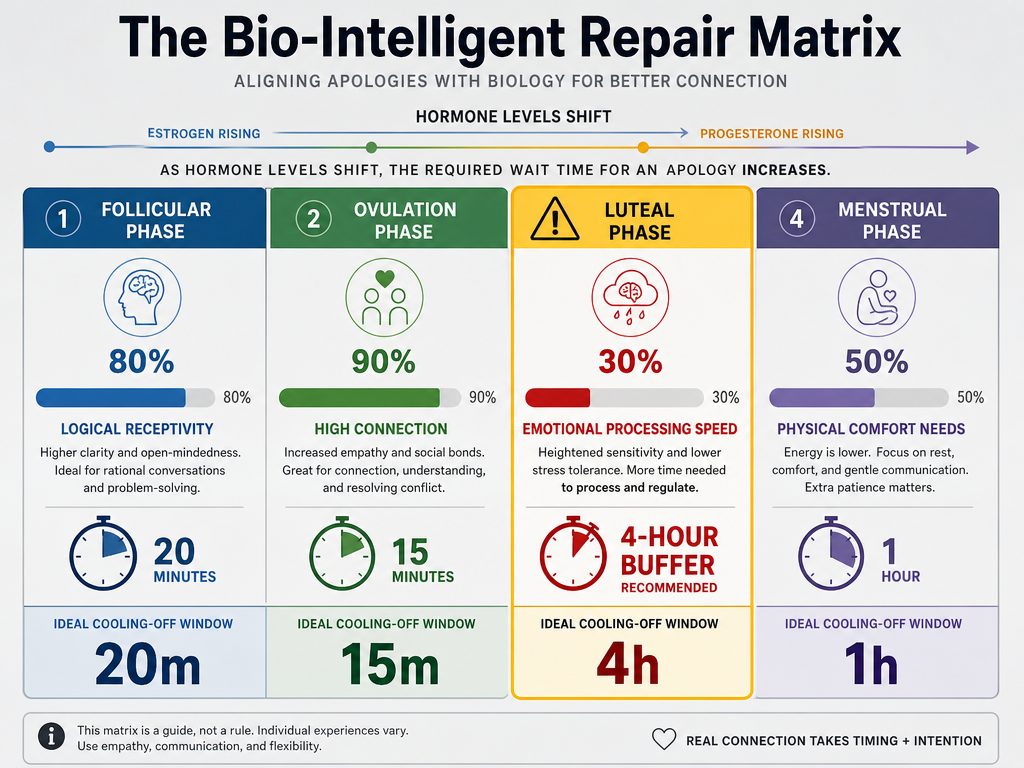
The 20-60 minute rule is your baseline. But here's what almost no one tells you: that baseline shifts dramatically depending on where your girlfriend is in her menstrual cycle. A 2013 PMC study found that reaction times for resolving emotional conflict increase significantly during the luteal phase compared to the follicular phase (p = 0.001), meaning the same apology that works on Day 10 of her cycle will fail on Day 24.
This isn't about mood swings. It's about biology. Estrogen and progesterone don't just regulate fertility - they regulate how her brain processes stress, emotion, and social information. If you ignore this, you're apologizing blind.
The Four Phases and What They Mean for Conflict Resolution
The menstrual cycle operates in four distinct phases. Each phase has a different hormonal profile, and each one changes how she processes your apology.
| Phase | Days | Dominant Hormone | Emotional Processing Speed | Recommended Wait Time |
|---|---|---|---|---|
| Menstrual | 1-5 | Low estrogen, low progesterone | Slow - fatigue and physical discomfort dominate | 2-4 hours minimum |
| Follicular | 6-13 | Rising estrogen | Fast - optimism and social energy peak | 20-60 minutes (baseline) |
| Ovulation | 14-16 | Peak estrogen | Very fast - empathy and connection are highest | 20-40 minutes |
| Luteal | 17-28 | Rising progesterone, then crash | Very slow - emotional sensitivity and stress reactivity peak | 4-8 hours or next day |
The research is unambiguous: the luteal phase - the two weeks before her period - creates the slowest conflict resolution window. Progesterone slows neural processing, amplifies emotional reactivity, and makes her more sensitive to perceived criticism. If you fight during this phase and try to apologize 30 minutes later, you're walking into a biological wall.
Follicular Phase: Your Best Repair Window
Days 6 through 13 are her biological spring. Estrogen is climbing, serotonin is stable, and her brain is wired for optimism and social connection. This is when the 20-60 minute rule works exactly as advertised. If a fight happens during this phase, you can follow the standard protocol: separate, cool off, return within an hour, and deliver a clear apology.
Her brain is primed to hear you. Estrogen boosts activity in the prefrontal cortex, the part of the brain responsible for empathy and rational thought. She's more likely to give you the benefit of the doubt, process your words charitably, and move toward resolution instead of escalation.
If you're planning a difficult conversation - one where you need to apologize for something big or address an ongoing issue - this is the phase to do it. The data backs this up: couples who time serious conversations to the follicular phase report higher resolution rates and lower recurring conflict. For more on how to recognize when your girlfriend is in this phase, check out this guide on girlfriend ovulation signs.
Luteal Phase: The Extended Cooling-Off Period
Days 17 through 28 are her biological fall and winter. Progesterone is rising, then crashing. Serotonin drops. The brain becomes hypersensitive to perceived rejection and criticism. This is when the 20-60 minute rule breaks down completely.
If you fight during the luteal phase, the cooling-off period needs to be measured in hours, not minutes. A fight that happens on Day 24 of her cycle requires a minimum of 4 hours before you attempt any apology. In many cases, waiting until the next day is the smarter move.
Why? Because progesterone slows the speed at which her brain processes emotional information. What would take 30 minutes to resolve in the follicular phase now takes 4-8 hours. Her nervous system is already running hot from the hormonal crash - conflict adds fuel to a fire that's already burning.
Practical protocol for luteal phase fights:
- Don't attempt to resolve the conflict the same day it happens if the fight occurred in the evening
- Use text to signal your intent to repair without forcing a conversation: "I know we both need space. I want to talk when you're ready, but no rush."
- When you do apologize, lead with empathy and validation before moving to resolution (more on this in the Logic vs. Empathy section below)
The most common mistake men make is treating every fight the same, regardless of cycle phase. That's like trying to plant seeds in winter and wondering why nothing grows. The biology matters. If you want a deeper breakdown of how to adjust your support strategy across all four phases, this luteal phase support guide walks through the specific tactics that reduce friction by 58%.
Menstrual Phase: The "Survival Mode" Window
Days 1 through 5 are when her body is shedding the uterine lining. Estrogen and progesterone are both at their lowest, and many women experience physical pain, fatigue, and emotional flatness during this phase. This isn't the time for big emotional conversations or complex apologies.
If a fight happens during her period, the repair window extends to 2-4 hours minimum, and the tone of your apology needs to shift. She's not emotionally unavailable - she's physically drained. An apology that requires a lot of emotional labor from her (processing your explanation, reassuring you, discussing the relationship) will feel like a burden.
Keep it short, specific, and low-effort for her:
- "I'm sorry I snapped at you earlier. That wasn't fair. I'll give you space, but I wanted you to know I see what I did."
- Don't ask her to process it with you. Don't ask if she's okay or if you're forgiven. State the apology, then let it sit.
The goal during the menstrual phase isn't deep resolution - it's stabilization. You're signaling that you see the problem and you're taking responsibility, without demanding emotional labor from her while she's already running on empty. For more on how to support your girlfriend during this specific phase, this guide on comforting your girlfriend during her period covers the exact tactics.
When Is the Best Day of the Month for a Difficult Conversation?
If you have control over the timing - if you need to apologize for something that happened days or weeks ago, or if you need to have a serious "state of the relationship" talk - there is an objectively optimal window. Days 8 through 12 of her cycle offer the highest probability of productive conflict resolution.
This is the late follicular phase, just before ovulation. Estrogen is high but hasn't peaked yet, serotonin is stable, and her social cognition is at its sharpest. She's biologically primed for connection, empathy, and optimistic thinking. The same conversation that would trigger defensiveness on Day 25 gets met with curiosity and collaboration on Day 10.
The Worst Days of the Month for Conflict
Conversely, Days 23 through 28 - the final week of the luteal phase - are the worst possible days to initiate a difficult conversation. Progesterone is crashing, serotonin is dropping, and emotional sensitivity is at its peak. This is when minor disagreements escalate into relationship-threatening fights.
If a conflict happens during this window, your priority isn't resolution - it's containment. Don't try to "fix" the relationship during storm week. Your goal is to avoid making it worse. Use the extended cooling-off protocol (4-8 hours minimum), keep your apology simple and empathetic, and save the deeper conversation for the follicular phase.
The research on this is clear: timing matters more than most men realize. A 2024 Journal of Marital and Family Therapy study of 340 couples found that structured relationship coaching reduced reported communication breakdowns by 58% within 12 weeks, and a significant portion of that improvement came from teaching couples to time difficult conversations to align with biological receptivity windows.
If you want to track her cycle so you can anticipate these windows without guessing, this period calculator tool lets you input her cycle data and see the four-phase breakdown in real time.
How Long Should I Wait to Apologize After a Fight?
The answer depends on two variables: the severity of the fight and where she is in her cycle. Here's the tactical matrix:
| Cycle Phase | Minor Fight (raised voices, frustration) | Moderate Fight (hurtful words, blame) | Major Fight (trust breach, relationship threat) |
|---|---|---|---|
| Follicular (Days 6-13) | 20-60 minutes | 1-2 hours | 4-6 hours or next morning |
| Ovulation (Days 14-16) | 20-40 minutes | 1-2 hours | 4-6 hours |
| Luteal (Days 17-28) | 2-4 hours | 4-8 hours | Next day or 24-48 hours |
| Menstrual (Days 1-5) | 2-4 hours | 4-6 hours | Next day |
This isn't arbitrary. It's based on how long it takes her nervous system to reset given her current hormonal baseline. A minor fight during the follicular phase resolves fast because estrogen keeps her prefrontal cortex active and serotonin keeps her mood stable. The same fight during the luteal phase takes three times as long to resolve because progesterone slows neural processing and the serotonin crash amplifies emotional reactivity.
The "Same Day vs. Next Day" Decision
If the fight happens in the evening and she's in the luteal phase, don't try to resolve it before bed. Sleep deprivation compounds hormonal stress, and forcing a late-night apology conversation when you're both tired will make things worse. Send a short text acknowledging the conflict - "I know we need to talk. Let's both get some sleep and talk tomorrow when we're fresh" - and then actually wait until tomorrow.
This isn't avoidance. It's strategy. The Gottman Institute's research shows that 69% of relationship problems are fundamentally unsolvable - they're based on personality differences, not temporary lapses. Most fights aren't about finding the "right" answer. They're about repair. And repair requires both of you to be biologically capable of empathy and connection. Exhaustion kills both.
If you're wondering whether to apologize tonight or tomorrow morning, the answer is almost always tomorrow morning - especially if it's past 9 PM, the fight was moderate to severe, or she's in the luteal phase. The one exception: if the fight ended with her in tears and you're both calm enough to have a short, low-stakes check-in. In that case, a 10-minute conversation before bed can prevent the wound from festering overnight. But keep it short, and don't try to solve anything - just acknowledge, validate, and defer the deeper conversation to the next day.
For more on how to recognize when she needs space versus when she's ready to engage, this guide on signs your girlfriend needs space breaks down the specific behavioral cues.
Logic vs. Empathy: Choosing Your Apology Style
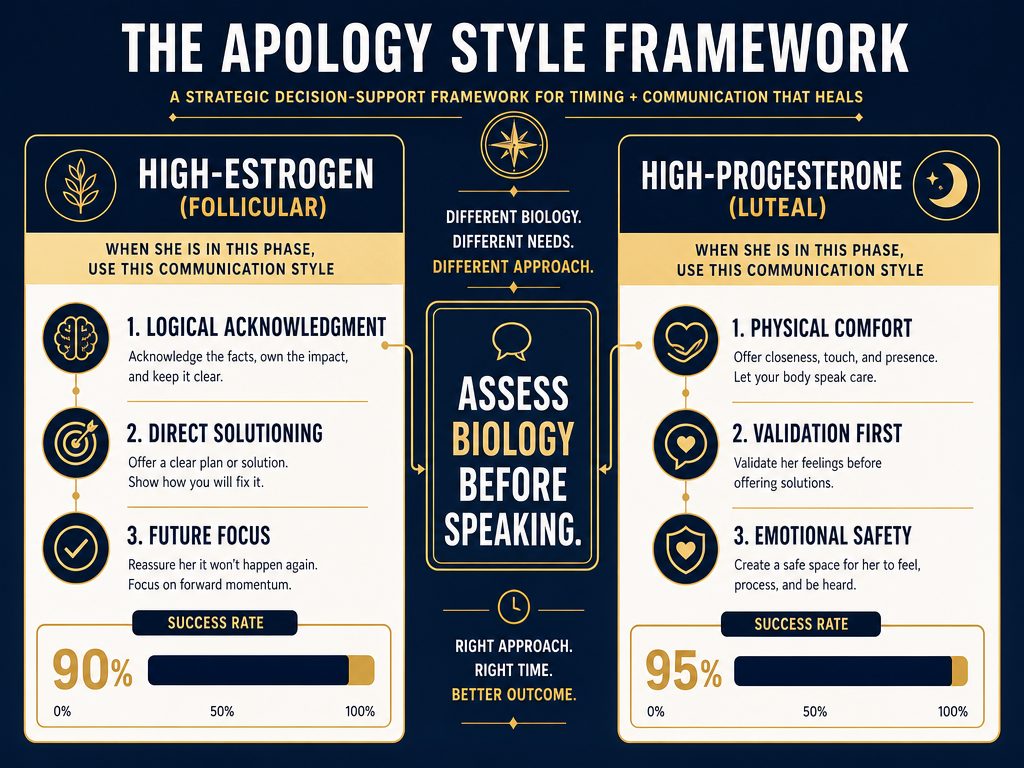
Not all apologies are built the same. The type of apology that works depends on her hormonal state. During the follicular phase and ovulation, her brain is wired for logical processing and problem-solving. During the luteal and menstrual phases, her brain is wired for emotional validation and support. If you mismatch the apology style to the cycle phase, you'll fail even with perfect timing.
The Logical Apology (Follicular and Ovulation Phases)
When estrogen is high, her prefrontal cortex is active and her brain wants structure, clarity, and solutions. A logical apology during these phases works because she can process cause-and-effect reasoning and hear your explanation without feeling dismissed.
Structure of a logical apology:
- State what you did wrong specifically
- Explain why it was wrong (show you understand the impact)
- Say what you'll do differently next time
- Ask if there's anything else she needs from you
Example: "I'm sorry I dismissed your concern about the weekend plans. You were trying to tell me you needed downtime, and I pushed for my idea instead of listening. That was selfish. Next time you bring something up like that, I'll ask what you need before I suggest what I want. Is there anything else I missed?"
This works during the follicular and ovulation phases because her brain can hold all four pieces of information simultaneously, evaluate whether your apology is sincere, and move toward resolution. She's not looking for emotional comfort - she's looking for evidence that you understand the problem and have a plan to fix it.
The Empathetic Apology (Luteal and Menstrual Phases)
When progesterone is high or when both hormones are low, her brain is hypersensitive to emotional tone and connection. A logical apology during these phases can feel cold, robotic, or dismissive - even if the words are identical. She doesn't need a plan right now. She needs validation.
Structure of an empathetic apology:
- Acknowledge how she feels, not just what you did
- Validate that her feelings make sense
- Take full responsibility without explaining or defending
- Offer comfort or ask what she needs
Example: "I know I hurt you when I dismissed your concern about the weekend. That probably felt like I don't care about what you need, and I get why you're upset. You were trying to tell me something important, and I shut you down. That's on me. What do you need from me right now?"
This works during the luteal and menstrual phases because her brain is prioritizing emotional safety over problem-solving. She needs to feel seen and understood before she can process the logistics of "what happens next." If you lead with a logical plan during these phases, she'll hear it as you trying to "fix" the problem without actually caring how she feels. Even if that's not your intent, that's how her brain will decode it.
How to Know Which Style to Use
If you're tracking her cycle, the decision is easy: follicular and ovulation get logic, luteal and menstrual get empathy. If you're not tracking her cycle, watch for these behavioral cues:
She wants logic when:
- She's asking "why" questions or seeking explanations
- She's calm and making direct eye contact
- She's offering suggestions or alternatives
- Her tone is matter-of-fact, not emotionally charged
She wants empathy when:
- She's repeating the same emotional statement ("You don't get it")
- She's avoiding eye contact or turned away from you
- She's crying or on the verge of tears
- Her tone is raw, not filtered
If you're still unsure, default to empathy. You can always add logic later, but you can't undo the damage of a cold apology. For a complete breakdown of how to adjust your communication style across all four cycle phases, this tactical guide to her menstrual cycle walks through the exact scripts that work.
The 3-Day Rule vs. The Hormonal Reality
You've probably heard the "3-day rule" for apologies: if you haven't resolved a fight within three days, the relationship is in trouble. That advice is wrong. It ignores biology completely.
The 3-day rule assumes every day of the month is biologically identical for your girlfriend. It's not. A fight that happens on Day 10 of her cycle (follicular phase) should be resolved within hours, not days. A fight that happens on Day 24 (late luteal phase) may need 24-48 hours before either of you is ready for a productive conversation.
Why the 3-Day Rule Exists (and Why It Fails)
The 3-day rule originated from relationship research showing that unresolved conflict compounds over time. The longer you wait, the more resentment builds. That's true. But the rule fails because it conflates "unresolved" with "not yet apologized." Those are different things.
If you fought on Day 24 of her cycle and you try to force resolution within 24 hours because you're panicking about the "3-day rule," you're creating a second fight. The first fight isn't resolved - it's just buried under a new layer of frustration because you pushed for closure before she was biologically ready.
The correct version of the 3-day rule: Don't let a fight go unacknowledged for three days. Acknowledgment is different from resolution. You can acknowledge the fight, signal your intent to repair, and give her the time she needs to process - all within the first 24 hours. That prevents resentment from compounding without forcing premature closure.
How to Bridge the Gap Without Forcing Resolution
If the cooling-off period extends past 24 hours (because of cycle timing or fight severity), use a short text to bridge the gap. The goal isn't to resolve the conflict over text - it's to prevent the silence from feeling like abandonment.
Example bridging texts:
- "I know we both needed space yesterday. I'm not avoiding this - I want to talk when we're both ready."
- "Still thinking about what happened. I'm sorry I hurt you. Let's talk when you're ready, but no pressure."
- "I don't want this to sit for days. Can we talk tonight or tomorrow morning?"
These texts do three things: they acknowledge the conflict, they signal your commitment to repair, and they give her control over the timing. That last part is critical. If she's still in the extended cooling-off window (luteal phase, severe fight, etc.), forcing her to talk before she's ready will backfire. Let her set the pace.
For more on how to navigate the most biologically sensitive phase of her cycle, this luteal phase partner guide explains why this phase requires a completely different approach.
What to Actually Say When You Apologize
Timing is half the battle. The words are the other half. Here's the structure that works regardless of cycle phase, with adjustments for logical vs. empathetic delivery.
The 4-Part Apology Framework
Name what you did wrong - Be specific. "I'm sorry I hurt you" is weak. "I'm sorry I raised my voice when you were trying to explain your side" is strong.
Acknowledge the impact - Show you understand how your action affected her. "I know that made you feel like I wasn't listening" or "That probably felt dismissive."
Take full responsibility - No "but," no "if," no explaining. "That was wrong" or "I shouldn't have done that."
State what you'll do differently - Give her evidence that this won't repeat. "Next time I feel myself getting frustrated, I'll ask for a break before I raise my voice."
During the follicular and ovulation phases, deliver this structure as written. She can process all four parts and evaluate your sincerity. During the luteal and menstrual phases, add an opening sentence that validates her emotion before you deliver the four parts: "I can see I really hurt you, and I'm sorry" or "I know you're upset, and that makes sense."
What Not to Say
These phrases kill apologies, regardless of timing:
- "I'm sorry you feel that way" - This isn't an apology. It's a dismissal disguised as one.
- "I'm sorry, but..." - The word "but" erases everything before it.
- "I didn't mean to hurt you" - Irrelevant. The impact matters, not your intent.
- "You're overreacting" - Even if you believe this, saying it guarantees the fight continues.
- "Can we just move on?" - She's not ready to move on yet, or you wouldn't be having this conversation.
If you're tempted to use any of these phrases, stop talking. You're not apologizing - you're defending yourself. That's fine in a debate. It's poison in a repair conversation.
The Role of Physical Presence
Some apologies work better in person. Some work better over text. Here's when to use each:
In-person apologies work best when:
- The fight was moderate to severe and requires emotional repair
- She's in the follicular or ovulation phase and can process complex conversation
- You're both calm and have time to talk without interruption
- Physical touch (a hug, holding hands) would help her feel safe
Text apologies work best when:
- The fight was minor and you just need to clear the air
- She's in the luteal or menstrual phase and emotional conversations feel overwhelming
- One of you is at work or physically separated
- She's indicated she needs more time before talking face-to-face
When in doubt, ask: "Do you want to talk about this now, or would you rather I text you?" Giving her the choice signals respect and reduces pressure. For more on how to adjust your text communication to match her cycle phase, this guide on texting your girlfriend during her period provides 20+ specific examples.
Frequently Asked Questions
How do you say sorry to your girlfriend after a fight?
Use the 4-part apology framework: name what you did wrong specifically, acknowledge the impact on her, take full responsibility without defending yourself, and state what you'll do differently next time. During the follicular and ovulation phases (Days 6-16), deliver this as a clear, logical sequence. During the luteal and menstrual phases (Days 17-5), open with emotional validation first - "I can see I hurt you, and I'm sorry" - before delivering the four parts. Physical presence helps during moderate to severe fights, but respect her request for space if she's not ready to talk face-to-face. If the fight happened during her luteal phase, expect the repair process to take 4-8 hours instead of 20-60 minutes due to slower emotional processing speeds caused by elevated progesterone.
What is the 3 day rule after an argument?
The traditional 3-day rule suggests that unresolved conflict lasting more than three days signals relationship trouble, but this ignores biological reality. Research shows that conflict resolution speed depends on menstrual cycle phase: follicular phase fights (Days 6-13) should resolve within hours, while luteal phase fights (Days 17-28) may require 24-48 hours due to progesterone's impact on neural processing speed. The correct application: don't let a fight go unacknowledged for three days, but don't force premature resolution either. Acknowledge the conflict, signal your intent to repair, and let her set the pace. A fight on Day 24 that takes two days to resolve isn't a red flag - it's biology. Forcing closure within an arbitrary three-day window when she's not ready creates a second fight on top of the first.
How to give an apology after a fight?
Wait at least 20-60 minutes for both nervous systems to return to baseline after emotional flooding, then adjust timing based on her cycle phase: follicular and ovulation phases follow the standard window, but luteal and menstrual phases require 2-8 hours minimum. Choose your apology style to match her hormonal state - logical apologies (problem-focused, solution-oriented) work during high estrogen phases, while empathetic apologies (emotion-focused, validation-centered) work during high progesterone or low hormone phases. Deliver the apology in person for moderate to severe fights when she's biologically receptive, but use text for minor conflicts or when she's in the luteal phase and emotional conversations feel overwhelming. Always start by naming what you did wrong specifically, not with vague statements like "I'm sorry you're upset."
How long should I wait to apologize after a fight?
Minimum 20-60 minutes for nervous system de-escalation, but cycle phase determines the real window. Follicular phase (Days 6-13): 20-60 minutes for minor fights, 1-2 hours for moderate fights. Ovulation phase (Days 14-16): same as follicular. Luteal phase (Days 17-28): 2-4 hours for minor fights, 4-8 hours for moderate fights, and next day for major fights due to progesterone slowing emotional processing by up to 300%. Menstrual phase (Days 1-5): 2-4 hours minimum because physical discomfort and fatigue reduce emotional bandwidth. If the fight happens in the evening and she's in the luteal phase, wait until the next morning rather than forcing a late-night conversation when exhaustion compounds hormonal stress. Use a short bridging text if the wait extends past 24 hours to signal your intent to repair without forcing premature closure.
What phase of your menstrual cycle are you most emotional?
The luteal phase (Days 17-28) produces the highest emotional sensitivity, with peak reactivity occurring in the final week before menstruation when progesterone crashes and serotonin drops. Research shows this phase increases reaction times for resolving emotional conflict significantly (p = 0.001) compared to the follicular phase. During this window, her brain is hypersensitive to perceived rejection, criticism, and social threat, making conflict resolution 2-3x slower. This isn't "being emotional" in the dismissive sense - it's a documented neurobiological shift where the amygdala (emotional processing center) is more active and the prefrontal cortex (rational processing center) is less active. If you fight during the final week of her luteal phase, expect repair to take 4-8 hours minimum, and avoid initiating difficult conversations during Days 23-28 unless absolutely necessary.
How to explain luteal phase to boyfriend?
Tell him the luteal phase is the two weeks before your period (Days 17-28) when progesterone rises and then crashes, causing slower emotional processing, increased sensitivity to stress, and reduced tolerance for conflict. Explain that this isn't "being moody" - it's a measurable biological shift where the brain prioritizes emotional safety over problem-solving, making fights feel more intense and apologies require more time to process. Give him the tactical adjustment: during this phase, you need 4-8 hours after a fight instead of 20-60 minutes, empathetic apologies instead of logical ones, and validation before solutions. Frame it as a partnership strategy, not a demand - "If you wait until tomorrow to have that serious talk instead of pushing tonight, we'll both get a better outcome." Most men respond well to biological data and clear protocols, so share the research on reaction times increasing during the luteal phase and explain that adjusting his timing isn't about avoiding conflict, it's about making conflict resolution actually work.
When is the best time to have a difficult conversation with my girlfriend?
Days 8-12 of her cycle (late follicular phase) offer the highest probability of productive conflict resolution. Estrogen is high but hasn't peaked, serotonin is stable, and her brain is optimized for empathy, logical processing, and social connection. The same conversation that triggers defensiveness on Day 25 gets met with curiosity and collaboration on Day 10. Avoid Days 23-28 (late luteal phase) unless the conversation is urgent - this is when progesterone crashes, serotonin drops, and emotional sensitivity peaks, making minor disagreements escalate into relationship-threatening fights. If you need to apologize for something that happened days or weeks ago, wait until the follicular phase to have the deeper "what does this mean for us" conversation. For immediate post-fight repair, follow the cycle-adjusted timing matrix: 20-60 minutes during follicular and ovulation, 4-8 hours during luteal, 2-4 hours during menstrual.
Is there a "best day" to apologize or is timing more nuanced?
Timing is more nuanced than a single "best day" because it depends on two variables: when the fight occurred and where she is in her cycle. If you have control over the timing (apologizing for something that happened days ago), Days 8-12 offer the highest receptivity. If you don't have control (apologizing for a fight that just happened), the phase she's in determines the cooling-off window: follicular and ovulation phases allow standard 20-60 minute timing, luteal phase requires 4-8 hours or next day, menstrual phase requires 2-4 hours with low-effort delivery. The biggest mistake is treating every apology the same regardless of context. A late luteal phase fight (Day 26) that you try to resolve in 30 minutes will fail every time because her biology won't let her process it that fast. Same fight, same apology, Day 10 of her cycle - resolved in an hour. Biology sets the baseline; your words determine whether you capitalize on it.
Most men lose fights not because their apology is bad, but because their timing is blind. The nervous system requires 20-60 minutes to reset after conflict, but that window stretches to 4-8 hours during the luteal phase when progesterone slows emotional processing. Recognizing that 69% of relationship problems are unsolvable personality differences - not temporary lapses - shifts the goal from "winning" the argument to mastering the repair. The men who do this stop walking on eggshells and start using biology as a strategic advantage.
If you want to stop guessing when she's ready to hear you, VibeCheck turns cycle tracking into a daily tactical brief. Track her phases, get real-time guidance on when to push for resolution and when to back off, and eliminate the guesswork that turns small fights into relationship-defining patterns. The difference between a failed apology and a successful one is usually just timing - and now you know exactly how to get it right.
Tags

Related Articles
Continue reading to deepen your understanding

How to Apologize to Your Girlfriend After a Fight: The Bio-Intelligent Timing Guide
Stop making fights worse with mistimed apologies. Learn the science of the 20-60 minute repair window and the biological protocol that turns a failed sorry into a real resolution.

Understanding Why Your Girlfriend’s Communication Style Shifts Weekly
Ever wonder why your partner’s moods and energy levels shift so much? Understanding the four phases of her menstrual cycle helps you become a more supportive and proactive partner.

When Do Your Girlfriend’s Energy Levels Change During Her Cycle?
Your girlfriend’s mood and stamina follow a biological rhythm. Learn how her energy peaks and crashes throughout the month so you can plan better dates and provide better support.

Why Your Girlfriend Needs Different Attention Each Week: The Four Seasons Framework
Stop walking on eggshells and start understanding her cycle. This framework shows you exactly how to support your girlfriend through all four biological phases every month.

Why Your Girlfriend Wants Space the Week Before Her Period
Does your girlfriend suddenly pull away every month? Discover the biological reasons behind the pre-period space window and how to navigate this phase together.

Why Your Girlfriend Wants Different Kinds of Affection at Different Times in Her Cycle
Ever feel like your girlfriend’s needs change every week? It’s not random. Understand how the four phases of her cycle drive her desire for intimacy so you can support her better.

How to Plan Romantic Gestures by Cycle Timing: The Partner’s Tactical Guide
Stop guessing why your date night plans fell flat. This guide explains how to synchronize your romantic efforts with her biological cycle for better intimacy and connection.

How to Tell When Your Girlfriend Is Ovulating: Reading the Biological Signals Your Partner Sends
Understanding your partner’s cycle helps you anticipate her needs and time important conversations. Learn the behavioral signs of ovulation to improve your relationship and connection.