Is Clue Connect Free for Partners? A Complete Guide to Costs and Features
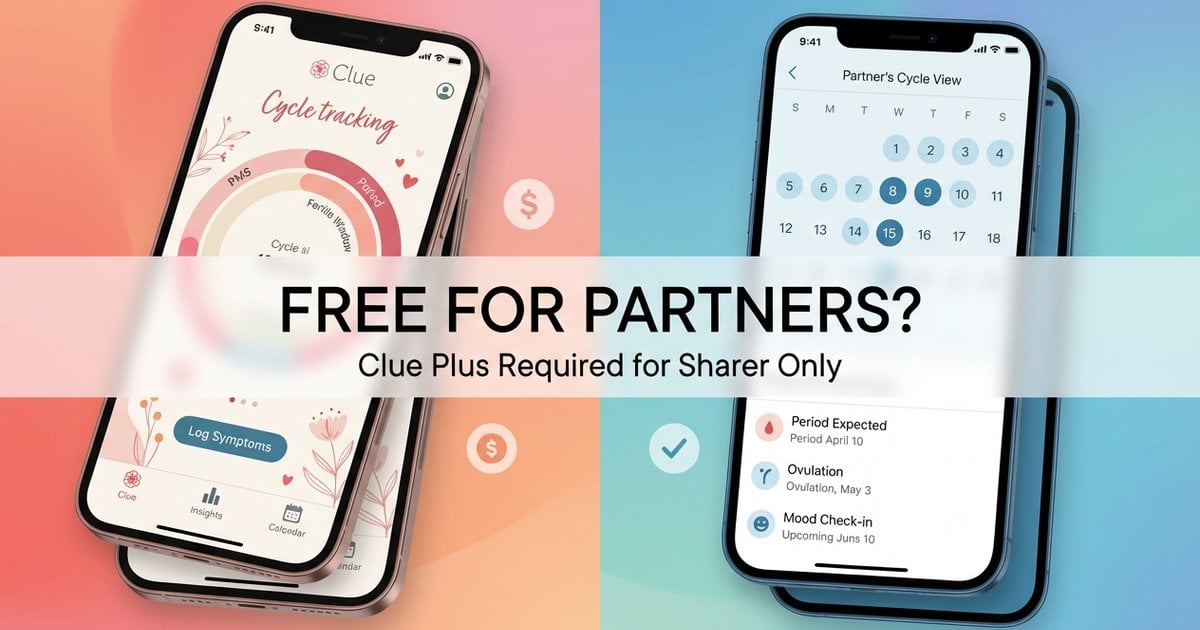
Wondering if you need a subscription to see your partner’s cycle? We break down exactly who pays for Clue Connect and what data the viewing partner actually sees on their screen.
Is Clue Connect Free for Partners? Everything You Need to Know
Table of Contents
- The Short Answer: Is Clue Connect Free or Paid?
- What Does a Partner Actually See in Clue Connect?
- Setup Guide for Couples: Getting Connected
- How to Interpret Clue Data as a Man
- Clue Connect vs. Competitors
- Common Issues and Troubleshooting
- Is Clue Connect Worth It for Your Relationship?
- Frequently Asked Questions
The Short Answer: Is Clue Connect Free or Paid?
Clue Connect's free tier won't tell you when to back off.
VibeCheck App
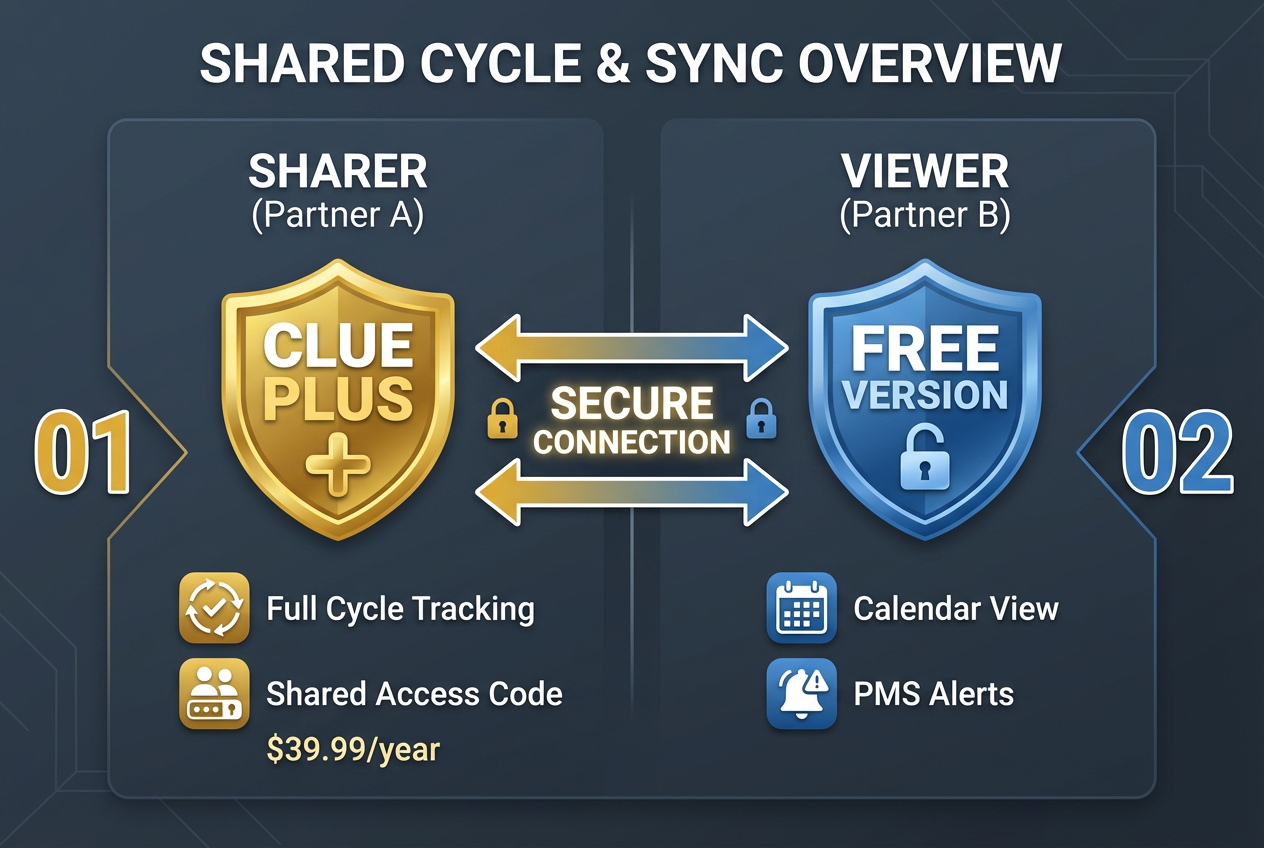
Get VibeCheck Free →Here’s the deal: Your partner (the woman sharing her data) needs a Clue Plus subscription at $39.99/year. You (the viewing partner) use the free version of the Clue app. That’s it. No hidden costs on your end.
The confusion exists because most apps charge both partners or require a "couples" plan. Clue doesn’t work that way. Think of it like this: she owns the premium data subscription, and she grants you viewing access through your free account.
Who Pays for What
| Person | Version Needed | Cost | What They Can Do |
|---|---|---|---|
| Sharer (Usually Her) | Clue Plus | $39.99/year | Track full cycle, generate invite codes, share calendar |
| Viewer (Usually You) | Clue Free | $0 | View shared cycle calendar, see period/ovulation dates |
Current Pricing Breakdown
Clue Plus costs about $40 annually, which breaks down to roughly $3.33 per month. Occasionally, they run promotions through partners like The Lowdown (look for discount codes like "LowdownxClue"). The subscription is billed as a single annual charge, not monthly installments.
VibeCheck App
Know what she needs. Before she has to say it.
Track her cycle, understand her phases, be the partner she deserves.
Download Free on iOS →What’s included in Clue Plus:
- Cycle predictions 12 months ahead
- Analysis and insights about patterns
- Access to Connect feature (the ability to share)
- Export your data
- No ads
What’s NOT required:
- You don’t need to subscribe to anything
- You don’t need to enter payment information
- You don’t need a "couples" tier
If you’re comparing costs, a period tracker for men like VibeCheck runs $4.99/month and provides actionable daily insights specifically designed for partners, not just raw data. More on that later.
What Does a Partner Actually See in Clue Connect?
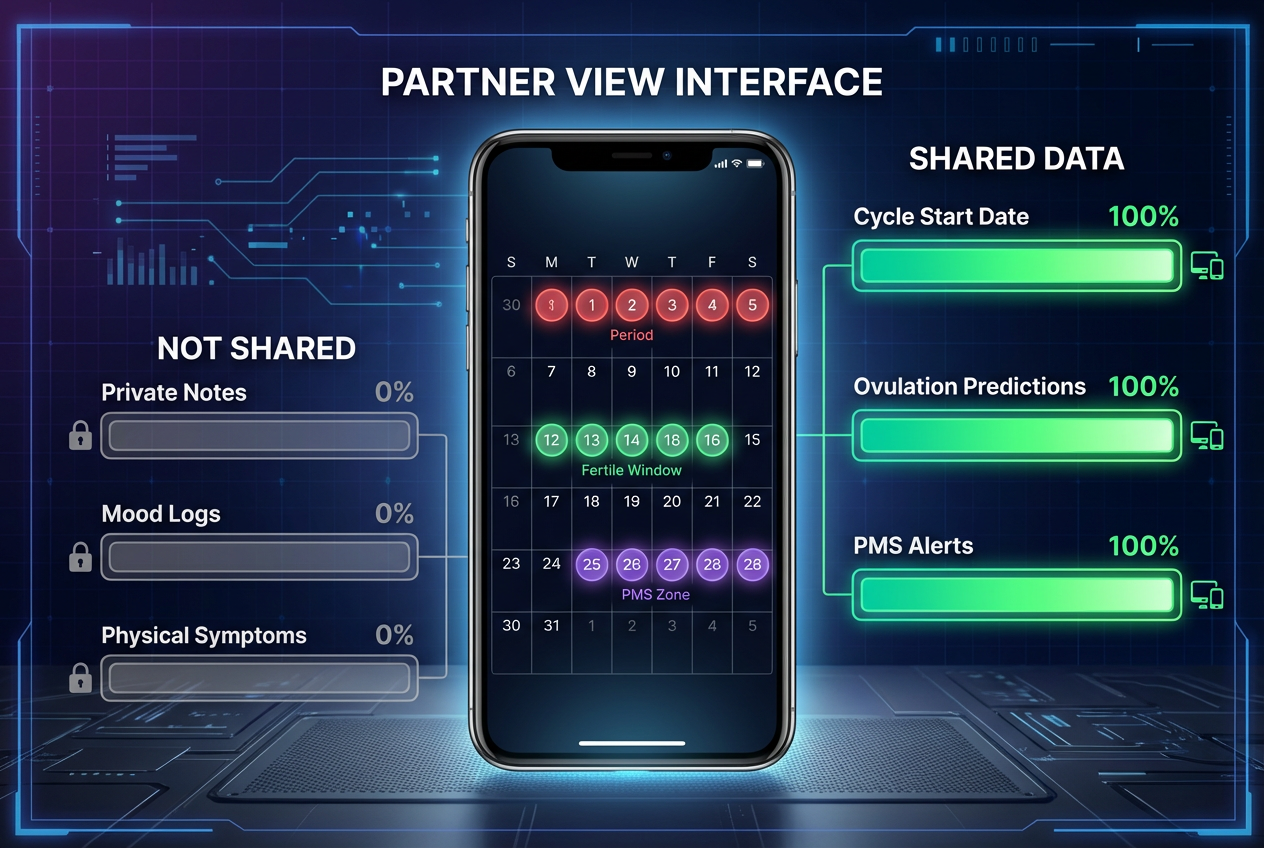
Bottom line first: You see period dates, fertile windows, ovulation timing, and PMS phases. You do NOT see her notes, symptoms, mood logs, or anything she writes down. It’s strictly calendar-level data.
This is the critical reality check most guys miss before setting up Clue Connect. The app shares "when" but not "what" or "why."
The Calendar View Breakdown
When you open Clue after connecting, you’ll see a calendar with color-coded days:
- Red Days: Active period (menstruation)
- Purple Days: Fertile window (roughly 5-6 days)
- Purple Circle: Ovulation day (usually one day)
- Yellow Days: PMS window (typically starts 7-10 days before period)
That’s genuinely it. There are no pop-ups saying "She logged a headache" or "Energy level: low." The system was designed for medical-grade tracking, not partner communication.
What You Will NOT See
This matters more than what you do see:
- Mood entries - Even if she logs feeling irritable, anxious, or happy, you won’t see it
- Physical symptoms - Cramps, bloating, breast tenderness, headaches all stay private
- Energy levels - Whether she’s feeling energized or exhausted isn’t shared
- Notes or diary entries - Any text she writes remains completely private
- Sexual activity tracking - This data isn’t shared with partners
- Medication or supplement logs - Also remains private
Some guys assume Clue Connect works like a shared journal. It doesn’t. It’s a calendar. If you want to understand how she’s feeling, you’ll still need to ask her directly or use that raw timing data to make educated guesses about her needs.
For men looking for more context about what’s happening during each phase, checking out a guide on understanding your partner’s cycle can fill in those gaps.
Privacy Protection
Clue designed the feature this way intentionally. Medical privacy laws (like HIPAA considerations) and basic relationship boundaries mean she controls what gets shared. The calendar data is considered "shareable" health information, but specific symptoms and feelings are not.
You can’t accidentally stumble across sensitive health information she didn’t explicitly choose to share. That’s a good thing for trust, but it also means the tool provides less actionable intelligence than you might expect.
Setup Guide for Couples: Getting Connected
In brief: She generates an invite code in her app. You download Clue (free version), enter the code, and you’re connected. The whole process takes about 3 minutes.
Here’s the step-by-step without the technical jargon.
For the Sharer (Your Partner)
Prerequisites:
- She must have an active Clue Plus subscription
- The app must be updated to the latest version
Steps:
- Open Clue and navigate to the More tab (bottom right corner)
- Tap "Clue Connect" from the menu
- Select "Get Started" or "Invite Someone"
- Generate the code - The app creates a unique 6-digit invite code
- Share the code with you (text, email, whatever works)
The code doesn’t expire immediately, but it’s meant for single use. Once you accept the invite, she can’t use that same code to connect another person.
For the Viewer (You)
Prerequisites:
- Download Clue from the App Store (iOS) or Google Play (Android)
- Create a free account (just basic email/password stuff)
Steps:
- Download Clue if you haven’t already
- Open the app and complete the basic setup (skip all the tracking stuff since you’re not logging your own cycle)
- Navigate to More in the bottom menu
- Select "Clue Connect"
- Tap "I have a code"
- Enter the 6-digit code your partner shared
- Confirm the connection - You’ll see a confirmation screen
Once connected, her calendar data automatically syncs to your view. There’s no manual refresh needed. Changes she makes (like updating her period start date) appear in your app within a few minutes.
Connection Status
You can verify you’re properly connected by:
- Checking the Connect tab - You should see her data, not an empty calendar
- Looking for a "Connected to [Name]" indicator at the top of the calendar
If you’re not seeing data, double-check that:
- She has an active Plus subscription (it may have lapsed)
- You entered the correct code
- Both apps are updated to the latest version
How to Interpret Clue Data as a Man
The reality: Clue tells you "She’s in her luteal phase." It doesn’t tell you "Pick up the slack on chores today." That translation is on you.
This is where Clue Connect’s design becomes both a strength and a weakness. Medical accuracy is high. Practical application for partners is low. You’re getting raw data without the instruction manual.
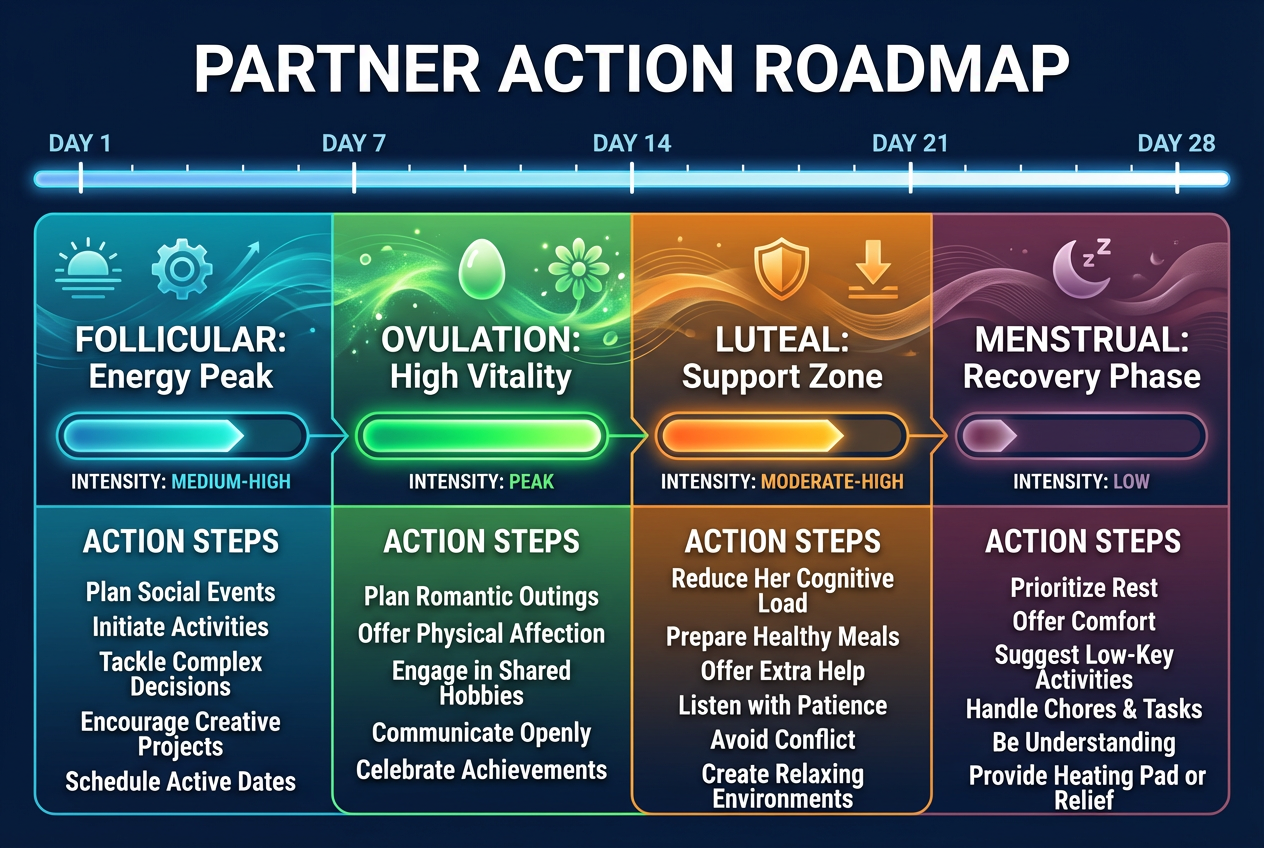
Here’s how to bridge that gap using basic cycle science.
The Follicular Phase: "The Energy Peak"
What Clue Shows: Days 1-14 (approximately), starting the first day of her period and ending at ovulation.
What’s Actually Happening: Estrogen is climbing. Energy levels are generally rising. Mood tends to be stable or improving. Pain tolerance is higher. Social battery is fuller.
What This Means for You:
- Best time for: New activities, social plans, difficult conversations, trying something new in the relationship
- Practical moves: Suggest that weekend trip you’ve been talking about. Plan date nights during this window. If you need to have a serious conversation about finances or future plans, this phase typically offers the most receptive timing.
- Energy matching: She’s more likely to say yes to spontaneous plans or handle multiple commitments without feeling overwhelmed.
This phase is often called her "Inner Spring" - things are blooming, energy is growing, optimism runs higher. You’re not walking on eggshells. Take advantage of that window.
For more on supporting your girlfriend during the follicular phase, including specific date ideas and conversation strategies, there are detailed playbooks available.
The Ovulation Window: "High Vitality"
What Clue Shows: Usually days 12-16, marked with a purple circle on the predicted ovulation day.
What’s Actually Happening: Estrogen peaks. Testosterone gets a small boost. Confidence is typically at its monthly high. Communication skills are sharper. Libido often increases.
What This Means for You:
- Best time for: Physical connection, athletic activities, social gatherings
- Practical moves: This is when she’s biologically most receptive to connection (not just sexual, but social and emotional too). Plan quality time together. If you’ve been meaning to introduce her to friends or family, this timing tends to go smoothest.
- What to avoid: Don’t waste this high-energy window by being passive or unavailable. If you’re consistently "too busy" during her peak vitality days, you’re missing the relationship’s natural momentum.
Think of ovulation as her monthly performance peak. Athletes time competitions around this window for a reason. If you’re planning anything that requires her to be "on" - social events, important meetings, travel - this is the sweet spot.
The Luteal Phase: "The Support Zone"
What Clue Shows: Days 15-28 (approximately), from after ovulation until her period starts. Often marked with yellow days indicating PMS.
What’s Actually Happening: Progesterone rises, then crashes if pregnancy doesn’t occur. Energy typically drops. Mood can become more sensitive. Physical symptoms like bloating or breast tenderness may appear. Patience wears thinner. The brain literally becomes more sensitive to stress.
What This Means for You:
- Best time for: Reducing her cognitive load, being proactive with household stuff, giving space when needed
- Practical moves: Don’t ask "What’s for dinner?" - just handle it. Notice the small stuff that needs doing and do it without announcing it. This isn’t about walking on eggshells; it’s about reducing unnecessary friction when her tolerance for annoyance is naturally lower.
- What to avoid: Starting arguments about whose turn it is to do dishes. Expecting her to coordinate social plans. Being needy about attention when she’s clearly wanting space. Making jokes about PMS (seriously, don’t).
The luteal phase support guide breaks this down further, but the core principle is simple: her body is working harder during this phase, so you should work smarter to reduce unnecessary stress.
Key stat: Studies show that during the late luteal phase, women’s brains show increased activity in regions associated with negative emotion processing. This isn’t "moodiness" - it’s neurology. Your job isn’t to fix it; it’s to not add to it.
The Menstrual Phase: "The Reset"
What Clue Shows: Red days indicating active bleeding, typically 3-7 days.
What’s Actually Happening: Hormone levels bottom out. Energy is usually lowest. Physical discomfort varies widely (some women barely notice, others deal with significant pain). The body is literally shedding and rebuilding uterine lining.
What This Means for You:
- Best time for: Low-key activities, comfort, practical support
- Practical moves: Stock the heating pad. Have her preferred pain relief available. Don’t suggest a 10-mile hike. Offer to pick up takeout. If she wants to cancel plans, support that decision without making her feel guilty.
- Physical support: Heat helps cramps. Magnesium supplements can reduce pain for some women. Gentle movement (like walking) sometimes helps more than staying completely still. Ask her what actually works for her body.
This is also the beginning of the next follicular phase, so by days 3-5, energy often starts climbing again. The worst is usually the first 1-2 days.
For a complete playbook on what to do when your girlfriend is on her period, including the science behind why certain support tactics work better than others, there’s a full breakdown available.
The "Software Update" Clue Connect Needs
Clue Connect’s greatest weakness is providing data without direction. You now have the direction. The app tells you "when" - you provide the "what to do about it."
This is why many guys supplement Clue with a relationship advice app designed for men that translates biological timing into daily actionable steps. Clue gives you the calendar. Other tools give you the playbook.
Clue Connect vs. Competitors
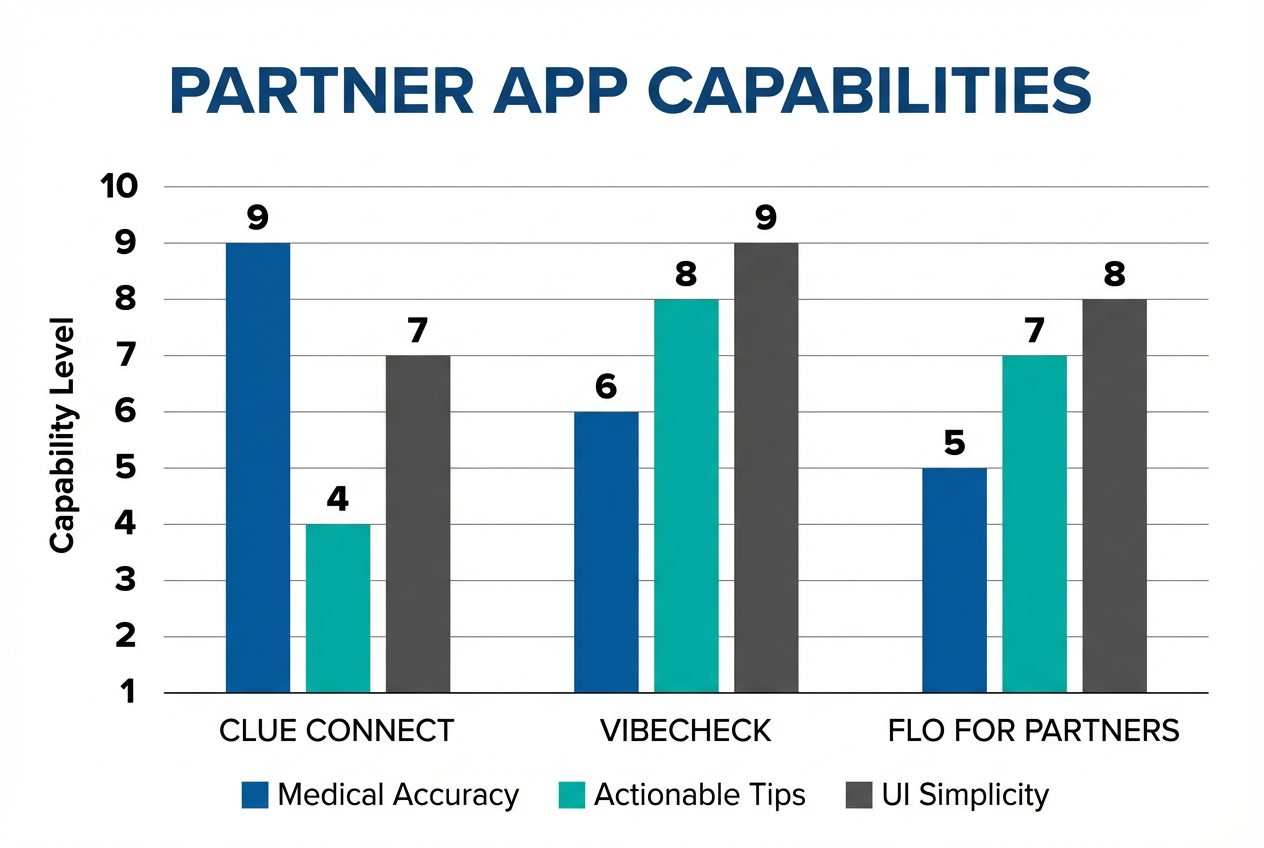
Quick take: Clue wins on medical accuracy. It loses on practical guidance for partners. Whether that trade-off works for you depends on what you actually need from the tool.
The Competitive Landscape
The partner cycle-tracking space is more crowded than you’d think. Here’s how Clue stacks up against the main alternatives.
Clue Connect vs. VibeCheck
| Feature | Clue Connect | VibeCheck |
|---|---|---|
| Who Pays | She pays ($40/year) | Partner pays ($4.99/month) |
| Data Shared | Period, ovulation, PMS dates | Same dates, plus mood/energy context |
| Actionable Tips | None | Daily missions based on her phase |
| Privacy Model | She controls all sharing | She grants access, partner subscribes |
| Target User | Women tracking for health | Men wanting relationship support |
| Best For | Medical-grade cycle data | Guys who want to be told what to do |
The difference in practice: Clue tells you she’s in her luteal phase. VibeCheck tells you she’s in her luteal phase AND suggests picking up dinner tonight without being asked. One is data. The other is data plus application.
For a detailed feature comparison, check out VibeCheck vs Clue.
Clue Connect vs. Flo for Partners
Flo’s approach: Similar to Clue in that it’s primarily a women’s health app with partner sharing as a secondary feature. The main difference is Flo includes more symptom tracking categories and slightly more partner-focused content.
Key differences:
- Flo has a "partner mode" that explains basics about periods
- Flo’s algorithm includes fertility predictions for couples trying to conceive
- Clue is generally considered more accurate for cycle predictions
- Both require the woman to have a premium subscription
Verdict: If she’s already using Flo, stick with that. If starting fresh and medical accuracy matters most, Clue has the edge. If neither of you care about fertility tracking, there’s not a massive difference for partner viewing purposes.
Clue Connect vs. Blood for Couples
Blood’s angle: Built specifically as a couples’ app from the ground up, not a women’s tracker with partner features bolted on.
What Blood does differently:
- Both partners track (she tracks her cycle, you track your stress/mood)
- Shared calendar view designed for relationship planning
- Tips and articles focused on relationship dynamics
- Costs both partners ($9.99/month for the pair)
Trade-off: Blood sacrifices some medical accuracy for relationship features. If you want to understand connection patterns (like "We fight more during week 3"), Blood makes that visible. If she needs serious cycle tracking for health reasons, Clue is the better tool.
When to Choose Clue Connect
Pick Clue if:
- She’s already using Clue and loves it
- Medical-grade accuracy matters (irregular cycles, PCOS, fertility concerns)
- You’re comfortable translating raw data into action yourself
- Privacy is a major concern (Clue has the strongest privacy stance)
- You don’t want notifications or "coaching" - just the facts
When to Choose Alternatives
Consider other apps if:
- You want daily proactive suggestions, not just a calendar
- You’re looking for relationship advice beyond cycle awareness
- She’s not particular about which tracking app she uses
- You want in-app education about what each phase means
- You’re trying to conceive and want optimized fertility features
The best period tracker apps for men comparison breaks down 20+ options across multiple criteria if you want to see the full landscape.
The Honest Assessment
Clue Connect is medical-grade cycle tracking with partner visibility. It’s not relationship coaching. If that’s what you need - pure, accurate data - it’s excellent. If you need someone to tell you "Today would be a good day to suggest takeout and a movie" based on that data, you’ll need to supplement with other resources or apps.
Think of it like getting a weather forecast versus getting a weather forecast plus clothing recommendations. Both are useful. They serve different needs.
Common Issues and Troubleshooting
Real talk: Most connection problems come down to three things: expired subscriptions, outdated apps, or typos in the invite code.
"I entered the code but nothing happened"
Check these:
- Code validity - Invite codes are single-use. If she generated a code, connected someone else, then gave you the same code, it won’t work. She needs to generate a fresh code.
- Subscription status - Log into her account and verify the Plus subscription is active. If it lapsed, the Connect feature stops working immediately.
- App version - Both of you should be running the latest version of Clue. Old versions have known bugs with the Connect feature.
Fix: Have her generate a new code. Make sure both apps are updated. Try again.
"I’m connected but seeing no data"
This usually means:
- She hasn’t logged enough cycle data yet for predictions
- Her subscription just expired
- There’s a sync issue
Fix:
- Have her log at least one complete cycle (period start to next period start) in the app
- Force-close and reopen your app to trigger a sync
- Check her subscription status in Settings
"The predictions seem wrong"
Remember: Clue’s algorithm needs 2-3 cycles of data to get accurate. If she just started using the app, predictions will be based on statistical averages, not her specific pattern.
Also consider: Stress, travel, illness, and changes in routine can throw off cycle timing. No app predicts perfectly because bodies aren’t perfectly predictable.
Not a fix, but realistic expectation: Even the best cycle-tracking apps are accurate within 2-3 days, not to the hour. Treat predictions as "probably around this time" rather than "definitely this exact day."
"She disconnected me and I can’t reconnect"
What happened: She can disconnect you at any time from her app settings. To reconnect, she needs to generate a fresh invite code and you need to enter it like the first setup.
Privacy note: This is intentional design. She controls access, always. If she’s disconnected you, have a conversation about whether Connect is right for your relationship before trying to reconnect.
"The app is showing her period but she says it hasn’t started"
Clue predicts based on patterns. What you’re seeing is a prediction, not real-time data entry. She needs to actually log her period start in the app for the calendar to show actual data (which will display differently than predictions).
The difference:
- Predicted days appear one way (usually lighter shading)
- Logged days appear differently (usually darker/solid color)
If the prediction was wrong, she can log the actual start date and Clue will adjust future predictions based on the new data.
"I want to disconnect but don’t know how"
In your app:
- Go to More > Clue Connect
- Select "Disconnect"
- Confirm
You’ll immediately lose access to her data. She’ll get a notification that you’ve disconnected.
Is Clue Connect Worth It for Your Relationship?
The practical answer: It depends on your current level of cycle awareness and what you plan to do with the information.
Who Benefits Most from Clue Connect
Best fit scenarios:
You have zero cycle awareness right now - Even basic calendar visibility is a massive upgrade from guessing. Knowing "Her period probably starts Friday" helps you plan the weekend better.
She’s dealing with health issues - If she’s tracking for medical reasons (PCOS, endometriosis, fertility concerns), having you plugged into the same data source helps you support her health management.
You’re trying to conceive - Fertility tracking is Clue’s strength. If you’re in baby-making mode, knowing the exact fertile window matters.
You want raw data, not coaching - Some guys prefer to figure things out themselves rather than having an app tell them what to do. Clue respects that preference.
Who Might Want More Than Clue Offers
Consider alternatives if:
You don’t know what to do with cycle data - A calendar is only useful if you understand how to interpret it. If you’re still asking "Okay, but what does luteal phase mean for our weekend plans?", you need education more than data.
You want proactive support suggestions - Clue won’t ping you saying "Energy might be low today, maybe order dinner." If you want that level of hand-holding, apps built specifically for partners do that better.
Your relationship needs work beyond cycle awareness - If communication, emotional connection, or basic relationship skills are the real issue, cycle tracking alone won’t fix those. Consider tools focused on relationship advice for men more broadly.
The Cost-Benefit Analysis
What you’re paying: $39.99/year (on her end)
What you’re getting:
- Visibility into approximately when her energy will be high or low
- Advance warning about period timing
- Better ability to plan around cycle phases
- Reduced guessing about "Why is she acting differently this week?"
What you’re NOT getting:
- Specific actionable advice
- Daily support missions
- Education about what each phase means
- Notifications reminding you to be supportive
For about $3.33/month, you get data accuracy. That’s worth it if data is what you need. If you need data plus guidance, you’ll supplement with other resources or pay for a different app that includes both.
Making Clue Connect Actually Work
Three requirements for success:
She needs to use it consistently - If she forgets to log data, predictions become unreliable. The system only works if she’s actually tracking.
You need to check it regularly - A calendar you never look at is useless. Set a weekly habit to review the month ahead so you’re not constantly surprised.
You need to translate data into action - This is the part most guys miss. Having the information and using the information are different skills. Read guides like this one, learn the phases, develop your own playbook.
Real example: One guy reported using Clue Connect specifically to plan his work travel. He scheduled intense work trips during her follicular phase when she’d handle solo parenting better, and cleared his schedule during her menstrual phase when she’d need more support. That’s practical application of simple calendar data.
The Alternative Approach
Some couples skip partner apps entirely and just communicate directly. "How are you feeling?" still works. Apps augment communication; they don’t replace it.
The argument against tracking:
- Some women find it invasive or unnecessary
- Over-reliance on apps can reduce actual conversation
- Not all cycle patterns are predictable enough to be useful
- Privacy concerns
The argument for tracking:
- Takes the guesswork out of timing
- Reduces need for her to constantly explain her physical state
- Helps partners plan proactively instead of reactively
- Creates shared awareness of biological patterns
Neither approach is universally right. Know your relationship.
Bottom Line
Clue Connect is worth the investment if you commit to actually using the information it provides. It’s not worth it if you’re just checking a box or think downloading an app will magically improve your relationship without effort on your part.
The data is only as valuable as your willingness to act on it.
Ready to actually understand her?
Join thousands of men using VibeCheck to track her cycle and show up better every day.
Frequently Asked Questions
Does the male partner need a paid subscription for Clue Connect?
No. The viewer (typically the male partner) uses the completely free version of Clue. Only the person sharing their data needs a Clue Plus subscription at $39.99/year. You download the app, enter the invite code she provides, and access the shared calendar without any payment information or subscription required on your end.
Can my girlfriend see what I’m looking at in the app?
No. Clue doesn’t provide analytics or notifications about when you view her calendar. There’s no "He checked the app 47 times this week" tracking. She shared access to her data, but she can’t monitor your usage patterns. However, it’s worth having an open conversation about expectations - some women want to know you’re engaged with the information, while others prefer you use it without constant updates.
What happens if the Clue Plus subscription expires?
You immediately lose access to the shared calendar data. The Connect feature requires an active Plus subscription from the sharer. If her subscription lapses, you’ll see a notice in your app that the connection is no longer active. Once she renews, the connection automatically restores without needing a new invite code (unless she explicitly disconnected you in the meantime).
Can I connect to multiple partners’ Clue accounts?
No. Clue Connect is designed for one-to-one sharing. You can only be connected to one person’s cycle data at a time. If you’re in a polyamorous relationship or need to support multiple people, each would need their own separate tracking solution since the app doesn’t support multiple simultaneous connections per viewer account.
Is Clue Connect data really private and secure?
Yes. Clue is based in Europe and follows strict GDPR privacy regulations. They explicitly state they don’t sell user data to third parties, don’t use it for advertising, and don’t share it with insurance companies. The company has published transparency reports and their privacy stance is stronger than most health apps. However, once data is shared with you via Connect, you’re responsible for keeping it private. Don’t screenshot her cycle calendar and share it with friends or post it on social media - that’s a violation of trust even if it’s technically "your" data view.
How accurate are Clue’s predictions for irregular cycles?
Clue’s algorithm is generally considered among the most accurate for cycle prediction, but irregular cycles are inherently harder to predict. The app needs consistent pattern data to generate reliable forecasts. If your partner has irregular cycles due to PCOS, stress, or other factors, expect predictions to be less precise. The app will become more accurate over time as it collects more data, but perfect prediction isn’t possible when the underlying biology is variable. Studies suggest Clue’s accuracy is around 85% for regular cycles but drops for irregular patterns.
Can I share Clue data with a doctor or fertility specialist?
The woman who owns the account can export her data and share it with healthcare providers. As the viewing partner, you can’t export or share her data - that control remains with her account. If you’re working with a fertility specialist together, she would be the one to provide the cycle data to the medical team. This is by design to protect medical privacy and ensure she maintains control over her health information.
What’s the difference between Clue and Flo for partner tracking?
Both apps offer partner sharing features and require the woman to have a premium subscription. Clue is generally considered more accurate for cycle predictions and has stronger privacy protections (based in Germany vs. US-based Flo). Flo includes more content about pregnancy and TTC (trying to conceive), while Clue focuses more on cycle tracking as a health tool. For partner viewing purposes, the differences are minimal - both show you period dates, fertile windows, and PMS timing. Choose based on which app she prefers to use, not which has marginally better partner features. For more details, check out this VibeCheck vs Flo comparison.
Will using Clue Connect improve my relationship automatically?
No tool improves relationships automatically. Clue Connect provides information; what you do with that information determines its value. Having a calendar that shows her cycle phases only helps if you use that timing awareness to be more supportive, plan better, and reduce friction. The app won’t make you a better partner by itself. It removes the excuse of "I didn’t know" but you still need to act on the knowledge. Think of it as relationship infrastructure - necessary but not sufficient. If you want more guidance on how to translate cycle data into better relationship dynamics, resources on understanding your partner can fill that gap.
Final Word
Clue Connect gives you visibility. What you do with that visibility is up to you. The data is medical-grade and the privacy protections are solid. But raw information without application is just trivia.
If you’re ready to stop guessing and start planning proactively based on biological patterns, Clue Connect delivers exactly what it promises: a clear view of her cycle timing. Download it, connect it, and actually use the information to be the partner who anticipates needs instead of reacting to them.
For men who want that data plus daily actionable missions on what to do with it, VibeCheck was built specifically for that purpose. Different tools for different needs. Both have their place.
Tags

Related Articles
Continue reading to deepen your understanding

Why Your Girlfriend Needs Different Communication Styles During Her Cycle
Stop wondering why your conversations feel like a minefield one week and a breeze the next. Use biology to understand her changing needs and adapt your style.

When Your Girlfriend Gets Withdrawn Before Her Period
If she suddenly pulls away, it is usually biology, not you. Learn why your girlfriend gets distant before her period and use these tactical scripts to help her during the luteal phase.

How to Respond When Your Girlfriend Needs Space During Her Period
If she’s suddenly sending one-word texts or pulling away, it’s likely not about you. Learn the science of the luteal phase and how to support her without feeling rejected.

Understanding Why Your Girlfriend’s Communication Style Shifts Weekly
Ever wonder why your partner’s moods and energy levels shift so much? Understanding the four phases of her menstrual cycle helps you become a more supportive and proactive partner.

When Do Your Girlfriend’s Energy Levels Change During Her Cycle?
Your girlfriend’s mood and stamina follow a biological rhythm. Learn how her energy peaks and crashes throughout the month so you can plan better dates and provide better support.

Why Your Girlfriend Needs Different Attention Each Week: The Four Seasons Framework
Stop walking on eggshells and start understanding her cycle. This framework shows you exactly how to support your girlfriend through all four biological phases every month.

Why Your Girlfriend Wants Space the Week Before Her Period
Does your girlfriend suddenly pull away every month? Discover the biological reasons behind the pre-period space window and how to navigate this phase together.

Why Your Girlfriend Wants Different Kinds of Affection at Different Times in Her Cycle
Ever feel like your girlfriend’s needs change every week? It’s not random. Understand how the four phases of her cycle drive her desire for intimacy so you can support her better.