How to Track Your Girlfriend’s Cycle: A Strategic Guide for Supportive Partners

Stop guessing why she’s stressed. Learn how tracking your girlfriend’s cycle helps you anticipate her needs, reduce arguments, and show up as a more supportive, proactive partner.
How to Track Your Girlfriend’s Cycle as Her Boyfriend: The Strategic Support Guide
Most guys stumble through their relationship like they’re navigating a minefield in the dark. One week, she’s up for spontaneous road trips. The next, suggesting takeout instead of cooking feels like you’ve personally insulted her family. You’re not imagining these shifts. Her 28-day biological cycle creates predictable patterns in energy, mood, and needs. This guide shows you how to track your girlfriend’s cycle not as surveillance, but as relationship intelligence that helps you show up when it matters most.
Table of Contents
- Why Partners Track Cycles (And Why It’s Not What You Think)
- The Conversation: How to Ask Without Being Weird
- The Four Seasons Framework: Translating Biology Into Action
- Comparative Review: Best Cycle Tracking Tools for Partners
- The Conflict Prevention Window: High-Friction Zone Strategy
- The Pro-Partner Checklist: Always-Ready Essentials
- Advanced Tactics: Moving Beyond Basic Tracking
- Frequently Asked Questions
Why Partners Track Cycles (And Why It’s Not What You Think)
BLUF: Tracking her cycle isn’t about monitoring her period dates. It’s about reducing her mental load and eliminating 50% of preventable relationship friction by anticipating her needs before she has to ask.
You’ve probably heard about period tracking apps. Most guys think they’re just calendars that tell you when to stock up on tampons and chocolate. That’s like thinking a weather forecast only tells you if it’ll rain today.
Her menstrual cycle is a biological operating system that affects everything: energy levels, stress tolerance, communication style, pain sensitivity, social battery, and yes, how she feels about you bringing up that "we need to talk" conversation on a random Tuesday.
VibeCheck App
Know what she needs. Before she has to say it.
Track her cycle, understand her phases, be the partner she deserves.
Download Free on iOS →The modern male audience (you, ages 25-40) values optimization. You track your workouts, your macros, maybe your sleep. Your relationship is the most important system in your life, yet you’re flying blind through it. Understanding your partner’s cycle gives you a competitive advantage that most men never develop.
Here’s what tracking actually does:
Reduces Her Mental Load: She’s already tracking this internally, often manually. When you know what phase she’s in, she doesn’t have to explain why she needs the heating pad or why she’d rather stay in tonight.
Prevents Conflict: Research shows that 60% of relationship arguments happen during the luteal phase (days 15-28). That’s not a coincidence. When you know she’s in a high-stress biological window, you can postpone the "Should we move in together?" talk for a week when she has the bandwidth for it.
Shows Elite-Level Care: Most guys are reactive. They respond when she tells them what she needs. Top-tier partners are proactive. They anticipate. The heating pad is already warm. The groceries include her specific cravings. You’ve cleared the calendar before she asks for a quiet night in.
Improves Intimacy: Her libido follows a predictable pattern. Understanding when she’s naturally more interested (ovulation) versus when physical touch might feel overwhelming (menstruation) helps you calibrate your approach and avoid rejection that isn’t personal.
The goal isn’t to become a creepy cycle detective. It’s to become the partner who gets it without her having to explain it every month.
The Conversation: How to Ask Without Being Weird
BLUF: The key to getting her buy-in is framing cycle tracking as a way to support her better, not as a way to monitor her. Give her full control of the data and emphasize you’re looking to reduce her mental load.
Most guys fail before they start because they make this conversation awkward. Here’s how to do it right.
The Wrong Way
"Hey babe, I want to start tracking your period so I know when you’re going to be... you know... difficult."
"I read online that I should know when you’re ovulating."
"My buddy said his girlfriend lets him track her cycle on an app."
All of these frame it as something YOU want for YOUR benefit. She’ll shut it down immediately.
The Right Way: The Script
Pick a neutral time (not during an argument, not right after a rough day). Use this script:
"Hey, I’ve been thinking about how I can be more supportive. I know your energy and stress levels change throughout the month, and I want to be more proactive about helping out when you’re low-energy or not feeling great. Would you be comfortable sharing your cycle info with me? I’m thinking it would help me know when to step up with stuff around the house or when you might need more space. Obviously, you’d be in control of what I see, and you can change your mind anytime."
Why This Works
"More supportive" - You’re positioning this as an act of service, not surveillance.
"Low-energy or not feeling great" - You’re acknowledging biological reality without making it sound like "when you’re crazy."
"You’d be in control" - She maintains the power dynamic. She can stop sharing anytime.
"Step up with stuff" - You’re committing to action, not just data collection.
The Veto Rule
Make this explicit: She holds the keys. If she ever wants to stop sharing cycle information, no questions asked. This isn’t negotiable. The moment she feels monitored instead of supported, you’ve lost the entire purpose.
Some women will be enthusiastic immediately. Others need time to think about it. Don’t push. If she says no, respect it and revisit in a few months after you’ve demonstrated you’re serious about being more supportive in other ways.
The Four Seasons Framework: Translating Biology Into Action
BLUF: Her cycle operates like four distinct seasons: Winter (menstrual), Spring (follicular), Summer (ovulation), and Fall (luteal). Each season has a specific energy level and requires a different support strategy from you.
Most guys think of the menstrual cycle as just "period" and "not period." That’s like thinking of the year as "winter" and "not winter." You need the full seasonal map.
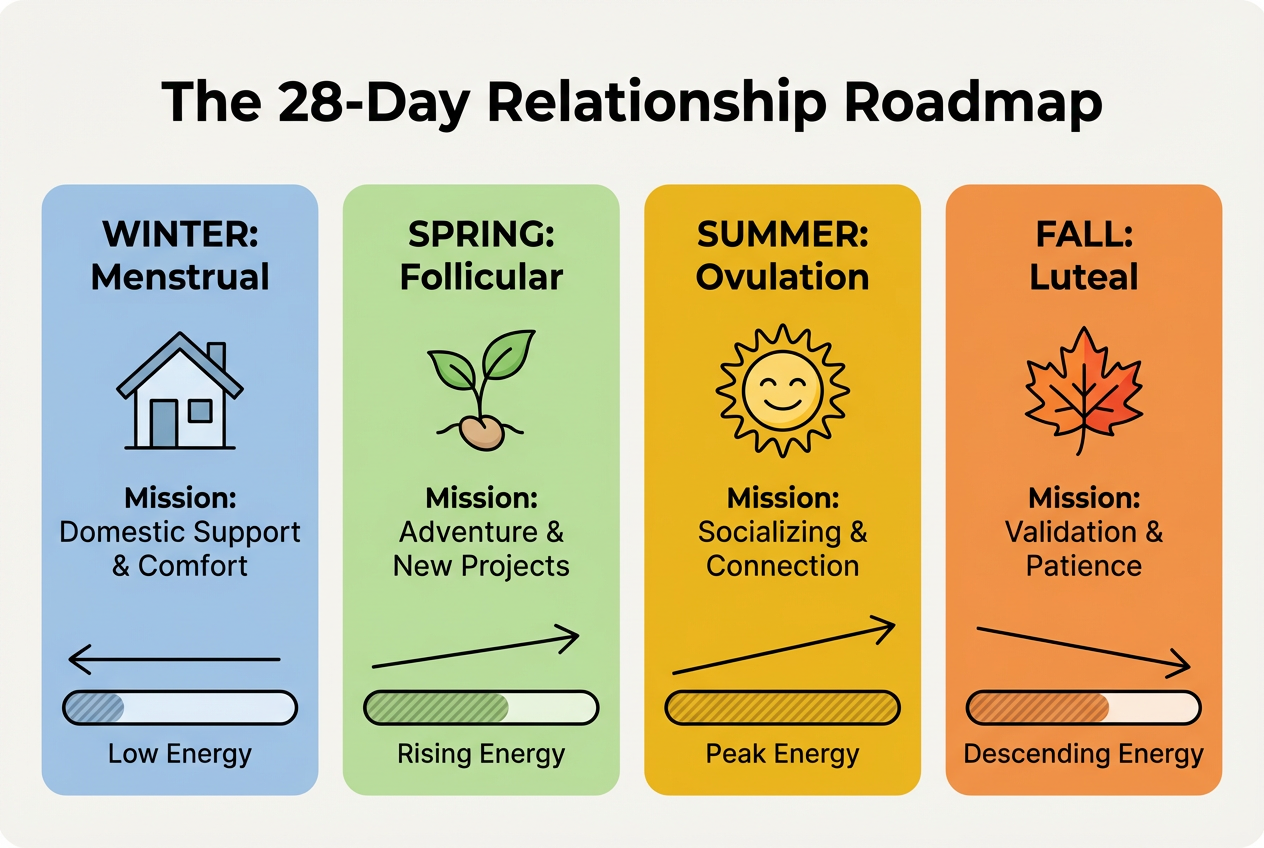 Understanding the ’Four Seasons’ framework helps partners translate biological phases into actionable support missions, moving from domestic assistance in the ’Winter’ to social planning in the ’Summer’.
Winter: Menstrual Phase (Days 1-5)
Her Biology: Estrogen and progesterone are at their lowest. She’s literally shedding her uterine lining. Energy is low. Pain tolerance is reduced. Her body is prioritizing recovery.
Her Needs: Comfort, warmth, low-effort activities, validation that it’s okay to rest.
Your Mission - Domestic Support:
- Handle the chores without being asked (dishes, laundry, groceries)
- Keep the heating pad charged and ready
- Stock her preferred pain relief (Ibuprofen works better than Tylenol for cramps)
- Suggest low-key plans: movie night at home, not a concert downtown
- Don’t take it personally if she needs physical space
- Bring food to her instead of suggesting she cook
What NOT to Do: Suggest she’s overreacting to pain, bring up serious relationship topics, expect high energy or enthusiasm for your ideas.
Spring: Follicular Phase (Days 6-14)
Her Biology: Estrogen is rising. Energy is increasing. She’s feeling optimistic, creative, and social. This is her "fresh start" phase.
Her Needs: Novelty, adventure, connection, collaboration on projects.
Your Mission - Adventure & New Projects:
- Propose new date ideas (new restaurant, hiking trail, weekend trip)
- This is the best time for "should we try..." conversations
- Support her starting new projects or hobbies
- Plan social events (dinner with friends, group activities)
- High-energy dates work well here
- She’s more receptive to feedback and growth conversations
What NOT to Do: Suggest staying in when she wants to go out, shut down her enthusiasm for new ideas, drag your feet on plans.
Summer: Ovulation (Days 15-17)
Her Biology: Estrogen peaks. Testosterone also rises. This is her biological "prime time" for energy, confidence, and yes, libido.
Her Needs: Social connection, validation, romance, physical intimacy.
Your Mission - Socializing & Peak Romance:
- This is the best window for date nights that matter
- Plan something that makes her feel attractive and desired
- Social events are easy for her right now (she has the energy)
- Physical intimacy is naturally higher
- Compliments and verbal affirmation land especially well
- She’s likely at her most confident, so support that
What NOT to Do: Be distant or withdrawn, miss opportunities for connection, treat this like any other week.
For a deeper dive into supporting your partner during this high-energy phase, check out our guide on how to support your girlfriend during her ovulation phase.
Fall: Luteal Phase (Days 18-28)
Her Biology: Progesterone rises, then both estrogen and progesterone crash before her period. This is the longest phase and the most variable. Early luteal (days 18-21) can still feel okay. Late luteal (days 22-28) is where PMS symptoms hit.
Her Needs: Validation, patience, low-pressure environment, comfort food, grace for emotional fluctuations.
Your Mission - Validation & Patience:
- Stock her specific cravings (sweet and salty, often)
- Avoid criticism or "constructive feedback"
- This is NOT the time for the "where is this relationship going?" talk
- Listen without trying to fix problems
- Give space if she asks for it
- Handle small annoyances without bringing them up
- Acknowledge that her feelings are valid even if they seem disproportionate to you
What NOT to Do: Dismiss her concerns as "just PMS," start arguments, expect high energy or enthusiasm, suggest she’s being irrational.
This is the phase where most relationship friction occurs. Understanding the luteal phase is your secret weapon for conflict prevention.
Comparative Review: Best Cycle Tracking Tools for Partners
BLUF: VibeCheck gives you actionable missions based on her cycle phase. Flo provides detailed medical data for women but has limited partner features. Clue prioritizes privacy. Shared Google Calendar is the low-tech option that works if you don’t need coaching.
Here’s the honest breakdown of what works and what doesn’t.
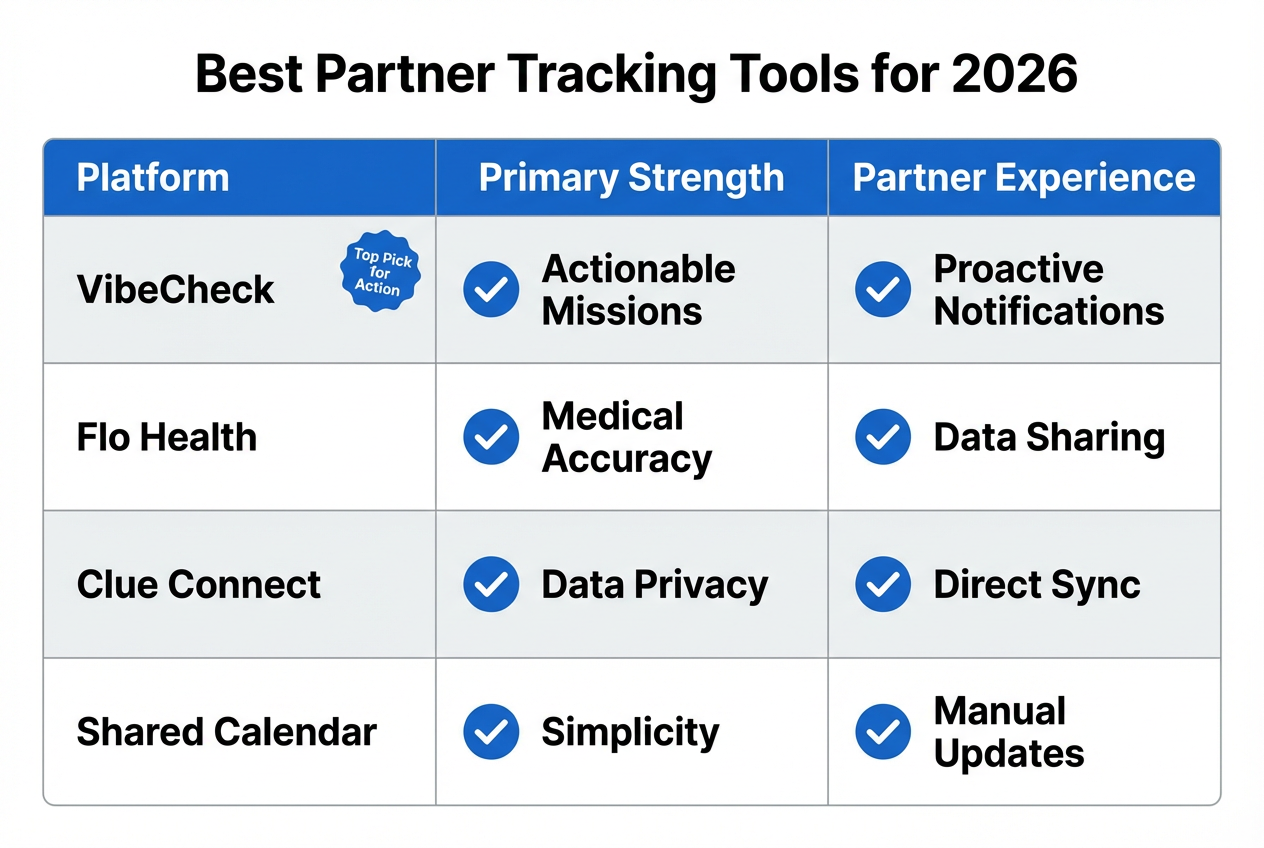 Choosing the right tool depends on your goals, whether you prioritize medical data, privacy, or receiving proactive missions to help you support your partner effectively.
VibeCheck: The Action-First Tool
Best For: Guys who want to be told what to do, not just when her period is.
Strengths:
- Translates cycle phases into specific missions ("Day 3: Handle dinner tonight. She’s low-energy.")
- Built specifically for male partners, not adapted from women’s tracking apps
- Daily notifications keep you ahead of the curve
- Explains WHY she might be feeling a certain way, which helps you not take things personally
Weaknesses:
- Newer app, smaller user base than Flo or Clue
- Requires both partners to engage with the tool
- Subscription-based (though cheaper than a single preventable argument)
Bottom Line: If you want a relationship tool, not just a calendar, this is it.
Flo: The Medical Data Powerhouse
Best For: Women who want comprehensive tracking; okay for partners as a secondary feature.
Strengths:
- Deep medical authority (OB-GYN reviewed content)
- Detailed symptom tracking for her
- Pregnancy and fertility features
- Established brand with millions of users
Weaknesses:
- Partner features feel like an afterthought
- Very feminine-focused interface
- You’re seeing her data, but you’re not getting coached on what to do with it
- Heavy on medical information, light on relationship application
Bottom Line: Great for her to use. Mediocre for you to use. Compare VibeCheck vs Flo to see the specific differences.
Clue: The Privacy-First Option
Best For: Partners who prioritize data security and minimal data sharing.
Strengths:
- Strong privacy controls
- Clean, clinical interface
- No fluff, just data
- Highly accurate predictions
- She maintains complete control of her information
Weaknesses:
- Very dry, no relationship guidance
- Doesn’t tell you what to DO with the information
- Partner feature (Clue Connect) is bare-bones
- High learning curve for guys not used to cycle terminology
Bottom Line: If she’s privacy-conscious and you’re self-directed, this works. If you need coaching, look elsewhere. For a detailed comparison, see VibeCheck vs Clue.
Shared Google Calendar: The DIY Method
Best For: Couples who want control and simplicity without installing another app.
Strengths:
- No subscription
- You both use it anyway
- Complete control of how much detail is shared
- Works on every device
- No learning curve
Weaknesses:
- Requires manual updates (friction = failure)
- No intelligence layer (you have to remember what each phase means)
- No predictions or insights
- Easy to forget to update
Bottom Line: Better than nothing. Worse than a purpose-built tool.
For a comprehensive side-by-side comparison of all major options, check our complete guide to the best period tracker apps for men.
The Conflict Prevention Window: High-Friction Zone Strategy
BLUF: Days 22-28 (late luteal phase) are a biological high-friction zone. Avoid heavy conversations, postpone criticism, and prioritize emotional validation over problem-solving during this window.
This section alone will save your relationship from dozens of preventable arguments.
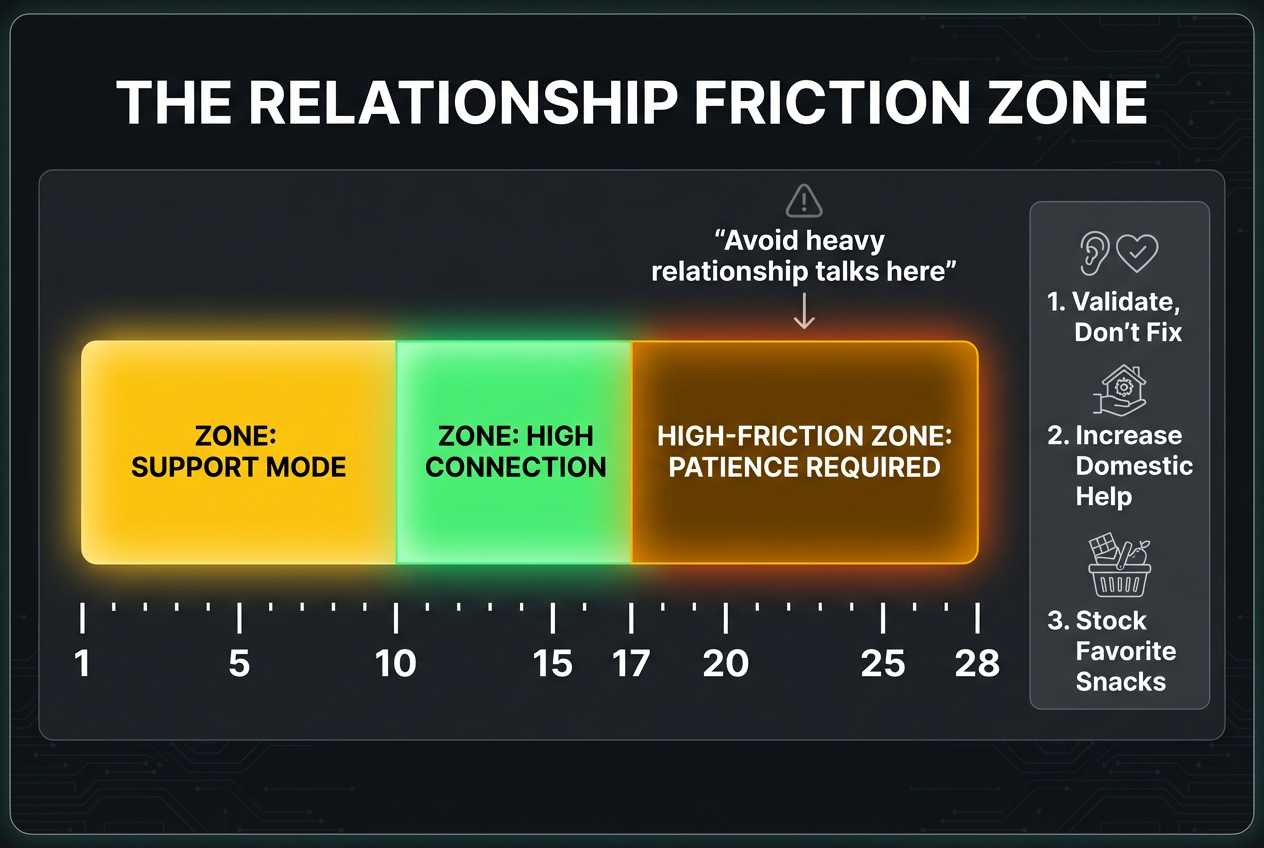 The ’Traffic Light’ graphic identifies the High-Friction Zone, advising partners on when to prioritize emotional validation over heavy discussions to maintain relationship harmony.
The Biology of the High-Friction Zone
During the late luteal phase (roughly days 22-28, the week before her period), both estrogen and progesterone crash. This hormonal withdrawal affects:
- Stress tolerance - 40% lower than during follicular phase
- Emotional regulation - The prefrontal cortex (rational thinking) has less influence
- Pain sensitivity - Physical discomfort amplifies emotional reactions
- Social battery - She has less capacity for dealing with interpersonal stress
This isn’t "she’s being irrational." This is biology creating a narrower margin for error in communication.
The Traffic Light System
Green Light: Days 1-21
- Safe for difficult conversations
- Good timing for "where should we go for our anniversary?" planning
- She has the bandwidth for your problems too
- Feedback and constructive criticism will land better
Yellow Light: Days 22-24
- Proceed with caution
- Keep heavy topics brief
- Read the room more carefully
- Stock preferred snacks
- Give more validation than usual
Red Light: Days 25-28
- Avoid serious relationship discussions
- Don’t bring up things she does that annoy you
- Cancel this window for "we need to talk" conversations
- Focus on support, not problem-solving
- Acknowledge feelings without debating them
Practical Rules for the Red Zone
1. The 48-Hour Rule If something bothers you during days 25-28, write it down. Wait 48 hours after her period starts. If it still bothers you, bring it up then. Most issues that feel urgent in the red zone look smaller in hindsight.
2. Validate First, Fix Never During this window, she doesn’t want solutions. She wants acknowledgment.
Wrong: "Have you tried talking to your boss about that?"
Right: "That sounds really frustrating. Your boss is being unreasonable."
3. The Grocery Mission Days 24-28: restock her preferred comfort items before she asks. Chocolate (dark, usually), salty snacks, whatever her specific cravings are. Having them ready eliminates one more decision she has to make.
4. Conflict De-Escalation Protocol If an argument starts during the red zone:
- Acknowledge her feelings first
- Avoid "you’re being emotional" or any variation
- Suggest tabling the discussion: "This is important. Can we come back to this on Saturday when we both have more energy?"
- Don’t storm off, but create space if she asks for it
5. The Exception Clause If she brings up a serious topic during this window, she’s doing so DESPITE her low bandwidth, which means it’s extremely important to her. Don’t dismiss it with "let’s talk about this next week."
The conflict prevention strategies extend beyond just cycle timing, but mastering this window eliminates half your relationship friction immediately.
The Pro-Partner Checklist: Always-Ready Essentials
BLUF: Stock these specific items before she asks. Having them ready transforms you from reactive to proactive and reduces her mental load by 30%.
Elite partners don’t wait to be asked. They anticipate. Here’s your tactical supply list.
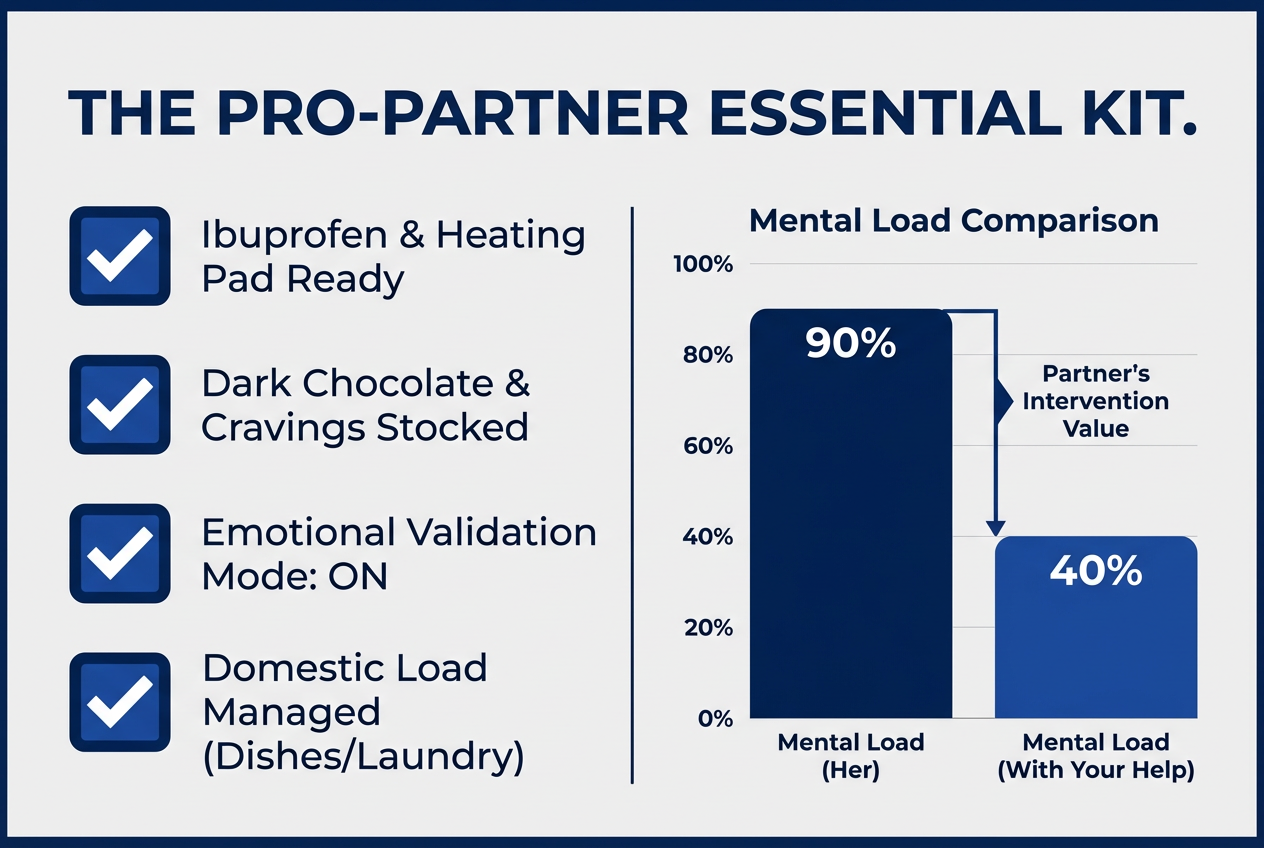 Implementing a ’Pro-Partner’ checklist drastically reduces your partner’s mental load, transforming cycle awareness into a tangible act of service that strengthens your bond.
Physical Comfort Essentials
Heating Pad - Not negotiable. Electric, not microwaveable. The rechargeable cordless ones are worth the investment. Keep it charged.
Ibuprofen (Advil) - Works better for menstrual cramps than acetaminophen (Tylenol). Stock the liquid gels, they work faster. Keep them at her place AND yours.
Her Preferred Menstrual Products - Know what she uses (tampons vs pads vs cup, specific brand, size). Have a backup supply. This is basic.
Extra Soft Blanket - Specifically for comfort, not decoration. Keep it clean.
Comfortable Clothes - If she stays over regularly, have sweats or soft clothes she can change into. Waistbands matter.
Food & Cravings
Dark Chocolate - 70% cacao or higher. Not milk chocolate. The magnesium helps with cramps.
Salty Snacks - Chips, pretzels, whatever her preference. Progesterone increases salt cravings.
Comfort Meal Options - Know her go-to comfort foods. Have the ingredients or the delivery app bookmarked.
Herbal Tea - Ginger or peppermint for nausea, chamomile for relaxation.
Magnesium Supplement - If she takes it (ask first, don’t assume). Magnesium glycinate helps with cramps and mood.
Environmental Setup
Temperature Control - She’ll run warmer during luteal phase, cooler during menstruation. Have extra blankets OR a fan ready.
Low Lighting Options - Dim lights, candles. Bright lights can intensify headaches during menstruation.
Entertainment Ready - Her comfort show/movie queued up. You’ve watched it 47 times. You’ll watch it again.
Quiet Space Available - If you live together, can she retreat to a quiet room? If not, can you go somewhere else for a few hours if she needs alone time?
Domestic Support Multipliers
Chore Automation - Days 1-5, you handle:
- All dishes
- All cooking (or ordering in)
- All laundry
- Groceries
- Any heavy lifting
Schedule Protection - She doesn’t need 17 social obligations during her menstrual phase. Run interference: "We’ve got plans that night" (the plan is resting at home).
Noise Management - If you have roommates or live in a loud building, can you minimize noise during the times she needs rest?
The 24-Hour Head Start Rule
When tracking shows her period is starting tomorrow, implement the checklist TODAY. Don’t wait until she wakes up with cramps to start helping.
The goal is that when she thinks "I need X," she realizes you already handled it. That’s the gap between a good partner and a great one.
To see how this proactive support fits into the bigger picture of understanding your partner, read our guide on what to do when your girlfriend is on her period.
Advanced Tactics: Moving Beyond Basic Tracking
BLUF: Once you’ve mastered the basics, cycle awareness unlocks advanced relationship strategies: optimal timing for important conversations, fertility awareness, surprise planning, and long-term health monitoring.
You’ve got the fundamentals down. Here’s the next level.
Timing High-Stakes Conversations
The Follicular Window (Days 6-14) is your strategic opportunity for:
- "Should we move in together?" discussions
- Financial planning conversations
- Meeting each other’s families for the first time
- Job changes that affect both of you
- Vacation planning
- Difficult but necessary relationship talks
Her estrogen is rising, optimism is high, and stress tolerance is at its peak. She has the emotional bandwidth for complex decisions.
The Ovulation Window (Days 15-17) is ideal for:
- Romantic gestures that matter
- Discussing physical intimacy needs
- Social events where you want her to shine
- Important dates or milestones
Avoid this window for anything that requires detailed analytical thinking. Emotions run high (in a good way), but it’s not the time for spreadsheet discussions.
Fertility Awareness (The Elephant In The Room)
Let’s be direct: ovulation is when pregnancy is possible. If you’re tracking her cycle, you know this.
If You’re Trying To Avoid Pregnancy:
- Days 12-18 are the high-risk window
- Use protection consistently, but be extra careful during this phase
- This is NOT foolproof birth control (ovulation timing varies)
- Have an honest conversation about what happens if protection fails
If You’re Trying To Conceive:
- Days 12-16 are your target window
- Track ovulation signs together (basal temperature, cervical mucus - yes, it’s clinical, but it works)
- Reduce pressure by not treating it like a scheduled task
- Support her if conception takes longer than expected (it’s normal to take 6-12 months)
Cycle tracking is NOT a substitute for proper contraception if you’re not ready for pregnancy. But it’s a useful additional data point for timing and planning.
Strategic Surprise Planning
Use the Four Seasons framework to time surprises for maximum impact.
Perfect Timing Examples:
- Spring/Follicular: Weekend trip announcement, new adventure date
- Summer/Ovulation: Romantic dinner, jewelry, heartfelt letter
- Fall/Luteal (early): Thoughtful small gestures, her favorite meal
- Winter/Menstrual: Cancelled plans so she can rest, spa day, cozy night in
Terrible Timing Examples:
- Late luteal: Surprise party with 20 people
- Menstrual phase: Physically demanding adventure
- Any phase: Surprise that requires immediate decision-making when she’s low-energy
The best surprises match her current energy level and needs, not yours.
Long-Term Health Monitoring
After 3-6 months of tracking, you’ll notice patterns. Deviations from those patterns can signal health issues worth discussing.
Red Flags To Notice:
- Cycles suddenly becoming irregular (varying by more than 7 days month-to-month)
- Significantly increased pain compared to her baseline
- New symptoms she hasn’t experienced before
- Bleeding between periods
- Cycles shorter than 21 days or longer than 35 days
You’re not her doctor, but you’re an extra set of eyes. "Hey, I noticed your cycle has been different the last two months. Might be worth mentioning to your doctor?" can catch issues early.
The Relationship Intelligence Dashboard
After six months of tracking, you’ll have enough data to see:
- Which phase is hardest for her personally (not all women struggle with the same phases)
- What specific support helps the most
- Patterns in your arguments (if 80% happen during the same phase, that’s actionable)
- When she’s most receptive to different types of communication
This isn’t about controlling the relationship. It’s about understanding the operating system so you can work with it instead of against it.
For more insights on how to deepen your understanding, explore our guide to understanding your partner’s cycle.
Ready to actually understand her?
Join thousands of men using VibeCheck to track her cycle and show up better every day.
Frequently Asked Questions
What is the best period tracker app for boyfriends?
VibeCheck is purpose-built for male partners, providing daily missions and relationship guidance based on her cycle phase. If your girlfriend already uses Flo or Clue, you can access partner features through those apps, but they won’t coach you on what to do with the information. For most guys who want actionable support strategies (not just calendar dates), VibeCheck delivers the best results. Compare options side-by-side in our boyfriend period tracker app guide.
Is tracking my girlfriend’s cycle creepy?
It depends entirely on consent and intent. Tracking without her knowledge or permission is absolutely inappropriate. Tracking WITH her consent, where she maintains control of the data and can revoke access anytime, is a supportive act that reduces her mental load. The difference is: Are you doing this TO her or WITH her? Frame it as a tool to help you support her better, emphasize she controls the data, and respect her decision if she declines.
What should I do during my girlfriend’s period?
Handle domestic tasks without being asked (cooking, cleaning, groceries), keep a heating pad ready, stock Ibuprofen and her preferred comfort foods, suggest low-key plans instead of high-energy activities, validate her feelings without trying to fix them, and give her physical space if she requests it. The goal is reducing friction and providing comfort, not earning points. For a complete playbook, read how to support your partner during her period.
How do I ask my girlfriend to share her cycle information with me?
Use this script during a neutral time: "Hey, I’ve been thinking about how I can be more supportive. I know your energy and stress levels change throughout the month, and I want to be more proactive about helping out when you’re low-energy or not feeling great. Would you be comfortable sharing your cycle info with me? You’d be in control of what I see, and you can change your mind anytime." Emphasize this is about supporting HER needs, not monitoring her, and make it clear she maintains full control of the data and can stop sharing anytime.
Why does my girlfriend get emotional before her period?
The late luteal phase (days 22-28) involves a significant drop in both estrogen and progesterone. This hormonal crash affects neurotransmitters like serotonin, reducing emotional regulation capacity and stress tolerance by up to 40%. Her emotional responses aren’t "irrational" - her biological stress threshold is genuinely lower. This doesn’t mean her feelings aren’t valid; it means she has less buffer for handling interpersonal stress. The right response is validation and patience, not dismissal. Learn more about hormonal changes during the menstrual cycle.
Can cycle tracking help prevent relationship arguments?
Yes, significantly. Research shows 60% of relationship conflicts occur during the luteal phase when stress tolerance is lowest. By identifying days 22-28 as a high-friction zone and postponing heavy conversations, criticism, or relationship discussions until her follicular phase (days 6-14), you eliminate preventable conflicts. This isn’t avoiding important topics - it’s strategic timing that gives those conversations a better chance of productive resolution instead of escalation.
When is the best time to have serious relationship conversations?
The follicular phase (days 6-14) is optimal for high-stakes discussions about moving in together, financial planning, or relationship direction. During this phase, estrogen is rising, stress tolerance peaks, and she has maximum emotional bandwidth for complex decisions. Avoid the late luteal phase (days 25-28) for these conversations - you’ll get worse outcomes and higher conflict. For relationship-defining topics, timing matters as much as content.
What’s the difference between VibeCheck and Flo for Partners?
VibeCheck is built for men and provides actionable daily missions based on cycle phase (what to do, not just what’s happening). Flo is built for women with partner features added as a secondary function - you get medical data and cycle dates but minimal coaching on relationship application. VibeCheck tells you "Handle dinner tonight, she’s Day 3," while Flo tells you "Menstruation - Day 3." Both work, but VibeCheck is optimized for the male partner experience. See the detailed breakdown at VibeCheck vs Flo comparison.
You don’t need to be a biology expert to be a great partner. You just need to understand that her body operates on a 28-day cycle that creates predictable patterns in energy, mood, and needs. Most guys stumble through this blindly. You now have the framework to anticipate, support, and show up exactly when it matters most. The Four Seasons model gives you the roadmap. The tools give you the data. The Pro-Partner Checklist gives you the tactics.
The difference between a good boyfriend and a top-tier partner isn’t effort. It’s intelligence. You’re now operating with information that 95% of men never learn.
Start with the conversation. Get her consent. Pick your tracking tool. Stock the checklist. Learn her specific patterns over 2-3 months. Watch your relationship friction decrease and your connection deepen.
Your next move: Have the conversation this week. If you want the tool that actually coaches you through this instead of just showing you dates, VibeCheck is built for exactly that. If she already uses another app, work with what she has.
The 28-day cycle isn’t a problem to solve. It’s a pattern to understand. You’ve got the playbook. Now execute.
Tags

Related Articles
Continue reading to deepen your understanding

Why Your Girlfriend Needs Different Communication Styles During Her Cycle
Stop wondering why your conversations feel like a minefield one week and a breeze the next. Use biology to understand her changing needs and adapt your style.

When Your Girlfriend Gets Withdrawn Before Her Period
If she suddenly pulls away, it is usually biology, not you. Learn why your girlfriend gets distant before her period and use these tactical scripts to help her during the luteal phase.

How to Respond When Your Girlfriend Needs Space During Her Period
If she’s suddenly sending one-word texts or pulling away, it’s likely not about you. Learn the science of the luteal phase and how to support her without feeling rejected.

Understanding Why Your Girlfriend’s Communication Style Shifts Weekly
Ever wonder why your partner’s moods and energy levels shift so much? Understanding the four phases of her menstrual cycle helps you become a more supportive and proactive partner.

When Do Your Girlfriend’s Energy Levels Change During Her Cycle?
Your girlfriend’s mood and stamina follow a biological rhythm. Learn how her energy peaks and crashes throughout the month so you can plan better dates and provide better support.

Why Your Girlfriend Needs Different Attention Each Week: The Four Seasons Framework
Stop walking on eggshells and start understanding her cycle. This framework shows you exactly how to support your girlfriend through all four biological phases every month.

Why Your Girlfriend Wants Space the Week Before Her Period
Does your girlfriend suddenly pull away every month? Discover the biological reasons behind the pre-period space window and how to navigate this phase together.

Why Your Girlfriend Wants Different Kinds of Affection at Different Times in Her Cycle
Ever feel like your girlfriend’s needs change every week? It’s not random. Understand how the four phases of her cycle drive her desire for intimacy so you can support her better.