Boyfriend Relationship Advice to Stop Guessing and Lead

Stop guessing how to support your partner and missing the mark. Master the biological rhythm strategy today to become an elite partner and build lasting clarity.
The Biological Cheat Code: Relationship Advice for Boyfriends Who Want to Stop Guessing
You're doing your best. You listen. You ask questions. You plan thoughtful dates. But sometimes it feels like you're playing a game where the rules change every week, and no one bothered to tell you.
Here's the truth most relationship advice won't tell you: Traditional boyfriend guidance teaches you what to do but ignores when to do it. The result? You're offering adventure when she needs stillness, initiating serious conversations when her brain is wired for threat detection, and wondering why your perfectly good intentions keep missing the mark.
This isn't about working harder. It's about working smarter by understanding the biological rhythm that influences everything from her energy levels to her communication style. Welcome to Biological Intelligence (BQ), the missing piece in conventional relationship advice.
Table of Contents
- The Four-Phase Playbook: Your Core Strategy
- Communication Landmines and How to Avoid Them
- The Invisible Load Hack: 10x Your Impact
- Cycle-Synced Dating: Planning That Actually Works
- Supporting Her From a Distance
- From Average Boyfriend to Elite Partner
- FAQ
The Four-Phase Playbook: Your Core Strategy
Your partner's energy, stress tolerance, and emotional bandwidth shift predictably across four distinct phases every month. By matching your support style to her current biological capacity, you transform from reactive responder to proactive partner.
Most guys treat every week the same. They bring the same energy, offer the same type of support, and wonder why it lands perfectly one week and falls flat the next. The difference isn't your effort. It's timing.
Women experience four distinct hormonal phases that create measurable changes in brain chemistry, energy levels, and stress response. Understanding these phases gives you a roadmap for when to push for adventure, when to pull back and create space, and when to quietly handle the logistics she doesn't have bandwidth for.
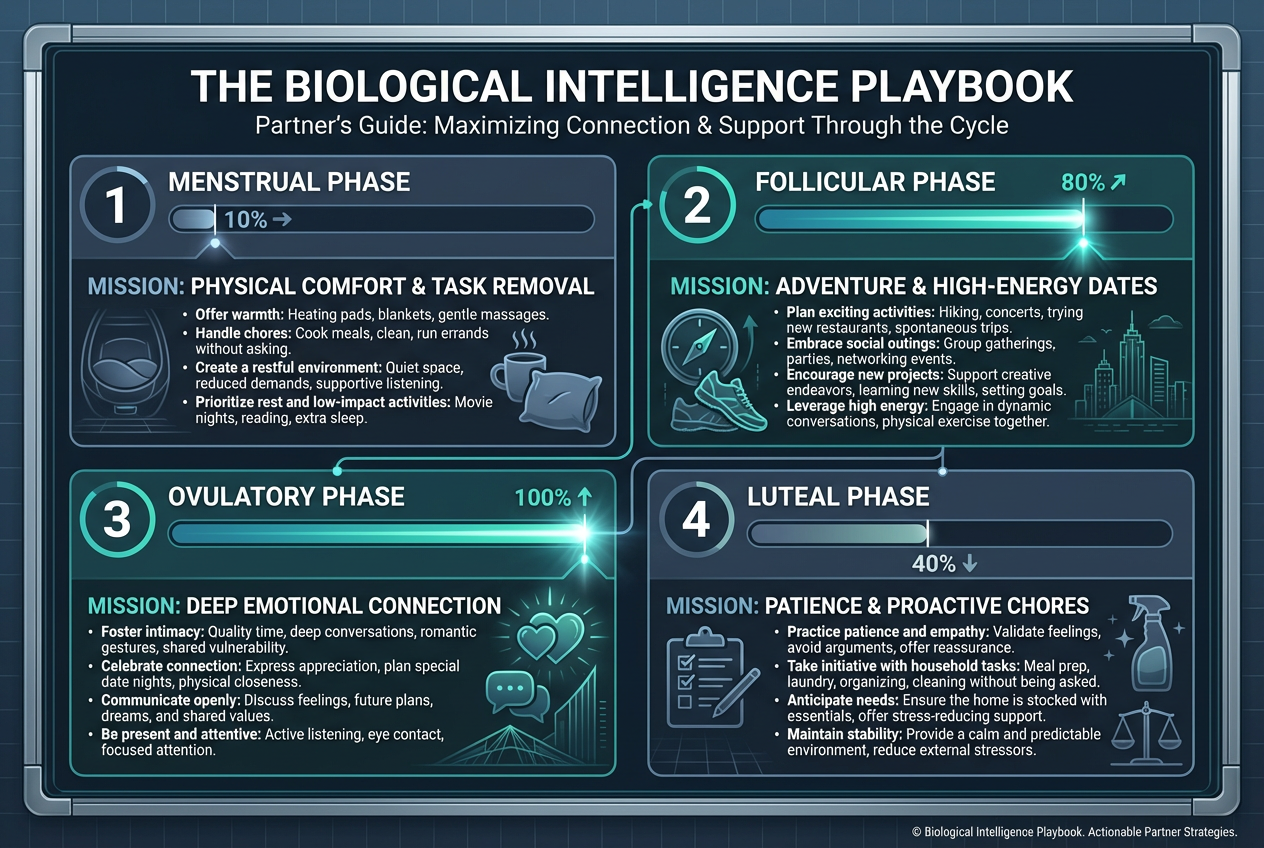
Mastering the Four-Phase Playbook allows you to transition from guessing to leading, providing the exact type of support your partner needs based on her current biological energy levels.
Phase 1: The Period (Days 1-5) - Physical Comfort & Task Removal
Primary Mission: Remove friction from her environment and make comfort effortless.
Her body is shedding the uterine lining, which creates legitimate physical discomfort. Hormones are at their lowest point, energy is depleted, and her body is prioritizing recovery over everything else.
What This Looks Like in Action:
- Stock the bathroom before she has to ask. Keep a supply of her preferred products, pain relievers, and heating pads easily accessible.
- Take dinner off her plate entirely. Order her favorite comfort food or cook something simple that requires zero input from her.
- Handle the small stuff. Trash goes out without mention. Dishes get done. The visible mess that would normally require her mental energy disappears.
- Create a low-stakes environment. This isn't the week for introducing friends to each other or planning complicated social events.
The Temperature Check: She'll appreciate you asking "what would help?" but she'll love you more for already knowing. Proactive beats reactive every time during this phase.
Phase 2: The Comeback (Days 6-12) - Adventure & High-Energy Dates
Primary Mission: Match her rising energy with opportunities for connection and new experiences.
Estrogen is climbing steadily. Her energy rebounds. Mood improves. The brain's reward centers light up more easily, making this the optimal window for trying new restaurants, planning weekend trips, or having those bigger relationship conversations you've been putting off.
What This Looks Like in Action:
- Plan the experiences that require energy and engagement. Rock climbing, hiking, exploring a new part of the city, taking that cooking class she mentioned months ago.
- Initiate social plans. Her capacity for group dynamics is highest here. Double dates and social gatherings will feel energizing rather than draining.
- Bring up the growth conversations. Want to talk about moving in together? Plan next year's vacation? Discuss finances? This is your window.
- Increase physical activity together. Her body is primed for movement. Morning runs, bike rides, and active dates will feel good rather than like obligations.
The Key Insight: She's not different because she's trying harder. Her biochemistry is literally creating more dopamine, serotonin, and energy. You're not convincing her to have fun. You're offering fun when her system is wired to receive it.
Phase 3: The Connection Phase (Days 13-18) - Emotional Intimacy & Nesting
Primary Mission: Create opportunities for depth, security, and emotional bonding.
Ovulation happens mid-phase, but the real shift you'll notice is progesterone beginning to rise after. This hormone creates a nesting instinct and a desire for emotional security. She's less interested in conquering the world and more interested in strengthening the foundation.
What This Looks Like in Action:
- Trade adventure for intimacy. Skip the loud bar. Choose the quiet dinner where you actually talk.
- Initiate the relationship check-ins. Not the heavy stuff, but the connective conversations. "How are we doing?" feels good to her now. It felt like pressure two weeks ago.
- Support her nesting projects. She wants to organize the closet? Perfect weekend for you to help rather than suggest she relax.
- Emphasize quality time over novel experiences. Movie night at home beats the crowded theater. Cooking together beats the trendy restaurant.
The Distinction: This phase often gets confused with low energy, but it's actually high connection energy with different priorities. She's not withdrawing. She's focusing inward, and that includes focusing on the relationship foundation.
Phase 4: The Support Phase (Days 19-28) - Patience & Proactive Logistics
Primary Mission: Anticipate stress, reduce decision load, and become reliably steady.
Progesterone peaks and then crashes. This creates the phase most guys dread because they don't understand it. Her brain's threat detection system becomes more sensitive. Small annoyances feel bigger. She has less bandwidth for additional stress or complex decisions.
What This Looks Like in Action:
- Handle decisions without asking. "What do you want for dinner?" becomes "I ordered Thai, it'll be here in 30." You just removed three decisions from her plate.
- Don't create additional logistics. This isn't the week to suggest reorganizing the garage or planning a complicated weekend trip.
- Reduce sensory overwhelm. Lower the TV volume. Clean up the clutter. Create a calm environment that doesn't require her to manage it.
- Bring patience to small frustrations. The dishes left in the sink aren't actually the problem. They're the visible symbol of the invisible load she's carrying. Just do them.
The Advanced Move: Ask her earlier in the month what typically stresses her out during this phase, then handle those things before she has to think about them. That's not managing her. That's being a strategic partner.
For a complete breakdown of how to implement this system daily, check out the VibeCheck partner cycle guide that translates these phases into specific daily missions.
Communication Landmines and How to Avoid Them
Hormonal shifts directly impact the brain's threat detection system and emotional processing capacity. Saying the right thing at the wrong time creates conflict that has nothing to do with your message and everything to do with her nervous system's current state.
You've experienced this. The exact same conversation goes two completely different ways depending on the week. You're not imagining it. Her amygdala (the brain's threat detection center) becomes more reactive during the luteal phase when progesterone is elevated. Neutral statements get interpreted as criticism. Suggestions feel like attacks. The content of what you said matters less than her brain's current capacity to process it calmly.
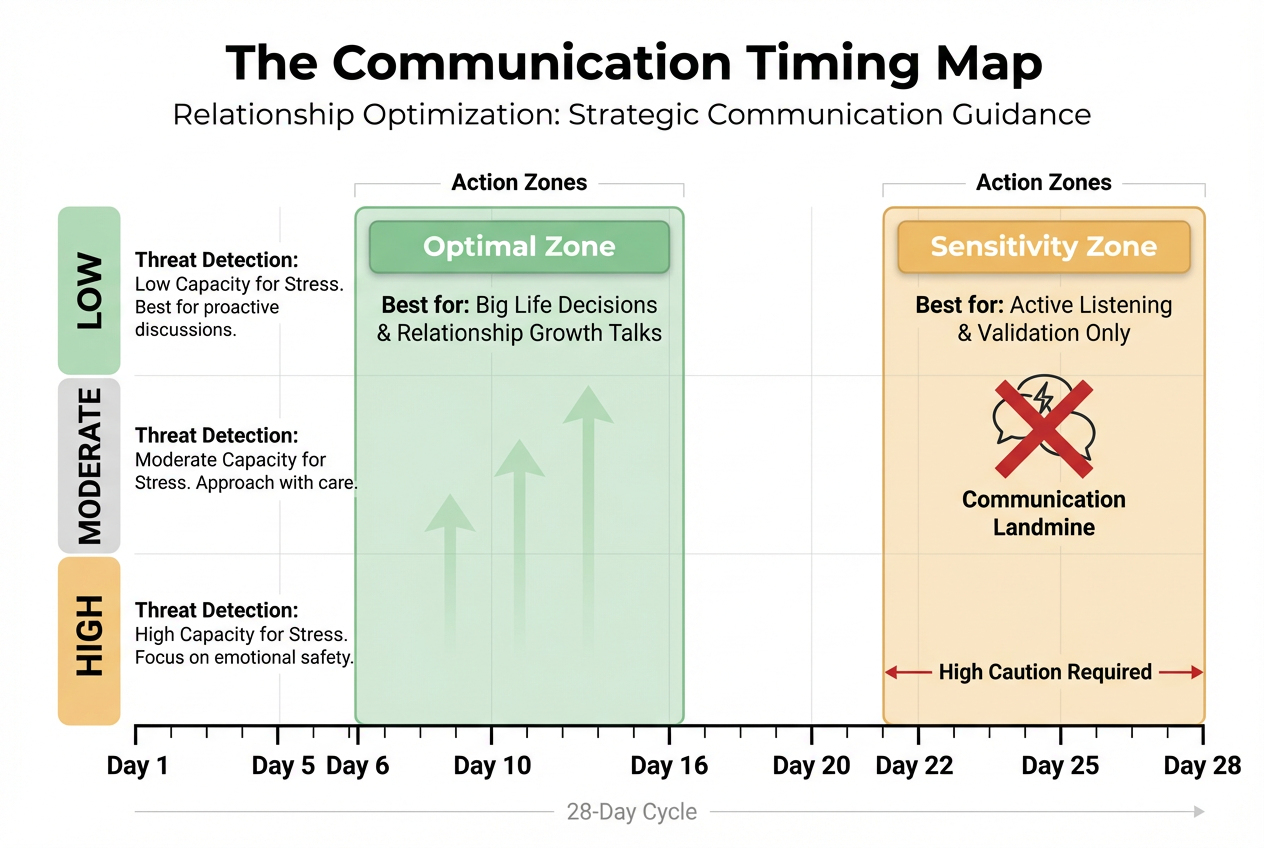
Timing is everything in relationship communication. This map identifies the high-capacity windows for growth talks and the sensitive periods where your primary job is simply to listen.
The High-Capacity Windows (Follicular & Ovulatory Phases)
Best For: Planning conversations, constructive feedback, discussing future goals, addressing relationship issues that require problem-solving.
Her brain has higher stress tolerance and better emotional regulation during these phases. Cortisol response is more measured. She can hear constructive feedback without her nervous system interpreting it as an attack.
Practical Application:
- Save the "we should talk about our budget" conversation for Day 10, not Day 25.
- Bring up friction points from last month after her period ends, when she has bandwidth to process them.
- Discuss vacation plans, major purchases, or life changes when her brain chemistry supports forward-thinking rather than threat assessment.
The Low-Capacity Windows (Luteal Phase)
Best For: Active listening, validation, taking things off her plate, being steady and predictable.
This isn't about walking on eggshells. It's about recognizing that her nervous system is already working overtime. Adding complex emotional discussions or criticism during this window is like asking someone to solve a puzzle while running a marathon.
What Changes:
- Switch from problem-solving to presence. She doesn't need you to fix things. She needs you to hear her.
- Avoid phrases that imply she's overreacting. "You're being too sensitive" or "it's not that big of a deal" activate defensiveness because her brain is literally more sensitive right now. That's biochemistry, not a character flaw.
- Table the big conversations. "Can we talk about this next week?" is a completely legitimate response when you notice the timing is off.
The "Check-In" Protocol
Instead of reacting to her mood, create a simple system for understanding where she is in her cycle. Many guys find that simply asking "where are you in your cycle?" early in the relationship normalizes the conversation and removes the guessing game.
Better yet, use a period tracker app designed for men that gives you a heads-up before the phase shifts happen. You're not tracking her. You're tracking the context that helps you be a better partner.
What This Prevents
Common Pattern: You notice she seems off. You ask what's wrong. She says nothing. You push. She gets frustrated. You get defensive. The fight that follows has nothing to do with the original issue and everything to do with timing.
With BQ Awareness: You notice she seems off. You recognize it's Day 24. You don't push. You handle dinner, clean up, and create space. The next week, she thanks you for not making it a thing. That's the difference.
The Invisible Load Hack: 10x Your Impact
Most relationship advice tells you to "help out more." Smart relationship strategy tells you exactly when your help provides maximum relief and minimum resentment.
The invisible load is the mental burden of remembering, planning, and managing household tasks that often falls disproportionately on women. Every relationship article tells you to share this load equally. None of them tell you that the weight of this load changes dramatically based on her cycle phase.

Efficiency meets empathy: By timing your support to coincide with her highest stress levels, you provide ten times the emotional relief with the same amount of effort.
The Support Multiplier Effect
Taking over dinner prep on Day 10 when she's energized and capable? She appreciates it, but it doesn't create significant relief because she had the bandwidth to handle it anyway.
Taking over dinner prep on Day 26 when progesterone is crashing and every small task feels like a mountain? You just removed genuine stress from an already overloaded system. Same action. Completely different impact.
The Math:
- Baseline help during high-energy phases = 1x appreciation
- Strategic help during low-capacity phases = 10x relief
You're not doing more work. You're timing the same effort to match her actual need.
Tactical Implementation
Week 1 (Menstrual Phase): Handle visible tasks without discussion. Dishes, trash, laundry, meal prep. She's managing physical discomfort. Remove everything else.
Week 2 (Follicular Phase): Normal division of labor works fine. She has energy. Collaborate rather than taking over.
Week 3 (Ovulatory/Early Luteal): Start anticipating. Check the calendar. Restock groceries before she has to think about it. Handle the pet care, the bills, the small logistics that create mental clutter.
Week 4 (Late Luteal): Full support mode. Assume every task is harder for her right now because biochemically, it is. Don't wait to be asked. Don't create additional decision points by asking "how can I help?" Just execute.
The Common Mistakes
Mistake 1: Performative Help Doing the dishes but leaving the kitchen a mess, requiring her to come behind you and finish the job, doesn't reduce the load. It adds supervisory work.
Mistake 2: Conditional Help "I'll do the dishes if you do the laundry" creates a transaction that requires negotiation and mental energy. That's not support. That's adding labor.
Mistake 3: Waiting to Be Asked If she has to ask, you already failed. She just spent mental energy recognizing the task, evaluating whether you'd do it, and formulating the request. You think you helped. You actually added steps.
The Advanced Strategy
During her follicular phase when she has bandwidth, have the conversation: "What are the three tasks that feel heaviest during PMS week?"
For many women, it's meal planning, decision-making about social plans, and managing household restocking. Now you have your target list. Those three things become your responsibility during Week 4 without discussion.
That's not managing her emotions. That's strategic partnership based on predictable patterns. For more on this approach, read about relationship advice for men using cycle syncing.
Cycle-Synced Dating: Planning That Actually Works
The best date for Week 2 is terrible for Week 4. Understanding this prevents the "I planned something nice and she didn't enjoy it" frustration that kills goodwill.
You spent two hours researching the perfect restaurant. Made reservations. Picked her up. She seems flat. Uninterested. You think she doesn't appreciate the effort. She thinks you don't notice she explicitly said she wanted a quiet night.
Neither of you is wrong. The plan was wrong for the timing.
High-Energy Dating (Follicular/Ovulatory Phases)
Energy Profile: She has capacity for novelty, stimulation, social interaction, and physical activity.
Ideal Plans:
- The new restaurant across town that requires an adventure to find
- Concert or live music where the environment is energizing
- Activities that create shared adrenaline (escape rooms, rock climbing, trying something new)
- Group social events where she gets to engage with multiple people
- Weekend trips that require logistics and planning
Why It Works: Her dopamine system is responsive. New experiences create genuine excitement rather than feeling like obligations. The extroversion that requires energy to perform feels natural right now.
Low-Energy Dating (Luteal Phase)
Energy Profile: She has capacity for depth but not breadth. Intimacy, yes. Stimulation, no. Emotional connection over social performance.
Ideal Plans:
- Cooking dinner together at home
- Movie night with zero pressure to go out afterward
- Walk in a familiar, quiet place rather than exploring somewhere new
- Board game night or low-key activity that doesn't require presentation
- Massage, bath, any activity that emphasizes relaxation over engagement
Why It Works: Progesterone creates a nesting instinct. Security feels good. Novelty feels threatening. You're not convincing her to have fun. You're meeting her where her biochemistry already wants to be.
The Transition Periods
Menstrual Phase: Default to whatever requires the least from her. If she wants to go out, great. If she wants to cancel, zero guilt.
Mid-Luteal (Days 19-23): She might still have energy for moderate plans, but build in easy exit strategies. Choose the restaurant close to home. Pick the movie showing that doesn't require driving across town.
The Planning Conversation
Early in the relationship, you can literally ask: "I noticed you seem to have different energy levels at different times of the month. What type of plans sound good during your period versus the week after?"
Most women will appreciate this question because it shows you're paying attention to patterns rather than taking her preferences personally. She's not rejecting your effort. She's working with a system you're finally acknowledging exists.
Avoiding the Classic Trap
The trap: You plan an elaborate date during her luteal phase. She's not enthusiastic. You feel rejected. She feels guilty. Resentment builds on both sides.
The solution: Track rough timing. Save the big plans for the weeks she can actually enjoy them. During the lower energy weeks, your job is to make her life easier, not more complicated.
If you need a simple system for tracking these patterns, a period tracker for boyfriends can give you the visibility you need without making it weird.
Supporting Her From a Distance
Long-distance relationships require modified tactics, but biological awareness becomes even more valuable when you can't physically be there to notice the shifts.
You can't bring her heating pad. You can't cook dinner. You can't clean the apartment. But you can still provide targeted support by understanding what type of connection she needs based on her current phase.
Phase 1 (Menstrual): Care Package Strategy
The Core Challenge: She's managing physical discomfort alone. Your presence would help. Your absence is felt more acutely.
Remote Tactics:
- Schedule food delivery for Day 1 or 2. Don't ask what she wants. Pick her comfort food and have it arrive with a note.
- Send the physical comfort items ahead of time. Heating pad, favorite tea, chocolate, the weighted blanket she mentioned. Arrive before the period starts.
- Reduce communication pressure. Don't demand FaceTime calls during this phase. Let her text when she has energy. Your consistency matters more than constant contact.
Phase 2 (Follicular): High-Engagement Connection
The Core Challenge: She has energy for connection but you're not physically present to share experiences.
Remote Tactics:
- Plan virtual dates that require participation. Online escape room. Watching the same movie simultaneously. Cooking the same meal together over video.
- This is your window for longer, deeper phone conversations about future plans and relationship growth.
- Send "thinking of you" messages that reference shared memories or future plans. Her brain is wired for optimism right now. Feed that.
Phase 3 (Ovulatory/Luteal Transition): Emotional Depth
The Core Challenge: She wants emotional security and evidence that the relationship foundation is solid despite distance.
Remote Tactics:
- Initiate the "how are we doing?" conversations. Check in on the relationship health.
- Send voice memos instead of texts. Hearing your voice creates more connection than reading words.
- Make small gestures that show permanence. Mail an actual letter. Send flowers to her work. Physical tokens matter more during this phase.
Phase 4 (Late Luteal): Low-Pressure Presence
The Core Challenge: She's managing stress with reduced bandwidth. Your texts asking "what's wrong?" feel like additional labor.
Remote Tactics:
- Reduce expectations. Don't schedule important calls during this week. Don't bring up relationship issues that require processing.
- Send one-way support messages. "Thinking of you. No need to respond." Give without requiring anything back.
- Handle logistics on your end without involving her. Planning the next visit? Do the research. Present options instead of asking her to help figure it out.
The Distance Advantage
Counterintuitively, distance can make biological awareness easier to implement because you're forced to be more intentional about communication. You can't fall back on physical presence to smooth over poor timing. You have to actually think about when to engage and when to give space.
The couples who succeed long-distance aren't the ones who talk constantly. They're the ones who match communication intensity to each person's actual capacity for connection. Learn more about implementing these strategies with the VibeCheck partner cycle playbook.
From Average Boyfriend to Elite Partner
The difference between a good partner and an exceptional one isn't effort. It's precision. Biological Intelligence gives you the targeting system to make your effort land where it matters most.
Most guys operate on one of two modes:
Mode 1: Reactive Support Wait for her to tell you what's wrong, then try to fix it. This keeps you perpetually behind, responding to problems after they've already created friction.
Mode 2: Constant Effort Give maximum effort all the time, burn out, then get frustrated when it doesn't seem to make a difference. You're watering a plant that doesn't need water and wondering why it's not thriving.
Elite partners operate in Mode 3: Strategic Support. They understand that relationships are dynamic systems with predictable patterns. They match their energy and support style to her current biological capacity, creating a partnership that feels effortless because the timing is right.
The Shift in Mindset
This isn't about managing her hormones. You can't manage someone else's biochemistry. This is about managing your own strategy based on information that's been available all along but rarely discussed in male-focused relationship advice.
Old Framework: "Why is she mad? What did I do wrong? How do I fix this?"
New Framework: "What phase is she in? What does her system need right now? How do I provide that before it becomes a problem?"
The first framework makes you defensive. The second makes you proactive.
The Implementation Timeline
Month 1: Observation Start noticing patterns without changing behavior. When does she have more energy? When does she want space? When do small things bother her more? You're gathering data.
Month 2: Basic Alignment Implement the four-phase playbook in broad strokes. More support during Week 4. More adventure during Week 2. You're testing the framework.
Month 3: Refinement Now you know her specific patterns. Some women have brutal periods but easy luteal phases. Others have easy periods but difficult PMS weeks. Customize the strategy to her specific experience.
Month 6: Automaticity At this point, you don't think about it consciously. You naturally know that suggesting the big weekend trip on Day 8 will land better than suggesting it on Day 24. The awareness becomes instinct.
The Relationship ROI
Guys who implement biological awareness report:
- Fewer arguments about "nothing" (because they recognize when her nervous system is already stressed)
- Better sex lives (because they understand when initiation is welcome versus intrusive)
- Stronger emotional connection (because strategic support creates safety and trust)
- Less mental exhaustion (because they stop trying to solve problems that don't need solving)
You're not working harder. You're working smarter. The effort you were already giving now lands with precision instead of scattering randomly.
The Tool That Makes This Easy
All of this sounds great in theory. Implementation is where most guys fall short. You're not going to manually track a 28-day cycle while managing work, life, and everything else competing for mental bandwidth.
That's why tools like VibeCheck exist. Instead of you remembering which phase she's in, you get a daily brief that tells you exactly what type of support makes sense today. Think of it as a weather forecast for your relationship. You don't control the weather, but knowing it's going to rain helps you bring an umbrella.
The guys who win aren't the ones with perfect intuition. They're the ones who use systems to replace guesswork with strategy.
FAQ
How do I bring this up without sounding like I'm reducing her to her hormones?
Frame it as you learning to be a better partner, not as you managing her biology. Try: "I've been reading about how I can be more supportive across your whole cycle, not just during your period. Would you be open to helping me understand what's actually helpful versus what sounds good in theory?"
Most women appreciate this because it shows you recognize there are patterns instead of treating every mood as random or personal. The key is positioning yourself as the student, not the expert on her experience.
What if her cycle is irregular or she's on birth control that eliminates periods?
Hormonal birth control changes the pattern but doesn't eliminate cyclical shifts entirely. Many women on continuous birth control still experience energy fluctuations, mood patterns, and physical symptoms on a roughly monthly cycle even without breakthrough bleeding.
The framework still applies, but you'll need to track based on her specific symptoms rather than counting days from her period. The observation phase becomes more important. Notice when she typically has more energy, when stress tolerance is lower, and when she craves different types of connection. The 28-day textbook cycle is a starting point, not a rigid rule.
Isn't this just emotional labor disguised as "hacking" the relationship?
No. Emotional labor is the unpaid, unrecognized work of managing other people's emotions and needs. Strategic support is you proactively managing your own behavior to align with your partner's capacity.
The difference: Emotional labor requires the person doing it to suppress their own needs. Strategic support improves outcomes for both people. You're not sacrificing yourself. You're timing your effort to create less friction and more connection. That benefits you as much as it benefits her.
How do I avoid making this weird or clinical?
Don't announce your strategy. Just implement it. She doesn't need a lecture on progesterone levels. She needs you to take out the trash on Day 25 without being asked.
The weirdness happens when guys treat cycle awareness like a science experiment they're conducting on their partner. The smoothness happens when you quietly adjust your approach based on patterns and she notices that things just feel easier without understanding exactly why.
What if I try this and she still gets upset during her luteal phase?
Biological awareness reduces friction. It doesn't eliminate human complexity. Her hormonal phase isn't the only variable affecting mood and behavior. Work stress, family issues, relationship problems, and legitimate grievances still exist.
The point isn't to prevent all conflict. The point is to not create unnecessary conflict by pushing for serious conversations or offering adventure when her system needs stillness. You're removing one variable from the equation, not solving every problem in the relationship.
Should I track her cycle without telling her?
Only if she's already comfortable with the topic. For many couples, using a shared tracker or period app designed for partners creates transparency and removes any sense that you're monitoring her secretly.
The healthiest approach: Ask if she'd be open to sharing her cycle information with you so you can be more supportive. If she says yes, use a tool built for that purpose. If she says no, respect the boundary and focus on noticing patterns based on what she tells you directly. For couples ready to share this information, check out the best Flo alternative apps for supportive partners.
How long before I see results from implementing this approach?
Most guys notice reduced conflict within the first month. By the second month, she'll likely comment that you seem more attuned or that things feel easier without necessarily connecting it to cycle awareness.
The key metric isn't whether she explicitly thanks you for timing your support strategically. It's whether arguments decrease, connection improves, and you feel less confused about what she needs. Those outcomes typically show up quickly once you stop offering rock climbing during her luteal phase and quiet nights during her follicular phase.
What's the biggest mistake guys make when they first learn about cycle awareness?
Overconfidence. They read one article, assume they're experts, and start explaining to their partner why she's feeling a certain way based on her cycle day. That's condescending and counterproductive.
The right approach: Learn the framework. Observe how it shows up specifically for your partner. Adjust your behavior quietly. Let the results speak for themselves. If she notices you've been more helpful during PMS week, she'll probably tell you. You don't need to announce that you've cracked the code.
Tags

Related Articles
Continue reading to deepen your understanding

Why Your Girlfriend Wants Space the Week Before Her Period
Does your girlfriend suddenly pull away every month? Discover the biological reasons behind the pre-period space window and how to navigate this phase together.

Why Your Girlfriend Wants Different Kinds of Affection at Different Times in Her Cycle
Ever feel like your girlfriend’s needs change every week? It’s not random. Understand how the four phases of her cycle drive her desire for intimacy so you can support her better.

How to Plan Romantic Gestures by Cycle Timing: The Partner’s Tactical Guide
Stop guessing why your date night plans fell flat. This guide explains how to synchronize your romantic efforts with her biological cycle for better intimacy and connection.

How to Tell When Your Girlfriend Is Ovulating: Reading the Biological Signals Your Partner Sends
Understanding your partner’s cycle helps you anticipate her needs and time important conversations. Learn the behavioral signs of ovulation to improve your relationship and connection.

Understanding Your Girlfriend’s Words of Affirmation Cycle: A Partner’s Guide
Ever feel like your compliments land wrong? Her need for words of affirmation isn’t random—it follows a biological rhythm. Learn how to match your support to her internal hormonal seasons.

The Partner’s Guide to the Luteal Phase: What It Is and How to Support Her
Stop walking on eggshells. Understand the biological changes of the luteal phase so you can support your partner through mood shifts and fatigue with empathy.

How to Plan Valentine’s Day Around Your Girlfriend’s Cycle
Does your romantic plan clash with her biological rhythm? Learn how to adjust your date night to her specific cycle phase so she feels comfortable and truly cared for this year.

The Strategic Partner’s Guide to Planning an Engagement Around Her Cycle
Don’t leave your proposal to chance. Learn how her biological rhythm impacts emotional receptivity and how to align your big question with the phase where she feels her best.