Compare Menopause App Subscription Tiers Side-by-Side

See exactly what menopause apps cost. Compare subscription tiers and premium features side-by-side to get the best value. Find the right plan for your partner today.
The Partner's Guide to Perimenopause Apps: Finding Reviews That Compare Flo with the Best Alternatives
If you're searching for detailed comparisons between Flo Health and other perimenopause tracking apps, you're probably looking for more than just cycle predictions. You want clarity on which platform will actually help you support your partner through the unpredictable hormonal changes that make early perimenopause feel like navigating in fog. The right comparison should focus on partner accessibility, medical depth, and privacy credibility, not just pretty interfaces.
This guide cuts through the noise. We'll show you exactly where to find legitimate side-by-side reviews, what features actually matter when hormones start behaving erratically, and which apps give you real-time intelligence instead of just data dumps.
Table of Contents
- Where to Find Reliable Perimenopause App Comparisons
- Understanding the Shift: Why Regular Period Trackers Stop Working
- Flo Health as the Market Benchmark: What Partners Need to Know
- The Top Flo Alternatives for Perimenopause Support
- Side-by-Side Feature Matrix: What Actually Matters
- The Privacy Conversation: How to Bring It Up Without Sounding Paranoid
- How to Choose the Right App for Your Situation
- Frequently Asked Questions
Where to Find Reliable Perimenopause App Comparisons
Most comparison reviews you'll find focus on women as the primary user. The reality? You're not just looking for app reviews; you're searching for relationship intelligence tools that translate biological chaos into actionable support strategies.
The best sources for trustworthy perimenopause app comparisons include specialized health platforms like Balance-Menopause.com, which offers medically reviewed comparisons emphasizing symptom management over fertility tracking. Healthline and Medical News Today provide comprehensive breakdowns that evaluate clinical accuracy alongside user experience. For unfiltered user feedback, Reddit's r/perimenopause and r/Menopause communities share real-world experiences comparing how apps perform when cycles become unpredictable.
Tech-focused sites like Horiva specialize in privacy-first app reviews and often lead with data security comparisons, which matters if your partner values digital health privacy. These sources explicitly contrast Flo's massive user base against smaller competitors built specifically for the perimenopause transition.
What these reviews often miss: the partner experience. Most analyses evaluate tracking accuracy and symptom logging but skip the critical question of whether you can actually access and interpret the data in a way that helps you show up better in the relationship. The best period tracker for couples should function as mission control, not a data graveyard.
Understanding the Shift: Why Regular Period Trackers Stop Working
Perimenopause isn't just "irregular periods." It's a complete rewiring of hormonal patterns that makes the predictable 28-day cycle model obsolete. The algorithms that worked perfectly for years suddenly can't keep up because the biological foundation has changed.
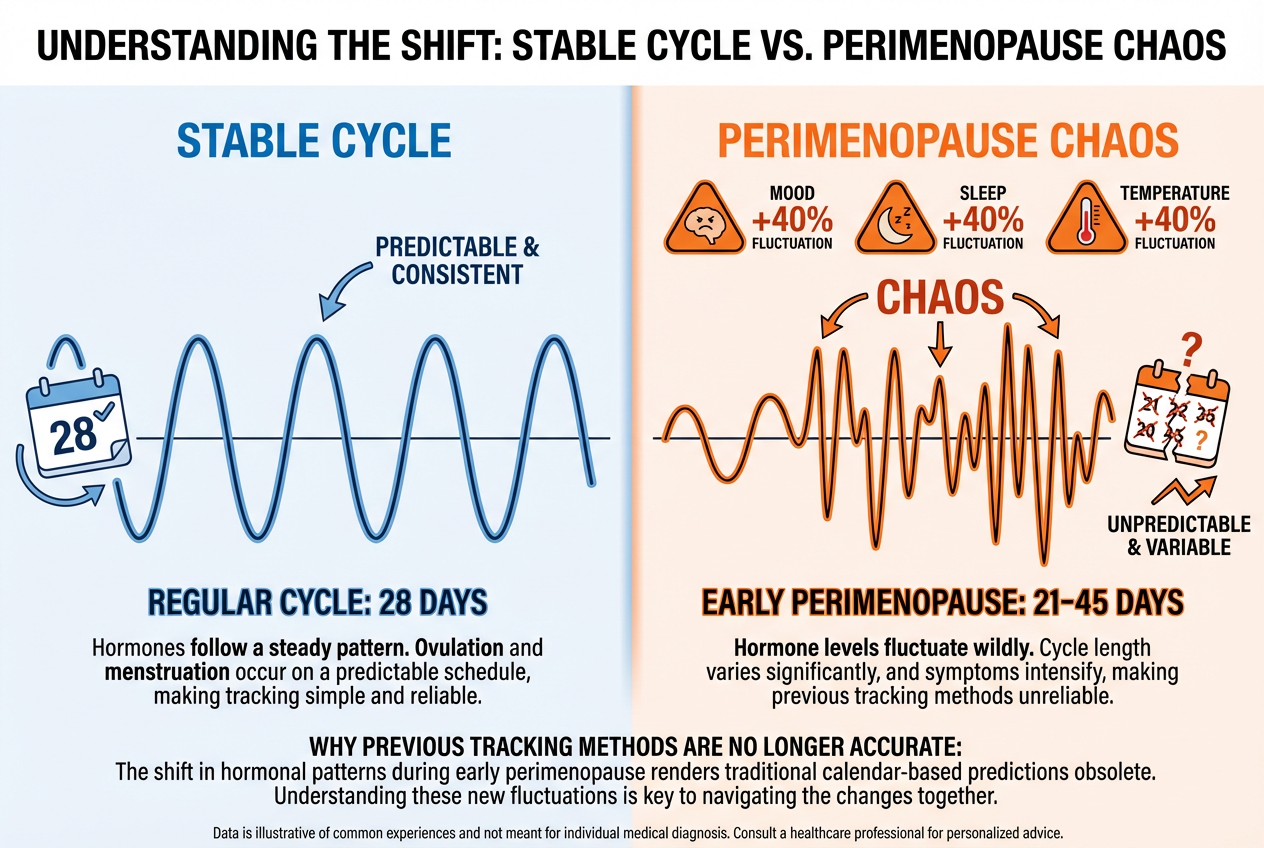
Here's what's actually happening: estrogen and progesterone levels begin fluctuating wildly rather than following the steady rise-and-fall pattern of reproductive years. One month might see a 25-day cycle, the next stretches to 45 days, followed by two periods in three weeks. The old trackers can't predict chaos; they're designed for patterns.
This is why symptoms seem to come out of nowhere. Brain fog on a Tuesday, joint pain on Thursday, sudden exhaustion on Saturday, all without the predictable relationship to cycle phase that used to exist. The apps built for fertility tracking use historical data to forecast the future, but when hormones are rewriting the rules every month, historical data becomes nearly useless.
For partners, this means the "heads up" notifications you relied on stop arriving at the right time, or don't arrive at all. She might snap at you on day 12 when the app said she'd be in her "happy phase," not because the app is broken, but because her hormones no longer follow the script.
Early perimenopause typically starts in the late 30s or early 40s, though some women experience changes earlier. If your partner is in this age range and you've noticed the cycle predictions getting less accurate, it's not user error. The tool wasn't designed for this phase.
Flo Health as the Market Benchmark: What Partners Need to Know
Flo dominates the menstrual tracking market with over 380 million users worldwide, which makes it the default comparison point for every competitor. But size doesn't automatically mean it's the best choice for perimenopause support, especially if you're trying to access data as a partner.
Flo introduced "Flo for Partners" specifically to address relationship support. After your partner enables sharing, you get your own dashboard with simplified cycle information, mood predictions, and specific suggestions like "She might be more tired today, maybe handle dinner?" The interface translates complex hormonal data into plain language actions.
The system uses push notifications to give you real-time awareness. Instead of asking "What's wrong?" and getting "Nothing" in response, you already know she's three days into her cycle and energy levels typically drop during this phase. This period tracker for boyfriends approach turns invisible biology into visible context.
Flo added a dedicated perimenopause mode in 2023, which adjusts tracking algorithms to accommodate irregular cycles. The app now logs symptoms like hot flashes, night sweats, and cognitive changes that weren't part of the standard fertility-focused tracking. For partners, this means you're not just seeing "period predicted in 5 days" but rather "increased irritability and sleep disruption logged this week."
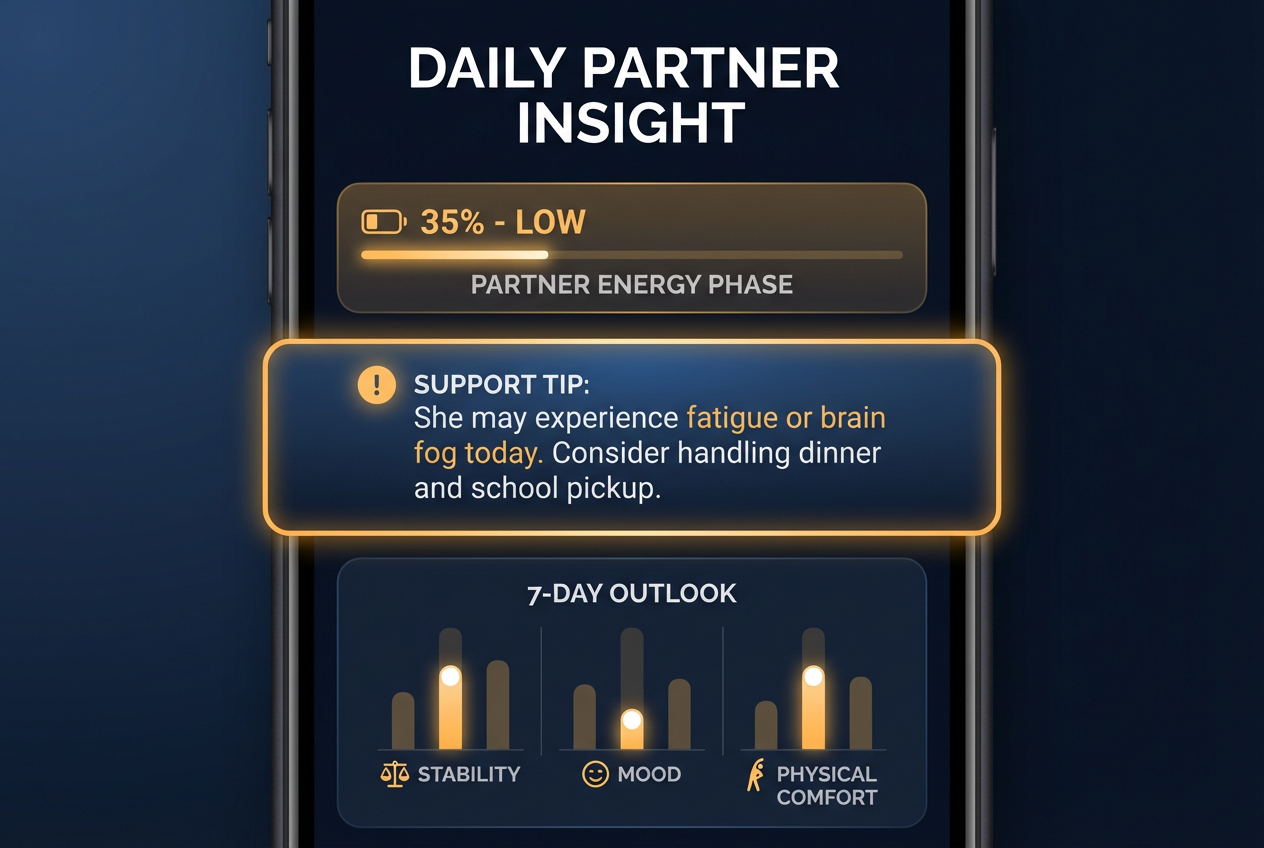
The platform also offers 60-second educational content designed specifically for male partners. Quick-read articles explain why certain symptoms cluster together or what's happening hormonally during different phases. It's the difference between raw data and actual intelligence.
However, Flo's history includes a 2021 FTC settlement over data privacy practices. The company was found sharing sensitive health information with Facebook and Google analytics without proper user consent. They've since overhauled their privacy policies and introduced better data controls, but this history remains relevant when evaluating trust.
The partner mode doesn't require you to download a separate app. You receive access through the main Flo platform using a pairing code, which keeps everything consolidated. This matters practically because you're not juggling multiple accounts or trying to remember which platform has which information. Understanding cycle awareness becomes part of your normal routine rather than an extra research project.
The Top Flo Alternatives for Perimenopause Support
Several competitors have built platforms specifically targeting the perimenopause transition, often positioning themselves as medical-grade alternatives to Flo's broader approach.
Balance was created by Dr. Louise Newson, one of the UK's leading menopause specialists. The app focuses exclusively on perimenopause and menopause rather than trying to serve the entire reproductive lifecycle. It's NHS-approved and ORCHA-certified, which means it meets strict medical accuracy and data security standards.
Balance doesn't offer partner sharing like Flo does. The platform is designed to help users document symptoms comprehensively so they can bring detailed reports to healthcare providers. If your partner is struggling with brain fog, joint pain, or other symptoms that doctors sometimes dismiss as "just stress," Balance gives her professional-grade tracking that physicians actually take seriously.
The app includes extensive educational content from medical experts, explaining hormone replacement therapy (HRT), lifestyle modifications, and symptom management strategies. For partners, this means you can read the same expert articles she's reading, which creates shared vocabulary for discussing what she's experiencing.
Clue takes a science-first approach to cycle tracking, emphasizing data accuracy and research-based predictions. The platform is EU-GDPR compliant and stores data on European servers, addressing privacy concerns that plagued Flo's early years. Clue added perimenopause tracking in 2024, acknowledging that their user base was aging and needed different tools.
Clue Connect allows simple cycle sharing with partners, though it's less sophisticated than Flo's dedicated partner mode. You can see when her period is predicted and when she's logged symptoms, but you won't get the contextualized suggestions or educational content that Flo provides. It's raw data sharing rather than translated intelligence.
Health & Her positions itself as a holistic perimenopause support platform, combining tracking with lifestyle recommendations and supplement protocols. The app emphasizes actionable changes: dietary adjustments, exercise modifications, and stress management techniques tailored to specific symptoms.
This platform doesn't offer partner access at all. It's entirely focused on individual users managing their own transition. If your partner values privacy or prefers to share information on her own terms rather than through automated data feeds, Health & Her might align better with her preferences.
None of these alternatives match Flo's partner education component. If you're looking for a guide to relationship timing and support, you'll need to supplement whatever tracking app she uses with your own research and communication strategies.
Side-by-Side Feature Matrix: What Actually Matters
When comparing perimenopause apps, most reviews focus on interface design or price. Those factors matter, but they're secondary to whether the platform actually helps you support your partner through hormonal chaos.
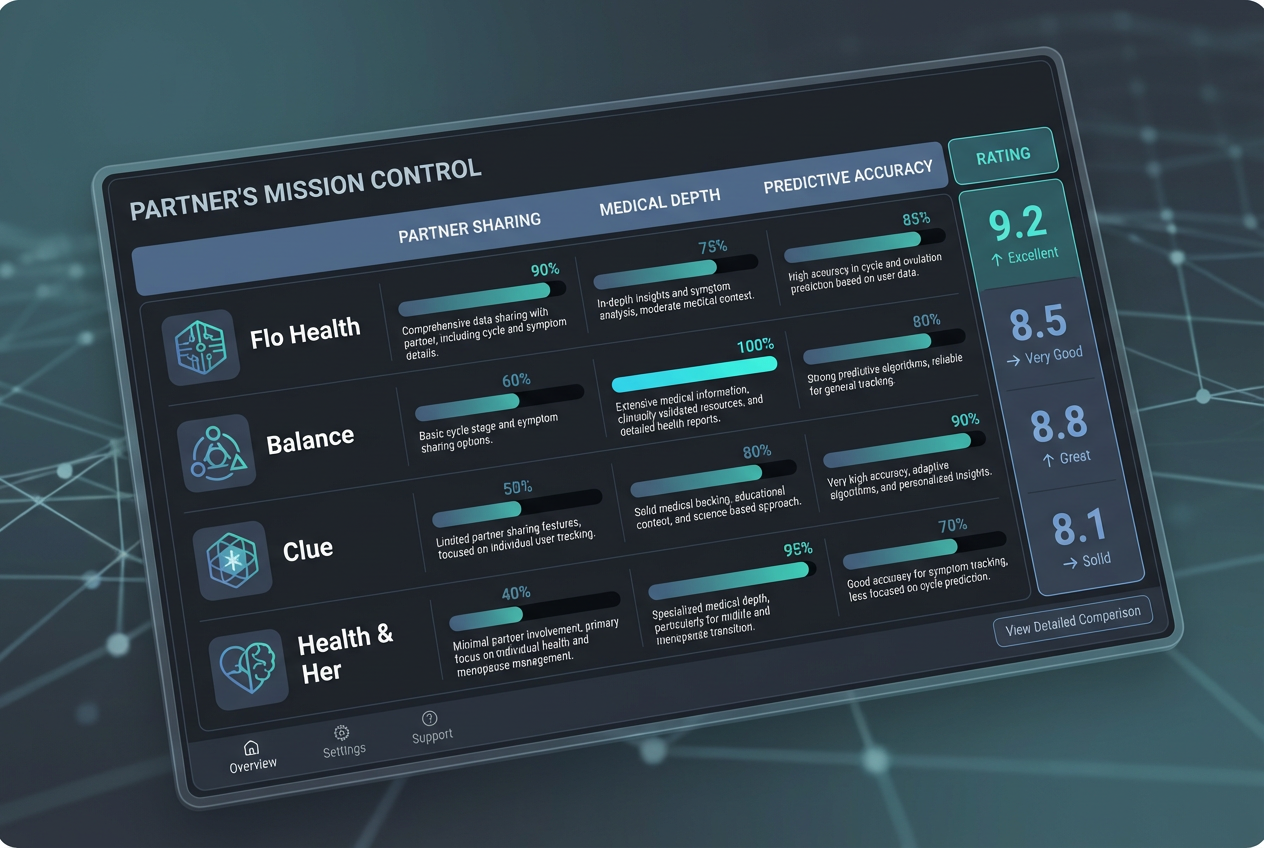
| Feature | Flo Health | Balance | Clue | Health & Her |
|---|---|---|---|---|
| Core Audience | General cycle and fertility tracking | Perimenopause and menopause specifically | Science-focused cycle tracking | Holistic perimenopause management |
| Partner Sharing | Dedicated partner dashboard with actionable suggestions | No partner features; doctor-focused reports | Basic cycle sharing through Clue Connect | No partner access available |
| Partner Education | 60-second articles, quizzes, and contextualized tips | Medical expert articles (clinical focus) | Deep scientific research articles | Personalized symptom advice only |
| Perimenopause Focus | Added mode; secondary to fertility tracking | Primary purpose; built for this transition | Added mode in 2024 update | Primary purpose; lifestyle-focused |
| Privacy Model | Improved after 2021 FTC settlement; commercial data use | NHS-certified; high medical standards | EU-GDPR compliant; European data storage | Standard commercial model |
| Prediction Accuracy | Struggles with irregular cycles | Doesn't predict; tracks for medical review | Good during regular cycles, adapts slowly | Focuses on symptom patterns over cycle prediction |
| Best Use Case | Real-time partner awareness and support coordination | Preparing comprehensive data for doctor appointments | Users who want research-grade tracking | Implementing lifestyle changes based on symptoms |
The matrix reveals a fundamental trade-off: platforms built specifically for perimenopause (Balance, Health & Her) offer better symptom documentation and medical credibility, but they don't provide partner access. Apps with strong partner features (Flo) were originally designed for fertility tracking and adapted to perimenopause as their user base aged.
This means your choice depends on what your relationship needs most. If she's struggling to get doctors to take her symptoms seriously, Balance's medical credibility might outweigh the lack of partner dashboard. If the main issue is relationship friction because you keep missing signals, Flo's partner mode might be worth its other limitations.
For partners specifically, Flo remains the most developed option because it's the only platform that treats "helping him support her" as a core feature rather than an afterthought. The tactical relationship intelligence approach requires tools built with both users in mind.
The Privacy Conversation: How to Bring It Up Without Sounding Paranoid
Data privacy in health apps isn't paranoia; it's legitimate concern based on documented misuse. But bringing up the topic with your partner requires finesse, especially if she's already overwhelmed by physical symptoms and doesn't want to add digital security stress.
Start by acknowledging the FTC found that Flo shared users' fertility tracking data, pregnancy status, and menstrual cycle information with Facebook and Google without proper disclosure. This isn't ancient history; the settlement happened in 2021. The company paid no financial penalty but agreed to get independent privacy assessments for 20 years.
Frame the conversation around agency, not fear. "I read that some tracking apps share health data with advertisers. Have you looked at the privacy settings on yours?" This opens discussion without sounding accusatory or like you're questioning her choices.
The practical concerns are real. Health data can affect insurance rates, employment decisions, and even legal situations depending on your location. Menstrual tracking data has already been subpoenaed in legal cases in several US states. If your partner values privacy, apps with on-device storage or EU-based servers (like Clue) offer better protection than cloud-based platforms that monetize through data partnerships.
Flo has improved significantly since the settlement. Users can now opt out of data sharing, request data deletion, and see exactly what information is collected. The company introduced "Anonymous Mode" that severs the connection between identity and health data. These changes matter, but they required regulatory action to implement.
Balance's NHS certification and ORCHA approval mean it meets strict UK healthcare data standards. For partners in healthcare or government jobs with security clearances, this medical-grade privacy model might be necessary rather than optional.
The conversation shouldn't be "You need to stop using Flo." It should be "Let's make sure whatever app you're using has the privacy settings configured the way you want." This respects her autonomy while ensuring she's making informed choices about her health data.
If she's resistant to switching apps because she has years of data in her current platform, most services allow data export. The transition doesn't mean losing historical information; it means moving it to a more secure environment.
How to Choose the Right App for Your Situation
The "best" perimenopause app depends entirely on what phase of transition your partner is experiencing and what kind of support your relationship needs most.
Choose Flo if: You're the primary issue. If relationship friction comes from you missing cues, misreading moods, or not understanding why her energy fluctuates wildly, Flo's partner mode translates biological data into relationship strategy. The boyfriend relationship advice approach works best when implemented through platforms designed for partner awareness.
Choose Balance if: Her doctors aren't listening. If she's experiencing symptoms that get dismissed as stress or aging, Balance provides medical-grade documentation that healthcare providers actually respect. The app generates professional reports that frame symptoms in clinical language, which unfortunately still matters when seeking proper treatment.
Choose Clue if: Privacy is non-negotiable. If your partner works in a field where health data could affect security clearances, or if you're in a location where reproductive health data carries legal risks, Clue's European data storage and GDPR compliance offer better protection than US-based alternatives.
Choose Health & Her if: She wants to take action herself. If your partner prefers managing her transition through lifestyle modifications rather than tracking for tracking's sake, this platform emphasizes what to do about symptoms rather than just documenting them. The trade-off is zero partner involvement, which works if she wants to maintain complete control over information sharing.
The decision doesn't have to be permanent. Many women use multiple apps simultaneously: Balance for medical appointments, Flo for daily tracking and partner coordination, and symptom-specific tools for things like sleep or mood. Digital tools should serve your relationship, not create additional stress.
Before suggesting any app, have a direct conversation about what she actually wants from tracking. Some women find detailed symptom logging helpful; others find it obsessive and anxiety-inducing. Some want you deeply involved in understanding her cycle; others prefer to share information selectively on their own terms.
The goal isn't perfect data collection. It's reducing the invisible friction that builds when biology creates challenges neither of you fully understands. The right app makes hormonal changes visible and actionable rather than mysterious and frustrating. If you're looking for comprehensive cycle syncing advice, remember that the tool matters less than how you use the information it provides.
Frequently Asked Questions
What makes perimenopause tracking different from regular period tracking?
Perimenopause tracking addresses hormonal chaos rather than predictable patterns. Regular period trackers use historical data to forecast future cycles, assuming consistency. Perimenopause tracking focuses on symptom correlation and medical documentation because cycles become too irregular for traditional prediction algorithms. The emphasis shifts from "When will her period start?" to "Why is she experiencing brain fog and joint pain this week?"
Can I access my partner's cycle data without her knowing?
No, and you shouldn't try. All legitimate tracking apps require explicit user consent before enabling partner access. Flo, Clue, and similar platforms use pairing codes that your partner must generate and share voluntarily. Attempting to access health data without consent is both unethical and potentially illegal depending on your jurisdiction. The entire purpose of partner cycle awareness is building trust and support, which requires transparent communication.
Is Flo safe to use after the 2021 privacy settlement?
Flo has implemented significant privacy improvements including Anonymous Mode, clearer data sharing disclosures, and user-controlled privacy settings. The FTC settlement requires independent privacy assessments for 20 years. However, the app remains a commercial platform that generates revenue partially through data partnerships. Users must actively configure privacy settings rather than relying on defaults. For maximum security, consider apps with EU-based data storage or medical-grade certifications.
Do I need a separate account to use Flo's partner features?
No. Flo's partner mode works through the main platform using a pairing code your partner generates. You download the same app and connect to her account with her explicit permission. This consolidated approach means one platform handles both perspectives rather than requiring separate boyfriend-specific apps. The interface automatically adjusts to show partner-relevant information rather than clinical tracking details.
How accurate are perimenopause symptom predictions?
Symptom predictions during perimenopause are inherently less accurate than regular cycle predictions because hormones fluctuate unpredictably. Apps can identify symptom patterns (brain fog tends to cluster with certain hormonal changes) but can't forecast with the precision possible during reproductive years. The value shifts from "She'll be irritable on Thursday" to "These three symptoms appearing together usually indicate she needs extra support this week." Treat predictions as probabilities rather than certainties.
What if my partner doesn't want me tracking her cycle?
Respect that boundary completely. Some women prefer to share cycle information on their own terms rather than through automated data feeds. You can still support her by learning about perimenopause symptoms, asking how she's feeling rather than assuming based on data, and responding to direct communication about what she needs. Not every relationship benefits from digital tracking; some require more privacy and personal communication.
Should I suggest she switch apps if I find a better alternative?
Tread carefully. Many women have years of data in their current platform and switching feels like losing valuable history. Instead of "You should use this instead," try "I found this app that has features for helping partners understand perimenopause better. Would you want to look at it together?" Frame it as adding tools rather than replacing what's working. If she's happy with her current app, focus on learning from external resources rather than pushing platform changes.
What's the difference between perimenopause and menopause tracking?
Perimenopause is the transition phase before menopause, characterized by irregular cycles and fluctuating hormones while periods still occur. Menopause is defined as 12 consecutive months without a period, after which hormones stabilize at lower levels. Perimenopause tracking focuses on unpredictability and symptom management during active transition. Menopause tracking emphasizes symptom management without cycle prediction since periods have stopped. Most apps designed for perimenopause work for both phases, while menopause-specific apps skip cycle tracking entirely.
Tags

Related Articles
Continue reading to deepen your understanding

What to Text Your Girlfriend During Her Period: 50+ Scripts & Support Tips
Texting during her period isn’t just about saying the right words. It is about proving you understand the biological marathon she is running without being asked to help.
The Partner’s Decoder Ring: How to Know When Your Girlfriend Wants Attention by Her Cycle
Stop the guesswork in your relationship. Learn how to identify exactly when she needs closeness or space by understanding the predictable patterns of her hormonal cycle.

What to Do When Your Girlfriend is Ovulating: The Ultimate Partner’s Playbook
Is your girlfriend suddenly glowing and high-energy? She is likely ovulating. Learn how to recognize the signs and match her vibe to build a deeper connection during her cycle.
How to Track Your Girlfriend’s Cycle: A Strategic Guide for Supportive Partners
Stop guessing why she’s stressed. Learn how tracking your girlfriend’s cycle helps you anticipate her needs, reduce arguments, and show up as a more supportive, proactive partner.

The 28-Day Relationship Strategy: Using Her Cycle to Plan Perfect Surprises
Ever wonder why your partner is up for an adventure one week and wants to stay home the next? The secret lies in her biological rhythm and knowing exactly when to plan your surprises.
Is Clue Connect Free for Partners? A Complete Guide to Costs and Features
Wondering if you need a subscription to see your partner’s cycle? We break down exactly who pays for Clue Connect and what data the viewing partner actually sees on their screen.
Why the Best Personalized Finance Apps Are Actually Relationship Tools
Stop arguing over grocery runs. Discover how the latest personalized finance apps are evolving into relationship tools that manage household energy, not just transactions and budgets.
Relatio App Review: Is This Relationship Cheat Code for Men Actually Worth It?
We review the Relatio relationship coaching app for men, examining its core features, pricing, and how it compares to alternatives like VibeCheck. Read our in-depth analysis to decide if Relatio's cycle-based coaching is right for you.