VibeCheck v Relatio Best Relationship App for Men 2026
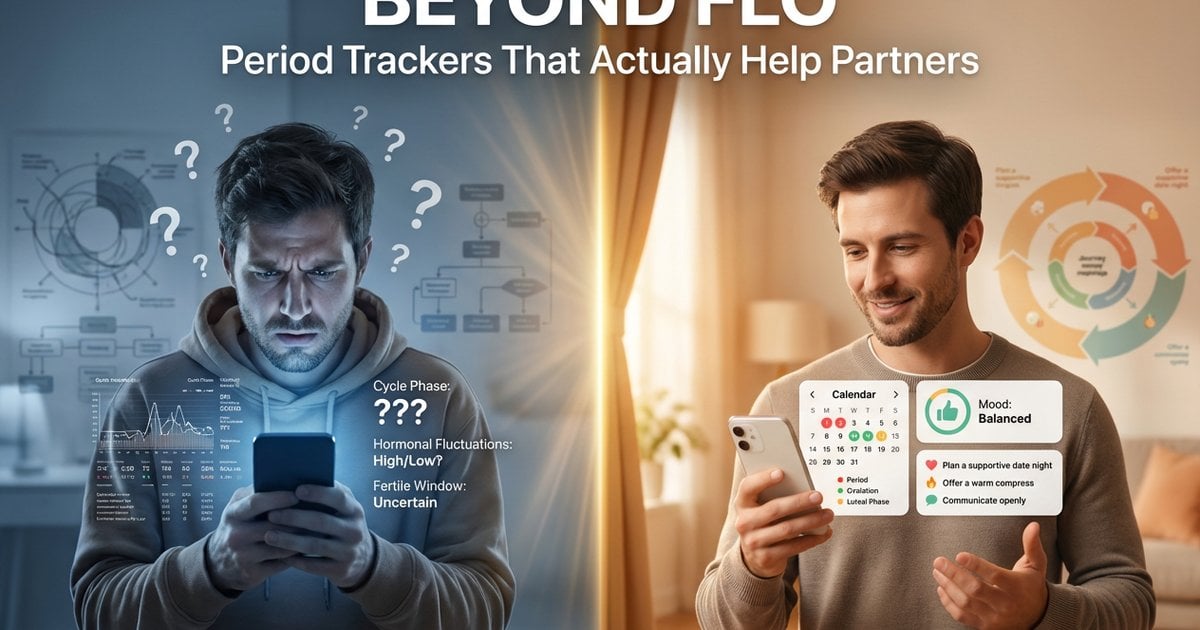
Tired of relationship landmines? Compare VibeCheck v Relatio to find the best relationship app for men. Discover the top Relatio alternative for clarity.
VibeCheck vs Relatio: Which Relationship App for Men Actually Works in 2026?
You've seen the ads. Your partner hinted you could "use some help." Or maybe you're just tired of stepping on conversational landmines once a month without understanding why. Welcome to 2026, where relationship apps for men have evolved from generic advice columns into what industry insiders call "Partner Intelligence" (PI) tools - tactical systems that promise to decode your partner's biological rhythms and make you a better boyfriend without requiring a psychology degree.
But here's the problem: VibeCheck and Relatio dominate the conversation, yet they solve completely different problems. One's a GPS for daily relationship navigation. The other's a bootcamp for long-term intimacy skills. Choosing the wrong one wastes money and leaves you exactly where you started - confused, reactive, and still in the doghouse.
This guide cuts through the marketing noise. You'll learn which app matches your actual needs, what the privacy-conscious alternative is, and why the question "VibeCheck or Relatio?" might be the wrong question entirely.
Table of Contents
- Why 2026 Changed Everything for Relationship Apps
- The Core Mission Comparison: GPS vs Bootcamp
- VibeCheck Deep Dive: The Tactical Cheat Code
- Relatio Deep Dive: The Intimacy Education Platform
- The Privacy Dark Horse: DuoSync
- Feature Comparison Matrix
- The Verdict: Who Should Buy What
- FAQ
Why 2026 Changed Everything for Relationship Apps
BLUF: Partner Intelligence (PI) apps emerged in 2026 as men demanded proactive AI assistance instead of reactive calendars, creating a market split between tactical support tools and skill-building platforms.
The relationship app market used to be simple: couples therapy apps like Paired required both partners to participate, or you tracked your partner's cycle in a shared calendar like a business meeting. Neither approach felt right. The former required her buy-in (and who wants to admit they need an app to communicate?). The latter reduced biological complexity to dates on a screen without context.
Then AI happened.
2026 brought three seismic shifts. First, men started searching for "what to do" rather than "when it happens." The question evolved from "When is her period?" to "What should I say on Day 14 versus Day 23?" Second, privacy concerns exploded. Men realized they were uploading their partner's intimate biological data to servers training AI models, often without her explicit knowledge. Third, the market fractured into two distinct categories: tactical support (tell me what to do today) versus skill development (teach me to be better long-term).
VibeCheck capitalized on the first trend. Relatio bet on the second. DuoSync addressed the third. Understanding this split determines which app actually helps you.
The "Supportive High-Achiever" - men aged 28-36 in committed relationships who love their partners but feel blindsided by monthly mood shifts - became the target demographic. These guys don't want therapy. They want data. They want a system. They want to stop feeling like they're guessing.
The Core Mission Comparison: GPS vs Bootcamp
BLUF: VibeCheck acts as relationship GPS providing daily navigation based on hormonal phases, while Relatio functions as intimacy bootcamp teaching long-term communication and performance skills through structured coursework.
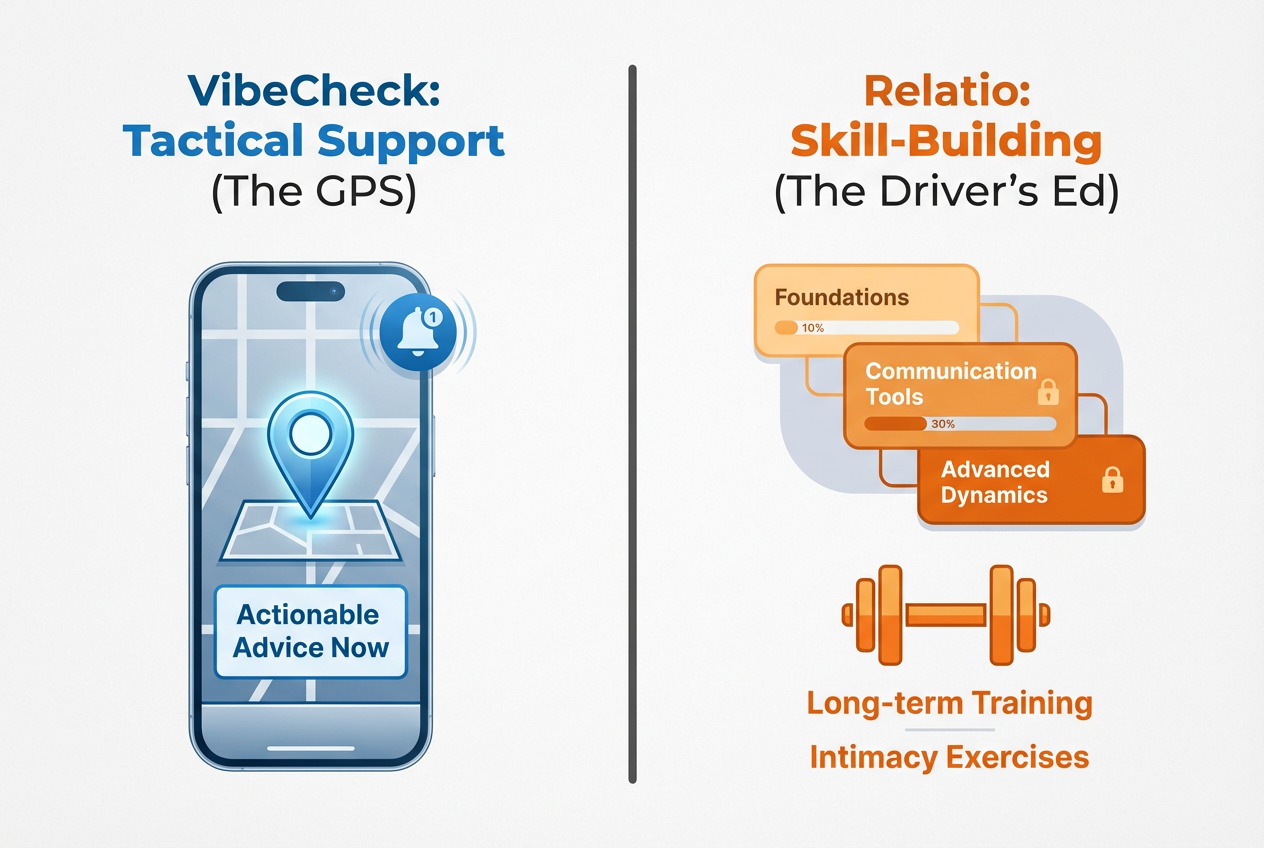
Think of it this way: if your relationship were a road trip, VibeCheck tells you which exit to take right now. "She's in her luteal phase - avoid heavy conversations tonight, suggest comfort food instead." It's prescriptive, immediate, and requires zero homework. You open the app, read the push notification, adjust your behavior. Done.
Relatio hands you a driver's manual and 150 practice exercises. "Here's a video on active listening. Now complete this couples' intimacy challenge. Track your progress over 12 weeks." It assumes the problem isn't today's argument - it's that you never learned the foundational skills. The focus skews toward physical intimacy, erectile dysfunction support, and Kegel exercises (which explains both its clinical reputation and its "scam" allegations on Reddit from users expecting relationship coaching but getting pelvic floor workouts).
The fundamental difference isn't quality. It's time horizon. VibeCheck optimizes this week. Relatio rebuilds your approach over months.
Most men don't realize they're shopping in two different categories. They see "relationship app" and assume all roads lead to the same destination. They don't. A GPS won't teach you to drive better. A driving school won't tell you which lane to be in right now. You need to know which problem you're solving.
If you're asking "Why did she get upset when I suggested takeout last night but loved it two weeks ago?" - you need VibeCheck. If you're asking "Why do we only have sex twice a month and how do I reconnect emotionally?" - Relatio might help. If you're asking "How do I support her without uploading her cycle data to the cloud?" - keep reading.
VibeCheck Deep Dive: The Tactical Cheat Code
BLUF: VibeCheck excels at converting cycle data into actionable daily missions without requiring partner participation, but costs $120/year and remains iOS-exclusive with unresolved privacy concerns about AI data usage.
Here's what makes VibeCheck genuinely different: your partner doesn't need the app. You input her cycle dates (manually or by asking once), and the AI generates daily relationship intelligence. "Follicular phase - she's energized and open to new activities. Suggest that hiking trip." "Late luteal - energy's low, irritability high. This isn't the weekend to invite your college friends over."
The interface looks like a fitness tracker had a baby with a relationship coach. You get:
- Push notifications with daily "missions" tied to her cycle phase
- AI-generated conversation starters appropriate for her hormonal state
- Conflict avoidance alerts ("High sensitivity window - postpone budget discussion")
- Intimacy timing suggestions based on testosterone and estrogen peaks
The "Boyfriend Mode" branding works because it acknowledges reality: most women don't want to manage another app or explain their cycle to their partner for the hundredth time. VibeCheck becomes the invisible support system. You look thoughtful and attentive. She doesn't know you're getting coached in real-time.
The Pros:
Independence matters. Unlike Paired or Flo for Partners, you don't need her to download anything, create an account, or remember to update data. You're the only user. That reduces friction and eliminates the "are you tracking me?" awkwardness. For men who want to provide proactive cycle support without making it transactional, this design choice is brilliant.
The AI genuinely learns. After two months, VibeCheck's suggestions become eerily accurate because it correlates your partner's unique cycle patterns with your reported relationship outcomes. "Last month you marked Day 19 as a great date night. Her estrogen was peaking. Want to try the same timing this month?"
Zero learning curve. You don't watch videos or complete exercises. You read three sentences and adjust your day accordingly. For time-starved professionals, this matters immensely.
The Cons:
The iOS-only limitation infuriates Android users. In 2026, platform exclusivity feels dated and arbitrary. The company promises an Android version "soon," but Reddit forums are full of complaints from men who switched to alternatives out of frustration.
Privacy is the elephant in the room. VibeCheck's terms of service acknowledge using anonymized data to train AI models. Your partner's cycle information - however anonymized - lives on someone else's server. For privacy-conscious users, this is a dealbreaker. The app doesn't offer local-only processing or offline modes.
The price ($9.99/month or $119.88/year) positions it as premium software, but there's no free tier to test functionality. You commit upfront based on marketing claims. Some users report the AI suggestions feel generic after the novelty wears off - less "reading her mind" and more "basic cycle knowledge presented as insight."
The "girlfriend doesn't need to know" angle, while practical, creates ethical ambiguity. You're tracking biological data about another person, even if you asked permission. Some partners feel uncomfortable when they discover they've been "analyzed" without ongoing consent. The app doesn't build in check-ins or partner notifications, leaving that entirely to user discretion.
Relatio Deep Dive: The Intimacy Education Platform
BLUF: Relatio prioritizes long-term intimacy reconstruction through 150+ educational exercises but suffers from subscription fatigue criticism and struggles with identity confusion between relationship coaching and sexual performance training.
Relatio came to market as the "clinical" option - therapist-approved exercises, medically accurate information, structured curriculum. It targets men experiencing relationship drift, declining physical intimacy, or recovering from breakups. The core promise: rebuild connection through deliberate practice rather than quick fixes.
The platform includes:
- Video courses on communication, conflict resolution, and emotional availability
- Intimacy challenges designed for couples to complete together
- Kegel and ED support modules (the source of its reputation problem)
- Progress tracking that gamifies relationship improvement
- Couples' calendar for shared activities and check-ins
The design philosophy assumes both partners participate, though it's technically usable solo. The app encourages you to invite your partner, share progress, and complete exercises together. This creates buy-in but also friction - if she's not interested in "relationship homework," the entire system stalls.
The Pros:
Educational depth sets Relatio apart. You're not getting daily tips - you're getting a structured curriculum. For men who recognize they lack fundamental relationship skills (active listening, non-defensive communication, expressing needs clearly), this approach builds competence rather than dependence. You learn the "why" behind the advice.
The intimacy modules address uncomfortable topics most men won't Google: performance anxiety, mismatched libidos, recovering from infidelity. The content is genuinely clinical, written by licensed therapists, which explains the higher price point ($14.99/month or $149.88/year).
Progress tracking appeals to data-driven personalities. You see completion percentages, milestone achievements, and relationship quality scores based on self-reported metrics. For the "Supportive High-Achiever" demographic, this gamification creates motivation.
The Cons:
The Kegel focus derailed Relatio's reputation. Early marketing emphasized erectile dysfunction and sexual performance over emotional connection, attracting users expecting a medical intervention. They found relationship exercises instead and flooded Reddit with "scam" complaints. The company has since rebalanced messaging, but the damage persists. Searching "Relatio review" returns skepticism before endorsement.
Time commitment becomes the silent killer. 150+ exercises sounds comprehensive until you realize each takes 15-45 minutes. Most couples abandon the program within six weeks because it feels like relationship homework stacked on top of already busy lives. The app doesn't adapt pacing to user engagement - it just keeps assigning modules.
The subscription model frustrates users. Unlike VibeCheck's straightforward annual fee, Relatio locks core features behind tiered pricing. The base subscription ($14.99/month) provides limited exercises. "Premium" ($24.99/month) unlocks the full curriculum and personalized coaching. Users report feeling nickel-and-dimed for content they assumed was included.
Partner participation remains the Achilles heel. If your girlfriend isn't interested, 70% of Relatio's features become inaccessible. The couples' challenges, shared calendar, and intimacy tracking all require her engagement. You can watch videos solo, but the platform's core value proposition - "reconnection through shared practice" - evaporates without buy-in.
Platform availability (iOS and Android) gives it an edge over VibeCheck, but the user interface feels dated compared to newer competitors. Navigation is clunky. Progress syncing occasionally fails. For $180-$300/year (depending on tier), users expect polish.
The Privacy Dark Horse: DuoSync
BLUF: DuoSync eliminates cloud storage by processing all cycle data locally on your device, offering comparable insights to VibeCheck at lower cost ($4.99/month) but with a less refined interface and smaller user community.
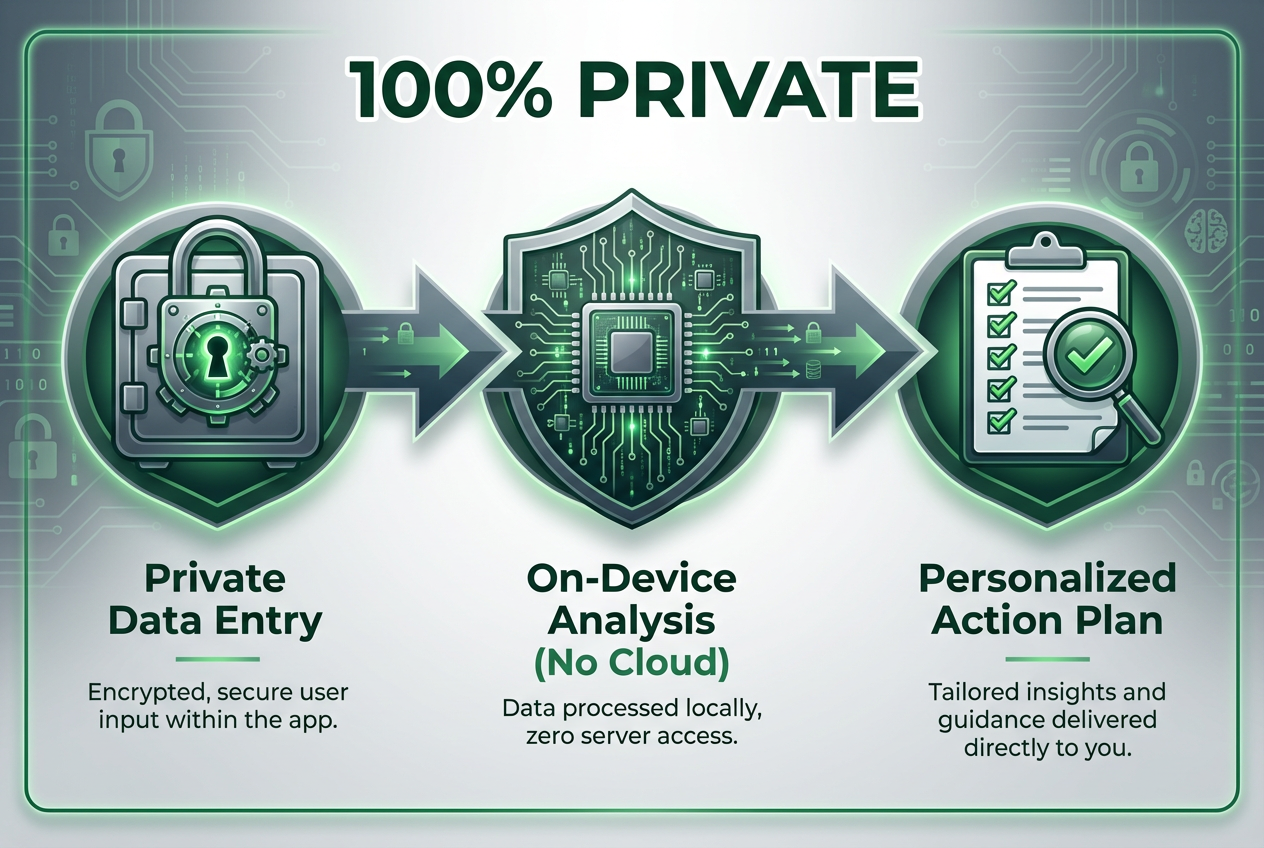
DuoSync emerged in late 2025 as the privacy-first response to concerns about AI-tracked biological data. The pitch is simple: "Same cycle intelligence as VibeCheck, zero cloud uploads, half the price."
Every calculation happens on your phone. Cycle predictions, phase analysis, even the relationship tips - all processed locally using on-device machine learning. Your partner's data never leaves your pocket. If you delete the app, the information vanishes completely. No servers. No anonymized datasets training corporate AI. No privacy policy fine print.
The feature set mirrors VibeCheck's core functionality:
- Phase-based daily insights tied to hormonal shifts
- Conflict timing suggestions (when to have tough conversations)
- Intimacy window predictions based on biological peaks
- Mood pattern tracking over multiple cycles
- Offline functionality (works during flights, camping, anywhere)
The app supports both iOS and Android from day one, fixing VibeCheck's platform problem. At $4.99/month or $49.99/year, it's less than half the cost of competitors while offering similar tactical value.
Why it matters for 2026:
Privacy isn't paranoia anymore. Data breaches, AI training transparency issues, and the commodification of personal information shifted consumer attitudes. Men increasingly ask: "Does an algorithm really need my partner's ovulation data?" DuoSync answers "no" without sacrificing functionality.
The "Invisible Support" model works identically to VibeCheck - your partner doesn't need the app or even know you're using it. You input cycle dates manually, and the local AI generates insights. The difference is trust. You can honestly say "nothing's uploaded" if she asks.
The tradeoffs:
The interface looks like it was designed by engineers, not UX specialists. It's functional but clunky. No sleek animations or polished coaching language. You get data and suggestions presented in straightforward text. For some users, this feels refreshingly honest. For others, it feels unfinished.
The AI is less sophisticated because it doesn't learn from millions of users' aggregated data like VibeCheck's cloud system. Your predictions improve over time based solely on your inputs, but they'll never benefit from pattern recognition across a massive dataset. Accuracy suffers slightly - maybe 85% versus VibeCheck's claimed 92%.
The community is smaller. Reddit forums for DuoSync exist but lack the robust discussion threads around VibeCheck. You're not finding "best practices" posts or shared success stories. The app is functional but lonely.
Feature development lags behind competitors. VibeCheck ships updates monthly. DuoSync releases quarterly patches. You're getting a mature, stable product but not cutting-edge AI improvements.
That said, for men who value privacy and want a trusted period tracker alternative that respects data sovereignty, DuoSync wins. It's the ethical choice that still delivers actionable relationship intelligence.
Feature Comparison Matrix
BLUF: VibeCheck leads on user experience and AI sophistication, Relatio offers unmatched educational depth, and DuoSync dominates privacy and affordability while requiring users to accept a less polished interface.
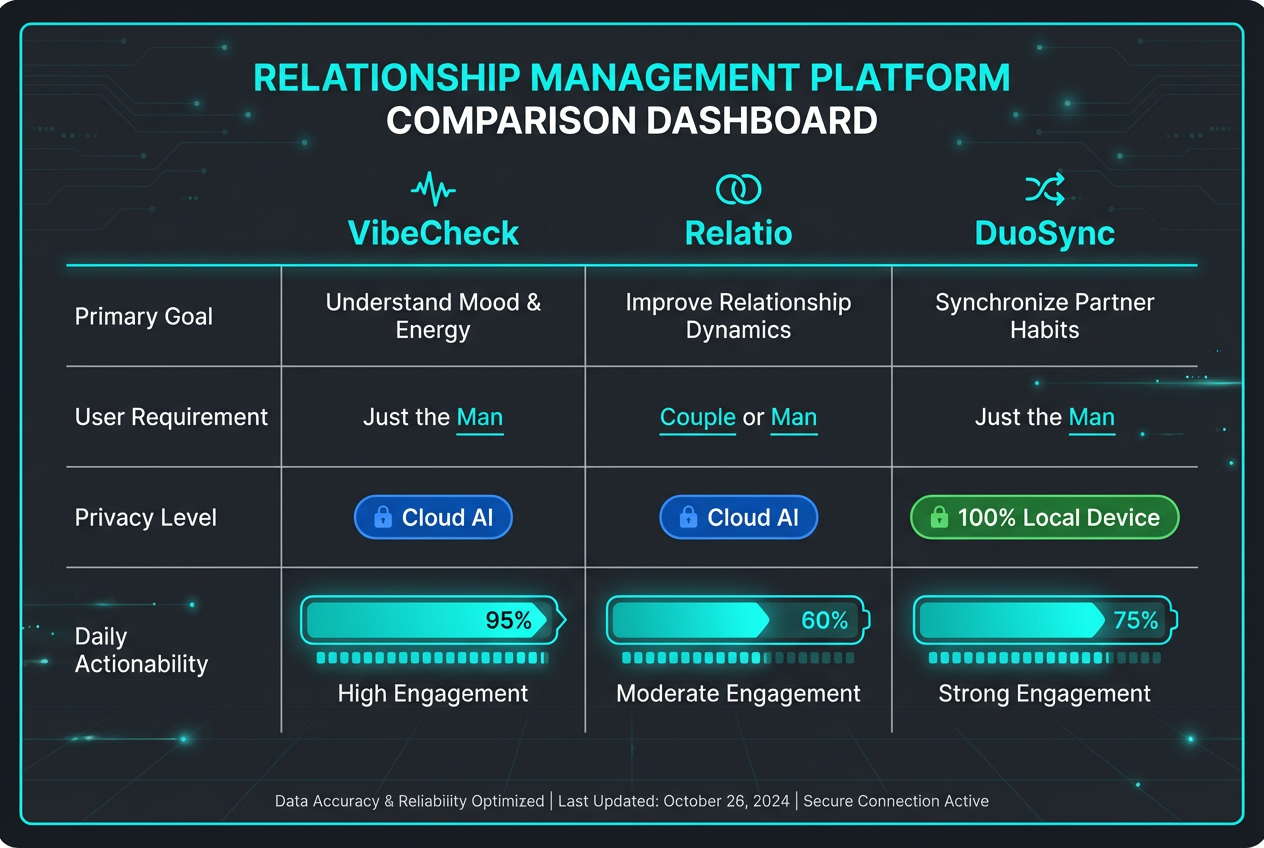
| Feature | VibeCheck | Relatio | DuoSync |
|---|---|---|---|
| Primary Goal | Daily tactical cycle support | Long-term intimacy education | Private cycle tracking with insights |
| Who Uses It | Just the man | Man or couple (works best together) | Just the man |
| Daily Value | AI push notifications with missions | Video courses and exercises | Phase-based insights and alerts |
| Intimacy Focus | Emotional timing and support | Performance, ED resources, Kegel training | Biological timing windows |
| Platform | iOS only | iOS and Android | iOS and Android |
| Privacy Level | Cloud storage with AI training | Cloud storage, account-based | 100% local device processing |
| Price | $9.99/month or $119.88/year | $14.99-$24.99/month or $149.88-$299.88/year | $4.99/month or $49.99/year |
| Partner Participation | Not required | Strongly encouraged | Not required |
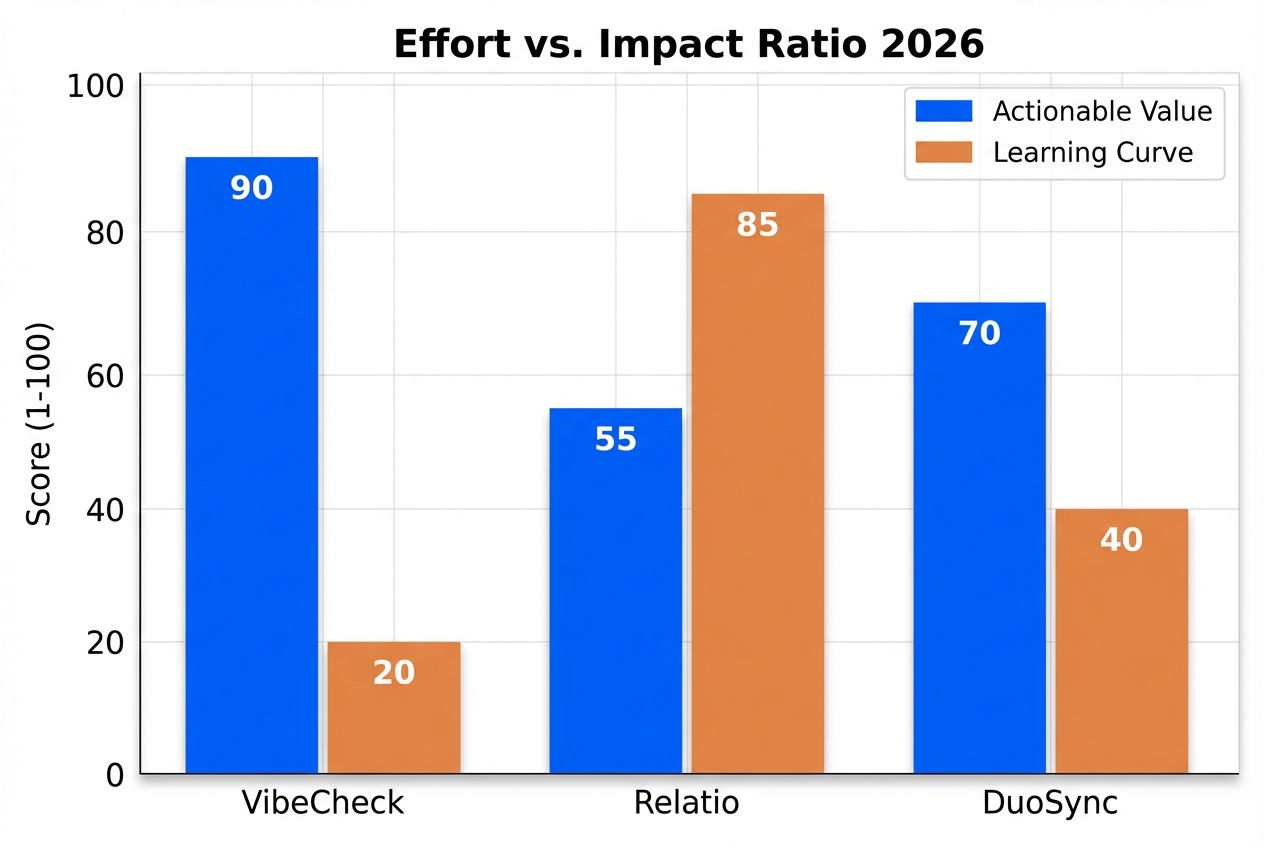
| Learning Curve | None - read and act | Moderate to high (coursework) | Low (data-focused interface) |
| Free Trial | No | 7-day trial | 14-day trial |
| Offline Mode | Limited (needs internet for AI) | No (streaming video) | Full offline functionality |
| Data Portability | Export basic reports | No export options | Full CSV export |
| Best For | Men wanting immediate actionable advice | Couples committed to structured improvement | Privacy-conscious users who want control |
The matrix reveals a clear pattern: choose based on your constraint. If you need Android support, Relatio or DuoSync. If privacy matters most, DuoSync. If you want zero learning curve, VibeCheck. If you're willing to invest serious time for deep change, Relatio.
Notice what's missing from all three: none offer direct partner integration without her active participation. VibeCheck and DuoSync work around this by making participation optional. Relatio assumes she's bought in. This explains why some men use multiple relationship tracking tools to cover different needs.
The Verdict: Who Should Buy What
BLUF: Choose VibeCheck for immediate tactical support with minimal effort, Relatio only if both partners commit to structured long-term work, or DuoSync when privacy and affordability outweigh interface polish.
Buy VibeCheck if:
- You own an iPhone and won't switch platforms
- You want daily coaching without watching videos or completing exercises
- Your partner is comfortable with you tracking her cycle for support purposes
- You're willing to pay premium pricing ($120/year) for convenience
- You don't have strong privacy concerns about cloud-based AI
- You want the "cheat code" approach - read a notification, adjust behavior, see results
VibeCheck dominates the 2026 market for good reason. It's the most polished, least demanding, highest-impact tool for men who want to support their partner better without becoming relationship experts. The iOS limitation is frustrating but doesn't negate the core value for existing Apple users.
Buy Relatio if:
- Your partner explicitly agrees to participate in structured relationship work
- You've identified specific skill deficits (communication, emotional availability, conflict resolution)
- You're comfortable investing 30+ minutes weekly in exercises for 3-6 months
- You need resources addressing sexual performance or physical intimacy issues
- You're recovering from relationship trauma (breakup, infidelity) and want guided reconstruction
- You value clinical credibility and therapist-approved content
Relatio isn't for casual users. It's for couples hitting a wall who recognize that quick tips won't fix foundational problems. The program works - user testimonials show genuine improvement - but only if both people commit. Buying Relatio alone and hoping she'll join later is a recipe for wasted money and frustration.
Buy DuoSync if:
- Privacy and data sovereignty are non-negotiable values
- You're on Android or want multi-platform flexibility
- You're comfortable with a functional-but-basic interface
- You want relationship intelligence at a fraction of competitors' cost ($50/year)
- You prefer offline functionality and local data storage
- You're willing to accept slightly lower AI accuracy for ethical peace of mind
DuoSync is the smart choice for technically savvy users who understand the privacy implications of cloud-based cycle tracking. It won't win design awards, but it delivers on its promise: comparable insights without the data extraction.
Don't buy any of these if:
- Your partner explicitly opposes cycle tracking (respect that boundary)
- You're looking for couples therapy or medical advice (these aren't replacements)
- You expect the app to "fix" your relationship without communication
- You're not willing to act on the information provided
The apps provide intelligence. You still need to execute. A GPS doesn't drive the car.
The hybrid approach:
Some men use VibeCheck or DuoSync for daily tactical support while working through Relatio's courses separately. This isn't crazy - it addresses both immediate needs (what to do today) and long-term growth (how to improve permanently). If budget allows, the combination accelerates results more than either tool alone.
For most users, though, start with one tool that matches your primary constraint. Master it for three months. Evaluate results. Then decide if adding a second layer makes sense. Trying to use all three simultaneously creates analysis paralysis and subscription fatigue.
The real competition isn't VibeCheck versus Relatio. It's active relationship investment versus passive hope that things improve on their own. Any of these tools beats scrolling Reddit relationship forums and hoping generic advice applies to your specific situation. The question isn't "which app is best universally" - it's "which app matches where I am right now?"
FAQ
What's the main difference between VibeCheck and Relatio?
VibeCheck provides daily tactical advice based on your partner's hormonal cycle phases without requiring her participation. You get push notifications telling you what to do today - suggest comfort food, postpone serious talks, plan date night. Relatio is an educational platform with 150+ video courses and exercises teaching long-term intimacy and communication skills, working best when both partners participate. Think GPS (VibeCheck) versus driving school (Relatio).
Do I need my partner's permission to use these apps?
Legally, you're tracking dates she's likely already shared with you, so there's no requirement. Ethically, it's more complex. VibeCheck and DuoSync work without her involvement, but many healthy relationships include a conversation: "I want to understand your cycle better to support you - would you be comfortable with me using an app for that?" Transparency prevents the "are you tracking me?" discomfort if she discovers the app later. Relatio explicitly encourages partner participation, so discussing it upfront is built into the model.
Can I use these apps if I'm on Android?
VibeCheck remains iOS-only as of 2026, frustrating Android users who want its features. Relatio and DuoSync both support Android and iOS. If platform flexibility matters, DuoSync offers the best privacy-focused alternative while Relatio provides the most educational depth. VibeCheck promises Android "eventually" but hasn't committed to a timeline.
Are these apps worth the subscription cost?
That depends on your relationship ROI calculation. VibeCheck at $120/year costs about $10/month to potentially avoid multiple arguments, improve intimacy timing, and increase your partner's feeling of being understood. Most users report the investment pays off in reduced friction within the first cycle. Relatio's $150-$300/year makes sense only if both partners commit to the coursework - otherwise you're paying for videos you won't finish. DuoSync at $50/year is the budget option providing 80% of VibeCheck's value at 40% of the cost.
What if my partner's cycle is irregular?
All three apps handle irregular cycles, but with varying effectiveness. VibeCheck's AI adapts predictions based on your partner's unique pattern history - after 2-3 months of data, it accounts for variability. Relatio focuses less on cycle prediction and more on general relationship skills, so irregularity matters less. DuoSync processes everything locally, so predictions improve only from your specific data inputs, not aggregate patterns. For highly irregular cycles (PCOS, perimenopause), consider supplementing app data with broader cycle understanding resources.
Can these apps help with long-distance relationships?
VibeCheck and DuoSync work identically for long-distance couples - you're getting daily insights about timing and communication strategies that apply regardless of physical proximity. Actually, some users report higher value in LDR contexts because limited interaction time makes "choosing the right moment" more critical. Relatio's couples exercises work long-distance if both partners commit to video calls for shared activities, but the platform isn't optimized for remote use - many exercises assume in-person presence.
What happens to my data if I cancel my subscription?
VibeCheck retains anonymized data for AI training per their terms of service but will delete your account data within 30 days of cancellation upon request. Relatio's policy is similar - account deletion removes personal information but may keep aggregated usage statistics. DuoSync's privacy advantage shines here: because everything processes locally, canceling the subscription and deleting the app removes all data immediately with no server-side retention. For privacy-focused users, DuoSync's local-only architecture eliminates the "what happens to my data" question entirely.
Do these apps replace actual relationship counseling?
No. These are tactical support tools and educational platforms, not clinical interventions. If you're facing serious issues (repeated infidelity, abuse, severe communication breakdown, mental health crises), you need licensed therapy, not an app. VibeCheck helps you time conversations better. Relatio teaches foundational skills. Neither replaces professional help when relationships face genuine trauma or dysfunction. Think of them as relationship vitamins - useful for general health, not treatment for serious illness.
Tags

Related Articles
Continue reading to deepen your understanding

Why Your Girlfriend Wants Different Kinds of Affection at Different Times in Her Cycle
Ever feel like your girlfriend’s needs change every week? It’s not random. Understand how the four phases of her cycle drive her desire for intimacy so you can support her better.

How to Plan Romantic Gestures by Cycle Timing: The Partner’s Tactical Guide
Stop guessing why your date night plans fell flat. This guide explains how to synchronize your romantic efforts with her biological cycle for better intimacy and connection.

How to Tell When Your Girlfriend Is Ovulating: Reading the Biological Signals Your Partner Sends
Understanding your partner’s cycle helps you anticipate her needs and time important conversations. Learn the behavioral signs of ovulation to improve your relationship and connection.

Understanding Your Girlfriend’s Words of Affirmation Cycle: A Partner’s Guide
Ever feel like your compliments land wrong? Her need for words of affirmation isn’t random—it follows a biological rhythm. Learn how to match your support to her internal hormonal seasons.

The Partner’s Guide to the Luteal Phase: What It Is and How to Support Her
Stop walking on eggshells. Understand the biological changes of the luteal phase so you can support your partner through mood shifts and fatigue with empathy.

How to Plan Valentine’s Day Around Your Girlfriend’s Cycle
Does your romantic plan clash with her biological rhythm? Learn how to adjust your date night to her specific cycle phase so she feels comfortable and truly cared for this year.

The Strategic Partner’s Guide to Planning an Engagement Around Her Cycle
Don’t leave your proposal to chance. Learn how her biological rhythm impacts emotional receptivity and how to align your big question with the phase where she feels her best.

How to Plan Weekend Trips Around Your Girlfriend’s Cycle: A Tactical Guide
Stop booking trips that end in friction. Learn how to map weekend travel to her biological phases to reduce friction by 41% and maximize your time together.