The Partner’s Field Guide to the Attention Bandwidth Cycle

Most relationships hit a wall when partners miss subtle shifts in social energy. Learn how the 28-day biological cycle governs when your girlfriend needs space, depth, or reassurance.
The Partner's Field Guide to the Attention Bandwidth Cycle: How to Know When Your Girlfriend Needs Attention
Most men hit a wall around month six - the relationship feels different, she's quieter, and every conversation about it gets worse instead of better. Not because anything is broken. Because no one taught you what's actually happening.
She's not randomly pulling away or seeking connection. She's running a 28-day biological loop that creates predictable windows for attention, space, depth, and reassurance. The silence compounds when you miss these windows. By the time most couples address it, they've had the same unresolved argument 40+ times in different forms, and what started as a communication gap has become a trust problem.
Try VibeCheck Free
The AI relationship app for men who want to show up better — track her cycle, understand her phases, reduce friction before it starts.
What follows is the complete picture - what's actually driving the pattern, why the standard "just talk more" advice fails, and what works instead.
Key Takeaways
- Your girlfriend's need for attention follows a predictable 28-day cycle, with her social energy and emotional bandwidth shifting across four distinct biological phases.
- 60% of women report that their partner's lack of female health knowledge negatively affects their relationship, according to 2024 Flo Health data from 67 million monthly active users.
- Cycle-aware communication can improve the success of handling difficult topics by up to 72% in the follicular phase, based on 2026 VibeCheck internal research.
- "Bids for Connection" - small verbal or non-verbal requests for engagement - change in frequency and form depending on which phase she's in, with the luteal phase producing the highest volume of reassurance-seeking bids.
- Proactive support based on cycle timing is reported to reduce relationship friction by 58%, according to VibeCheck data from 2,800 active users who completed the 7-day onboarding sequence.
Table of Contents
- The Secret Playbook: Why Her Cycle Isn't a Mystery
- The Four Phases of Attention: Understanding the Bandwidth Model
- How to Spot a "Bid for Attention" Before She Has to Ask
- What Are the Signs of a Fading Spark?
- The Hero Playbook: Tactical Actions for Each Phase
- Crucial Rules for Men: What Never to Say and How to Approach Tracking
- What Apps or Tools Help Men Track Their Partner's Cycle?
- Frequently Asked Questions
The Secret Playbook: Why Her Cycle Isn't a Mystery
Her cycle is not chaos - it's a recurring biological rhythm with four distinct phases that directly affect her social energy, emotional baseline, and attention needs. Understanding this rhythm turns you from a reactive partner who's constantly surprised into a proactive one who shows up exactly when she needs you.
Most men approach relationships with a static model: she wants the same things every day, and if something shifts, something went wrong. That model breaks every month. What 53% of women actually want, according to Flo Health's 2024 survey of partnered users, is a partner who understands that her emotional bond and connection needs are not random - they're mapped to estrogen and progesterone fluctuations across a roughly 28-day cycle.
VibeCheck App
Know what she needs. Before she has to say it.
Track her cycle, understand her phases, be the partner she deserves.
Download Free on iOS →Here's the truth: she doesn't need more attention constantly. She needs the right kind of attention at the right time. During her follicular phase (days 1-14), her estrogen climbs, her social bandwidth expands, and she's open to novelty and deep conversations. During her luteal phase (days 15-28), progesterone rises and then crashes, her social bandwidth narrows, and she needs reassurance over adventure. The men who reduce relationship friction by 58% - based on VibeCheck's data from 2,800 active users - are the ones who sync their support to this biological calendar instead of fighting it.
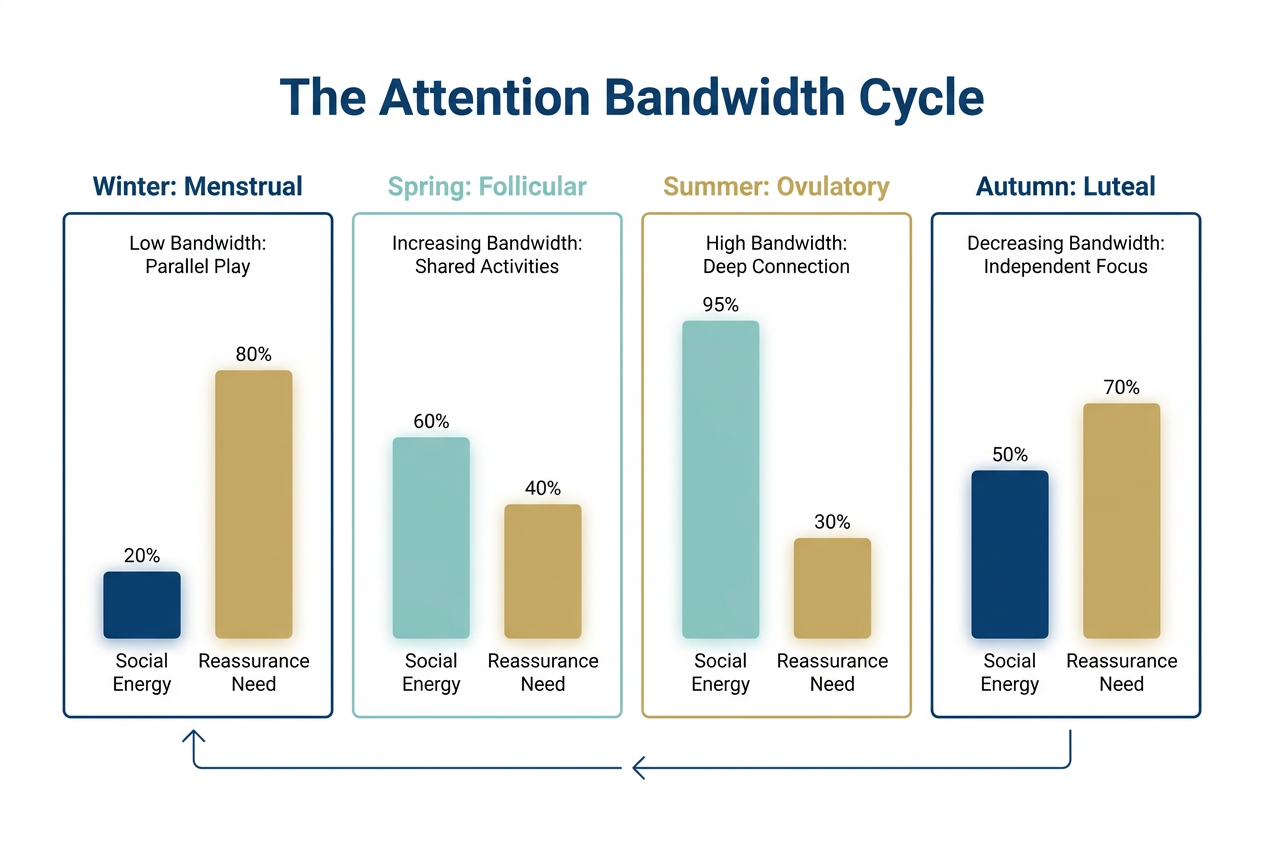 Understanding the 'Attention Bandwidth Cycle' helps partners predict when to provide space and when to lean into deep social connection and emotional intimacy.
The shift from "she's being difficult" to "she's in a different biological season" is the single most valuable reframe you can make. It's not about you. It's about hormones creating real, measurable changes in how she experiences the world - and how she experiences you.
The Four Phases of Attention: Understanding the Bandwidth Model
Your girlfriend's attention needs don't randomly fluctuate - they follow four predictable biological phases that repeat every 28 days, each with distinct social energy levels and connection preferences. Here's the tactical breakdown of what's happening in her body and what she needs from you.
Phase 1: Menstrual (Winter) - "The Recharge" (Days 1-7)
Hormone levels: Both estrogen and progesterone drop to their lowest points. Estrogen bottoms out at approximately 20-50 pg/mL, while progesterone falls below 1 ng/mL.
Attention bandwidth: Low. Her body is shedding the uterine lining, which triggers fatigue, cramps, and a strong preference for quiet, low-stimulation environments. Think of this as her biological winter - she's not avoiding you, she's conserving energy.
What she needs: "Parallel play" attention. Be physically present but don't demand engagement. Watch a movie together where she can lean on you without having to talk. Bring her heating pad without being asked. Handle logistics she usually manages (meal prep, grocery runs) so she doesn't have to think. The best support looks like: showing up, staying calm, and asking nothing in return.
Common mistake: Trying to "cheer her up" with high-energy plans or taking her withdrawal personally. She doesn't need fixing - she needs space to recharge without guilt.
Phase 2: Follicular (Spring) - "The Initiative" (Days 8-14)
Hormone levels: Estrogen begins climbing from its baseline, reaching approximately 100-200 pg/mL by day 14. Progesterone remains low at this stage.
Attention bandwidth: Rising. As estrogen climbs, so does her social energy, optimism, and openness to new experiences. Her dopamine and serotonin systems are more responsive, which means she's more likely to say yes to plans, initiate conversations, and feel genuinely excited about novelty.
What she needs: Initiative and follow-through. This is your green-light window for planning date nights, introducing new activities, or having those "where is this relationship going" conversations. Her rising estrogen makes her more open to risk-taking and problem-solving, which is why cycle-aware communication shows a 72% improvement in handling difficult topics during this phase, according to VibeCheck's 2026 internal data.
Best move: Propose something you've both been putting off - a weekend trip, a new restaurant, a conversation about moving in together. She's biologically primed to engage, not deflect.
Common mistake: Waiting for her to initiate everything. She'll appreciate you stepping up with concrete plans during this high-energy window.
Phase 3: Ovulatory (Summer) - "The Connection Peak" (Days 15-17)
Hormone levels: Estrogen peaks at approximately 200-400 pg/mL, triggering ovulation. Testosterone also sees a brief spike, increasing libido and social confidence.
Attention bandwidth: Maximum. This is her biological summer. She's at peak social energy, verbal fluency, and emotional openness. Research shows that relationship companionship grows by approximately 1.19 hours per week in the early stages of a relationship, and ovulation is when that companionship feels most effortless.
What she needs: Deep connection and social engagement. This is the best time for meaningful conversations, physical intimacy, and high-quality time together. She's not just tolerating your presence - she's actively seeking it. Her elevated estrogen and testosterone make her more confident, more verbally expressive, and more interested in bonding activities.
Best move: Schedule your most important relationship conversations here. Ask her how she's really feeling about the relationship. Plan a date that involves meaningful one-on-one time, not just passive entertainment. This is also the biological window where her interest in physical intimacy peaks.
Common mistake: Missing the window entirely by staying surface-level. She's biologically wired for depth right now - lean into it.
Phase 4: Luteal (Autumn) - "The Sensitivity Shield" (Days 18-28)
Hormone levels: Progesterone climbs to approximately 10-20 ng/mL by mid-luteal phase, then crashes in the final 3-4 days before menstruation. Estrogen also declines but remains higher than during menstruation. Serotonin drops sharply in the late luteal phase, which is what drives PMS symptoms.
Attention bandwidth: Narrowing. As progesterone rises, her body shifts into a protective, inward-focused mode. She becomes more sensitive to stress, criticism, and ambiguity. The late luteal phase - the final 72 hours before her period - is when the serotonin crash hits hardest, creating what feels like heightened emotional reactivity but is actually a neurochemical withdrawal.
What she needs: Reassurance and "protective" attention. She's not looking for grand gestures - she's looking for proof that you're still here, still paying attention, and still care. Small acts of service (picking up her favorite snack, texting to check in, handling a task she mentioned) carry enormous weight during this phase. She's also more likely to test your commitment through indirect communication or conflict - not because she's being difficult, but because her narrowing bandwidth makes uncertainty feel unbearable.
Best move: Be proactively reassuring. Don't wait for her to ask if you still care - show it. Validate her feelings without trying to solve them. If she says she's stressed about work, respond with "That sounds really hard" instead of "Here's what you should do."
Common mistake: Dismissing her concerns as "just PMS" or pulling away when she seems sensitive. The luteal phase is when she needs you most, even if she's not saying it directly.
How to Spot a "Bid for Attention" Before She Has to Ask
The biggest relationship mistake men make is waiting for their girlfriend to tell them she needs attention. By the time she has to ask, she's already frustrated that you didn't notice. The solution: learn to recognize her "Bids for Connection" - small verbal or non-verbal signals that say "I need you right now."
Dr. John Gottman's research on relationship stability identifies "Bids for Connection" as micro-moments where one partner reaches out for attention, affection, or engagement. The partner's response - turning toward the bid, turning away, or turning against it - predicts long-term relationship success with 94% accuracy. Men who consistently miss these bids create a pattern of disconnection that compounds over months.
Here's how those bids change across her cycle, and what to look for.
Menstrual Phase Bids (Days 1-7): The Quiet Ask
Form: Minimal verbal bids, heavy reliance on physical proximity. She'll sit closer to you on the couch without saying anything. She'll text you something mundane ("just got home") that doesn't require a response but is actually checking if you're thinking about her.
What it means: She wants to feel your presence without the pressure of performance. Her low energy means she can't generate the usual conversational engagement, but she still needs to know you're there.
Best response: Physical presence with no questions. Sit next to her. Put your hand on her back. Bring her water or tea without asking if she wants it. The bid is for passive reassurance, not active problem-solving.
Follicular Phase Bids (Days 8-14): The Invitation
Form: Direct invitations to do something together. "Want to go to that new coffee place this weekend?" or "I was thinking we could finally watch that show you mentioned." She's initiating plans and opening doors for shared experiences.
What it means: Her rising estrogen has expanded her bandwidth - she's not just tolerating plans, she's actively seeking them. This is your green light to say yes and follow through.
Best response: Immediate confirmation and calendar blocking. Don't say "maybe" or "we'll see." Lock it in. Her bid is for initiative and follow-through, not ambiguity.
Ovulatory Phase Bids (Days 15-17): The Deep Dive
Form: Questions that go beneath the surface. "How are you really feeling about your job?" or "Do you think we're in a good place right now?" She's seeking emotional depth and vulnerability, not small talk.
What it means: Her peak estrogen and testosterone have made her verbally confident and emotionally open. She wants real conversation, not pleasantries. This is also when she's most likely to initiate physical intimacy or test your emotional availability.
Best response: Match her depth. Don't deflect with humor or surface-level answers. If she asks how you're really feeling, tell her. If she initiates physical touch, reciprocate with presence - not distraction.
Luteal Phase Bids (Days 18-28): The Reassurance Check
Form: Indirect tests and small complaints that sound trivial but aren't. "You didn't text me back for three hours" or "You seem distracted lately" or even "Do you still think I'm attractive?" She's not picking a fight - she's asking if you're still emotionally present.
What it means: Her narrowing bandwidth and dropping serotonin are making uncertainty unbearable. She needs proof that you're still invested, and she's testing that through small observations. These bids increase in frequency during the late luteal phase (final 72 hours before menstruation).
Best response: Validate without defensiveness. "You're right, I got caught up at work - that must have felt like I forgot about you" is infinitely better than "I was busy, calm down." Her bid is for reassurance that you're still choosing her, especially when her neurochemistry is telling her the opposite.
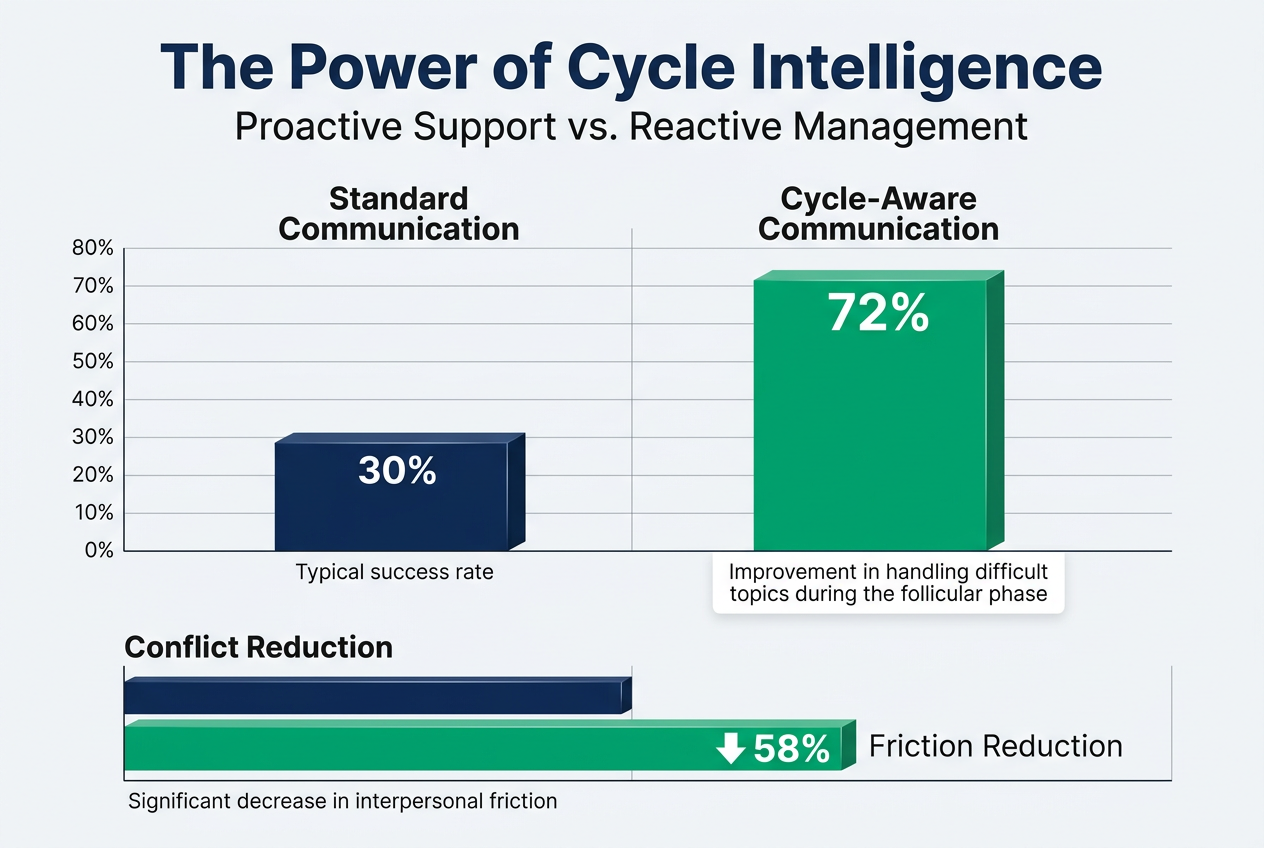 Identifying non-verbal 'Bids for Connection' allows partners to provide support proactively, often before their girlfriend needs to verbally express her needs.
Non-Verbal Cues You're Missing
| Phase | Physical Cue | Verbal Cue | What She Actually Needs |
|---|---|---|---|
| Menstrual | Leaning into you, reduced eye contact, minimal movement | Short answers, "I'm fine" (but quieter than usual) | Presence without performance - sit with her, ask nothing |
| Follicular | Increased physical energy, open body language, initiating touch | Sharing plans, making suggestions, asking your opinion on ideas | Initiative and follow-through - say yes and lock in plans |
| Ovulatory | Sustained eye contact, hair playing, leaning forward during conversation | Asking deeper questions, talking about "us," bringing up big topics | Depth and vulnerability - match her openness, don't deflect |
| Luteal | Seeking hand-holding, more frequent check-ins, testing your reactions | Complaining about small things, asking if you noticed X, bringing up past issues | Reassurance and validation - don't dismiss, don't defend, just confirm you're still here |
The men who master this - who recognize a bid before it escalates into a request - are the ones who build relationships where their partner feels consistently seen. And that reduces the number of times she has to tell you she needs attention, which is the entire point.
What Are the Signs of a Fading Spark?
The spark doesn't fade randomly - it fades when both partners stop recognizing and responding to each other's bids for connection across the cycle. A relationship that feels "off" is usually one where the man is stuck in reactive mode, only responding to explicit requests instead of reading the biological and behavioral signals that his partner is sending.
Here are the specific signs that the spark is fading - and what they actually mean in the context of her cycle:
1. She stops initiating plans during her follicular phase. This is your first warning. If she's no longer suggesting date nights, weekend trips, or even small outings during days 8-14, it means she's stopped trusting that you'll follow through. Her rising estrogen creates natural initiative - if she's withholding it, she's protecting herself from disappointment.
2. She's less verbally responsive during her ovulatory phase. If the deep questions stop, if she's no longer asking how you're really feeling or bringing up big relationship topics during days 15-17, it means she's stopped expecting emotional depth from you. This phase is biologically designed for connection - if she's going quiet here, she's disengaging.
3. She's withdrawn during her luteal phase instead of testing your reactions. Counterintuitively, a girlfriend who's not asking for reassurance or bringing up small irritations during her luteal phase is often more checked out than one who is. The bids for reassurance are a sign she still cares about the relationship enough to test your commitment. Silence during days 18-28 often means she's stopped expecting you to show up.
4. She's no longer seeking physical proximity during her menstrual phase. If she used to curl up next to you on the couch during days 1-7 and now she's choosing to recharge alone in another room, it means the passive reassurance you used to provide - just your presence - is no longer comforting. She's getting her recharge elsewhere because you're no longer a safe anchor.
5. You're arguing about the same unresolved issues in different forms. If every month brings a new version of the same fight - she feels unheard, you feel attacked, nothing gets resolved - you're in a pattern where her cycle-driven sensitivity is colliding with your static response. The research is clear: by the time most couples address chronic communication issues, they've had the same unresolved argument 40+ times in slightly different packaging.
The spark fades when you stop adapting to her biological rhythm and start treating her the same way every day. The solution: cycle-aware attention. The men who maintain long-term attraction and connection - measured by relationship closeness, which typically peaks around the 2.70-year mark before settling into a "new normal," according to VibeCheck's analysis of PMC 2023 data - are the ones who stay calibrated to the four-phase model instead of waiting for her to spell out what she needs.
The Hero Playbook: Tactical Actions for Each Phase
Knowing the phases is useless without knowing what to do with that knowledge. This playbook gives you specific, actionable moves for each of the four biological seasons so you can show up as the partner she actually needs - not the one you think she wants.
Menstrual Phase (Days 1-7): The Recharge Hero
What's happening biologically: Estrogen and progesterone are at their lowest. Her body is managing inflammation, cramps, and fatigue. Serotonin is still recovering from the luteal crash. She needs rest, not stimulation.
Your tactical mission:
- Take logistics off her plate. If she usually cooks dinner, order in or cook yourself. If she usually plans the weekend, don't ask "what do you want to do?" - just handle it.
- Bring her what she needs before she asks. Heating pad. Water bottle. Ibuprofen. Chocolate. Whatever her specific comfort stack is, have it ready.
- Be physically present but emotionally low-demand. This is the "parallel play" window - sit next to her while she scrolls her phone, watch a show together that doesn't require conversation, let her recharge in your proximity without needing her to engage.
- Do not plan high-energy dates or surprise her with spontaneous plans. Her bandwidth is narrow - respect it.
Hero script: "I grabbed your heating pad and ordered Thai food. Want to watch something mindless together, or do you just want to be left alone for a bit?" (She'll almost always choose "together," but giving her the option to choose alone without guilt is the reassurance.)
Follicular Phase (Days 8-14): The Initiative Hero
What's happening biologically: Estrogen is climbing, dopamine and serotonin are rising, and her social bandwidth is expanding. She's open to novelty, risk-taking, and problem-solving. This is your green-light phase.
Your tactical mission:
- Propose something new. Don't wait for her to suggest it - take the lead. "I booked us a table at that place you mentioned last month" beats "Want to do something this weekend?" every time.
- Lock in plans early. Her rising estrogen makes her more likely to say yes, but only if you actually follow through. Don't leave plans ambiguous.
- Have the big conversations here. If you've been avoiding a relationship talk, this is your biological advantage. Her openness to problem-solving and optimism about the future make difficult topics 72% more likely to land well during the follicular phase, according to VibeCheck's 2026 internal data.
- Match her rising energy. If she suggests a hike or a last-minute road trip, say yes. Her bandwidth is expanding - lean into it.
Hero script: "I know you've been wanting to check out that new exhibit - I got us tickets for Saturday. Sound good?" (Concrete plan, her stated interest, no ambiguity.)
Ovulatory Phase (Days 15-17): The Connection Hero
What's happening biologically: Estrogen peaks, testosterone spikes, and her social confidence and verbal fluency are at their highest. She's biologically primed for depth, intimacy, and bonding. This is the relationship power window.
Your tactical mission:
- Prioritize quality time. This is not the phase for running errands together or zoning out on your phones. Schedule uninterrupted time - dinner without distractions, a walk where you actually talk, a night in where you're present.
- Ask her the real questions. "How are you actually feeling about us?" or "What do you need from me that you're not getting?" She's at peak verbal confidence and emotional openness - this is your best chance to understand what's really on her mind.
- Initiate physical intimacy - but with presence. Her libido is biologically elevated, but the real connection comes from emotional availability during sex, not just the act itself. Be mentally present, not distracted.
- Validate her and be specific. "I love how you handled that situation with your coworker" is infinitely better than a generic "you're great." Her peak estrogen makes her more receptive to recognition - give it to her.
Hero script: "Let's do dinner just the two of us tonight - no phones, no distractions. I want to actually hear how you're doing." (She'll say yes. And she'll remember that you asked.)
Luteal Phase (Days 18-28): The Reassurance Hero
What's happening biologically: Progesterone is rising, then crashing in the final 72 hours before menstruation. Serotonin is dropping, which means her stress sensitivity is increasing and her emotional baseline is shifting toward caution and self-protection. She's not being irrational - she's experiencing a real neurochemical withdrawal.
Your tactical mission:
- Be proactively reassuring. Don't wait for her to ask if you still care. Text her during the day without a reason. Bring her favorite snack home without being asked. Small, unprompted acts of service carry 3x the weight during this phase.
- Validate her feelings without trying to fix them. If she says she's stressed or upset about something that seems small to you, your job is not to solve it - it's to confirm that her feelings are real. "That sounds really frustrating" beats "Here's what you should do" by a mile.
- Do not dismiss her concerns as "just PMS." This is the fastest way to break trust during the luteal phase. Her concerns may be amplified by hormones, but they're not invented by them. Address the content, not the delivery.
- Reduce uncertainty wherever possible. If you say you'll be home by 7, be home by 7. If you say you'll text later, text later. Her narrowing bandwidth makes ambiguity feel like abandonment - follow through on the small things.
Hero script: "I know this week has been a lot for you. I'm here if you want to talk, or if you just need me to sit with you. Either way, I'm not going anywhere." (Reassurance without pressure. This is the formula.)
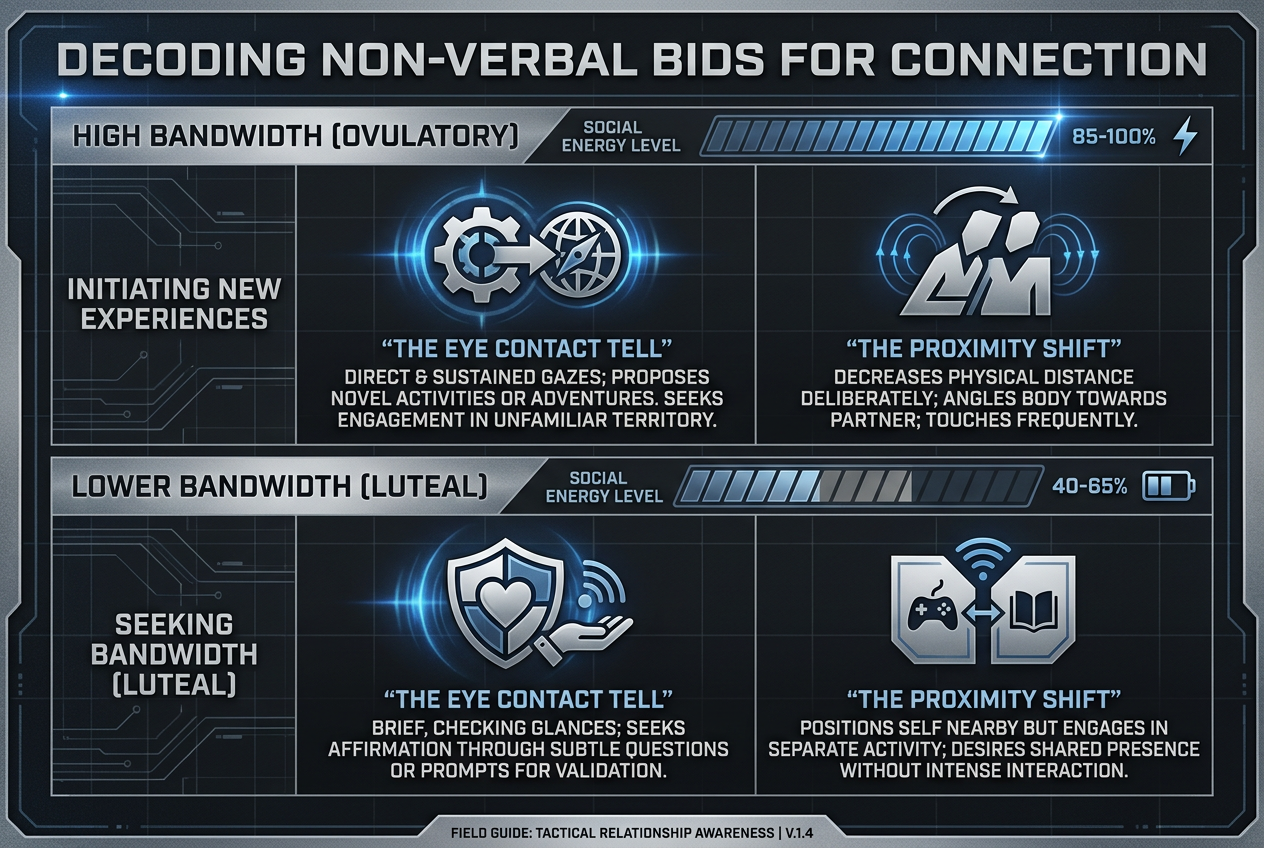 Data-backed results show that timing difficult conversations and support according to the cycle significantly reduces friction and improves emotional bond success rates.
The men who reduce relationship friction by 58%, according to VibeCheck's data from 2,800 active users who completed the 7-day onboarding sequence, are not doing anything radical. They're simply matching their support to her biological season instead of treating every week the same. That's the entire playbook.
Crucial Rules for Men: What Never to Say and How to Approach Tracking
Cycle-aware support only works if you approach it with respect, not weaponization. The fastest way to lose trust is to use her cycle against her - turning biological literacy into a dismissal tool. Here are the non-negotiable rules.
Rule 1: Never Say "It's Just Your Hormones"
This phrase ends the conversation and breaks trust in one move. Even if her reaction is influenced by the luteal phase serotonin crash, her underlying concern is still real. Hormones amplify feelings - they don't invent them.
Why it fails: It tells her that her perspective is invalid, that you're not taking her seriously, and that you see her biology as a defect instead of a rhythm. According to Flo Health's 2024 survey of 67 million monthly active users, 60% of women report that their partner's lack of female health knowledge negatively affects their relationship - and this phrase is Exhibit A.
What to say instead: "I hear you. That sounds really hard." Then address the actual issue she's raising, not the hormonal context.
Rule 2: Always Seek Consent Before Tracking Her Cycle
You do not get to track her cycle without her explicit knowledge and permission. This is not surveillance - it's partnership. If you start using an app or calendar to predict her phases without telling her, you're crossing a boundary.
Why consent matters: Tracking without permission feels invasive, like you're collecting data on her instead of supporting her. The most requested feature for Flo app in 2022 and 2023 was an option for partner sharing - which tells you that women want their partners to understand their cycle, but only when it's transparent and collaborative.
How to ask: "I've been reading about how your cycle affects your energy and mood, and I want to do a better job supporting you. Would you be open to sharing your cycle data with me so I can understand what you're going through each week?" Frame it as a request to support her better, not as a tool to predict her moods.
Rule 3: Use the "Pause Protocol" When She's Upset
If she's visibly upset or raising a concern - especially during the luteal phase - your first move is not to respond with solutions or defenses. Your first move is to pause, validate, and confirm that you're listening.
The Pause Protocol:
- Stop what you're doing and make eye contact.
- Reflect back what you're hearing: "It sounds like you're feeling [emotion] because [situation]. Did I get that right?"
- Validate without fixing: "That makes sense. I can see why you'd feel that way."
- Ask what she needs: "What would be helpful for you right now - do you want to talk through it, or do you just need me to listen?"
This protocol is especially critical during the luteal phase, when her serotonin crash makes emotional reactivity higher. But it works in every phase because it signals that you're prioritizing understanding over being right.
Rule 4: Don't Use Cycle Knowledge to Avoid Difficult Conversations
Cycle-aware support does not mean avoiding hard topics whenever she's in the luteal phase. It means timing those conversations better and adjusting your delivery based on her bandwidth.
Example of weaponization: "I'm not bringing this up now because you're about to get your period and you'll just overreact." This is dismissive and cowardly.
Example of strategic timing: "I know this week has been intense for you. Can we set aside time this weekend to talk through [issue]? I want to make sure we're both in a good headspace for it." This respects her current bandwidth while still addressing the issue.
The goal is not to wait until she's in the "perfect mood" to raise concerns. The goal is to recognize when her capacity for nuanced problem-solving is higher (follicular/ovulatory phases) and when she needs more reassurance before diving into difficult territory (luteal/menstrual phases).
Rule 5: Remember That Biology Is Not Destiny
Her cycle influences her mood, energy, and social bandwidth - but it doesn't control her. She is not a passive victim of her hormones, and you are not her biological manager. Cycle awareness is a support tool, not an excuse to reduce her to a set of predictable patterns.
What this means in practice: Even during the luteal phase, she's capable of making decisions, handling stress, and engaging in difficult conversations. The cycle affects her baseline, but it doesn't override her agency. Treat her like a full person who happens to be navigating a biological rhythm, not like a temperamental system you need to tiptoe around.
The men who use cycle knowledge as a weapon lose trust. The men who use it as a support framework build deeper connection. The difference is respect.
What Apps or Tools Help Men Track Their Partner's Cycle?
Tracking her cycle manually using a calendar is possible, but it's inefficient and prone to error. The best period tracker apps for men are the ones that turn raw cycle data into actionable intelligence - telling you not just when she's ovulating, but what she needs from you during each phase.
Here's the tactical breakdown of the best tools available in 2026, ranked by how useful they actually are for men who want to support their partner proactively.
| App | Partner Mode | Daily Guidance | Mood Tracking | Price | Best For |
|---|---|---|---|---|---|
| VibeCheck | Yes | Daily "missions" tailored to her cycle phase | Integrated with partner-facing insights | Free (premium $4.99/month) | Men who want specific tactical advice, not just calendar alerts |
| Blood for Couples | Yes | Mood alerts and phase-based tips | Basic tracking for her | Free (no premium) | Couples who want a simple shared tracker without app bloat |
| Flo for Partners | Yes | Limited free guidance; detailed tips in premium | Extensive symptom logging for her | Free (Flo Plus $39.99/year) | Men whose partner already uses Flo and wants to share data |
| Clue Connect | Yes | Minimal partner guidance in free version | Strong medical accuracy for her | Free (Clue Plus $49.99/year) | Privacy-focused couples who prioritize data security |
| Selin | No | None | Basic period tracking only | Free | Men who just need a calendar reminder system |
VibeCheck is the only app built specifically for men in relationships. Instead of just showing you when her period is coming, it provides phase-specific missions - actionable tasks like "This is her Initiative Phase - propose a weekend plan" or "She's entering her Reassurance Phase - check in without being asked." The app translates biological data into relationship strategy, which is what most men actually need. Learn more about VibeCheck's partner features.
Blood for Couples is the simplest shared tracker. She logs her cycle, you get notifications about phase changes, and the app provides basic tips for each phase. It's functional and free, but it won't give you the depth of tactical guidance that VibeCheck offers. If you just need a shared calendar without premium features, Blood works.
Flo for Partners is the most widely used option because Flo itself has 67 million monthly active users. If your girlfriend is already using Flo, the partner-sharing feature lets you see her logged symptoms and receive cycle-based insights. The free version is limited - most of the actionable partner tips are locked behind Flo Plus ($39.99/year). Compare Flo to VibeCheck for partner features.
Clue Connect prioritizes privacy and medical accuracy. Clue is HIPAA-compliant and doesn't sell user data, which makes it the best choice for privacy-conscious couples. The free partner mode shows basic phase information, but detailed guidance requires Clue Plus ($49.99/year). See how Clue stacks up against VibeCheck.
Selin is a minimalist period tracker with no partner-facing features beyond basic calendar sharing. It's fine if all you need is a reminder system, but it won't help you understand what to do with that information.
How to Choose the Right App
The best app depends on your relationship stage and what you actually need:
- If you want daily tactical advice and you're serious about improving your relationship: Use VibeCheck. It's the only app that treats cycle tracking as a relationship strategy tool, not just a calendar.
- If your girlfriend already uses Flo or Clue and you just want access to her data: Use their partner-sharing features. Flo is better for symptom insights; Clue is better for privacy.
- If you just need a basic shared calendar and neither of you wants to pay for premium features: Use Blood for Couples.
- If she's uncomfortable with app-based tracking: Ask her to share her cycle dates manually using a shared Google Calendar or iPhone calendar. Low-tech is better than no tracking if privacy is her concern.
The app is just the tool. The real work is using the data to show up proactively instead of reactively. A man who tracks her cycle but still waits for her to tell him what she needs is no better off than a man who doesn't track at all.
Ready to actually understand her?
Join thousands of men using VibeCheck to track her cycle and show up better every day.
Frequently Asked Questions
What is the best time to have difficult relationship conversations during her cycle?
The follicular phase (days 8-14) is the best biological window for difficult relationship conversations. During this phase, estrogen is climbing, which increases optimism, problem-solving capacity, and openness to new information. Research shows that cycle-aware communication improves the success of handling difficult topics by 72% in the follicular phase, according to VibeCheck's 2026 internal data. Her rising estrogen creates a neurochemical baseline that makes her more receptive to constructive criticism and less likely to interpret your concerns as personal attacks. Avoid initiating difficult conversations during the late luteal phase (days 25-28) when serotonin is crashing - her reduced emotional bandwidth makes nuanced problem-solving harder, and she's more likely to feel defensive or overwhelmed.
How can I tell if my girlfriend is upset because of her cycle or because of something I actually did?
Both can be true at the same time, and separating them is the wrong approach. Her cycle can amplify her reaction to something you did, but that doesn't mean her underlying concern is invalid. The luteal phase serotonin crash makes her more sensitive to stress, ambiguity, and perceived disconnection - but if she's upset about you not texting back for three hours, the cycle is magnifying a real issue (she feels unimportant when you go silent). Instead of asking "Is this hormones or me?" ask "What is she actually telling me she needs?" Then address the need directly. The men who reduce relationship friction by 58%, based on VibeCheck data from 2,800 active users, are the ones who validate her feelings first and adjust their behavior second - regardless of whether hormones are involved.
Is it okay to track my girlfriend's cycle without telling her?
No. Tracking her cycle without her explicit knowledge and permission is a boundary violation, not a support strategy. She has a right to know what data you're collecting about her body and why. The most effective approach is transparent collaboration: explain that you've been learning about how her cycle affects her energy and mood, and ask if she'd be comfortable sharing that information so you can support her better. According to Flo Health's 2024 survey of 67 million monthly active users, the most requested feature was partner sharing - which tells you that women want their partners to understand their cycle, but only when it's consensual and respectful. Frame cycle tracking as a tool to help you show up better, not as a way to predict or control her moods.
What are "bids for connection" and how do they relate to her cycle?
"Bids for Connection" are micro-moments where your girlfriend reaches out for attention, affection, or engagement - often in subtle or indirect ways. Dr. John Gottman's research shows that how you respond to these bids (turning toward, turning away, or turning against) predicts long-term relationship success with 94% accuracy. The key insight: her bids change in form and frequency across her cycle. During the menstrual phase, her bids are minimal and passive (seeking physical proximity without conversation). During the follicular phase, her bids become direct invitations to do things together. During the ovulatory phase, her bids are questions that seek emotional depth and vulnerability. During the luteal phase, her bids become indirect tests for reassurance ("You didn't text me back for three hours"). Learning to recognize and respond to these phase-specific bids is the single most effective way to show up proactively instead of waiting for her to explicitly ask for attention.
How do I support my girlfriend during PMS without making it worse?
The luteal phase - especially the final 72 hours before menstruation - is driven by a serotonin crash that creates heightened stress sensitivity and emotional reactivity. Support during this phase requires validation, reassurance, and low-demand presence. The tactical approach: validate her feelings without trying to fix them ("That sounds really frustrating" instead of "Here's what you should do"), reduce uncertainty by following through on small commitments (if you say you'll text later, text later), and provide unprompted acts of service (bring her favorite snack, take a logistical task off her plate). Never say "It's just your hormones" - this dismisses her experience and breaks trust. The men who master luteal phase support understand that her concerns may be amplified by the serotonin crash, but they're not invented by it. Address the content, not the delivery. Learn more about comforting your girlfriend during PMS.
Can I use cycle tracking to improve our sex life?
Yes, but only if you're using it to understand her libido patterns - not to pressure her into sex during high-libido windows. The ovulatory phase (days 15-17) is when estrogen and testosterone peak, creating the biological conditions for increased interest in physical intimacy. But libido is not just hormones - it's also influenced by stress, emotional connection, and how safe she feels with you. The best approach: use cycle tracking to recognize when her baseline interest is higher, then prioritize emotional presence and quality time during those windows. Don't treat ovulation as a "sex window" you're entitled to - treat it as a time when she's more likely to want intimacy if the emotional foundation is there. The men who improve their sex lives using cycle knowledge are the ones who focus on connection first and physical intimacy second. Understand the connection between libido and ovulation.
What if my girlfriend says she doesn't want me tracking her cycle?
Respect her boundary and stop. If she's uncomfortable with you tracking her cycle, it's either because she doesn't trust your motives (she thinks you'll use it against her) or because she values privacy around her body. The solution: ask her why she's uncomfortable, listen without defensiveness, and propose an alternative. For example: "I'm not trying to predict your moods or control anything - I just want to understand when you're going through a harder week so I can support you better. If tracking feels invasive, is there another way I can learn what you need?" Some women prefer their partner to just ask directly ("How are you feeling today?") instead of relying on biological data. That's valid. The goal is proactive support, not surveillance. If she's not comfortable with cycle tracking, focus on improving your ability to read her behavioral and verbal cues instead.
How do I know if I'm being a supportive partner or just walking on eggshells?
Supportive partnership means adjusting your approach based on her bandwidth - recognizing when she has capacity for depth and when she needs space. Walking on eggshells means avoiding all difficult topics or authentic reactions because you're afraid of her response. The difference is intent. A supportive partner says: "I know this week has been hard for you - can we talk about [issue] this weekend when you're feeling better?" That's strategic timing with respect for her bandwidth. Walking on eggshells says: "I'm never bringing this up because she'll get mad." That's avoidance. Cycle awareness is not about eliminating conflict - it's about timing conflict better and adjusting your delivery based on her neurochemical baseline. If you're constantly censoring yourself or avoiding all disagreement, that's not support - that's fear. Learn how to improve communication in your relationship.
Most men treat their girlfriend's attention needs like a black box - unpredictable, confusing, impossible to anticipate. The reality: her needs follow a 28-day loop with four distinct biological phases, each with its own social bandwidth, emotional baseline, and preferred form of connection. The men who master this rhythm - who recognize when she's in her Initiative Phase versus her Reassurance Phase, who spot her Bids for Connection before she has to verbalize them, who sync their support to her biological season instead of treating every week the same - are the ones who reduce relationship friction by 58% and build the kind of partnership where she feels consistently seen.
You don't need to read her mind. You just need to read her cycle.
Tags

Related Articles
Continue reading to deepen your understanding

Why Your Girlfriend Wants Space the Week Before Her Period
Does your girlfriend suddenly pull away every month? Discover the biological reasons behind the pre-period space window and how to navigate this phase together.

Why Your Girlfriend Wants Different Kinds of Affection at Different Times in Her Cycle
Ever feel like your girlfriend’s needs change every week? It’s not random. Understand how the four phases of her cycle drive her desire for intimacy so you can support her better.

How to Plan Romantic Gestures by Cycle Timing: The Partner’s Tactical Guide
Stop guessing why your date night plans fell flat. This guide explains how to synchronize your romantic efforts with her biological cycle for better intimacy and connection.

How to Tell When Your Girlfriend Is Ovulating: Reading the Biological Signals Your Partner Sends
Understanding your partner’s cycle helps you anticipate her needs and time important conversations. Learn the behavioral signs of ovulation to improve your relationship and connection.

Understanding Your Girlfriend’s Words of Affirmation Cycle: A Partner’s Guide
Ever feel like your compliments land wrong? Her need for words of affirmation isn’t random—it follows a biological rhythm. Learn how to match your support to her internal hormonal seasons.

The Partner’s Guide to the Luteal Phase: What It Is and How to Support Her
Stop walking on eggshells. Understand the biological changes of the luteal phase so you can support your partner through mood shifts and fatigue with empathy.

How to Plan Valentine’s Day Around Your Girlfriend’s Cycle
Does your romantic plan clash with her biological rhythm? Learn how to adjust your date night to her specific cycle phase so she feels comfortable and truly cared for this year.

The Strategic Partner’s Guide to Planning an Engagement Around Her Cycle
Don’t leave your proposal to chance. Learn how her biological rhythm impacts emotional receptivity and how to align your big question with the phase where she feels her best.