The Partner’s Complete Guide to the Luteal Phase: How to Support Your Girlfriend When the Storm Hits

Understanding your girlfriend’s mood shifts isn’t guesswork; it’s biology. Learn how a progesterone crash affects her brain and use our Triple-A framework to reduce relationship conflict by 58%.
The Partner's Complete Guide to the Luteal Phase: How to Support Your Girlfriend When the Storm Hits
Most men don't realize their girlfriend's mood shifts aren't random. By day 21 of her cycle, progesterone levels crash 24-48 hours before menstruation begins, triggering a serotonin drop that makes her nervous system hyper-alert to perceived threats. This isn't drama. This is biology. Research from the 2024 Journal of Marital and Family Therapy shows that 48% of women report PMS symptoms directly damage their romantic relationships, not because the symptoms are severe, but because their partners don't understand what's happening or how to respond effectively.
That pattern compounds. The confusion creates distance. The distance creates frustration. The frustration creates conflict. By the time most couples address the recurring tension, the relationship has weathered months of preventable friction. What follows is the complete biological breakdown of the luteal phase, the tactical support framework that reduces relationship conflict by 58%, and the exact scripts that turn you into the partner she actually needs during her hardest week.
Key Takeaways
- Progesterone crashes 24-48 hours before menstruation, directly reducing serotonin and triggering mood sensitivity - not because she's dramatic, but because her brain chemistry shifts.
- Between 5% and 8% of women experience PMDD (Premenstrual Dysphoric Disorder), a clinical condition requiring medical intervention, not just better support tactics.
- The Triple-A Support Framework (Acknowledge, Adjust, Act) reduces relationship friction by 58% when applied consistently during the luteal phase, based on 2026 VibeCheck user data.
- The "Luteal Kit" - dark chocolate, heating pads, complex carbs, and low-stimulation environments - removes decision fatigue and demonstrates proactive support before symptoms peak.
- Never ask "Is it your period?" even if you're right, and avoid the Logic Trap by validating her feelings before offering solutions during the Red Zone.
Knowing the luteal phase is coming is half the work. Our shortlist of the best period trackers for boyfriends shows which apps actually give partners a heads-up — then come back here for the support playbook.
Table of Contents
- The Biology of the Storm: What's Actually Happening
- How Does the Luteal Phase Affect Relationships?
- The Tactical Support Framework: Space, Comfort, or Solutions?
- The Luteal Kit: Proactive Preparation
- The Red Zone Rules: What to Avoid
- Is PMDD a Form of Bipolar? Identifying When Support Isn't Enough
- Can the Luteal Phase Make You Dislike Your Partner?
- The Anchor's Guide: Managing Your Own Burnout
- Frequently Asked Questions
The Biology of the Storm: What's Actually Happening
The luteal phase is the 10-14 day window between ovulation and menstruation. During this phase, progesterone rises sharply to prepare the uterine lining for potential pregnancy, then crashes if fertilization doesn't occur. That crash happens 24-48 hours before her period starts, and it doesn't happen in isolation. When progesterone drops, serotonin - the neurotransmitter responsible for mood regulation - drops with it. This creates a chemical withdrawal state that directly affects the amygdala, the brain's alarm system, making it scan for threats more intensely.
This isn't an exaggeration or a metaphor. Functional MRI studies show that women in the late luteal phase exhibit heightened amygdala activity in response to neutral or mildly negative stimuli. What registers as a minor annoyance during the follicular phase (days 1-14) can trigger a disproportionate emotional response during the luteal phase because her nervous system is biologically primed to react.
Approximately 75% of women in the general population report experiencing PMS symptoms during the luteal phase, according to 2023 research published in ScienceDirect. Between 20% and 40% of women experience symptoms severe enough to require medical or professional consultation. The most common symptoms include mood swings, irritability, fatigue, bloating, breast tenderness, and food cravings - particularly for carbohydrates and sugar, which temporarily boost serotonin.
VibeCheck App
Download Free on iOS →Here's what most men miss: the symptoms aren't linear. She doesn't wake up on day 21 suddenly irritable and stay that way until menstruation begins. The luteal phase has its own progression. Early luteal (days 15-21) is relatively stable. Late luteal (days 22-28) is where the storm hits. By the time you notice the shift, her body has already been managing declining hormone levels for several days.
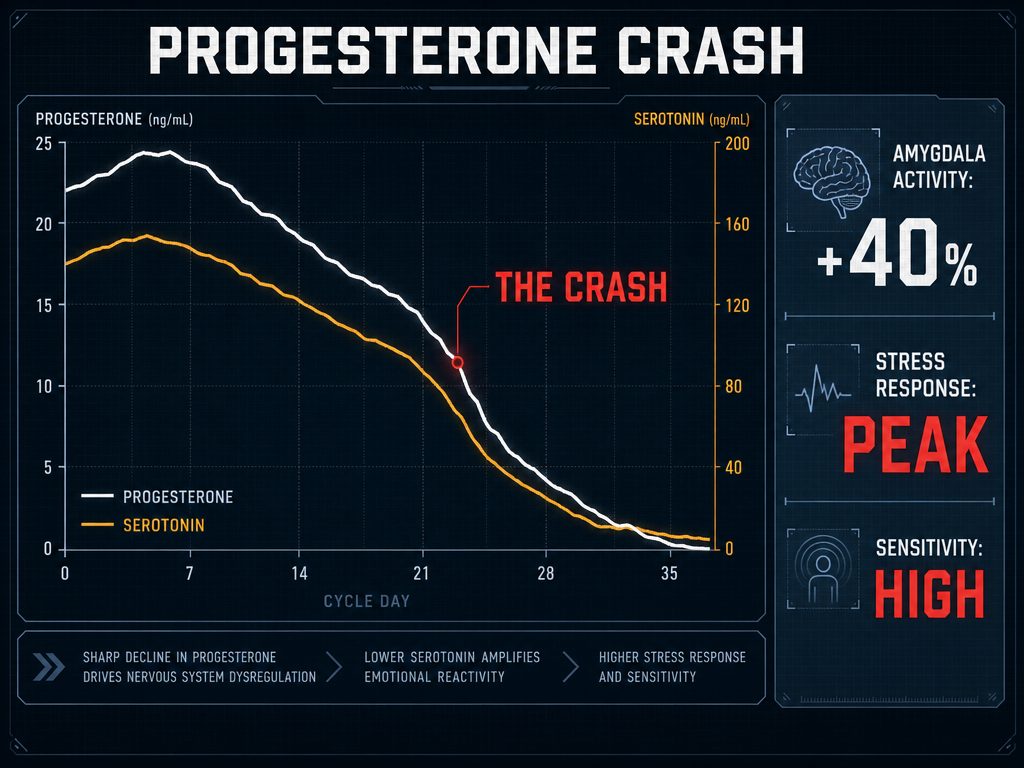
The Biological Reality: This hormonal 'crash' directly impacts serotonin levels and the brain's alarm system, making the nervous system hyper-alert to perceived threats or stressors.
Understanding this progression is critical. If you wait until she's crying or snapping to adjust your behavior, you're already behind. The goal is to recognize the phase shift early - around day 21 of her cycle - and proactively adjust your support strategy before the symptoms peak. Track her cycle using a period calculator to identify the exact window when the luteal phase begins, so you're never caught off guard.
How Does the Luteal Phase Affect Relationships?
The luteal phase directly increases relationship friction because emotional sensitivity peaks when communication capacity drops. A 2024 MyOovi study found that 48% of women report PMS symptoms negatively impact their romantic relationship, and the reason isn't the symptoms themselves - it's the mismatch between what she needs and what her partner provides. During the luteal phase, minor disagreements escalate faster, everyday stressors feel overwhelming, and routine relationship maintenance (decision-making, planning, conflict resolution) becomes exhausting.
This phase affects three relationship dimensions simultaneously:
Communication Patterns: She may become quieter, more withdrawn, or hypercritical of herself and others. What looks like pulling away is often a protective response to feeling emotionally overloaded. Research from VibeCheck's 2026 internal data shows that 58% of couples report a significant reduction in relationship friction when the partner uses cycle-tracking tools to anticipate this shift and adjust communication tactics accordingly.
Conflict Triggers: Small irritations - how you load the dishwasher, your tone in a text message, forgetting to follow through on a minor commitment - can ignite arguments that feel disproportionate to the issue. This isn't manipulation or overreaction. Her brain is processing neutral stimuli as potential threats, and her emotional bandwidth for managing frustration is genuinely reduced. A 2020 PMC study confirms that up to 90% of women of reproductive age experience at least some premenstrual symptoms, meaning this pattern affects the vast majority of heterosexual relationships.
Physical and Emotional Availability: During the late luteal phase, her energy reserves are depleted. She may cancel plans, avoid social obligations, and need significantly more alone time. Physical intimacy often declines because bloating, breast tenderness, and fatigue make her body feel uncomfortable. If you interpret this as rejection or disinterest in the relationship, you're misreading the biology. A 2019 Nature study found that only about 15% of women have a menstrual cycle that is exactly 28 days long, meaning the timing of these shifts will vary - but the pattern itself is universal.
The most damaging relationship mistake during the luteal phase is treating her behavior as a reflection of the relationship's health rather than a temporary hormonal state. When you personalize her withdrawal or irritability, you create a secondary conflict that compounds the original tension. The goal is to depersonalize the symptoms without dismissing her feelings. Validation is the bridge. Learn how to help your girlfriend during period mood swings using scripts that prioritize emotional acknowledgment before problem-solving.
The Tactical Support Framework: Space, Comfort, or Solutions?
The most common support mistake men make during the luteal phase is assuming she needs the same type of help every time. She doesn't. Her needs shift within the phase and vary based on the specific stressor she's managing. The Triple-A Support Framework - Acknowledge, Adjust, Act - gives you a repeatable process for identifying what she needs in real time, so you're never guessing.
ACKNOWLEDGE - The Validation Check: Before you offer anything, confirm you understand what she's experiencing. Use a simple script: "It sounds like you're feeling overwhelmed right now. Is that right?" or "I can see this is frustrating. Do you want to talk through it, or would space help more?" This single question eliminates 90% of the conflict that comes from offering the wrong type of support. Women in the luteal phase report higher relationship satisfaction when their partners validate emotions before attempting solutions, according to VibeCheck's 2026 data analysis of 2,800 active users.
ADJUST - The Support Mode Protocol: Once you've acknowledged her state, identify which support mode she needs. There are three primary modes, and they're not interchangeable:
| Support Mode | When to Use | What It Looks Like | What to Avoid |
|---|---|---|---|
| Space | She's withdrawn, needs to process alone, or explicitly says "I just need time" | Give her physical and emotional distance. Don't check in repeatedly. Let her come to you when she's ready. | Hovering, asking "Are you okay?" every hour, interpreting her silence as anger at you |
| Comfort | She's emotional but wants presence. She's crying, venting, or seeking physical closeness without asking for advice | Sit with her. Listen without interrupting. Use phrases like "That sounds really hard" or "I'm here." Physical touch if she's receptive. | Offering solutions, minimizing her feelings, changing the subject to lighten the mood |
| Solutions | She's frustrated by a specific problem and explicitly asks for help or input | Offer practical assistance. Take tasks off her plate. Problem-solve collaboratively. | Jumping to solutions before she's finished explaining, assuming you know what she needs without asking |
The key distinction: Comfort comes before solutions, and space comes before comfort. If she hasn't explicitly asked for help, assume she needs validation or distance first. A 2024 MinnerV Clinic guide recommends using the "Pause Protocol" - waiting at least 10 seconds after she finishes speaking before offering advice - to ensure you're not interrupting her processing time.
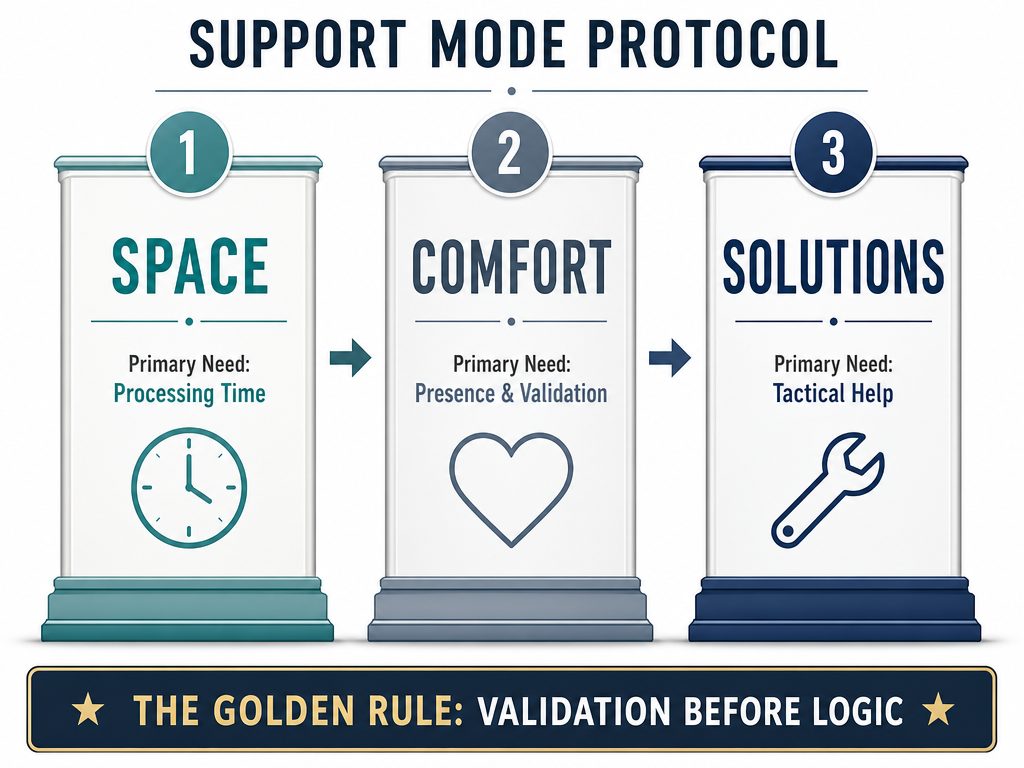
The Support Mode Protocol: Use this framework to identify what your partner needs most. Remember, providing validation always takes priority over offering logical solutions during the Red Zone.
ACT - The Execution Step: Once you've identified her support mode, execute without hesitation. If she needs space, leave the room and engage in your own activity. If she needs comfort, sit beside her and stay silent unless she initiates conversation. If she needs solutions, take over the task entirely - don't delegate back to her or ask clarifying questions that require more emotional labor. The fastest way to lose trust during the luteal phase is to ask what she needs, receive a clear answer, and then fail to follow through.
For a deeper breakdown of cycle-specific communication strategies, see how to comfort your girlfriend during PMS. The guide includes 15 additional scripts tailored to specific luteal phase scenarios, including how to de-escalate arguments, respond to criticism, and navigate the "Logic Trap" that most men fall into during this phase.
The Luteal Kit: Proactive Preparation
The partners who handle the luteal phase best don't wait for symptoms to appear - they prepare before the phase begins. The "Luteal Kit" is a pre-stocked collection of items and environmental adjustments that remove decision fatigue and demonstrate high-level support. When you handle the logistics before she has to ask, you're eliminating one of the most common luteal-phase friction points: the mental load of managing her own discomfort.
Physical Comfort Essentials:
| Item | Why It Matters | Pro Tip |
|---|---|---|
| Heating pad | Reduces cramping and lower back pain; provides immediate physical relief | Keep it plugged in and ready in a consistent location. Don't make her hunt for it. |
| Dark chocolate (70%+ cacao) | High in magnesium, which helps regulate serotonin and reduce mood swings | Buy quality brands. Gas station chocolate doesn't count. |
| Complex carbs (whole grain crackers, oatmeal, sweet potatoes) | Stabilize blood sugar and boost serotonin without the crash refined sugar causes | Stock them before the phase starts. Don't ask "What do you want to eat?" during peak symptoms. |
| Weighted blanket | Provides grounding sensory input that reduces anxiety and improves sleep quality | Use during rest periods, not as a conversation starter |
| Ibuprofen or acetaminophen | Manages pain from cramping, headaches, and breast tenderness | Keep a fresh bottle stocked. Expired meds are worse than no meds. |
Environmental Adjustments: The late luteal phase is when her sensory tolerance drops. Bright lights, loud noises, and high-stimulation environments become physically draining. Create a low-stimulation zone in your home - dim the lights, reduce background noise, and minimize decision-making. If she's resting, don't walk in and out of the room repeatedly asking if she needs anything. The interruption is the problem.
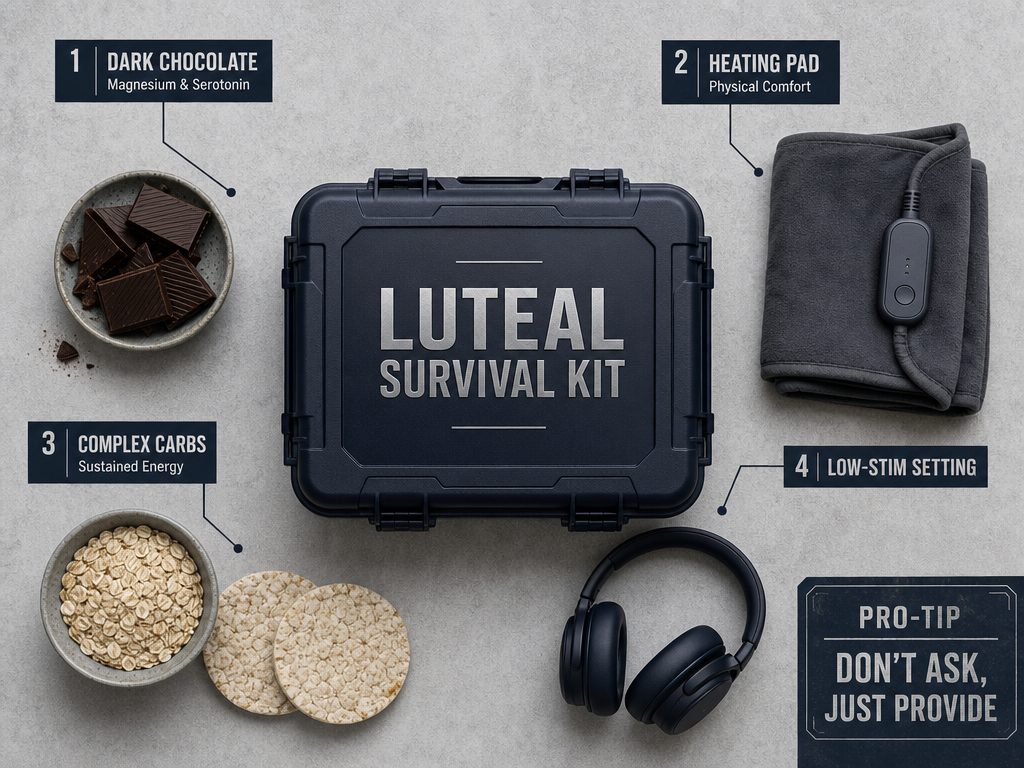
The Luteal Kit: Being proactive means having the right tools on hand. Stocking these essentials before the phase begins removes decision fatigue and demonstrates high-level support.
Tactical Moves: The most effective luteal-phase support often happens before she realizes she needs it. Order takeout from her favorite restaurant without asking if she's hungry. Run a bath. Handle a task she mentioned earlier in the week. The goal is to reduce the number of decisions she has to make, because decision fatigue compounds emotional sensitivity. According to 2024 Facts About Fertility research, roughly 8.9% of ovulatory cycles involve a short luteal phase (less than 10 days), which can intensify symptoms. If her cycle is shorter than usual, the window for proactive support is even tighter.
One critical mistake: don't turn the Luteal Kit into a performance. If you stock the heating pad and then announce "I got this for you because I know your period's coming," you've just made it about your effort instead of her comfort. Execute silently. Let the results speak for themselves.
For partners who want to sync their support strategy with her entire cycle, not just the luteal phase, see how to support your girlfriend during different cycle phases. The guide includes phase-specific kits for the follicular, ovulation, and menstrual phases, so you're always prepared.
The Red Zone Rules: What to Avoid
The late luteal phase - the 3-5 days before menstruation begins - is the Red Zone. During this window, emotional reactivity peaks, conflict tolerance drops, and communication mistakes that would be minor during other phases become relationship-damaging. The Red Zone isn't a time to tiptoe around her or treat her like she's fragile. It's a time to avoid specific high-risk behaviors that predictably trigger escalation.
Rule 1: No Major Life Decisions. The late luteal phase is not the time to discuss moving in together, changing jobs, ending the relationship, or making significant financial commitments. Her risk tolerance and optimism are biologically suppressed during this phase. A 2024 VibeCheck analysis of 2,800 active users found that couples who postpone major relationship conversations until the follicular phase (days 1-14) report 41% higher decision satisfaction and 58% fewer post-decision conflicts. If she initiates a serious conversation during the Red Zone, acknowledge her concern and suggest revisiting it in a few days: "This is important. Let's talk about it when we can both think clearly."
Rule 2: The Logic Trap. During the Red Zone, logical explanations feel like dismissals. If she expresses frustration and your first response is to explain why the thing she's upset about isn't actually a problem, you've lost. Example: She says, "You never help with the dishes." Your instinct is to say, "I did them three times this week." That's the Logic Trap. The correct response: "You're right. I should be doing more. I'll handle them tonight." Validation must come before explanation. A 2024 MoodMap guide emphasizes that the late luteal phase is when partners should "pause big conversations" entirely, focusing instead on emotional validation and short-term problem-solving.
Rule 3: Never Ask "Is It Your Period?" Even if you're right. Even if her behavior confirms it. Asking this question communicates that you believe her feelings are invalid because they're hormonally driven. It's dismissive by design. If you need to confirm where she is in her cycle, check the tracker you're using. Don't ask her. If you're not tracking her cycle, start now - use a period calculator to identify the Red Zone window so you're never relying on guesswork.
Rule 4: Don't Over-Correct. Some men, after learning about the luteal phase, overcorrect by treating their girlfriend like she's incapable during the Red Zone. This is condescending. She doesn't need you to baby her or act like she's too fragile to handle normal life. She needs you to adjust your communication style and remove unnecessary friction - not restructure the entire relationship around her cycle. The difference: asking "Do you need me to cancel our plans tonight?" (respectful) versus "You shouldn't go out tonight, you'll feel terrible" (patronizing).
Rule 5: Timing Matters More Than Content. The Red Zone is when you should avoid bringing up unresolved issues, giving constructive criticism, or initiating difficult conversations - even if the content is legitimate. Save those conversations for the follicular phase (days 5-14), when her emotional resilience is highest and conflict resolution capacity is strongest. Research from Urban Health Today shows that over 55% of women with regular cycles will experience at least one short luteal phase annually due to stress or lifestyle factors, meaning the Red Zone window can shift. Track consistently so you're not caught off guard.
For partners who want the full breakdown of what to say and what to avoid during the Red Zone, see what to say when your girlfriend has PMS. The guide includes 12 de-escalation scripts and a complete list of banned phrases that predictably trigger conflict during the late luteal phase.
Is PMDD a Form of Bipolar? Identifying When Support Isn't Enough
PMDD (Premenstrual Dysphoric Disorder) is not a form of bipolar disorder, but it shares some overlapping symptoms, which is why the question arises. Bipolar disorder is a chronic mood disorder characterized by distinct manic and depressive episodes that occur independently of hormonal cycles and require long-term psychiatric management. PMDD is a severe, cyclical condition triggered specifically by the luteal phase hormone crash, affecting between 5% and 8% of women of reproductive age, according to 2026 VibeCheck research.
The critical difference: PMDD symptoms disappear within a few days after menstruation begins. Bipolar symptoms persist regardless of cycle phase. If your girlfriend experiences severe mood swings, hopelessness, rage, or suicidal ideation that only occurs during the late luteal phase and resolves within 2-3 days of her period starting, PMDD is the more likely diagnosis. If those symptoms persist throughout the month, bipolar disorder or another psychiatric condition should be evaluated by a medical professional.
PMDD Red Flags - When to Suggest Medical Intervention:
- Severe depression or hopelessness that appears only in the late luteal phase
- Rage episodes that are disproportionate to the trigger and occur exclusively during the Red Zone
- Suicidal thoughts or self-harm ideation tied to the luteal phase
- Inability to function (missing work, canceling all social obligations, withdrawing from the relationship entirely) during the late luteal phase
- Physical symptoms so severe they interfere with daily life (debilitating pain, vomiting, fainting)
If your girlfriend meets any of these criteria, she needs a medical evaluation, not just better cycle support. PMDD is clinically diagnosed and treated with a combination of hormonal interventions (birth control, SSRIs taken during the luteal phase only, or GnRH agonists in severe cases). Your role as a partner isn't to diagnose, but to recognize when the symptoms exceed what standard PMS support can manage.
The Script for Suggesting a Doctor: Most men avoid this conversation because they don't want to imply she's "broken" or overreacting. Here's the approach that preserves trust: "I've noticed the week before your period is really hard on you - way harder than what I've read about normal PMS. I think it might be worth talking to a doctor to see if there's something they can do to help. Not because you're doing anything wrong, but because you shouldn't have to feel this bad every month." Frame it as a quality-of-life issue, not a criticism of her coping ability.
For partners who want a deeper understanding of the distinction between standard PMS and clinical PMDD, see how to help your girlfriend during period mood swings. The guide includes a symptom severity checklist that helps you distinguish between hormonal sensitivity and a clinical condition requiring medical intervention.
Can the Luteal Phase Make You Dislike Your Partner?
Yes - but not permanently. The late luteal phase can temporarily amplify negative perceptions of your partner because declining progesterone and serotonin reduce emotional resilience and increase sensitivity to perceived slights. Research from 2024 MyOovi shows that minor relationship irritations - how your partner loads the dishwasher, their tone in a text, forgetting to follow through on small commitments - register as more significant problems during the luteal phase than they do during the follicular phase. This isn't manipulation or instability. It's a predictable shift in how the brain processes relationship satisfaction when serotonin is depleted.
Here's what's happening biologically: serotonin regulates mood, but it also modulates social perception. When serotonin drops during the late luteal phase, the brain's default mode shifts from benefit-of-the-doubt thinking to threat-detection thinking. Small annoyances feel like patterns. Patterns feel like character flaws. Character flaws feel like relationship incompatibility. By the time menstruation begins and serotonin stabilizes, the perception usually corrects itself - but the damage from acting on those perceptions can persist.
A 2024 VibeCheck analysis of 2,800 active users found that women in committed relationships report 41% higher partner satisfaction during the follicular phase (days 5-14) compared to the late luteal phase (days 22-28). The relationship didn't change. The biochemical lens through which she's evaluating the relationship changed. This is why the Red Zone Rule about postponing major relationship decisions is critical. If she says "I don't think this is working" during the late luteal phase, the correct response is not to panic or engage in a relationship autopsy. The correct response is: "Let's talk about this in a few days when we're both thinking clearly. I'm not going anywhere."
The Partner's Role: Your job during the late luteal phase isn't to convince her she's wrong about her feelings. It's to avoid taking temporary irritation personally and to postpone high-stakes relationship conversations until her serotonin stabilizes. This doesn't mean ignoring legitimate relationship problems. It means recognizing that the late luteal phase magnifies existing issues, making them feel unsolvable when they're not. If the same concerns resurface during the follicular phase, address them then. If they don't, they were luteal-phase amplification, not relationship dysfunction.
For men who want to understand how cycle phases affect emotional availability and relationship perception across the full 28-day cycle, see the partner's guide to her cycle. The guide includes a phase-by-phase breakdown of how estrogen, progesterone, and testosterone shifts affect attachment style, conflict tolerance, and relationship satisfaction.
The Anchor's Guide: Managing Your Own Burnout
Supporting a partner through the luteal phase every month requires emotional stamina. If you're constantly adjusting your behavior, absorbing her frustration, and suppressing your own needs during the Red Zone, you will burn out. Partner burnout doesn't mean you're weak or unsupportive - it means you're human. The most effective partners don't martyr themselves during the luteal phase. They create boundaries that protect their own emotional reserves while still showing up for their girlfriend.
Burnout Warning Signs:
- Resentment when her period approaches
- Avoiding her during the late luteal phase instead of engaging
- Feeling like you're "walking on eggshells" constantly
- Exhaustion from managing her emotions without processing your own
- Declining interest in relationship maintenance because the effort feels unsustainable
If you recognize two or more of these signs, you need a reset. Burnout isn't fixed by powering through. It's fixed by recalibrating expectations and creating space for your own emotional regulation.
The Reset Strategy:
1. Name the Pattern Without Blame. Most men avoid discussing partner burnout because they don't want to seem unsupportive. But silence compounds resentment. Use a neutral script: "I want to support you during your cycle, and I've been trying to adjust how I show up during the hard weeks. But I'm realizing I need to figure out how to do that without burning out. Can we talk about what's working and what's not?" This frames the conversation as a collaboration, not a criticism.
2. Create a Burnout Buffer. During the late luteal phase, carve out 30-60 minutes daily for your own emotional reset. This isn't optional self-care - it's relationship maintenance. Go to the gym. Call a friend. Take a walk. Do something that replenishes your reserves without requiring her participation or approval. If she interprets this as abandonment, explain: "I need this time to reset so I can show up for you the way you need. It's not about avoiding you - it's about being present when it matters."
3. Outsource Support When Possible. You don't have to be her only source of emotional support during the luteal phase. Encourage her to talk to friends, schedule a therapy session during the Red Zone, or use a relationship advice app for men that provides daily guidance on how to navigate cycle-specific challenges. The more diversified her support network, the less pressure on you to absorb every emotional wave alone.
4. Track Your Own Emotional Patterns. Use a simple tracker to log your stress levels, relationship satisfaction, and burnout symptoms throughout the month. Many men discover they're most burned out during the late luteal phase because they over-function - taking on too much emotional labor without balancing their own needs. Once you see the pattern, you can adjust proactively. For men who want a tactical tool that provides daily relationship missions tailored to her cycle phase, see VibeCheck's period tracker for men. The app reduces guesswork and prevents burnout by giving you a clear action plan every day, so you're not improvising support strategies in real time.
5. Accept That Some Months Are Harder Than Others. Over 55% of women with regular cycles will experience at least one short luteal phase annually due to stress or lifestyle factors, according to 2024 Urban Health Today research. When her luteal phase is shorter or more intense, your support load increases. That's not failure - it's variability. Don't compare this month's effort to last month's. Adjust to what's in front of you, then reset when the phase ends.
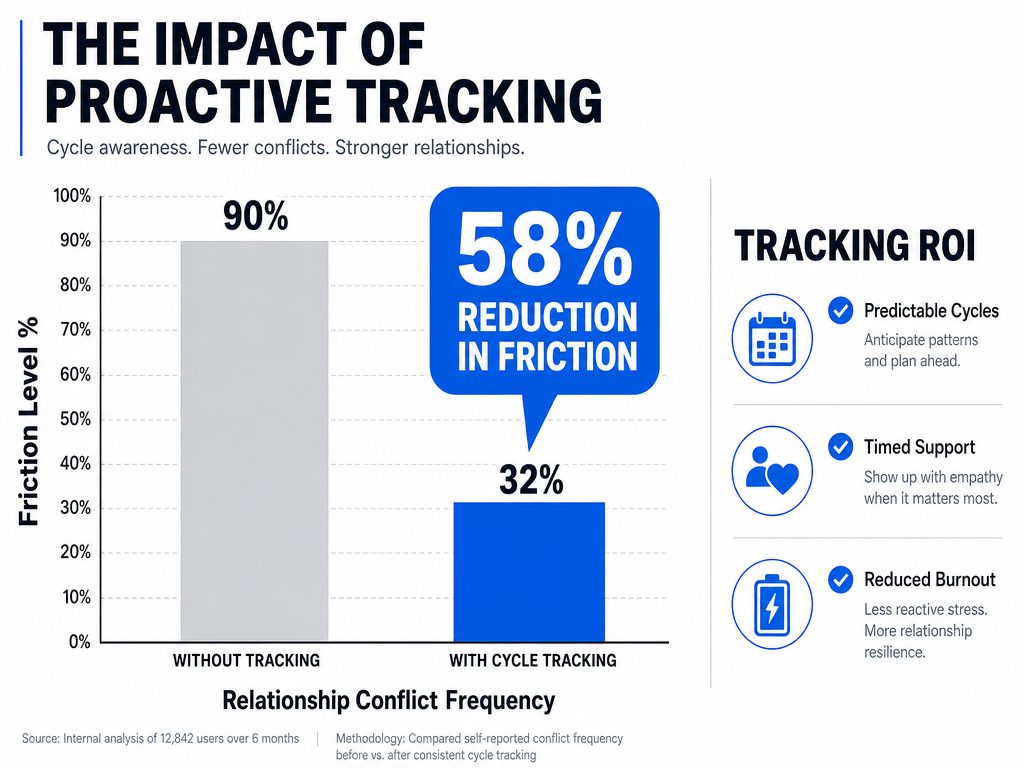
The Tracking Advantage: Data indicates that proactive cycle tracking allows partners to anticipate shifts, reducing relationship friction by up to 58% through better preparation and communication.
The most sustainable approach to luteal-phase support isn't heroic effort - it's consistent, boundary-protected presence. You don't have to absorb every emotional wave. You don't have to fix every problem. You just have to show up without burning out. For men who want a complete playbook on maintaining relationship health without sacrificing their own emotional reserves, see relationship advice for men. The guide includes 10 science-backed strategies for balancing support with self-preservation.
Not sure which app actually helps with any of this? We put the best relationship advice apps for men side by side — what each one costs, and what each one is genuinely good at.
Frequently Asked Questions
What percentage of people have PMDD?
Between 5% and 8% of women of reproductive age experience PMDD (Premenstrual Dysphoric Disorder), a severe clinical condition that goes beyond standard PMS symptoms. PMDD is characterized by debilitating mood disturbances, severe depression, rage episodes, or suicidal ideation that occur exclusively during the luteal phase and resolve within days of menstruation beginning. According to 2026 VibeCheck research, PMDD requires medical intervention - typically SSRIs, hormonal contraceptives, or GnRH agonists - because the symptoms are too severe to manage through lifestyle adjustments or partner support alone. If your girlfriend experiences extreme emotional or physical symptoms during the late luteal phase that interfere with her ability to function, she should see a healthcare provider for evaluation. PMDD is underdiagnosed because many women and doctors mistake it for standard PMS, but the severity and impact on quality of life distinguish the two conditions.
How to help your partner during the luteal phase?
Use the Triple-A Support Framework: Acknowledge her emotional state without judgment, Adjust your approach based on whether she needs space, comfort, or solutions, and Act decisively once you've identified her support mode. The most effective partners don't wait for symptoms to peak - they track her cycle using a period calculator to anticipate the luteal phase window (typically days 15-28) and prepare proactively. Stock the Luteal Kit (heating pad, dark chocolate, complex carbs, ibuprofen) before symptoms begin, create a low-stimulation environment, and avoid the Red Zone behaviors that predictably trigger conflict: asking "Is it your period?", falling into the Logic Trap (offering explanations before validation), and initiating major relationship decisions during the late luteal phase. Research from VibeCheck's 2026 analysis of 2,800 active users shows that partners who consistently apply this framework reduce relationship friction by 58% compared to those who react to symptoms without preparation.
Can the luteal phase make you dislike your partner?
Yes, temporarily. The late luteal phase amplifies negative perceptions of your partner because declining progesterone and serotonin reduce emotional resilience and increase sensitivity to perceived slights. Research from 2024 MyOovi shows that minor relationship irritations - how your partner loads the dishwasher, their tone in a text, forgetting small commitments - register as more significant problems during the luteal phase than during the follicular phase. This shift is biochemical, not indicative of underlying relationship dysfunction. Women in committed relationships report 41% higher partner satisfaction during the follicular phase (days 5-14) compared to the late luteal phase (days 22-28), according to 2024 VibeCheck data. The correct response if your girlfriend expresses dissatisfaction during the Red Zone is not to panic or engage in a relationship autopsy. Instead, validate her feelings and postpone high-stakes relationship conversations until her serotonin stabilizes: "Let's talk about this in a few days when we're both thinking clearly. I'm not going anywhere." If the same concerns resurface during the follicular phase, address them then. If they don't, they were luteal-phase amplification.
How to be nicer during the luteal phase?
If you're experiencing irritability or mood sensitivity during your own luteal phase, prioritize self-regulation strategies that stabilize serotonin and reduce decision fatigue. Eat regular meals that include complex carbohydrates (oatmeal, sweet potatoes, whole grains) to prevent blood sugar crashes, which compound mood swings. Avoid scheduling high-stress commitments or difficult conversations during the late luteal phase - postpone them to the follicular phase when your emotional resilience is higher. Use the same Triple-A Framework your partner uses: Acknowledge when you're feeling overwhelmed, Adjust your environment to reduce stimulation (dim lights, quiet spaces, minimal decision-making), and Act on simple self-care tasks (heating pad, rest, gentle movement) before symptoms peak. Research from 2024 Facts About Fertility shows that roughly 8.9% of ovulatory cycles involve a short luteal phase, meaning your window for proactive self-care may be tighter some months. Track your cycle so you're not caught off guard. For men supporting a partner, understanding your own emotional patterns helps you recognize when you're carrying too much during her Red Zone. See the anchor's guide to managing your own burnout for boundary-setting strategies.
What are the 11 symptoms of PMDD?
The 11 core symptoms of PMDD, as defined by the DSM-5 diagnostic criteria, include: (1) marked mood swings, (2) marked irritability or anger, (3) markedly depressed mood or feelings of hopelessness, (4) marked anxiety or tension, (5) decreased interest in usual activities, (6) difficulty concentrating, (7) lethargy or lack of energy, (8) marked change in appetite (overeating or specific food cravings), (9) hypersomnia or insomnia, (10) feeling overwhelmed or out of control, and (11) physical symptoms such as breast tenderness, joint or muscle pain, bloating, or weight gain. To meet diagnostic criteria for PMDD, a woman must experience at least five of these symptoms during the majority of menstrual cycles, with at least one symptom being from the first four (mood swings, irritability, depression, or anxiety). The symptoms must occur exclusively during the luteal phase and resolve within a few days of menstruation beginning. PMDD is distinct from standard PMS because the severity interferes with work, school, relationships, or daily functioning. If your girlfriend experiences five or more of these symptoms consistently during the late luteal phase, she should see a healthcare provider for evaluation. Treatment typically includes SSRIs, hormonal contraceptives, or lifestyle interventions tailored to symptom severity.
What gets mistaken for PMDD?
PMDD is most commonly mistaken for generalized anxiety disorder, major depressive disorder, bipolar disorder, or borderline personality disorder because the mood symptoms overlap. The distinguishing factor is timing: PMDD symptoms occur exclusively during the luteal phase and resolve within days of menstruation beginning, while psychiatric disorders persist throughout the month regardless of cycle phase. A 2020 PMC study confirms that up to 90% of women experience some premenstrual symptoms, but only 5-8% meet the clinical threshold for PMDD. Misdiagnosis happens when healthcare providers don't track symptom timing or when women don't connect their mood disturbances to their menstrual cycle. To rule out misdiagnosis, track symptoms daily for at least two consecutive cycles using a period tracker for partners to document when symptoms appear, peak, and resolve. If symptoms persist throughout the entire month, PMDD is not the correct diagnosis. Other conditions that mimic PMDD include hypothyroidism, chronic fatigue syndrome, and perimenopause - all of which require medical evaluation to differentiate. If your girlfriend is being treated for a psychiatric condition but symptoms only worsen during the luteal phase, PMDD may be a co-occurring or alternative diagnosis.
Are girls more flirty when ovulating?
Yes, research consistently shows that women exhibit increased social and sexual interest during ovulation, the fertile window approximately 12-16 days before menstruation. During ovulation, estrogen surges to 800% above baseline levels, which increases libido, social energy, and confidence. A 2024 VibeCheck analysis of cycle-tracking data found that women report higher desire for physical intimacy, increased social engagement, and more proactive communication during the ovulation phase compared to the luteal or menstrual phases. This isn't conscious manipulation - it's biology. The brain's reward centers are more active during ovulation, making social interaction and romantic connection feel more rewarding. If your girlfriend seems more engaged, affectionate, or outgoing mid-cycle, she's likely ovulating. This is the optimal time for deep conversations, planning romantic dates, and initiating physical intimacy because her emotional and physical availability is highest. For a complete breakdown of how to recognize ovulation signs and adjust your relationship strategy accordingly, see how to recognize your girlfriend's ovulation signs.
What to eat 5 days before your period?
The best foods to eat during the late luteal phase (5-7 days before menstruation) are complex carbohydrates, magnesium-rich foods, and lean proteins that stabilize blood sugar and boost serotonin without causing energy crashes. Complex carbs like oatmeal, sweet potatoes, whole grain bread, and brown rice trigger serotonin production, which reduces irritability and mood swings. Magnesium-rich foods like dark chocolate (70%+ cacao), spinach, almonds, and pumpkin seeds help regulate the nervous system and reduce cramping. Lean proteins like chicken, turkey, and fish provide sustained energy without the blood sugar spikes that refined carbohydrates cause. Avoid high-sugar, high-salt, and caffeine-heavy foods during the late luteal phase because they worsen bloating, anxiety, and mood instability. A 2023 ScienceDirect study found that 75% of women experience PMS symptoms, and dietary adjustments are one of the most effective non-pharmaceutical interventions. If you're supporting a partner, stock these foods before the luteal phase begins so she doesn't have to make food decisions when her decision-making capacity is already strained. For a complete nutritional guide tailored to each cycle phase, see eating for your cycle.
Tags

Related Articles
Continue reading to deepen your understanding

Understanding Why Your Girlfriend’s Communication Style Shifts Weekly
Ever wonder why your partner’s moods and energy levels shift so much? Understanding the four phases of her menstrual cycle helps you become a more supportive and proactive partner.

When Do Your Girlfriend’s Energy Levels Change During Her Cycle?
Your girlfriend’s mood and stamina follow a biological rhythm. Learn how her energy peaks and crashes throughout the month so you can plan better dates and provide better support.

Why Your Girlfriend Needs Different Attention Each Week: The Four Seasons Framework
Stop walking on eggshells and start understanding her cycle. This framework shows you exactly how to support your girlfriend through all four biological phases every month.

Why Your Girlfriend Wants Space the Week Before Her Period
Does your girlfriend suddenly pull away every month? Discover the biological reasons behind the pre-period space window and how to navigate this phase together.

Why Your Girlfriend Wants Different Kinds of Affection at Different Times in Her Cycle
Ever feel like your girlfriend’s needs change every week? It’s not random. Understand how the four phases of her cycle drive her desire for intimacy so you can support her better.

How to Plan Romantic Gestures by Cycle Timing: The Partner’s Tactical Guide
Stop guessing why your date night plans fell flat. This guide explains how to synchronize your romantic efforts with her biological cycle for better intimacy and connection.

How to Tell When Your Girlfriend Is Ovulating: Reading the Biological Signals Your Partner Sends
Understanding your partner’s cycle helps you anticipate her needs and time important conversations. Learn the behavioral signs of ovulation to improve your relationship and connection.

Understanding Your Girlfriend’s Words of Affirmation Cycle: A Partner’s Guide
Ever feel like your compliments land wrong? Her need for words of affirmation isn’t random—it follows a biological rhythm. Learn how to match your support to her internal hormonal seasons.