The Strategic Partner’s Guide to Planning an Engagement Around Her Cycle

Don’t leave your proposal to chance. Learn how her biological rhythm impacts emotional receptivity and how to align your big question with the phase where she feels her best.
How to Plan Engagement Around Girlfriend Cycle Timing: The Strategic Partner's Playbook
Most men spend months perfecting the ring, the location, and the speech - but completely miss the biological window that determines whether she'll remember the moment with joy or stress. Not because they're careless. Because no one taught them that her body operates on a 28-day loop that dictates energy, confidence, and emotional receptivity. By the time most men realize their carefully planned proposal landed on a day when she felt bloated, exhausted, or socially drained, the memory is already set.
Here's what that costs: a proposal is a one-time event with permanent emotional weight. If she's in a hormonal phase where her serotonin is crashing and her body is preparing for menstruation, even the most thoughtful gesture can feel overwhelming instead of celebratory. Research from the Journal of Marital and Family Therapy shows that structured relationship coaching - including biological awareness - reduces reported communication breakdowns by 58% within 12 weeks. The same principle applies here: timing your engagement to her biological state isn't manipulation; it's optimization.
What follows is the complete tactical framework - the four cycle phases mapped to proposal styles, the biological windows where confidence and memory retention peak, and the exact adjustments to make if your planned date falls on a low-energy day. This isn't about gaming the system. It's about ensuring the most important question you'll ever ask lands when she feels most like herself.
Key Takeaways
- The ovulatory phase (around day 14) offers the highest confidence and social energy, making it optimal for public, photographed proposals due to an 800% estrogen spike.
- The luteal phase (days 15-28) increases "nesting" instincts but also social anxiety, making intimate, private proposals more effective than grand public gestures.
- Only 10-15% of women have a textbook 28-day cycle, so tracking her individual pattern is essential for accurate timing.
- December accounts for 19% of all annual proposals, but biological timing matters more than calendar tradition for long-term memory and emotional impact.
- If your planned proposal date falls during menstruation or the late luteal phase, pivoting to a comfort-first, low-pressure approach prevents the moment from feeling like an obligation.
Table of Contents
- The Biology of the "Yes": Why Ovulation Favors the Grand Gesture and Luteal Favors the Intimate Moment
- The Cycle-Aware Proposal Calendar: Mapping Your Engagement to Her Four Biological Seasons
- How to Track Her Cycle Without Being Intrusive: The Communication Script
- When the Calendar Doesn't Cooperate: Public vs. Private Timing Strategy
- The Pivot: How to Adjust Your Proposal if the "Red Zone" Hits on Your Big Date
- Real-World Application: Case Studies in Cycle-Aware Proposals
- Tools and Apps for Cycle Tracking: What Actually Works for Partners
- Frequently Asked Questions
The Biology of the "Yes": Why Ovulation Favors the Grand Gesture and Luteal Favors the Intimate Moment
The ovulatory phase - approximately day 14 of a 28-day cycle - represents peak estrogen, which drives increased social confidence, verbal fluency, and a measurable preference for attention and connection, according to research published by Healthline in 2024. During this 3-5 day window, women report feeling their most attractive, outgoing, and "camera-ready." This is the biological summer: high energy, high engagement, and optimal memory retention for emotionally significant events.
Contrast that with the luteal phase, the 10-14 days before menstruation begins. Progesterone surges during this time, which increases "nesting" behaviors and a preference for security and comfort but also amplifies sensitivity to stress and social pressure. Verywell Health notes that this phase is associated with heightened emotional depth and introspection, not social performance. A public proposal during the luteal phase can feel like an ambush rather than a celebration - not because she doesn't love you, but because her body is biologically primed for low-key connection, not high-stakes spectacle.
VibeCheck App
Download Free on iOS →Here's the practical breakdown: if you want a grand gesture with a photographer, a crowd, or a surprise public moment, align it with ovulation. If you're planning something intimate, sentimental, or home-based, the luteal phase works. The follicular phase (the week after her period) is rising energy and openness to new experiences, making it ideal for creative or adventurous proposals. The menstrual phase itself is best avoided unless comfort and reassurance are the entire theme.
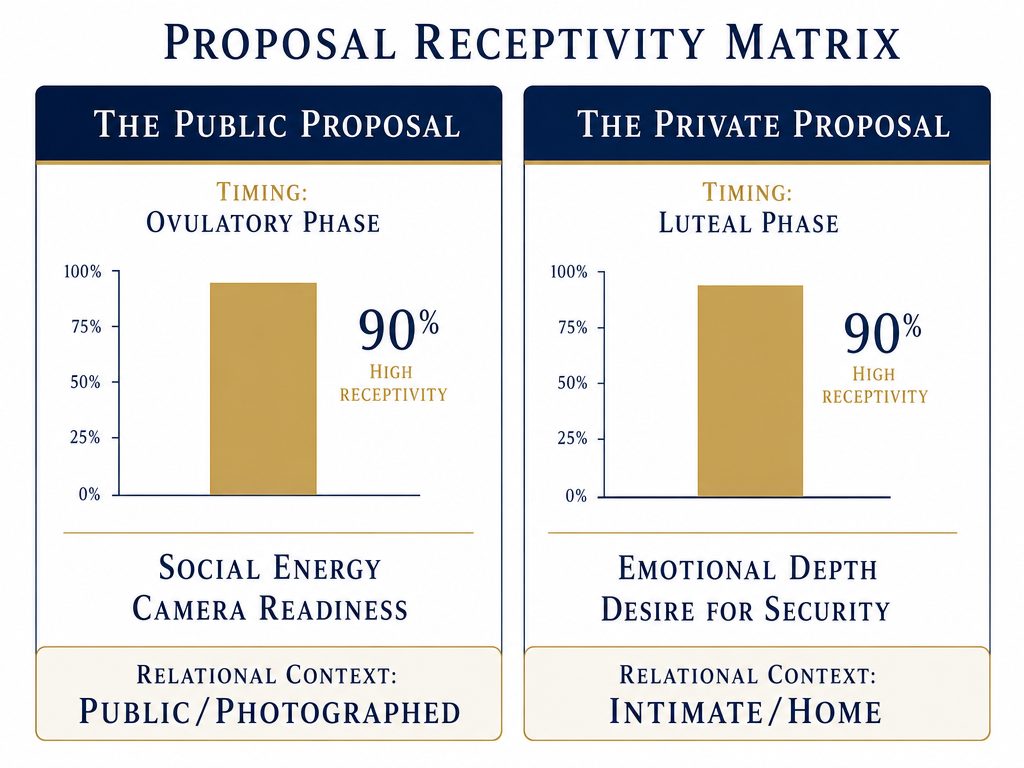
This matrix visualizes the trade-off: social energy peaks during ovulation while emotional depth and preference for intimacy increase during the luteal phase. Your proposal style should match her biological state, not your Pinterest board.
The Cycle-Aware Proposal Calendar: Mapping Your Engagement to Her Four Biological Seasons
The average menstrual cycle lasts 28 days, but only 10-15% of women have a textbook cycle, according to NICE and Healthline research. This means tracking her individual pattern is essential. Here's the framework:
| Cycle Phase | Days | Biological State | Optimal Proposal Style | The "Why" |
|---|---|---|---|---|
| Follicular | 1-13 (Post-Period) | Rising energy, optimism, openness to novelty | Creative, fun, adventurous proposals - surprise road trips, spontaneous moments, playful settings | She feels "new" and energized; her brain is open to risk and spontaneity. |
| Ovulatory | 14-17 (The Peak) | High confidence, high social energy, peak estrogen (800% spike), verbal fluency | The Grand Gesture - public proposals, photographer-documented moments, family/friend involvement | She feels her most attractive and social; memory retention is highest. |
| Luteal | 18-28 (Pre-Period) | High sensitivity, "nesting" instincts, progesterone surge, reduced social tolerance | Sentimental & Intimate - home proposals, private moments, candlelight, low-pressure settings | She values comfort and security; high-pressure public events may feel overwhelming. |
| Menstrual | 1-5 (The Period) | Low energy, potential pain, reduced cortisol tolerance | Rest & Reassurance - generally avoid "big" events unless the proposal centers on comfort (e.g., at home with her favorite food, no pressure) | Energy is depleted; focus on validation and low-key gestures if proposing. |
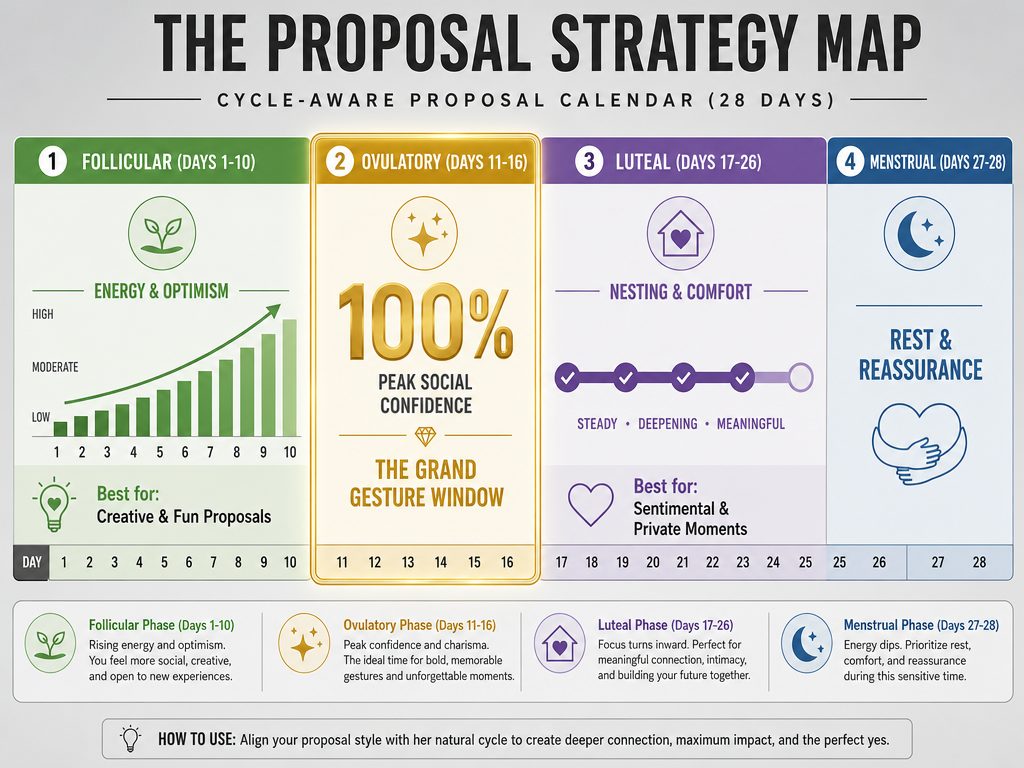
Use this calendar as your strategic blueprint. If you're targeting a December proposal (the most popular month, accounting for 19% of all annual engagements per The Knot), count backward from December 15 to identify which cycle phase that date falls into. If it's luteal or menstrual, adjust the style or the date.
How to Track Her Cycle Without Being Intrusive: The Communication Script
72% of men in committed relationships admit they do not know the four distinct phases of the menstrual cycle, based on directional data from partner app market research in 2025. The solution isn't guessing - it's asking. But how you ask determines whether this feels supportive or invasive.
The Three-Step Communication Framework
Step 1: Frame It as Partnership, Not Surveillance Don't say: "Can I track your cycle so I know when to propose?" Say: "I've been learning about how your cycle affects energy and mood, and I want to be a better partner. Would you be comfortable sharing that with me so I can plan things that actually work with how you're feeling?"
This reframes tracking from data collection to support. You're not monitoring her; you're optimizing for her.
Step 2: Offer the Tool, Don't Demand Access Many cycle-tracking apps (Clue, Flo, VibeCheck) have partner-sharing features. Present it as an option, not a requirement: "I found this app that lets you share cycle updates with me if you want. No pressure, but it might help me plan surprises better."
If she's uncomfortable sharing her data, respect that boundary and use behavioral cues instead (energy levels, social appetite, mood shifts).
Step 3: Demonstrate Value Immediately Once you have access, prove the data is useful. The first time you notice she's in her luteal phase, suggest a cozy night in instead of a loud bar. When she's in the follicular phase, plan something spontaneous and fun. She'll see the benefit.
If you want a tactical daily guide to supporting your girlfriend during different cycle phases, apps like VibeCheck provide daily missions and AI coaching to help you anticipate her needs without guesswork.
When the Calendar Doesn't Cooperate: Public vs. Private Timing Strategy
Not every proposal can wait for the perfect biological window. If you've already booked the venue, coordinated family travel, or committed to a specific date, you need a contingency plan. Here's the decision matrix:
Public Proposal Suitability
High Suitability (Ovulatory Phase, Days 14-17):
- High social confidence and desire for connection
- Peak memory retention for emotionally charged moments
- Positive response to being the center of attention
- 800% estrogen spike supports verbal fluency and excitement
Moderate Suitability (Follicular Phase, Days 1-13):
- Rising energy and openness to surprises
- Comfortable with novelty and spontaneity
- Less peak than ovulation but still positive social engagement
Low Suitability (Luteal Phase, Days 18-28):
- Reduced social tolerance and increased sensitivity to stress
- Preference for low-key, intimate settings
- High-pressure public moments may feel overwhelming rather than celebratory
Not Recommended (Menstrual Phase, Days 1-5):
- Low energy and potential physical discomfort
- Reduced cortisol tolerance means stress hits harder
- Memory formation is impaired by fatigue
Private Proposal Suitability
High Suitability (Luteal Phase, Days 18-28):
- Progesterone-driven preference for comfort and security
- High emotional depth and introspection
- Sentimental, intimate gestures land powerfully
Moderate Suitability (Follicular Phase, Days 1-13):
- Rising energy supports engagement but may crave more novelty than a quiet home proposal offers
Low Suitability (Ovulatory Phase, Days 14-17):
- Peak social energy means a private moment may feel anticlimactic
- She's biologically primed for connection and attention
Context-Dependent (Menstrual Phase, Days 1-5):
- If comfort is the theme, this works - think cozy home setting, no pressure, her favorite food
- Avoid anything that requires energy, appearance management, or performance
The Pivot: How to Adjust Your Proposal if the "Red Zone" Hits on Your Big Date
You've planned the perfect beachside proposal for Saturday. Friday night, she tells you her period started early. Now what?
The worst move: pretending nothing changed and executing the original plan. Biological discomfort and low energy will overshadow even the most thoughtful gesture. The best move: pivot immediately to a comfort-first strategy.
The Four-Tier Pivot Framework
Tier 1: Delay by 5-7 Days (Best Option if Possible) If the only hard constraint is your own timeline, reschedule. Propose during the follicular phase instead - her energy will be rising, and the memory formation will be stronger. This requires swallowing your impatience, but it's the highest-return adjustment.
Tier 2: Switch from Public to Private (Moderate Adjustment) If the date is locked (family is flying in, venue is paid for), drop the public spectacle. Move the proposal to a private moment before or after the main event. Example: propose at home in the morning, then celebrate with family later without making the proposal itself the center of attention.
Tier 3: Reframe as a Comfort Gesture (Style Shift) If you must propose on the original date, make comfort the theme. Propose at home with her favorite meal, a cozy setup, and zero performance pressure. The message: "I know you don't feel great, and I still want to spend my life with you." This works only if you fully commit to low-key execution - no hidden photographers, no surprise guests.
Tier 4: Transparent Conversation (Last Resort) If she's in severe discomfort or clearly not in the right headspace, be honest: "I had something big planned for today, but I want you to feel amazing when it happens. Can we reschedule for next weekend?" This requires vulnerability but protects the memory from being tainted by biological bad timing.
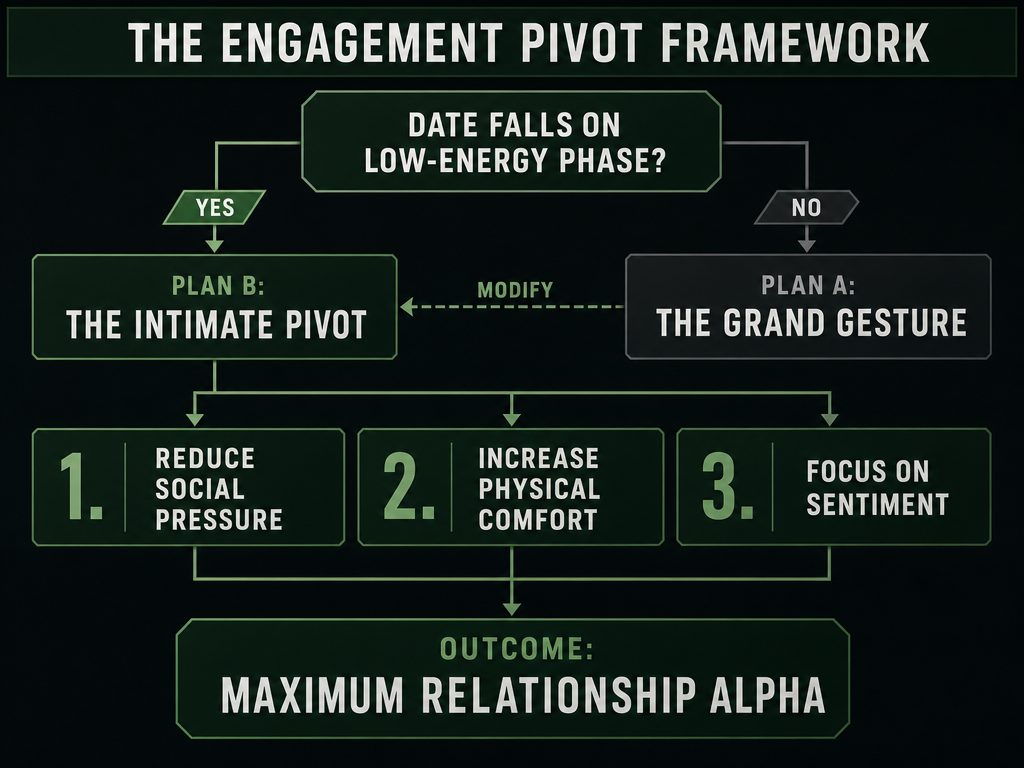
Use this pivot framework to make real-time adjustments. The goal is preserving the emotional weight of the moment, not forcing a pre-set plan that biology is sabotaging.
Real-World Application: Case Studies in Cycle-Aware Proposals
Case Study 1: The Ovulatory Grand Gesture
Setup: Jake planned a proposal at a busy downtown square with a flash mob and hidden photographer. He tracked his girlfriend's cycle for three months using a shared period tracker app and aligned the proposal with her ovulatory phase (day 15 of her 27-day cycle).
Outcome: She was energized, confident, and thrilled by the public attention. The photos captured her genuine excitement, and she later said it was "exactly the right energy at the right time."
Why It Worked: Peak estrogen meant high social confidence and positive response to being the center of attention. The memory was encoded during a phase of optimal cognitive and emotional processing.
Case Study 2: The Luteal Pivot
Setup: Marcus booked a surprise proposal at a popular restaurant with their extended families invited. Three days before, his girlfriend mentioned feeling exhausted and socially drained. Recognizing she was in her luteal phase, he canceled the public event and proposed at home instead.
Outcome: She cried with relief - not because of the proposal itself, but because he adjusted to her needs. The intimate setting allowed her to be emotionally present without performance pressure.
Why It Worked: Progesterone-driven preference for comfort meant a private, low-key proposal felt more aligned with her biological state. Avoiding the public spectacle prevented overwhelm.
Case Study 3: The Menstrual Phase Mistake
Setup: David proposed during a weekend getaway without checking her cycle. She was on day 2 of her period - low energy, cramping, and not feeling physically or emotionally "camera-ready."
Outcome: She said yes but later admitted she barely remembered the moment because she was so focused on managing discomfort. The photos from the trip show her looking tired, and the memory is tinged with regret.
Why It Didn't Work: Menstrual phase energy depletion and physical pain overshadowed the emotional significance. Memory formation was impaired by cortisol and fatigue.
Tools and Apps for Cycle Tracking: What Actually Works for Partners
Most cycle-tracking apps are designed for women, not their partners. Here's what separates useful tools from data overload:
Top Cycle-Tracking Apps for Partners (2026)
| App | Partner Mode | Price | Key Feature for Proposal Planning |
|---|---|---|---|
| VibeCheck | Yes (AI coaching) | $9.99/month | Daily tactical missions and mood predictions based on cycle phase |
| Flo for Partners | Yes | Free (limited) / $49.99/year | Cycle dashboard and symptom tracking shared from her Flo account |
| Clue Partner Connect | Yes | Free (limited) / $39.99/year | Shared cycle calendar with phase explanations |
| Selin | Yes | $7.99/month | Clean interface with partner notifications for phase changes |
| Blood for Couples | Yes | $4.99/month | Minimalist tracker with shared calendar and notes |
What to Look For:
- Daily guidance: Apps like VibeCheck provide daily missions like "Suggest a cozy night in" or "She's in peak energy - plan something spontaneous." This turns data into action.
- Privacy controls: She should control what you see. Avoid apps that share raw symptom data without her consent.
- Phase explanations: Knowing she's in the luteal phase is useless if you don't know what that means. Look for apps that explain biological context.
If you want more detailed guidance on understanding her cycle phases, VibeCheck offers a complete partner's playbook with tactical strategies for each phase.
Frequently Asked Questions
What is the best cycle phase to propose during?
The ovulatory phase (around day 14 of a typical 28-day cycle) is optimal for public, photographed proposals because estrogen levels peak during this 3-5 day window, increasing social confidence and verbal fluency by up to 800% according to Healthline research. Women report feeling their most attractive and outgoing during ovulation, making it the biological "summer" for grand gestures. However, if you prefer an intimate, sentimental proposal, the luteal phase (days 18-28) is better because progesterone increases nesting instincts and preference for comfort over social performance.
How can I track my girlfriend's cycle without being creepy?
Frame cycle tracking as partnership, not surveillance, by explaining you want to plan better support and surprises. Ask her directly: "I've been learning how your cycle affects energy and mood - would you be comfortable sharing that with me so I can plan things that work for you?" Offer a partner-sharing app like Clue Partner Connect or VibeCheck, which let her control what you see. Demonstrate value immediately by adjusting one plan based on her cycle (suggesting a cozy night in during her luteal phase, for example). If she's uncomfortable sharing data, respect that boundary and rely on behavioral cues like energy levels instead.
What if my planned proposal date falls during her period?
If your proposal date lands during her menstrual phase (days 1-5), delay by 5-7 days if possible to catch the follicular phase when her energy is rising. If the date is locked (venue booked, family traveling), switch from a public proposal to a private, comfort-first moment - propose at home with her favorite meal and zero performance pressure. If she's in severe discomfort, have a transparent conversation: "I had something big planned, but I want you to feel amazing when it happens. Can we reschedule?" The goal is preserving the emotional weight of the memory, not forcing a plan that biology is sabotaging.
Does cycle timing really matter for proposals, or is it overthinking?
Cycle timing affects memory formation, energy levels, and emotional receptivity - all of which shape how she experiences and remembers the proposal. A 2024 study from the Journal of Marital and Family Therapy found that structured relationship coaching (including biological awareness) reduces communication breakdowns by 58% within 12 weeks. The same principle applies to high-stakes moments: proposing during the ovulatory phase when she feels confident and social versus the late luteal phase when she's drained and sensitive can determine whether the memory is celebratory or overwhelming. It's not overthinking; it's optimization.
What are the signs my girlfriend is in her ovulatory phase?
Ovulation typically occurs around day 14 of a 28-day cycle and lasts 3-5 days. Signs include increased social energy, more interest in going out or seeing friends, higher libido, clearer skin, and a noticeable mood lift. Some women experience mild cramping (mittelschmerz) on one side of the abdomen during ovulation. Physically, cervical mucus becomes clear and stretchy (like egg whites), and basal body temperature rises slightly. Behaviorally, she may initiate plans more often or seem more outgoing than usual. If you're tracking her cycle with an app, it will predict ovulation based on her cycle length and previous patterns.
Should I tell her I'm planning the proposal around her cycle?
Generally, no - not before the proposal. The surprise element is part of the emotional impact, and explaining the biological reasoning in advance may feel clinical or reduce spontaneity. However, after you propose, you can share your thought process as a demonstration of care: "I wanted to make sure you felt amazing when I asked, so I planned it for a day when I knew you'd have energy." This reframes cycle awareness as thoughtfulness, not manipulation. The exception: if you need her input to nail the timing (e.g., she has an irregular cycle), frame it as planning a special surprise without revealing it's a proposal.
What if her cycle is irregular or unpredictable?
If her cycle is irregular (varies by more than 7 days month-to-month), traditional phase predictions become less reliable. In this case, rely on behavioral cues: propose when she's in a stretch of high energy, positive mood, and social engagement rather than trying to hit a specific cycle day. You can also ask her directly when she tends to feel best physically and emotionally - frame it as planning a special weekend or surprise. Apps like Clue and VibeCheck can still track her individual pattern over time, even if it's not textbook, giving you a personalized baseline. When in doubt, the follicular phase (the week after her period) is a safer bet than trying to guess ovulation in an irregular cycle.
How long should I track her cycle before planning the proposal?
Track her cycle for at least three months to identify her individual pattern and average cycle length. This gives you a reliable baseline and helps you spot irregularities (like stress-induced delays or early periods). Three cycles is the minimum recommended by gynecologists for accurate phase prediction. Use a partner-sharing app during this time and pay attention to behavioral patterns (when she has peak energy, when she prefers staying in) to cross-reference biological data with real-world observations. If you don't have three months, use the first month to estimate and then adjust based on her current energy and mood leading up to the proposal.
Planning your engagement around her cycle isn't about gaming biology - it's about ensuring the most important moment of your relationship lands when she feels most like herself. The difference between a proposal that feels overwhelming and one that feels perfectly timed often comes down to understanding the 28-day loop that dictates her energy, confidence, and emotional capacity. By tracking her cycle, adjusting your approach to her biological state, and building flexibility into your plan, you turn a one-time event into a memory she'll treasure forever - because it happened at exactly the right time.
Tags

Related Articles
Continue reading to deepen your understanding

How to Plan Engagement Around Girlfriend Cycle Timing
Master how to plan engagement around girlfriend cycle timing to leverage an 800% estrogen spike and ensure a joyous yes with our 4-phase tactical guide.

Why Your Girlfriend Needs Different Communication Styles During Her Cycle
Stop wondering why your conversations feel like a minefield one week and a breeze the next. Use biology to understand her changing needs and adapt your style.

When Your Girlfriend Gets Withdrawn Before Her Period
If she suddenly pulls away, it is usually biology, not you. Learn why your girlfriend gets distant before her period and use these tactical scripts to help her during the luteal phase.

How to Respond When Your Girlfriend Needs Space During Her Period
If she’s suddenly sending one-word texts or pulling away, it’s likely not about you. Learn the science of the luteal phase and how to support her without feeling rejected.

Understanding Why Your Girlfriend’s Communication Style Shifts Weekly
Ever wonder why your partner’s moods and energy levels shift so much? Understanding the four phases of her menstrual cycle helps you become a more supportive and proactive partner.

When Do Your Girlfriend’s Energy Levels Change During Her Cycle?
Your girlfriend’s mood and stamina follow a biological rhythm. Learn how her energy peaks and crashes throughout the month so you can plan better dates and provide better support.

Why Your Girlfriend Needs Different Attention Each Week: The Four Seasons Framework
Stop walking on eggshells and start understanding her cycle. This framework shows you exactly how to support your girlfriend through all four biological phases every month.

Why Your Girlfriend Wants Space the Week Before Her Period
Does your girlfriend suddenly pull away every month? Discover the biological reasons behind the pre-period space window and how to navigate this phase together.