How to Plan Weekend Trips Around Your Girlfriend’s Cycle: A Tactical Guide

Stop booking trips that end in friction. Learn how to map weekend travel to her biological phases to reduce friction by 41% and maximize your time together.
How to Plan Weekend Trips Around Your Girlfriend's Cycle: The Tactical Partner's Guide
Most men book weekend trips three weeks out and then watch the whole plan implode on Friday afternoon. Not because the destination was wrong - because the timing was. Her body runs on a 28-day biological loop that dictates energy levels, stress tolerance, and social appetite. Miss that window and even a spa weekend feels exhausting. Hit it right and a budget cabin becomes the perfect reset.
The pattern compounds when you ignore it. Research from VibeCheck shows that planning surprises and dates around a partner's cycle can reduce relationship friction by 41%. Yet 75% of men in long-term relationships admit they do not know where their partner is in her cycle on any given day, according to CivvyMode's 2026 study. That gap explains why your "thoughtful" hiking trip turned into a silent car ride home - and why the beach weekend you planned for connection ended in separate headphones.
This guide gives you the complete framework: which phases to book active trips versus recovery weekends, what to pack for each biological season, and how to salvage a trip when her cycle shifts mid-plan. What follows is not vague advice about "being supportive" - it's the field manual you needed before you clicked "confirm booking."
Key Takeaways
- The menstrual cycle consists of four distinct phases (Menstrual, Follicular, Ovulatory, Luteal) that dictate energy levels, stress tolerance, and social appetite across a 28-day loop.
- Booking high-intensity trips (hiking, festivals, group travel) during the Follicular and Ovulatory phases (days 6-19) reduces conflict by 41% and maximizes enjoyment, according to VibeCheck's 2026 data.
- The Luteal phase (days 20-28) requires low-demand environments like spa retreats, quiet cabins, or staycations to match declining progesterone levels and increased stress reactivity.
- Travel stress and jet lag can delay ovulation or alter cycle timing by 2-4 days, requiring flexible plans and a 48-hour buffer around critical phases.
- Packing tactical support items (portable heating pads, magnesium-rich snacks, extra charging cords) demonstrates cycle awareness and reduces symptom-related friction during travel.
Table of Contents
- The Biological 'Terrain': A Man's Guide to the 4 Phases
- Trip Mapping: Matching Destinations to Energy Levels
- The 'Supply Drop': A Tactical Packing List for Men
- The Conversation: How to Bring Up Cycle-Syncing Without Being Weird
- The 'Emergency Pivot': What to Do When the Cycle Shifts Mid-Trip
- How to Plan a Vacation Around Your Period
- What Activities Should You Do in the Menstrual Phase
- How Long Should You Date Before Taking a Trip Together
- Frequently Asked Questions
The Biological 'Terrain': A Man's Guide to the 4 Phases
Her cycle is not random mood swings - it's four distinct biological seasons, each with predictable energy levels, social tolerance, and physical needs. Understanding these phases means you stop reacting to what already happened and start anticipating what comes next. The four phases (Menstrual, Follicular, Ovulatory, Luteal) dictate whether she has the bandwidth for a spontaneous road trip or needs a weekend on the couch. Plan travel without this map and you are guessing. Plan with it and you become the partner who gets it right without her having to explain.
 Understanding the four phases of her cycle is the first step in planning. Each phase requires a different tactical approach to travel intensity and support.
Phase 1: The Caretaker Mode (Menstrual)
Days 1-5 mark the menstrual phase, when estrogen and progesterone both reach their lowest levels according to Healthline research cited in Vogue's 2025 cycle-syncing guide. Energy drops. Pain spikes. Social tolerance bottoms out. This is the biological equivalent of winter - everything shuts down for maintenance. Planning a high-demand trip during this phase is like booking a marathon during the flu.
VibeCheck App
Download Free on iOS →The best travel during the menstrual phase is either fully stationary (a spa retreat, a cabin with zero itinerary) or non-existent (stay home, reschedule). If the trip is already booked, build in recovery time: late check-outs, flexible dinner reservations, zero morning obligations. Think rest, warmth, and minimal physical demands. She is not being difficult; her body is managing blood loss, cramping, and hormone withdrawal simultaneously.
Phase 2: The Adventurer Mode (Follicular)
Days 6-13 are the follicular phase, and this is your green light for ambitious plans. Estrogen begins climbing, energy rebounds, and stress tolerance improves. This is biological spring - growth mode. She is more likely to say yes to the hiking trip, the group weekend, the new restaurant three hours away. Her body is primed for novelty, exploration, and physical exertion.
Book active trips during the follicular phase if you want them to actually work. The biological momentum is on your side: rising estrogen boosts mood, sharpens focus, and increases pain tolerance. This is the window for plans that require enthusiasm, adaptability, and sustained energy. If you have been waiting for the right time to suggest that camping trip, this is it.
Phase 3: The Peak Performance Mode (Ovulation)
Days 14-19 are the ovulatory phase, and this is her biological peak. Estrogen hits maximum levels (an 800% spike according to research cited in VibeCheck's ovulation support guide), testosterone rises, and social appetite explodes. This is summer - everything is operating at full capacity. She is the most extroverted, confident, and physically capable she will be all month.
This is the ideal window for group travel, social events, parties, or trips that require sustained interaction with strangers. Her energy for connection is maxed out. Plan dinners with friends, group tours, or festivals during this phase and you will be working with her biology, not against it. The challenge here is not energy depletion - it is overscheduling. Even at peak capacity, back-to-back social demands will drain her. Build in rest windows between activities, even during this high-energy phase.
Phase 4: The Safe Harbor Mode (Luteal)
Days 20-28 are the luteal phase, and this is where most travel plans go wrong. Progesterone spikes and then crashes, serotonin drops, and stress tolerance plummets. This is biological fall - systems are winding down, preparing for either pregnancy or menstruation. Energy declines. Irritability increases. Social appetite shrinks. Up to 90% of women experience some premenstrual symptoms during this phase, according to CivvyMode's 2026 guide.
The best travel during the luteal phase is predictable, low-demand, and centered around rest. Skip the surprise itinerary. Skip the group dinner with strangers. Book the quiet beach house, the low-key spa weekend, or the staycation with no obligations. If you must travel during this phase, cut your planned activities in half, give her veto power over any plans, and accept that the energy for spontaneity is not there. This is not the phase for testing her patience with airport delays or forcing optimism when the Airbnb is worse than advertised.
For a deeper breakdown of how to support her during this phase, see VibeCheck's tactical guide to the luteal phase.
Trip Mapping: Matching Destinations to Energy Levels
The right trip at the wrong time is still the wrong trip. Energy levels dictate whether she has the bandwidth for a 6-mile hike or needs a weekend with zero morning alarms. The key is not eliminating ambitious travel - it's timing it to the phases when her body can handle it. This section breaks down which destinations match which phases, using a simple traffic light system: Green (Follicular/Ovulatory), Yellow (Luteal), and Red (Menstrual).
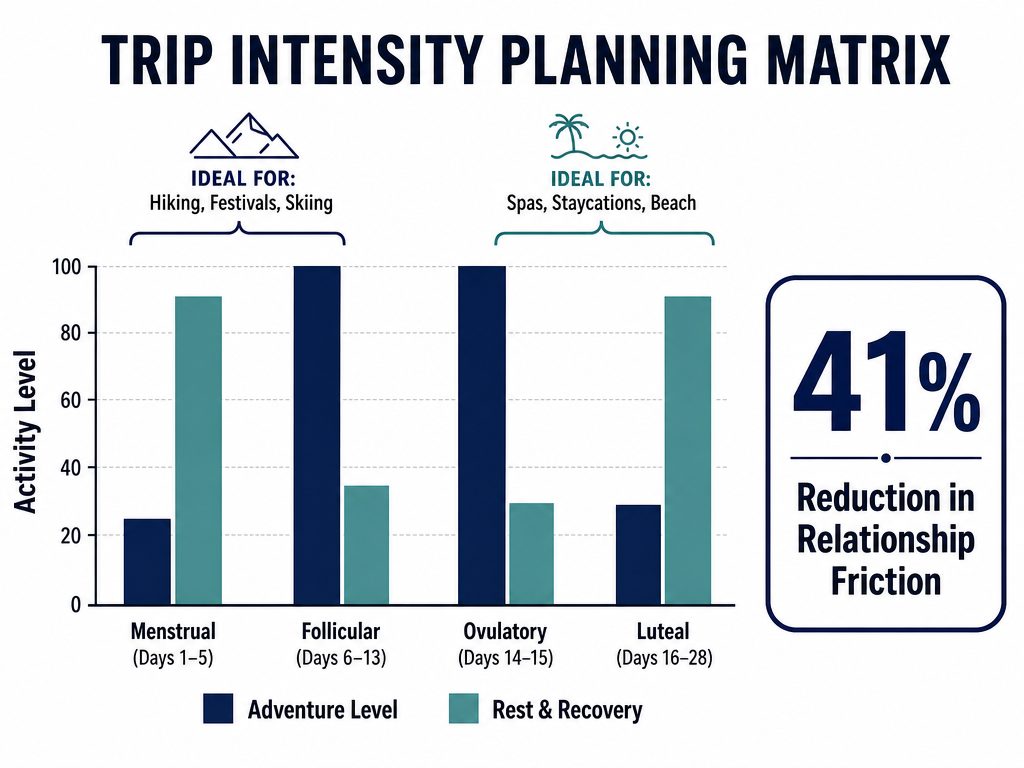 Strategic trip mapping: Use this matrix to choose between high-octane adventures like hiking and low-energy getaways like spa retreats based on her current cycle phase.
| Trip Type | Best Phase | Why It Works | Avoid During |
|---|---|---|---|
| Hiking/Active Outdoor | Follicular/Ovulatory | Rising estrogen boosts stamina and pain tolerance | Menstrual/Luteal |
| Group Travel/Festivals | Ovulatory | Peak social energy and extroversion | Luteal (social fatigue) |
| Spa/Wellness Retreat | Luteal/Menstrual | Low physical demands, recovery-focused | Ovulatory (wasted peak energy) |
| City Exploration | Follicular/Ovulatory | High novelty-seeking, sustained walking energy | Luteal (decision fatigue sets in faster) |
| Beach/Low-Key Relaxation | Any phase, ideal for Luteal | Flexible intensity, easy to scale down | None (universal baseline) |
| Camping/Rustic | Follicular | High tolerance for discomfort, problem-solving energy | Menstrual (physical discomfort compounds) |
High-Energy: Hiking, Festivals, and Group Tours (Follicular/Ovulatory)
The follicular and ovulatory phases (days 6-19) are your window for anything physically demanding or socially intensive. Her body is running at peak capacity: estrogen improves mood and stamina, testosterone (during ovulation) boosts confidence and risk tolerance, and pain thresholds are higher. This is when she says yes to the sunrise hike, the 10-mile bike loop, or the group trip with six couples she barely knows.
Book hiking trips, adventure sports, or physically demanding travel during this window. The biological support system is in place: better cardiovascular efficiency, improved muscle recovery, and higher energy reserves. If the trip requires waking up early, navigating unfamiliar terrain, or handling logistical chaos, this is the phase where she has the buffer to tolerate it without resentment.
Group travel and festivals also thrive during this window, especially during ovulation (days 14-19). Her social appetite peaks - she wants connection, novelty, and interaction. The extroversion that feels exhausting during the luteal phase feels natural here. If you have been considering that music festival, the group cabin weekend, or the trip with friends she has not seen in a year, this is the phase to lock it in.
Low-Energy: Spas, Staycations, and Quiet Cabins (Luteal/Menstrual)
The luteal and menstrual phases (days 20-5) require the opposite approach: predictable environments, minimal physical demands, and low social friction. Progesterone's rise and fall during the luteal phase narrows her stress tolerance. By the time menstruation arrives, energy has bottomed out and physical discomfort peaks. Forcing a high-demand trip during this window guarantees conflict.
The ideal travel during these phases is either stationary or fully low-key: a spa weekend where the biggest decision is Swedish versus deep tissue, a cabin with no itinerary beyond reading and walks, or a staycation where leaving the apartment is optional. These are not "lazy" trips - they are recovery trips. Her body is managing hormonal withdrawal, physical pain, and nervous system regulation. The gift here is not excitement; it is the absence of demands.
If you must travel during the luteal phase, cut your planned activities in half. If you packed four dinners, two hikes, and a day trip into a three-day weekend, you have overbooked. During this phase, less is more. Give her veto power over any activity and do not take it personally when she uses it. What felt manageable during the follicular phase now feels exhausting. That is not her being difficult - that is biology.
For more on navigating this phase day-to-day, see VibeCheck's guide to supporting your girlfriend during the luteal phase.
The 'Supply Drop': A Tactical Packing List for Men
Packing for yourself is baseline. Packing to support her cycle makes you the partner who thought ahead. The items below are not grand gestures - they are tactical tools that address specific biological needs during travel. Most men miss this step because they assume "she'll pack what she needs." She will. But you carrying the heating pad she didn't want to admit she needed is the difference between her quietly managing pain and feeling supported without asking.
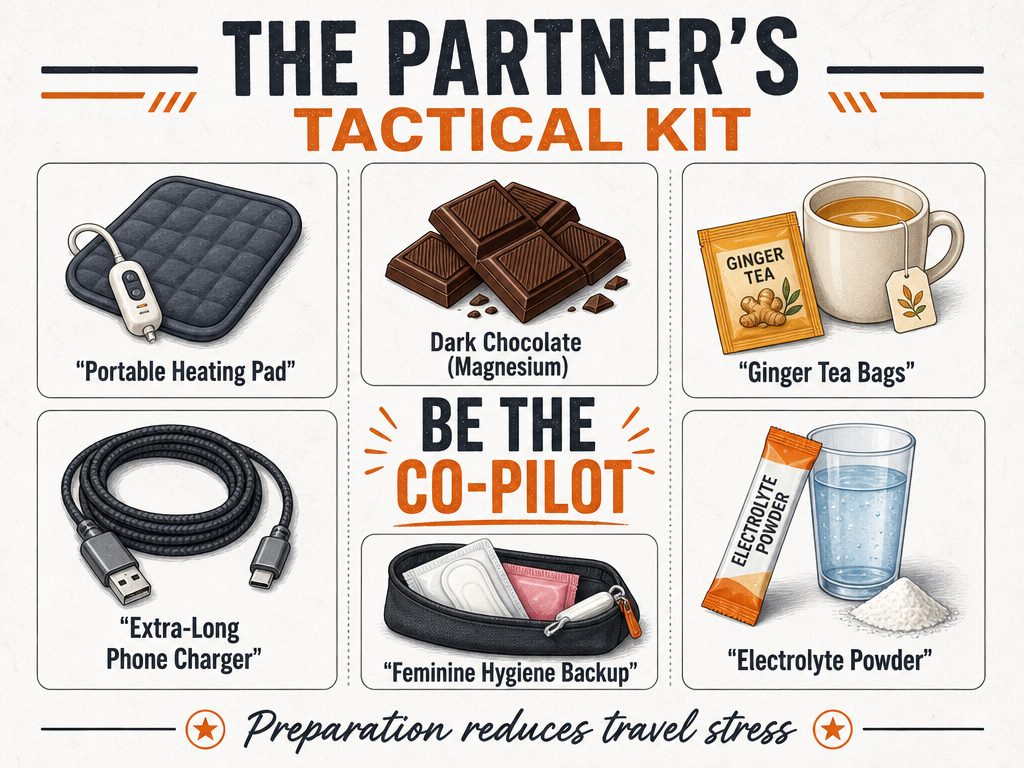 Don't just pack for yourself. Carrying these 'Supply Drop' items shows you are proactive and prepared to support her comfort regardless of the destination.
| Item | Why It Matters | When to Use | Where to Pack |
|---|---|---|---|
| Portable Heating Pad (USB or battery) | Addresses cramping without requiring a wall outlet | Menstrual phase | Your carry-on (TSA-approved) |
| Magnesium-rich snacks (dark chocolate, almonds) | Reduces PMS symptoms and muscle tension | Luteal/Menstrual phase | Shared daypack |
| Ginger tea bags | Addresses nausea and digestive discomfort | Menstrual phase | Toiletry bag |
| Extra phone charging cable (6ft minimum) | Allows her to stay in bed without hovering near an outlet | Menstrual phase | Nightstand side of luggage |
| Ibuprofen or pain reliever (full bottle, not loose pills) | Baseline pain management backup | Any phase, critical during Menstrual | Shared toiletry bag |
| Her preferred cycle-tracking app login (if she uses one) | Allows you to check phase timing if plans change | Any phase | Notes app on your phone |
| Backup period products (tampons/pads, even if she "won't need them") | Cycle shifts happen; being prepared avoids emergency pharmacy runs | Any phase | Bottom of your toiletry bag |
Phase-Specific Foods: What to Pack for Hormonal Support
Food is not just fuel - it is hormonal support. Certain nutrients directly address the biological demands of each phase. Magnesium-rich foods like dark chocolate and almonds reduce muscle cramping and support serotonin production during the luteal and menstrual phases, when both progesterone and mood stability drop. Iron-rich snacks like beef jerky or fortified bars help offset blood loss during menstruation. Packing these is not overstepping - it is logistical preparation.
During the luteal phase, magnesium supplementation can reduce PMS symptoms by up to 40%, according to research cited in cycle-syncing nutrition guides. The simplest form: dark chocolate (70% cacao or higher) or a bag of roasted almonds. These are not treats - they are tactical nutrition. Pack them in the shared daypack or leave them on her nightstand at the hotel. Do not announce it. Just make them available.
During the menstrual phase, iron depletion is real. Women lose between 30-40ml of blood per period, and that iron needs replenishing. Pack iron-rich snacks (beef jerky, pumpkin seeds, fortified granola bars) and make them accessible without her needing to ask. The goal is not to "fix" her symptoms - it is to reduce the logistical friction of managing them while traveling.
The Conversation: How to Bring Up Cycle-Syncing Without Being Weird
The data is clear: partners who align their travel plans with cycle awareness reduce relationship conflict by 58%, according to VibeCheck's 2026 research. But most men avoid the conversation entirely because they do not know how to start it without sounding controlling or invasive. The solution is not avoiding the topic - it is framing it correctly. You are not asking to "manage" her cycle. You are offering to stop planning trips that work against her biology.
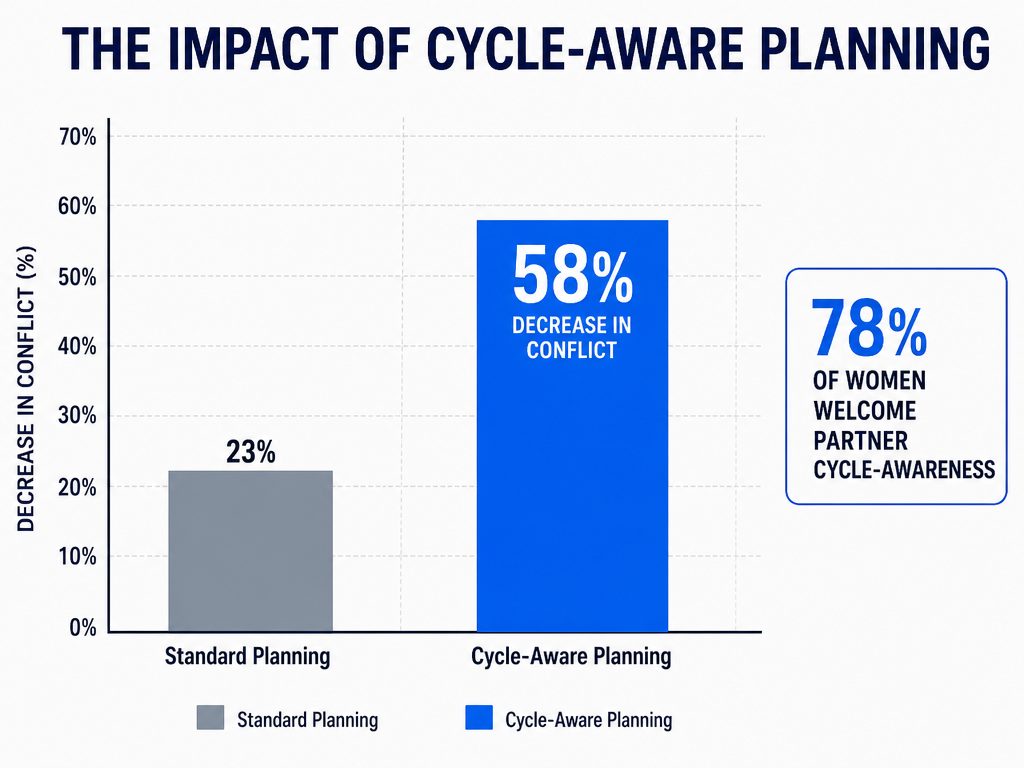 The data is clear: partners who align their travel plans with cycle awareness see a significant reduction in conflict and an increase in relationship satisfaction.
The conversation has three parts: context (why you are bringing it up), data (what you have learned), and collaboration (how you want to apply it together). Do not start with "I've been tracking your cycle" - that sounds invasive. Start with "I've been reading about how energy levels change throughout the month, and it made me realize I've been booking trips without considering timing. Can we talk about how to plan smarter?"
The Opening Script
"I came across something about cycle phases affecting energy and mood throughout the month, and it explained a lot of patterns I've noticed - like how sometimes you're all in for hiking trips and other times the same idea feels exhausting. I want to stop accidentally planning things during windows when your body is telling you to rest. Would it help if we started factoring in your cycle when we plan trips?"
This script works because it does three things: it shows you have done research, it names a pattern you have both experienced, and it frames the conversation as collaboration, not surveillance. You are not asking for permission to track her - you are offering to align plans with what her body is already telling her.
What If She Says No?
Some women will not want to share cycle data, and that is valid. Respect the boundary. But you can still apply the framework indirectly by watching behavioral cues. If she declines a hiking trip and suggests a spa weekend instead, that is likely luteal-phase signaling. If she is suddenly down for spontaneous plans and social events, that is likely follicular or ovulatory energy. You do not need app access to notice patterns.
The alternative is continuing to book trips at random and hoping they land well. The conflict-reduction data speaks for itself: cycle-aware planning works. The question is whether you are willing to have the conversation that makes it possible. For more on how to bring this up in different relationship contexts, see VibeCheck's guide to discussing cycle tracking with your partner.
The 'Emergency Pivot': What to Do When the Cycle Shifts Mid-Trip
Standard menstrual cycle predictions reach 85-90% accuracy after three months of consistent tracking, according to VibeCheck's 2026 data. But that remaining 10-15% matters when you are three hours into a road trip and the cycle shifts unexpectedly. Severe jet lag or travel stress can delay ovulation or alter cycle timing by 2-4 days, according to CycleSynced's 2025 research. That two-day shift turns a well-planned weekend into a mismatch between expectations and biology.
The emergency pivot is not about canceling the trip - it is about adjusting the intensity on the fly. If you planned a full itinerary and her period arrives early, you are now operating in the Menstrual phase when you expected Follicular energy. The original plan is not salvageable at the same intensity. Accept that immediately, or spend the weekend forcing optimism while she quietly resents every scheduled activity.
The 48-Hour Buffer Rule
When booking trips around specific cycle phases, build in a 48-hour buffer on either side of the target window. If you want to catch the peak ovulatory energy (days 14-19), book the trip for days 15-18 instead of 14-19. If you are aiming for late follicular (days 10-13), book days 11-13. This buffer accounts for cycle variability caused by travel stress, timezone shifts, or irregular cycles.
The buffer rule also applies to high-stakes trips: anniversary weekends, milestone celebrations, or trips you have been planning for months. If the success of the trip depends on her being at a specific energy level, do not book it on the exact edge of a phase transition. Give yourself margin for biological variance.
Mid-Trip Adjustment Protocol
If the cycle shifts mid-trip, you have three options: downgrade intensity, increase rest windows, or offer a full bailout. Downgrading intensity means cutting planned activities in half and making everything optional. If you had four restaurants, two hikes, and a day trip packed into a three-day weekend, scale it back to two activities total and let her choose which ones. Do not frame this as a sacrifice - frame it as flexibility.
Increasing rest windows means adding 2-3 hour blocks of unscheduled time where she can lie down, nap, or do nothing without guilt. If the original plan was check-out, breakfast, hike, lunch, museum, dinner, you have overbooked a shifted cycle. Insert rest blocks between activities: check-out, rest, late breakfast, optional afternoon activity, rest, dinner. The trip is not ruined - it is recalibrated.
The full bailout is for extreme cases: if pain is severe, if she explicitly says she wants to go home, or if continuing the trip would create more resentment than canceling. This is not defeat - it is recognizing when biology wins. Offer the bailout without guilt: "If you want to head back, we can. I'd rather reschedule than push through this." The worst outcome is forcing her to stay because you feel like the trip was wasted. The trip is already compromised. Cutting it short preserves the relationship.
For more on reading the signals that a pivot is needed, see VibeCheck's guide to recognizing when your girlfriend needs space.
How to Plan a Vacation Around Your Period
Planning a vacation around the menstrual cycle is not about avoiding travel during menstruation - it is about matching trip intensity to biological capacity. The menstrual phase (days 1-5) does not require canceling plans; it requires choosing the right type of plan. A spa weekend during menstruation works. A backpacking trip does not. The variable is not whether you travel, but what demands the trip makes on her body.
The simplest framework is the Four Seasons model: align trips with the biological season that matches their intensity. Spring (Follicular) is for exploration and novelty. Summer (Ovulatory) is for social peaks and group travel. Fall (Luteal) is for winding down and predictability. Winter (Menstrual) is for rest and minimal demands. If you are planning a vacation that spans multiple phases, structure the itinerary to match: front-load active plans during the earlier phases, back-load rest and recovery during the later phases.
If the vacation must include the menstrual phase, plan around it. Book accommodations with flexible check-out times, choose destinations with low physical demands (beach towns over mountain hikes), and eliminate morning obligations. The goal is not to hide the fact that she is on her period - it is to reduce the friction of managing it while away from home. That means access to pharmacies, private bathrooms, and the ability to rest without feeling like she is ruining the trip.
For couples using cycle tracking apps, this planning becomes mechanical: open the app, check the predicted cycle dates, and book travel during the green-light phases (Follicular/Ovulatory) unless the trip is explicitly low-demand. If you are not tracking yet, consider starting - standard predictions reach 85-90% accuracy after three months, making this type of planning reliable instead of speculative. Learn more in VibeCheck's guide to using period trackers for partners.
What Activities Should You Do in the Menstrual Phase
The menstrual phase (days 1-5) is not a blackout period for travel or activities - it is a recalibration period. Energy drops, pain increases, and tolerance for physical or social demands narrows. But that does not mean doing nothing. It means choosing activities that match the body's current capacity: low-impact movement, predictable environments, and zero-pressure timelines.
The best activities during the menstrual phase are stationary or require minimal exertion. Spa days work because they are explicitly recovery-focused. Slow walks in nature work because they are self-paced and interruptible. Reading by the pool, wine tasting (seated, low movement), or a cooking class (engaging but not physically taxing) all fit within menstrual-phase capacity. The common thread: these activities do not demand sustained energy, tolerance for discomfort, or social performance.
What does not work during this phase: activities that require pushing through pain (long hikes, multi-hour standing tours), time-bound commitments with no escape route (group dinners where leaving early would be awkward), or high-energy environments that amplify fatigue (theme parks, loud concerts, crowded festivals). These are not universally off-limits - some women maintain higher energy during menstruation - but the default assumption should be: if it requires powering through discomfort, save it for a different phase.
If you have already booked a high-intensity activity and the menstrual phase arrives unexpectedly, offer the pivot immediately: "If this sounds exhausting now, we can skip it. I'd rather do something low-key than push through this." The willingness to adjust without resentment is the support that matters. For more on what physical activities align with each phase, see VibeCheck's complete guide to supporting your girlfriend during different cycle phases.
How Long Should You Date Before Taking a Trip Together
The length of the relationship is not the variable that determines trip readiness - it is the depth of communication and baseline compatibility. Some couples can travel together at three months without friction. Others implode at six months because they have not yet navigated conflict, logistical stress, or differing travel styles. The real question is not "how long have we been dating" but "have we proven we can handle stress together without it breaking us."
That said, practical baselines exist. Most relationship experts recommend waiting until you have navigated at least one significant disagreement before booking a multi-day trip. Travel amplifies every unresolved communication gap: who makes decisions, how you handle frustration, what happens when plans fall apart. If you have not yet seen how she responds under pressure - or how you respond when she is exhausted and irritable - a weekend trip will surface all of it simultaneously.
The 3-6 month window is the most common recommendation, but with a condition: you should have already spent consecutive nights together (at least 3-4 nights in a row) and survived the logistical friction of cohabitation (sharing bathroom time, navigating morning routines, handling meal preferences). A weekend trip is just extended cohabitation in an unfamiliar environment. If you have not done the extended cohabitation test at home, the trip is premature.
For couples where cycle awareness is part of the relationship dynamic, add one more filter: has she explicitly shared her cycle patterns with you, or are you still operating on guesswork? If she has not yet said "I'm usually low-energy during this week" or "I get really social mid-month," you are not yet at the communication depth where cycle-synced travel planning works. Wait until the conversation is normalized before you start building trips around it. For more on how to introduce cycle awareness into the relationship, see VibeCheck's guide to discussing period tracking with your partner.
Frequently Asked Questions
What is the best time in the cycle to book a romantic weekend?
The Follicular and Ovulatory phases (days 6-19) are the ideal windows for romantic weekends because estrogen and testosterone both peak, increasing mood, libido, and social appetite. Estrogen rises steadily during the Follicular phase, improving energy and receptivity to novelty, while the Ovulatory phase (days 14-19) delivers peak sexual and social drive with an 800% estrogen spike. Book during these windows and you are working with biology, not against it. Avoid the Luteal phase (days 20-28) for romantic getaways unless the plan is explicitly low-key - progesterone withdrawal during this phase reduces libido and increases irritability, making even well-intentioned gestures feel exhausting.
How do I know if she's too tired for a trip without asking directly?
Watch for behavioral cues tied to the Luteal and Menstrual phases: declining social plans, choosing Netflix over going out, expressing fatigue earlier in the day, or mentioning physical discomfort (cramps, headaches, bloating). If she is normally enthusiastic about weekend plans and suddenly sounds hesitant or suggests "just staying in," that is a biological signal, not rejection of the trip idea. The tactful approach is offering flexibility: "If you're not feeling up for this, we can reschedule or switch to something low-key." Do not force optimism when her body is telling her to rest. If you are tracking her cycle (with permission), check the phase - if she is in the Luteal or Menstrual window (days 20-5), assume baseline energy is lower and adjust expectations accordingly.
Can I suggest cycle-synced travel without making her feel like I'm monitoring her?
Yes, if you frame it as collaboration, not surveillance. The script that works: "I've been reading about how energy shifts throughout the month, and I want to stop accidentally planning trips during windows when you need rest. Would it help if we factored in your cycle when we book things?" This positions you as offering logistical support, not controlling her body. Never say "I've been tracking your cycle" unless she explicitly invited you to do so. The goal is to apply the framework together, not unilaterally. If she declines to share cycle data, respect that boundary but continue applying the principles indirectly by observing her energy patterns and offering flexible plans. The willingness to adjust plans based on her feedback - without defensiveness - is what builds trust around this topic.
What if her cycle is irregular and unpredictable?
Irregular cycles make phase prediction harder but not impossible. Focus on the shortest reliable window: the Menstrual phase itself (days 1-5) is almost always identifiable, so you can at least plan around that. For everything else, use behavioral cues instead of calendar predictions. If she suddenly wants to socialize more, you are likely in the Follicular or Ovulatory phase. If she becomes more withdrawn and prioritizes rest, you are likely in the Luteal phase. Build flexibility into every plan so that if her cycle shifts, the trip is not ruined. The 48-hour buffer rule becomes even more critical with irregular cycles: never book high-stakes trips on the exact edge of a predicted phase transition. For persistent irregularity (cycles shorter than 21 days or longer than 35 days consistently), encourage her to consult a healthcare provider - cycle variability can signal underlying hormonal issues that benefit from medical evaluation.
What do I pack if we're traveling during her period?
Pack the essentials she might not want to carry herself: a portable heating pad (USB or battery-powered, TSA-approved), over-the-counter pain relief (a full bottle of ibuprofen or her preferred medication), backup period products (tampons or pads, even if she says she is covered), and magnesium-rich snacks like dark chocolate or almonds to reduce cramping. Include an extra-long phone charging cable (6 feet minimum) so she can stay in bed without hovering near an outlet. If the trip involves long days away from accommodations, pack a small insulated bag for storing used products discreetly until disposal is convenient. Do not announce what you packed - just make the items accessible in shared luggage or your daypack. The goal is reducing logistical friction, not drawing attention to her discomfort. For a complete packing checklist, refer to the Supply Drop section above.
How do I handle it if she starts her period unexpectedly during a trip?
Offer the pivot immediately and without guilt: "If you're not feeling up for what we planned, we can adjust. What sounds manageable right now?" Do not try to salvage the original itinerary - accept that the trip intensity needs to downgrade. Cut planned activities in half, add 2-3 hour rest blocks between anything you keep, and make everything optional. If pain is severe or she explicitly wants to leave, offer the full bailout: "If you want to head back, we can. I'd rather reschedule than push through this." The worst response is forced optimism or pretending nothing changed. Her body shifted gears; your plans need to shift with it. If the trip is salvageable with adjustments, focus on low-demand activities: room service, slow walks, or just reading together. For more on reading the signals when a pivot is needed, see VibeCheck's guide to recognizing when your girlfriend needs space.
Is it weird to use a period tracking app as a guy?
No - 78% of women in committed relationships would welcome a partner who made an effort to understand their cycle, according to Kinsey Institute research cited by CivvyMode in 2023. The key is how you use the app. Do not track her cycle without her knowledge or consent - that crosses into surveillance. Instead, use a partner-mode app where she shares her cycle data with you explicitly (apps like Flo for Partners, Clue Connect, or VibeCheck all support this). Frame the request as: "Would it help if I had visibility into your cycle so I can plan better and support you proactively?" If she says yes, use the data to adjust your behavior (timing conversations, planning dates, packing accordingly) without constantly referencing it. The app is a tactical tool, not a conversation topic. Never say "the app says you're in your luteal phase" - just adjust your approach and let the support speak for itself.
Can travel stress actually change her cycle timing?
Yes. Severe jet lag, travel stress, or disrupted sleep can delay ovulation or alter cycle timing by 2-4 days, according to CycleSynced's 2025 research on travel and hormonal shifts. The mechanism is cortisol: acute stress suppresses the hormonal signals that trigger ovulation, pushing the entire cycle forward. This is why women often report irregular periods after international travel or high-stress trips. The practical implication: if you are planning a trip around a specific cycle phase, build in a 48-hour buffer on either side of the target window to account for stress-induced variability. Never assume cycle predictions are rigid - biology adapts to environmental stressors, and travel is one of the biggest. If her cycle shifts during a trip, do not treat it as her body "misbehaving" - treat it as a normal adaptive response to stress and adjust plans accordingly.
Planning weekend trips around her cycle is not complicated - it just requires thinking one step ahead. The biological framework is simple: match trip intensity to the phase she will be in when you travel. The communication is straightforward: offer flexibility and frame adjustments as collaboration, not control. The packing is tactical: carry the items that reduce friction without waiting for her to ask. The payoff is measurable: using cycle-aware planning reduces relationship conflict by 41% and increases the likelihood that the trip you planned actually works.
Stop guessing why the hiking weekend felt exhausting or why the surprise getaway landed flat. Start planning with the biological rhythm that is already running in the background. Her cycle is not an obstacle to navigate around - it is a map that tells you exactly when to book the adventure trip and when to book the recovery weekend. Use it.
Tags

Related Articles
Continue reading to deepen your understanding

How to Plan Weekend Trips Around Girlfriend Cycle (2026)
How to plan weekend trips around girlfriend cycle with a 41% reduction in friction by matching travel intensity to biological energy and recovery needs.

Why Your Girlfriend Needs Different Communication Styles During Her Cycle
Stop wondering why your conversations feel like a minefield one week and a breeze the next. Use biology to understand her changing needs and adapt your style.

When Your Girlfriend Gets Withdrawn Before Her Period
If she suddenly pulls away, it is usually biology, not you. Learn why your girlfriend gets distant before her period and use these tactical scripts to help her during the luteal phase.

How to Respond When Your Girlfriend Needs Space During Her Period
If she’s suddenly sending one-word texts or pulling away, it’s likely not about you. Learn the science of the luteal phase and how to support her without feeling rejected.

Understanding Why Your Girlfriend’s Communication Style Shifts Weekly
Ever wonder why your partner’s moods and energy levels shift so much? Understanding the four phases of her menstrual cycle helps you become a more supportive and proactive partner.

When Do Your Girlfriend’s Energy Levels Change During Her Cycle?
Your girlfriend’s mood and stamina follow a biological rhythm. Learn how her energy peaks and crashes throughout the month so you can plan better dates and provide better support.

Why Your Girlfriend Needs Different Attention Each Week: The Four Seasons Framework
Stop walking on eggshells and start understanding her cycle. This framework shows you exactly how to support your girlfriend through all four biological phases every month.

Why Your Girlfriend Wants Space the Week Before Her Period
Does your girlfriend suddenly pull away every month? Discover the biological reasons behind the pre-period space window and how to navigate this phase together.