How to Plan Valentine’s Day Around Your Girlfriend’s Cycle

Does your romantic plan clash with her biological rhythm? Learn how to adjust your date night to her specific cycle phase so she feels comfortable and truly cared for this year.
How to Plan Valentine's Day Around Your Girlfriend's Cycle
At any given moment, 1 in 7 women is menstruating. You've booked the fancy restaurant, picked out a thoughtful gift, and planned a romantic evening - but if her body is in the wrong phase of its cycle, your perfectly planned date might feel like dragging her through a marathon when all she wants is a couch and a heating pad.
This isn't about lowering your standards for romance. It's about raising your relationship intelligence. When you understand the biological rhythm driving her energy, mood, and social battery, you can plan a Valentine's Day that actually matches what her body needs - not just what the greeting card companies tell you she wants.
Table of Contents
- The Science: Why Her Body Runs on a Hormonal Loop
- Understanding Cycle Phases
- The Tactical Playbook: Valentine's Day by Phase
- What to Do When Your Wife Is on Her Period on Valentine's Day
- The Period-Proof Valentine's Kit
- How to Act Around Your Girlfriend Based on Her Period Cycle
- Communication: The Permission-Based Tracking Talk
- Frequently Asked Questions
The Science: Why Her Body Runs on a Hormonal Loop
Her menstrual cycle isn't just about bleeding for a few days each month. It's a recurring hormonal pattern that influences her energy levels, social capacity, pain threshold, and emotional sensitivity. While cycles are often described as 28 days, normal cycles actually vary considerably in length, and this variation is completely normal. Two hormones drive this entire system: estrogen and progesterone.
Estrogen and progesterone fluctuate throughout the cycle, creating distinct patterns. These hormonal shifts can influence various aspects of physical and emotional experience, though the specific effects vary significantly from woman to woman.
Research shows that 69% of the variance in total cycle length comes from the follicular phase, while only a small portion comes from the luteal phase, which has an average length of 13.3 days with individual variation. Individual patterns can still vary significantly across women.
Understanding this isn't about controlling her or dismissing her feelings. It's about recognizing that her body is working through a biological process you can't see - and adjusting your plans accordingly shows you're paying attention.
VibeCheck App
Download Free on iOS →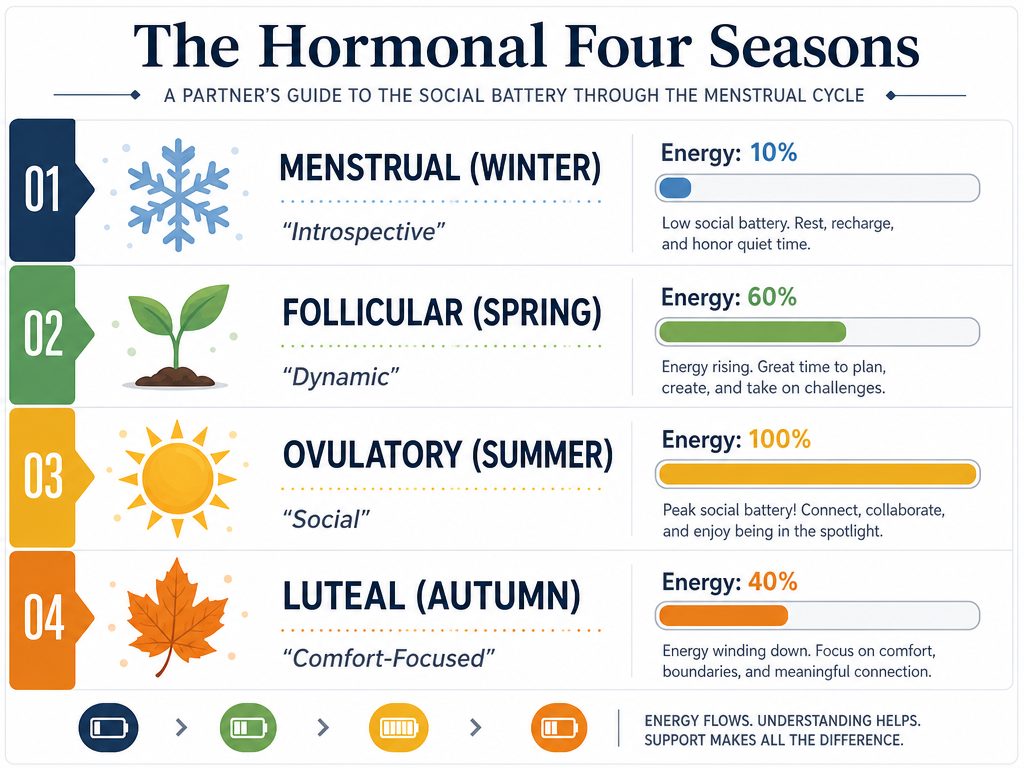 Understanding hormonal patterns throughout the cycle can help inform more intuitive and successful Valentine's Day planning.
Understanding Cycle Phases
Think of her cycle like four distinct phases, each with its own characteristics:
Menstrual Phase (Early Cycle): Both estrogen and progesterone are at their lowest. Her body is shedding the uterine lining, which can mean cramping, fatigue, and a strong need for rest. 88% of women experience physical cramps during their cycle. This is often a lower-energy period.
Follicular Phase (Mid-Early Cycle): Estrogen begins to rise steadily. Some women notice shifts in energy and mood during this phase, though experiences vary widely.
Ovulatory Phase (Mid-Cycle): Hormonal changes around ovulation can bring shifts in energy and comfort levels, though experiences vary considerably.
Luteal Phase (Late Cycle): After ovulation, progesterone rises and eventually both hormones decline. Some women experience increased sensitivity to stress, bloating, and fatigue during this phase. Physical symptoms like acne and sore breasts affect 60% and 70% of women respectively during the premenstrual window.
If you've been treating every day of the month the same, you've been planning dates in the dark. Learning which phase she's in and how it affects her personally gives you insight that can help you be a better partner.
You can learn more about how to support your girlfriend during different cycle phases to deepen your understanding of this framework.
The Tactical Playbook: Valentine's Day by Phase
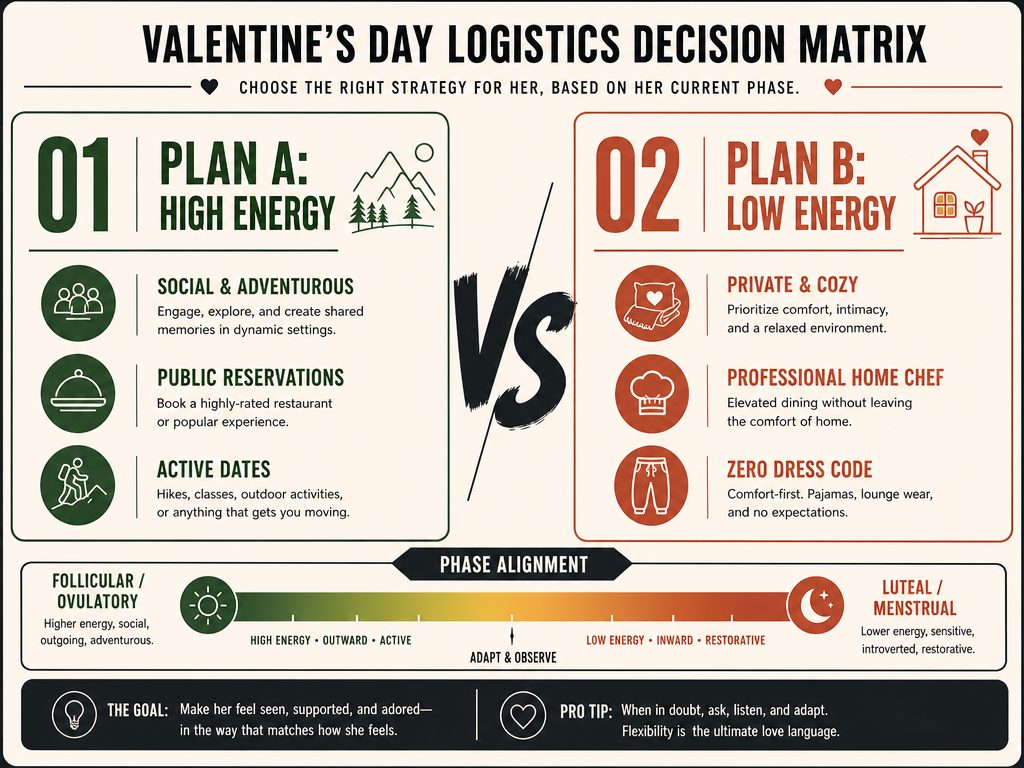 Use this strategic framework to prepare two distinct date options, ensuring a perfect Valentine's celebration regardless of where your partner is in her cycle.
Most Valentine's Day advice assumes she'll have infinite energy and enthusiasm on February 14th. But biology doesn't care what day it is. Here's how to think about planning with her cycle in mind, not against it.
The key is flexibility: have options ready that match different energy levels, and communicate with her about what sounds appealing.
If She's in the Menstrual Phase
Lower-key option: Consider a quiet, private setting like a spa day or a cozy evening at home. Have a heating pad ready, order her favorite takeout, and don't make her get dressed up. Your presence and willingness to take care of logistics can be meaningful here. Offering to handle dinner prep, laundry, or any other household task she'd normally do shows you understand what she might need.
What to Avoid: Don't book a loud restaurant with a long wait time. Don't plan a surprise that requires her to "rally" and put on makeup. Don't act disappointed if she's not in the mood for lingerie or physical intimacy - her body may be in pain, and she needs comfort, not performance pressure.
If She's in the Follicular Phase
Higher-energy option: If she's feeling energized, consider planning something more active or social. A group dinner with friends, tickets to a concert, or an active date like a hike or bike ride could work well if her energy supports it.
Stay-in alternative: If you're staying home, make it interactive. Try a cooking class, an art project, or an activity that engages her if she's in an exploratory mood.
What to Avoid: Don't assume a passive, low-energy date is what she wants. Ask what sounds good to her, since energy levels can vary.
If She's in the Ovulatory Phase
Special occasion option: Consider a high-end, dress-up dinner at a restaurant with ambiance if she's feeling comfortable and social. Live music, dancing, or any activity that creates a memorable experience may appeal.
Stay-in alternative: If you're staying home, make it an event. Dress up anyway, light candles, play music, and create the atmosphere of a special night.
What to Avoid: Don't underplay the occasion with a casual, low-effort approach if she's feeling good and wants something special.
For more insights on how to support your girlfriend during ovulation, check out our detailed guide.
If She's in the Luteal Phase
Quieter option: If you're going out, book a quiet, private booth at a low-key restaurant. Avoid loud environments, large groups, or anything overly stimulating. Social energy may be lower for some women during this phase.
Stay-in alternative: Hire a private chef to cook at home, or cook for her yourself. The key is eliminating tasks - she may not want to plan, coordinate, or make decisions. Let her show up in sweatpants if she wants. Taking things off her plate can be meaningful.
What to Avoid: Don't plan a surprise party. Don't invite friends over without warning. Don't assume she'll have energy for elaborate plans or public displays of affection.
If you want to dive deeper into this phase, read our guide on how to support your girlfriend during the luteal phase.
What to Do When Your Wife Is on Her Period on Valentine's Day
If her period lands on February 14th, don't panic. You're not doomed - you just need to adjust your strategy. Her body may be in pain, her energy may be low, and what she needs most is for you to reduce friction, not create it.
The No-Pressure Framework:
Ask her what sounds good. Don't present a single plan as a fait accompli. Give her options: "Would you rather stay in with takeout and a movie, or would you like me to book a quiet table somewhere low-key?"
Have the Period Kit ready. More on this below, but if you've stocked pain relievers, dark chocolate, and her preferred menstrual products in advance, you've shown thoughtfulness.
Take over logistics. If she's cooking dinner on a normal night, you're cooking tonight. If she usually does the dishes, you're doing them. Acts of service during her period can be particularly appreciated.
Don't act disappointed. If she's not in the mood for physical intimacy or a fancy night out, your reaction matters more than the date itself. Saying "I just want you to be comfortable" beats "But I planned this whole thing" every time.
Reschedule with intention. If she's genuinely miserable, suggest celebrating Valentine's Day the following weekend when she's feeling better. Frame it as "I want you to actually enjoy this," not "Well, I guess we'll just skip it."
The goal here isn't to eliminate Valentine's Day - it's to eliminate the performance pressure. Her period doesn't make her less romantic; it makes her body prioritize physical comfort. If you can meet her where she is, you'll be the partner she remembers.
Learn more practical strategies in our guide on how to comfort your girlfriend during PMS.
The Period-Proof Valentine's Kit
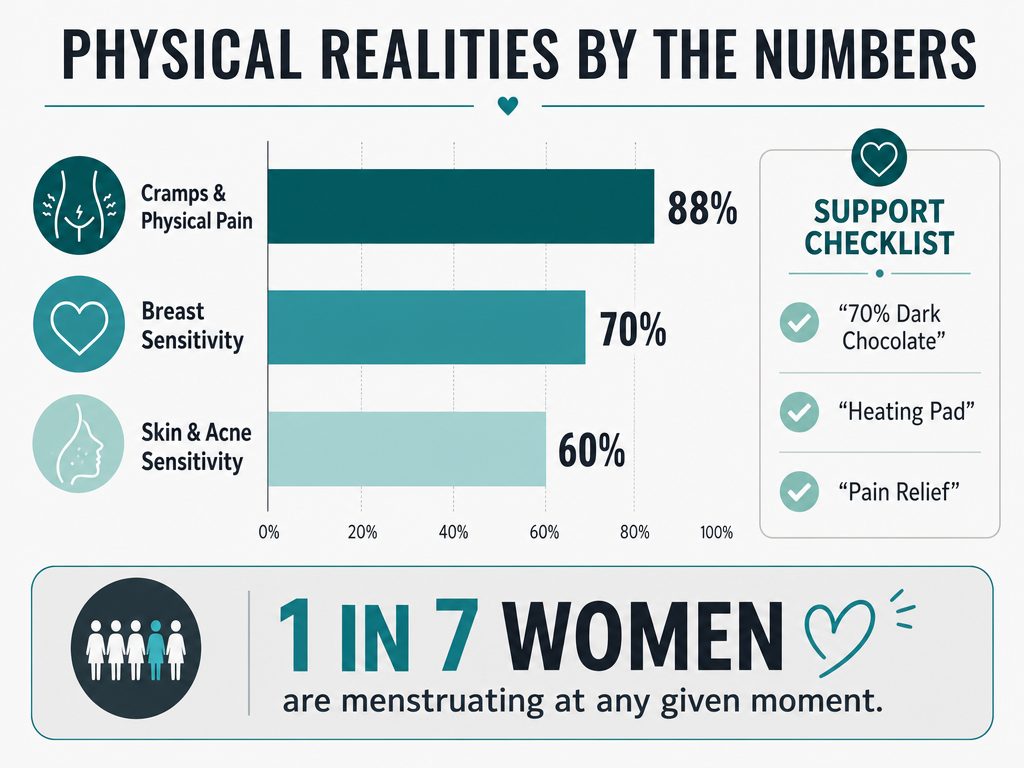 With 88% of women experiencing physical cramps, being prepared with a 'Period-Proof Kit' demonstrates thoughtfulness and active support during the holiday.
If you know her period might land near Valentine's Day, having a Period-Proof Kit ready shows you've anticipated her needs. This isn't about infantilizing her - it's about removing friction when her body is already dealing with discomfort.
What to Stock:
- Pain Relief: Ibuprofen or Midol. Ask her which one she prefers and keep it accessible.
- Dark Chocolate: High-quality dark chocolate is a common craving during menstruation and can be a comforting treat.
- Heating Pad or Hot Water Bottle: Physical heat can provide relief for menstrual cramps.
- Her Preferred Menstrual Products: Whether she uses pads, tampons, or a menstrual cup, have a backup supply so she never has to make a drugstore run when she's already uncomfortable.
- Comfort Food: Whatever she craves during her period - whether it's salty snacks, carbs, or a specific takeout order - know it and have it ready.
The Emotional Component:
Beyond physical supplies, supportive behavior matters. During her Menstrual and Luteal phases:
- Validate feelings, don't solve them. If she says she's exhausted or stressed, don't jump to "Here's how to fix it." Say "That sounds hard" and let her vent.
- Lower decision fatigue. Don't ask "What do you want for dinner?" when she's already overwhelmed. Say "I'm ordering Thai - does that sound good or should I grab something else?"
- Take over chores without being asked. The dishes, laundry, and grocery shopping don't disappear during her period. If you handle them proactively, she'll notice.
The kit is a symbol: you've been paying attention, you've planned ahead, and you're treating her period as a biological reality you're prepared to support.
For a comprehensive approach to supporting her through every phase, check out our 28-day relationship manual.
How to Act Around Your Girlfriend Based on Her Period Cycle
The question "How should I act around my girlfriend during her period?" is too narrow. Consider adjusting your awareness throughout the entire cycle, not just when she's bleeding. Here's a framework to consider:
General Principles Across Phases:
Ask, don't assume: Rather than guessing what she needs, check in: "What sounds good to you tonight?" or "Are you feeling up for going out, or would you rather stay in?"
Reduce friction during lower-energy phases: During menstrual and late luteal phases, handle logistics, reduce tasks, and create space for rest if she needs it.
Match her energy when it's higher: If she's initiating plans or suggesting activities, engage with enthusiasm rather than defaulting to low-key options.
Validate without fixing: Throughout the cycle, but especially during phases when she's more sensitive, acknowledge her feelings without trying to solve them immediately.
The Validation Approach:
During times when she's emotionally sensitive, saying "That doesn't make sense" or "You're overreacting" escalates the situation.
Instead, use validation:
- "That sounds really frustrating."
- "I can see why that would bother you."
- "What do you need from me right now?"
You're not agreeing that her feelings are objectively correct - you're acknowledging that they're real to her in this moment. That distinction matters.
To understand mood patterns more deeply, read our guide on how to predict girlfriend mood swings by cycle.
Communication: The Permission-Based Tracking Talk
 Master the 'Permission-Based Tracking' conversation using this three-step script to build trust and ensure your planning is always in sync with her needs.
If you want to track her cycle to plan better dates, you need her permission. Doing it covertly is invasive; doing it collaboratively is strategic. Here's how to have the conversation without sounding like you're turning her body into a science project.
The Permission Script:
"I've been reading about how your cycle can affect energy and mood throughout the month, and I realized I've been planning dates without considering where you are in that pattern. I want to be a better partner by understanding when you're likely to have high energy versus when you need more downtime. Would you be open to sharing your tracker app with me - or just giving me a heads-up when you're in a phase where you'd prefer low-key plans?"
Why This Works:
- It frames the conversation around your behavior (planning better dates) rather than her behavior (being moody).
- It asks for permission rather than assuming access.
- It gives her control over how much information she shares.
What Not to Say:
- "Are you on your period?" during an argument. This turns cycle tracking into a weapon.
- "You're just PMSing" as a way to dismiss her feelings.
- "I need to know your cycle so I can predict when you'll be difficult." This is the fastest way to end the relationship.
Respecting Privacy:
Some women are comfortable sharing full access to their cycle tracker. Others prefer to just give you a heads-up when they're entering the Luteal or Menstrual phase. Honor whichever boundary she sets. The goal isn't to surveil her - it's to support her.
If she's hesitant, start small: "Can you just let me know when you're not feeling up for big plans? I don't need to know specifics - I just want to be more considerate." Most women will appreciate the intention even if they're not ready to share full cycle data.
For tools to help with this process, explore our period calculator designed with partners in mind.
Frequently Asked Questions
How do I know if I'm in my luteal or follicular phase?
You won't - she will. But you can learn to recognize behavioral cues with her guidance. The most reliable method is tracking her cycle with her permission using an app that shows the four phases clearly. Apps like VibeCheck are built specifically for partners who want to understand and support their girlfriend's cycle. Ask her to share which phase she's in when it feels relevant to planning.
What are the worst days of the luteal phase?
Many women find the final few days before their period starts to be particularly challenging. This is the premenstrual window when hormonal shifts can trigger increased mood sensitivity, irritability, and physical symptoms. The luteal phase itself lasts around two weeks on average, but those last few days are when symptoms often intensify for women who experience them. If you're planning a major conversation, surprise, or high-energy date, it may be wise to check in with her first about timing.
Do you feel better in the luteal or follicular phase?
This varies significantly by individual. Some women notice higher energy and better mood during the Follicular and Ovulatory phases, while the Luteal phase can bring lower energy and increased sensitivity. However, every woman's experience is different - some women have minimal symptoms during the Luteal phase, while others struggle considerably. Don't assume her experience matches general patterns; ask her directly about how she experiences different phases.
How do I delay my period so I'm not on my period on Valentine's Day?
This question comes up frequently, but it's not something you should be suggesting or researching on her behalf. Delaying a period requires medical intervention - either hormonal birth control manipulation or prescription medication - and carries risks that should be discussed with a healthcare provider, not a partner. If she brings it up independently, you can be supportive, but don't pressure her to alter her cycle for a holiday. Instead, focus on planning a Valentine's celebration that works regardless of where she is in her cycle. If her period lands on February 14th, reschedule the celebration to the following week when she's feeling better. Framing it as "I want you to actually enjoy this" rather than "You ruined Valentine's Day" makes all the difference.
For more information on cycle-related topics, read our guide on whether stress can cause a period to come early.
Planning Valentine's Day around your girlfriend's cycle isn't about lowering your romantic standards - it's about raising your relationship intelligence. When you understand the biological rhythm that can influence her energy and mood, you can plan more thoughtfully. You become the partner who anticipates her needs rather than reacting to them after the fact.
The couples who thrive aren't the ones who ignore biology - they're the ones who work with it. Start learning about her cycle with her permission, adjust your plans accordingly, and see how communication improves when you're both aware of patterns that matter.
If you want a tool that turns cycle tracking into actionable daily guidance, check out VibeCheck - the relationship app built specifically for men who want to understand their partner's biological rhythm and become better partners in the process.
Tags

Related Articles
Continue reading to deepen your understanding
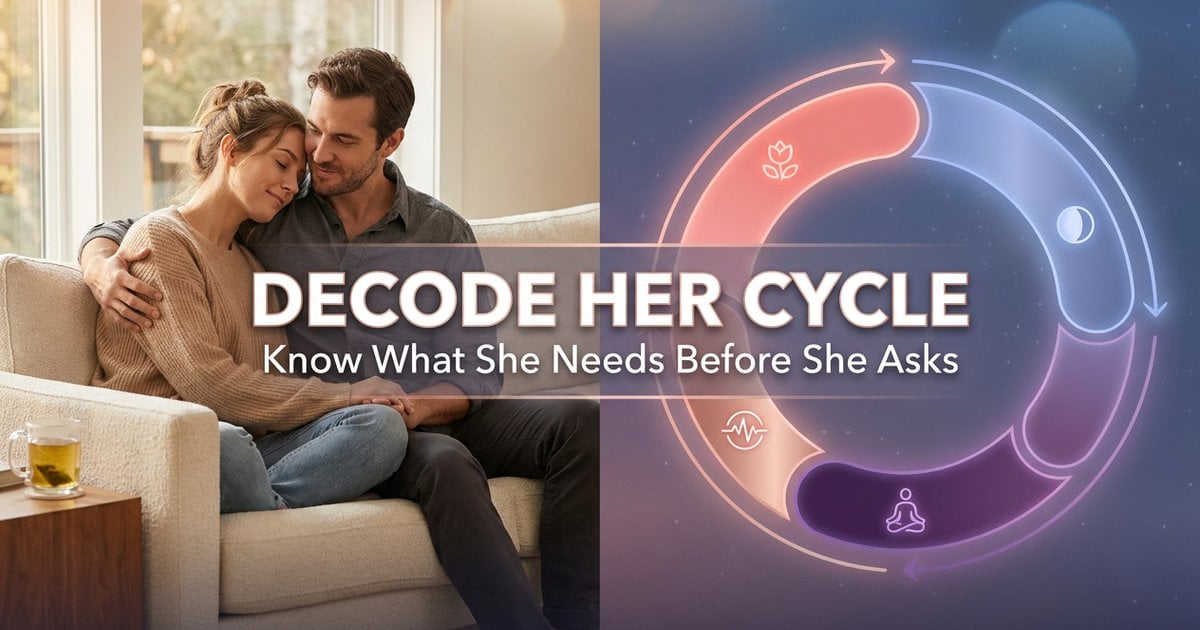
How to Plan Valentine’s Day Girlfriend Cycle
Knowing how to plan valentines day girlfriend cycle ensures 4 phases of biology-backed romance based on her energy levels, mood, and physical comfort.

How to Plan Romantic Gestures by Cycle Timing: The Partner’s Tactical Guide
Stop guessing why your date night plans fell flat. This guide explains how to synchronize your romantic efforts with her biological cycle for better intimacy and connection.

How to Tell When Your Girlfriend Is Ovulating: Reading the Biological Signals Your Partner Sends
Understanding your partner’s cycle helps you anticipate her needs and time important conversations. Learn the behavioral signs of ovulation to improve your relationship and connection.

Understanding Your Girlfriend’s Words of Affirmation Cycle: A Partner’s Guide
Ever feel like your compliments land wrong? Her need for words of affirmation isn’t random—it follows a biological rhythm. Learn how to match your support to her internal hormonal seasons.

The Partner’s Guide to the Luteal Phase: What It Is and How to Support Her
Stop walking on eggshells. Understand the biological changes of the luteal phase so you can support your partner through mood shifts and fatigue with empathy.

The Strategic Partner’s Guide to Planning an Engagement Around Her Cycle
Don’t leave your proposal to chance. Learn how her biological rhythm impacts emotional receptivity and how to align your big question with the phase where she feels her best.

How to Plan Weekend Trips Around Your Girlfriend’s Cycle: A Tactical Guide
Stop booking trips that end in friction. Learn how to map weekend travel to her biological phases to reduce friction by 41% and maximize your time together.

How to Plan Engagement Around Girlfriend Cycle Timing
Master how to plan engagement around girlfriend cycle timing to leverage an 800% estrogen spike and ensure a joyous yes with our 4-phase tactical guide.