How to Be a Better Boyfriend to Your Girlfriend

Learn how to be a better boyfriend to your girlfriend with actionable advice on communication, empathy, and building a deeper, more connected relationship.
Being a better partner isn’t about some grand, sweeping romantic gesture you see in movies. It's about the small stuff. The real work happens in the quiet, everyday moments, and it all boils down to showing up consistently. The biggest shift you can make is moving from a "fix it" mindset to one of genuine understanding. That’s a skill, and like any skill, you'll learn it.
The Real Foundation of a Great Relationship

Let’s be honest. Most guys never got a manual on how to be a great partner. We end up winging it, pulling ideas from movies, our parents, and a whole lot of messy trial and error. But what if there was a more straightforward way to build a stronger connection and really get your girlfriend?
Good news: there is. And it doesn’t require you to become a mind reader or change who you are. Learning how to be a better boyfriend to your girlfriend is about building simple, repeatable habits based on empathy and awareness. It’s less about one giant bouquet of roses and more about a thousand small, thoughtful moments.
This guide is that starting point. We're cutting through the noise to give you practical, actionable strategies that really work.
Ditch the "Fix It" Mentality
Here’s a classic mistake many of us make. Your girlfriend shares a problem, and your brain immediately leaps into problem solving mode. Your intentions are good. You want to help, to fix it.
But here's the thing: she's usually not looking for a solution. She's looking for a partner. She needs you to listen, validate how she’s feeling, and just be in her corner. Countless studies by relationship experts confirm that emotional validation is the bedrock of a secure partnership.
Key Takeaway: Your job isn't always to solve her problems. More often, it's to hear her problems and let her know you're on her team. Saying "That sounds really tough" is often more powerful than "Have you tried this?"
Focus on Consistent, Small Efforts
Big gestures are great for Instagram, but they don't sustain a relationship day to day. The real magic is in the daily grind. It's the small, consistent acts of kindness and attention that forge a deep, lasting bond.
Think of it like going to the gym. One massive, heroic workout won't get you in shape. It's showing up consistently that builds strength over time. Your relationship is no different. These small efforts compound, creating a powerful foundation of trust, intimacy, and security.
To get started, here are a few things you can implement right away. These aren't complicated. They're simple choices that communicate respect, care, and a true sense of partnership.
Three High Impact Actions to Take Today
| Action | Why It Works | Simple Example |
|---|---|---|
| Practice Active Listening | It shows you genuinely value her thoughts and feelings, making her feel seen and heard. It's about presence, not just hearing words. | When she's talking, put your phone away. Make eye contact. Ask a follow up question like, "Wow, what was that like for you?" |
| Offer Proactive Support | Taking initiative removes the mental load from her shoulders and demonstrates that you're an equal partner in the relationship. | Instead of asking, "Do you need help with dinner?" try, "I've got dinner tonight, why don't you relax for a bit?" |
| Give Specific Appreciation | Vague compliments are nice, but specific ones show you're paying attention to the details that make her unique. | Don't just say, "You look nice." Say, "I love the way your eyes light up when you talk about your new project." |
By focusing on these fundamentals, you start building the kind of relationship that feels supportive and connected for both of you. And ultimately, that’s what being a great boyfriend is all about.
Getting Good at Empathetic Communication
If you want a stronger relationship, communication is your superpower. Seriously. It’s the one skill that separates the guys who are just guessing what she needs from the guys who actually get it. But here’s the thing. Great communication isn’t about just swapping words. It's about connecting with the feeling underneath them.
This is where a lot of us stumble. We're wired to listen so we can find a solution or form our reply, not to truly understand. Becoming a better partner means flipping that switch. Your main goal isn't to solve the problem. It's to hear the emotion behind what she's saying.
Don't Just Hear Her, Really Listen
"Active listening" might sound like something from a therapist's office, but it's a real world, practical skill. It just means you’re locked in. Phone is face down. TV is off. Your focus is 100% on her.
Let's play out a common scene. She gets home after a rough day and vents, "My boss was a nightmare today. He doesn't appreciate a single thing I do."
- The typical "fix it" guy response: "You should just tell him off," or "Why don't you start looking for a new job?"
- The active listener's response: "Ugh, that sounds totally draining. It must feel awful to put in all that work and get no recognition for it."
See that difference? The first response jumps to solutions she’s probably already considered. The second one connects with her feeling, showing her you understand why she's upset. That connection is what she’s really looking for.
You Don't Have to Agree to Validate Her Feelings
Validation is a total game changer. Let's be clear. It doesn't mean you agree with her or think her reaction is perfectly logical. It just means you accept that her feelings are real for her.
Simple phrases like "I can see why you'd feel that way" or "That sounds so frustrating" aren't you admitting she's right. They're you saying, "I see you, and I'm with you in this." You’re on her team, not watching from the sidelines.
Key Takeaway: Validation is the ultimate relationship hack. It shuts down conflict and builds a sense of emotional safety faster than almost anything else. You're not admitting fault. You're just acknowledging her reality.
This one small shift can completely change how you talk to each other, turning what could have been an argument into a moment where you actually feel closer. For a deeper dive with more specific scripts, check out our full guide on how to achieve better communication in relationships.
The Power of the Weekly Check In
If listening and validating are the tools in your kit, the weekly check in is where you schedule the maintenance. It might sound a bit formal, but it’s really just about setting aside a dedicated, no pressure time to talk about the relationship itself.
This isn’t a time to air out a long list of complaints. The point is to create a safe space to talk about what’s working, what's been on your minds, and how you can have each other's backs in the week ahead. It keeps the small stuff from becoming big stuff.
This simple habit can make a huge difference. While only 28% of couples feel they 'always communicate effectively,' research shows that couples who do weekly check ins are 80% more likely to be deeply satisfied with their relationship. You can read more about the study on relationship satisfaction.
Here’s an easy way to get started:
- What went well this week? Always start with the good stuff. What did she do that you really appreciated?
- Was there anything that felt a little off? This is a chance to gently bring up minor issues.
- How can I be a better partner to you next week? This is proactive and shows you’re committed.
Making this a regular thing builds a solid foundation of open dialogue and mutual support. And that’s what a great partnership is all about.
Understand Her Natural Rhythm
Look, her energy levels, mood, and even how social she feels aren't just random. Most of the time, they’re tied to a predictable monthly rhythm driven by hormones. Getting a handle on this isn't about knowing a bunch of biological details. It's about seeing the pattern so you can time your support, plan better dates, and connect on a much deeper level.
Learning how to be a better boyfriend to your girlfriend means seeing her as a whole person, and her cycle is a huge part of her physical and emotional reality. This awareness gives you a massive advantage. It helps you anticipate what she might need and show up in a way that actually makes a difference.
True empathetic communication really boils down to three simple, powerful actions: you hear her, you validate what she’s feeling, and you check in.
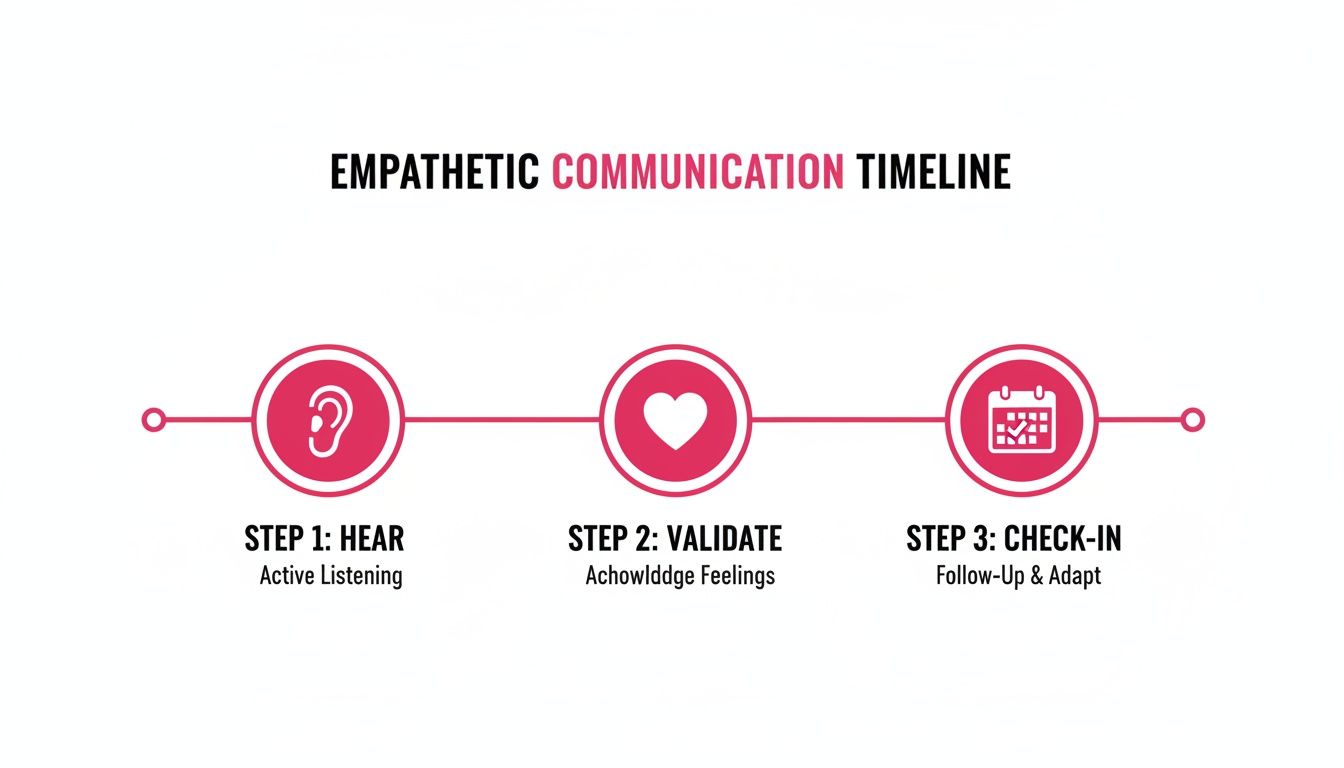
This isn't complicated. It's just a sequence of thoughtful moves that build trust and connection over time.
The Four Phases in Simple Terms
You don't need a biology degree for this. The easiest way to think about her month is in four distinct "seasons," each with its own vibe and energy level. Knowing which season she's in helps you plan better and show up as a more tuned in partner.
The Menstrual Phase (Days 1-7ish)
This is when her period starts, and it's the beginning of her cycle. Key hormones like estrogen and progesterone are at their lowest. Think of this as her body’s "winter."
- Her Vibe: Energy is usually pretty low. She might feel more withdrawn, tired, and just want to be comfortable. Cramps and physical discomfort are also super common during this time.
- How You Can Help: This is your moment to be a rockstar of support. Think comfort. Offer to handle dinner, bring her a heating pad, or just chill for a quiet movie night on the couch. Don't push for big social outings. Your job is to be a calm, steady presence.
The Follicular Phase (Days 1-13ish)
Once her period ends, her body enters its "spring." Estrogen starts to rise, which gives her energy, mood, and confidence a serious boost. She’s likely feeling more creative, optimistic, and ready for new things.
- Her Vibe: She's probably feeling energetic, social, and ready to take on the world. Her brain is sharp, and she’s often at her most resilient.
- How You Can Help: Now is the perfect time to plan that fun, adventurous date. Suggest trying a new restaurant, hitting a concert, or even tackling a project together. If you need to have any important conversations, now is a great time when her energy is high.
Key Takeaway: Syncing your plans with her energy can make all the difference. An amazing date idea at the wrong time can fall flat, while a simple gesture at the right time can mean the world.
A deeper understanding of her cycle can be a total game changer. You can learn more in our guide explaining why a period tracker for men is a relationship tool.
The Ovulatory Phase (Around Day 14)
This is the peak of her cycle—a short "summer" window that only lasts a few days. Estrogen and testosterone are at their highest, and she’s likely feeling her most confident, social, and connected.
- Her Vibe: Confident, outgoing, and communicative. Her libido is also typically at its highest during this phase.
- How You Can Help: Go for it. Plan that big social event or a romantic night out. She’s primed for connection and fun, making it a great time to express your feelings and deepen both your emotional and physical intimacy.
The Luteal Phase (Days 15-28ish)
This is her body's "autumn." After ovulation, hormones shift again. Progesterone rises, and then both progesterone and estrogen drop right before her period starts. That hormonal dip is what often triggers premenstrual symptoms (PMS).
- Her Vibe: You'll notice her energy gradually decrease. She might feel more sensitive, anxious, or get irritated more easily in the days leading up to her period. She may also crave alone time or get the urge to nest and organize things around the house.
- How You Can Help: Patience and reassurance are your best friends here. It's crucial not to take her sensitivity personally. Offer a listening ear without trying to fix anything, take a few things off her plate, and give her space if she needs it. Small acts of kindness have the biggest impact now.
Research that looked at 593 couples found that relationship satisfaction can swing quite a bit, even from one day to the next. But here's the kicker. The study also showed that couples who learn to sync up and navigate these shifts together build a much stronger, more stable bond. This kind of awareness turns you into that steady, reliable partner she can always count on, no matter what day it is.
Your Daily Guide to Being a Better Partner

Understanding the science behind her cycle is a great start. But let's be honest. When your partner has had a rough day, you're not going to be thinking about the definition of the "luteal phase." You just want to know how to show up for her.
This is where the real work begins. Turning that big picture knowledge into small, meaningful actions. The goal is to shift from knowing about her to truly knowing her. It's about making empathy a daily habit, not a one time research project. That’s how you truly learn how to be a better boyfriend to your girlfriend.
From Information to Action
You don't need a PhD in hormones to be a great partner. What you do need is a simple way to connect the dots between what's happening in her body and how you can be the supportive guy she needs in that moment.
This is exactly where a tool like VibeCheck can make a huge difference. Think of it as your daily playbook. A simple, personalized heads up delivered right to your phone. It translates all that complex cycle information and relationship psychology into clear, actionable advice. It’s not about telling you what to do, but giving you the context to make a more thoughtful move.
What This Looks Like in Real Life
Imagine waking up to an insight that says something like, "Her energy might be dipping today as she enters her luteal phase. A great time for quiet support. Maybe handle a chore she dislikes without being asked."
That single prompt can completely change the vibe of your entire day.
- Without the insight: You come home, sense she’s quiet, and immediately think, "Is she mad at me?" That assumption can easily lead to a defensive conversation or a needless argument.
- With the insight: You walk in the door already understanding she might just be drained. Instead of a loaded "What's wrong?" you can say, "Hey, you look beat. Why don't you relax? I've got dinner covered tonight."
See the difference? It’s massive. You've gone from being reactive and confused to proactive and supportive. You haven't "fixed" her day, but you've shown up in a way that meets her exactly where she is. That's what builds a rock solid connection.
Key Takeaway: The right information at the right time turns guesswork into genuine thoughtfulness. It doesn’t replace your intuition. It gives it a solid foundation to work from.
Timing Your Support Perfectly
So much of a great relationship comes down to timing. Knowing when to suggest an adventurous date versus a quiet night in, or when it’s a good time to have a serious talk, can make all the difference.
VibeCheck helps you become the partner who consistently gets the timing right.
- Planning Dates: The app might suggest an active, social date night during her follicular or ovulatory phase, when her energy is naturally at its peak.
- Having Tough Talks: It could recommend having that important conversation when she’s in her follicular phase, as she’s more likely to feel resilient and clear headed.
- Offering Comfort: It will also remind you that during her late luteal and menstrual phases, small acts of service and emotional reassurance are often the most powerful ways to show you care.
This isn't about gaming the system. It's about creating the best possible conditions for you both to connect and thrive by working with her natural rhythm, not against it. Being more intentional with your timing reduces friction and creates more opportunities for positive interactions, which is the foundation of solid relationship advice for men.
Over time, this consistent effort builds an incredible amount of trust. She starts to see you as the guy who just gets it, someone who’s tuned in all the time, not just when it’s convenient. That’s what separates a good boyfriend from a truly great partner.
Build a Lasting Connection Through Emotional Safety
Look, the real goal here isn't just to check boxes and be a "good" boyfriend. It's to build a relationship where you both feel completely secure, seen, and valued for exactly who you are.
That feeling is called emotional safety, and it’s the bedrock of a partnership that can weather any storm.
Think of it like the foundation of a house. You can have great communication (the windows) and incredible intimacy (the furniture), but if the foundation is cracked, the whole structure feels shaky. When your partner feels emotionally safe, she knows she can be her truest self around you without ever fearing judgment, blame, or criticism.
This isn’t some fluffy, abstract concept. It's the core ingredient for long term happiness. In fact, mindful partners report 20% higher satisfaction in their relationships. You can see the full breakdown of relationship stats for yourself.
Be Her Safe Harbor, Not Another Storm
So, how do you actually create this feeling? It all starts with being a man of your word. Emotional safety is built on a mountain of kept promises, both big and small. She needs to know that when you say you'll do something, it gets done.
- Follow Through Religiously: If you say you'll call at 8, call at 8. If you offer to pick up milk on the way home, come back with the milk. These small acts of reliability build a massive bank of trust over time.
- Be Her Rock: Life is going to get tough. On her worst days, she needs to know she can turn to you for support, not more stress. This means being a calming presence when she’s spinning out and her biggest cheerleader when she feels defeated.
Your consistency proves your reliability, which is the cornerstone of trust. It sends a powerful message: she can count on you, no matter what.
Handle Fights Without Drawing Blood
Let's be real. Conflict is going to happen. The difference between a healthy partnership and a toxic one is how you navigate those disagreements. Emotional safety means she knows a fight won't threaten the entire relationship.
You have to learn to fight the problem, not each other. That means dropping the blame game and personal attacks for good.
Instead of pointing the finger with, "You always do this," try framing it from your perspective using "I feel" statements. For example, "I feel a little disconnected when we're both on our phones through dinner."
This small shift changes everything. It invites teamwork instead of escalating the conflict. The dynamic moves from you vs. her to us vs. the problem. When she knows she can bring up an issue without it turning into an attack on her character, she’ll feel safe enough to be truly open with you. Learning how to be more emotionally available is a huge part of mastering this skill.
Key Takeaway: In any disagreement, your goal isn't to win the argument. Your goal is to understand her perspective and find a solution together. A "win" for you that's a "loss" for her is always a loss for the relationship.
Small, Specific Appreciation Goes a Long Way
Finally, emotional safety thrives on appreciation. You probably think she’s incredible, but how often do you actually say it? And more importantly, how are you saying it?
Vague compliments are fine, but simple, specific ones can completely change the dynamic of your relationship. Thanking her for something specific she did or noticing a small detail about her shows you truly see and value her.
- Instead of: "You're great."
- Try: "I really admire how you handled that tough conversation with your family. You were so calm and clear."
This kind of specific praise proves you're paying attention. It makes her feel seen not just for what she does, but for who she is. By building this environment of trust, respect, and genuine appreciation, you forge a bond that makes you both feel like you can take on the world, together.
Got Questions? Let's Talk.
It’s a good sign you have questions. It means you’re actually thinking about this stuff and want to get it right. Here are some of the most common things guys ask when they’re trying to figure out how to be a better boyfriend to your girlfriend.
How Can I Support Her During Her Period Without Being Awkward?
First off, relax. You don't need to make a big production out of it. Honestly, the best support is often the most low key and practical. It’s less about grand gestures and more about just doing things.
- Handle the small stuff. Take a few chores off her plate without her having to ask. Cook dinner, do the dishes, or run that errand she’s been putting off. You’re lightening her load when she’s already feeling drained.
- Offer comfort, not cures. She’s not a problem to be solved. Don't try to "fix" her discomfort. Instead, just offer things that bring comfort. A simple, "Hey, I'm running to the store, can I grab you any snacks or a heating pad?" shows you’re tuned into her needs.
- Just be there. Sometimes, the best thing you can do is simply exist nearby. Sit with her on the couch and watch her favorite show, even if you can't stand it. Your calm presence can be incredibly reassuring.
The goal here is to be a source of ease, not another thing she has to manage. This is a core idea behind using a period tracker for men. Being aware helps you act with intention.
What If I Don't Agree With Why She's Upset?
This is a big one. It's a classic tripwire for a lot of guys. The key is to separate her feeling from her reason. You don't have to agree with her logic to validate her emotion. Her feelings are real in that moment, and your job is to acknowledge them, not debate them.
Remember This: Validation isn't agreement. It's just acknowledging that you see and hear her. Saying, "I can see why that would be really frustrating for you," doesn't mean you think her boss was a jerk. It just means you get why she is frustrated.
Focus on her emotion, not the "facts" of the situation. When you show her you’re on her team emotionally, you build trust and can stop a small disagreement from blowing up into a big fight.
She Says I Don't Listen, But I Hear Every Word. What's Going On?
You might be hearing the words, but are you hearing the music? There's a huge difference between passively hearing someone and actively listening. She's not just giving you a report. She’s reaching out for a connection.
She just wants to feel seen.
- Put your phone down. All the way down. Make eye contact and give her your full attention.
- Ask better questions. Go beyond the surface. Inquiries like "What was that like for you?" or "Wow, how did that make you feel?" show you’re trying to understand her experience, not just the plot of her story.
- Play it back. Briefly summarize her feelings. "Okay, so it sounds like you felt totally unappreciated at work today." This proves you were actually processing what she said.
This small shift takes you from being a sounding board to being her partner in the conversation.
How Often Should We Have "Serious" Relationship Talks?
Don't. At least, don't force them. Staging a "serious talk" can feel like you’re both about to walk into an ambush. A much better approach is to make connection a regular, low pressure habit.
This is why a weekly check in is so powerful. It's not a formal meeting. It’s just 15-20 minutes to touch base. Ask a few simple questions:
- What was one of your favorite moments with me this week?
- Was there anything that felt a little off or that we could have handled better?
- Is there anything you need from me in the week ahead?
This kind of consistent, casual chat stops small annoyances from snowballing into huge resentments. It creates a safe space to talk, which is the foundation of any solid relationship advice for men.
What's the Best Way to Apologize When I Screw Up?
A real apology has three parts. Most guys only do the first one, which is why their apologies often fall flat.
- Say you’re sorry. State it clearly and without excuses. "I am sorry for what I did."
- Acknowledge the impact. This is the part you can't skip. Show her you understand how your actions affected her. "I know that when I was late, it made you feel like I don't value your time."
- Explain what you’ll do differently. This shows you’re serious about not letting it happen again. "From now on, I'm going to set a reminder on my phone so I leave on time."
Without steps two and three, an "I'm sorry" can feel pretty empty. A full apology, on the other hand, rebuilds trust and shows you’re taking real responsibility.
Ready to put these ideas into practice? VibeCheck is the relationship app for men that gives you personalized, daily tips to help you understand and support your partner better.
Download VibeCheck and start building a stronger connection today.
Tags

Related Articles
Continue reading to deepen your understanding

How to Understand Your Girlfriend’s Social Battery and Hormones
Does your girlfriend suddenly cancel plans or seem withdrawn? This guide explains how her cycle impacts her energy so you can support her like a pro.

How Your Girlfriend’s Emotional Needs Change During Her Cycle
Does your girlfriend’s mood seem unpredictable? Learn how her emotional needs shift on a biological loop and how to support her through every phase of her cycle.

What to Buy When Your Girlfriend Has Hormone Cravings: A Support Guide
Stop wondering what to pick up at the store. This guide explains the science behind cycle cravings and provides a specific list of foods and comfort items she needs.

Your Girlfriend’s Mood Shifts Throughout the Month, Explained
Ever wonder why her energy and moods change so drastically each week? Understand the four hormonal phases and how to be the partner she needs during every stage of her cycle.

How to Support Your Girlfriend When She’s Crying Because of Hormones
Watching her cry when hormones hit can feel overwhelming. Learn the biological why behind the tears and use these proven scripts to provide the support she actually needs right now.

How to Help Your Girlfriend with Hormonal Mood Swings Without Arguing
Understand her cycle and learn tactical scripts to handle tension. This guide shows you how to support her through hormonal shifts without getting into unnecessary fights.

When to Feed Your Girlfriend: Understanding Hangry Hormones
Does your girlfriend get irritable when she hasn’t eaten? It’s not just in her head. Learn why hormones cause hanger and the specific times her body needs more fuel.

The Boyfriend’s Guide to Supporting Your Partner Through PMS
If your partner is suddenly irritable and exhausted, it’s biology, not you. Learn about the luteal phase and how to provide meaningful support without walking on eggshells.