Master Relationship Communication for Men: Practical Tips for Better Talk
Master relationship communication for men with science-backed tips to improve conversations and strengthen your connection.
It all starts with one simple, powerful shift in your thinking: move from being a problem-solver to being a perspective-seeker. Instead of launching into solutions, your first job is to truly understand the emotion driving her words. This one change can transform frustrating arguments into moments of real connection. Excellent relationship communication for men isn't about having all the answers. It's about asking the right questions and truly listening.
Why Your Conversations Keep Hitting a Wall

Does this sound familiar? Your partner gets home, clearly upset, and starts telling you about a frustrating situation at work. Your brain instantly switches into high gear, analyzing every detail to come up with the most logical, step by step fix.
You lay out your brilliant plan. But instead of gratitude, you get a frustrated sigh. "You're not listening," she says. You're baffled. You heard everything she said and gave her a perfect solution.
This is the classic communication breakdown between men and women. It's not about who's right or who wins. It's about recognizing that what you hear and what she needs can be two completely different things. That powerful, hard wired instinct to fix things often misses the entire point of the conversation.
Hearing Words vs. Understanding Emotion
For most guys, communication is about swapping information. The mission is to identify a problem and solve it. Fast. But for her, the conversation is often about feeling an emotional connection first. Problem solving can come later, if at all.
When she's sharing a struggle, she's usually looking for validation, not a five point action plan. She needs to feel like you're in her corner, that you get why she's upset or overwhelmed. When you jump straight into "fix it" mode, you might be accidentally sending messages you don't intend:
- "Your feelings are a problem." It can make her feel like her emotions are an inconvenience to be cleared away.
- "You can't handle this yourself." It can sound like you doubt her ability to manage her own life.
- "I don't care how you feel." By bulldozing past the emotion, you miss the chance to truly connect.
The real work isn't about becoming a better debater or having the perfect answer. It's about becoming a safe harbor for her thoughts and feelings, a place where she feels completely understood without judgment.
This is exactly why becoming a great listener is a non negotiable skill. It's what separates a relationship that feels like a true partnership from one that feels like a constant battle. This is a core part of our relationship advice for men.
The Science of Connection and Hormones
It's not just a difference in communication styles, either. A woman's needs in a conversation can literally change from week to week because of her hormonal cycle. The natural rise and fall of estrogen and progesterone impact everything from her mood and energy to her emotional sensitivity.
During certain phases of her cycle, she might be more resilient and open to logical solutions. At other times, she may feel more vulnerable and simply need emotional support and reassurance. Being aware of these natural rhythms is a game changer.
This knowledge allows you to adapt your approach. You learn when to lead with empathy and when it's the right time to offer practical advice. This isn't about walking on eggshells. It's about being tuned into her reality. The very foundation of science backed empathy.
And the payoff is huge. In relationships where partners rated each other as good listeners, a whopping 63% were thriving. For couples with poor listeners, that number plummeted to just 1.4%. Mastering this one skill can dramatically stack the odds in your favor. You can learn more about communication skills for relationship success and see the data for yourself.
Changing your role from problem solver to perspective seeker is the first, most critical step in improving your relationship communication for men. It builds the trust and intimacy needed for a bond that can weather any storm.
The Art of Listening Without Fixing
Let's be honest, the instinct to fix is strong in most men. When your partner comes to you with a problem, your brain immediately starts searching for a solution. It's a genuine sign of care, but it's often the exact opposite of what she needs in that moment.
This is probably the single biggest hurdle in relationship communication for men: learning to shift from being a fixer to being a listener. The goal isn't to provide an answer. It's to provide a safe space where she feels completely seen and heard.
Why Your Solutions Get Shut Down
Think about it this way. She's telling you she's caught in a storm. Your first impulse is to hand her an umbrella, a raincoat, and a map to the nearest shelter. But what she really wants is for you to stand in the rain with her for a minute and say, "Wow, this storm is intense. I'm right here with you."
When you jump straight into problem solving mode, it can accidentally send the message that her feelings are an inconvenience. Something that needs to be tidied up and put away. Active listening, on the other hand, communicates deep respect and partnership. It shows you trust her to handle her own problems, but you're there to support her emotionally no matter what.
The most powerful thing you can do is make her feel like she's the most important person in the room. This isn't achieved by solving her problems, but by truly understanding her experience of them.
Practical Ways to Listen Actively
Active listening isn't just about staring silently and nodding along. It's an engaged process. You have to participate in the conversation without completely taking it over. It's a skill you can learn, and you can start practicing it tonight.
Here are a few simple, non cheesy techniques that actually work:
- Reflect Back What You Hear: This is the simplest and most effective tool in your arsenal. After she shares something, just summarize it in your own words. It proves you're paying attention and gives her a chance to clarify. For example, "Okay, so what I'm hearing is you felt totally undermined in that meeting when your boss took credit for your idea. That sounds incredibly frustrating."
- Ask Open Ended Questions: Avoid questions that can be answered with a simple "yes" or "no." Instead, ask questions that invite her to share more. Think "How did that make you feel?" or "What was that like for you?" instead of just "Was it a bad meeting?"
- Name the Emotion: This is where you can score major points because it shows you're listening on a much deeper level. Try to identify the feeling behind her words. Phrases like, "It sounds like you felt really disappointed," or "I can see why you'd be so angry about that," connect with the emotion, not just the facts of the story.
Phrases That Validate, Not Dismiss
Validation is the secret sauce here. It's simply the act of acknowledging her feelings as real and valid, even if you don't fully understand or agree with them.
Here are some go to phrases to keep in your back pocket:
- "I get why you'd feel that way."
- "That makes total sense."
- "That sounds really tough."
- "Tell me more about what happened."
- "I'm on your team here."
Notice that none of these phrases offer a solution. They offer solidarity. They build a bridge of connection, which is often all she was looking for in the first place. You can find more powerful ways to improve your connection in our guide to communication tips for couples.
By putting down your toolbox and just listening, you give your partner something far more valuable than a quick fix. You give her your full attention, your empathy, and a profound sense of security. You're telling her, "Your feelings are safe with me," and that is the foundation of unbreakable trust.
How to Communicate in the Digital Age
Let's face it. Texting, DMs, and late night calls are just part of relationships now. They've completely changed how we connect. But without being able to see her face or hear the tone in her voice, a simple message can get twisted into something you never intended. Getting this right is a modern skill, and it's a huge part of showing up for your partner, especially when you're not in the same room.
It's not about finding the perfect emoji. It's about knowing which tool to use and when. Is this a quick "thinking of you" text, or does this conversation need the nuance that only a phone call can provide? Choosing the right channel can be the difference between a minor hiccup and a major fight.
Texting Traps and How to Sidestep Them
Texts are built for speed, not for depth. That's their biggest strength and their most glaring weakness. Because you can't hear tone or see a smile, it's incredibly easy for your playful joke to land like a criticism, or for a simple question to feel like an interrogation.
This gets especially dicey during disagreements. One study on couples' communication found that while about 49% use digital channels for daily check ins, things get complicated when arguments flare up. Even though most of us know it's better to talk in person, over 25% of women and 20% of men admit they prefer to text during a fight. This is where things get really risky, because all the emotional context just vanishes. You can see the full breakdown of how couples communicate digitally to get a clearer picture.
Here are a few common traps I see guys fall into all the time:
- The Rapid Fire Barrage: Sending five messages in a row when one would've worked. It can feel overwhelming and come across as anxious or demanding, even if you're just thinking out loud.
- The One Word Shutdown: Replying with "K" or "Fine." It feels cold and dismissive, instantly killing the conversation and leaving her wondering what she did wrong.
- Texting About Big Feelings: This is a big one. Serious topics deserve a real conversation. Never break up, start a huge argument, or dive into deep emotional issues over text. It's a guaranteed recipe for misinterpretation and hurt.
Knowing When to Actually Pick Up the Phone
Here's a simple rule of thumb. If the conversation involves real emotion, switch from your thumbs to your voice. Hearing you provides a warmth, sincerity, and reassurance that a text message just can't deliver. Period.
A phone or video call shows you're willing to give her your undivided attention. It sends a clear message: "This is important, and you are important to me." This is especially vital for guys in long distance relationships, where these calls are the absolute lifeline for connection.
The goal of your digital communication isn't just to pass along information. It's to maintain emotional intimacy, even when you're miles apart. One well timed call can do more for your relationship than a hundred texts.
If you're trying to figure out the right things to say in those texts to keep the connection strong, it helps to have some ideas in your back pocket. We put together a guide on what to text your girlfriend to help you send messages that actually build her up.
Choosing to listen first is the key to connection in any conversation, whether it's over the phone or in person. This decision tree breaks it down.
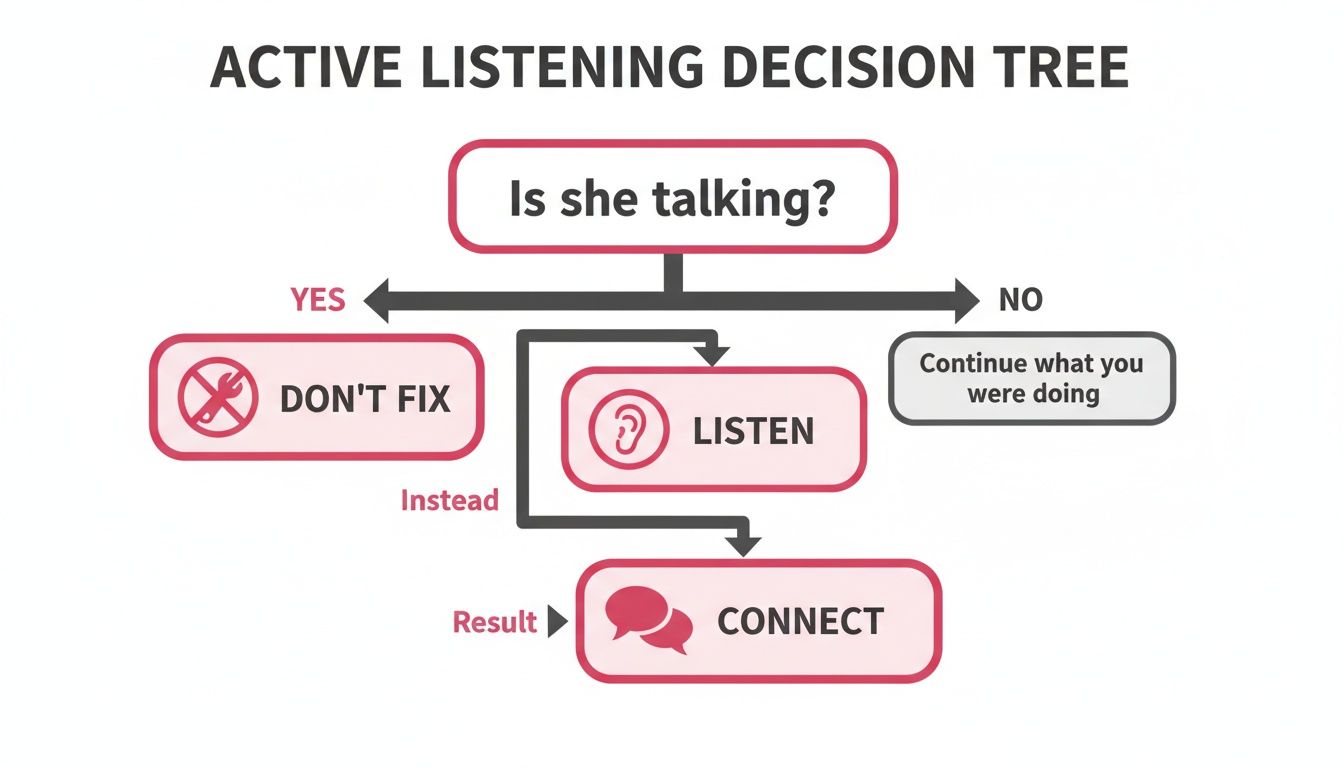
The real insight here is that connection isn't a side effect of solving her problems. It's the direct result of making her feel truly heard.
Choosing the right channel is a skill, and it's one you can learn. Here's a quick guide to help you decide whether to send a text or make a call.
When to Text Versus When to Call
| Situation | Best Channel (And Why) | Avoid This Channel (And Why) |
|---|---|---|
| Quick check in or "thinking of you" message | Text. It's low pressure, sweet, and lets her know she's on your mind without interrupting her day. | Call. A call for something minor can feel intrusive if she's busy or focused on something else. |
| Making simple plans (e.g., "Dinner at 7?") | Text. It's efficient for logistics and gives a clear record of the details you've both agreed on. | Call. Unless plans are complex, a call can be overkill and less convenient for a quick confirmation. |
| She's had a rough day and is venting | Call. Your voice conveys empathy and support that text can't. It shows you're truly present for her. | Text. One word answers or advice giving via text can feel dismissive and make things worse. |
| You need to apologize or clear up a misunderstanding | Call. Tone is everything here. An apology needs to sound sincere, which is impossible to guarantee over text. | Text. A texted apology often feels cheap and can easily be misinterpreted as you not taking it seriously. |
| Celebrating a win or sharing good news | Call. Hearing the excitement in your voice makes the moment feel more shared and special. | Text. A text can feel a bit flat for big news. It doesn't capture the genuine joy of the moment. |
Ultimately, thinking before you type or dial shows you're being intentional. It's a small habit that pays off in a big way by preventing unnecessary friction.
Using VibeCheck for Digital Cues
So how do you know if today is a good day for a funny meme or if she might need something more substantial? This is where having a little inside info can make all the difference.
VibeCheck helps take the guesswork out of your digital interactions. The app gives you daily insights based on where she is in her hormonal cycle, which can absolutely influence her mood and communication preferences. Our VibeCheck period tracker for men gives you this crucial context.
For example, you might get a heads up that she's in a phase where her energy is low and she's more sensitive. On a day like that, a supportive, low pressure text ("Hey, just thinking of you. Hope you have a great day.") might land perfectly. A call demanding a big decision, on the other hand, might feel totally overwhelming. VibeCheck gives you the context to make your digital communication more thoughtful and in sync with her needs, turning your phone back into a tool for connection, not confusion.
Why Your Daily Check In Is Everything
We tend to think relationships are built on grand gestures. The big vacation, the anniversary dinner, the movie style declaration of love. But if you talk to anyone who's been in a long term, happy partnership, they'll tell you the real magic is in the small stuff. The real strength of your bond is forged in the quiet, everyday moments.
Those seemingly random conversations you have while making coffee or right before bed are the very foundation of your connection. They're far more powerful than you might think, acting as the glue that holds everything together. Get them right, and you build a massive reserve of goodwill and intimacy. Get them wrong, and you silently chip away at the connection until one day, you realize there's not much left.
The Hidden Power of Everyday Chatter
Daily chit chat might feel insignificant, but it's where the real work of a relationship happens. Don't just take my word for it. A fascinating study from the National Institutes of Health actually tracked couples with audio recorders to see what was really going on.
The findings were eye opening. Men spoke an average of 4,205 words to their partners each day. Nearly the same as women. Yet, just six months later, a staggering 21.8% of the couples had split. The deciding factor? The quality of their everyday conversations was directly linked to dissatisfaction and conflict. You can dive into the full research on daily communication patterns yourself, but the takeaway is clear: these small moments predict big outcomes.
It's not about the number of words you say. It's about the quality of the exchange. It's about warmth, genuine interest, and actually being present instead of just going through the motions.
Ditch "How Was Your Day?" for Good
Let's be honest, the standard check in is a conversational dead end. "How was your day?" gets you a "Good. Yours?" and... that's it. Conversation over. It doesn't invite any real connection or give you a genuine window into her world.
To make these moments count, you need to ask better questions. The goal is to get past the one word summary and into her actual experience. Stop asking for a report and start asking for a story.
Give these a try instead:
- "What was the best part of your day today?"
- "Tell me something that made you laugh."
- "What was the most challenging thing you had to deal with?"
- "Did anything totally surprise you today?"
See the difference? These questions can't be answered with a grunt. They open the door for a real conversation and prove you're not just checking a box. You're genuinely interested in her life.
The point of the daily check in isn't just to get a status update. It's to reinforce the message: "I see you, I'm with you, and what happens in your life matters to me." That's a message that needs to be sent every single day.
Open Up Your World, Too
This isn't an interrogation. A huge part of making these check ins work is sharing a piece of your own world. It's about reciprocity. When you open up, it builds trust and makes it safer for her to do the same.
You don't have to launch into a long story. Just offer one small, specific detail that goes beyond the boring facts.
-
Instead of: "Work was busy."
-
Try: "I was really proud of how I handled that tense meeting today. It felt great to finally get that project over the finish line."
-
Instead of: "The commute was awful."
-
Try: "I heard this wild podcast on the way home that made me think about..."
That simple shift transforms the conversation from a dry report into a shared experience. It gives her something real to connect with and makes her feel like an actual partner in your life, not just a spectator. Turning these routine chats into genuine moments of connection is how you build a relationship that doesn't just survive, but actually thrives.
How VibeCheck Helps You Communicate Better
 What if you had a cheat sheet for what your partner actually needs before a conversation even starts? I'm not talking about mind reading, just a solid, science backed heads up. That's the whole idea behind VibeCheck. It's built to translate complex science into simple, actionable advice you can use every single day.
Solid relationship communication for men isn't about memorizing scripts. It's about timing, awareness, and showing up in a way that truly connects. VibeCheck gives you that edge by translating the patterns in her hormonal cycle and your relationship history into practical, daily insights.
Personalized Cues Instead of Guesswork
Every morning, the app delivers a personalized tip. This isn't just some generic fortune cookie advice. It's a specific suggestion based on her cycle data, her unique preferences, and what's worked for your relationship in the past. It essentially builds a living playbook for your partnership.
This means you get real world guidance you can actually use.
- Verbal Affirmation Cues: You might get a notification like, "Her estrogen is rising, which can boost confidence and social energy. Today's a great day to tell her specifically what you admire about her. She'll be more receptive to verbal praise."
- Action Oriented Support: On another day, the tip might be, "Progesterone is dominant, which can leave her feeling tired. An act of service, like taking care of dinner without her asking, will speak volumes today."
- Space and Patience Reminders: You might get a heads up when she's in a phase where she's more likely to feel overwhelmed. The insight could be, "Her energy might be low today. Give her some space to recharge. Sometimes the best support is quiet understanding."
VibeCheck doesn't tell you what to say. It helps you understand when to listen, when to act, and when to simply be there. It's about being prepared with understanding, not just reacting in the moment.
Turning Insights into Connection
Let's walk through a real life scenario. Imagine you need to talk about something heavy, like finances or a family issue. You check VibeCheck and see she's in a phase where she's more sensitive to stress and might feel easily criticized.
Armed with that insight, you can completely shift your approach.
Instead of launching into the topic head on, you start with connection. You might say, "Hey, I want to talk about something later, but first, I just want to say I'm on your team no matter what."
That simple adjustment, prompted by a bit of scientific context, can be the difference between a productive conversation and a week long argument. The app helps you show up as the thoughtful, in sync partner you want to be. Consistently. It gives you the tools to be proactive with your empathy, which is what builds a truly unbreakable bond.
By using these insights, you can learn to see the patterns that strengthen your connection and get ahead of the ones that cause friction. You can learn more about how VibeCheck offers relationship insights for men and how it can help you feel more confident in your communication.
FAQ: Your Top Communication Questions Answered
Alright, let's cut right to the chase. I've worked with hundreds of men on their communication, and the same handful of questions come up over and over. You're not alone in this. Here are the direct, no nonsense answers to the real world situations you're facing.
Why does my partner say I’m not listening when I am?
This one is maddening, isn't it? You're tracking every single word she says, but you're still getting the "You're not even listening to me!" treatment. It's because hearing and listening are two totally different things. She isn't just downloading information. She's looking for a sign that you're connecting with the feeling behind her words. Listening, for her, is an active sport. It's not enough for you to hear her. She needs to feel heard. Proving you're engaged is just as important as the listening itself. Try reflecting back what she said in your own words. A simple, "Okay, wow. So you're feeling completely buried by X and Y," proves you're not just a sounding board. You're on her team.
How can I bring up a serious topic without starting a fight?
The fate of a tough conversation is usually sealed before you even open your mouth. It all boils down to two critical elements: timing and framing. First, never ambush her. Pick a quiet, neutral time when you both have the emotional bandwidth for a real conversation. Next, frame the issue as an "us" problem, not a "you" problem. Use "I" statements to express your feelings without pointing a finger. Instead of "You never make time for us," try, "I've been feeling a bit disconnected lately, and I miss you. I'd love to figure out how we can get back on the same page." This turns a potential fight into a collaborative strategy session.
What is the best way to communicate when my partner is on her period?
This is where a little proactive awareness can make you a hero. Her energy, patience, and emotional state can be on a completely different planet depending on her cycle. The best strategy isn't to walk on eggshells. It's to understand and support her ahead of time. Instead of guessing what she needs, just ask. A simple, "Hey, I know this can be a tough time of the month. Is there anything I can do today to make your life a little easier?" is incredibly powerful. It shows you're paying attention and that you care. An app like VibeCheck can give you a quiet heads up about what's going on hormonally, so you can offer that extra patience or support before a tough moment even happens. This kind of tuned in relationship communication for men shows you're actively caring for the person you love.
How do I stop trying to "fix" everything for her?
This is a tough habit to break because it comes from a good place. The key is to consciously shift your goal. Before you respond, ask yourself: "What does she need from me right now? A solution or support?" Most of the time, the answer is support. Practice using validating phrases like, "That sounds incredibly frustrating," or "I get why you're so upset." It takes practice, but pausing and choosing empathy over action will transform your conversations.
What if we just communicate differently?
You do. And that's okay. Men and women are often socialized to communicate in different ways. Men often use communication to exchange information and solve problems, while women often use it to build connection and emotional intimacy. Recognizing this difference is the first step. The goal isn't for one person to adopt the other's style completely. It's about learning to speak each other's language. Acknowledge the difference and make a conscious effort to meet in the middle.
Ready to stop guessing and start building a deeper, more connected relationship? VibeCheck provides the science backed insights you need to become the partner you've always wanted to be.
Tags

Related Articles
Continue reading to deepen your understanding

How to Understand Your Girlfriend’s Social Battery and Hormones
Does your girlfriend suddenly cancel plans or seem withdrawn? This guide explains how her cycle impacts her energy so you can support her like a pro.

How Your Girlfriend’s Emotional Needs Change During Her Cycle
Does your girlfriend’s mood seem unpredictable? Learn how her emotional needs shift on a biological loop and how to support her through every phase of her cycle.

What to Buy When Your Girlfriend Has Hormone Cravings: A Support Guide
Stop wondering what to pick up at the store. This guide explains the science behind cycle cravings and provides a specific list of foods and comfort items she needs.

Your Girlfriend’s Mood Shifts Throughout the Month, Explained
Ever wonder why her energy and moods change so drastically each week? Understand the four hormonal phases and how to be the partner she needs during every stage of her cycle.

How to Support Your Girlfriend When She’s Crying Because of Hormones
Watching her cry when hormones hit can feel overwhelming. Learn the biological why behind the tears and use these proven scripts to provide the support she actually needs right now.

How to Help Your Girlfriend with Hormonal Mood Swings Without Arguing
Understand her cycle and learn tactical scripts to handle tension. This guide shows you how to support her through hormonal shifts without getting into unnecessary fights.

When to Feed Your Girlfriend: Understanding Hangry Hormones
Does your girlfriend get irritable when she hasn’t eaten? It’s not just in her head. Learn why hormones cause hanger and the specific times her body needs more fuel.

The Boyfriend’s Guide to Supporting Your Partner Through PMS
If your partner is suddenly irritable and exhausted, it’s biology, not you. Learn about the luteal phase and how to provide meaningful support without walking on eggshells.