How to Plan Anniversary Around Girlfriend Hormones: Guide

Match how to plan anniversary around girlfriend hormones with our 4-season framework to improve connection by using her natural peak energy levels.
How to Plan Your Anniversary Around Your Girlfriend's Hormones
You've marked the date, booked the reservation, and planned the perfect surprise. Then the day arrives and she's exhausted, irritable, or just not feeling it. You didn't do anything wrong - you just didn't account for where she is in her biological cycle.
Her menstrual cycle isn't just about bleeding for a few days each month. It's a 28-day loop of shifting hormones that directly affect her energy, mood, social capacity, and emotional bandwidth. Planning a high-stakes celebration like an anniversary without understanding these phases is like scheduling a marathon during a flu - you're setting both of you up for disappointment.
This guide gives you a tactical framework to align your anniversary plans with her biological rhythm, so you can reduce friction, increase connection, and ensure the celebration lands the way you intended.
Table of Contents
- The Four Seasons Framework: Understanding Her Biological Rhythm
- The Golden Window: When to Plan High-Energy Celebrations
- How to Calculate Where She Is in Her Cycle
- The Tactical Anniversary Matrix: Matching Plans to Her Phase
- What to Do When Your Anniversary Falls During Her Sensitive Phase
- The 7-2-1 Rule: When to Shift from Celebration to Support
- The Bail-Out Plan: Last-Minute Pivots That Still Feel Special
- How to Start the Conversation About Cycle-Syncing Your Plans
- Phase-Specific Anniversary Gift Strategy
- Does Hormonal Birth Control Change the Planning Rules?
- Frequently Asked Questions
The Four Seasons Framework: Understanding Her Biological Rhythm
The menstrual cycle has four distinct phases: menstrual (bleeding, roughly days 1-5), follicular (day 1 through ovulation, with estrogen rising), ovulation (around day 14 in a 28-day cycle, triggered by a surge in luteinizing hormone), and luteal (after ovulation to the next period, with progesterone rising then falling). Think of them as four seasons, each with its own internal climate.
Winter: The Menstrual Phase (Days 1-5)
This is when bleeding happens. Her body is shedding the uterine lining it built up the month before. Energy is at its lowest. Research shows the period lasts a median of 4 days, and many women experience significant physical discomfort during this time - ~88% report menstrual cramps every cycle.
What this feels like for her: Low physical energy, comfort-seeking, reduced social battery, potential pain or bloating. She's not withdrawn because of you; her body is redirecting resources inward for repair.
VibeCheck App
Download Free on iOS →Anniversary vibe: Private, nurturing, low-movement. Think home-based intimacy, not a five-course tasting menu that requires her to sit upright for three hours.
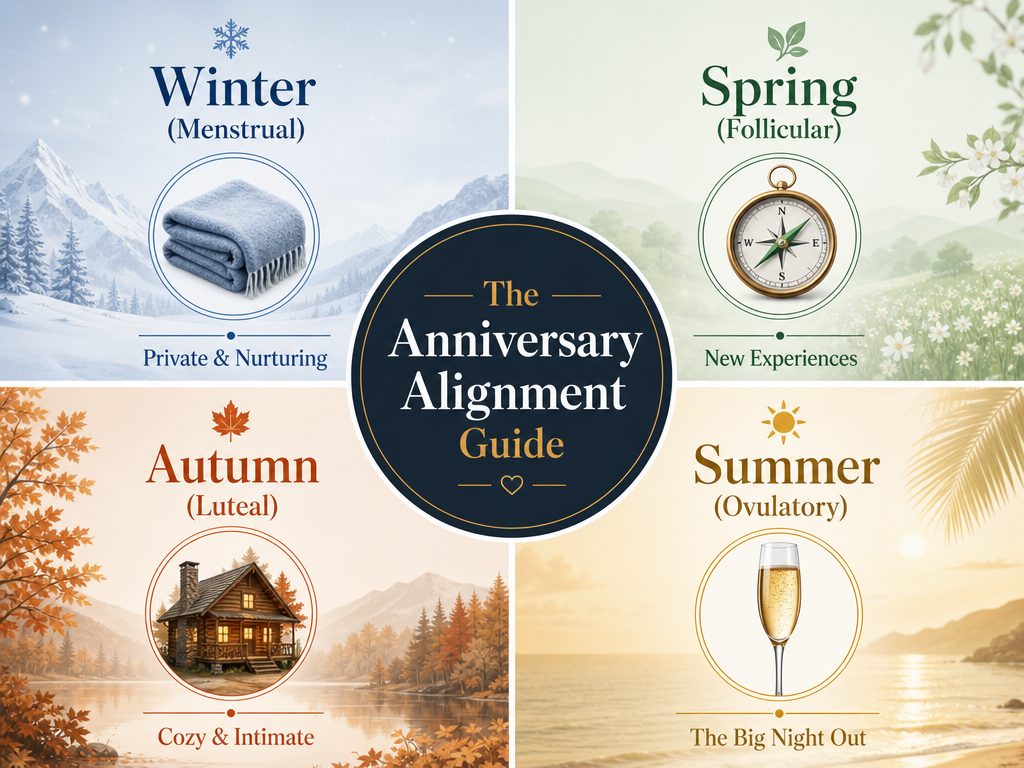 Understand the four hormonal seasons to align your anniversary celebration with your partner's energy levels, ensuring a successful and stress-free milestone.
Spring: The Follicular Phase (Days 6-13)
During the follicular phase, estrogen rises as an egg-containing follicle develops in the ovary. This rising estrogen also thickens the uterine lining and, critically, affects many body systems including brain function and the ability to focus. Energy builds. Creativity peaks. She's more open to novelty and adventure.
What this feels like for her: Increasing energy, social openness, willingness to try new things, optimism about plans.
Anniversary vibe: Novel experiences. This is the phase for surprise trips, new restaurants, activities you haven't done together before. She has the bandwidth for spontaneity.
Summer: The Ovulatory Phase (Days 14-17)
Ovulation is when a surge in luteinizing hormone causes the ovary to release an egg, typically around day 14 of a 28-day cycle. Estrogen levels are highest in the days leading up to this moment. Around ovulation, many women notice symptoms such as increased sex drive, mild pelvic or abdominal pain, tender breasts, bloating, and mood changes - though these vary person to person.
What this feels like for her: Peak confidence, high social battery, maximum physical energy, increased libido. This is her biological "prime time."
Anniversary vibe: The classic celebration. Dancing, cocktail bars, multi-course dinners, dressing up. This is the window where a "big night out" will feel effortless for her, not draining.
Autumn: The Luteal Phase (Days 18-28)
After ovulation, the luteal phase begins: progesterone rises to help prepare the uterine lining for a possible pregnancy. If pregnancy doesn't happen, both progesterone and estrogen drop sharply before the next period. This is when PMS symptoms show up for many women - mood shifts, breast tenderness, bloating, acne, and appetite changes.
As many as 3 in 4 women report experiencing PMS symptoms at some point in their life, though severity varies widely. The hormone crash can feel emotionally destabilizing, not because she's "overreacting," but because serotonin (a mood-stabilizing neurotransmitter) is chemically linked to estrogen levels.
What this feels like for her: Sensitivity to overstimulation, need for emotional connection over novelty, lower tolerance for crowds or loud environments, increased need for comfort and predictability.
Anniversary vibe: Cozy and intimate. Quiet dinners at home, sunset walks, cabin weekends. She wants to feel emotionally close, not socially "on."
The Golden Window: When to Plan High-Energy Celebrations
If you have flexibility on when you celebrate, the "golden window" for high-energy anniversary plans is the follicular and ovulatory phases (days 6-17). This is when her estrogen is rising or peaking, her social battery is charged, and she has the physical and emotional capacity for elaborate surprises, long dinners, or travel.
Research into cycle-linked energy patterns shows energy tends to be lower during the period and can build through the follicular phase toward ovulation, with PMS-type symptoms more likely in the luteal phase. While specific "cycle syncing" lifestyle programs haven't been clinically tested, the broader hormonal mechanism is well-established.
If your anniversary falls during the luteal or menstrual phases (days 18-28, then 1-5), expect her to prefer lower-key, emotionally intimate plans over high-stimulation outings. That doesn't mean the day is ruined - it just means the definition of "special" needs to shift.
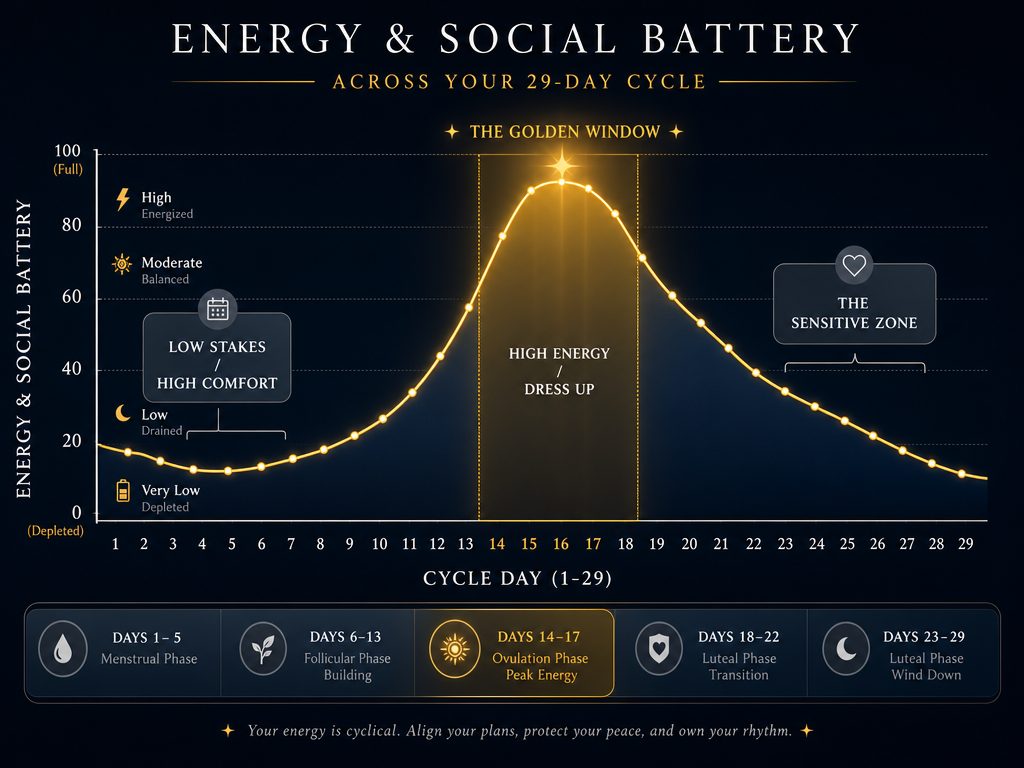 Use this 29-day energy map to identify the 'Golden Window' for high-energy celebrations or plan for high-comfort experiences during sensitive phases.
How to Calculate Where She Is in Her Cycle
You don't need to be creepy about this. You just need to count from Day 1, which is the first day of her period (the first day of bleeding).
A "normal" cycle varies between women - menstrual bleeding can start anywhere from every 24 to every 38 days and last up to 8 days. The textbook 28-day cycle is an average, not a universal rule. Data from Clue users shows a median cycle length of 29 days, with high variability from woman to woman.
The Math
- Day 1 = First day of bleeding
- Days 1-5 = Menstrual phase (Winter)
- Days 6-13 = Follicular phase (Spring)
- Days 14-17 = Ovulatory phase (Summer)
- Days 18-28 = Luteal phase (Autumn)
If your anniversary is on March 15 and her last period started March 1, she's on Day 15 - right in the middle of her ovulatory phase. That's a green light for a high-energy celebration.
If her period started March 10 and your anniversary is March 15, she's on Day 6 - early follicular. Energy is building but not yet peaked. A moderately active plan (brunch, museum, afternoon walk) will feel better than an all-day hike.
If you don't know when her last period was, ask her directly (more on that conversation below). Many women track their cycles in apps like Flo, Clue, or VibeCheck, and will appreciate the thoughtfulness of you asking.
The Tactical Anniversary Matrix: Matching Plans to Her Phase
Here's how to align your anniversary activity with her biological capacity.
| If Anniversary Falls In... | Strategy | Date Ideas |
|---|---|---|
| Winter (Days 1-5) | The "Cozy Retreat" | Private chef at home, silk pajamas + favorite treats, low-movement film marathon, heated blanket + takeout from her favorite place |
| Spring (Days 6-13) | The "Novel Adventure" | Hot air balloon ride, mystery weekend trip, cooking class together, exploring a new neighborhood |
| Summer (Days 14-17) | The "Classic Celebration" | Multi-course tasting menu, cocktail bar + live music, dancing, tickets to a show or concert |
| Autumn (Days 18-28) | The "Supportive Haven" | Cabin in the woods, quiet sunset picnic, at-home spa night, nostalgic photo album + wine |
The goal isn't to "trap" her in a specific type of date - it's to start with a plan that matches her natural energy level, so she doesn't have to force herself to enjoy something that feels exhausting.
What to Do When Your Anniversary Falls During Her Sensitive Phase
If your anniversary lands in the luteal or menstrual phase, don't panic. You have three options:
Option 1: Reschedule the Celebration (Not the Acknowledgment)
The date itself isn't sacred - the experience is. If your anniversary falls on Day 3 of her period (peak cramps, low energy), acknowledge the calendar date with a card or small gesture, then celebrate a week later when she's in her follicular phase. Frame it as "I want you to actually enjoy this, so let's move it to a day when you're feeling like yourself."
Most women will appreciate the biological awareness more than they'll care about celebrating on the exact calendar date.
Option 2: Dial Down the Intensity
If you can't move the date, adjust the plan. Replace the five-course dinner with delivery from her favorite restaurant. Swap the concert tickets for a cozy night in with her favorite movie. Lifestyle approaches that can help ease PMS symptoms include adequate sleep and stress-reduction practices, so building a low-pressure evening supports her physical comfort, not just your romantic agenda.
Option 3: Build a "Bail-Out" Layer Into the Original Plan
Book the fancy restaurant but have a backup plan ready if she's too tired or uncomfortable to go. This might mean keeping high-quality takeout menus on hand, having a playlist and candles ready for an at-home evening, or pre-arranging a refundable reservation. The bail-out isn't a failure - it's a sign you're paying attention.
The 7-2-1 Rule: When to Shift from Celebration to Support
The 7-2-1 rule is a clinical guideline for identifying heavy menstrual bleeding that may require medical attention:
- 7: Periods lasting more than 7 days
- 2: Needing to change a pad or tampon in less than 2 hours
- 1: Passing blood clots larger than 1 inch
If your girlfriend is hitting any of these markers, this isn't the time for a surprise weekend trip or a high-energy celebration. This is the time to ask, "What do you need?" and offer to reschedule plans or pivot to something that prioritizes her physical comfort.
Tracking symptoms and mood changes across the cycle for a few months is a legitimate, medically endorsed way to identify real patterns and timing - rather than assuming based on stereotypes or a single cycle. If heavy bleeding is a recurring issue, suggesting she talk to a doctor isn't overstepping - it's being a proactive partner.
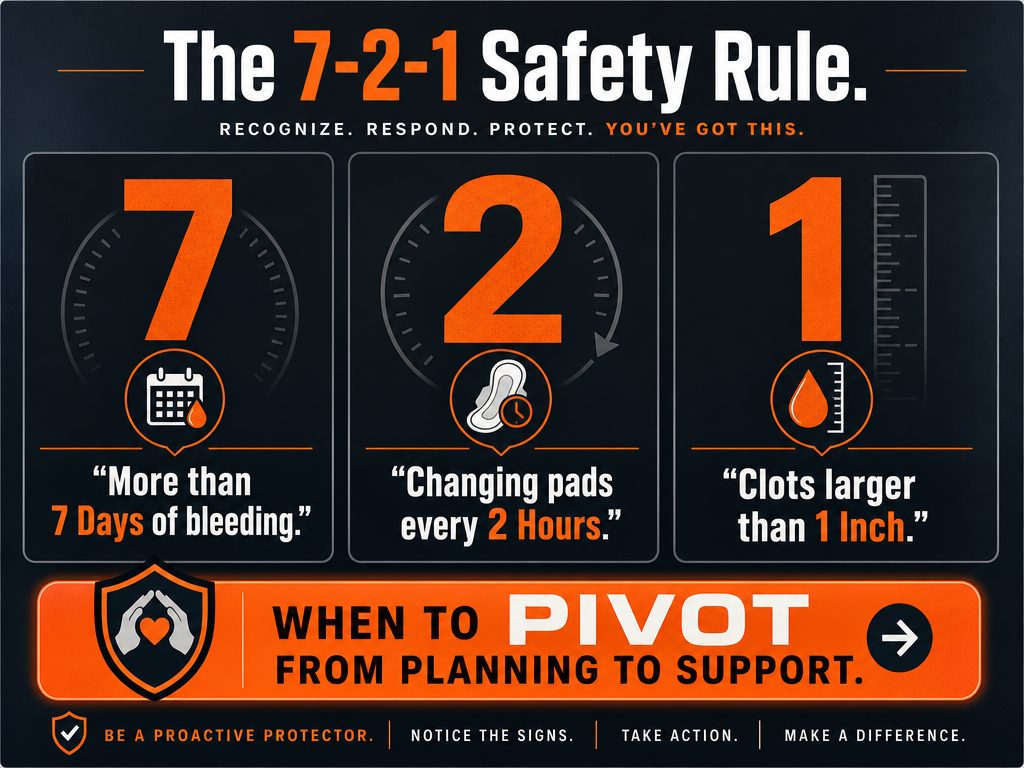 The 7-2-1 rule is an essential tool for partners to monitor health markers, signaling when to shift from anniversary celebration to physical support.
The Bail-Out Plan: Last-Minute Pivots That Still Feel Special
Even with perfect planning, biology doesn't always cooperate. Her period might start two days early. A migraine might hit. PMS symptoms might be worse than usual. Here's how to pivot without making her feel like she "ruined" the anniversary:
Tier 1: The Original Plan
Fancy dinner, concert, weekend getaway - whatever you booked when you assumed she'd be at peak energy.
Tier 2: The Modified Plan
Same venue or activity but dialed down. Dinner at the restaurant but an earlier reservation so she can go home and rest. The concert but with seats instead of standing. The weekend trip but with a spa day built in instead of hiking.
Tier 3: The Home Anniversary
When leaving the house feels like too much, bring the celebration to her:
- Order from the restaurant you were going to visit
- Set up a "movie theater" at home with her favorite snacks and a projector or big screen
- Run her a bath with candles and a glass of wine while you handle dinner
- Create a "memory station" with photos from past anniversaries and a handwritten note
The key is framing this as thoughtful adaptation, not plan failure. Say: "I know you're not feeling great, so I set up a version of tonight that doesn't require you to leave the couch. We can still celebrate - just in a way that feels good for you."
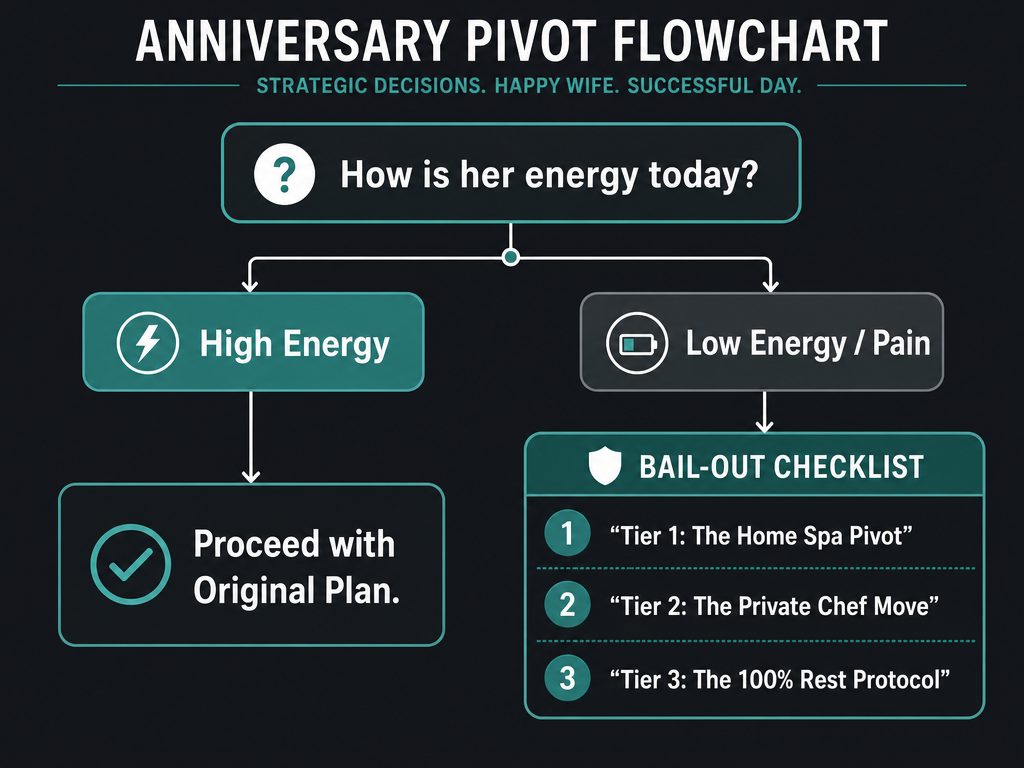 Having a 'Bail-Out' plan ensures that even if her cycle shifts unexpectedly, the anniversary remains a positive and supportive experience for both partners.
How to Start the Conversation About Cycle-Syncing Your Plans
Most women will not find it weird that you're asking about her cycle if you frame it as wanting to plan around her energy levels, not control her biology.
The Script
"I want to make sure I'm planning our anniversary based on your energy levels so you can actually enjoy it. Where are you in your cycle that week? I want to match the vibe to how you'll be feeling."
This shows:
- You understand her cycle affects her capacity
- You're willing to adjust your plans to support her
- You care more about her experience than checking a box
If she tracks her cycle in an app, she can give you an exact answer. If she doesn't, you can offer to help her start tracking (many apps like Clue or VibeCheck allow partner modes, so you can stay informed without invading her privacy).
What Not to Say
Avoid phrasing that sounds like you're treating her cycle as a problem to manage:
- ❌ "Are you going to be moody that week?"
- ❌ "Should we just skip celebrating if you're PMSing?"
- ❌ "I don't want to deal with you on your period."
These frames make her feel like a burden. The goal is to show you're adapting for her, not despite her.
Phase-Specific Anniversary Gift Strategy
Gifts can complement her biological phase, making them feel more thoughtful and less generic.
Winter (Menstrual Phase)
- High-quality heating pad or TENS unit (like Ovira or Livia)
- Weighted blanket
- Silk or cashmere pajamas
- Subscription to her favorite comfort food (chocolate, tea, etc.)
- "Stay home" self-care kit: bath bombs, face masks, cozy socks
Spring (Follicular Phase)
- Tickets to an event or experience (concert, comedy show, escape room)
- Travel voucher or surprise weekend trip
- New hobby supplies (art class, cooking kit, etc.)
- Adventure-based gift (zip-lining, hot air balloon, etc.)
Summer (Ovulatory Phase)
- Jewelry she can wear out (statement earrings, necklace)
- New dress or outfit for a night out
- Fancy dinner reservation + matching cocktail bar afterward
- "Dress-up" date kit: wine tasting, rooftop bar, theater tickets
Autumn (Luteal Phase)
- Nostalgic or sentimental gift (photo album, handwritten letter, framed memory)
- Comfort food delivery subscription
- At-home spa kit (massage oil, candles, bath salts)
- "Cozy night in" package: favorite movie, snacks, weighted blanket
The gift should match the capacity of the phase, not force her into an activity that drains her.
Does Hormonal Birth Control Change the Planning Rules?
Yes. Hormonal birth control (the pill, IUD, patch, ring) often flattens the peaks and valleys of the natural cycle by delivering a steady dose of synthetic hormones. This can mute the "Four Seasons" energy pattern, making it harder to predict exactly when she'll feel high-energy versus low-energy.
Some women on hormonal birth control report feeling more emotionally stable across the month. Others report persistent low-grade fatigue or mood flatness because the natural estrogen surge (which drives that "Spring" and "Summer" energy) never happens.
If your girlfriend is on hormonal birth control, the cycle-syncing framework is less predictive. Instead, ask her directly: "Do you notice your energy or mood shifting at certain times of the month, or does it feel pretty consistent?" Some women still experience withdrawal bleeding (the "period" on birth control) and PMS-like symptoms during the placebo week, so the menstrual phase advice may still apply.
For a deeper dive on how different contraceptive methods affect mood and energy, check out this guide on supporting your girlfriend through cycle phases.
Frequently Asked Questions
What is the 7-2-1 rule for menstruation?
The 7-2-1 rule is a clinical guideline to identify heavy menstrual bleeding: periods lasting more than 7 days, needing to change a pad/tampon in less than 2 hours, or passing clots larger than 1 inch. If she's hitting any of these markers regularly, it may signal a health issue that warrants a doctor visit. As her partner, knowing this rule helps you recognize when to shift from planning celebrations to supporting her health.
How should a boyfriend deal with a girlfriend's period?
Stop treating it like a mystery or an inconvenience. Approximately 1 in 7 women are menstruating at any given time, and ~88% experience cramps every cycle. The best approach: ask what she needs, validate that her discomfort is real, and adjust plans without making her feel like she's ruining things. Practical support (heating pad, favorite food, taking logistics off her plate) beats empty reassurance every time.
What phase do you feel the prettiest?
Many women report feeling most confident and attractive during the ovulatory phase (days 14-17), when estrogen peaks and energy is highest. Around ovulation, many women notice symptoms such as increased sex drive and a general sense of well-being. If you're planning a "dress-up" anniversary or photo-heavy celebration, this is the biological window where she's most likely to feel like herself.
Can you provide a guide to the menstrual cycle for men?
The menstrual cycle has four phases: menstrual (bleeding, days 1-5), follicular (days 6-13, estrogen rising), ovulation (days 14-17, peak estrogen), and luteal (days 18-28, progesterone rising then crashing). Each phase has a distinct hormonal profile that affects her energy, mood, and social capacity. Read our full guide for a tactical breakdown of what each phase feels like and how to adjust your behavior accordingly.
What to do for your girlfriend on the menstrual phase?
During the menstrual phase (days 1-5), energy is lowest and physical discomfort is highest. Focus on reducing friction: handle logistics she'd normally manage, stock her favorite comfort foods, offer a heating pad without being asked, and don't push for high-energy activities. If your anniversary falls during this phase, prioritize low-movement, emotionally intimate plans - think cozy night in, not multi-hour restaurant experience.
What's a good anniversary date idea?
The best anniversary date matches her energy level to the activity. During her follicular or ovulatory phase, go for novelty and high-energy plans: new restaurants, concerts, surprise trips. During her luteal or menstrual phase, lean into emotional intimacy and comfort: at-home dinners, nostalgic photo albums, sunset walks. The date isn't about impressing her - it's about creating an experience she has the capacity to enjoy.
How do I romance when my wife is in periods?
Romance during her period doesn't mean pushing through her discomfort - it means adapting your approach. Physical intimacy may be off the table, but emotional intimacy isn't. Small gestures (running her a bath, handling dinner, giving her space to rest) show you understand what her body is going through. Research shows lifestyle approaches that help ease PMS symptoms include adequate sleep and stress reduction, so creating a low-pressure environment is itself an act of care.
How to postpone a menstrual cycle date?
You can't safely or reliably delay a period without medical intervention (hormonal birth control, prescribed by a doctor). Some women use continuous birth control pills to skip their period for specific events like weddings, but this requires planning weeks in advance and medical supervision. If your anniversary falls during her period and you want to reschedule the celebration, the best approach is to acknowledge the calendar date with a card or small gesture, then plan the "real" celebration a week later when she's feeling better.
Planning your anniversary around your girlfriend's hormones isn't about playing a guessing game or treating her like she's fragile. It's about understanding that her body runs on a 28-day loop, and aligning your plans with that rhythm makes you a proactive partner, not a reactive one.
The men who do this well don't do it because they're afraid of conflict - they do it because they've figured out that timing their gestures to her biology increases the odds that both people actually enjoy the celebration. And when she feels seen, supported, and understood, that's the kind of anniversary that lasts.
If you want daily guidance on how to adjust your approach based on where she is in her cycle, VibeCheck gives you a personalized mission every day so you're never guessing what she needs.
Tags

Related Articles
Continue reading to deepen your understanding

How to Plan Your Anniversary Around Your Girlfriend’s Hormones
Ensure your big day lands perfectly by matching your plans to her cycle. This guide explains how to sync your celebration with her energy and mood for a better connection.

How to Understand Your Girlfriend’s Social Battery and Hormones
Does your girlfriend suddenly cancel plans or seem withdrawn? This guide explains how her cycle impacts her energy so you can support her like a pro.

How Your Girlfriend’s Emotional Needs Change During Her Cycle
Does your girlfriend’s mood seem unpredictable? Learn how her emotional needs shift on a biological loop and how to support her through every phase of her cycle.

What to Buy When Your Girlfriend Has Hormone Cravings: A Support Guide
Stop wondering what to pick up at the store. This guide explains the science behind cycle cravings and provides a specific list of foods and comfort items she needs.

Your Girlfriend’s Mood Shifts Throughout the Month, Explained
Ever wonder why her energy and moods change so drastically each week? Understand the four hormonal phases and how to be the partner she needs during every stage of her cycle.

How to Support Your Girlfriend When She’s Crying Because of Hormones
Watching her cry when hormones hit can feel overwhelming. Learn the biological why behind the tears and use these proven scripts to provide the support she actually needs right now.

How to Help Your Girlfriend with Hormonal Mood Swings Without Arguing
Understand her cycle and learn tactical scripts to handle tension. This guide shows you how to support her through hormonal shifts without getting into unnecessary fights.

When to Feed Your Girlfriend: Understanding Hangry Hormones
Does your girlfriend get irritable when she hasn’t eaten? It’s not just in her head. Learn why hormones cause hanger and the specific times her body needs more fuel.