How to Understand Girlfriend Hormonal Mood Swings

Stop taking it personally. Master the science behind her cycle, the 4-phase breakdown, and the best strategies to support her through hormonal mood swings.
How to Understand Your Girlfriend’s Hormonal Mood Swings: The Science and Strategy
You’re three weeks into the month, everything’s been smooth, and then she snaps at you for leaving a mug on the counter. The same mug that’s been there for days. Yesterday, she laughed it off. Today, it’s a referendum on your character.
This isn’t random. It’s not about the mug. And it’s not you.
It’s a predictable biological event that happens every single month, and once you understand the pattern, you’ll stop taking it personally and start showing up as the partner she actually needs.
Most relationship advice tells you to "be supportive" during PMS. That’s not enough. You need to understand the neurochemistry driving her mood, the four distinct phases of her cycle, and exactly what to say when the storm hits. This guide gives you the science, the scripts, and the strategy to turn her hormonal fluctuations from a relationship minefield into a competitive advantage.
VibeCheck App
Know what she needs. Before she has to say it.
Track her cycle, understand her phases, be the partner she deserves.
Download Free on iOS →Table of Contents
- Why Her Mood Actually Changes (The Biology You Need to Know)
- The 4-Phase Breakdown: Your Cycle Cheat Sheet
- The Science of "The Dip" (Why Storm Week Happens)
- The "Say This, Not That" Cheat Sheet
- The 3-Day Rule: How to Know If It’s Really About You
- Proactive Care Kits for Each Phase
- When It’s Serious: PMDD vs. Normal PMS
- The Sync-Partner Strategy: From Reactive to Proactive
- Frequently Asked Questions
Why Her Mood Actually Changes (The Biology You Need to Know)
Her mood swings aren’t psychological warfare. They’re a side effect of a biological process that’s been running since puberty.
Every month, her body goes through a coordinated hormonal symphony designed to prepare for pregnancy. When pregnancy doesn’t happen, hormone levels crash, and that crash affects her brain chemistry in specific, measurable ways.
The key players:
- Estrogen: Think of this as her confidence and energy hormone. When it’s high, she feels social, optimistic, and energized. When it drops, so does her mood.
- Progesterone: The calming hormone. It rises after ovulation and peaks in the luteal phase. When it drops right before her period, anxiety and irritability spike.
- Serotonin: The "feel-good" neurotransmitter. Estrogen helps produce serotonin, so when estrogen drops, serotonin follows. Lower serotonin means higher sensitivity to stress, lower frustration tolerance, and emotional volatility.
- GABA: Your brain’s natural sedative. Progesterone boosts GABA production, which is why she might feel calm mid-cycle. When progesterone crashes, GABA drops too, leaving her feeling anxious and "on edge."
Here’s the crucial insight: when these hormones drop simultaneously in the days before her period, her brain literally processes emotions differently. She’s not overreacting. Her neurochemistry is running a different operating system.
This is why the same comment that made her laugh on Day 10 makes her cry on Day 25. The stimulus is identical. The biological context isn’t.
The 4-Phase Breakdown: Your Cycle Cheat Sheet
Her cycle isn’t one long stretch of unpredictability. It’s four distinct phases, each with its own hormonal profile, energy signature, and support needs.
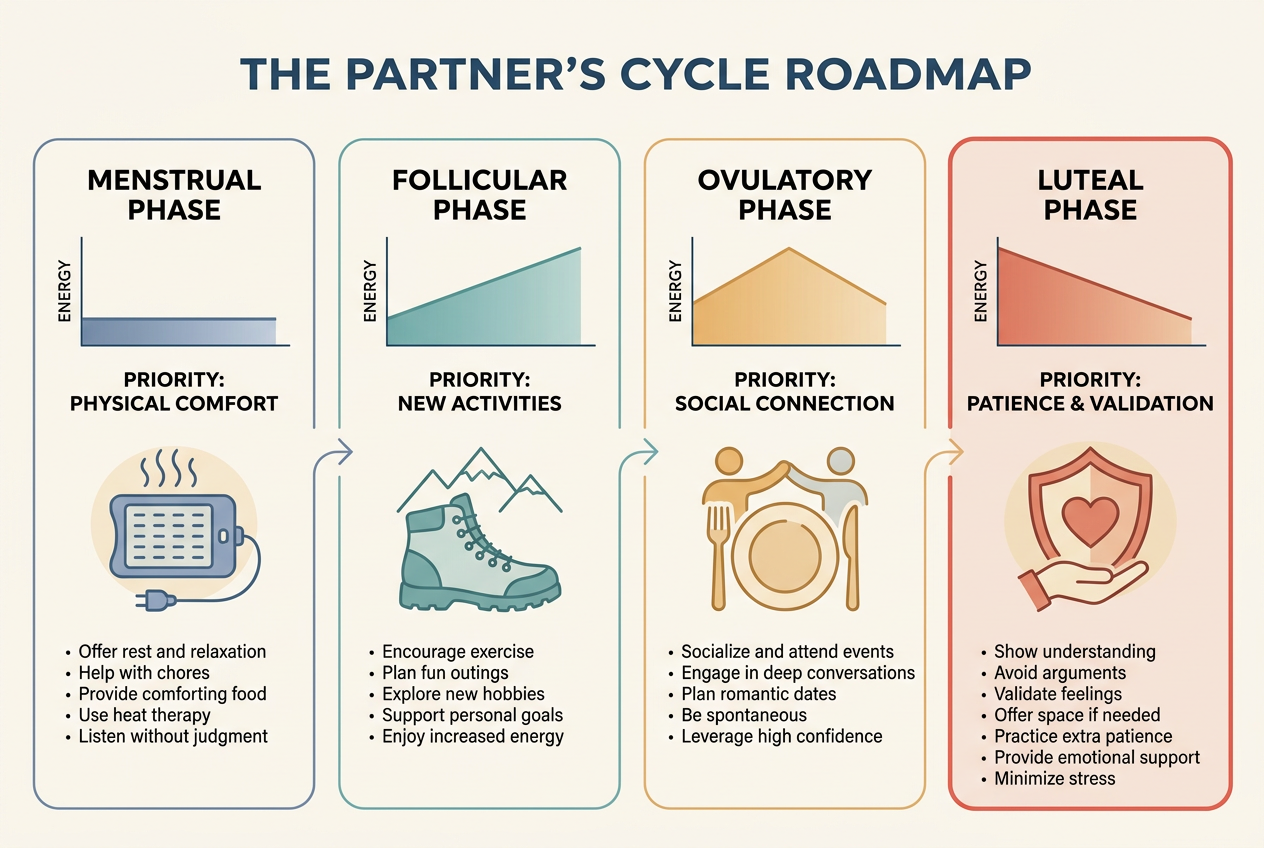 This roadmap helps you transition from being reactive to proactive by aligning your support strategy with the biological reality of her cycle’s four distinct phases.
| Phase | Days | Her Energy | Your Strategy |
|---|---|---|---|
| Menstrual | 1-5 | Low, fatigued, inward-focused | Be a "safe harbor." Reduce demands. Offer physical comfort (heating pad, dark chocolate, low-key Netflix). Don’t push for conversation or activities. |
| Follicular | 6-14 | Rising, optimistic, social | Match her energy. This is your window for adventure dates, new restaurants, social plans. She’s resilient and open to novelty. |
| Ovulation | 14-17 | Peak confidence, high libido, magnetic | Capitalize on her high energy. Plan date nights, initiate intimacy, have deep conversations. She’s at her most receptive. |
| Luteal | 18-28 | Declining, sensitive, irritable | Become a "shock absorber." Avoid heavy criticism. Validate her feelings. Offer proactive help before she asks. This is storm week. |
The luteal phase (Days 18-28) is where most relationship friction happens. Progesterone and estrogen are both dropping, serotonin is declining, and her emotional filter is thinner. Small irritations feel bigger. Unresolved issues surface. She’s not looking for problems - her brain is just more sensitive to them.
Understanding this pattern means you can stop personalizing her mood shifts and start anticipating them. You move from defense to offense.
For a deeper dive into how each phase affects her energy and mood, check out our complete breakdown of the menstrual cycle phases.
The Science of "The Dip" (Why Storm Week Happens)
The week before her period is when most guys feel like they’re walking through a minefield. One wrong word and boom - an argument that seems to come out of nowhere.
This isn’t random. It’s the result of a specific hormonal event called "the dip."
Here’s what happens in the late luteal phase:
- Progesterone drops sharply - This hormone kept her calm and balanced for two weeks. When it crashes, so does her stress tolerance.
- Estrogen falls simultaneously - Estrogen is tied to serotonin production. Less estrogen means less serotonin, which means higher emotional sensitivity and lower mood.
- Cortisol (stress hormone) rises - As progesterone drops, cortisol increases, making her feel more anxious and reactive.
- GABA declines - Without progesterone to boost GABA (your brain’s natural sedative), she loses her built-in anxiety buffer.
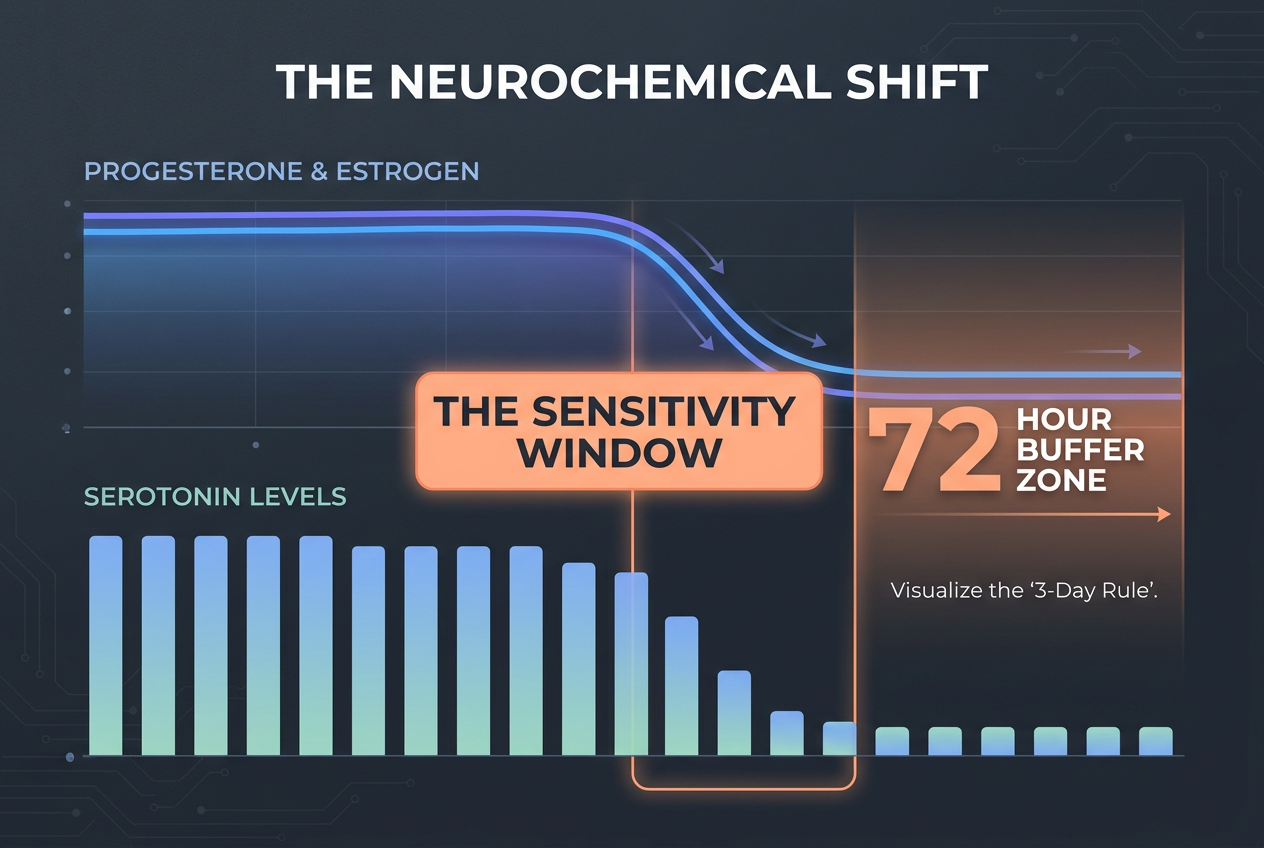 Understanding that mood swings are driven by a significant physiological drop in hormones and serotonin helps depersonalize conflict and foster empathy during difficult days.
The result? She’s running on neurochemical fumes. Her frustration threshold is lower. Her emotional filter is thinner. Things that normally wouldn’t bother her suddenly feel overwhelming.
This is why she might cry during a commercial or snap at you for breathing too loudly. It’s not about the commercial or your breathing. It’s about her brain processing stress through a serotonin-depleted lens.
The depersonalization principle: When you understand that her irritability is a biological symptom - not a character flaw or a reflection of your relationship - you stop getting defensive. You stop matching her intensity. You become the stable force she needs instead of adding fuel to the fire.
Want more tactical support for this phase? Read our guide on how to comfort your girlfriend during PMS week.
The "Say This, Not That" Cheat Sheet
Biology explains why she’s sensitive. But you still need to know what to say when the storm hits.
Most guys get this wrong because they try to logic their way out of an emotional moment. You can’t. Her brain isn’t looking for solutions right now - it’s looking for validation and safety.
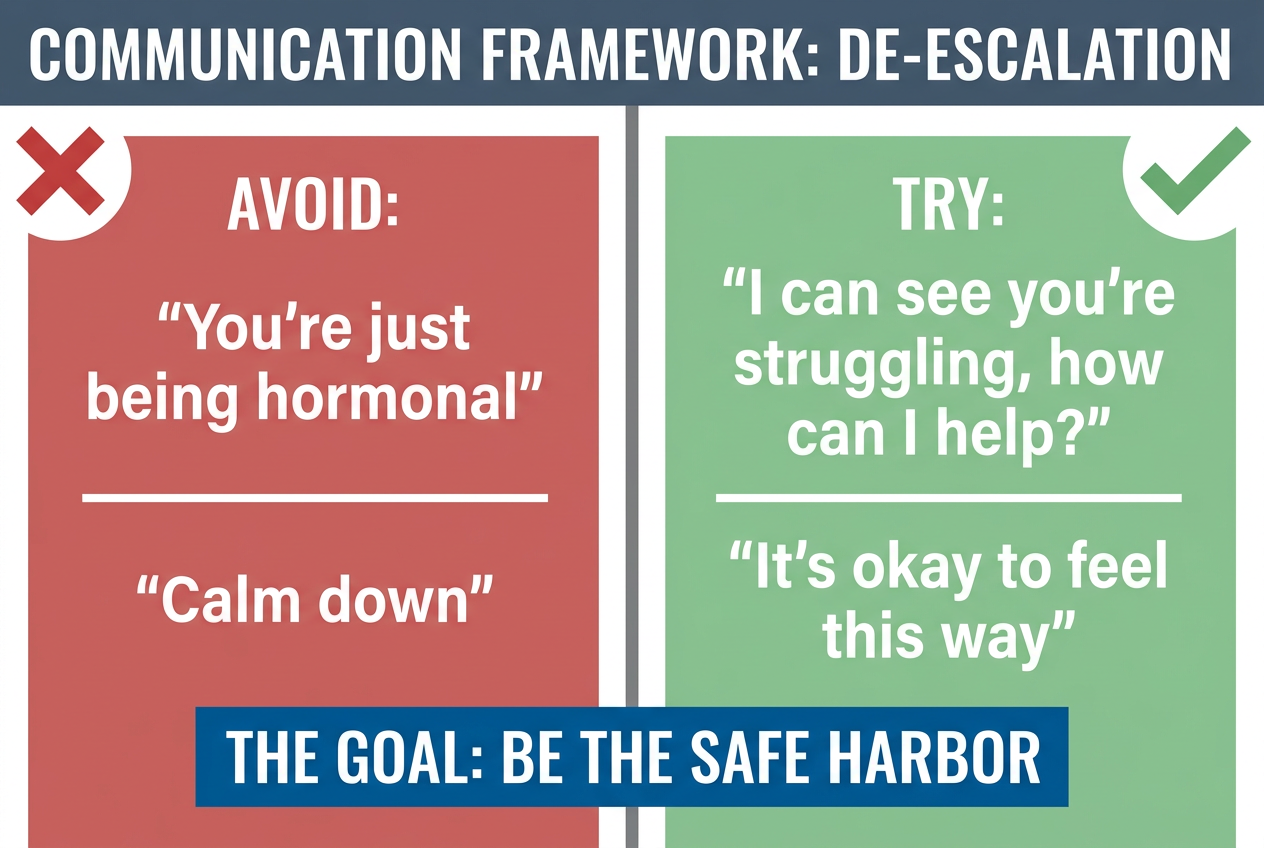 Using validated scripts moves the conversation from a potential argument to a moment of connection, helping you become the ’hero’ partner she needs during the luteal phase.
When she’s upset about something "small"
Don’t say: "Why are you so upset about this? It’s not a big deal."
Say instead: "I can see this is really bothering you. Tell me what’s going on."
Why it works: You’re validating her emotion without dismissing it. You’re giving her permission to feel what she’s feeling.
When she snaps at you
Don’t say: "Wow, are you on your period or something?"
Say instead: "Hey, I know things have been stressful lately. What do you need from me right now?"
Why it works: You’re acknowledging tension without weaponizing her biology. You’re offering support instead of judgment.
When she’s overwhelmed
Don’t say: "Just relax. You’re overreacting."
Say instead: "That sounds really hard. How can I help?"
Why it works: You’re not minimizing her experience. You’re positioning yourself as her ally, not her opponent.
When she’s crying and you don’t know why
Don’t say: "What’s wrong? Why are you crying?"
Say instead: "I’m here. Take your time."
Why it works: You’re creating space for her to process without pressure. Sometimes she doesn’t know why she’s crying either - the hormonal crash just makes her more emotionally permeable.
When you made a mistake
Don’t say: "I didn’t mean it like that. You’re being too sensitive."
Say instead: "You’re right. I messed up. I’m sorry."
Why it works: Owning your mistake without defensive justifications stops the conflict from escalating. Her sensitivity isn’t the problem - the thing you did is.
The pattern: validate, offer support, don’t defend. She’s not looking for a debate. She’s looking for connection.
For more communication strategies during her cycle, check out our guide on how to talk to your girlfriend during PMS.
The 3-Day Rule: How to Know If It’s Really About You
Here’s the tactical question every guy faces: Is this a real relationship issue, or is this a hormonal amplification of a minor irritation?
The answer matters because your response should be different.
The 3-Day Rule:
If a fight or emotional conversation happens 3-5 days before her period, wait 72 hours before having the "big relationship talk."
Here’s why: During the late luteal phase, her brain amplifies problems. A small annoyance that normally wouldn’t register suddenly feels like a relationship-ending crisis. Three days later, after her period starts and progesterone stabilizes, the same issue often feels manageable again.
How to apply it:
- In the moment: Address the immediate emotion. Use the validation scripts above. Make her feel heard.
- After the moment: Don’t ignore what she said, but don’t treat it as an ultimatum either. Say something like: "I hear you. Let’s talk about this more when we both have some space."
- Three days later: Check in. "Hey, you mentioned you were frustrated about [X] the other day. Is that still weighing on you?" If she brings it up again with the same intensity, it’s a real issue. If she’s moved on or minimizes it, it was hormonally amplified.
This doesn’t mean her feelings during PMS are "fake." They’re real - but they’re often disproportionate to the actual trigger. The 3-Day Rule gives you both perspective.
The exceptions: If she’s bringing up a recurring pattern (you never help with chores, you don’t prioritize her, etc.), that’s not hormonal amplification. That’s a real issue that’s been building. Address it immediately.
Proactive Care Kits for Each Phase
Most guys are reactive. They wait for her to tell them what she needs, then scramble to respond.
Elite partners are proactive. They know what’s coming and show up before she has to ask.
Here’s what that looks like in practice:
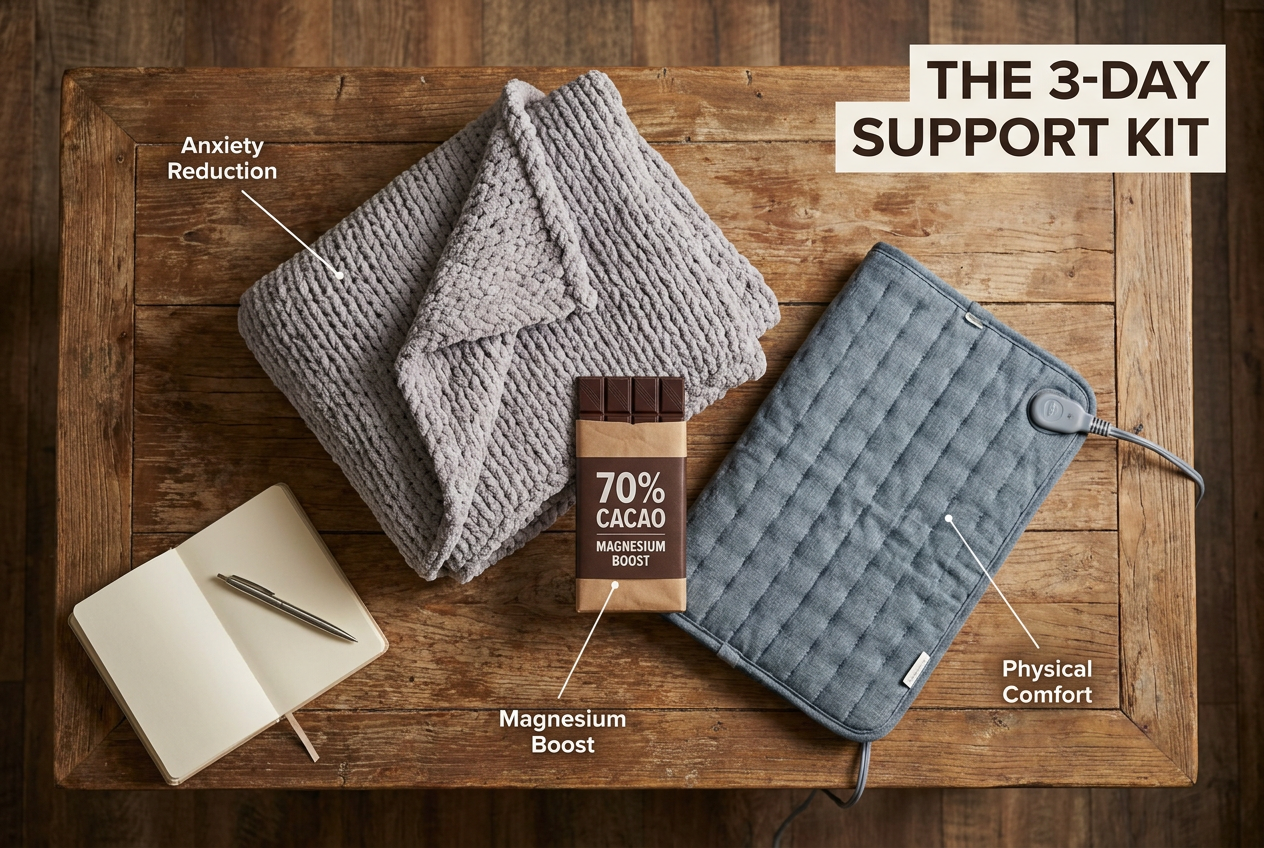 A proactive support kit demonstrates high emotional intelligence, addressing her physical and psychological needs before she has to ask for help.
Menstrual Phase (Days 1-5): The Comfort Kit
Physical needs: Cramps, fatigue, low energy
Your kit:
- Heating pad (microwaveable or electric)
- Dark chocolate (magnesium helps with cramps and mood)
- Herbal tea (chamomile, ginger)
- Ibuprofen or Midol
- Comfort food she actually likes (not what you think is healthy)
Bonus move: Take over one of her usual tasks without being asked. Do the dishes. Walk the dog. Handle dinner. She’ll remember.
Follicular Phase (Days 6-14): The Adventure Kit
Psychological needs: Novelty, social connection, movement
Your kit:
- Plan a date she’s been wanting to do
- Book tickets to something new
- Suggest a weekend trip or day hike
- Invite friends over for dinner
- Try a new restaurant or activity
She’s resilient right now. This is your window to introduce novelty without it feeling like added stress.
Ovulation Phase (Days 14-17): The Connection Kit
Psychological needs: Intimacy, deep conversation, feeling desired
Your kit:
- Plan a romantic date night (candlelit dinner, sunset walk)
- Initiate physical intimacy (she’s at her peak libido)
- Have a vulnerable conversation (she’s emotionally open)
- Give her a genuine compliment about something deeper than looks
This is her high-confidence window. Match her energy and deepen your connection.
Luteal Phase (Days 18-28): The Support Kit
Psychological needs: Safety, validation, low-stress environment
Your kit:
- Keep plans low-key (Netflix > party)
- Offer unprompted help ("I’ll handle dinner tonight")
- Give her space if she needs it
- Use validation scripts liberally
- Have her favorite comfort snacks on hand
This is where proactive support pays off. Don’t wait for her to tell you she’s overwhelmed. Anticipate it.
For specific guidance on this challenging phase, read our complete guide to supporting your girlfriend’s luteal phase.
When It’s Serious: PMDD vs. Normal PMS
Most mood swings are a normal part of the menstrual cycle. But sometimes, what looks like "bad PMS" is actually PMDD (Premenstrual Dysphoric Disorder) - a severe form that requires medical attention.
Normal PMS symptoms:
- Mild to moderate mood swings
- Irritability that’s manageable
- Temporary sadness or anxiety
- Physical symptoms (cramps, bloating, fatigue)
PMDD red flags:
- Severe depression or hopelessness
- Intense anxiety or panic attacks
- Mood swings that interfere with work or relationships
- Suicidal thoughts or self-harm ideation
- Symptoms that disappear after her period starts
If she experiences the red flag symptoms regularly (for most cycles over several months), she should talk to her doctor. PMDD affects 3-8% of women and is often underdiagnosed.
How to bring it up:
Don’t say: "I think you have PMDD."
Say instead: "I’ve noticed you’ve been really struggling before your period. Have you ever talked to your doctor about it? There are treatments that can help."
Frame it as care, not criticism. PMDD is a medical condition, not a personality flaw.
What helps:
- SSRIs (antidepressants) - often prescribed just during the luteal phase
- Birth control (can stabilize hormones)
- Lifestyle changes (exercise, diet, stress reduction)
- Therapy (especially CBT)
Your role isn’t to diagnose her. It’s to notice patterns, validate her experience, and support her in getting professional help if needed.
The Sync-Partner Strategy: From Reactive to Proactive
The difference between an average partner and an elite one is predictive intelligence.
Average partners react to her mood. Elite partners anticipate it.
This doesn’t mean you’re tracking her cycle to manipulate her. It means you’re using biological data to show up as the partner she needs before she has to explain herself.
The framework:
- Track her cycle - Use a shared period tracking app or just note patterns in your calendar. You don’t need exact dates, just a general sense of where she is.
- Predict her needs - Use the 4-phase breakdown above to anticipate her energy and mood.
- Adjust your approach - Match your communication style and activities to her current phase.
- Show up proactively - Offer support before she asks. Reduce friction before conflict starts.
What this looks like in practice:
- You notice she’s in the follicular phase (Days 6-14). You suggest a hiking trip she’s been wanting to do. She says yes, you have a great time, and she feels understood.
- You notice she’s approaching the luteal phase (Days 18-28). You handle dinner without being asked, keep plans low-key, and use validation scripts when she’s stressed. She feels supported, not judged.
- You notice she’s starting her period. You show up with a heating pad and dark chocolate. She doesn’t have to ask for what she needs because you’re already there.
This isn’t about being perfect. It’s about being present and informed. Most guys treat her cycle like an unknowable mystery. You’re treating it like a competitive advantage.
If you want tactical tools to master this strategy, check out the VibeCheck app - built specifically to help guys like you understand and support your partner’s cycle.
Ready to actually understand her?
Join thousands of men using VibeCheck to track her cycle and show up better every day.
Frequently Asked Questions
Why does my girlfriend get so moody before her period?
The mood swings you’re noticing are caused by a sharp drop in estrogen and progesterone in the days before her period. This hormonal crash reduces serotonin (the feel-good neurotransmitter) and GABA (the brain’s natural anxiety buffer), making her more sensitive to stress and irritation. It’s not about you - it’s neurochemistry. Her brain is literally processing emotions through a different filter during this phase.
How do I know if her mood swings are normal or if it’s PMDD?
Normal PMS causes mild to moderate mood swings, temporary irritability, and manageable physical symptoms. PMDD is more severe and includes intense depression, severe anxiety or panic attacks, mood swings that interfere with daily life, and symptoms that disappear after her period starts. If she experiences these red flag symptoms for most cycles over several months, she should talk to her doctor. PMDD is a medical condition that responds to treatment.
What should I say when my girlfriend is upset during PMS?
Use validation scripts instead of logic or dismissal. Say things like "I can see this is really bothering you - tell me what’s going on" or "That sounds really hard. How can I help?" Avoid phrases like "you’re overreacting" or "is it your period?" Your goal is to validate her emotion and offer support, not to fix the problem or debate whether her feelings are justified.
Should I track my girlfriend’s period to understand her mood better?
Yes, but frame it correctly. You’re not tracking to control or manipulate - you’re tracking to anticipate her needs and show up proactively. Use the 4-phase framework (menstrual, follicular, ovulation, luteal) to predict her energy levels and adjust your support strategy. This moves you from reactive to proactive, which reduces relationship friction and makes you a better partner.
What’s the best way to support my girlfriend during her period?
Be a "safe harbor" during her menstrual phase (Days 1-5). Reduce demands, offer physical comfort (heating pad, dark chocolate, low-stress activities), and take over one of her usual tasks without being asked. Don’t push for conversation or activities if she’s low-energy. The goal is to create a low-friction environment where she can rest and recover.
Can I tell her I think her mood swings are hormonal?
Only if you do it with extreme care. Never use her cycle as a weapon during an argument ("are you on your period?"). Instead, have a conversation outside of an emotional moment where you acknowledge patterns you’ve noticed and offer support. Frame it as teamwork: "I’ve noticed you’ve been feeling overwhelmed before your period lately. What can I do to help?" This validates her experience without dismissing her feelings.
How long do PMS mood swings usually last?
PMS symptoms typically start 5-7 days before her period and resolve within 1-3 days after bleeding begins. This corresponds to the late luteal phase when progesterone and estrogen are dropping. If her mood swings last longer than this or don’t improve after her period starts, it could indicate PMDD or another hormonal issue that needs medical attention.
What are the four phases of the menstrual cycle and how do they affect mood?
The four phases are: Menstrual (Days 1-5) - low energy, inward-focused; Follicular (Days 6-14) - rising energy, optimism, social openness; Ovulation (Days 14-17) - peak confidence, high libido, emotional resilience; Luteal (Days 18-28) - declining energy, increased sensitivity, irritability. Each phase has a distinct hormonal profile that affects her mood, energy, and needs. Understanding this pattern helps you anticipate her shifts and support her proactively.
Tags

Related Articles
Continue reading to deepen your understanding

How to Understand Your Girlfriend’s Social Battery and Hormones
Does your girlfriend suddenly cancel plans or seem withdrawn? This guide explains how her cycle impacts her energy so you can support her like a pro.

How Your Girlfriend’s Emotional Needs Change During Her Cycle
Does your girlfriend’s mood seem unpredictable? Learn how her emotional needs shift on a biological loop and how to support her through every phase of her cycle.

What to Buy When Your Girlfriend Has Hormone Cravings: A Support Guide
Stop wondering what to pick up at the store. This guide explains the science behind cycle cravings and provides a specific list of foods and comfort items she needs.

Your Girlfriend’s Mood Shifts Throughout the Month, Explained
Ever wonder why her energy and moods change so drastically each week? Understand the four hormonal phases and how to be the partner she needs during every stage of her cycle.

How to Support Your Girlfriend When She’s Crying Because of Hormones
Watching her cry when hormones hit can feel overwhelming. Learn the biological why behind the tears and use these proven scripts to provide the support she actually needs right now.

How to Help Your Girlfriend with Hormonal Mood Swings Without Arguing
Understand her cycle and learn tactical scripts to handle tension. This guide shows you how to support her through hormonal shifts without getting into unnecessary fights.

When to Feed Your Girlfriend: Understanding Hangry Hormones
Does your girlfriend get irritable when she hasn’t eaten? It’s not just in her head. Learn why hormones cause hanger and the specific times her body needs more fuel.

The Boyfriend’s Guide to Supporting Your Partner Through PMS
If your partner is suddenly irritable and exhausted, it’s biology, not you. Learn about the luteal phase and how to provide meaningful support without walking on eggshells.