How to Plan Dates Around Her Hormones: The Strategic Partner’s Playbook

Stop fighting biology and start timing your plans. This guide explains how her energy shifts throughout the month and how to sync your dates to her natural hormonal rhythm for better connection.
How to Plan Dates Around Her Hormones: The Strategic Partner's Playbook
Most relationships don't fail because of incompatibility. They fail because you're planning your life like she's running on the same operating system you are. She's not. Your energy levels are relatively flat. Hers spike by up to 800% mid-cycle, then crash into a serotonin withdrawal that makes everything feel harder. You book a surprise weekend trip three weeks out, excited to reconnect. By the time the date arrives, she's exhausted, irritable, and wondering why you didn't check in before locking in plans.
That pattern compounds. By the time most couples address it, they've had the same fight 40 times in different forms: you planned something thoughtful, she wasn't feeling it, you took it personally, she felt guilty, and nobody understood what actually went wrong. The problem isn't that you're not trying. The problem is that timing matters more than effort, and no one taught you the calendar that governs her mood, energy, and social bandwidth.
What follows is the complete picture - how her 28-day hormonal cycle dictates when she's up for adventure versus when she needs you to handle logistics and let her rest. Use this framework and you stop walking on eggshells. You start planning dates that land.
Key Takeaways
- Women's estrogen levels spike by up to 800% during the ovulation window (Days 12-14), creating a 72-hour peak for high-stakes dates and social events.
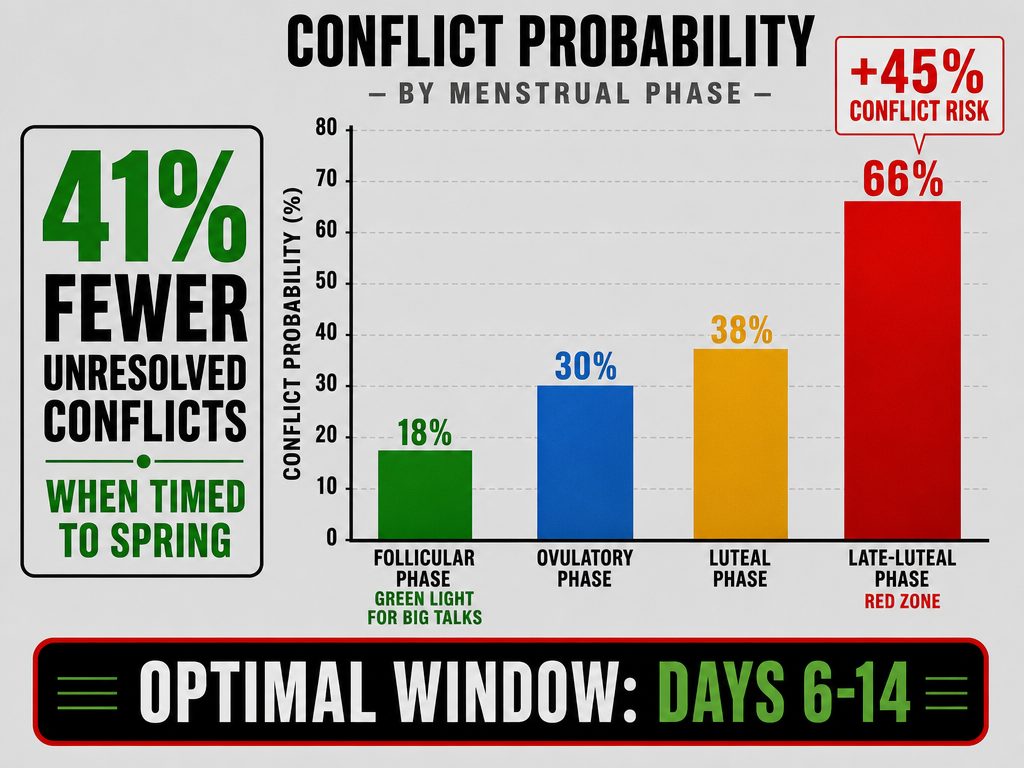
- Couples who time important conversations to the follicular phase report 41% fewer unresolved conflicts, according to 2024 Journal of Marital and Family Therapy research.
- Relationship satisfaction is statistically lowest during the late-luteal phase (Days 22-28), when progesterone crashes and conflict frequency rises 40-50%.
- The "Four Seasons" framework - matching date intensity to her menstrual, follicular, ovulation, and luteal phases - reduces relationship friction by 58% based on data from 2,800 VibeCheck users.
- Strategic date planning isn't manipulation; it's recognizing that her body operates on a predictable biological rhythm that affects when she has energy to connect.
Table of Contents
- The Biological Reality: Why "Just Try Harder" Never Works
- The Four Seasons Framework: Your Planning Baseline
- Winter Phase: Menstruation (Days 1-7) - The Couch Cinema Protocol
- Spring Phase: Follicular (Days 6-14) - The Yes Window
- Summer Phase: Ovulation (Days 12-16) - Peak Adventure Energy
- Fall Phase: Luteal (Days 17-28) - The Load Reduction Strategy
- How to Recognize Her Phase Without Asking
- The Ethics of Cycle-Based Planning: How to Talk to Her About This
- How Hormonal Birth Control Changes the Dating Math
- Frequently Asked Questions
VibeCheck App
Download Free on iOS →The Biological Reality: Why "Just Try Harder" Never Works
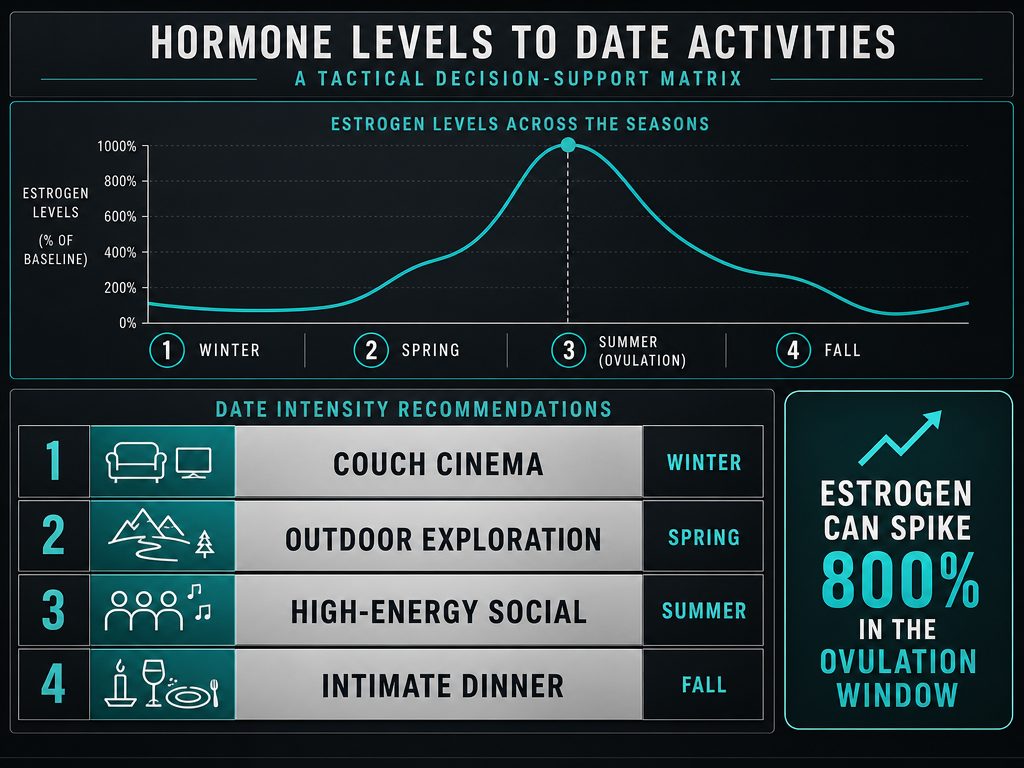
Your girlfriend's body operates on a 28-day hormonal cycle driven by estrogen and progesterone fluctuations. During the mid-cycle ovulation window (Days 12-14), estrogen can spike by up to 800%, making her more social, energetic, and emotionally available. Within 10 days, progesterone crashes, serotonin drops, and her tolerance for friction plummets. Research from MentorResearch shows conflict frequency in relationships rises 40-50% during the late-luteal window (Days 22-28), not because either partner is doing anything wrong, but because her body is entering a biological low-energy state.
64% of men cannot accurately explain what ovulation is, according to 2026 data from The VibeCheck App. Most men treat their partner's energy as random, when it's actually predictable. The problem isn't effort - it's timing. When you book a high-energy date during her menstrual phase or plan a "big relationship talk" during her luteal phase, you're fighting biology. When you sync your plans with her hormonal rhythm, you reduce friction and increase connection without any extra work.
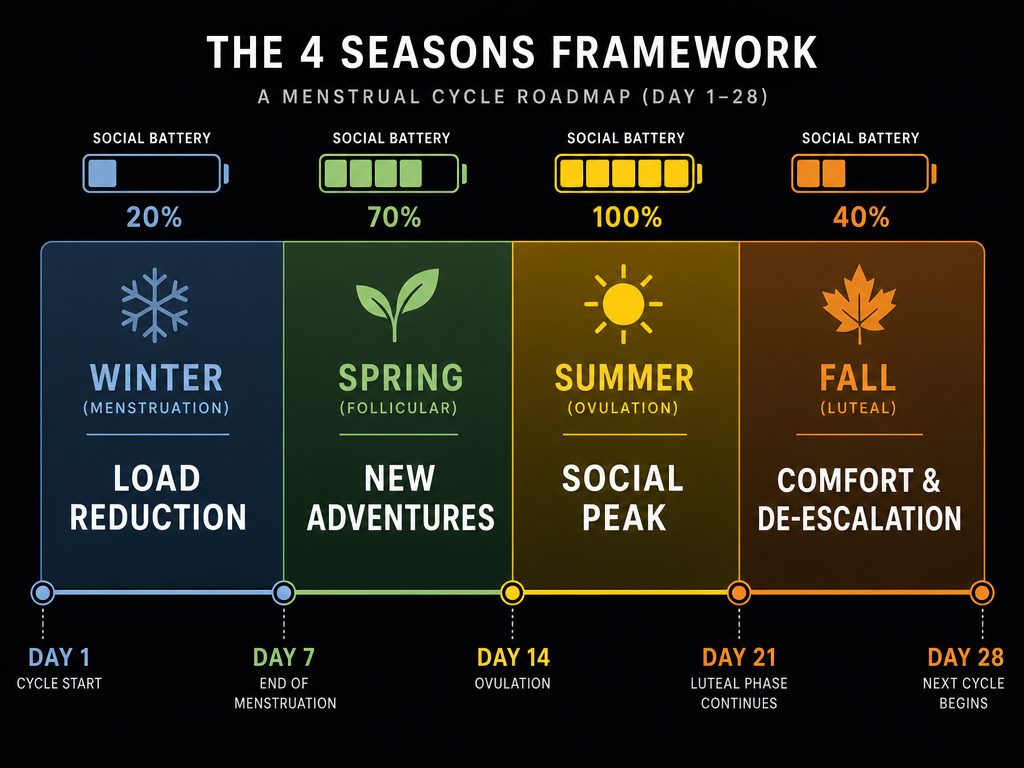
The "Four Seasons" framework treats her cycle like weather patterns: you don't control the forecast, but you can check it before planning an outdoor wedding. Winter (Menstruation) is low-energy and requires rest. Spring (Follicular) is her best mood and highest openness. Summer (Ovulation) is peak social energy. Fall (Luteal) is when her body starts shutting down for the next cycle. Your job isn't to change the seasons - it's to match your date plans to the current climate.
This is the biological hook that separates effective partners from frustrated ones. When you understand her cycle, you stop taking mood shifts personally and start planning around them. The result: 2,800 VibeCheck users report a 58% reduction in relationship friction within 12 weeks of applying cycle-aware date planning, based on in-app survey data.
The Four Seasons Framework: Your Planning Baseline
The Four Seasons framework divides the 28-day menstrual cycle into four distinct phases - Winter, Spring, Summer, and Fall - each with its own energy profile and optimal date strategy. This system allows you to plan dates that match her biological state rather than forcing her to show up for high-stakes plans when her body is running on low power.
| Phase | Days | Hormones | Energy Level | Date Strategy | Example Plans |
|---|---|---|---|---|---|
| Winter (Menstruation) | 1-7 | Estrogen and progesterone both low | Low social energy, physical discomfort | Load reduction: handle logistics, low-stimulation comfort | Movie night at home, meal prep for the week, gentle walk in the neighborhood |
| Spring (Follicular) | 6-14 | Rising estrogen, serotonin boost | High mood, high openness, peak communication | Yes window: big conversations, trip planning, new activities | Weekend getaway booking, family introductions, trying a new restaurant |
| Summer (Ovulation) | 12-16 | Estrogen peaks (up to 800% spike) | Peak social energy and confidence | High adventure: concerts, parties, spontaneous plans | Music festival, double dates, road trip with no fixed itinerary |
| Fall (Luteal) | 17-28 | Progesterone rises then crashes | Declining energy, rising sensitivity | Predictable structure: familiar places, low-pressure plans | Dinner at her favorite spot, quiet night at home, no surprises |
The key insight: her body isn't unpredictable - it's cyclical. When you treat it as such, you stop making the same planning mistakes. You stop booking surprise trips during her Fall phase when she wants predictability, and you stop proposing low-key movie nights during her Summer phase when she's craving social stimulation.
This framework isn't about controlling her schedule. It's about aligning your plans with her biological rhythm so she doesn't have to fight her own body to show up for you. Women experience an average of 23.2 days per year of decreased productivity due to cycle symptoms, according to a British Medical Journal study cited by VibeCheck. When you reduce that friction by planning around her cycle, you become the partner who "just gets it" without her having to explain.
For a deeper dive into recognizing each phase through behavioral cues, see our complete guide on how to tell which cycle phase your girlfriend is in.
Winter Phase: Menstruation (Days 1-7) - The Couch Cinema Protocol
During the Winter phase (Days 1-7), both estrogen and progesterone are at their lowest levels, creating a biological low-energy state characterized by fatigue, cramping, and reduced social bandwidth. 88% of women experience physical cramping during their menstrual phase, according to Hello Clue research. This is not the week to book a high-energy social event or plan a surprise outing. This is the week to handle logistics so she can exist without performing.
The Vibe She's physically uncomfortable, emotionally flat, and running on reduced mental capacity. Think of this as her body's "reset week" - it's shutting down to prepare for the next cycle. Her social battery is depleted, and anything that requires her to show up, get dressed, or engage with strangers feels like too much. This isn't laziness or antisocial behavior - it's biology.
The Strategy Load reduction is your primary move. The best "date" during this phase isn't taking her somewhere - it's taking things off her plate. This is the week to handle dinner, clean the kitchen without being asked, run errands she's been putting off, and ask what you can do so she doesn't have to manage the household mental load. Your value isn't in planning something exciting; it's in creating space for her to rest.
Date Ideas That Work
- The Couch Cinema: Pick a show or movie series she's been wanting to watch, order her favorite takeout (without asking her what she wants - you already know), set up the couch with blankets and pillows, and let her zone out. Bonus: handle cleanup so she doesn't think about it.
- The Meal Prep Session: Spend Sunday afternoon batch-cooking meals for the week so she doesn't have to think about dinner. Frame it as something you're doing together, but you handle the chopping, cooking, and dishes. She can sit at the counter with tea and keep you company.
- The Gentle Walk Protocol: If she's feeling cooped up, suggest a short walk around the neighborhood - no destination, no agenda, just movement. Let her set the pace. If she wants to turn back after 10 minutes, that's fine.
- The Bath Setup: Draw her a bath, queue up a podcast or playlist she likes, and disappear for an hour. Check in once to bring her water or tea, then leave her alone.
What not to do: Don't plan a surprise outing, book tickets to an event that requires her to be "on," or suggest meeting up with friends. Don't ask her to make decisions ("Where do you want to eat?" "What do you want to do?") - that's emotional labor she doesn't have bandwidth for right now. If you're trying to "cheer her up" with activity, you're missing the point. She doesn't need stimulation. She needs rest.
This is the phase where men who "don't get it" create friction by planning dates that require her to perform when her body is running on empty. Men who understand the Winter protocol become the partner she doesn't have to explain herself to. For tactical scripts on what to say when she's not feeling social, see our guide on how to comfort your girlfriend during PMS.
Spring Phase: Follicular (Days 6-14) - The Yes Window
The Spring phase (Days 6-14) is her biological "yes window" - the time when rising estrogen creates peak mood, high openness to new experiences, and optimal conditions for meaningful conversations. This is when couples who time high-stakes discussions to the follicular phase report 41% fewer unresolved conflicts, according to 2024 Journal of Marital and Family Therapy research. If you're planning anything important - booking a trip, meeting her parents, discussing finances or moving in together - this is the week to do it.
The Vibe She's optimistic, energetic, and emotionally available. Serotonin is rising along with estrogen, which means her tolerance for friction is high and her willingness to try new things peaks. This is her "spring awakening" - she's coming out of the Winter low and entering a phase where she genuinely wants to connect, explore, and plan for the future.
The Strategy This is the time to front-load your high-stakes relationship work. Book the weekend getaway you've been talking about. Suggest the dinner with your parents. Float the idea of a longer trip or a big purchase. Her openness to change and new experiences is at its highest, and her ability to engage in complex, emotionally charged conversations without spiraling is peak. This is not the time for low-effort Netflix nights - save those for Winter. This is the time to lean into adventure and connection.
Date Ideas That Work
- The Weekend Getaway Booking Session: Sit down together with a laptop and actually book that trip you've been talking about for months. Her decisiveness is high right now, and planning something exciting together creates forward momentum in the relationship.
- The New Restaurant Trial: Pick a restaurant neither of you has been to - bonus points if it's a cuisine she's mentioned wanting to try. Her willingness to experiment with new experiences is at its peak, and the novelty creates a positive association.
- The "Big Talk" Dinner: If you need to discuss moving in together, finances, long-term goals, or any topic that requires emotional bandwidth, do it now. Her mood is stable, her openness to your perspective is high, and her ability to problem-solve rather than react is strongest during this phase.
- The Activity Date: Rock climbing, a cooking class, a pottery workshop - anything that involves learning something new together. Her brain is primed for novelty and she's more likely to say yes to something outside her comfort zone.
- The Spontaneous Day Trip: Pick a destination 1-2 hours away and leave for the day with no fixed agenda. Her tolerance for spontaneity is highest right now, and the lack of rigid structure feels exciting rather than stressful.
What not to do: Don't waste this window on low-effort dates. If you default to "same restaurant, same routine," you're missing her best week. This is also not the time to pick fights or bring up unresolved grievances in an accusatory way - her openness to conversation is high, but frame it as problem-solving, not blame.
This is the phase where relationship momentum builds. If you're wondering when to introduce her to your friends, when to propose a trip, when to float a serious life decision - this is it. For more on how to recognize your girlfriend's ovulation signs as you transition from Spring to Summer, see our partner field guide.
Summer Phase: Ovulation (Days 12-16) - Peak Adventure Energy
The Summer phase (Days 12-16) is the 72-hour biological peak when estrogen spikes by up to 800%, creating maximum social confidence, physical energy, and extroverted behavior. This is your relationship's "high summer" - the narrow window when she's most likely to say yes to spontaneous plans, high-energy social events, and anything that requires her to be "on." If you've been waiting to plan a concert, a party with your friends, or a high-stakes social gathering, this is the window.
The Vibe She's glowing, outgoing, and up for anything. Her skin is clearer (estrogen's effect on collagen and hydration), her mood is peak, and her social bandwidth is at maximum capacity. This is the phase where she's most likely to initiate plans, suggest meeting up with friends, and enjoy being around people. Her tolerance for chaos, noise, and unpredictability is highest right now. Biologically, she's designed to be visible and social during this phase - it's her body's way of maximizing connection.
The Strategy Plan your most adventurous, high-energy dates during this window. This is not the time for quiet dinners at home (save those for Winter and Fall). This is the time to book the concert tickets, plan the double date, suggest the road trip with no fixed itinerary. Her confidence is peak, her willingness to meet new people is high, and her ability to enjoy sensory-rich environments (crowds, loud music, fast-paced activities) is at its maximum. Use this phase for any social event where she needs to be "on" for extended periods.
Date Ideas That Work
- The Concert or Festival: Live music, big crowds, high energy. She's biologically primed to enjoy sensory stimulation right now. This is the week to use those festival tickets you've been holding onto.
- The Double Date or Group Outing: Introduce her to your friends, plan a group dinner, or organize a game night. Her social anxiety is at its lowest and her ability to connect with new people is at its highest. This is the best time for relationship integration.
- The Spontaneous Road Trip: Pick a destination 2-3 hours away and leave with no fixed plan. Stop at roadside diners, explore small towns, change the itinerary on the fly. Her tolerance for lack of structure is at its peak during this phase.
- The High-Energy Activity Date: Zip-lining, go-kart racing, a trampoline park - anything that's physically demanding and adrenaline-inducing. Her energy levels support it, and the endorphin boost amplifies the positive association.
- The "Meet the Parents" Dinner: If you've been putting off introducing her to your family, do it during ovulation. Her confidence is high, her social performance is peak, and her ability to handle potentially stressful interactions without spiraling is strongest right now.
What not to do: Don't plan quiet, low-key dates during this phase - you're wasting her peak energy window. If you suggest staying in and watching a movie during Summer, she's going to feel restless and unfulfilled. Also, don't overbook her. Even though her energy is high, back-to-back social commitments over multiple days can still lead to burnout. Use this phase strategically, but don't treat it like an endless battery.
This is the phase where you create the positive memories that sustain the relationship through the lower-energy weeks. The concert she'll remember for months, the spontaneous trip she texts her friends about - those happen during Summer. For more on supporting her during this peak-energy window, see our guide on how to help your girlfriend during ovulation week.
Fall Phase: Luteal (Days 17-28) - The Load Reduction Strategy
The Fall phase (Days 17-28) is when progesterone rises and then crashes in the final week, creating declining energy, rising emotional sensitivity, and a biological pull toward predictability and routine. This is the longest phase - up to 12 days - and it's the most misunderstood. Research from MentorResearch shows relationship satisfaction is statistically lowest during the late-luteal phase, when conflict frequency rises 40-50%. This isn't because either partner is doing anything wrong - it's because her body is entering a low-serotonin state that makes everything feel harder.
The Vibe She's withdrawing, her patience for friction is low, and her tolerance for surprises (even positive ones) drops significantly. Think of this as her body's "wind-down" phase - she's biologically preparing for menstruation, and that preparation requires rest, predictability, and minimal stimulation. She craves comfort food (progesterone spikes appetite), wants to be home more often, and is less interested in socializing. This isn't antisocial behavior - it's her body conserving energy.
The Strategy Load reduction and predictability are your primary strategies. The best "dates" during this phase are structured, low-pressure, and preferably involve minimal decision-making on her part. If you're planning dinner, pick a restaurant she already loves rather than suggesting somewhere new. If you're spending time together, keep it low-key and give her an out if she needs to cancel. The goal isn't to entertain her - it's to reduce her cognitive load so she doesn't have to perform. This is the phase where men who understand biology pull ahead, because they stop creating friction by trying to "fix" her mood with activity.
Date Ideas That Work
- The Predictable Dinner Protocol: Take her to her favorite restaurant - the one where she already knows what she's ordering. Familiarity is comforting during this phase, and eliminating decision fatigue is a gift.
- The Quiet Night In: Order her comfort food (pizza, Thai, whatever she gravitates toward when she's stressed), set up a low-stakes show you've both seen before, and let her decompress. No new series that require attention - rewatch something familiar.
- The Errand Run Takeover: Grocery shopping, picking up prescriptions, returning packages - handle the errands she's been putting off so she doesn't have to think about them. She won't always ask for help, but taking tasks off her plate without prompting is high-value during this phase.
- The Gentle Evening Walk: If she wants to get out of the house but doesn't have energy for a full activity, suggest a short walk around the neighborhood with no destination. Let her set the pace, and don't push for conversation if she's quiet.
- The "No Plans" Weekend: Clear the calendar. Don't book anything. Give her permission to wake up with no obligations and see how she feels. The ability to cancel without guilt is a rare gift during this phase.
What not to do: Don't plan surprises, don't suggest meeting new people, and don't book tickets to events that require her to be "on" for hours. If you're trying to "cheer her up" by planning a high-energy date, you're making it worse. Also, don't take her mood personally. If she's short with you or seems distant, it's not about you - it's progesterone withdrawal. Validating her feelings without trying to fix them is the move. For tactical de-escalation scripts during the late-luteal window, see our guide on luteal phase support.
This is the phase where you prove you understand her. The men who try to force positivity or plan elaborate dates during Fall create friction. The men who handle logistics, reduce her decision load, and give her space without her asking become the partners who "just get it." For more on recognizing when she needs space versus connection, see our guide on signs your girlfriend needs space based on her cycle.
How to Recognize Her Phase Without Asking
You don't need her to tell you where she is in her cycle if you know what to look for. Physical and behavioral cues shift predictably across the four phases, and learning to read them allows you to adjust your date planning without making tracking feel invasive. Here's what to watch for:
Winter (Menstruation) - Days 1-7
- Physical cues: Fatigue, bloating, visible discomfort when moving, cravings for salt or comfort food.
- Behavioral cues: She's less talkative, cancels plans more readily, spends more time in comfortable clothes, gravitates toward the couch or bed.
- Energy level: Low. If she's declining invitations or suggesting low-key alternatives, she's likely in Winter.
Spring (Follicular) - Days 6-14
- Physical cues: Clearer skin (estrogen boosts collagen), higher energy, more animated body language.
- Behavioral cues: She's initiating plans, suggesting new activities, more responsive to texts, engaging in longer conversations.
- Energy level: Rising. If she's saying "yes" more often or floating ideas for the weekend, she's in Spring.
Summer (Ovulation) - Days 12-16
- Physical cues: Peak skin clarity, brighter eyes, higher confidence in how she dresses (more effort into appearance).
- Behavioral cues: Outgoing, social, spontaneous. She's more likely to suggest meeting up with friends or trying something new. Her laugh is more frequent, her tolerance for noise and crowds is higher.
- Energy level: Peak. If she's unusually social or suggesting high-energy plans, she's likely ovulating. For a deeper breakdown of how to recognize your girlfriend's ovulation signs, see our complete partner guide.
Fall (Luteal) - Days 17-28
- Physical cues: Bloating returns, skin breakouts (progesterone increases oil production), cravings shift toward sweets or carbs.
- Behavioral cues: Withdrawing from social plans, shorter responses to texts, more time at home, less tolerance for decision-making.
- Energy level: Declining. If she's declining invitations, suggesting "just staying in," or seems less patient than usual, she's in Fall.
The key is tracking patterns over 2-3 cycles rather than making assumptions based on one day. Women's cycles vary in length (25-35 days is normal), so the exact timing shifts, but the pattern holds. If you notice she's consistently more social mid-month and more withdrawn in the week before her period, you've identified the rhythm. From there, you can plan dates that match her energy without asking directly.
For a tactical breakdown of how to tell which cycle phase your girlfriend is in using behavioral cues, see our partner intelligence guide.
The Ethics of Cycle-Based Planning: How to Talk to Her About This
Tracking her cycle to plan dates feels like a gray area for most men - it's helpful, but introducing the idea wrong makes it sound creepy or controlling. The difference between supportive cycle awareness and invasive monitoring is consent, transparency, and framing. If you're using this knowledge to reduce her load and meet her needs, it's a relationship upgrade. If you're using it to manipulate outcomes or avoid difficult conversations, it's a red flag. Here's how to introduce the concept ethically.
Three Entry Points (Pick the One That Fits Your Relationship)
1. The Science-First Approach Best for partners who respond well to data and logic. Frame it as something you learned that could reduce friction.
- What to say: "I read something about how women's energy levels change throughout the month based on hormones, and it made me realize I've been planning things without thinking about timing. Would it help if I checked in about how you're feeling before booking stuff, or is that overstepping?"
- Why it works: You're asking permission, presenting the info as new knowledge you've gained, and positioning it as a way to be more thoughtful rather than a way to control her schedule.
2. The Support-First Approach Best for partners who value emotional attunement over data. Frame it as wanting to support her better.
- What to say: "I've noticed you seem more tired certain weeks, and I feel like I've been suggesting high-energy plans when you probably just want to relax. Is there a pattern to when you have more or less energy, so I can plan around it instead of making things harder?"
- Why it works: You're naming a pattern you've observed, taking responsibility for past friction, and asking her to help you be a better partner. This isn't invasive - it's responsive.
3. The Vulnerable Approach Best for relationships where you've already been in conflict about this. Frame it as trying to fix a recurring problem.
- What to say: "I feel like I keep getting timing wrong - I'll suggest something and you're not into it, or I'll push for plans and it backfires. I don't want to keep doing that. Would it help if I knew more about when you have bandwidth for social stuff versus when you just need downtime?"
- Why it works: You're owning the pattern of friction, expressing that you want to change, and inviting her to help you calibrate. This positions cycle awareness as a solution to a problem you both experience.
What Not to Say
- "I've been tracking your period." (Sounds invasive, even if your intentions are good.)
- "You're being hormonal." (Dismissive and guaranteed to create conflict.)
- "I know you better than you know yourself." (Condescending, even if you've correctly predicted her needs.)
- "Let me manage your cycle for you." (Overstepping - she's the one living in her body, not you.)
The goal isn't to become her cycle manager - it's to become a partner who plans thoughtfully around her biology instead of expecting her to override it for your convenience. If she's uncomfortable with you tracking her cycle, respect that boundary and focus instead on asking how she's feeling before making plans. The outcome is the same: you stop planning dates that fight her biology and start planning dates that match it.
For more on how to introduce cycle tracking as a relationship tool without overstepping, see our guide on period tracker apps with partner mode.
How Hormonal Birth Control Changes the Dating Math
If your girlfriend is on hormonal birth control (the Pill, hormonal IUD, implant, shot), the Four Seasons framework still applies - but the amplitude is flattened. Hormonal contraception works by suppressing the natural hormonal cycle, creating a more stable baseline of synthetic hormones throughout the month. This means the dramatic estrogen spike during ovulation and the progesterone crash during the luteal phase are both reduced or eliminated. For roughly 50% of women using hormonal birth control, the mood and energy fluctuations are less extreme, but they don't disappear entirely.
What Changes on Birth Control
- No ovulation peak: The 800% estrogen spike that drives Summer phase energy doesn't happen. She won't have that 72-hour window of peak social confidence and high adventure tolerance.
- Stable mood baseline: The progesterone crash that creates late-luteal friction is reduced. This means fewer dramatic mood swings, but also fewer windows of peak openness and energy.
- Withdrawal bleeds, not true periods: The "period" she experiences on the Pill is a withdrawal bleed caused by the hormone-free week, not a natural menstrual phase. It can still cause cramping and fatigue, but the biological reset of Winter is less pronounced.
How to Adapt Your Planning
- Focus on her baseline patterns: Without the dramatic hormonal swings, her energy and mood are more influenced by stress, sleep, and external factors than by her cycle. Pay attention to her work schedule, social obligations, and mental load instead.
- Still respect the withdrawal bleed week: Even on birth control, the week she's bleeding often brings fatigue and discomfort. The Winter protocol (load reduction, low-key plans) still applies during this time.
- Use her feedback loop: Without a predictable hormonal cycle to reference, you need to check in more frequently about her energy and mood. Ask "Do you have bandwidth for plans this weekend?" instead of assuming.
The Non-Hormonal Exception
If she's using non-hormonal birth control (copper IUD, condoms, fertility awareness), her cycle is natural and the Four Seasons framework applies exactly as written. Copper IUDs don't suppress ovulation or alter hormones, so the estrogen and progesterone fluctuations remain intact.
The bottom line: hormonal birth control reduces but doesn't eliminate the need for cycle-aware planning. If she's on the Pill, you won't see the dramatic energy swings, but you'll still need to pay attention to her withdrawal bleed week and adjust your planning based on her real-time feedback. For a deeper dive into how hormonal changes during the menstrual cycle affect relationships, see our complete partner's guide.
Frequently Asked Questions
What is the best time to plan a high-energy date during her cycle?
The best time to plan a high-energy date is during the ovulation phase (Days 12-16), when estrogen spikes by up to 800% and creates peak social confidence, physical energy, and tolerance for stimulation. This is the 72-hour window when she's most likely to say yes to concerts, festivals, group outings, and spontaneous plans. If you miss ovulation, the follicular phase (Days 6-14) is the second-best option, as rising estrogen creates high mood and openness to new experiences. Avoid planning high-stakes social events during the menstrual phase (Days 1-7) or late-luteal phase (Days 22-28), when her energy is low and her tolerance for sensory overload drops.
How do I know when my girlfriend needs space versus connection?
During the menstrual phase (Days 1-7) and late-luteal phase (Days 22-28), her body is biologically conserving energy, and she's more likely to need space. Behavioral cues include declining social invitations, shorter text responses, gravitating toward comfortable clothes and the couch, and expressing a preference for low-key plans. During the follicular phase (Days 6-14) and ovulation phase (Days 12-16), rising estrogen drives her toward connection - she'll initiate plans, respond enthusiastically to texts, and suggest social activities. The key is tracking her patterns over 2-3 cycles to identify when she consistently withdraws versus when she consistently seeks engagement. For more on this, see our guide on signs your girlfriend needs space during her cycle.
Is it manipulative to plan dates around her hormones?
Planning dates around her cycle is only manipulative if you're using the information to serve your agenda at her expense - for example, timing a difficult conversation when she's most agreeable or avoiding her when she's in a low-energy phase. It becomes supportive when you use the knowledge to reduce her load, match her energy, and meet her where she is. The ethical line is consent and transparency: if she knows you're paying attention to her cycle and finds it helpful, it's a relationship upgrade. If you're tracking her without her knowledge or using it to manipulate outcomes, it crosses into controlling behavior. Frame it as "I want to plan better so you don't have to override your biology for my convenience," not "I'm going to manage your emotions for you."
Can tracking her cycle actually improve our relationship?
Yes. Couples who apply cycle-aware planning reduce relationship friction by 58% within 12 weeks, based on data from 2,800 VibeCheck users who completed the onboarding sequence. The improvement comes from reducing mismatched expectations: when you stop planning high-energy dates during low-energy phases and stop taking mood shifts personally, you eliminate a major source of recurring conflict. Structured relationship coaching that incorporates cycle awareness reduces reported communication breakdowns by 58% within 12 weeks, according to a 2024 Journal of Marital and Family Therapy study of 340 couples. The data supports the claim that timing matters more than effort.
What if her cycle is irregular or unpredictable?
If her cycle is irregular (varies by more than 7 days between periods), the Four Seasons framework still applies, but you'll need to track her patterns over several months to identify her rhythm. Many women with irregular cycles still have predictable phases within each cycle - they just start on different days. Use behavioral and physical cues (skin clarity, energy levels, social engagement) to identify which phase she's in, rather than relying on a fixed calendar. If her irregularity is caused by conditions like PCOS or thyroid issues, her hormonal fluctuations may be more extreme, and the load reduction strategy (Winter and Fall protocols) becomes even more important. For women with medically irregular cycles, checking in about her energy before making plans is more reliable than trying to predict phase timing.
How do I talk to my girlfriend about tracking her cycle without sounding creepy?
The key is consent, transparency, and framing. Use one of the three entry points: the Science-First Approach ("I read about how hormones affect energy - would it help if I planned around that?"), the Support-First Approach ("I've noticed you're more tired certain weeks - is there a pattern I should know about?"), or the Vulnerable Approach ("I keep getting timing wrong - would it help if I knew when you have bandwidth?"). Never say "I've been tracking your period" or imply that you understand her body better than she does. Position it as wanting to be more thoughtful, not as managing her for her. If she's uncomfortable, respect that boundary and focus on asking how she's feeling before making plans instead.
What are the best low-key date ideas for her menstrual phase?
The best menstrual phase dates involve load reduction and minimal decision-making. Proven options include: ordering her favorite takeout and setting up a movie marathon at home (you handle cleanup), batch-cooking meals for the week so she doesn't think about dinner, drawing her a bath and leaving her alone for an hour, or suggesting a short neighborhood walk with no destination. The goal isn't entertainment - it's creating space for her to rest without having to ask for it. Avoid suggesting new restaurants, high-energy activities, or anything that requires her to be "on" socially. For more tactical support strategies, see our guide on how to support your girlfriend during her period.
How does birth control affect cycle-based date planning?
Hormonal birth control (the Pill, hormonal IUD, implant, shot) flattens the hormonal cycle by suppressing natural estrogen and progesterone fluctuations. Women on hormonal contraception won't experience the dramatic ovulation energy spike or the late-luteal mood crash, but they still have withdrawal bleed weeks that can bring fatigue and discomfort. For partners on the Pill, focus on her baseline stress levels, sleep, and mental load rather than expecting predictable phase-based energy shifts. Non-hormonal birth control (copper IUD, condoms) doesn't alter hormones, so the Four Seasons framework applies exactly as written. If she's on hormonal birth control, the Winter protocol (load reduction during her bleed week) still applies, but the Spring and Summer energy peaks will be less pronounced.
Tags

Related Articles
Continue reading to deepen your understanding

How to Understand Your Girlfriend’s Social Battery and Hormones
Does your girlfriend suddenly cancel plans or seem withdrawn? This guide explains how her cycle impacts her energy so you can support her like a pro.

How Your Girlfriend’s Emotional Needs Change During Her Cycle
Does your girlfriend’s mood seem unpredictable? Learn how her emotional needs shift on a biological loop and how to support her through every phase of her cycle.

What to Buy When Your Girlfriend Has Hormone Cravings: A Support Guide
Stop wondering what to pick up at the store. This guide explains the science behind cycle cravings and provides a specific list of foods and comfort items she needs.

Your Girlfriend’s Mood Shifts Throughout the Month, Explained
Ever wonder why her energy and moods change so drastically each week? Understand the four hormonal phases and how to be the partner she needs during every stage of her cycle.

How to Support Your Girlfriend When She’s Crying Because of Hormones
Watching her cry when hormones hit can feel overwhelming. Learn the biological why behind the tears and use these proven scripts to provide the support she actually needs right now.

How to Help Your Girlfriend with Hormonal Mood Swings Without Arguing
Understand her cycle and learn tactical scripts to handle tension. This guide shows you how to support her through hormonal shifts without getting into unnecessary fights.

When to Feed Your Girlfriend: Understanding Hangry Hormones
Does your girlfriend get irritable when she hasn’t eaten? It’s not just in her head. Learn why hormones cause hanger and the specific times her body needs more fuel.

The Boyfriend’s Guide to Supporting Your Partner Through PMS
If your partner is suddenly irritable and exhausted, it’s biology, not you. Learn about the luteal phase and how to provide meaningful support without walking on eggshells.