A Boyfriend’s Guide to Supporting Your Girlfriend Through Hormonal Changes

Understanding her cycle isn’t about walking on eggshells; it’s about being a proactive partner. Learn how to navigate her monthly hormonal shifts and provide the exact support she needs.
The Tactical Field Manual: A Boyfriend’s Guide to Supporting Your Girlfriend Through Hormonal Changes
You’re watching her pull away from plans you were both excited about last week. She’s irritable about the dishes you forgot - again. Or she’s suddenly overwhelmed by a work email that wouldn’t have fazed her yesterday.
Here’s what most men don’t realize: these aren’t random mood swings. They’re predictable biological patterns repeating every 28 days.
Your girlfriend’s body runs a sophisticated hormonal cycle that affects everything from her energy levels to her stress tolerance to her desire for connection. Understanding this cycle doesn’t just help you avoid arguments - it transforms you from a reactive partner into a proactive one who knows exactly what she needs before she asks.
This guide breaks down the four biological seasons of her menstrual cycle and gives you a tactical playbook for each phase. No medical jargon. No walking on eggshells. Just practical scripts, timing strategies, and support tactics that actually work.
VibeCheck App
Know what she needs. Before she has to say it.
Track her cycle, understand her phases, be the partner she deserves.
Download Free on iOS →Most of this gets easier when you can see the shift coming. Our shortlist of the best period trackers for boyfriends covers the apps built for partners — then come back for the playbook below.
Table of Contents
- The Biology of "Vibes": Why Her Mood Isn’t Random
- The Four Seasons Framework: Your Strategic Overview
- Phase 1: Menstrual (Days 1-7) - The Infrastructure Phase
- Phase 2: Follicular (Days 8-14) - The Expansion Phase
- Phase 3: Ovulatory (Days 15-17) - The Connection Phase
- Phase 4: Luteal (Days 18-28) - The Stability Phase
- The Communication Matrix: Say This, Not That
- The 7-2-1 Medical Red Flag Guide
- The Proactive Infrastructure Checklist
- Long-Distance Relationship Support Strategies
- Frequently Asked Questions
The Biology of "Vibes": Why Her Mood Isn’t Random
When she’s suddenly exhausted on a Saturday morning despite sleeping 10 hours, or crying during a commercial that’s objectively not sad, your first instinct might be confusion. The problem isn’t her sensitivity - it’s that you’re missing the biological context.
Her menstrual cycle operates on two primary hormones: estrogen and progesterone. Think of estrogen as the social battery hormone. When it’s high (roughly Days 8-17), she’s got energy for new experiences, difficult conversations, and spontaneous plans. Progesterone, which dominates the second half of her cycle (Days 18-28), is the calm and rest hormone. It prepares her body for potential pregnancy, which means conserving energy and avoiding unnecessary stress.
Here’s the part that matters for your relationship: During the luteal phase (the week or so before her period), progesterone drops sharply while estrogen plummets. This hormonal crash causes serotonin levels to fall by up to 30%. Serotonin regulates mood, impulse control, and stress response. When it drops, minor irritations feel like major crises. The dishes you forgot aren’t just annoying - they feel like evidence you don’t care.
She’s not being unreasonable. Her brain chemistry is temporarily making everything feel heavier.
Understanding this doesn’t mean excusing poor behavior or accepting mistreatment. It means recognizing that certain weeks require different support strategies. When you align your approach with her biological reality, you reduce friction and build trust.
The Four Seasons Framework: Your Strategic Overview
The 28-day menstrual cycle breaks into four distinct phases, each with its own energy signature and support needs. The most effective way to conceptualize these phases is through seasonal metaphors - a system that translates complex biology into actionable relationship intelligence.
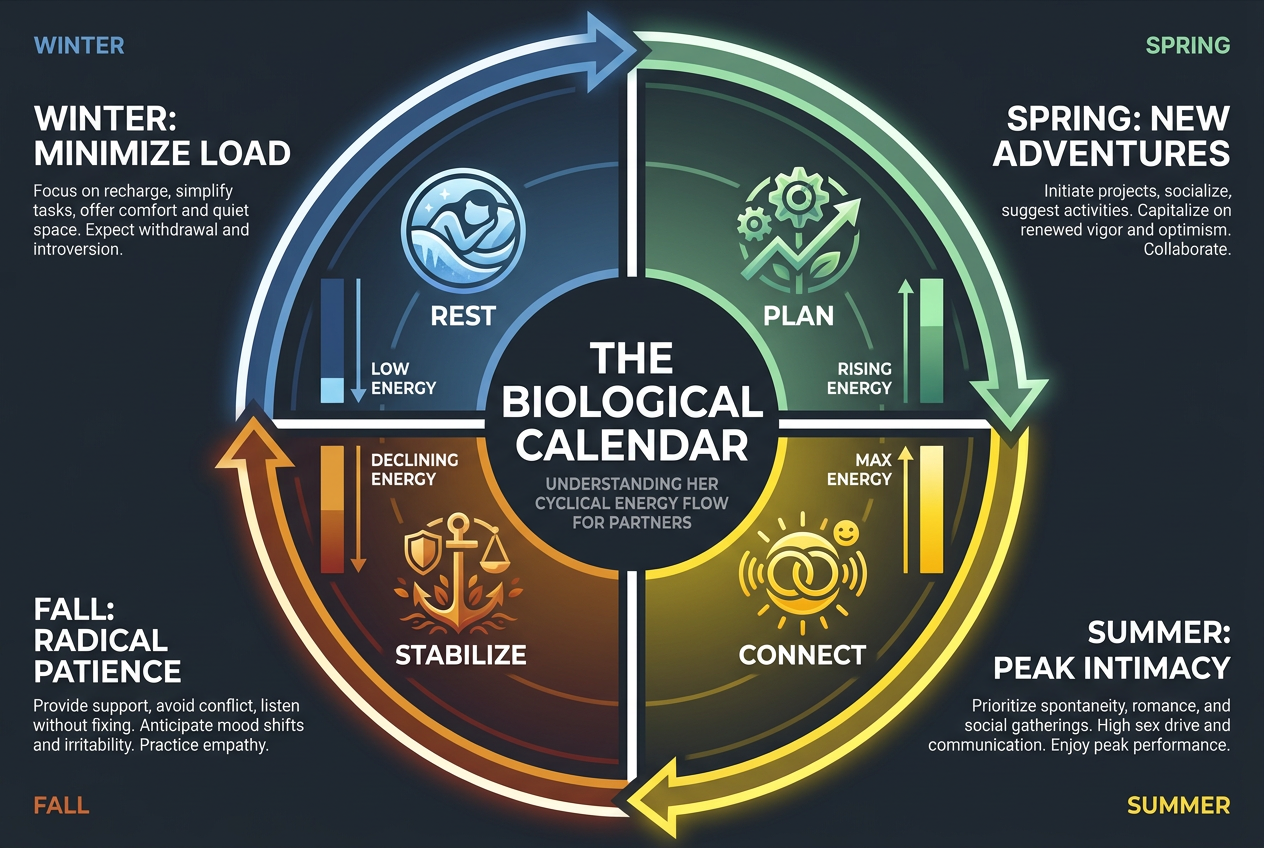 Understand the four biological seasons of her cycle to better anticipate energy shifts, mood changes, and specific support needs throughout the month.
Winter (Menstrual Phase, Days 1-7): Low energy, physical discomfort, need for rest. Your mission is reducing her physical and mental load.
Spring (Follicular Phase, Days 8-14): Rising energy, optimism, openness to new experiences. Your mission is matching her momentum and planning adventures.
Summer (Ovulatory Phase, Days 15-17): Peak energy, heightened social desire, maximum confidence. Your mission is prioritizing connection and intimacy.
Fall (Luteal Phase, Days 18-28): Declining energy, increased sensitivity, preference for routine. Your mission is providing stability and taking over executive functions.
Each season requires a different tactical approach. The man who treats all four phases the same will constantly miss the mark. The man who adjusts his strategy based on where she is in her cycle becomes an indispensable partner.
Phase 1: Menstrual (Days 1-7) - The Infrastructure Phase
What’s happening biologically: Both estrogen and progesterone are at their lowest. Blood loss and prostaglandin release (the hormone that triggers uterine contractions) cause cramping, fatigue, and sometimes nausea or headaches. Her body is literally shedding the uterine lining it built over the past month.
Her internal experience: Physical discomfort ranges from mild to debilitating. She’s exhausted but may struggle to rest because life doesn’t stop. Decision fatigue is high - even minor choices feel overwhelming. This is not the week to ask "What do you want for dinner?" or "Should we go to your parents’ this weekend?"
Your Tactical Mission: Reduce Load
Your job during Winter is simple: handle the infrastructure. Take things off her plate without asking permission. The key phrase here is unprompted action.
The Infrastructure Kit (Stock These Now):
- Electric heating pad with auto-shutoff timer
- Ibuprofen or naproxen sodium (more effective than acetaminophen for cramps)
- 70% dark chocolate (magnesium content helps with muscle tension)
- Her preferred menstrual products (keep backups in the bathroom)
- Comfortable, loose clothing (period underwear if she uses it)
Specific Actions:
- Handle meal planning and cooking. Don’t ask what she wants - just provide nutritious, low-effort food.
- Take over household chores: dishes, laundry, trash, pet care.
- Reduce social obligations. If you had plans, offer to reschedule.
- Provide physical comfort: heating pad, back rubs, running a bath.
- Minimize decisions. Say: "I’m picking up Thai food and doing the dishes. You just rest."
What NOT to do:
- Ask if she’s on her period (she knows you can see the heating pad)
- Suggest yoga, exercise, or wellness tips unless she specifically asks
- Expect her to manage logistics or make decisions
- Push for sex or physical affection beyond what she initiates
- Complain about the mess or the lack of energy in the relationship
One partner reported in a period tracker for men community: "I used to take her low energy personally during this phase. Once I started treating Days 1-5 like a scheduled rest period and just handled the house without asking, our arguments dropped by 80%."
Phase 2: Follicular (Days 8-14) - The Expansion Phase
What’s happening biologically: Estrogen is rising rapidly. This hormone boost increases serotonin, dopamine, and energy levels. Her brain is literally more optimistic during this phase - studies show women score higher on cognitive tests and report better moods during the follicular window.
Her internal experience: She feels capable, social, and open to new experiences. This is her "yes" window for trying new restaurants, planning trips, or having big conversations about the future. Her tolerance for risk and novelty is higher. She wants to expand, not contract.
Your Tactical Mission: Match Her Momentum
Spring is your opportunity to build the relationship bank account. Estrogen makes her more receptive to romantic gestures, deep conversations, and spontaneous plans.
Specific Actions:
- Plan adventure dates: hiking, concerts, exploring a new neighborhood, trying a cooking class.
- Have important relationship conversations. If you’ve been wanting to discuss moving in together, finances, or future plans, this is the phase to do it.
- Match her energy. If she wants to go out three nights in a row, don’t anchor her down.
- Initiate thoughtful gestures: surprise flowers, booking that restaurant she mentioned weeks ago, planning a weekend trip.
- Support her personal projects. If she wants to start a new hobby or tackle a home improvement project, be her enthusiastic co-pilot.
What NOT to do:
- Waste her high-energy phase on low-effort dates (another movie night at home)
- Shoot down her ideas or enthusiasm
- Be passive about planning - take initiative
- Miss the window for important conversations (if you wait until the luteal phase, the same topic will feel 10x heavier)
Many men using boyfriend relationship advice platforms report that this phase is when their partners feel most understood and appreciated - not because they’re doing more, but because they’re syncing effort with biological receptivity.
Phase 3: Ovulatory (Days 15-17) - The Connection Phase
What’s happening biologically: Estrogen peaks right before ovulation, then drops sharply. Testosterone also spikes, which boosts libido for many women. Evolutionarily, this is the fertile window - her body is primed for connection and reproduction, even if pregnancy isn’t the goal.
Her internal experience: Peak confidence, social magnetism, and physical desire. She feels attractive and wants to be seen. Her communication is clear and direct. This is the best phase for intimacy, both emotional and physical.
Your Tactical Mission: Prioritize Connection
Summer is short (only 2-3 days) but powerful. This is when your relationship feels effortless. Your job is to lean into that connection.
Specific Actions:
- Prioritize physical intimacy. If you’ve been in a dry spell, this is your moment. Her libido is naturally elevated.
- Plan romantic dates: candlelit dinners, live music, anything that feels emotionally resonant.
- Give her genuine compliments. She’s feeling confident - reinforce it.
- Be fully present. Put down your phone, make eye contact, listen actively.
- Match her social energy. If she wants to go to a party or host friends, be her engaged co-host.
What NOT to do:
- Be distant or distracted during this phase
- Miss the window for physical connection (if you wait until the luteal phase, her libido may drop significantly)
- Take her peak mood for granted and coast
Understanding when your girlfriend is ovulating can transform your approach to intimacy. One man described it as "finally understanding why some weeks she’s all in and other weeks she needs space - it wasn’t about me at all."
Phase 4: Luteal (Days 18-28) - The Stability Phase
What’s happening biologically: Progesterone dominates, preparing her body for potential pregnancy. When fertilization doesn’t occur, both progesterone and estrogen crash around Day 25-26. This hormonal drop triggers PMS symptoms: irritability, bloating, food cravings, fatigue, and heightened emotional sensitivity.
Her internal experience: Energy declines. Her stress tolerance drops. Tasks that felt manageable last week now feel overwhelming. She’s more prone to negative thinking and catastrophizing. This isn’t weakness - it’s neurobiology. Her prefrontal cortex (the decision-making center) is literally less efficient during this phase.
Your Tactical Mission: Provide Stability
 In the luteal phase, proactively taking over executive functions like meal planning and chore management significantly reduces her stress and prevents relationship friction.
Fall is the most critical phase for relationship maintenance. This is where most arguments happen - not because you’re incompatible, but because her nervous system is more reactive and your communication hasn’t adapted.
Specific Actions:
- Take over decision-making. Don’t ask "What should we do for dinner?" - just handle it.
- Increase physical affection without expecting sex. Back rubs, cuddling, hand-holding.
- Reduce social obligations. If you had plans, consider rescheduling.
- Be proactive about chores. Do the dishes, take out the trash, tidy the living room - before she asks.
- Validate her feelings without fixing. When she vents, your job is to listen, not solve.
- Keep routines predictable. This is not the week to surprise her with an impromptu road trip.
What NOT to do:
- Ask if she’s PMSing (you will regret this)
- Take her irritability personally (it’s neurochemical, not personal)
- Push for productivity or new commitments
- Expect her to manage household logistics
- Be defensive when she’s frustrated
The luteal phase is when your girlfriend’s mood swings are most pronounced - not because she’s irrational, but because her serotonin and dopamine levels are crashing. Your communication strategy needs to reflect that reality.
The Communication Matrix: Say This, Not That
Knowing what to do is only half the battle. Knowing what to say separates good partners from great ones. The wrong phrase during the luteal phase can escalate a minor frustration into a full argument. The right phrase de-escalates tension and provides the emotional security she needs.
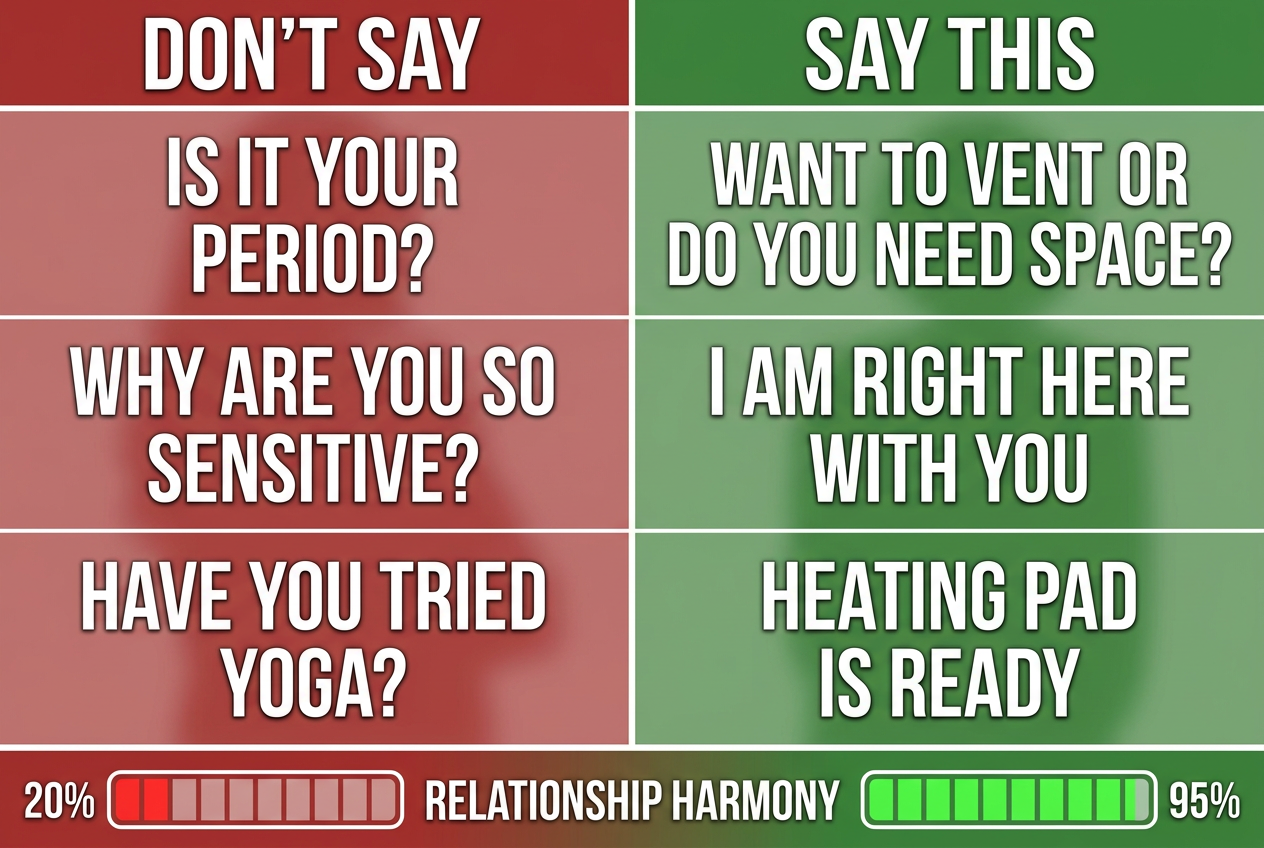 Small shifts in your phrasing can de-escalate tension and provide the emotional security your partner needs during high-sensitivity phases like the luteal window.
| Situation | Don’t Say | Say This Instead |
|---|---|---|
| She’s irritable about something minor | "You’re overreacting." / "Is it your period?" | "I can tell today feels heavy. Want to talk or do you need space?" |
| She’s in physical pain | "Have you tried yoga?" / "Take some Advil." | "Heating pad is already plugged in. I’ll handle dinner and the dishes." |
| She’s crying over something that seems small | "Why are you so sensitive?" / "It’s not that big of a deal." | "I’m right here. That sounds really frustrating." |
| She’s exhausted and withdrawing | "You’ve been distant lately." / "Why don’t you want to hang out?" | "You seem tired. Let’s order in and put on your favorite show." |
| She’s venting about work stress | "Here’s what you should do..." / "Have you tried...?" | "That sounds incredibly stressful. Tell me more." |
| She’s craving specific foods | "You just ate." / "That’s not healthy." | "Want me to grab that for you?" / "I’ll order it now." |
| She’s frustrated with you | "I’m trying my best." / "You’re being unfair." | "You’re right. I should have handled that differently." |
The pattern here is simple: validate first, problem-solve later (and only if asked). During the luteal phase especially, she doesn’t need solutions - she needs to feel heard.
For more tactical scripts, check out what to text your girlfriend during her period - the same principles apply to in-person communication.
The 7-2-1 Medical Red Flag Guide
Understanding her cycle means knowing when to be a supportive partner and when to be a medical advocate. Most period symptoms - cramping, mood changes, fatigue - are normal. But some signs require medical attention.
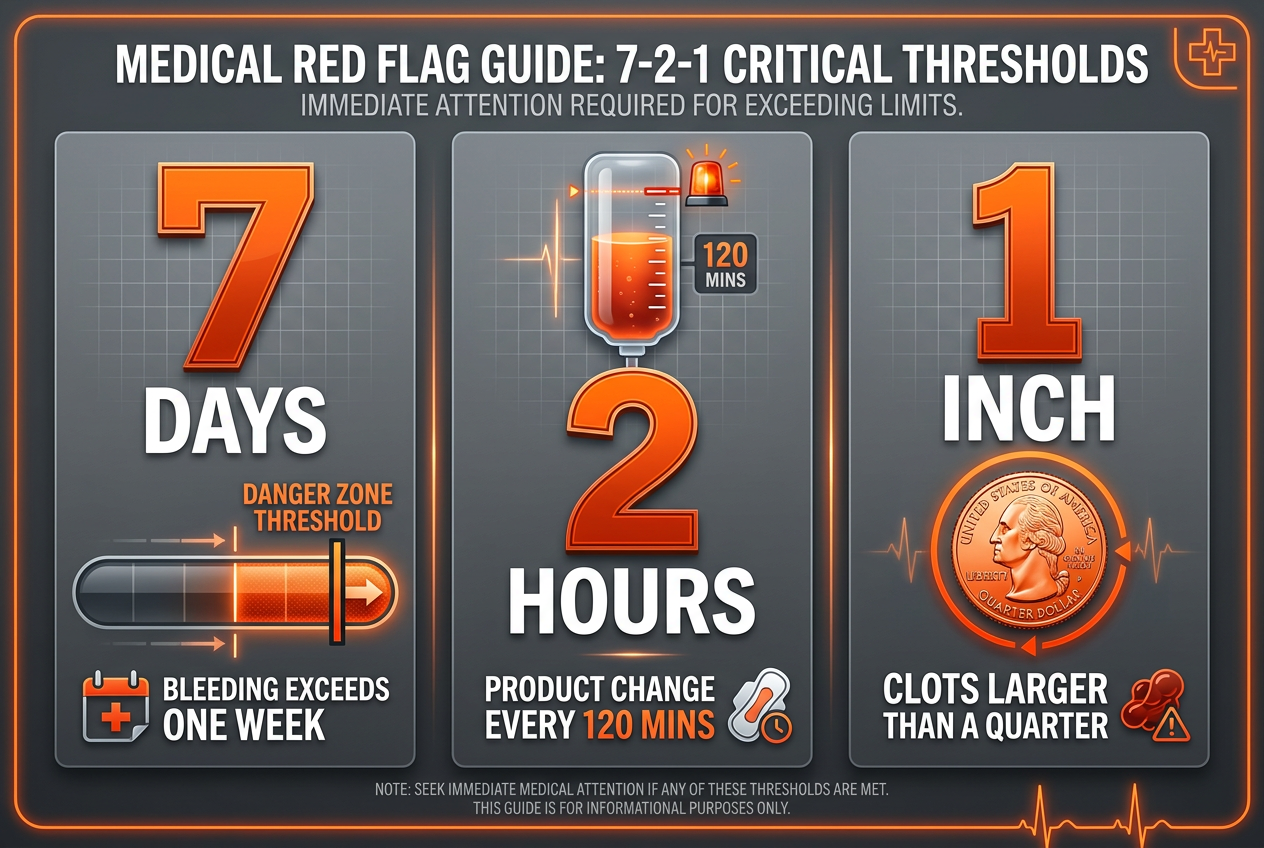 Use the 7-2-1 framework to determine when to transition from a supportive partner to a proactive medical advocate for her reproductive health.
Use the 7-2-1 Rule to identify when something needs professional evaluation:
7 Days: Bleeding that lasts longer than 7 days consistently is worth discussing with a doctor. One long period isn’t necessarily concerning, but if it’s a pattern, it could indicate fibroids, endometriosis, or hormonal imbalances.
2 Hours: Soaking through a pad or tampon every 2 hours or less is considered heavy bleeding (menorrhagia). This can lead to anemia and should be evaluated by a healthcare provider.
1 Inch: Blood clots larger than a quarter (about 1 inch) are a sign of excessive bleeding. Occasional small clots are normal, but large clots suggest the uterus is shedding tissue faster than it can break it down.
Other Red Flags to Watch For:
- Severe pain that doesn’t respond to over-the-counter medication
- Pain that interferes with daily activities (work, school, social life)
- Bleeding between periods or after sex
- Sudden changes in cycle length or regularity
- Nausea, vomiting, or dizziness during her period
- Symptoms of anemia: extreme fatigue, pale skin, shortness of breath
If she’s dismissive ("It’s always been like this") but you’re noticing these patterns, gently advocate: "I know you’re used to this, but I read that [specific symptom] can sometimes be treated. Would you be open to mentioning it at your next appointment?"
Many conditions like endometriosis, PCOS, and fibroids go undiagnosed for years because women normalize severe symptoms. Your outside perspective can be valuable.
The Proactive Infrastructure Checklist
The difference between a reactive partner and a proactive one is preparation. Stock these items before you need them:
Physical Comfort
- Electric heating pad with auto-shutoff (safer than microwavable options)
- Hot water bottle (portable option for cramps)
- Extra blankets and pillows
- Epsom salt for baths
Pain Management
- Ibuprofen or naproxen sodium (more effective for cramps than acetaminophen)
- Her preferred pain reliever
- Backup supply in your car or bag
Nutrition
- 70% or higher dark chocolate (magnesium helps with muscle tension)
- Herbal teas (chamomile, ginger, peppermint)
- Easy-to-prepare comfort foods she enjoys
- Electrolyte drinks if she experiences heavy bleeding
Menstrual Products
- Her preferred pads, tampons, or menstrual cups
- Backup products (keep some in your bathroom, car, and travel bag)
- Period underwear if she uses them
Technology
- A shared cycle-tracking app or calendar system
- Reminders set for each phase transition
- A notes app for logging patterns (what helps, what doesn’t)
Many men using a period calculator report that simply knowing when to expect each phase reduces relationship tension by 40-60%. You’re not caught off guard, and she doesn’t have to explain her needs every month.
Long-Distance Relationship Support Strategies
Physical distance doesn’t eliminate your ability to provide cycle-based support - it just requires more intentional communication and creative logistics.
Menstrual Phase (Winter) Support from Afar:
- DoorDash/Uber Eats her favorite comfort food without asking. Include a heating pad if she doesn’t have one.
- Send a care package: dark chocolate, fuzzy socks, a handwritten note, ibuprofen, her favorite tea.
- Reduce communication expectations. Don’t take it personally if she’s less responsive. Send low-pressure texts: "No need to reply, just thinking of you."
- Schedule a low-energy virtual date: Watch a movie together via screen share, no talking required.
Follicular Phase (Spring) Support from Afar:
- Plan your next in-person visit. This is when she’ll be most excited about future plans.
- Have deeper conversations. Video call instead of text. Talk about goals, dreams, relationship milestones.
- Send a spontaneous gift or flowers. Her optimism is high - lean into it.
Ovulatory Phase (Summer) Support from Afar:
- Prioritize video calls over texting. She wants face-to-face connection, even if virtual.
- Be flirty and affectionate. Send compliments, inside jokes, photos that remind her you’re thinking about her.
- Make her feel seen. Comment on her social media posts, send voice notes, be enthusiastic about her life updates.
Luteal Phase (Fall) Support from Afar:
- Be extra responsive. This is when she’s most likely to feel insecure or disconnected.
- Send unprompted reassurance texts: "You’ve been on my mind all day."
- Don’t push for deep conversations or problem-solving. Keep communication light and supportive.
- Offer logistical help remotely: "I can order groceries for you" or "Let me book that appointment."
For more LDR-specific strategies, explore long-distance relationship communication tips and how tracking apps can bridge the physical gap.
Ready to actually understand her?
Join thousands of men using VibeCheck to track her cycle and show up better every day.
Frequently Asked Questions
What is the best way to track my girlfriend’s cycle without making it weird?
Use a shared tracking app designed for partners, like VibeCheck, which translates her cycle data into actionable support tips. Alternatively, add her period dates to a shared calendar (with her permission). The key is framing it as "I want to support you better" rather than "I need to monitor you." Most women appreciate a partner who takes initiative to understand their cycle - it shows you care.
How do I bring up cycle tracking without offending her?
Approach it during a neutral moment (not during an argument or her period). Say: "I’ve been reading about how your cycle affects energy and mood, and I want to be a better partner. Would you be open to sharing your cycle dates with me so I can be more supportive?" Focus on your desire to help, not on fixing her behavior. If she’s hesitant, respect that and revisit later.
What if her symptoms seem more severe than what’s described here?
Trust your instincts. If she’s experiencing debilitating pain, extremely heavy bleeding, or symptoms that interfere with daily life, encourage her to see a gynecologist. Conditions like endometriosis, PCOS, and fibroids are common but underdiagnosed. Frame it as concern for her health: "I know this is normal for you, but I want to make sure you’re not dealing with something treatable."
Can birth control change how I should approach cycle-based support?
Yes. Hormonal birth control (pills, IUDs, implants) can suppress the natural hormonal fluctuations described in this guide. Some women on hormonal birth control experience more stable moods and energy levels throughout the month. Others still experience PMS-like symptoms during the placebo week. Ask her how birth control affects her specifically and adjust your strategy accordingly. Non-hormonal methods (copper IUD, condoms) don’t alter her natural cycle.
What if I get the timing wrong or make a mistake?
You will. That’s part of learning. If you assume she’s in her luteal phase and suggest a quiet night in when she’s actually in her follicular phase and wants to go out, just apologize and adjust. Say: "I misread where you were at. Let’s go out." The goal isn’t perfection - it’s effort. She’ll appreciate that you’re trying to understand her patterns.
How do I handle it when she says ’I’m fine’ but clearly isn’t?
During the luteal phase especially, many women downplay their discomfort or frustration. Instead of pushing ("Are you sure you’re fine?"), offer specific support: "I’m making dinner and handling the dishes tonight. You don’t have to do anything." Actions speak louder than interrogations. If she continues to insist she’s fine, respect that and check in later.
Is it normal for her cycle to affect our sex life this much?
Yes. Hormonal fluctuations directly impact libido. During ovulation (Days 15-17), many women experience peak desire due to estrogen and testosterone surges. During the luteal phase and menstruation, progesterone dominance and physical discomfort can reduce interest in sex. This isn’t personal rejection - it’s biology. Focus on non-sexual physical affection (cuddling, massages) during low-libido phases and initiate more during the ovulatory window. For more on this, read libido and ovulation.
What if we’re trying to get pregnant? Does this guide still apply?
Absolutely. Understanding her cycle is even more critical when trying to conceive. The follicular and ovulatory phases (Days 8-17) are your fertile window. Track basal body temperature and cervical mucus changes in addition to calendar dates. The emotional support strategies remain the same - she’ll still experience hormonal shifts, stress, and physical symptoms. Be patient and supportive, especially if conception takes longer than expected.
Should I tell my friends or family about her cycle?
No. This information is private and personal. Don’t joke about it, share details, or blame her behavior on her period to others. Violating her privacy destroys trust. The only exception is if she’s experiencing a medical emergency and you need to provide relevant information to healthcare providers.
Your girlfriend’s menstrual cycle isn’t a mystery you need to solve - it’s a pattern you can learn to anticipate and support. The men who master this framework report stronger relationships, fewer arguments, and a deeper sense of partnership.
You don’t need to be perfect. You just need to be intentional. Stock the heating pad. Learn the four seasons. Adjust your communication. Take initiative.
The tactical advantage of understanding her cycle isn’t control - it’s connection. When you show up with the right support at the right time, you prove you’re paying attention. And that’s what separates good boyfriends from indispensable partners.
Want a tool that does the heavy lifting for you? VibeCheck translates her cycle into daily missions so you always know what to do. No guessing. No walking on eggshells. Just actionable intelligence delivered when you need it.
Tags

Related Articles
Continue reading to deepen your understanding

How to Understand Your Girlfriend’s Social Battery and Hormones
Does your girlfriend suddenly cancel plans or seem withdrawn? This guide explains how her cycle impacts her energy so you can support her like a pro.

How Your Girlfriend’s Emotional Needs Change During Her Cycle
Does your girlfriend’s mood seem unpredictable? Learn how her emotional needs shift on a biological loop and how to support her through every phase of her cycle.

What to Buy When Your Girlfriend Has Hormone Cravings: A Support Guide
Stop wondering what to pick up at the store. This guide explains the science behind cycle cravings and provides a specific list of foods and comfort items she needs.

Your Girlfriend’s Mood Shifts Throughout the Month, Explained
Ever wonder why her energy and moods change so drastically each week? Understand the four hormonal phases and how to be the partner she needs during every stage of her cycle.

How to Support Your Girlfriend When She’s Crying Because of Hormones
Watching her cry when hormones hit can feel overwhelming. Learn the biological why behind the tears and use these proven scripts to provide the support she actually needs right now.

How to Help Your Girlfriend with Hormonal Mood Swings Without Arguing
Understand her cycle and learn tactical scripts to handle tension. This guide shows you how to support her through hormonal shifts without getting into unnecessary fights.

When to Feed Your Girlfriend: Understanding Hangry Hormones
Does your girlfriend get irritable when she hasn’t eaten? It’s not just in her head. Learn why hormones cause hanger and the specific times her body needs more fuel.

The Boyfriend’s Guide to Supporting Your Partner Through PMS
If your partner is suddenly irritable and exhausted, it’s biology, not you. Learn about the luteal phase and how to provide meaningful support without walking on eggshells.