The Partner's Field Guide to Her Cycle: How to Sync Your Relationship for Less Friction and More Connection
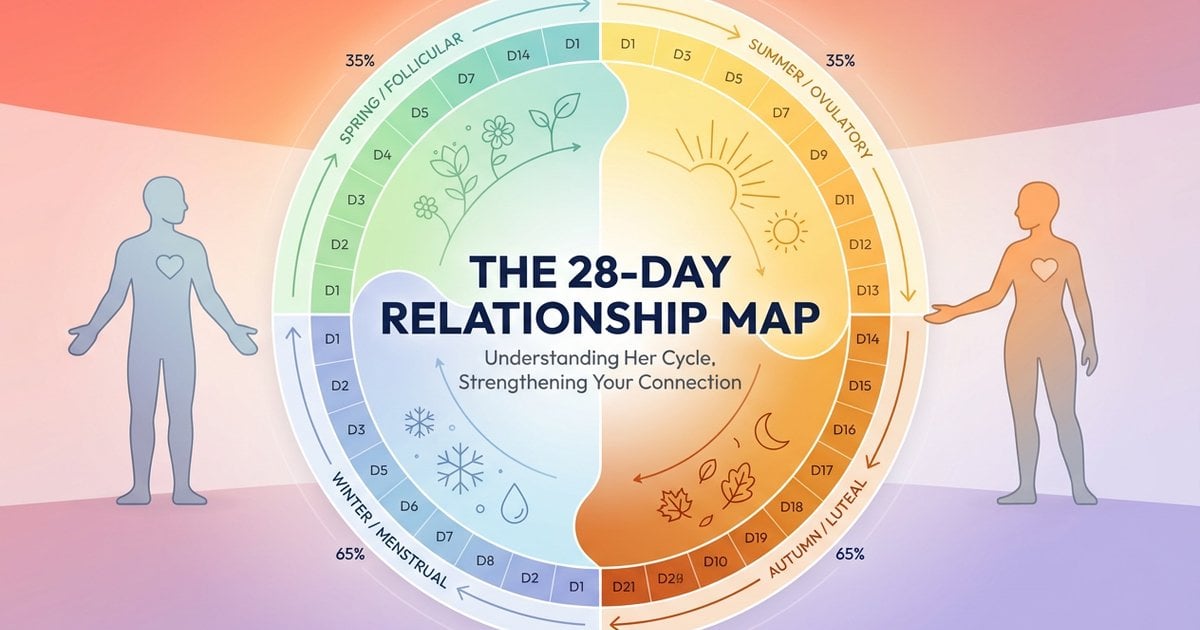
Stop treating hormonal shifts like unpredictable weather. This guide teaches you the four seasons of her cycle so you can anticipate needs, avoid arguments, and build a stronger connection.
The Partner's Field Guide to Her Cycle: How to Sync Your Relationship for Less Friction and More Connection
Table of Contents
- Beyond the Period: Why the 28-Day Cycle is Your New Secret Weapon
- The Four Seasons of Her Cycle (The Cheat Sheet)
- Red Flags: How to Spot a Medical Issue (The 7-2-1 Rule)
- The "Don'ts" (Common Pitfalls)
- Pro-Tip: Sharing the Data
- Consistency is the Goal
- Frequently Asked Questions
Beyond the Period: Why the 28-Day Cycle is Your New Secret Weapon
BLUF: Understanding her cycle gives you a predictable map of energy shifts, allowing you to anticipate needs, reduce arguments, and strengthen connection rather than reacting to mood changes you don't understand.
Here's a pattern you've probably noticed: Week 1, everything feels smooth. Week 2, she's planning trips and suggesting spontaneous adventures. Week 3 starts fine, but by Week 4, a simple question about dinner plans turns into a three-hour discussion about your relationship. You're left wondering what changed.
Nothing changed in your relationship. Her hormones changed.
Most guys treat their partner's cycle like unpredictable weather - something that just happens to them. But what if you could check the forecast? What if you knew that the heaviest conversations always land during Week 4 because progesterone withdrawal makes her brain hypersensitive to relationship threats? What if you realized that Week 2's high energy isn't random, but the biological window when estrogen peaks and she genuinely has more capacity for new experiences?
VibeCheck App
Know what she needs. Before she has to say it.
Track her cycle, understand her phases, be the partner she deserves.
Download Free on iOS →This isn't about excusing behavior or treating her like a science experiment. It's about recognizing that the person you're with experiences four distinct hormonal environments every month, and each one affects her energy, mood, and needs differently. You already adjust your behavior based on whether she's had a good day at work or a terrible commute. This is the same principle, just with a biological basis you can actually predict.
The real game-changer is that this knowledge lets you be proactive instead of reactive. Instead of scrambling to understand why she's suddenly irritated, you can look at the calendar and realize it's Day 24. Instead of suggesting a high-energy social event when she needs quiet time, you can plan accordingly. Instead of taking her withdrawal personally, you can recognize it as a temporary hormonal shift that has nothing to do with your worth as a partner.
Think of it this way: professional athletes don't just show up and wing it. They study their opponent's patterns, tendencies, and weaknesses. They prepare. They strategize. Your relationship deserves the same level of attention. Not manipulation - preparation. Not control - understanding.
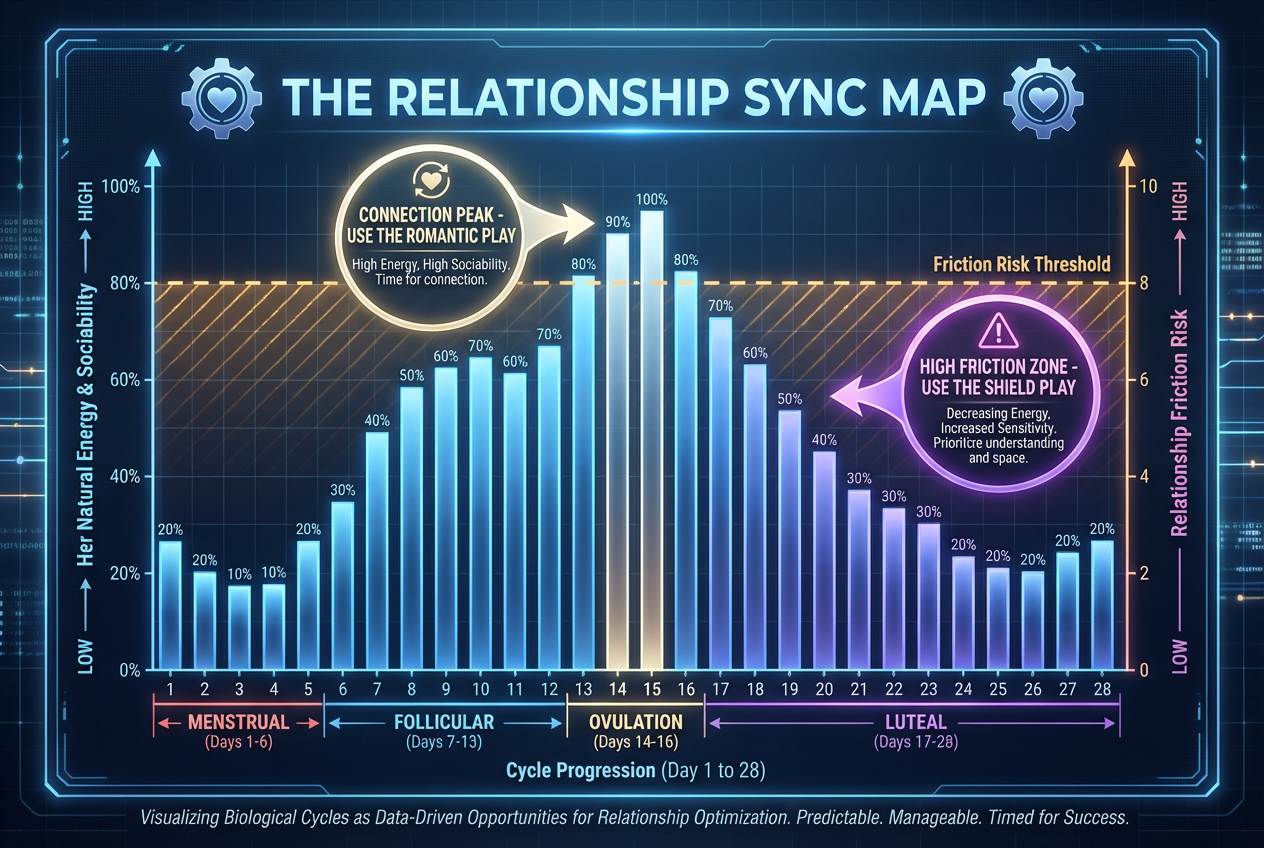
The cycle isn't an obstacle. It's a cheat code hiding in plain sight. When you learn to read it, you stop having the same arguments at the same time every month. You stop feeling blindsided by mood shifts. You start leading your relationship with confidence because you're operating from knowledge, not confusion.
Here's what most men don't realize: roughly 1 in 7 women you encounter on any given day is menstruating. That's not rare. It's constant, predictable biology. Your partner goes through approximately 13 complete cycles per year. That's 13 opportunities to prove you're paying attention, or 13 cycles where you're completely oblivious.
The guys who figure this out stop walking on eggshells. They stop feeling like their relationship is a minefield. They become the partner who somehow always knows exactly what she needs before she asks. And from the outside, it looks like relationship magic. From the inside, it's just pattern recognition and timing.
The Four Seasons of Her Cycle (The Cheat Sheet)
BLUF: Her cycle divides into four phases with distinct energy patterns and support needs. Match your behavior to each phase to reduce friction and maximize connection.
The menstrual cycle isn't a light switch - it's a gradual shift through four distinct phases, each with its own hormonal profile and resulting energy level. Understanding these phases transforms you from a confused bystander into someone who can anticipate and meet her needs before she has to explain them.
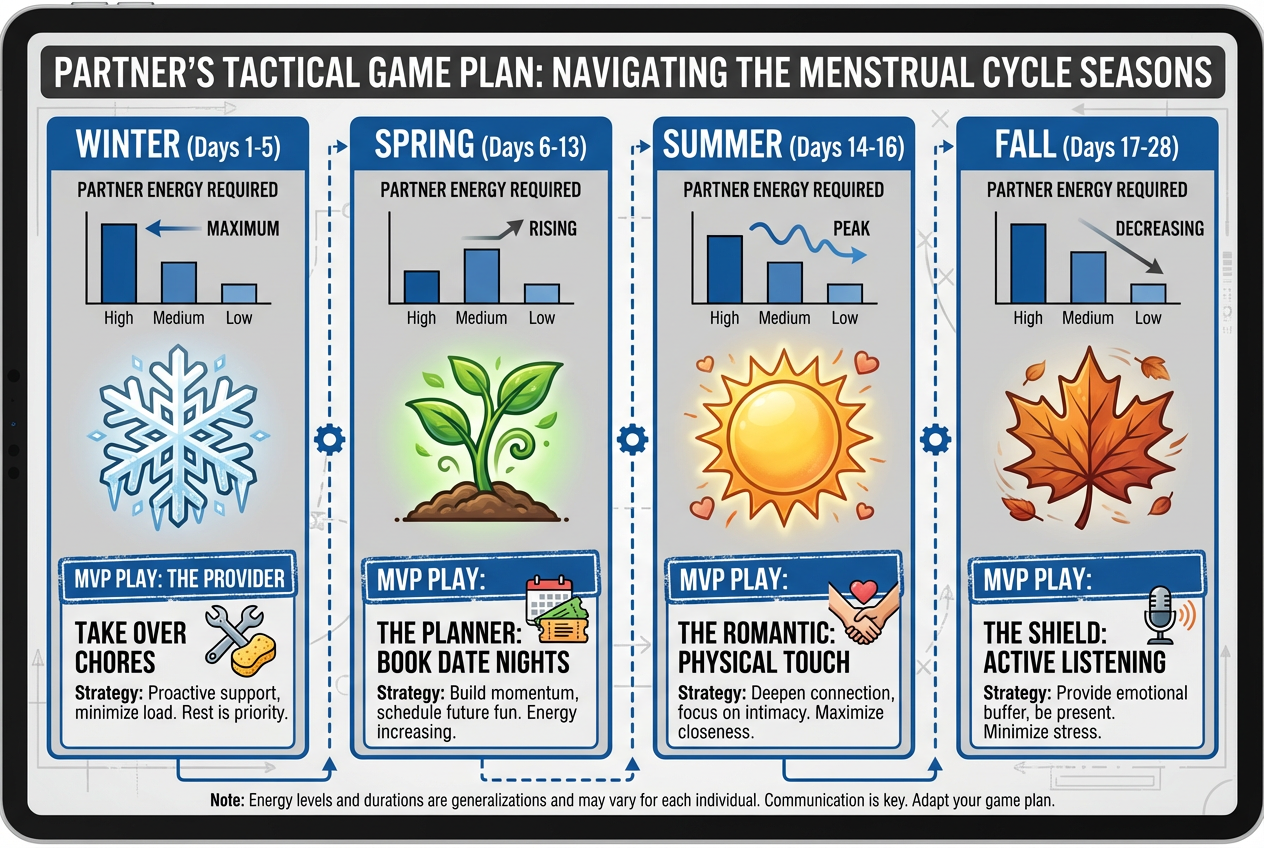
| Season | Phase | Days | Her Energy | Hormone Status | Your Role | Specific Actions |
|---|---|---|---|---|---|---|
| Winter | Menstrual | 1-5 | Low/Introspective | Estrogen & progesterone drop | The Provider | Hot water bottles, handle heavy lifting, take over cooking/dishes, give space for rest, stock pain relievers |
| Spring | Follicular | 6-13 | Rising/Optimistic | Estrogen climbing | The Planner | Book date nights, try new restaurants, start projects together, suggest adventures, plan social events |
| Summer | Ovulation | 14-16 | High/Magnetic | Estrogen peaks | The Romantic | Physical affection, genuine compliments, high-energy activities, initiate intimacy, be fully present |
| Fall | Luteal | 17-28 | High-Alert/Sensitive | Progesterone rises then crashes | The Shield | Active listening, zero "fixing," stock comfort foods, give emotional space, validate feelings |
Let's break down what's actually happening in each phase and why it matters.
Winter (Days 1-5): The Provider Phase
When her period starts, both estrogen and progesterone are at rock bottom. This isn't just "feeling tired" - it's genuine physical depletion combined with potential cramping, bloating, and discomfort. Her body is literally shedding uterine lining while simultaneously dealing with inflammatory prostaglandins that cause pain.
This is your week to step up on logistics. She doesn't need you to solve her period or make it go away. She needs you to remove friction from her daily routine. Pick up the groceries. Handle dinner without asking what she wants. Take the dog for that evening walk. Make sure the heating pad is charged and accessible.
The key word here is "anticipate." Don't wait for her to ask. Don't make her manage you while she's managing cramps. If you know she typically deals with heavy flow and fatigue during Days 1-3, those are the days you proactively take tasks off her plate.
Spring (Days 6-13): The Planner Phase
As estrogen climbs, so does her energy, optimism, and openness to new experiences. This is the biological window where her brain is literally more receptive to dopamine and reward signals. She's more likely to say yes to plans, more willing to try that new activity you've been suggesting, and generally more enthusiastic about life.
This is your relationship building phase. Book that concert. Suggest the weekend trip. Try the new restaurant. Start the home improvement project you've been discussing. Her increased energy means she has genuine capacity for these things, not just polite tolerance.
Men who ignore this window waste prime relationship real estate. You're trying to plan date nights during Week 4 when she barely has energy for basic conversation, while Week 2 passes by with another night on the couch watching the same show.
Summer (Days 14-16): The Romantic Phase
Ovulation is a 24-48 hour event, but its effects ripple across roughly three days. Estrogen peaks right before the egg releases, testosterone gets a small bump, and biologically speaking, this is when she's most likely to feel sexually receptive and socially confident.
You'll notice physical changes: clearer skin, more energy, increased confidence. Her body language is more open. She's more receptive to touch and compliments. This isn't the week to be passive or distant. Lean in. Initiate physical connection. Give genuine, specific compliments. Be present and engaged.
This is also the phase where she's biologically primed for relationship evaluation. Studies show women are subconsciously more attuned to partner quality during ovulation. That doesn't mean you need to perform or prove yourself, but it does mean checked-out or distracted behavior lands harder right now.
Fall (Days 17-28): The Shield Phase
This is the longest phase and the one most guys screw up. After ovulation, progesterone rises to prepare the body for potential pregnancy. When no pregnancy occurs, both progesterone and estrogen crash hard in the final week before her period starts. This hormonal withdrawal affects mood, energy, and stress tolerance.
Week 3 (Days 17-23) often feels normal because progesterone is still elevated. Week 4 (Days 24-28) is where things get tricky. As hormones crash, her brain becomes hypersensitive to threats - social, emotional, and relationship-based. The same comment that bounced off her in Week 2 now feels like a personal attack. The mess you left in the kitchen isn't just annoying, it's evidence you don't respect her space.
This is when you become The Shield. Your job is to absorb stress, not create it. Listen without trying to fix. Validate feelings without dismissing them as "just hormones." Stock her favorite snacks. Give her space when she needs it and presence when she asks. Don't schedule difficult conversations or major social obligations.
Understanding these phases is the foundation of relationship intelligence. It's not about treating her differently because she's "hormonal." It's about recognizing that her needs genuinely change across the month and adjusting your support accordingly.
Red Flags: How to Spot a Medical Issue (The 7-2-1 Rule)
BLUF: While cycle tracking helps you support normal hormonal fluctuations, the 7-2-1 Rule helps you identify when her symptoms cross into medical concern territory requiring professional evaluation.
Most cycle awareness content stops at "support her during PMS." But there's a critical gap between normal hormonal shifts and symptoms that indicate an underlying medical issue. As her partner, you're uniquely positioned to notice patterns she might dismiss as "just bad periods."
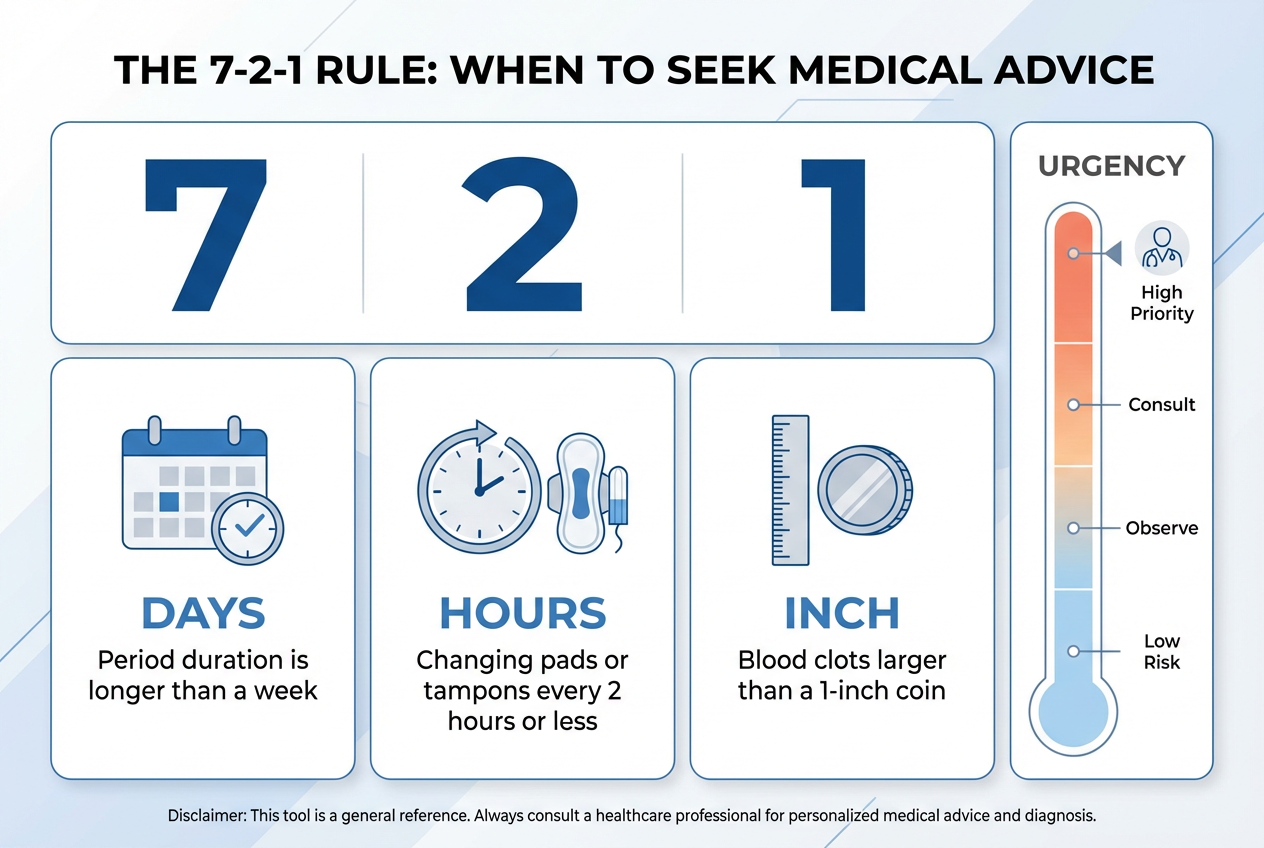
The 7-2-1 Rule gives you a simple framework to identify Heavy Menstrual Bleeding (HMB) and other red flags:
7 Days: If her period consistently lasts longer than 7 days, that's beyond normal range. While some variation is common, bleeding that extends past a full week suggests her body might be dealing with fibroids, polyps, or hormonal imbalances that need medical evaluation.
2 Hours: If she's changing pads or tampons more frequently than every 2 hours because they're completely soaked, that's excessive blood loss. This level of bleeding can lead to iron deficiency anemia, causing the fatigue and brain fog she might be attributing to normal period tiredness.
1 Inch: If she's passing blood clots larger than 1 inch (roughly the size of a quarter), that indicates abnormally heavy flow. Occasional small clots are normal, but large clots suggest blood is pooling in the uterus rather than flowing steadily.
Other red flags that deserve attention:
Debilitating Pain: Cramps are common. Pain so severe she can't work, needs prescription painkillers, or regularly vomits is not normal. This could indicate endometriosis, adenomyosis, or other conditions where uterine tissue grows outside the uterus or into the muscle wall.
Breakthrough Bleeding: Spotting or bleeding between periods, especially if it's consistent, can signal hormonal imbalances, polyps, or in rare cases, more serious conditions. One month of spotting might not mean much. Three months in a row deserves investigation.
Cycle Chaos: While some variation is normal (25-35 days is typical range), if her cycle is completely unpredictable - 18 days one month, 45 days the next, with no discernible pattern - that suggests her hormones aren't cycling properly.
Severe PMS: There's normal luteal phase sensitivity, and then there's PMDD (Premenstrual Dysphoric Disorder). If she's experiencing suicidal thoughts, rage episodes, or complete inability to function during Week 4, that's a clinical condition requiring treatment, not just extra support.
Here's where you add real value as a partner: she might be normalizing symptoms because she's dealt with them for years, or because her mother or friends tell her "periods are just terrible." She might not realize that while some discomfort is normal, severe disruption to daily life is not.
Your role isn't to diagnose. It's to notice patterns and gently suggest professional evaluation. The conversation might sound like: "I've noticed your period has been lasting 9-10 days consistently for the past few months. That seems really draining. Have you mentioned it to your doctor?"
Don't frame it as "something is wrong with you." Frame it as "I want to make sure you're getting the support you need." The difference matters.
It's worth noting that many women have been dismissed by healthcare providers who downplay period symptoms. If she does see a doctor and gets brushed off with "periods are just painful" when she's describing symptoms that match the 7-2-1 criteria, encourage her to seek a second opinion or find a provider who specializes in women's health.
You're not being overprotective. You're being observant. There's a significant difference between supporting normal hormonal fluctuations and ignoring symptoms that indicate an underlying medical condition. Learning to track these patterns helps you be the partner who catches issues early rather than watching her suffer for years with a treatable condition.
The "Don'ts" (Common Pitfalls)
BLUF: Even with good intentions, certain phrases and behaviors will sabotage your support efforts. Avoid these common mistakes that invalidate her experience or make hormonal shifts about you.
Understanding the cycle is only half the equation. The other half is not screwing it up with well-meaning but tone-deaf responses. Here are the landmines to avoid:
Never Ask "Is It That Time of the Month?"
This phrase, even said gently, translates to "Your feelings aren't valid, your body is just making you irrational." Even if you're 100% correct that it's Day 26 and her irritation is hormonally amplified, asking this question achieves nothing except making her angrier.
Why? Because it dismisses the substance of what she's saying. If she's upset that you forgot to do something you promised, her hormonal state might amplify her reaction, but the core issue (you forgot your commitment) is still legitimate. Pointing to her cycle sidesteps accountability.
The better approach: address the actual concern she's raising. If you genuinely believe her reaction is disproportionate to the situation and hormones are amplifying it, wait until she's in a different phase to discuss communication patterns. Don't weaponize cycle knowledge to invalidate present feelings.
Don't Try to Logic Her Out of Feelings
During the luteal phase, her emotional brain is running hot while her rational brain is running on fumes. This isn't a bug, it's a hormonal feature. Trying to "fix" her feelings with logical arguments will fail spectacularly.
When she says "I feel like you never listen to me," responding with "That's not true, just last week I..." is logic. It's also completely missing the point. She's expressing a feeling, not presenting a legal case that needs evidence-based rebuttal.
What she needs: validation before solutions. "I hear you, and I can see why you'd feel that way" goes further than any logical counterargument. This doesn't mean you're admitting fault or agreeing with an inaccurate characterization. It means you're acknowledging her emotional reality before debating the factual one.
Don't Take Withdrawal Personally
In the late luteal phase, many women experience some level of social withdrawal or need for solitude. This isn't about you. It's not a reflection of your attractiveness, your conversation skills, or the health of your relationship.
Her body is preparing for either pregnancy or menstruation. Both scenarios require internal focus and energy conservation. When she says she needs space or wants to skip the social event, that's her being honest about her capacity, not a subtle criticism of your plans.
Taking it personally and pressing for reassurance ("Are you sure you're okay? Did I do something? Are we okay?") adds emotional labor to her plate when she has minimal capacity for it. Trust that if something is wrong beyond normal hormonal shifts, she'll tell you. Otherwise, give her the space she's requesting without making it a referendum on your relationship.
Don't Weaponize Cycle Knowledge
Learning about her cycle should make you a better partner, not give you ammunition in arguments. Saying "You're only upset because you're about to get your period" during a disagreement is using cycle knowledge as a weapon to dismiss her concerns.
Even if hormones are amplifying her reaction, the underlying issue she's raising likely has merit. Using your cycle knowledge to invalidate rather than understand defeats the entire purpose of learning this information.
Don't Make It About Your Needs
"Well, what about me? I have needs too!" is technically true but terrible timing during her menstrual or late luteal phase. Yes, you have needs. No, Week 4 isn't when you should be centering them in conversation.
This doesn't mean you ignore your own needs entirely. It means you recognize that her capacity fluctuates and timing matters. The intimacy conversation you want to have will go better during her follicular phase when she has more emotional and physical energy to engage with it.
Don't Overshare with Others
Learning about her cycle is private relationship intelligence. It's not conversation fodder for your friends, even in a "my girlfriend is being so moody" commiseration session. Discussing her menstrual cycle specifics with others without permission violates her privacy.
If you need to vent about relationship stress, keep it general. Don't attribute her behavior to her cycle when talking to friends or family. That crosses a line from awareness into disclosure of private medical information.
Don't Expect Perfection from Yourself
You'll screw this up sometimes. You'll forget it's Week 4 and suggest a high-energy activity. You'll say the wrong thing. You'll miss signals. The goal isn't perfection. The goal is consistent effort and genuine attempt to understand.
When you mess up, acknowledge it simply and move on. "I should have been more aware of your energy levels this week. My mistake." No grand gestures needed. Just recognition and course correction.
Avoiding these pitfalls is as important as knowing what to do. Good intentions combined with poor execution creates more problems than ignorance combined with genuine care. The awareness you're building should make her life easier, not give you a new way to be tone-deaf.
Pro-Tip: Sharing the Data
BLUF: Tracking her cycle together requires careful framing as a team effort for better support, not surveillance. Use "we" language and focus on your ability to help, not her obligation to share.
The most effective cycle awareness happens when you're working from actual data, not guesswork. But suggesting you want access to her cycle tracking information can feel invasive if approached wrong. Here's how to do it right.
Start with Your Motivation
Don't open with "Can I see your period tracker app?" Start with why you want this information: "I've been reading about how hormonal cycles affect energy and mood, and I want to understand how I can better support you throughout the month."
Frame it as you seeking to improve, not her needing to be monitored. The goal is partnership, not surveillance.
Use "We" Language
"I want to know when you might need extra support" lands differently than "I want to track your cycle." The first centers your ability to help. The second centers control.
Try: "Could we find a way to share cycle information so I'm not constantly asking how you're feeling and adding to your mental load?" This frames tracking as removing burden from her, not adding scrutiny.
Respect Her Comfort Level
Some women will immediately see the value and share their tracking app. Others will feel uncomfortable with the idea. Both responses are valid.
If she's hesitant, don't push. Instead, ask what would make her comfortable. Maybe she's willing to give you a heads up when she's entering the luteal phase, even if she doesn't want to share detailed tracking data. Maybe she's okay with you checking in periodically rather than having constant access.
The goal is partnership. If detailed tracking feels invasive to her, find a middle ground that works for both of you.
Choose the Right Tool
If you're starting fresh with cycle tracking together, consider using a period tracker designed for couples. Apps designed for partner access handle privacy and boundaries better than you trying to use her personal tracking app.
Some apps let her control what information you see. She might share cycle phase and symptom intensity without sharing every detail about cervical mucus and basal body temperature. That level of filtering matters for comfort.
Don't Make Her Manage Your Access
If she agrees to share cycle information, don't make her responsible for keeping you updated. Set up notifications or calendar reminders on your end so you can check the information yourself rather than constantly asking "What phase are you in?"
The entire point is reducing her mental load, not creating a new task where she has to brief you daily on her hormonal status.
Use the Information Wisely
Having cycle data doesn't give you permission to predict her every mood or behavior. It's a guide, not a script. She's still an individual with daily variations influenced by stress, sleep, work, and hundreds of other factors beyond hormones.
Use the information to be proactive about support (stocking comfort food before Week 4 starts, not scheduling difficult conversations during late luteal) rather than reactive about blame ("You're only upset because it's Day 25").
The Subtle Power Move
Here's the sophisticated version: after she's shared cycle information, prove you're paying attention through actions, not announcements. Don't tell her "I know you're in Week 4 so I got your favorite snacks." Just have them available. Don't announce "It's your follicular phase, want to try that new restaurant?" Just suggest the restaurant.
The most powerful cycle awareness is invisible. She starts noticing that you somehow always suggest high-energy activities when she has capacity for them. You somehow always give her space right when she needs it. The support feels intuitive rather than mechanical.
That's when cycle tracking evolves from "nice gesture" to genuine relationship intelligence. You're not following a script. You're reading the room based on data you know matters.
When She Changes Her Mind
Some women will initially resist cycle tracking, then later see the benefit when they notice you're consistently mistiming support or suggestions. Others will enthusiastically share at first, then realize it feels like too much scrutiny.
Both shifts are fine. Check in periodically about whether the current arrangement is working. Treat cycle information sharing as something that needs ongoing consent, not a one-time permission that lasts forever.
The right tracking approach balances your genuine need for information with her valid need for privacy and autonomy. Get this balance right, and cycle tracking becomes a relationship asset. Get it wrong, and it becomes another source of tension.
Consistency is the Goal
BLUF: Perfect cycle awareness matters less than consistent effort to understand and support. Small, regular adjustments to your behavior build trust more than grand gestures timed to phases.
Here's what most guys get wrong: they learn about the cycle, get excited about this new relationship intelligence, over-perform for a month, then completely forget about it when life gets busy. That inconsistency is worse than never learning at all.
Your partner doesn't need you to be a hormonal cycle expert. She needs you to be consistently attentive to patterns that affect her daily experience. The difference is subtle but critical.
Small Adjustments Compound
You don't need to overhaul your entire relationship based on cycle phases. You need to make small, consistent adjustments that show you're paying attention:
Taking over dinner prep during her menstrual phase without being asked. Suggesting weekend plans during her follicular phase when energy is high. Giving extra patience during difficult conversations in Week 4. Not scheduling the "we need to talk" discussion on Day 26.
These micro-adjustments accumulate into a relationship where she feels genuinely understood rather than managed.
Observation Over Intervention
The goal isn't to fix her cycle or eliminate all discomfort. The goal is to reduce unnecessary friction and amplify natural connection points.
You're not trying to "solve" her luteal phase sensitivity. You're trying to avoid adding stress during a time when her tolerance for stress is already low. You're not trying to force intimacy during ovulation. You're simply being available and receptive when her natural interest is highest.
Build Your Own Pattern Recognition
Beyond general cycle knowledge, start noticing her individual patterns. Does she always crave specific foods during Week 4? Does her sleep disruption consistently start on Day 23? Does she always want more physical affection during Week 2?
These personal patterns matter more than textbook cycle descriptions. She's not a generic woman experiencing a generic cycle. She's your specific partner with her specific expression of hormonal shifts.
Course Correct Without Drama
You'll forget. You'll schedule a dinner party during Week 4. You'll suggest hiking when she's cramping. You'll ask "what's wrong?" when nothing is wrong beyond normal hormonal sensitivity.
When you realize your mistake, course correct simply. "I should have checked before scheduling that. Want me to postpone?" That's it. No self-flagellation about being a "terrible partner" who "can't remember anything." Just acknowledgment and adjustment.
The Long Game
Cycle awareness is a long-term relationship investment. You won't see dramatic results after one month. You'll see them after six months when you realize you're not having the same arguments at the same time anymore. After a year when she tells friends you "somehow always know" what she needs.
This isn't magic. It's just paying attention to patterns most men completely ignore.
Don't Make Her Applaud Your Efforts
You don't get bonus points for doing what should be baseline relationship awareness. Taking her cycle into consideration when making plans or providing support isn't extraordinary - it's thoughtful partnership.
Don't expect gratitude for remembering to stock tampons or not scheduling stressful conversations during her late luteal phase. These are small acts of awareness, not heroic gestures deserving recognition.
When to Revisit the Strategy
Cycle awareness needs periodic recalibration. Her cycle might change as she ages, switches birth control, or experiences major life stress. The patterns you learned at 25 might not hold at 30. The approach that worked when you first moved in together might need adjustment after marriage or kids.
Check in every few months: "I've been trying to pay attention to your cycle to be more supportive. Is there anything I'm missing or should be doing differently?"
This question shows you're treating cycle awareness as an ongoing learning process, not a problem you solved once and checked off your list.
The Real Benefit
At the end of the day, cycle awareness isn't about becoming a menstrual cycle expert. It's about demonstrating consistent attention to your partner's experience. It's about choosing to understand rather than judge. It's about recognizing that the person you love experiences genuine biological fluctuations that affect her daily life, and you care enough to factor that into how you show up.
That consistent effort is what transforms a good relationship into a great one. Not grand romantic gestures. Not perfect timing on every interaction. Just regular, reliable awareness that she experiences the world differently across the month, and you're committed to meeting her where she is rather than expecting her to maintain one consistent state.
That's not rocket science. It's just partnership.
Ready to actually understand her?
Join thousands of men using VibeCheck to track her cycle and show up better every day.
Frequently Asked Questions
What is the difference between PMS and PMDD?
PMS (Premenstrual Syndrome) affects about 75% of menstruating women and includes physical symptoms like bloating, cramps, and fatigue plus mild emotional changes like irritability or sadness during the week before menstruation. It's uncomfortable but manageable.
PMDD (Premenstrual Dysphoric Disorder) is a severe form affecting about 5-8% of women. It includes debilitating emotional symptoms like severe depression, anxiety, rage, or suicidal thoughts that significantly interfere with work, relationships, and daily functioning. PMDD is a clinical diagnosis requiring medical treatment - therapy, medication, or both. If your partner experiences thoughts of self-harm, complete emotional dysregulation, or inability to function during Week 4, encourage professional evaluation immediately. This isn't "bad PMS" - it's a distinct condition.
How accurate is cycle tracking for predicting her mood?
Cycle tracking predicts hormonal phases with reasonable accuracy (within 1-2 days for regular cycles), but individual responses to those hormones vary significantly. Two women at Day 24 might experience completely different moods based on stress, sleep, diet, genetics, and dozens of other factors.
Think of cycle tracking as a weather forecast, not a crystal ball. It tells you "high probability of storms" but can't guarantee exactly when lightning will strike. Use it to prepare and adjust expectations, not to predict every emotional state. The goal is awareness of likely patterns, not perfect prediction of daily moods.
Should I track her cycle if she does not want to share that information?
No. Tracking her cycle without consent crosses into surveillance territory and violates trust. While you might think you're doing it "to be helpful," tracking someone's private health information without permission is a boundary violation.
If she's uncomfortable sharing cycle data, respect that boundary while still learning general patterns you can observe. You can notice when she seems lower energy, when she mentions cramps, or when she's particularly social without needing access to her tracking app. Ask directly what kind of support she wants and respect whatever boundaries she sets around privacy.
What if her cycle is irregular and does not follow the 28-day pattern?
Many women have irregular cycles, especially those with PCOS, thyroid issues, high stress, or perimenopause. Cycle length anywhere from 21-35 days is considered normal variation, though it makes prediction harder.
For irregular cycles, focus on recognizable symptoms rather than calendar days. Learn what her menstrual phase looks like regardless of when it arrives. Notice her personal signals for ovulation (increased energy, clearer skin) or luteal phase (food cravings, lower energy) rather than relying on strict timing. Some women never get regular cycles, but their symptoms within each phase are still consistent once you learn to recognize them.
How do birth control pills affect the cycle and mood patterns?
Combination birth control pills create an artificial "cycle" that's fundamentally different from a natural menstrual cycle. The pills suppress ovulation completely, deliver steady synthetic hormones for three weeks, then withdraw them during the placebo week to trigger bleeding (which isn't a real period, just withdrawal bleeding).
This means the dramatic hormonal fluctuations of a natural cycle are flattened. Many women on the pill report more stable moods because they're not experiencing the natural progesterone crash of the luteal phase. However, some women experience mood side effects from the synthetic hormones themselves. The key is understanding that what you learned about natural cycles doesn't directly apply to pill cycles - the hormonal landscape is entirely different.
Can I help reduce her PMS symptoms or do I just have to accept them?
You can't eliminate PMS symptoms, but your behavior can make them better or worse. Reducing stress during her late luteal phase genuinely helps because cortisol (stress hormone) amplifies PMS symptoms. Taking tasks off her plate, avoiding unnecessary conflict, and providing emotional support all reduce her total stress load.
Physical comfort measures also help: having heating pads available, stocking magnesium-rich foods (which help with cramps), ensuring she has pain relief medication before she needs it, and not scheduling high-energy activities when she's dealing with fatigue. You can't fix the hormonal root cause, but you can significantly reduce the external stressors that make symptoms worse. Supporting her during the luteal phase is about removing friction, not providing cures.
What should I do if I notice red flags but she dismisses them as normal?
Present your observations factually and express concern without being pushy. "I've noticed your periods consistently last 8-9 days and you've mentioned feeling exhausted for weeks after. I'm concerned that might be more than typical period symptoms. Would you be willing to mention it to your doctor?"
If she dismisses it, don't keep pushing immediately. Give it time, continue documenting what you observe, and bring it up again if symptoms persist or worsen. Many women have normalized severe symptoms because they've dealt with them for years or had doctors dismiss their concerns previously. Your consistent, non-judgmental observation can help her realize that her "normal" might not actually be healthy.
If she does see a doctor and gets dismissed, encourage seeking a second opinion with a gynecologist or women's health specialist. Your role is supportive concern, not medical diagnosis, but sometimes an outside perspective helps someone recognize when professional help is needed.
How long does it take to learn her individual cycle patterns?
Track observations for at least three full cycles (roughly 3-4 months) to identify consistent patterns. The first month you're just learning the basics. The second and third months let you see what's truly consistent versus what was a one-time variation due to stress or other factors.
Individual women vary in how predictable their cycles are. Some are so consistent you could set a watch by them. Others have more variation month to month. The goal isn't perfect prediction - it's developing general awareness of her personal patterns so you can provide better support over time.
Tags

Related Articles
Continue reading to deepen your understanding

How to Understand Your Girlfriend’s Social Battery and Hormones
Does your girlfriend suddenly cancel plans or seem withdrawn? This guide explains how her cycle impacts her energy so you can support her like a pro.

How Your Girlfriend’s Emotional Needs Change During Her Cycle
Does your girlfriend’s mood seem unpredictable? Learn how her emotional needs shift on a biological loop and how to support her through every phase of her cycle.

What to Buy When Your Girlfriend Has Hormone Cravings: A Support Guide
Stop wondering what to pick up at the store. This guide explains the science behind cycle cravings and provides a specific list of foods and comfort items she needs.

Your Girlfriend’s Mood Shifts Throughout the Month, Explained
Ever wonder why her energy and moods change so drastically each week? Understand the four hormonal phases and how to be the partner she needs during every stage of her cycle.

How to Support Your Girlfriend When She’s Crying Because of Hormones
Watching her cry when hormones hit can feel overwhelming. Learn the biological why behind the tears and use these proven scripts to provide the support she actually needs right now.

How to Help Your Girlfriend with Hormonal Mood Swings Without Arguing
Understand her cycle and learn tactical scripts to handle tension. This guide shows you how to support her through hormonal shifts without getting into unnecessary fights.

When to Feed Your Girlfriend: Understanding Hangry Hormones
Does your girlfriend get irritable when she hasn’t eaten? It’s not just in her head. Learn why hormones cause hanger and the specific times her body needs more fuel.

The Boyfriend’s Guide to Supporting Your Partner Through PMS
If your partner is suddenly irritable and exhausted, it’s biology, not you. Learn about the luteal phase and how to provide meaningful support without walking on eggshells.