How to Understand Your Girlfriend's Hormonal Cycle: The Ultimate Partner Playbook
You are not imagining the shifts in her energy or mood. This guide breaks down the biological patterns of her cycle so you can stop being reactive and start being an intentional partner.
How to Understand Your Girlfriend's Hormonal Cycle: The Ultimate Partner Playbook
You've been there. One week she's planning weekend adventures and laughing at your terrible jokes. Two weeks later, those same jokes get a death stare, and suggesting a hike feels like you've proposed climbing Everest in flip-flops. You're not imagining it, and no, she's not "just being emotional."
Her body operates on a roughly 28-35 day biological cycle that affects everything from energy levels to pain tolerance to how she processes stress. The problem isn't that these changes happen. The problem is that most men have zero understanding of what's happening or when.
This isn't about "fixing" your girlfriend or treating her like a science experiment. It's about becoming the kind of partner who anticipates needs, reduces friction, and shows up in ways that actually matter. Think of this as relationship intelligence: understanding the biological patterns that influence mood, energy, and communication so you can stop being reactive and start being intentional.
Table of Contents
- Why Menstrual Literacy is Your Relationship Cheat Code
- The Biological Foundation: What's Actually Happening
- The Four Seasons of the Cycle
- The "Don't Be That Guy" Section: What Never to Say
- Practical "Ally" Kits: Phase-Specific Actions
- How to Use a Tracking App Together
- Long-Distance Cycle Support
- Building Your Partner Support System
- Frequently Asked Questions
Why Menstrual Literacy is Your Relationship Cheat Code
Your girlfriend's hormonal cycle creates predictable patterns in energy, mood, and physical comfort. Understanding these phases lets you provide the right support at the right time, transforming you from confused bystander to invaluable partner.
VibeCheck App
Know what she needs. Before she has to say it.
Track her cycle, understand her phases, be the partner she deserves.
Download Free on iOS →Here's the reality: women share this content with their partners because they're exhausted from explaining why they feel the way they feel. They want you to get it without having to spell it out every single month.
When you understand her cycle, several things happen. Arguments decrease because you recognize that her request for space on Day 23 isn't personal rejection. Planning improves because you're not suggesting intense activities during her lowest energy window. Your relationship deepens because she feels genuinely understood rather than merely tolerated.
This knowledge separates average partners from exceptional ones. Most men treat their relationship like they're navigating in the dark, stumbling into conflict and wondering what went wrong. You're about to turn the lights on.
The biological reality is simple: two primary hormones (estrogen and progesterone) rise and fall throughout the month, creating distinct phases with measurable effects on mood, energy, pain sensitivity, and stress response. These aren't subtle shifts. When estrogen peaks around ovulation, her energy and sociability can increase by 30-40%. When it crashes right before her period, some women experience a mood drop comparable to mild depression.
You don't need a medical degree to use this information. You just need to recognize the patterns and adjust your approach accordingly.
The Biological Foundation: What's Actually Happening
Two hormones drive the menstrual cycle: estrogen builds up from day 1 through ovulation, boosting energy and mood, while progesterone dominates the second half, preparing the body for possible pregnancy and often causing fatigue and irritability when it drops.
The average cycle lasts 28 days, but anywhere from 21-35 days is normal. It starts on the first day of bleeding (that's Day 1, always) and continues until the day before the next period begins.
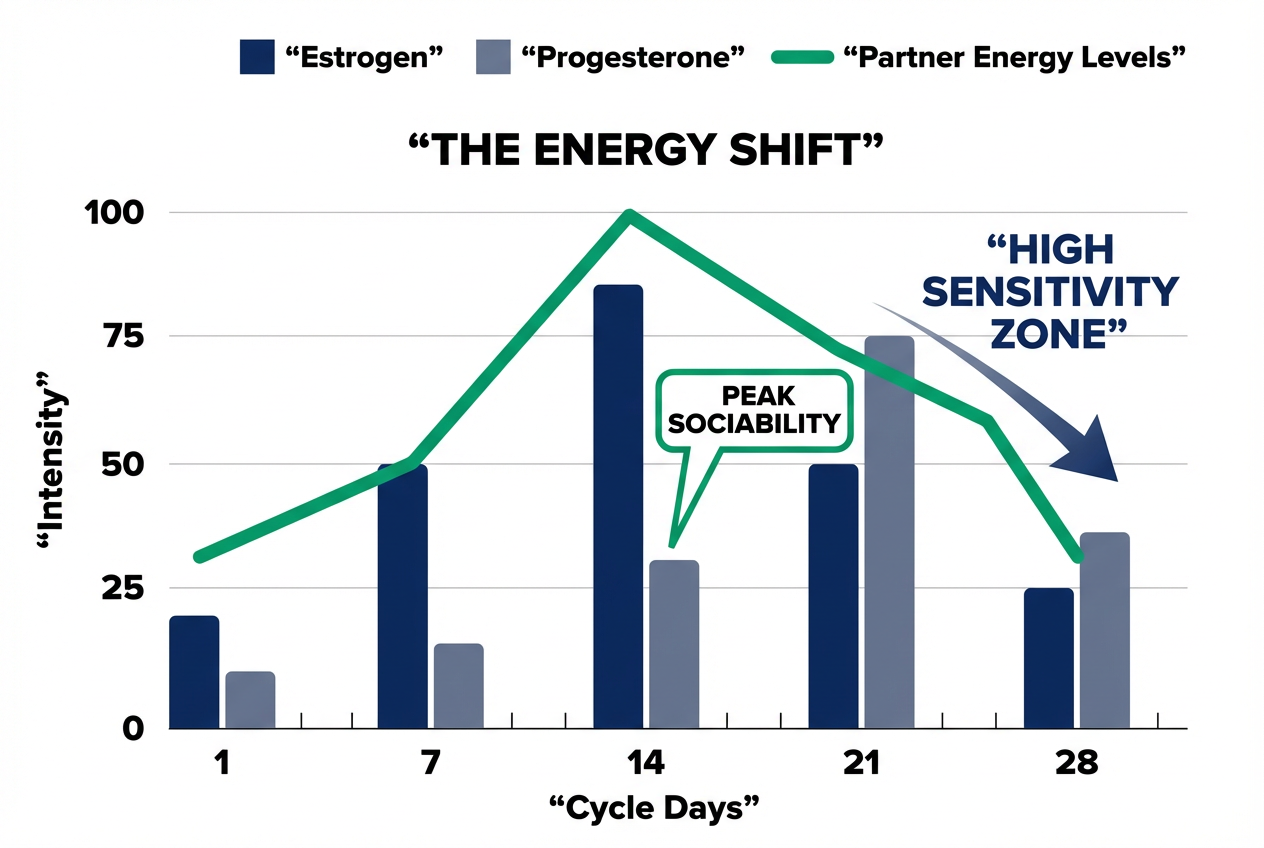
Estrogen is the "growth and energy" hormone. When it's high, she typically feels more social, confident, and energetic. Her pain tolerance increases. Her skin often looks clearer. She's more likely to initiate plans and feel optimistic about tackling challenges.
Progesterone is the "rest and prepare" hormone. It rises after ovulation and creates a natural slowdown. This hormone can cause bloating, breast tenderness, food cravings, and a shift toward introspection. When it drops suddenly right before her period, the crash can trigger mood swings, anxiety, and irritability.
According to the American College of Obstetricians and Gynecologists, up to 90% of women experience some premenstrual symptoms, and about 5-8% have severe symptoms that interfere with daily activities (what's called PMDD, or premenstrual dysphoric disorder).
The key insight: her body isn't malfunctioning. These hormonal shifts are normal biological processes. Your job isn't to "fix" anything. Your job is to adapt your support to match what her body needs at different times of the month.
The Four Seasons of the Cycle
The menstrual cycle mirrors four distinct seasons: Winter (menstruation) demands rest and warmth, Spring (follicular) brings renewed energy for new projects, Summer (ovulation) peaks with confidence and connection, and Fall (luteal) requires patience as energy naturally declines.
The "four seasons" framework works because it's memorable and intuitive. Each season has a distinct vibe, specific support needs, and predictable patterns. Once you recognize which season she's in, you'll know exactly how to show up.
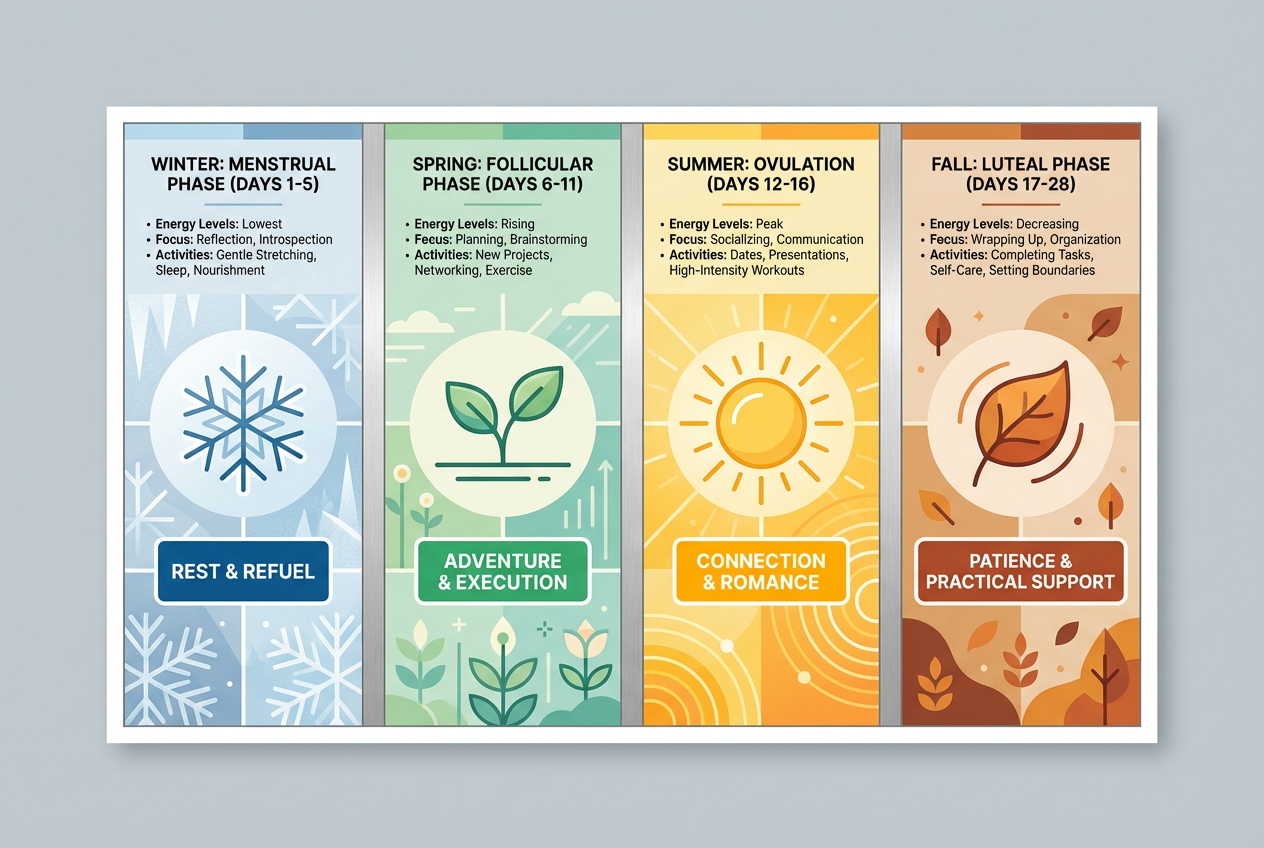
Winter: The Menstrual Phase (Days 1-5)
During menstruation, her body sheds the uterine lining, causing cramping, fatigue, and often a desire for solitude. Your mission: create a low-pressure environment focused on rest, warmth, and practical support without needing to be asked.
This is the phase where estrogen and progesterone are at their lowest levels. Her body is working hard - menstruation isn't passive. The uterus contracts to shed its lining, which can cause pain ranging from mild discomfort to debilitating cramps. About 20% of women experience cramps severe enough to interfere with daily activities.
Energy levels typically bottom out. She might feel more introverted, preferring quiet time over social obligations. Some women experience increased anxiety or sadness during the first few days of bleeding.
What she needs from you:
- Handle household tasks without being asked (dishes, laundry, cooking)
- Keep plans low-key and flexible
- Have pain relief options readily available (ibuprofen works better than acetaminophen for cramps)
- Provide warmth (heating pads, hot water bottles, warm blankets)
- Don't take it personally if she wants space
What not to do:
- Suggest strenuous activities or intense social events
- Get defensive if she seems less interested in physical intimacy
- Act grossed out or uncomfortable about menstruation
- Minimize her discomfort ("It can't be that bad")
The Winter phase is when you build trust by showing up quietly and competently. You're not the hero swooping in to save the day. You're the reliable partner who makes her life easier when she's dealing with physical discomfort.
One practical move that men consistently underestimate: having a supply kit already stocked. Keep ibuprofen, a heating pad, her preferred chocolate or comfort snacks, and extra supplies (tampons or pads) accessible. Don't wait until she's in pain to ask what she needs.
Spring: The Follicular Phase (Days 6-14)
After menstruation ends, estrogen rises steadily, boosting energy, creativity, and social confidence. This is your window for new activities, ambitious projects, and quality time together - she's primed for action and connection.
Spring is the rebuilding phase. Her body is preparing to release an egg, and rising estrogen creates a measurable lift in mood and energy. Research published in Hormones and Behavior shows that women score higher on verbal tasks and creative problem-solving during the follicular phase.
She'll likely feel more optimistic, outgoing, and motivated. This is when she's most likely to say yes to trying new restaurants, planning trips, or tackling home projects. Her skin often looks better, she might feel more attractive, and she's generally more receptive to physical intimacy.
What she needs from you:
- Match her energy with enthusiasm for plans and activities
- Support new ideas and projects she brings up
- Initiate date nights and adventures
- Be present and engaged in conversations
- Take advantage of her increased interest in physical connection
What not to do:
- Dismiss her energy as "just hormones" or unrealistic optimism
- Be the wet blanket who shoots down every new idea
- Stay glued to your phone or video games during quality time
- Assume this high-energy phase will last all month (it won't)
Spring is your easiest phase. She's feeling good, you're feeling appreciated, and the relationship flows naturally. Use this time to bank goodwill and create positive memories that'll sustain you both through the harder phases.
This is also the ideal time for important conversations or negotiations. Her stress tolerance is higher, she's thinking more optimistically, and she's better equipped to handle challenging topics. If you've been putting off discussing finances, future plans, or relationship concerns, Spring is your strategic window.
Summer: Ovulation (Days 15-17)
Ovulation brings peak estrogen and testosterone, creating maximum confidence, social energy, and physical attraction. This 2-3 day window is prime time for romance, deep conversations, and activities that require her to be "on" socially.
Summer is short but intense. Biologically, her body is signaling fertility, which translates to increased attractiveness (studies show women's faces are rated as more attractive during ovulation), heightened libido, and maximum social confidence.
She'll likely feel her best during these few days. Communication tends to be clearer, she's more forgiving of minor annoyances, and she's generally more interested in sex and physical affection. This is also when she's most likely to enjoy being the center of attention or attending social events.
What she needs from you:
- Be emotionally and physically present
- Plan romantic gestures or intimate date nights
- Engage in meaningful conversations without distractions
- Match her social energy if she wants to see friends or attend events
- Show genuine appreciation and attraction
What not to do:
- Miss this narrow window by being checked out or distracted
- Start arguments or bring up contentious issues
- Be dismissive of her increased confidence or social energy
- Forget that this phase is extremely brief (don't expect it to last)
Summer is your relationship's peak performance window. Everything feels easier because her hormones are optimized for connection and communication. Smart partners recognize this phase and intentionally create memorable experiences during it.
One caveat: if you're actively trying to avoid pregnancy, be extra careful during ovulation. Despite myths, women can absolutely get pregnant during this window, and it's the most fertile time of the month. If you're using fertility awareness methods, consult the Mayo Clinic's guidance on tracking accurately.
Fall: The Luteal Phase (Days 18-28)
Progesterone dominates the luteal phase, bringing physical discomfort (bloating, breast tenderness, fatigue) and emotional sensitivity that peaks right before menstruation. Your mission: provide stability, practical support, and validation without trying to "fix" her feelings.
Fall is the longest and most complex season. It starts after ovulation and continues until menstruation begins. Progesterone rises to prepare the body for possible pregnancy, then crashes when no pregnancy occurs, triggering PMS symptoms.
This is the phase that gives the menstrual cycle its bad reputation. About 75% of women experience some combination of bloating, breast tenderness, food cravings, fatigue, mood swings, anxiety, irritability, or depression during late Fall. These symptoms typically worsen in the 5-7 days before menstruation starts.
Here's what's actually happening: the progesterone crash creates a domino effect. Serotonin (your brain's "feel good" chemical) drops. Stress hormones become more reactive. Pain sensitivity increases. She's not "choosing" to be irritable - her neurochemistry is literally different during this phase.
What she needs from you:
- Validate her feelings without trying to solve or dismiss them
- Handle extra household responsibilities
- Be patient with emotional sensitivity
- Provide or support comfort food cravings (complex carbs actually help stabilize mood)
- Give space when requested, but stay available and attentive
- Keep your communication straightforward and drama-free
What not to do:
- Say anything remotely close to "Is it that time of the month?"
- Get defensive or argumentative when she's already emotionally raw
- Minimize her physical discomfort
- Start big life discussions or drop stressful news during late Fall
- Expect her to have the same energy levels as Spring or Summer
Fall requires a completely different support strategy than the other phases. You're not motivating or adventuring together. You're providing stable, calm, practical support while she navigates real physical and emotional discomfort.
The late luteal phase (the week before her period) is when most relationship conflict occurs. Her stress threshold is lower, minor irritations feel major, and she's more likely to speak bluntly about things that bother her. Don't interpret this as sudden relationship dissatisfaction. These concerns might be valid, but the intensity is amplified by hormonal sensitivity.
If you want to deepen your understanding of how to support your girlfriend during period phases, recognizing that Fall requires the most intentional patience and practical help is essential.
The "Don't Be That Guy" Section: What Never to Say
Certain phrases instantly invalidate your partner's experience and mark you as someone who doesn't understand or respect what she's dealing with. These statements damage trust and create resentment that outlasts the cycle.
Let's be direct: there are things you should never say to a woman dealing with hormonal symptoms, no matter how frustrated or confused you feel. These phrases reveal ignorance at best and contempt at worst.
Forbidden Phrases:
| What You Say | Why It's Terrible | What to Say Instead |
|---|---|---|
| "Are you on your period?" or "Is it that time of the month?" | Dismisses legitimate feelings as "just hormones" and implies her emotions aren't valid | "You seem upset. What's going on?" or "What do you need from me right now?" |
| "You're being so emotional/irrational right now" | Invalidates her perspective and suggests she's incapable of logical thought | "I hear you. Help me understand what you're feeling." |
| "Other women don't make this big a deal about their periods" | Compares her suffering to others and minimizes her experience | "I can see you're in pain. What would help?" |
| "You were fine yesterday, what changed?" | Demonstrates complete ignorance of how rapidly hormones fluctuate | "How are you feeling today?" (and accept the answer) |
| "Can't you just take something for that?" | Implies the solution is obvious and she's being dramatic by not implementing it | "Do you have what you need for pain relief, or should I pick something up?" |
| "I don't see why this is such a big deal" | Centers your confusion over her lived experience | Don't say anything. Listen instead. |
Beyond specific phrases, avoid the entire category of statements that minimize, explain away, or compare her experience to others. You're not trying to win a debate. You're trying to support someone navigating real physical discomfort and hormonal sensitivity.
Common Misconceptions to Avoid:
You can't get pregnant during menstruation. False. Sperm can survive up to five days inside the reproductive tract, and some women ovulate early. Unprotected sex during menstruation can absolutely result in pregnancy.
PMS is psychological, not physical. False. Hormonal fluctuations create measurable changes in neurotransmitter levels, pain sensitivity, and inflammatory responses. The symptoms are as real as any other medical condition.
All women experience the cycle the same way. False. Symptoms vary wildly. Some women barely notice their periods while others experience debilitating pain or severe mood changes. Never compare your partner's experience to other women's.
If she's on birth control, she doesn't have hormonal fluctuations. Partially false. Hormonal birth control changes and often reduces natural fluctuations, but women on the pill still experience some cyclical symptoms, especially during the placebo week when hormone levels drop.
Understanding what not to do is as important as knowing what to do. Men who master cycle syncing for better relationship timing recognize that avoiding these communication landmines builds as much trust as proactive support.
Practical "Ally" Kits: Phase-Specific Actions
Each phase requires different types of support. Stock specific items and prepare specific actions for each season to provide exactly what she needs without waiting to be asked - this is how you become irreplaceable.
The difference between good intentions and actual help is preparation. Most men wait until their partner is in pain or upset, then scramble to figure out what to do. Elite partners anticipate needs and have resources ready.
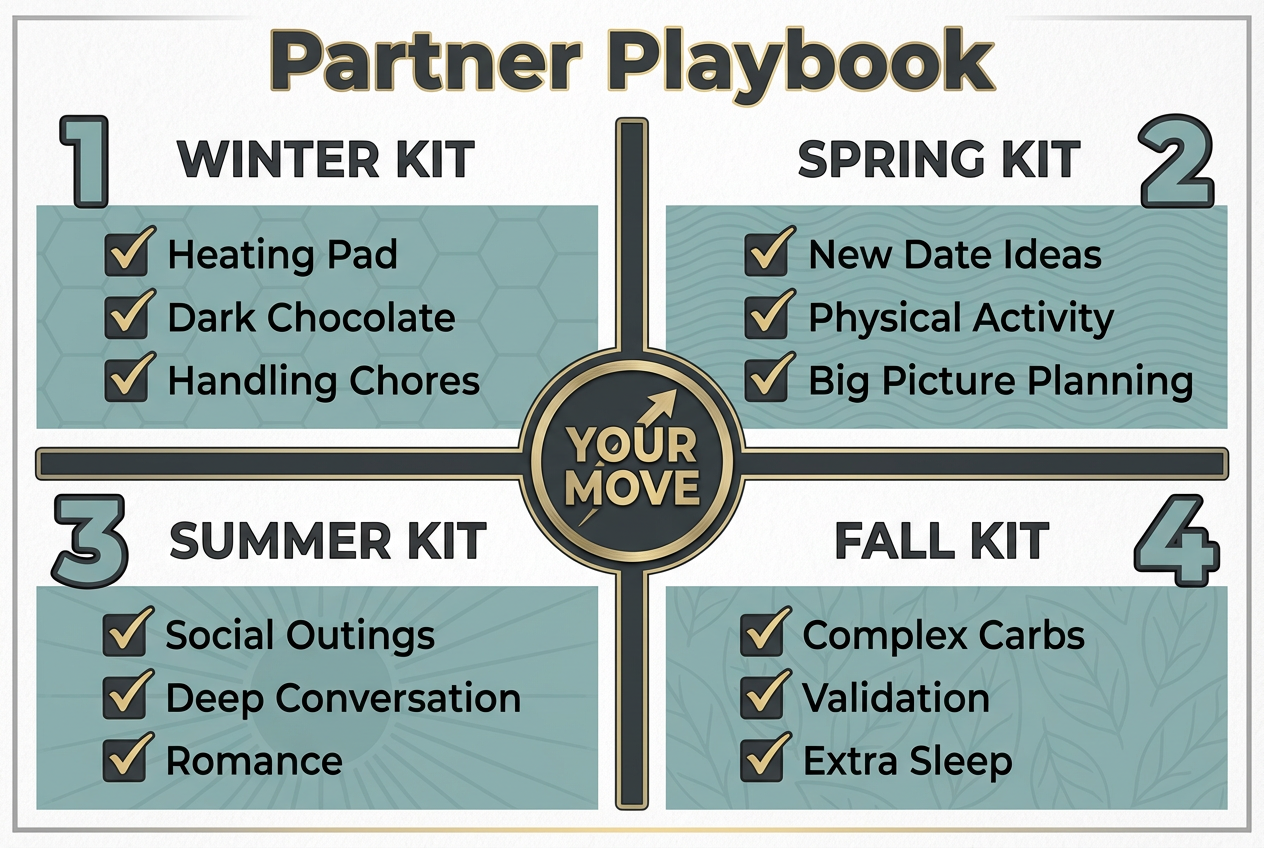
Winter Kit (Menstrual Phase):
- Ibuprofen or naproxen (more effective for cramps than acetaminophen)
- Heating pad or hot water bottle
- Dark chocolate (70% cacao or higher - magnesium helps with cramps)
- Herbal tea (ginger, chamomile, or peppermint)
- Extra blankets and comfortable clothes
- Her preferred menstrual products (tampons, pads, or period underwear)
Actions: Handle cooking, cleaning, and errands without being asked. Keep the house warm. Offer gentle back rubs. Cancel or postpone demanding plans. Create a comfortable nest on the couch with everything she needs within reach.
Spring Kit (Follicular Phase):
- Energy-boosting snacks (nuts, fruit, protein bars)
- Calendar or planning tools for the projects she'll want to start
- Tickets or reservations for activities she's been wanting to try
- Ingredients for favorite meals (her appetite typically increases)
Actions: Say yes to adventures and new experiences. Support her ideas and initiatives. Plan date nights and quality time. Match her energy and enthusiasm. Be present and engaged in conversations.
Summer Kit (Ovulation):
- Date night essentials (nice wine, candles, quality time focus)
- Thoughtful romantic gestures (flowers, handwritten notes)
- Comfortable but attractive home environment
Actions: Prioritize intimacy and deep connection. Have meaningful conversations. Show genuine appreciation and attraction. Be fully present without phone or screen distractions. This is prime time for relationship-building.
Fall Kit (Luteal Phase):
- Complex carbohydrates (whole grain crackers, bread, pasta - these genuinely help stabilize mood)
- Salty snacks (cravings for salt increase during this phase)
- Comfort foods she specifically requests
- Magnesium supplements (can reduce PMS symptoms for some women)
- Extra patience (not a physical item, but stock up mentally)
Actions: Anticipate emotional sensitivity. Take on extra household tasks. Give space when requested. Avoid starting arguments or stressful discussions. Validate feelings without trying to fix them. Be present but not hovering.
One highly effective strategy: create a small, dedicated drawer or basket with Winter and Fall supplies that's always stocked. When she's in pain or exhausted, the last thing she wants to do is send you to the store with a detailed shopping list. Having essentials ready demonstrates thoughtfulness that transcends any single gesture.
The men who succeed at this don't just stockpile items. They notice patterns. They remember that she always wants Thai food during late Fall, or that she gets a specific type of headache two days before her period. That level of attention and memory is what separates "helpful" from "indispensable."
How to Use a Tracking App Together
Sharing cycle data through a tracking app isn't surveillance - it's a communication tool that helps you anticipate her needs and plan around her energy levels. The key is positioning it as partnership intelligence, not partner monitoring.
Here's where technology becomes your strategic advantage. Trying to manually track her cycle in your head while also managing work, fitness, and everything else is unrealistic. Apps automate the memory work and provide predictive insights.
The conversation about app-sharing needs careful framing. Many women initially resist the idea because they've had past partners who used cycle information dismissively ("You're just on your period") or treated tracking like surveillance. You need to position this as a support tool, not a weapon.
How to bring it up: "I've been learning about how your cycle affects your energy and mood, and I want to be better at supporting you without you having to explain everything. Would you be comfortable sharing your cycle data with me through an app? I'm thinking of it like weather forecasts - it helps me plan better and show up in ways that actually help."
What makes a good tracking app for partners:
- Clean, simple interface (you don't need to see every symptom detail)
- Predictive phase notifications ("Spring starts in 3 days")
- Shared access that she controls (she can revoke your access anytime)
- Educational content explaining what each phase means
- Suggestion prompts for partner support actions
Apps like those discussed in our guide to period tracker apps for men translate raw data into actionable support strategies. The best ones tell you "she's entering Fall, expect lower energy" rather than just showing a calendar with dots.
How to use app data without being weird:
- Don't announce the phase changes like you're a meteorologist ("Looks like Summer's coming!")
- Use the information to adjust your expectations and preparation, not to explain her behavior
- If she's irritable during Fall, you don't say "I know you're in your luteal phase." You just give extra grace and support
- Treat the data as private - never share it with friends or make jokes about it
- Check the app regularly so you're prepared, but don't make it obvious you're tracking
The goal is invisible support. She should notice that you're somehow always prepared with the right snacks, that you mysteriously handle more chores during her low-energy weeks, that you suggest outdoor adventures exactly when she's feeling energetic. The tracking should enhance your intuition, not replace it.
One practical tip: set private reminders on your phone for key transitions. "Winter starts tomorrow - stock the supply kit" or "Spring begins in 2 days - plan something fun." These prompts help you stay proactive rather than reactive.
The men who get this right report significantly fewer arguments and higher relationship satisfaction. When you're using tools like those explored in our best period tracker for boyfriend options comparison, you're essentially building a early-warning system that helps you avoid preventable conflict.
Long-Distance Cycle Support
Physical distance doesn't eliminate your ability to provide cycle support. Strategic communication, proactive deliveries, and emotional presence during each phase show your partner she's still a priority even when you're apart.
Long-distance relationships add complexity to cycle awareness, but the principles remain the same. You can't hand her a heating pad personally, but you can demonstrate that you're still paying attention and actively supporting her needs.
Winter (Menstrual Phase) LDR Support:
- Send a DoorDash gift card or food delivery during the first few days of her period
- Mail a care package timed to arrive during Winter (include chocolate, tea, a cozy item)
- Schedule a low-pressure video call where she can just vent or stay quiet together
- Text check-ins without expecting immediate responses
- Avoid planning serious relationship discussions during this week
Spring (Follicular Phase) LDR Support:
- This is your best window for longer, energetic video calls
- Share interesting articles, videos, or activities you want to do together
- Make plans for your next visit during this high-energy phase
- Send encouraging messages about her projects and goals
- Be enthusiastic and engaged in conversation
Summer (Ovulation) LDR Support:
- Prioritize intimacy even through distance (thoughtful messages, voice notes, whatever works for you both)
- This is prime time for deep, meaningful conversations about your relationship
- Send a romantic surprise (flowers delivered to her door, a heartfelt letter)
- Schedule a longer video date focused on connection
Fall (Luteal Phase) LDR Support:
- Increase communication frequency but keep messages low-pressure
- Send comfort food through delivery apps
- Be extra patient if responses are shorter or moodier
- Avoid bringing up stressful topics or relationship concerns
- Simple "thinking of you" messages without expecting long conversations
The biggest mistake in LDR cycle support is assuming distance excuses you from awareness. She's still experiencing the same physical and emotional fluctuations whether you're in the same city or on different continents. Your ability to acknowledge and support those changes from afar actually strengthens the relationship by proving your attention isn't dependent on proximity.
One highly effective LDR strategy: maintain a shared calendar (many period apps have partner sync features) so you both know which phase is coming. This prevents you from accidentally scheduling a serious "where is this relationship going?" conversation during late Fall when she's least equipped to handle that stress.
Building Your Partner Support System
Cycle awareness is one component of being an exceptional partner. Combine it with strong communication, emotional intelligence, and genuine care to create a relationship foundation that handles any challenge.
Everything you've learned here becomes infinitely more valuable when integrated into a broader support system. Knowing which season she's in matters, but only if you're also doing the basic relationship work: listening actively, respecting boundaries, sharing household labor, and maintaining emotional connection.
The support system hierarchy:
Foundation Layer - Basic Partnership:
- Equal division of household labor (not "helping" her with "her" chores)
- Active listening without trying to immediately solve every problem
- Respecting her autonomy and decision-making
- Maintaining your own mental and physical health
Second Layer - Emotional Intelligence:
- Recognizing and regulating your own emotions
- Understanding that her feelings are valid even when you don't share them
- Communicating needs and boundaries clearly
- Asking "What do you need from me right now?" instead of assuming
Third Layer - Cycle Awareness:
- Understanding the four phases and their characteristics
- Adjusting expectations and support to match her current season
- Anticipating needs before being asked
- Using tracking tools to enhance your intuition
Top Layer - Proactive Partnership:
- Researching ways to improve your relationship skills
- Adapting support strategies based on her specific patterns and preferences
- Continuous learning about women's health and hormonal impacts
- Treating the relationship as something requiring ongoing investment
Cycle awareness doesn't replace the fundamentals. If you're a terrible communicator who never does dishes, knowing she's in her luteal phase won't save you. But when you combine basic partnership competence with strategic cycle support, you become the kind of partner who navigates challenges smoothly and creates genuine relationship security.
The men who master this approach report something interesting: their partners start trusting them with deeper vulnerabilities. When someone demonstrates consistent, reliable support through your most uncomfortable biological processes, it signals safety at a fundamental level. That trust extends into every other area of the relationship.
For guys looking to take their partnership skills further, resources like our VibeCheck partner cycle playbook offer structured approaches to translating biological awareness into daily relationship actions that actually move the needle.
Ready to actually understand her?
Join thousands of men using VibeCheck to track her cycle and show up better every day.
Frequently Asked Questions
What is the menstrual cycle in simple terms for men who never learned this?
The menstrual cycle is a roughly 28-day biological process where a woman's body prepares for possible pregnancy each month. It involves hormone fluctuations (primarily estrogen and progesterone) that affect mood, energy, pain sensitivity, and physical symptoms. The cycle starts on the first day of menstrual bleeding and includes four phases: menstruation (shedding the uterine lining), the follicular phase (rebuilding and preparing to release an egg), ovulation (releasing an egg), and the luteal phase (maintaining conditions for possible pregnancy, then triggering menstruation if no pregnancy occurs). Understanding these phases helps you anticipate your partner's changing needs throughout the month.
How do I know which phase my girlfriend is in without asking her directly?
Track her cycle using a shared app or by noting patterns over 2-3 months. Most women have relatively consistent cycle lengths, so once you know when her period starts, you can calculate the approximate phases. Winter (menstruation) is easiest to identify because bleeding is visible. Spring typically follows immediately after bleeding stops. Summer (ovulation) occurs roughly mid-cycle (around days 13-15 in a 28-day cycle) and often involves increased energy and social engagement. Fall begins after ovulation and continues until the next period, with PMS symptoms typically appearing in the final week. The most accurate method is using period tracking tools designed for couples that provide phase predictions and partner notifications.
What should I do if my girlfriend's PMS seems severe?
First, validate her experience rather than minimizing it. About 5-8% of women have PMDD (premenstrual dysphoric disorder), a severe form of PMS that significantly interferes with daily life and can include symptoms resembling clinical depression. If her symptoms are severe, suggest she talk to her doctor about potential treatments, which might include birth control adjustments, antidepressants, or other medical interventions. Your role is providing consistent support, helping with practical tasks during difficult weeks, and encouraging professional help when symptoms cross from uncomfortable to debilitating. Never suggest she's "overreacting" - if symptoms interfere with work, relationships, or daily functioning, that's a legitimate medical concern requiring treatment.
Can understanding her cycle really reduce relationship arguments?
Yes, significantly. Research shows that most couples' arguments occur during the late luteal phase (the week before menstruation) when stress tolerance is lowest and emotional sensitivity is highest. When you understand this pattern, you can avoid starting difficult conversations during this window, lower your defensiveness when she's irritable, and recognize that temporary relationship doubts during PMS often don't reflect her actual feelings about the relationship. Men who track cycles and adjust their approach report 30-40% fewer arguments simply by timing sensitive discussions better and providing appropriate support during high-stress phases. The key is using this knowledge to increase empathy and patience, not to dismiss her concerns as "just hormones."
What if my girlfriend doesn't want me tracking her cycle?
Respect her decision completely. Some women find partner tracking intrusive, creepy, or invalidating. If she's uncomfortable with it, you can still learn the general principles of cycle phases and pay attention to patterns without using an app. Notice when she seems lower energy or more emotionally sensitive, and respond with appropriate support. You can also ask periodically, "How are you feeling today?" or "What would be most helpful right now?" which gives her control over sharing information. The goal is being supportive, not conducting surveillance. If she changes her mind later, the option is always available. Never pressure someone into sharing health data they're not comfortable sharing.
How do I support my girlfriend's cycle if we're long-distance?
Use technology strategically. Send food deliveries during her period, schedule video calls during her high-energy phases, and maintain more frequent (but low-pressure) communication during her low-energy phases. Mail care packages timed to arrive during menstruation with comfort items like tea, chocolate, or cozy socks. The most important thing is demonstrating awareness even from a distance - a "thinking of you, hope you're feeling okay" text during her period means more than you'd expect because it shows you're paying attention to her experience even when you're not physically present. Avoid scheduling serious relationship discussions during her late luteal phase when she's least equipped to handle that stress. Many of the relationship apps for men now include LDR-specific features for this exact purpose.
Does birth control change how I should approach cycle support?
Yes, but the principles remain similar. Hormonal birth control (pills, IUDs, implants) suppresses natural hormonal fluctuations to prevent ovulation, which often reduces severe PMS symptoms. However, women on birth control still experience some cyclical patterns, especially during the placebo week of birth control pills when hormone levels drop and withdrawal bleeding occurs. She might still experience fatigue, mood changes, and physical discomfort during this week. Non-hormonal methods (copper IUD, fertility awareness) don't change the natural cycle at all. Ask your partner how her specific birth control affects her symptoms rather than assuming, and adjust your support accordingly. The communication and support principles you've learned here apply regardless of contraceptive method.
What's the single most important thing to understand about supporting a partner through her cycle?
Her experience is real, variable, and not something she can simply "control" through willpower. The hormonal fluctuations that drive her cycle create measurable changes in brain chemistry, pain sensitivity, and stress response. Your job isn't to fix, minimize, or explain away these changes. Your job is to adapt your support to match what she needs at different times. The most impactful thing you can do is shift from reactive ("Why is she upset?") to proactive ("She's in Fall, so I'll handle extra chores and be patient with emotional sensitivity"). This requires ongoing attention, genuine care, and willingness to prioritize her comfort even when it's inconvenient. Men who master this approach don't just have fewer arguments - they build relationships characterized by deep trust and genuine partnership.
Tags

Related Articles
Continue reading to deepen your understanding

How to Understand Your Girlfriend’s Social Battery and Hormones
Does your girlfriend suddenly cancel plans or seem withdrawn? This guide explains how her cycle impacts her energy so you can support her like a pro.

How Your Girlfriend’s Emotional Needs Change During Her Cycle
Does your girlfriend’s mood seem unpredictable? Learn how her emotional needs shift on a biological loop and how to support her through every phase of her cycle.

What to Buy When Your Girlfriend Has Hormone Cravings: A Support Guide
Stop wondering what to pick up at the store. This guide explains the science behind cycle cravings and provides a specific list of foods and comfort items she needs.

Your Girlfriend’s Mood Shifts Throughout the Month, Explained
Ever wonder why her energy and moods change so drastically each week? Understand the four hormonal phases and how to be the partner she needs during every stage of her cycle.

How to Support Your Girlfriend When She’s Crying Because of Hormones
Watching her cry when hormones hit can feel overwhelming. Learn the biological why behind the tears and use these proven scripts to provide the support she actually needs right now.

How to Help Your Girlfriend with Hormonal Mood Swings Without Arguing
Understand her cycle and learn tactical scripts to handle tension. This guide shows you how to support her through hormonal shifts without getting into unnecessary fights.

When to Feed Your Girlfriend: Understanding Hangry Hormones
Does your girlfriend get irritable when she hasn’t eaten? It’s not just in her head. Learn why hormones cause hanger and the specific times her body needs more fuel.

The Boyfriend’s Guide to Supporting Your Partner Through PMS
If your partner is suddenly irritable and exhausted, it’s biology, not you. Learn about the luteal phase and how to provide meaningful support without walking on eggshells.