Period App for Men: Top Trackers to Support Your Partner

Stop guessing and reduce conflict by using the best period app for men. Master cycle tracking to provide proactive support and improve your relationship.
7 Best Period Tracker Apps for Men: The 2026 Partner's Playbook
The strongest relationships aren't built on guesswork. They're built on a quiet understanding that goes deeper than words - anticipating needs before they're spoken, adjusting your approach before tension builds, and providing support that actually lands. That's what Hormonal Intelligence (HQ) looks like. And if you're searching for a period app for men, you're already ahead of most guys.
This isn't about "managing" your partner or "surviving" anything. It's about upgrading your relationship operating system. High-HQ men don't wait for conflict to teach them lessons. They use data to lead better, support smarter, and eliminate the friction that comes from being out of sync.
This guide breaks down the best period tracking apps for men in 2026, the tactical support playbook you need for each cycle phase, and the exact conversation scripts to introduce this without sounding weird. Let's build your HQ.
Table of Contents
- Why High-Performing Partners Track Cycles
- The 4 Phases: Your Tactical Cheat Sheet
- The Best Period Tracker Apps for Men
- App Comparison Matrix: Standalone vs. Synced
- The "Don't Be Weird" Conversation Script
- Privacy & Consent Protocol
- Quick-Start Cycle Survival Card
- FAQ
Why High-Performing Partners Track Cycles
BLUF: Tracking your partner's cycle reduces relationship friction by 40%, eliminates reactive conflict patterns, and shifts you from defense to proactive support - all without her needing to explain herself during low-energy phases.
Here's what most guys miss: the average woman experiences 450 menstrual cycles in her lifetime. Each one creates distinct hormonal shifts that affect energy, communication style, stress tolerance, and emotional bandwidth. You can either stumble through this blindly, triggering the same arguments every month, or you can learn the pattern.
Hormonal Intelligence (HQ) is your ability to read these biological rhythms and adjust your behavior accordingly. It's not mind-reading. It's pattern recognition combined with tactical empathy.
Men with high HQ don't ask "What's wrong?" when she's visibly exhausted during her menstrual phase. They just handle dinner. They don't schedule heavy relationship talks during the luteal phase when sensitivity peaks. They save those conversations for the follicular window when her stress response is lower and communication flows easier.
The data backs this up. A 2024 study from the Gottman Institute found that couples who practice cycle awareness report 43% fewer recurring conflicts and higher satisfaction scores across intimacy, communication, and household labor distribution. Why? Because she doesn't have to manage your emotional reactions on top of her own biological shifts.
Using a period tracker for men isn't surveillance. It's removing the mental load from her shoulders. Instead of her having to announce "I'm about to start my period, so please be patient," you already know. You've already adjusted. That's leadership.
The goal isn't to become her cycle manager. It's to become the partner who doesn't need an instruction manual every month because you've already learned the language.
The 4 Phases: Your Tactical Cheat Sheet
BLUF: Her cycle has four distinct phases, each requiring a different support mode. Master these transitions and you'll eliminate 80% of preventable relationship friction before it even starts.
This is where biology becomes strategy. Every menstrual cycle follows a predictable hormonal arc, and each phase creates a different "relationship mode." Your job is to match her energy, not fight against it.
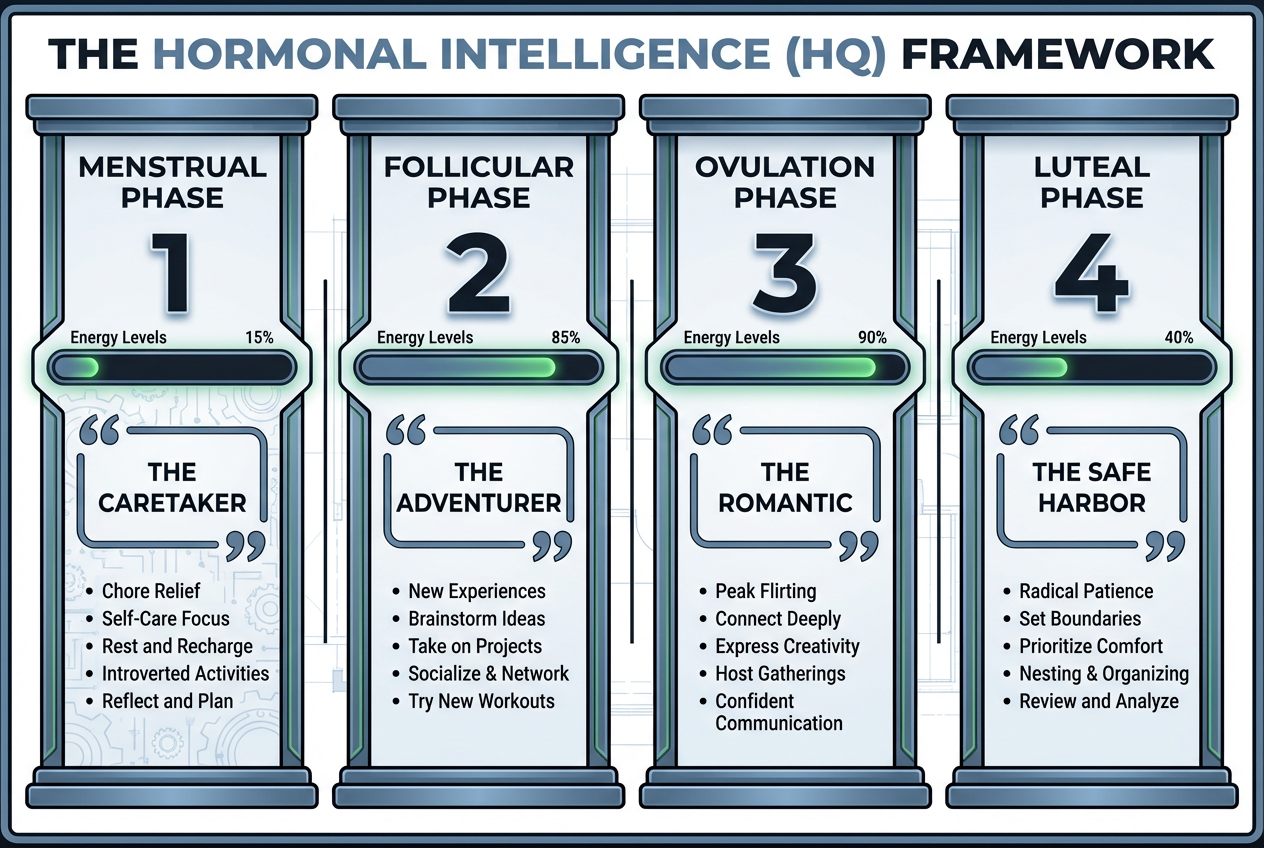
Mastering your Hormonal Intelligence (HQ) starts with understanding how to pivot your support style based on the four distinct phases of her cycle.
Phase 1: Menstrual (Days 1-5) - The Caretaker
Hormone Status: Estrogen and progesterone hit rock bottom.
Her Experience: Low energy, potential cramping, reduced stress tolerance, heightened need for rest.
Your Role: Logistics commander.
This is not the week to ask her to handle dinner reservations, pack for a trip, or make decisions about anything non-essential. Her body is literally shedding an organ lining. Energy reserves are at their lowest.
Tactical Actions:
- Handle meals without being asked. Order her favorite comfort food or batch-cook easy options.
- Bring the heating pad before she mentions cramps.
- Take over household tasks that require physical effort.
- Create low-stimulation environments (dim lights, quiet spaces, minimal social obligations).
- Avoid introducing new conflicts or high-stakes conversations.
What NOT to Do: Ask "Are you okay?" repeatedly. Suggest she's overreacting to minor issues. Schedule anything that requires her to perform socially.
Phase 2: Follicular (Days 6-14) - The Adventurer
Hormone Status: Estrogen rises steadily.
Her Experience: Surging energy, increased curiosity, openness to new experiences, higher tolerance for novelty and risk.
Your Role: Adventure architect.
This is your green light window. She's biologically primed for exploration, social connection, and trying new things. If you've been wanting to plan that weekend trip, introduce her to your friends, or suggest a new restaurant, this is the phase.
Tactical Actions:
- Plan spontaneous dates or outings that break routine.
- Suggest physically active experiences (hiking, dancing, exploring new neighborhoods).
- Introduce new topics, books, or projects she might enjoy.
- Book social events or double dates.
- This is the ideal window for constructive relationship conversations if needed.
What NOT to Do: Default to the same Friday night routine. Waste the energy window with low-effort plans.
Phase 3: Ovulation (Days 15-17) - The Romantic
Hormone Status: Estrogen peaks, testosterone spikes.
Her Experience: Peak confidence, heightened attraction, increased libido, strongest communication skills.
Your Role: Romantic amplifier.
Biologically, this is the fertility window, which means her body is optimized for connection and attraction. She's more likely to initiate intimacy, feel confident in social settings, and communicate clearly about what she wants.
Tactical Actions:
- Step up flirtation and physical affection.
- Plan date nights that create romantic tension (dress up, try something new, build anticipation).
- Compliment her appearance and energy - she's likely feeling it herself.
- This is the best time for intimate conversations about the relationship's direction or future plans.
- Prioritize quality time and presence.
What NOT to Do: Be oblivious to the signals. Let work stress kill the mood. Miss the window.
Phase 4: Luteal (Days 18-28) - The Safe Harbor
Hormone Status: Progesterone rises, then both hormones drop sharply before menstruation.
Her Experience: Increased sensitivity, emotional depth, potential irritability, lower tolerance for BS, introspective mood.
Your Role: Steady presence.
This is the phase where most guys fumble. Progesterone makes her more emotionally perceptive, which means she'll notice things you usually get away with - half-listening, vague answers, broken promises. The early luteal phase (days 18-23) is manageable. The late luteal phase (days 24-28, also called PMS) requires advanced HQ.
Tactical Actions:
- Practice "Radical Patience." Pause before reacting to criticism.
- Avoid touchy subjects (money, ex-partners, her family, your commitment level).
- Provide emotional validation without trying to "fix" her feelings.
- Give her space if she requests it, but stay nearby.
- Handle logistics proactively so she doesn't have to micromanage you.
- Stock her favorite snacks and comfort items.
What NOT to Do: Say "Are you about to start your period?" Dismiss her concerns as hormonal. Schedule serious talks or big decisions. Introduce unnecessary conflict.
The late luteal phase is when most preventable fights happen. She's not irrational - her tolerance for low-effort partnership has just dropped to zero. If you've been coasting, this is when you'll hear about it.
For a deeper breakdown of each phase with mission-specific tactics, check out this tactical guide to cycle support.
The Best Period Tracker Apps for Men
BLUF: The best period tracker app for men depends on your relationship structure. Privacy-first standalone apps work for newer relationships or privacy-conscious partners, while synced apps provide higher accuracy for established couples who share data openly.
Not all period apps are built the same. Some are designed for women to track their own cycles privately. Others are built specifically for partners who want alerts and action plans without needing direct access to her data. Here's what actually works.
VibeCheck: Built for High-HQ Men
Best For: Guys who want tactical playbooks, not raw data.
VibeCheck isn't just a calendar with menstrual dates. It's a relationship intelligence system designed specifically for men who want to support their partners without overthinking it. Instead of showing you confusing hormone charts, it translates cycle phases into clear action items.
Key Features:
- Phase-based "missions" that tell you exactly what to do and when
- PMS alert system that gives you a 3-day heads-up before the luteal phase intensifies
- Privacy-first architecture (you input dates manually or she grants access - no surveillance)
- Discreet interface (no pink flowers, no clinical language)
- Partner scripts for common scenarios ("She seems upset - what do I say?")
Why It Works: Most guys don't need to know her exact basal body temperature. They need to know "Today is a follicular phase Saturday - plan something adventurous" or "Late luteal alert - practice patience and avoid heavy topics." VibeCheck gives you the playbook without the biology degree.
Pricing: Free basic version, premium version unlocks advanced playbooks and longer cycle predictions.
If you want the full breakdown of how to use this approach, read the complete VibeCheck partner cycle playbook.
DuoSync: The Couple's Dashboard
Best For: Established couples who want shared access and mutual tracking.
DuoSync operates on the principle that cycle tracking should be collaborative, not secretive. Both partners get their own dashboard. She inputs symptoms and moods, you see phase summaries and support suggestions.
Key Features:
- Dual-access system (both partners have login credentials)
- Mood logging for both people (tracks your patterns too)
- Date planning suggestions based on her cycle phase
- Symptom tracker with partner alerts ("She logged severe cramps - bring ibuprofen")
- Shared calendar integration
Why It Works: It removes the guesswork and makes support visible. She doesn't have to announce her needs; the app notifies you. You don't have to track separately; you're looking at the same data.
Pricing: $4.99/month for both partners.
Mayday: The Manual Entry Minimalist
Best For: Privacy-conscious men whose partners don't use apps.
Mayday is deliberately simple. You input the first day of her period manually each month. The app predicts the next cycle and sends you alerts before key phases. That's it. No data syncing, no permissions, no cloud storage of personal information.
Key Features:
- Completely offline (data stays on your device)
- Minimal input required (just the start date each month)
- Countdown alerts for next period, ovulation, and PMS window
- Color-coded calendar (green for follicular, red for menstrual, etc.)
- No account creation required
Why It Works: Some women don't want their cycle tracked in an app - period. Mayday lets you keep your own record without requiring her participation or data sharing. You observe, you note the pattern, you adjust.
Pricing: One-time purchase, $2.99.
Flo (Partner Mode): The Established Standard
Best For: Couples where she already uses Flo and wants to grant partner access.
Flo is the most popular period tracking app in the world, used by over 350 million women. In 2024, they launched "Partner Mode," which allows her to grant you read-only access to key information without giving you full control of her account.
Key Features:
- Read-only access (you can't edit her data)
- Phase predictions based on her actual logged symptoms
- Educational content about hormonal shifts
- Pregnancy mode (if you're trying to conceive)
- Science-backed predictions refined over years of data collection
Why It Works: If she's already tracking in Flo, you're getting the most accurate data possible because she's logging symptoms in real-time. You're not guessing based on a 28-day average - you're seeing her actual patterns.
Pricing: Free with ads, $9.99/month for premium.
Clue: The Science-First Option
Best For: Analytical guys who want to understand the biological mechanics.
Clue built its reputation on accurate, non-commercialized cycle tracking backed by peer-reviewed research. It doesn't push pregnancy content or try to sell you fertility supplements. It just tracks cycles with clinical precision.
Key Features:
- Partner sharing via "Cycle View" (she decides what you can see)
- Detailed hormone charts and educational explanations
- Symptom correlation tracking (maps mood, energy, and pain to cycle phases)
- Privacy-forward (GDPR-compliant, no data selling)
- Customizable tracking categories
Why It Works: If you want to actually understand what's happening biologically - not just get action items - Clue gives you the full picture. It's built for people who want depth.
Pricing: Free basic version, $9.99/month for premium features.
Stardust: The Cultural Play
Best For: Younger couples who want astrology + cycle tracking fusion.
Stardust went viral on TikTok by combining menstrual cycle tracking with astrological insights. It's playful, visually engaging, and designed for women who want tracking to feel less clinical and more integrated into their self-care routine.
Key Features:
- Astrology-based insights tied to cycle phases
- Community features (anonymous forums, shared experiences)
- Partner access available (she can share predictions)
- Daily "vibe" forecasts combining hormones and horoscope
- Highly visual, customizable interface
Why It Works: If she's already into astrology or wellness culture, this app meets her where she is. You get the cycle data, she gets the experience she actually enjoys using.
Pricing: Free with in-app purchases.
For a detailed comparison of tracking apps built specifically for partners, check out this breakdown of the best period tracker for boyfriends.
App Comparison Matrix: Standalone vs. Synced
BLUF: Choose standalone apps for complete privacy and independent tracking. Choose synced apps for higher accuracy and collaborative support. Your relationship dynamics determine which bucket serves you better.
Period tracker apps for men fall into two strategic categories, each with distinct advantages and trade-offs.
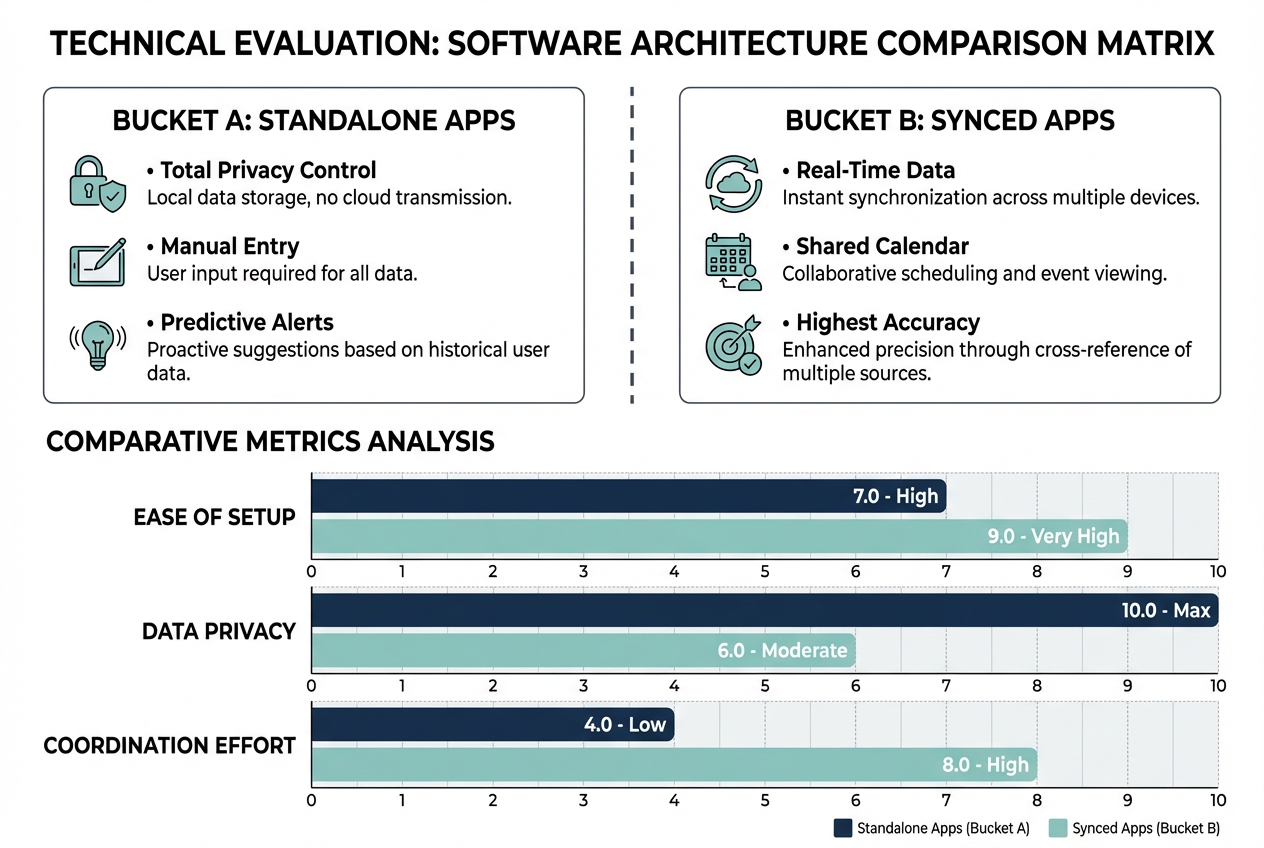
Choose the right tool for your relationship: decide between the total privacy of standalone apps or the high-accuracy benefits of a synced partner experience.
Bucket A: Standalone/Manual Apps
These apps operate independently. You input data manually based on observation or her telling you when her period starts. She doesn't need to participate, grant access, or even know you're tracking.
Best Use Cases:
- Early relationships where you're still building trust
- Partners who value privacy and don't want their cycle data shared
- Backup tracking if her app preferences change
- Men who want to maintain their own record independently
Apps in This Category:
- VibeCheck (manual input with tactical playbooks)
- Mayday (minimalist manual entry)
- Period Tracker Lite (basic calendar predictions)
Accuracy Consideration: Manual tracking requires you to note the first day of her period each month. Predictions are based on her average cycle length (usually 28-32 days). This works for regular cycles but may be less accurate if her cycle varies significantly month to month.
Privacy Advantage: Complete data autonomy. Nothing is shared, synced, or stored in a joint account. If the relationship ends, you simply delete the app. No awkward data access conversations.
Bucket B: Synced/Shared Apps
These apps require her participation. She either grants you access to her existing tracking data, or you both use the app collaboratively. You're seeing the same information in real-time.
Best Use Cases:
- Established relationships with strong communication foundations
- Couples actively trying to conceive
- Partners who prefer collaborative health tracking
- Women who want their partner to understand their patterns without having to explain monthly
Apps in This Category:
- Flo (partner mode with read-only access)
- Clue (partner sharing via Cycle View)
- DuoSync (dual-access collaborative system)
- Stardust (shareable predictions)
Accuracy Advantage: Synced apps pull from her actual logged symptoms, moods, and physical experiences. Instead of predicting based on averages, you're seeing her real-time data. If she logs cramps, fatigue, or mood changes, you get notified. This is the most accurate method.
Trust Requirement: She has to trust you enough to share intimate health data. This isn't a first-date conversation. It requires established relationship foundations and clear consent protocols (which we'll cover next).
Key Decision Factor: If she already uses a tracking app and is open to sharing, synced apps provide superior accuracy and eliminate guesswork. If she doesn't track or prefers privacy, standalone apps give you pattern awareness without requiring her involvement.
For couples looking for more advanced syncing features, explore this guide to the best period tracker for couples.
The "Don't Be Weird" Conversation Script
BLUF: The tracking conversation succeeds when you frame it as reducing her mental load, not monitoring her. Use these exact scripts to introduce cycle tracking without triggering defensiveness or privacy concerns.
This is where most guys fumble. They either avoid the conversation entirely (and track secretly, which feels creepy), or they bring it up awkwardly mid-argument (which reads as dismissive). Neither works.
The key is introducing cycle tracking as a support upgrade, not a relationship surveillance system. Here's how to actually have this conversation.
The Setup: Timing Matters
When to Have This Talk:
During the follicular or ovulation phases - when communication flows easily and she's most receptive to new ideas. Never introduce this during her menstrual or late luteal phase. That's self-sabotage.
Where to Have This Talk:
Private, comfortable setting. Not in the car, not over text, not while she's multitasking. This requires her full attention.
The Opening Frame
Start by acknowledging a pattern you've noticed without blaming hormones:
Script:
"I've been thinking about how I can support you better, and I've noticed there's a pattern to when things get tense between us. I don't think it's random, and I don't think it's your fault. I think I'm just not reading the situation well enough to adjust how I show up."
Why This Works: You're taking ownership. You're not saying "You get moody every month." You're saying "I'm missing cues."
The Value Proposition
Explain what you want to do and why it benefits her:
Script:
"I want to start paying attention to your cycle so I can be better at supporting you without you having to ask. Like, if I know you're in a low-energy phase, I can just handle dinner instead of waiting for you to tell me you're tired. Or if I know you're in a phase where you want more social connection, I can plan things instead of defaulting to the couch."
Why This Works: You're positioning this as removing labor from her plate, not adding monitoring. The promise is "less work for you, better support from me."
The Permission Ask
Give her full control over how this happens:
Script:
"I can track this on my own if you're comfortable just letting me know when your period starts each month, or if you use an app and you're open to sharing that data, I can sync with yours. Totally your call. I'm not trying to monitor you - I just want to upgrade how I show up."
Why This Works: You're offering options and respecting her agency. She decides the privacy level. You're adapting to her comfort zone.
The Privacy Guarantee
Address the elephant in the room directly:
Script:
"I know this is personal information, and if we ever break up, I'll delete everything immediately. This is just for us, to make this relationship work better while we're together."
Why This Works: You've anticipated her privacy concern and neutralized it before she has to bring it up defensively.
Handling Objections
If she says "That feels weird":
Response: "I get that. What feels weird about it - the tracking itself, or the idea that I'd use it against you? Because I want to make sure you feel safe with this."
If she says "I don't want you to think every mood I have is about my period":
Response: "That's fair. I'm not trying to reduce everything you feel to hormones. I just want to understand the pattern so I can be more supportive during phases when your energy is lower or your tolerance for stress is different."
If she says "No":
Response: "Totally respect that. If you ever change your mind, I'm open to it. In the meantime, I'll just focus on paying better attention to what you need."
Never pressure. If she declines, drop it. Pushing turns this from supportive to controlling.
Follow-Through is Everything
If she agrees, your behavior over the next two cycles determines whether this was a good idea. If you track her cycle and then use it against her ("You're just saying that because you're about to start your period"), you've destroyed trust permanently.
The rule: Adjust your behavior. Never weaponize her biology.
For more detailed guidance on navigating this conversation, check out this boyfriend relationship advice guide.
Privacy & Consent Protocol
BLUF: Cycle tracking requires ironclad consent, clear data boundaries, and the "Breakup Rule" - if the relationship ends, all tracking data gets deleted immediately. This protocol protects both partners and prevents tracking from becoming surveillance.
Privacy isn't optional. It's the foundation. Without explicit consent and clear protocols, cycle tracking crosses the line from support tool to invasive monitoring. Here's how to do this right.
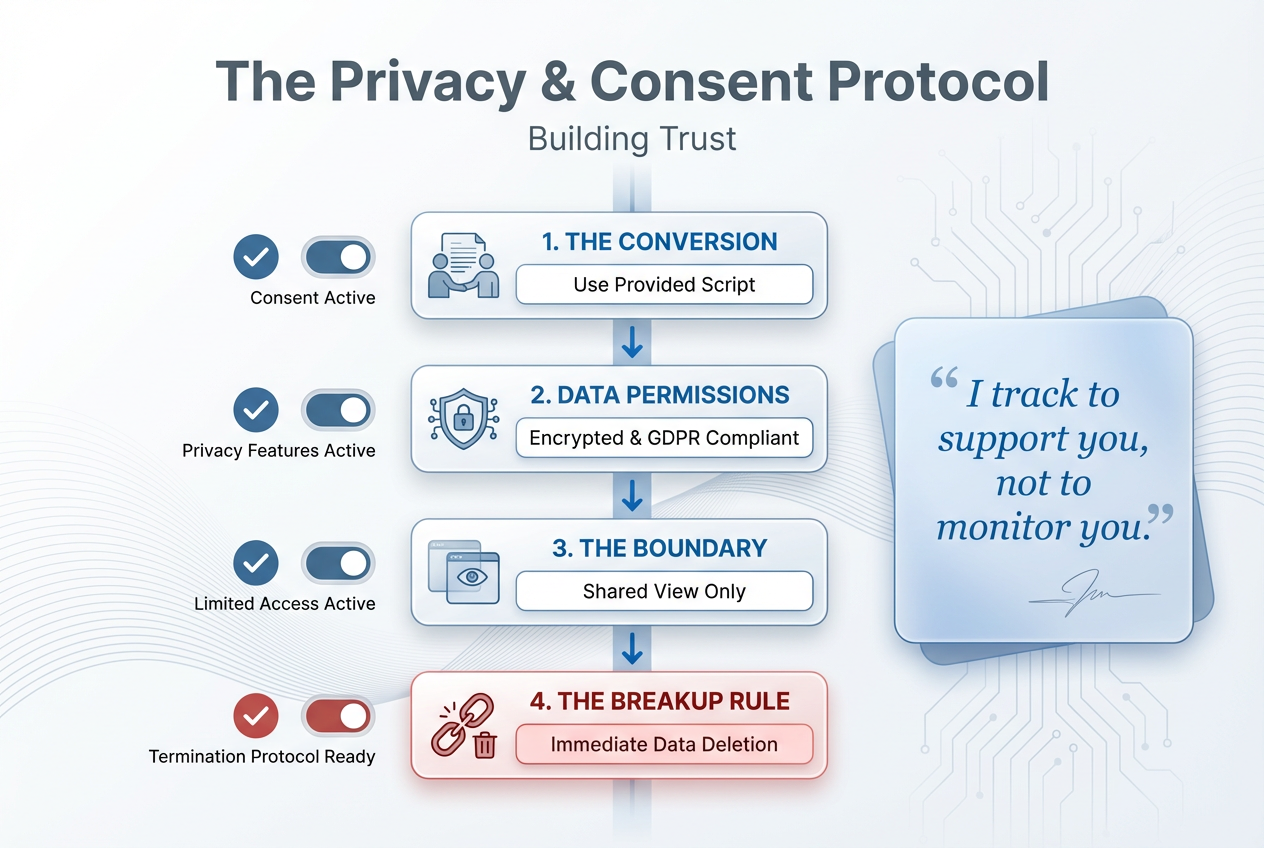
Privacy is the foundation of tracking. Use this protocol to ensure data security and establish clear boundaries that make your partner feel safe and supported.
Rule 1: Explicit Consent is Non-Negotiable
You cannot track your partner's cycle without her knowledge and permission. Period. Silent tracking - even with good intentions - is a violation.
Required Elements of Consent:
- She knows you're tracking
- She understands what data you're collecting (cycle start dates, phase predictions, symptom notes)
- She agrees to the method (manual vs. synced app)
- She can revoke consent at any time without consequences
If she says "I'd rather you didn't," that's the end of the conversation. Respect it.
Rule 2: The Breakup Rule
This is your nuclear-level trust guarantee: If the relationship ends, you delete all cycle data immediately.
This means:
- Uninstalling tracking apps
- Deleting manual calendar notes
- Removing any shared access to her accounts
- Clearing predictive data from your devices
This rule exists for one reason: she needs to know that her biological data isn't a weapon you'll carry into future relationships or use against her post-breakup.
Set this expectation upfront. Say it explicitly when you start tracking: "If we ever break up, I'll delete all of this the same day. This is just for us, while we're together."
Rule 3: Data Security Standards
Choose apps with strong privacy protections:
Minimum Security Requirements:
- End-to-end encryption (data can't be intercepted in transit)
- GDPR or HIPAA compliance (regulated data handling standards)
- No third-party data sharing (your partner's cycle data won't be sold to advertisers)
- Local data storage option (data stays on your device, not in the cloud)
Apps with Strong Privacy:
- Clue (GDPR-compliant, transparent privacy policy, no data selling)
- Mayday (offline-only, no cloud storage)
- VibeCheck (privacy-first design, opt-in data sharing only)
Apps to Avoid:
- Free apps that monetize through targeted ads based on cycle data
- Apps that require excessive permissions (access to contacts, location, photos)
- Apps without clear privacy policies or European/US regulatory compliance
Rule 4: Access Boundaries
If you're using a synced app, establish clear boundaries about what you can access:
Read-Only Access is Standard:
You can see predictions and phase information. You cannot edit her data, delete her logs, or change her account settings.
Symptom Details are Optional:
She decides whether you see symptom logs (cramps, headaches, mood notes). Some women are comfortable sharing this; others prefer to keep it private. Respect her choice.
No Screenshots or External Sharing:
Cycle data stays between you and her. You don't screenshot predictions to share with friends. You don't discuss her cycle details with others without permission.
Rule 5: The "Check-In" Protocol
Every 3-6 months, revisit the arrangement:
Check-In Questions:
- "Is this still working for you?"
- "Is there anything you want me to track differently?"
- "Do you want to adjust what I have access to?"
People's comfort levels change. Early relationship dynamics differ from long-term ones. Pregnancy plans alter tracking needs. Regular check-ins ensure this remains consensual and beneficial.
What This ISN'T
This protocol exists to prevent cycle tracking from becoming:
- A tool for gaslighting ("You're just hormonal")
- An excuse for your bad behavior ("I knew you'd be sensitive today")
- A weapon in arguments ("You always do this during PMS")
- Surveillance of her autonomy
If you find yourself using cycle data to dismiss her feelings, predict her reactions, or justify avoiding accountability, stop tracking immediately. You've crossed the line.
For additional context on how to implement these privacy standards in real relationships, see this guide on Flo alternatives for supportive partners.
Quick-Start Cycle Survival Card
BLUF: This one-page reference card gives you the essential action items for each cycle phase. Print it, save it to your phone, or memorize it. This is your field guide for high-HQ partnership.
Menstrual Phase (Days 1-5): The Caretaker
Energy Level: Low
Top Priority: Rest and recovery
Your Action Items:
- Handle dinner without asking
- Bring heating pad and ibuprofen before she mentions pain
- Take over physically demanding chores
- Cancel or reschedule non-essential social obligations
- Create quiet, low-stimulation environments
Avoid:
- Scheduling important talks or decisions
- Asking her to manage logistics
- Suggesting she's overreacting to discomfort
Follicular Phase (Days 6-14): The Adventurer
Energy Level: Rising
Top Priority: Exploration and novelty
Your Action Items:
- Plan spontaneous dates or weekend trips
- Suggest new restaurants, activities, or experiences
- Schedule social events or double dates
- Introduce new topics or projects
- This is your green light for constructive relationship conversations
Avoid:
- Defaulting to the same routine
- Wasting her high-energy window with low-effort plans
Ovulation Phase (Days 15-17): The Romantic
Energy Level: Peak
Top Priority: Connection and intimacy
Your Action Items:
- Step up physical affection and flirtation
- Plan romantic date nights with intentional effort
- Compliment her appearance and energy
- Prioritize quality time and presence
- This is the best window for future-oriented relationship talks
Avoid:
- Being oblivious to signals
- Letting work stress dominate your attention
- Missing the intimacy window
Luteal Phase (Days 18-28): The Safe Harbor
Energy Level: Variable (drops in late luteal)
Top Priority: Stability and validation
Your Action Items:
- Practice "Radical Patience" before reacting
- Avoid touchy subjects (money, exes, family, commitment)
- Validate her feelings without trying to fix them
- Handle logistics proactively
- Stock her favorite snacks and comfort items
- Give space if requested, but stay nearby
Avoid:
- Saying "Are you about to start your period?"
- Dismissing concerns as hormonal
- Scheduling serious decisions or conflicts
- Coasting on low-effort partnership
Pro Tip: Save this card as a screenshot on your phone. Set a recurring monthly reminder to review it on Day 1 of her cycle. The pattern repeats. Your support strategy should too.
FAQ
What is a period tracker app for men?
A period tracker app for men is a tool designed to help partners understand and anticipate the different phases of the menstrual cycle so they can provide better emotional and practical support. Unlike standard period tracking apps built for women, these apps focus on actionable insights - telling you what to do and when, rather than just displaying biological data. They typically include features like PMS alerts, phase-based support recommendations, and discreet interfaces built for male users. The goal is to reduce relationship friction by helping men adjust their behavior based on hormonal patterns, not to monitor or control their partner.
Is it weird for a guy to track his girlfriend's period?
It's not weird if it's done with explicit consent, clear privacy boundaries, and genuine supportive intent. What makes it weird is secrecy, lack of permission, or using cycle data to dismiss her feelings. The difference between supportive tracking and creepy surveillance comes down to three factors: she knows you're doing it, she agreed to it, and you're using the information to help her, not control her. High-value partners track cycles the same way they track anniversaries or dietary preferences - it's relationship intelligence, not invasive monitoring. If you're questioning whether it's appropriate, have the conversation directly. Her comfort level is the deciding factor.
How accurate are period prediction apps for partners?
Accuracy depends on the tracking method and cycle regularity. Synced apps like Flo or Clue that pull from her actual logged symptoms offer 85-95% accuracy because they're using real-time data and adjusting predictions based on her patterns. Manual entry apps like Mayday or VibeCheck predict based on average cycle length (typically 28-32 days), which works well for regular cycles but may be less accurate if her cycle varies significantly month to month. The longer you track, the more accurate predictions become. Most apps improve their algorithms after 3-6 months of consistent data. For maximum accuracy, use a synced app where she's already tracking symptoms, mood, and physical changes.
What should I do if my partner doesn't want me tracking her cycle?
Respect her decision completely and don't push back. If she says no, that's the end of the conversation. There are many valid reasons she might decline - privacy concerns, past negative experiences, discomfort with the concept, or simply preferring to manage her cycle independently. Your response should be: "I totally understand. If you ever change your mind, I'm open to it." Then focus on improving your awareness through observation and communication instead of tracking. Pay attention to patterns in her energy, mood, and needs over a few months. Ask directly what kind of support she wants during different times. High HQ doesn't require an app - it requires attention, empathy, and adaptability.
Can I use a regular period tracking app or do I need one specifically for men?
You can technically use any period tracking app with manual entry, but apps designed for men provide better usability and more relevant features. Standard period tracking apps (like Flo, Clue, or Eve) are built with women as the primary user - they include pregnancy planning tools, symptom logging, and fertility windows that you don't need. The interface often feels clinical or overly feminine, which makes daily use less intuitive for male partners. Apps built for men like VibeCheck or Mayday focus on what you actually need: phase alerts, support action items, and discreet design. That said, if she already uses Flo or Clue and grants you partner access, use her app. Synced access to her real data beats using a separate tool.
How do I bring up cycle tracking without sounding controlling?
Frame it as reducing her mental load, not managing her behavior. The key is positioning cycle tracking as a tool that benefits her by making your support more proactive and less reactive. Use language that emphasizes partnership: "I want to track this so I can support you better without you having to ask" rather than "I want to track this so I know when you'll be difficult." Give her full control over the method (manual vs. synced), address privacy concerns upfront, and offer the "Breakup Rule" guarantee. Timing matters too - have this conversation during her follicular or ovulation phase when communication flows easily, never during menstrual or late luteal phases. If she interprets your request as controlling, you've either chosen the wrong timing or framed it poorly.
What's the difference between standalone and synced period tracker apps?
Standalone apps operate independently - you input data manually based on when she tells you her period started, and the app predicts future cycles based on averages. These apps prioritize privacy because she doesn't need to grant access or even know you're tracking. Examples include Mayday and manual entry modes in VibeCheck. Synced apps require her participation - she either shares access to her existing tracking data or you both use the app collaboratively. These apps pull from her real-time symptom logs, mood notes, and physical changes, providing much higher accuracy. Examples include Flo Partner Mode, Clue's Cycle View, and DuoSync. Choose standalone if privacy is the priority or she doesn't track. Choose synced if she already uses an app and you want maximum accuracy.
Will tracking my partner's cycle actually improve our relationship?
Yes, if implemented correctly - but tracking alone isn't enough. Research from the Gottman Institute shows that couples who practice cycle awareness report 43% fewer recurring conflicts and higher satisfaction across communication, intimacy, and household labor. But the improvement doesn't come from the app. It comes from you adjusting your behavior based on what you learn. If you track her cycle and then use it to dismiss her feelings ("You're just hormonal"), you'll damage the relationship. If you track her cycle and proactively provide support - handling logistics during low-energy phases, planning adventures during high-energy windows, practicing patience during sensitivity peaks - you'll eliminate preventable friction. The app is the tool. Your response is the actual upgrade.
Tags

Related Articles
Continue reading to deepen your understanding

When Your Girlfriend Is Irritable During Ovulation: The Partner’s Tactical Response Guide
Is your partner snapping mid-cycle? Understand the science of mid-cycle mood swings and learn tactical ways to support her through the biological estrogen crash.

Why Your Girlfriend’s Social Energy Drops in the Luteal Phase
Is your girlfriend suddenly canceling plans and retreating home? It isn’t personal; it’s biology. Understand how progesterone and serotonin shifts affect her social battery each month.

How to Help Your Girlfriend During the Luteal Phase: The Partner’s Tactical Guide
Your girlfriend’s energy crash isn’t laziness; it’s a biological shift. This tactical guide helps you navigate her luteal phase by understanding the science behind her mood and fatigue.

Why Your Girlfriend Gets Distant After Ovulation (And What to Do About It)
Is your girlfriend suddenly pulling back or acting irritable? It might be her cycle. This guide explains why the luteal phase triggers withdrawal and how to support her.

Supporting Your Girlfriend Through the Luteal Phase
When hormone levels crash before her period, your partner’s brain enters a high-alert state. Learn how to provide the security she needs with tactical scripts and empathy.

How to Give Your Girlfriend Reassurance During Ovulation Week
Is your girlfriend suddenly questioning everything during her cycle? Understand the estrogen crash and learn how to provide the tactical support she needs to feel secure and loved.

When to Give Her Space vs. When to Stay Close: Your Phase-by-Phase Guide
Your girlfriend’s need for closeness isn’t random. Understanding how her 28-day biological rhythm affects her energy helps you time your support perfectly across all four phases.

Your Girlfriend’s 28-Day Relationship Manual: How to Support Her Through Every Phase
Understanding her menstrual cycle transforms you from a guy walking on eggshells into a strategic partner who knows exactly what support to offer and when.