Best Period Tracker Apps with Partner Mode for Men (2026)

Find the best apps like Clue or Flo with partner mode. Get real-time mood tracking, cycle reminders, and message prompts to build a deeper connection today.
The 7 Best Period Tracker Apps for Boyfriends (That Actually Tell You What to Do)
You’re not imagining the shifts. One week she’s ready for a hike and dinner with friends, the next she wants the couch and silence. You want to help, but guessing wrong feels worse than doing nothing. You need a tactical advantage, not just a calendar.
The good news? A new generation of apps goes beyond tracking dates. They translate her biological rhythms into actionable intelligence so you can show up as the partner she needs, exactly when she needs it. This guide breaks down the 7 best options for men who want to understand their partner’s cycle, reduce friction, and build deeper connection.
If your priority is choosing the right overall tool, compare this list with our guide to the best period app for men before you commit.
If you are currently focused on supporting her through the luteal phase, use this ranking alongside that phase-specific playbook so your timing and responses stay aligned.
Table of Contents
- Why Partner-Focused Period Trackers Are Different
- The Four Seasons Framework: Your Relationship Playbook
- The 7 Best Period Tracker Apps for Boyfriends
- The Affectionate Partner Checklist
- Privacy and Consent: How to Ask Without Being Creepy
- How to Choose the Right App for Your Relationship
- Frequently Asked Questions
Why Partner-Focused Period Trackers Are Different
Traditional period trackers give you a date. Partner-focused apps give you a mission. The difference is massive.
Standard apps like Clue and Flo were built for women to track their own cycles. They focus on medical data, symptoms, and predictions. You can connect as a partner, but you’re looking at raw data without context. You see "Luteal Phase" and wonder what you’re supposed to do with that information.
VibeCheck App
Know what she needs. Before she has to say it.
Track her cycle, understand her phases, be the partner she deserves.
Download Free on iOS →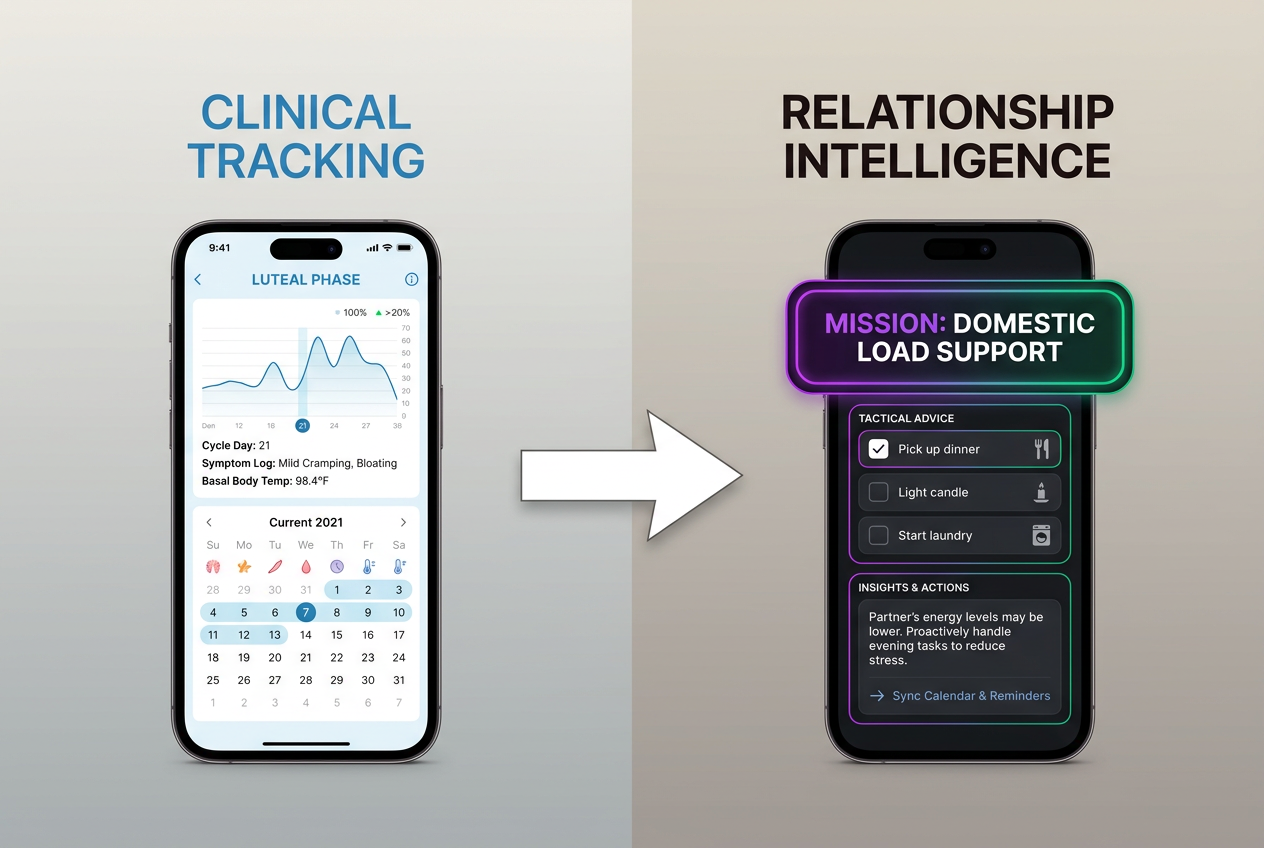
Partner-focused apps translate biological phases into relationship intelligence. Instead of "Day 14 of cycle," you get "Her energy is peaking - great time for an adventure date" or "She’s entering her low-energy window - handle dinner tonight and give her space to rest."
This shift from data to action changes everything. You’re not tracking her period. You’re building a framework for proactive support.
The apps in this guide excel at three things traditional trackers miss:
- Tactical missions that tell you what to do, not just what phase she’s in
- Affection reminders that prompt you to buy flowers, send sweet texts, or plan thoughtful gestures during high-stress windows
- Mood mapping that shows trends so you can see the calm before the storm and prepare accordingly
If you want to understand how hormones affect relationships at a deeper level, the right app becomes your tactical playbook.
The Four Seasons Framework: Your Relationship Playbook
Every month, your partner’s body runs through four distinct phases. Each one brings different energy levels, moods, and needs. Understanding this pattern is your strategic advantage.
Think of her cycle like four seasons, each lasting roughly a week:
Winter (Menstrual Phase - Days 1-7)
Her body is resetting. Energy is low, she needs more rest, and physical comfort matters. This is Heavy Lifting season for you.
Your mission: Take over household tasks without being asked. Handle dinner plans. Give her space to recover. Physical touch (like a heating pad or gentle back rub) beats grand gestures.
Spring (Follicular Phase - Days 8-14)
Estrogen rises and she starts feeling like herself again. Energy returns, mood lifts, and she’s more open to new experiences. This is Adventure season.
Your mission: Plan activities she enjoys. Try new restaurants, go on day trips, have deeper conversations. Her cognitive performance and mood are peaking - it’s the best window for tackling relationship discussions or making big decisions together.
Summer (Ovulatory Phase - Days 15-17)
This is her biological peak. Confidence, energy, and libido hit their highest point. She’s more social and outgoing. This is Connection season.
Your mission: Match her energy. Plan social activities or intimate time together. This is when she’s most likely to say yes to spontaneous plans. If you’ve been waiting for the right time to initiate something, this is it. Learn more about libido and ovulation to maximize this window.
Fall (Luteal Phase - Days 18-28)
Progesterone dominates and everything slows down. Energy drops, she becomes more introspective, and small irritations feel bigger. This is Domestic Support season.
Your mission: Reduce her mental load. Take care of details without being asked. Be patient during disagreements (her irritability isn’t about you). Stock her favorite comfort foods. Give her permission to say no to plans.
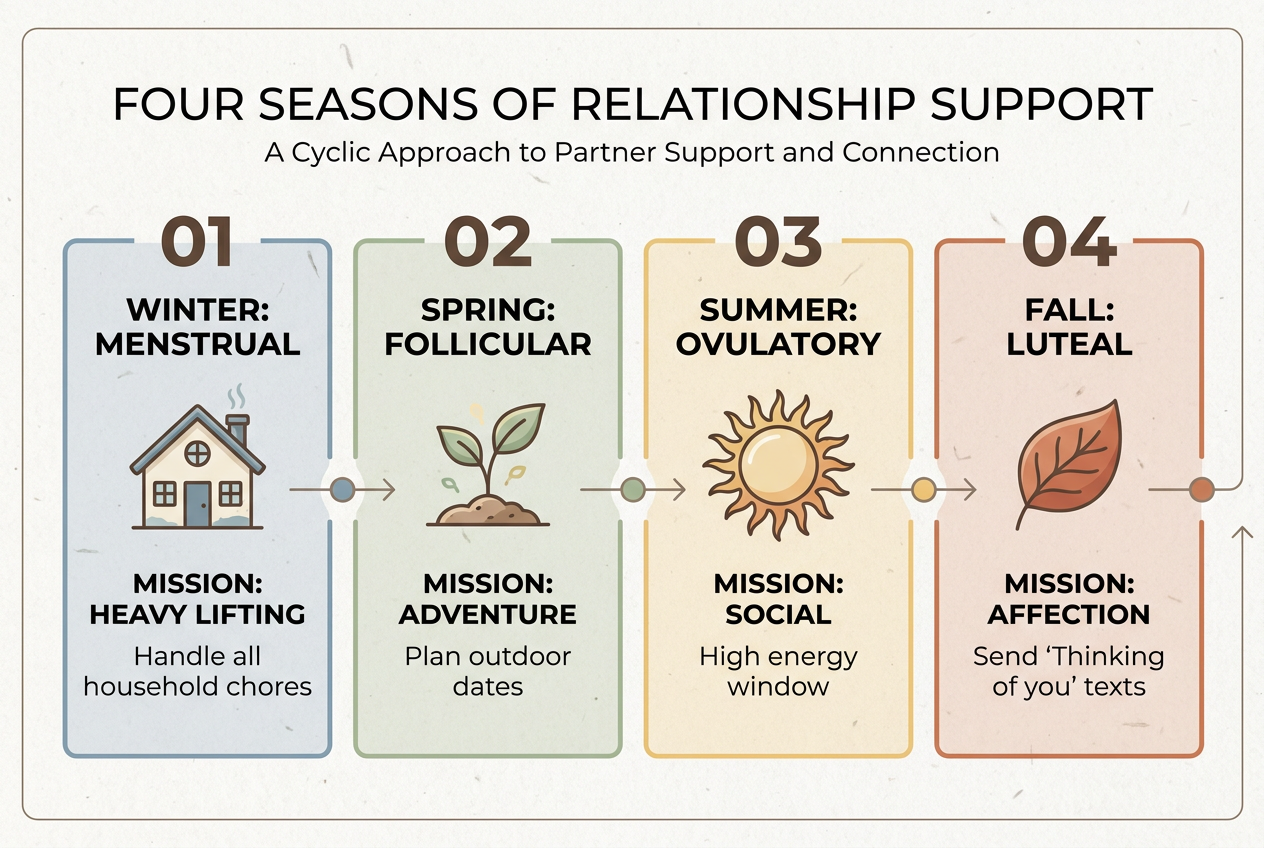
The apps below use variations of this framework to give you daily actionable advice. The best ones send push notifications before each phase starts so you’re never caught off guard.
The 7 Best Period Tracker Apps for Boyfriends
These apps were built with partners in mind. Each one translates cycle data into missions, reminders, or support strategies. We tested all seven to find what actually works.
1. VibeCheck - Best for Tactical Daily Missions
What makes it different: VibeCheck is the only app built specifically for men in relationships. Instead of giving you raw cycle data, it sends you a daily mission based on where your partner is in her cycle.
You get push notifications like "Her energy is low today - handle dinner and give her quiet time" or "She’s in her social window - great day to suggest plans with friends." The app explains the biological why behind each mission so you’re building hormonal literacy, not just following orders.
Key features:
- Daily tactical missions matched to her cycle phase
- Plain-language explanations (no medical jargon)
- Mood trend mapping that shows patterns over time
- Reminders for thoughtful gestures during high-stress windows
- Privacy-first design (she controls what data you see)
Best for: Guys who want a tactical playbook without becoming armchair endocrinologists. If you’re the type who appreciates direct advice and actionable steps, this is your app.
Pricing: Free with basic features, premium unlocks advanced insights and unlimited history.
Why it wins: Most apps show you data and expect you to figure out what to do. VibeCheck tells you exactly what to do and when to do it. The daily mission format removes guesswork and builds your confidence as a supportive partner.
Compare VibeCheck to other trackers to see how it stacks up on features and pricing.
2. Selin - Best for Romantic Gestures and Gift Tracking
What makes it different: Selin focuses on helping you be more thoughtful. It includes a "Favorites Vault" where you save her preferred flowers, chocolates, self-care items, and comfort foods. The app sends reminders during specific cycle windows (usually premenstrual) to buy or arrange these treats.
Key features:
- Favorites Vault for tracking her preferences
- Automated reminders for thoughtful gestures
- Shared profile so you both see the same data
- Notes section for logging what worked (great for remembering which massage place she loves)
- Integration suggestions for flower delivery services
Best for: Romantic partners who want structure around showing affection. If you struggle to remember details or need prompts to be thoughtful, Selin gives you a system.
Pricing: Free with basic tracking, premium adds unlimited favorites and delivery service integrations.
Why it wins: Selin solves the "What does she like again?" problem. The Favorites Vault means you’re never guessing which chocolate brand to buy or which flowers she prefers. The app makes thoughtfulness systematic.
See how Selin compares to VibeCheck on romance-focused features.
3. Mayday - Best for Simplicity and No Medical Jargon
What makes it different: Mayday strips everything down to the essentials. You get a simple calendar view, clear phase labels (like "She needs space" or "Good time to plan dates"), and basic prep reminders. No articles, no quizzes, no clutter.
Key features:
- Clean, minimalist interface
- Plain-language phase descriptions
- Push notifications 2-3 days before phase changes
- Prep checklist (stock comfort foods, clear your schedule, etc.)
- One-tap "emergency tips" for each phase
Best for: Men who want cycle awareness without complexity. If detailed tracking feels overwhelming, Mayday gives you just enough information to be useful.
Pricing: Free with ads, one-time payment removes them.
Why it wins: Sometimes less is more. Mayday doesn’t try to teach you reproductive biology. It gives you the minimum viable information to show up prepared.
Check how Mayday compares to VibeCheck on ease of use.
4. Flo (Partners Mode) - Best for Clinical Depth and Education
What makes it different: Flo is a medical-grade period tracker that added a companion mode for partners. You get access to detailed cycle data, science-backed articles, and interactive quizzes that test your hormonal literacy.
Key features:
- Comprehensive cycle data with medical terminology
- Educational articles written by doctors
- Quizzes and "Quick-fire Stories" to build knowledge
- Symptom logging and pattern analysis
- Integration with wearables for temperature tracking
Best for: Couples who want deep understanding of reproductive health. If you’re curious about the biological mechanisms or planning for conception, Flo provides clinical-level detail.
Pricing: Free with basic features, premium adds detailed health insights and symptom analysis.
Why it wins: No app matches Flo’s depth of medical information. If you want to understand the endocrine system and how hormones interact, Flo is unmatched. The partner mode is less tactical but more educational.
Compare VibeCheck vs Flo to see tactical vs. clinical approaches side by side.
5. Clue Connect - Best for Privacy and Direct Data Sync
What makes it different: Clue Connect lets your partner share her cycle data directly with you through end-to-end encryption. You see exactly what she sees - phases, symptoms, predictions - without a middleman. The app prioritizes privacy and gives her granular control over what you access.
Key features:
- End-to-end encrypted data sharing
- Science-backed cycle predictions
- Detailed symptom tracking your partner controls
- No third-party access to shared data
- She can revoke access anytime
Best for: Privacy-conscious couples who want transparent data sharing. If she’s hesitant to share cycle information through an intermediary app, Clue Connect’s direct sync model builds trust.
Pricing: Free with basic tracking, premium adds advanced predictions and symptom analysis.
Why it wins: Clue’s reputation for privacy and scientific rigor makes it the gold standard for data security. The Connect feature gives you insight without compromising her autonomy.
See how Clue Connect compares to VibeCheck on privacy and partner features.
6. Stardust - Best for Vibe-Heavy and Spiritual Couples
What makes it different: Stardust combines cycle tracking with astrology and moon phases. If your relationship values vibes, energy work, and cosmic timing, this app speaks your language. You can "Cast a Spell" to share your needs with your partner in a playful, mystical framework.
Key features:
- Moon phase tracking alongside menstrual phases
- Astrology insights for relationship timing
- "Cast a Spell" feature for communicating needs
- Community features for sharing experiences
- Gift and gesture suggestions tied to cosmic events
Best for: Couples who lean spiritual or New Age. If you both believe in energy work, manifestation, or lunar cycles, Stardust makes cycle tracking feel like part of your existing practice.
Pricing: Free with basic features, premium adds personalized astrology reports.
Why it wins: Stardust doesn’t just track biology - it frames hormonal shifts as part of a larger cosmic rhythm. For the right couple, this context makes the information more meaningful and easier to integrate into your relationship.
7. Blood for Couples - Best for Visual Tracking and Shared Calendars
What makes it different: Blood for Couples emphasizes visual design and shared calendar views. You both see a color-coded timeline that makes patterns obvious at a glance. The app is minimalist but visually intuitive.
Key features:
- Shared calendar with color-coded phases
- Visual mood tracking over time
- Simple interface with no clutter
- Joint notes section for both partners
- Pattern recognition highlights (like "she’s more tired during this week every month")
Best for: Visual learners who want to see patterns rather than read explanations. If you prefer charts and timelines to text-based advice, Blood makes data beautiful and understandable.
Pricing: Free with basic features, premium adds unlimited history and advanced pattern analysis.
Why it wins: The visual approach makes hormonal patterns obvious. You can literally see the cycle’s impact on mood and energy, which builds intuitive understanding faster than reading articles.
Compare Blood for Couples to VibeCheck on visual design and usability.
The Affectionate Partner Checklist
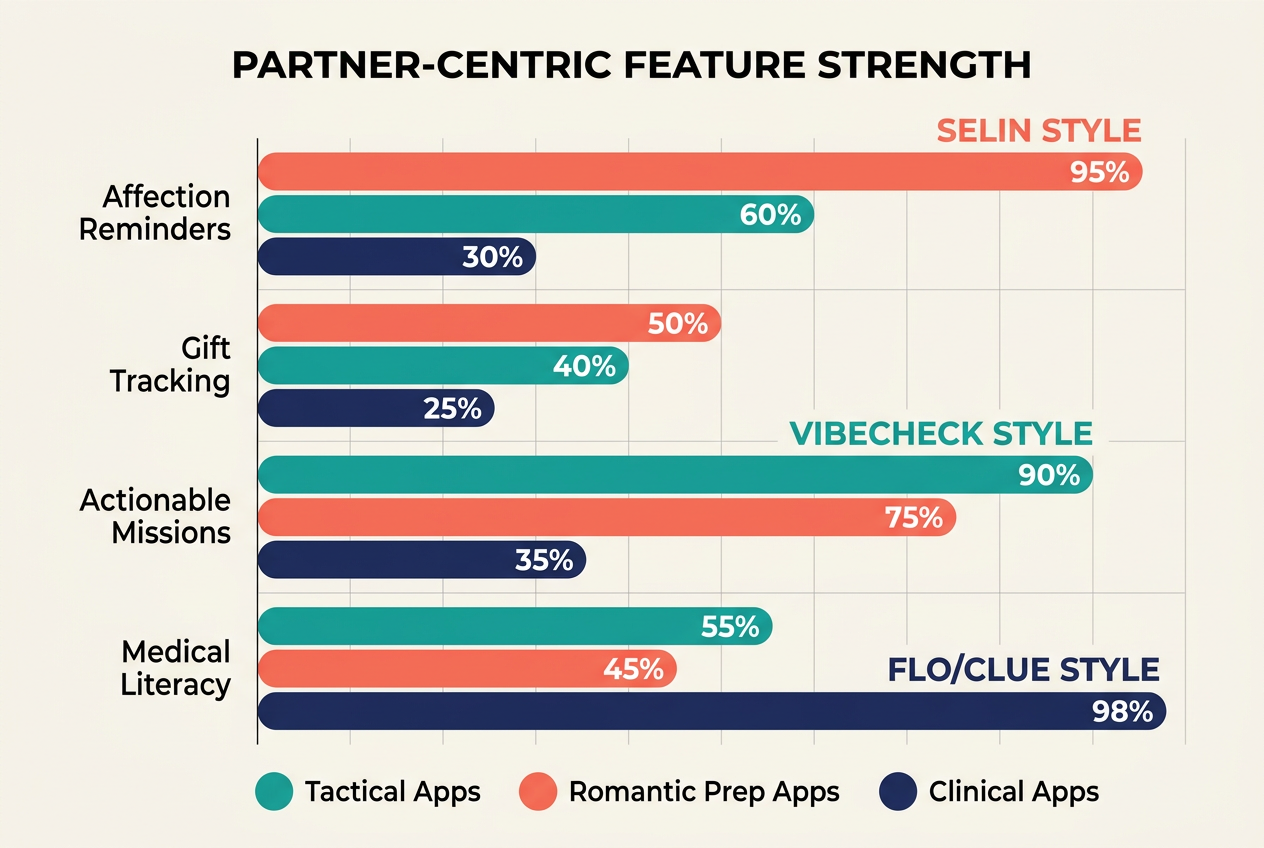
Not all apps are equal when it comes to prompting affection and thoughtful gestures. Here’s how they stack up on the features that matter most for reducing relationship friction and increasing connection.
| Feature | VibeCheck | Selin | Mayday | Flo | Clue | Stardust | Blood |
|---|---|---|---|---|---|---|---|
| Daily actionable missions | ✓ | - | ✓ | - | - | - | - |
| Affection reminders | ✓ | ✓ | - | - | - | ✓ | - |
| Gift/treat tracking | - | ✓ | - | - | - | - | - |
| Mood trend analysis | ✓ | - | - | ✓ | ✓ | - | ✓ |
| Pre-written text scripts | - | - | - | - | - | - | - |
| Phase change alerts | ✓ | ✓ | ✓ | ✓ | ✓ | ✓ | ✓ |
| Energy level predictions | ✓ | - | ✓ | ✓ | ✓ | - | - |
| Thoughtful gesture suggestions | ✓ | ✓ | - | - | - | ✓ | - |
The Affection Gap: Notice that no app currently offers pre-written text message templates for specific cycle phases. This is a massive opportunity gap. You’re left to figure out what to say during premenstrual stress or post-period recovery.
Until apps fill this gap, check out our guide on what to text your girlfriend for science-backed message ideas matched to each cycle phase.
Romantic vs. Tactical: Selin wins for systematic gift-giving and romantic gestures. VibeCheck wins for daily tactical support and energy management. Stardust wins if you want affection prompts framed as cosmic timing.
Most men need tactical support more than romantic prompts. You can buy flowers, but if you don’t know when she needs space versus when she wants connection, those flowers won’t land right. Focus on apps that give you timing intelligence first, romantic suggestions second.
Privacy and Consent: How to Ask Without Being Creepy
The fastest way to ruin this whole strategy is to track her cycle without permission. Here’s how to have the conversation the right way.
The wrong approach:
"Hey, I downloaded this app that tracks your period so I know when you’re about to get emotional."
Why it fails: You sound like you’re monitoring her instead of supporting her. The phrase "get emotional" implies her feelings aren’t valid. You’ve centered yourself (I know when) instead of her needs.
The right approach:
"I’ve noticed you have different energy levels throughout the month, and I want to be better at supporting you during low-energy times. Would you be open to sharing your cycle info with me so I can be more helpful? You’d control exactly what I see."
Why it works: You acknowledge her reality (different energy levels), frame it as support (not surveillance), ask permission (would you be open), and emphasize her control (you decide what I see).
The conversation script:
Pick the right timing: Don’t ask during her premenstrual or menstrual phase when she’s already stressed. Wait for her follicular phase (days 8-14) when energy and mood are higher.
Lead with empathy: "I’ve been thinking about how I can be a better partner, especially during weeks when you’re dealing with more physical stress."
Acknowledge the weirdness: "I know this might sound strange, but I read about apps that help partners understand cycle phases. It’s not about monitoring - it’s about me knowing when to step up with practical help."
Give her control: "You’d control exactly what information I see, and you can revoke access anytime. I’m not interested in private details, just the general phase so I know when to handle more household stuff or give you space."
Emphasize benefit to her: "The goal is reducing friction - like me not suggesting we host friends during a week when you need to recharge, or me handling dinner without you asking during low-energy days."
Common objections and how to handle them:
"That’s weird and invasive."
"I get that. What if we tried it for one month and you tell me exactly what information feels okay to share? If it doesn’t help, we stop."
"I don’t want you using my cycle against me."
"Fair concern. This isn’t about dismissing your feelings or blaming biology. It’s about me recognizing when you’re dealing with extra physical stress so I can be more proactive about support. Your feelings are always valid - this just helps me understand context."
"You’ll just use it as an excuse when I’m upset."
"If I ever say something like ’you’re just hormonal,’ call me out immediately. That’s exactly what I’m trying to avoid. This is about understanding, not dismissing."
For more guidance on building trust around cycle tracking, read our article on understanding your partner’s cycle.
After she agrees:
- Let her choose the app and set up sharing
- Check in after two weeks: "Has this been helpful or annoying?"
- Demonstrate value by taking action based on what you learn
- Never mention her cycle during an argument
- If she wants to stop, respect it immediately without guilt
The apps that handle consent best are Clue Connect (she controls exactly what you see) and VibeCheck (she approves your access and can revoke it). Avoid apps that give you full access without her explicit, ongoing permission.
How to Choose the Right App for Your Relationship
Your relationship isn’t generic, so your app choice shouldn’t be either. Here’s how to pick based on what you actually need.
Choose VibeCheck if:
- You want daily tactical missions without guesswork
- You prefer action steps over medical explanations
- You’re building hormonal literacy from scratch
- You want push notifications that tell you exactly what to do
- You value privacy and want your partner to control data access
Choose Selin if:
- You struggle to remember her favorite things
- You want systematic prompts for romantic gestures
- You’re better at being thoughtful when you have reminders
- You want to track what worked (which massage place, which flowers)
- You value romance as much as tactical support
Choose Mayday if:
- You want simplicity over depth
- Medical terminology overwhelms you
- You prefer minimalist design
- You just need basic prep reminders
- You don’t want to read articles or take quizzes
Choose Flo if:
- You’re curious about reproductive biology
- You want medical-grade accuracy
- You’re planning for conception
- You value educational depth
- She’s already using Flo and you want to connect
Choose Clue Connect if:
- Privacy is your top concern
- She’s hesitant about third-party apps
- You want transparent data sharing
- You value scientific rigor
- She wants granular control over what you see
Choose Stardust if:
- You both value spiritual practices
- Astrology matters to your relationship
- You want cycle tracking framed in cosmic terms
- You prefer vibes over clinical language
- You’re part of a community that values moon phases
Choose Blood for Couples if:
- You’re a visual learner
- You want to see patterns at a glance
- You prefer charts over text explanations
- You want a shared calendar view
- Minimalist design matters to you
The tactical vs. clinical decision:
Most men benefit more from tactical apps (VibeCheck, Mayday) than clinical ones (Flo, Clue). Here’s why: knowing she’s in the luteal phase doesn’t help if you don’t know what to do about it.
Clinical apps give you data. Tactical apps give you missions.
If you’re the type who reads research papers for fun and wants to understand endocrinology, go clinical. If you’re the type who wants to know "what should I do today," go tactical.
Start simple, add complexity:
You don’t need to master everything immediately. Start with one app that gives you basic phase awareness and daily tips. Use it for two months to build pattern recognition. Then, if you want deeper understanding, add a clinical app or educational resource.
The mistake most guys make is downloading three apps and getting overwhelmed. Pick one, commit to using it daily for 60 days, then evaluate whether you need something different.
For a side-by-side comparison of features and pricing, visit our complete app comparison guide.
Ready to actually understand her?
Join thousands of men using VibeCheck to track her cycle and show up better every day.
Frequently Asked Questions
What is the best period tracker app for boyfriends who are just starting out?
VibeCheck is the best choice for beginners because it gives you daily actionable missions without requiring you to understand medical terminology or biological mechanisms. You get push notifications like "Her energy is low today - handle dinner and give her quiet time" that tell you exactly what to do. Mayday is the second-best option if you want even more simplicity with a minimalist interface and basic prep reminders. Both apps remove the guesswork so you can start being more supportive immediately without getting overwhelmed by data.
Can my girlfriend see that I’m tracking her cycle?
It depends on the app and how you set it up. Apps like VibeCheck and Clue Connect require her explicit permission and she controls exactly what information you can access. These apps are designed for transparent sharing where she knows you’re receiving cycle information. Selin and Blood for Couples use shared profiles where you both see the same data. Never use a period tracker to monitor your girlfriend without her knowledge - that crosses from support into surveillance and will damage trust. Always have an open conversation about consent before accessing any cycle information.
Do these apps actually help reduce arguments in relationships?
Yes, when used correctly. Research shows that many relationship conflicts stem from mismatched expectations around energy levels and emotional availability. When you understand her biological rhythm, you can adjust your expectations and behavior proactively. For example, suggesting a busy social weekend during her premenstrual phase (when energy is naturally lower) will likely cause friction. Using cycle awareness to handle more household tasks during that week and suggest social plans during her follicular phase (when energy is higher) reduces preventable conflicts. The key is using the information to be more supportive, not to dismiss her feelings as "just hormones."
What’s the difference between period tracker apps for women and apps for partners?
Apps built for women (like Flo, Clue, Eve) focus on medical data, symptom logging, fertility tracking, and predictions for the woman herself. They use clinical terminology and provide health insights. Apps built for partners (like VibeCheck, Selin, Mayday) translate biological phases into relationship advice and actionable support strategies. Instead of "Luteal Phase begins," you get "Her energy is dropping - time to reduce her mental load." Partner apps remove medical jargon and focus on what you should do, not just what’s happening biologically. The difference is data versus action.
How do I explain to my girlfriend why I want to use a period tracker app?
Frame it as a support tool, not a monitoring system. Try this approach: "I’ve noticed you have different energy levels throughout the month, and I want to be better at supporting you during low-energy times. Would you be open to sharing your cycle info with me so I can be more helpful? You’d control exactly what I see." Emphasize that your goal is reducing friction and being more proactive about household tasks and emotional support. Avoid phrases like "when you’re hormonal" or "track your moods" which sound dismissive. Focus on practical benefits to her: you’ll handle more tasks during stressful weeks without her needing to ask. For more guidance, check our article on how to have this conversation.
Are period tracker apps for men worth paying for, or should I stick with free versions?
Start with free versions to see if cycle tracking actually improves your relationship. Most apps (VibeCheck, Flo, Clue, Mayday) offer solid free tiers that include basic phase tracking and reminders. Upgrade to premium if you find yourself using the app daily and wanting deeper features like unlimited history, advanced mood analysis, or custom reminders. VibeCheck’s premium is worth it if you want detailed daily missions and pattern recognition. Selin’s premium is worth it if you need unlimited space in the Favorites Vault for gift ideas. Flo and Clue’s premium tiers are worth it if you want medical-grade health insights or fertility planning features. Don’t pay until you know cycle awareness is making a measurable difference in your relationship.
Can using these apps help me understand when to initiate sex or plan dates?
Absolutely. Your partner’s cycle directly affects her libido, energy, and social battery. The ovulatory phase (roughly days 15-17) is when libido and energy peak - this is the biological yes window for intimacy and social activities. The follicular phase (days 8-14) is when her mood is most positive and she’s open to new experiences, making it ideal for date nights and adventures. The menstrual and premenstrual phases (days 1-7 and 24-28) are when energy is lowest and she needs more rest and physical comfort - avoid suggesting busy plans during these windows. Apps like VibeCheck explicitly tell you when to initiate versus when to give space. For detailed timing strategies, read our guide on planning dates around her cycle.
Will my girlfriend think it’s weird if I know more about her cycle than she does?
Not if you’re using the information to be supportive rather than to lecture her. Many women don’t fully track their own cycles or recognize the patterns between phases and moods. If you notice patterns and use them to be proactively helpful (like handling dinner before she’s exhausted, or suggesting rest days before she hits a wall), she’ll likely appreciate it. The creepy line is when you tell her how she’s feeling or use cycle information to dismiss her concerns. Never say "you’re just PMSing" or "that’s your hormones talking." Instead, say "I know this week is physically harder for you - I’ve got dinner covered" or "Want me to handle the grocery run so you can rest?" Focus on actions that make her life easier, not on proving you understand her body.
Tags

Related Articles
Continue reading to deepen your understanding

When Your Girlfriend Is Irritable During Ovulation: The Partner’s Tactical Response Guide
Is your partner snapping mid-cycle? Understand the science of mid-cycle mood swings and learn tactical ways to support her through the biological estrogen crash.

Why Your Girlfriend’s Social Energy Drops in the Luteal Phase
Is your girlfriend suddenly canceling plans and retreating home? It isn’t personal; it’s biology. Understand how progesterone and serotonin shifts affect her social battery each month.

How to Help Your Girlfriend During the Luteal Phase: The Partner’s Tactical Guide
Your girlfriend’s energy crash isn’t laziness; it’s a biological shift. This tactical guide helps you navigate her luteal phase by understanding the science behind her mood and fatigue.

Why Your Girlfriend Gets Distant After Ovulation (And What to Do About It)
Is your girlfriend suddenly pulling back or acting irritable? It might be her cycle. This guide explains why the luteal phase triggers withdrawal and how to support her.

Supporting Your Girlfriend Through the Luteal Phase
When hormone levels crash before her period, your partner’s brain enters a high-alert state. Learn how to provide the security she needs with tactical scripts and empathy.

How to Give Your Girlfriend Reassurance During Ovulation Week
Is your girlfriend suddenly questioning everything during her cycle? Understand the estrogen crash and learn how to provide the tactical support she needs to feel secure and loved.

When to Give Her Space vs. When to Stay Close: Your Phase-by-Phase Guide
Your girlfriend’s need for closeness isn’t random. Understanding how her 28-day biological rhythm affects her energy helps you time your support perfectly across all four phases.

Your Girlfriend’s 28-Day Relationship Manual: How to Support Her Through Every Phase
Understanding her menstrual cycle transforms you from a guy walking on eggshells into a strategic partner who knows exactly what support to offer and when.