How to Induce a Period Safely Guide for Partner Support
Learn how to induce a period safely with natural methods. Help your partner reduce stress and support her cycle with this essential guide for late periods.
How to Induce a Period: A Partner's Guide to Cycle Support
When her period is late, you're both dealing with it. The stress, the speculation, the what-ifs. Most medical advice treats this as a woman's solo project, but here's the reality: you can actively support her through this, and that starts with understanding what actually works and what doesn't.
This guide translates clinical information into practical actions you can take. You'll learn why periods delay, what safe methods exist to encourage them to start, and most importantly, how to be a real ally rather than just a worried bystander.
Table of Contents
- Safety First: The Non-Negotiable Checkpoint
- Why Periods Actually Delay
- Natural Methods That Work
- The Warmth and Movement Protocol
- Physical Intimacy and Cycle Timing
- When to Choose Medical Options
- The Supportive Partner Protocol
- Red Flags: When Home Methods Aren't Enough
- Frequently Asked Questions
Safety First: The Non-Negotiable Checkpoint
Before anything else, pregnancy test first. Always. No exceptions. Every natural method carries risks if pregnancy is present, and trying to induce a period without ruling this out first creates unnecessary medical dangers.
The order matters more than you think. A late period sends stress through the roof for both of you, but that anxiety shouldn't skip the most important verification step. Here's what that checkpoint actually looks like:
VibeCheck App
Know what she needs. Before she has to say it.
Track her cycle, understand her phases, be the partner she deserves.
VibeCheck App
Download Free on iOS →Step One: Take the test together. Modern pregnancy tests detect hormones as early as 6-10 days after conception. Get a two-pack from any pharmacy. Take one now, wait 48 hours, take the second if the first is negative and her period still hasn't arrived.
Step Two: Check for medical red flags. If she's experiencing severe abdominal pain, fever above 101°F, abnormally heavy bleeding, or if her period has been absent for more than three months, stop here. That's not a timing issue - that requires a healthcare provider.
Step Three: Understand what counts as "late." The average menstrual cycle runs 28 days, but normal ranges from 21 to 35 days. Stress, travel, diet changes, sleep disruption, or illness can shift timing by 5-7 days without signaling anything wrong. If she typically runs a 30-day cycle and you're on day 33, that's within normal variation.
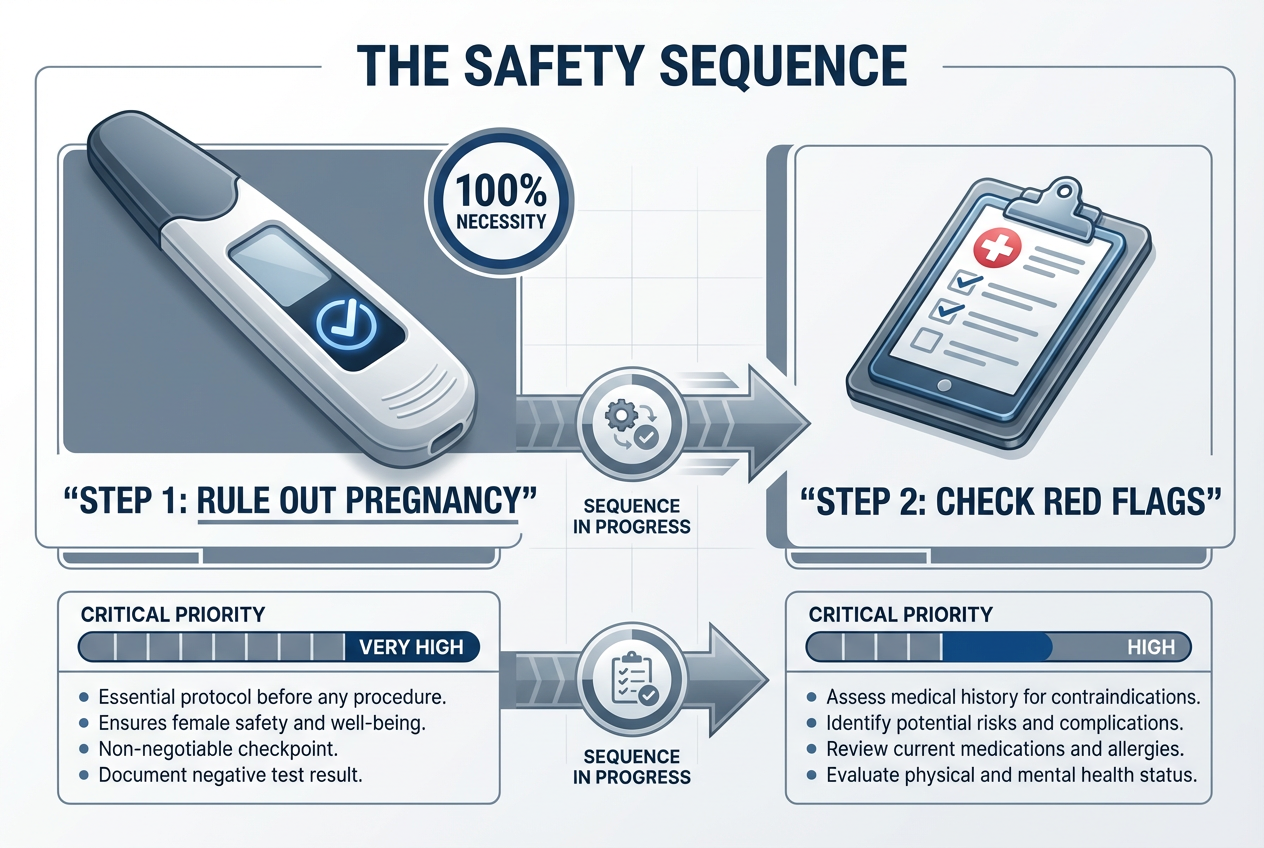
Safety is the absolute priority. This sequence ensures you and your partner have the necessary clarity before exploring any natural induction methods or herbal supports.
Once you've cleared these checkpoints, you're ready to explore actual induction support. But skip them, and you're operating blind.
Why Periods Actually Delay
Cortisol blocks the hormonal signals that trigger menstruation. When stress spikes - yours or hers - it directly interferes with her cycle. This isn't abstract biology. It's a measurable, physical process.
Here's the mechanism: Her menstrual cycle relies on a precise hormone cascade. The hypothalamus releases GnRH, which signals the pituitary gland to release FSH and LH, which trigger estrogen and progesterone production in the ovaries. When cortisol levels stay elevated, that entire sequence gets disrupted. Her body literally prioritizes survival mode over reproductive functions.
And here's the part most guys miss: your stress contributes to her stress. If you're visibly anxious about the delay, checking in every few hours with "still nothing?", that amplifies her cortisol levels. You become part of the delay mechanism without realizing it.
The three most common delay triggers:
Stress and cortisol dysregulation. Job pressure, relationship tension, financial worry, travel, or even positive stress from major life changes. All of it registers as threat-level hormones in her system.
Sudden weight changes or intensive exercise. Dropping body fat percentage quickly or ramping up workout intensity signals caloric scarcity to her body, which can suppress ovulation and delay the cycle.
Sleep disruption. Irregular sleep patterns or chronic sleep debt mess with melatonin production, which directly affects reproductive hormone regulation.
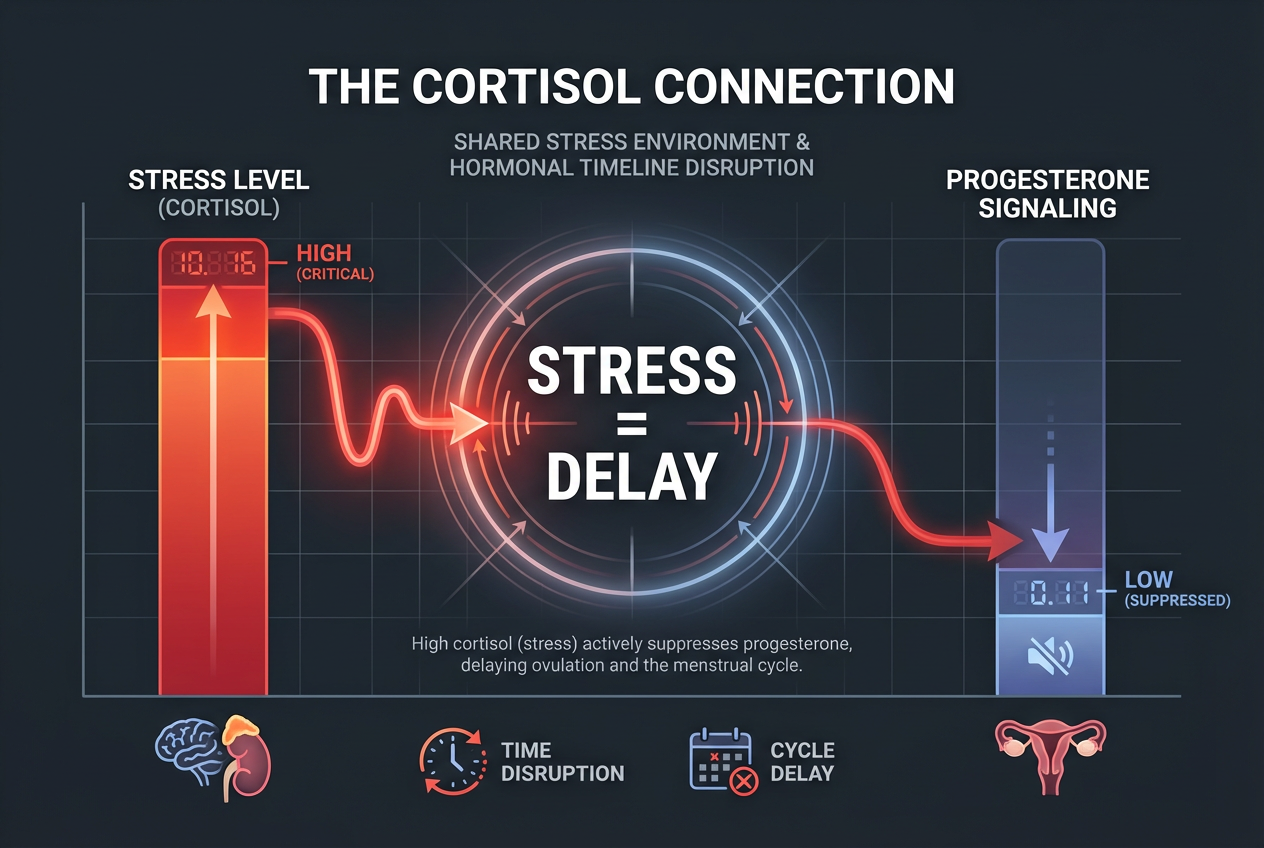
Understanding the hormonal impact of stress is key. When cortisol levels rise, they can physically block the signals your partner's body needs to initiate her period.
The practical takeaway: before you focus on what foods or teas might help, address the stress load. That means you regulating your reaction first. Calm yourself, and you reduce one variable contributing to her delay.
Natural Methods That Work
Certain foods and herbs function as emmenagogues - substances that stimulate blood flow to the pelvic area and uterus. They don't force a period, but they create better conditions for one to start naturally if it's already close.
These methods work best when her period is 3-7 days late and stress or minor hormone fluctuation is the likely cause. They won't overcome major hormonal disorders or medical conditions, but they support the body's natural preparation for menstruation.
Ginger: It increases heat in the body and stimulates uterine contractions. Make fresh ginger tea by steeping sliced ginger root in hot water for 10 minutes. She can drink 2-3 cups per day. Don't use this if she has bleeding disorders or takes blood thinners.
Parsley: Contains compounds that soften the cervix and stimulate mild uterine contractions. The most effective method is parsley tea - steep fresh parsley in boiling water for 5 minutes. Drink twice daily. Avoid during pregnancy because it can trigger contractions.
Vitamin C: High doses may lower progesterone levels and raise estrogen, which can trigger the uterine lining to shed. She can take 500mg supplements three times daily or eat vitamin C-rich foods like oranges, strawberries, and bell peppers. Don't exceed 3,000mg daily - it causes digestive distress.
Pineapple and papaya: Both contain enzymes (bromelain and papain) that may soften the cervix and encourage menstruation. Fresh fruit works better than juice or supplements. She should eat 1-2 cups of fresh pineapple or papaya daily for 3-5 days.
Turmeric: Functions as an emmenagogue and reduces inflammation that might be stalling the cycle. Add it to food or make golden milk by mixing turmeric powder with warm milk and honey. Use about 1 teaspoon daily.
Cinnamon: Stimulates uterine circulation. Add cinnamon to tea, oatmeal, or warm milk. Use 1-2 teaspoons daily. Don't use cassia cinnamon in large amounts - it contains coumarin, which affects blood clotting.
What you actually do: Go to the store. Get fresh ginger, parsley, pineapple. Make the tea yourself. Hand it to her warm. This transforms "have you tried ginger?" into "I made you ginger tea and it's ready now."
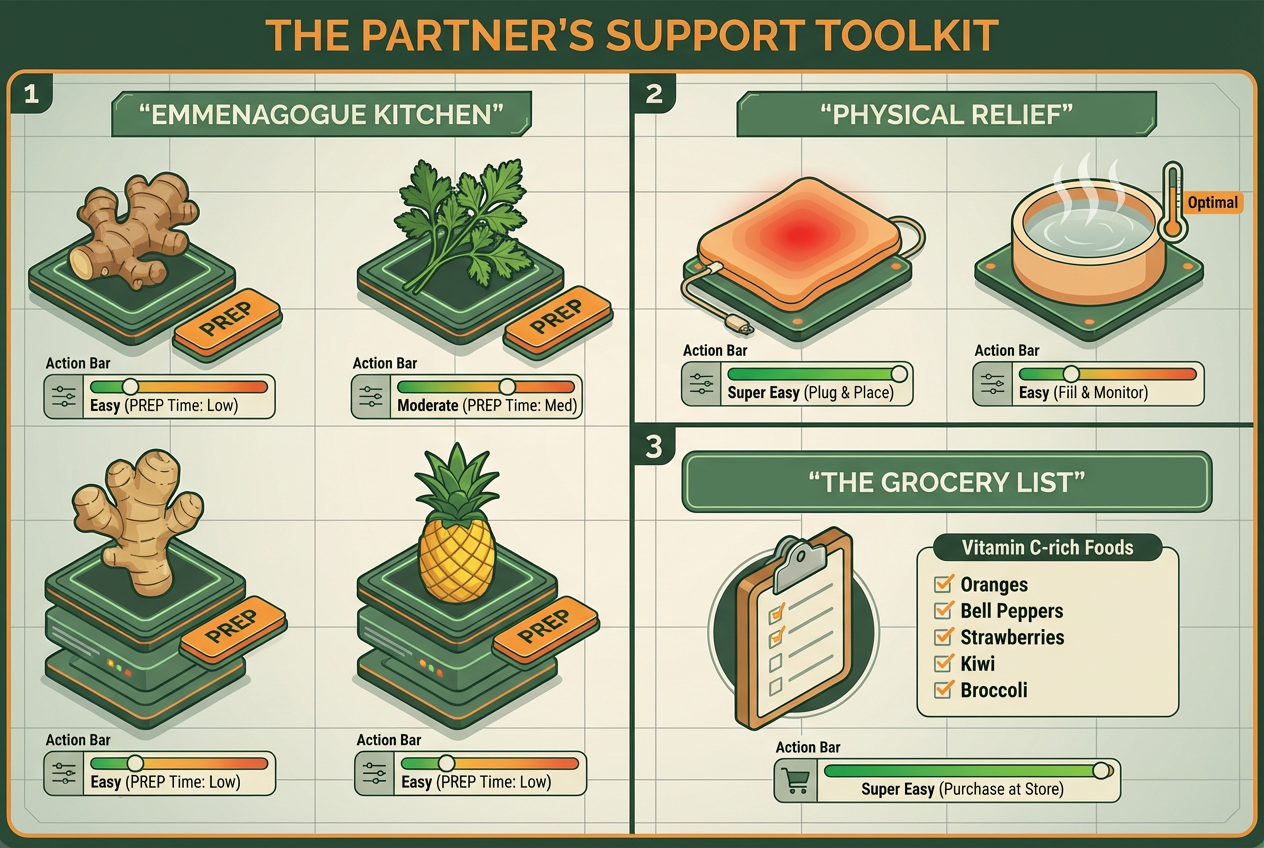
Transform anxiety into action with this support toolkit. Having these items ready shows your partner that you are an active, informed ally in her cycle health.
Understanding her menstrual cycle patterns through tracking tools designed for partners helps you recognize when these natural methods are appropriate versus when something more significant might be happening.
The Warmth and Movement Protocol
Heat relaxes pelvic muscles and increases blood flow to the uterus, which helps the body prepare to shed the uterine lining. This isn't folk medicine - it's basic physiology that gynecologists regularly recommend.
A heating pad on her lower abdomen or back creates localized vasodilation, expanding blood vessels and improving circulation to the pelvic region. That increased blood flow brings nutrients and oxygen while removing metabolic waste products that might be causing cramping or tension.
The practical warmth routine:
Get a quality electric heating pad with multiple temperature settings. Set it to medium-low - too hot causes discomfort and skin irritation. Place it on her lower abdomen, just above the pubic bone, or on her lower back if that's where she feels tension. She can use it for 15-20 minutes, three times daily.
A warm bath works even better because the full-body heat reduces overall cortisol levels while targeting the pelvic area. Fill the tub to a comfortable temperature (not scalding), add Epsom salts if available, and let her soak for 20-30 minutes. The magnesium in Epsom salts also helps relax muscles.
Movement matters as much as warmth. Light exercise increases circulation and can help trigger a delayed period. The key word is light - intense workouts during this time can backfire by increasing stress hormones.
Walking for 20-30 minutes gets blood flowing without triggering a cortisol spike. It's enough movement to support healthy circulation but gentle enough that it won't further delay her cycle.
Specific yoga poses target the pelvic area. Child's pose, cat-cow, and reclining bound angle pose all encourage blood flow to the uterus and gently stretch the lower abdomen. You don't need to be a yoga expert - just look up these basic positions and suggest doing them together.
What you do: Set up the heating pad without being asked. Draw the bath. Suggest the walk by actually putting on your shoes and opening the door. The difference between "you should try walking" and "I'm ready, let's go walk around the block" is the difference between advice and support.
For guys looking to build this kind of proactive awareness into regular practice, tactical cycle tracking helps you anticipate needs before they're verbalized.
Physical Intimacy and Cycle Timing
Orgasms trigger uterine contractions that can help the body begin shedding the uterine lining. This is documented physiology, not speculation. During and after orgasm, the uterus contracts rhythmically, which can stimulate the start of menstruation when the body is already close to that point.
The mechanism involves oxytocin release during climax. Oxytocin stimulates uterine contractions - the same hormone that induces labor during childbirth, just at much lower levels during sexual activity. Those contractions can help dislodge the uterine lining if it's ready to shed but hasn't started the process yet.
Physical closeness also reduces stress hormones. Intimate contact, whether sexual or just cuddling, lowers cortisol and increases feelings of safety and connection. Since stress is one of the primary causes of delayed periods, creating that hormonal environment can remove a barrier to menstruation starting.
A few important qualifications: This only works if her period is already close to starting. It won't force menstruation if she's not near that point in her cycle. And this approach requires her to actually want physical intimacy - pressuring someone for sex "to help her period start" is coercion, not support.
The right approach: Maintain normal physical affection and intimacy without treating it as a medical intervention. If she's interested, that's between you two. If she isn't, the warmth and herbal methods above work just fine without adding awkwardness.
Understanding these biological connections is part of mastering cycle awareness to improve your overall relationship intelligence, not just managing one delayed period.
When to Choose Medical Options
Birth control pills can predictably trigger a period through controlled hormone manipulation. This is the most reliable method when timing really matters, like before a vacation or major event, but it requires a healthcare provider.
The mechanism: Hormonal birth control regulates the cycle by providing synthetic versions of estrogen and progesterone. Taking the active pills for 21 days, then stopping or switching to placebo pills, causes progesterone levels to drop. That drop signals the uterine lining to shed, typically within 2-3 days.
Some doctors prescribe progesterone-only pills specifically to induce a period. She takes the pills for 5-10 days, then stops. The withdrawal bleeding usually starts within 2-7 days after the last pill. This approach works when her delay is due to anovulation (not ovulating) or hormonal imbalance.
Who this works for: Women with irregular cycles, those planning around specific events, or cases where natural methods haven't worked after a reasonable attempt. It doesn't work if pregnancy is present, which circles back to why the pregnancy test is non-negotiable.
The reliability difference: Natural methods depend on multiple variables aligning - stress levels, hormone sensitivity, individual body response. Medical methods work through direct hormonal intervention with predictable timing. If she absolutely needs her period to start by a specific date, medical intervention is the only option with real reliability.
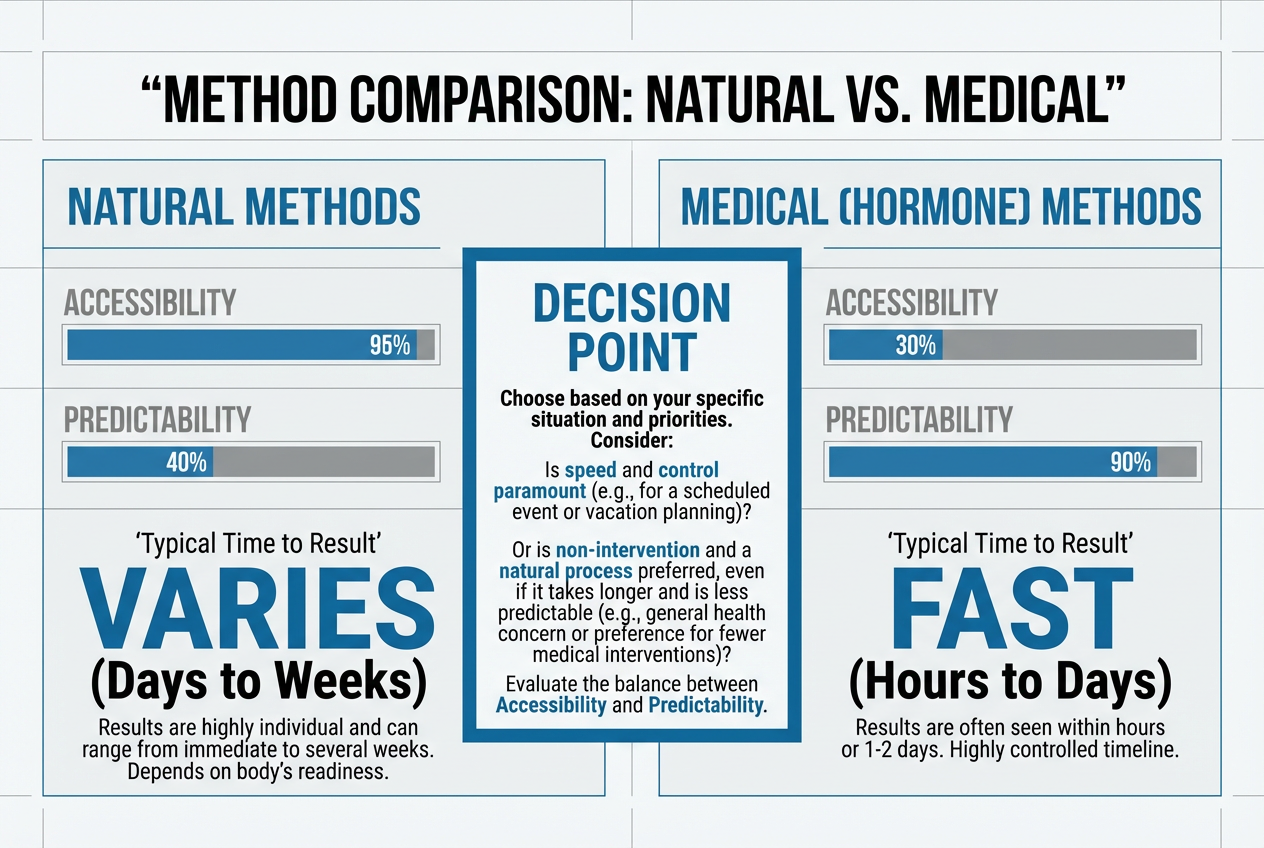
Choosing the right method depends on your goals. This framework helps you weigh the immediate ease of home remedies against the high predictability of medical options.
What you do: If she's considering medical options, offer to go to the appointment with her. Make the call to schedule. Follow up on getting the prescription filled. These small actions matter more than you think.
| Method | Timeline to Results | Reliability | Best For | Requirements |
|---|---|---|---|---|
| Natural herbs/foods | 3-7 days | Moderate | Minor delays, low stress | None |
| Heat and movement | 2-5 days | Low to moderate | Stress-related delays | None |
| Hormonal birth control | 2-3 days after stopping | High | Event planning, reliable timing | Prescription |
| Progesterone therapy | 2-7 days after stopping | High | Anovulation, hormone imbalance | Prescription |
The Supportive Partner Protocol
Your words and actions during a delayed period either reduce her stress or amplify it. There's no neutral position - you're either part of the solution or part of the problem.
The wrong approach looks like this: "Are you sure you aren't pregnant?" asked for the third time. "Just stop stressing about it." Hovering. Asking "anything yet?" every few hours. These responses, however well-intentioned, increase her cortisol levels and make the delay worse.
What not to say:
- "Are you sure you aren't pregnant?" (You already took the test. Trust it.)
- "Just relax." (If she could just relax, she would.)
- "Maybe it's because you've been stressed." (Yes, and you pointing it out isn't helping.)
- "Is it coming yet?" (She'll tell you when it arrives.)
- "This always happens." (Dismissive and unhelpful.)
What actually helps:
"I made ginger tea. It's on the counter." Direct action replacing empty reassurance.
"I got a heating pad and set it up." Physical preparation that shows you understand the biology.
"Want to take a walk?" Movement suggestion without pressure.
"I picked up a pregnancy test so we can verify and stop wondering." Proactive problem-solving.
"What would make this easier for you?" Actual inquiry into her specific needs.
The grocery store cheat sheet:
When you go to the store, grab these without making a production of it:
- Fresh ginger root
- Parsley (fresh bunch)
- Fresh pineapple
- Heating pad (if you don't have one)
- Epsom salts
- Dark chocolate (because comfort matters)
- Her preferred tea
- Ibuprofen (for when cramping starts)
Show up with these items. Don't announce that you're going to buy period-inducing supplies. Just handle it.
The timing element: If you're consistently tracking her cycle, you'll recognize when delays are abnormal versus when they're within her typical variation. That knowledge prevents unnecessary panic and lets you provide actually useful context: "Your cycle was 31 days last month and 29 days the month before, so 33 days isn't that far off your pattern."
This is where relationship cycle awareness tools transform from optional to essential - they give you objective data when emotions are running high.
Red Flags: When Home Methods Aren't Enough
Some situations require immediate medical attention, not home remedies. Knowing the difference between "let's try some ginger tea" and "we need to call a doctor now" is critical.
Stop all home induction attempts and contact a healthcare provider if:
Her period is more than three months late (unless she's pregnant, breastfeeding, or in perimenopause). This signals potential hormonal disorders like PCOS, thyroid problems, or pituitary issues that need medical diagnosis.
She's experiencing severe abdominal or pelvic pain. Sharp, intense pain isn't normal period cramping - it could indicate ovarian cysts, ectopic pregnancy, or other conditions requiring urgent care.
She has fever above 101°F. Combined with a late period, this might indicate pelvic inflammatory disease or other infections.
She's experiencing abnormally heavy bleeding or passing large clots. A delayed period followed by extremely heavy flow can signal hormonal imbalances or uterine problems.
She's dizzy, fainting, or showing signs of severe anemia. Heavy bleeding or underlying conditions can cause dangerous blood loss.
She has sudden, unusual vaginal discharge or foul odor. These symptoms combined with period irregularity suggest infection.
She's lost significant weight rapidly or has other signs of eating disorders. Amenorrhea (absent periods) from malnutrition needs specialized medical care.
She's taking medications that might interact with herbal remedies. Blood thinners, diabetes medications, and some antidepressants can interact dangerously with emmenagogues.
What you do when red flags appear:
Call the doctor's office. Not "you should call your doctor." You make the call or hand her the phone after looking up the number.
Offer to drive to urgent care or the ER if pain is severe. Don't debate whether it's "bad enough" - if she thinks it needs immediate attention, it does.
Write down symptoms, timing, and severity. Medical providers need this information, and stress makes it hard to remember details.
Stay calm. Your panic doesn't help. Your steady presence does.
Ready to actually understand her?
Join thousands of men using VibeCheck to track her cycle and show up better every day.
Frequently Asked Questions
Can stress really delay a period?
Yes. Elevated cortisol directly disrupts the hypothalamic-pituitary-ovarian axis that controls menstruation. When your body interprets stress as a survival threat, it deprioritizes reproductive functions. Even moderate stress sustained over weeks can shift cycle timing by 5-7 days. Major stressors - job loss, relationship problems, grief - can delay periods by weeks or stop them entirely until stress levels normalize.
How late is too late for natural methods?
If her period is more than 7 days late and the pregnancy test is negative, natural methods are still safe to try for another week. Beyond 14 days late with negative pregnancy tests, she should see a healthcare provider to rule out underlying conditions. Natural methods work best for minor delays of 3-7 days caused by stress or hormone fluctuation, not for significant cycle disruption.
Do natural induction methods actually work?
They work for some people in some situations, with moderate reliability. Research on emmenagogues shows they can stimulate blood flow to the pelvic area and create conditions favorable for menstruation to begin. But they can't override major hormonal imbalances or force a period when the body isn't ready. Think of them as supportive rather than guaranteed solutions. Individual response varies significantly based on the underlying cause of the delay.
Can you induce a period overnight?
No. Despite what some internet sources claim, there's no safe method that reliably starts a period within 24 hours. Hormonal changes and uterine lining shedding require time. Even medical interventions like progesterone therapy take 2-7 days after stopping the medication. Natural methods typically show results in 3-7 days if they're going to work at all. Anyone selling "overnight period induction" is either lying or recommending dangerous practices.
Is it safe to take high doses of vitamin C to start a period?
Moderately high doses (up to 3,000mg daily) are generally safe for short periods, but mega-dosing above that level causes digestive problems and can lead to kidney stones with repeated use. Vitamin C may help by lowering progesterone levels, but evidence is limited and individual response varies. If you try this method, don't exceed 3,000mg daily, split the dose throughout the day, and stop after 5-7 days regardless of results.
What's the difference between a late period and pregnancy?
A late period means menstruation hasn't started when expected but isn't due to pregnancy. Pregnancy prevents periods entirely because the uterine lining must remain intact to support the developing embryo. The only way to know which one you're dealing with is a pregnancy test. Symptoms like nausea, breast tenderness, and fatigue occur in both early pregnancy and PMS, so symptoms alone can't differentiate them.
Should you try multiple induction methods at once?
You can combine complementary methods safely - like drinking ginger tea while using a heating pad and going for walks. Don't combine multiple herbal remedies without research, since some herbs interact or amplify each other's effects in ways that aren't well-studied. Start with one or two methods, maintain them consistently for 3-5 days, then add others if needed. Combining too many approaches at once makes it impossible to know what actually worked and increases the risk of side effects.
How do you know if the delay is serious?
Track three things: duration of delay, accompanying symptoms, and cycle history. A delay becomes more concerning when it extends beyond two weeks with negative pregnancy tests, occurs alongside severe pain or abnormal bleeding, or represents a sudden change from normally regular cycles. If she typically runs like clockwork and suddenly goes three weeks late, that's more significant than someone with naturally irregular cycles experiencing a similar delay. When in doubt, consult a healthcare provider. They can run hormone tests and ultrasounds to identify underlying causes that home methods can't address.
Tags

Related Articles
Continue reading to deepen your understanding

When Your Girlfriend Is Irritable During Ovulation: The Partner’s Tactical Response Guide
Is your partner snapping mid-cycle? Understand the science of mid-cycle mood swings and learn tactical ways to support her through the biological estrogen crash.

Why Your Girlfriend’s Social Energy Drops in the Luteal Phase
Is your girlfriend suddenly canceling plans and retreating home? It isn’t personal; it’s biology. Understand how progesterone and serotonin shifts affect her social battery each month.

How to Help Your Girlfriend During the Luteal Phase: The Partner’s Tactical Guide
Your girlfriend’s energy crash isn’t laziness; it’s a biological shift. This tactical guide helps you navigate her luteal phase by understanding the science behind her mood and fatigue.

Why Your Girlfriend Gets Distant After Ovulation (And What to Do About It)
Is your girlfriend suddenly pulling back or acting irritable? It might be her cycle. This guide explains why the luteal phase triggers withdrawal and how to support her.

Supporting Your Girlfriend Through the Luteal Phase
When hormone levels crash before her period, your partner’s brain enters a high-alert state. Learn how to provide the security she needs with tactical scripts and empathy.

How to Give Your Girlfriend Reassurance During Ovulation Week
Is your girlfriend suddenly questioning everything during her cycle? Understand the estrogen crash and learn how to provide the tactical support she needs to feel secure and loved.

When to Give Her Space vs. When to Stay Close: Your Phase-by-Phase Guide
Your girlfriend’s need for closeness isn’t random. Understanding how her 28-day biological rhythm affects her energy helps you time your support perfectly across all four phases.

Your Girlfriend’s 28-Day Relationship Manual: How to Support Her Through Every Phase
Understanding her menstrual cycle transforms you from a guy walking on eggshells into a strategic partner who knows exactly what support to offer and when.