The Luteal Phase Playbook: A Man’s Tactical Guide to Supporting His Partner

Is she crying about milk or questioning your entire future? It might be the luteal phase. Learn the biology behind the mood shifts and how to be the partner she actually needs right now.
The Luteal Phase Playbook: A Man’s Tactical Guide to Supporting His Partner (and Surviving the Storm)
Your girlfriend just asked if you remembered to buy milk. You forgot. Now she’s crying about milk, but also about her job, your future together, and something you said three weeks ago. You’re confused. She’s overwhelmed. And neither of you knows why this keeps happening.
Here’s what’s actually going on: it’s not you, it’s not her character, and it’s not even "just hormones" in the dismissive way people usually mean. It’s her luteal phase - a 10-14 day biological window where her brain chemistry fundamentally shifts, making everything feel heavier, threats feel bigger, and minor annoyances feel catastrophic.
Most men stumble through this phase month after month, triggering the same fights, offering the same unhelpful solutions, and wondering why nothing works. This guide changes that. You’re about to learn the biological mechanics behind the storm, the tactical communication scripts that actually de-escalate conflict, and the proactive moves that transform you from a reactive firefighter into a strategic partner.
By understanding this single window, you’ll eliminate 80% of your recurring arguments.
VibeCheck App
Know what she needs. Before she has to say it.
Track her cycle, understand her phases, be the partner she deserves.
Download Free on iOS →Table of Contents
- The Luteal Logic: Understanding the Progesterone Crash
- The Luteal Kit: Your Survival Shopping List
- Communication Scripts: What to Actually Say
- The Red Zone Rules: Topics to Avoid
- PMDD vs. PMS: When She Needs Professional Help
- The Partner Burnout Section: Taking Care of Yourself
- Frequently Asked Questions
The Luteal Logic: Understanding the Progesterone Crash
The luteal phase starts right after ovulation (roughly day 15-16 of her cycle) and runs until her period begins. During ovulation, her body ramped up estrogen and testosterone, giving her energy, confidence, and optimism. Her brain was flooded with dopamine and serotonin. She felt like herself - maybe even the best version of herself.
Then ovulation ends. Her body shifts gears. Progesterone rises sharply for about a week, then crashes hard in the final days before her period. Estrogen also drops. And when those hormones plummet, so do serotonin and dopamine - the neurotransmitters responsible for mood stability, impulse control, and emotional resilience.
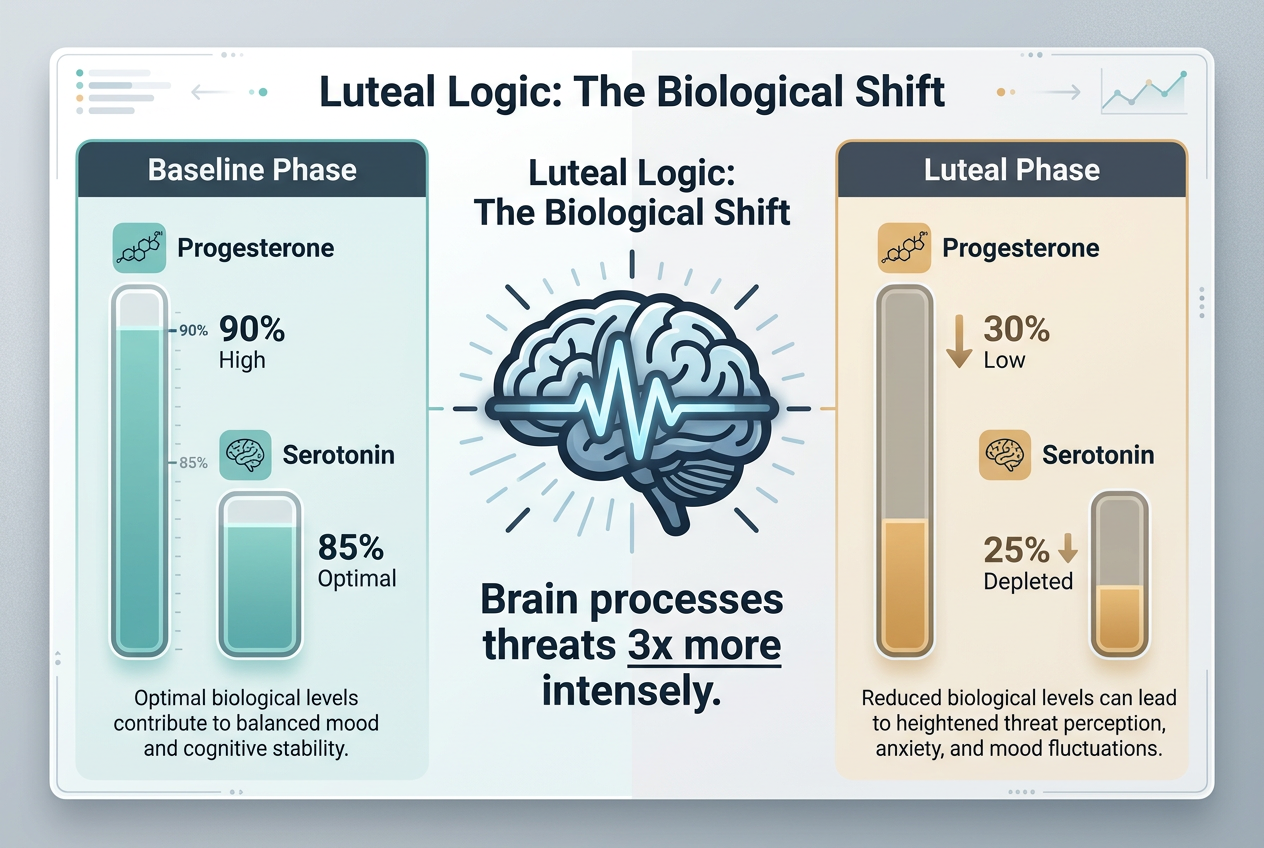 Understanding that the luteal phase involves a significant neuro-chemical shift helps partners recognize that mood changes are biological, not intentional or dramatic.
This isn’t "being dramatic." Her brain is literally processing threats differently right now. The amygdala (the brain’s alarm system) becomes hyperactive. The prefrontal cortex (the logic center) loses some of its regulatory power. She’s not choosing to be irritable or anxious. Her nervous system is on high alert, scanning for problems, and every small issue registers as a bigger threat than it would during other phases.
This is why the same comment you made last week that got a laugh now triggers tears or anger. The stimulus didn’t change. Her brain’s interpretation of it did.
Understanding this single biological fact is the foundation of everything else in this guide. When you recognize that her reactions aren’t about you - they’re about a temporary neuro-chemical state - you stop taking things personally and start responding strategically.
For a deeper breakdown of how each phase impacts her energy and mood, check out The Boyfriend’s Field Manual: Mastering Your Partner’s Four Cycle Phases.
The Luteal Kit: Your Survival Shopping List
Most guys wait until she’s already in crisis mode, then scramble to figure out what she needs. That’s reactive. Elite partners prepare before the storm hits.
A "Luteal Kit" is your proactive move. It’s a collection of physical comfort items you assemble before her symptoms peak, so when she needs relief, you’re ready. This isn’t about fixing her - it’s about removing logistical friction so she can focus on managing her symptoms instead of managing you.
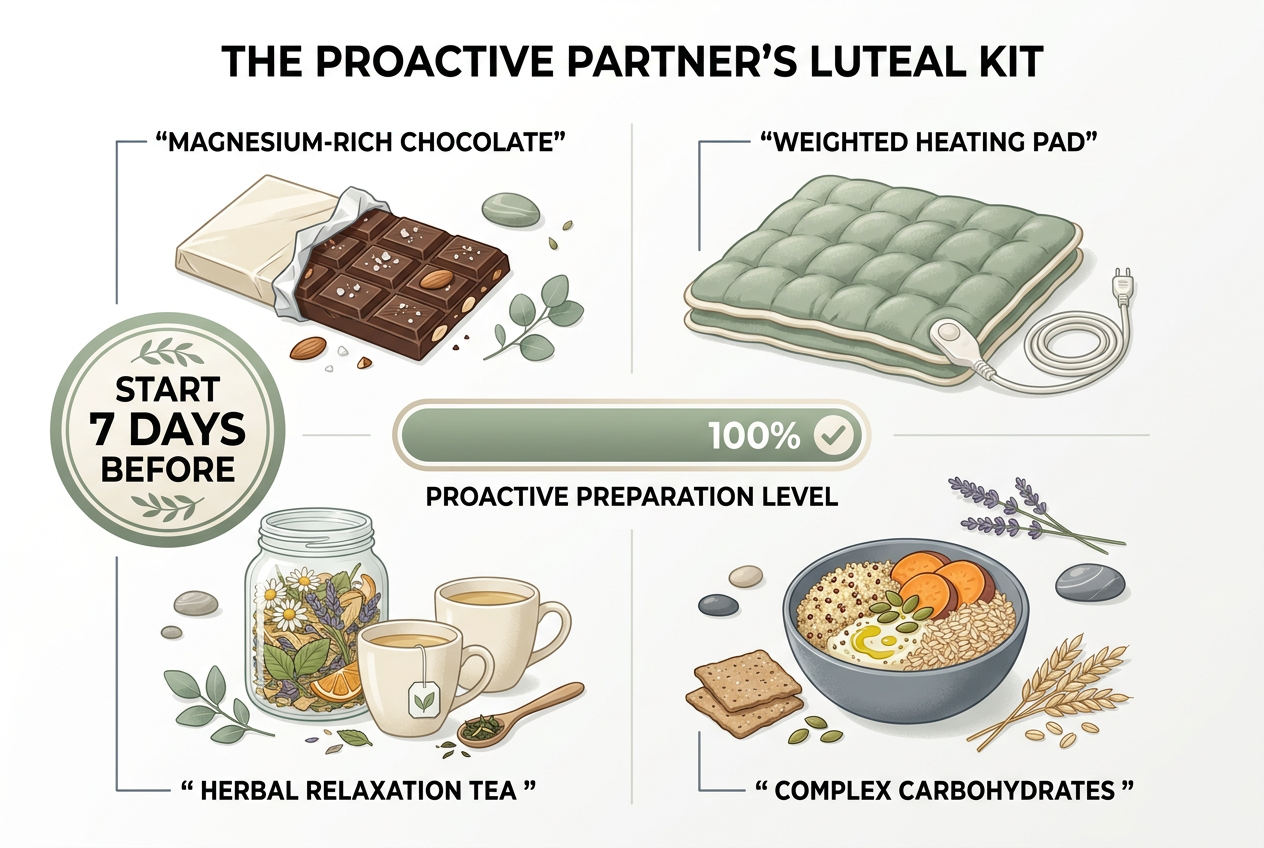 Building a ’Luteal Kit’ before symptoms peak demonstrates proactive care and ensures you have the necessary tools to provide immediate physical relief for your partner.
What Goes in the Kit
Food & Cravings:
- Dark chocolate (at least 70% cocoa - high in magnesium, which helps regulate mood and muscle cramps)
- Complex carbs: sweet potatoes, whole grain bread, oatmeal (these stabilize blood sugar and boost serotonin)
- Salty snacks: pretzels, chips, popcorn (progesterone increases sodium loss, triggering salt cravings)
- Herbal teas: chamomile, peppermint, ginger (anti-inflammatory and calming)
Physical Comfort:
- Heating pad or microwavable heat pack (for cramps and lower back pain)
- Epsom salt (magnesium-rich baths reduce muscle tension and anxiety)
- High-quality ibuprofen or naproxen (ask her what brand she prefers - don’t guess)
- Period underwear or extra pads/tampons (restock before she runs out)
Environment:
- Weighted blanket (the deep pressure stimulation calms the nervous system)
- Low-stimulation entertainment: comfort TV shows, audiobooks, podcasts she loves
- Blackout curtains or eye mask (progesterone can disrupt sleep quality)
The point isn’t to buy everything on this list. The point is to know what she needs and have it ready before she has to ask. Asking "What do you need?" when she’s already in pain puts the emotional labor back on her. Having it ready removes that burden.
Want more tactical support strategies? Read How to Reduce Your Girlfriend’s PMS Mood Swings: A Partner’s Tactical Guide.
Communication Scripts: What to Actually Say
The biggest communication mistake men make during the luteal phase is treating every conversation the same way they would during other weeks. But her nervous system is different right now. What works during her follicular phase (weeks 1-2) doesn’t work during her luteal phase (weeks 3-4).
You need different scripts.
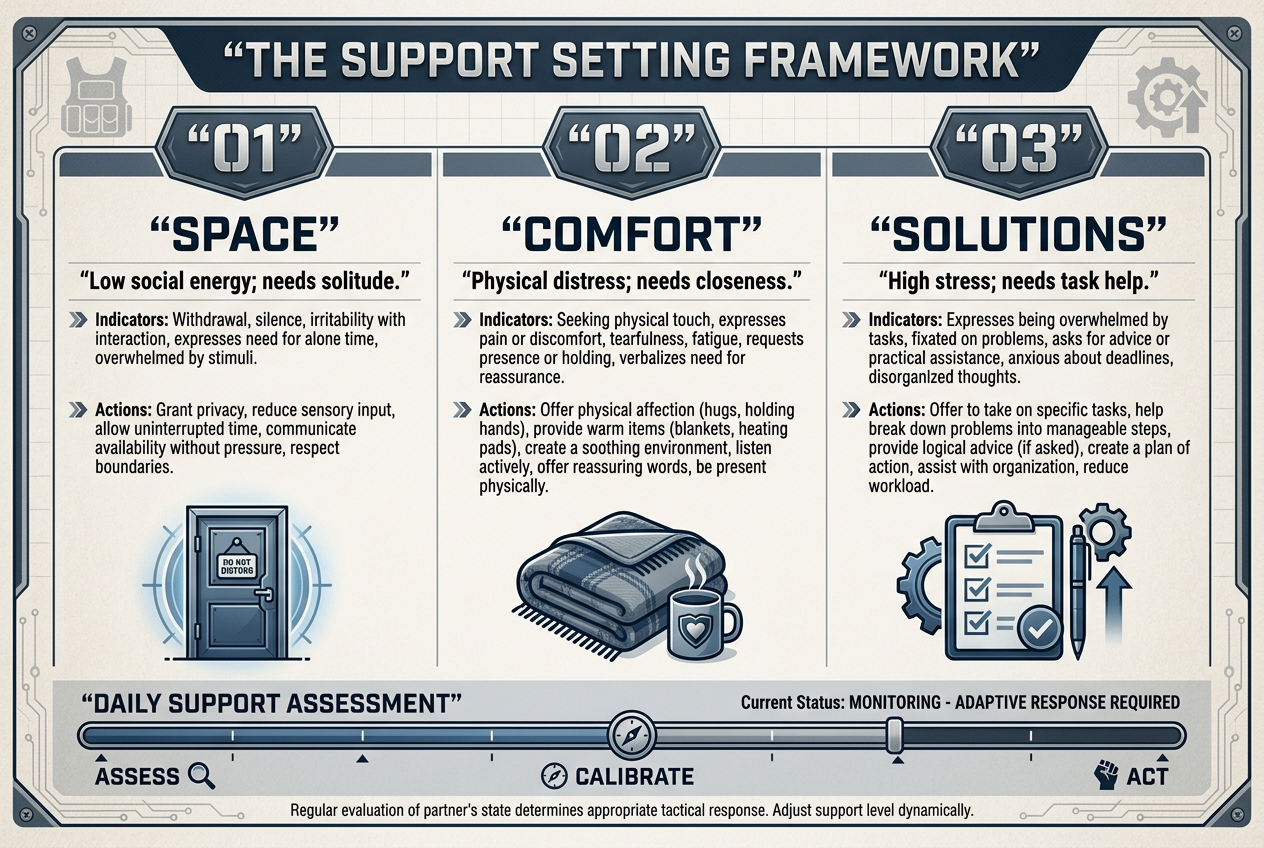 This framework allows you to ask which ’support setting’ is needed today, effectively removing the guesswork and potential for conflict in your daily communication.
The Three Support Settings
Instead of guessing what she needs, ask her to choose between three modes:
Space: "I need you to give me room to process this on my own right now." Comfort: "I need you close. I don’t need you to fix anything - just be here." Solutions: "I need you to help me problem-solve this."
Here’s how to use it:
The Check-In (Use this daily during her luteal phase): "Hey - I know we’re in your luteal window. What’s the support setting for today: Space, Comfort, or Solutions?"
This single question does three things:
- It acknowledges her biological reality without being patronizing
- It removes the burden of her having to explain what she needs
- It gives her control over the kind of support you provide
The De-Escalator (Use this when conflict starts brewing)
When she’s upset and you can feel the conversation spiraling:
Don’t say:
- "You’re overreacting."
- "Is it your period?"
- "You’re being irrational."
- "Let’s talk about this logically."
Do say: "I’m on your team. I can see this is really hard right now. Let’s revisit this conversation in three days. Right now, I just want to make you dinner."
Why this works: You’re validating her feelings without agreeing that the fight is productive right now. You’re proposing a pause (which gives her hormones time to stabilize), and you’re offering immediate, tangible support.
When She Says "I’m Fine" (But Clearly Isn’t)
Don’t say:
- "You don’t seem fine."
- "What’s wrong?"
Do say: "I’m noticing you seem a little off. I’m here if you want to talk, but I’m also happy to just hang out and watch something with you. No pressure either way."
You’re giving her the option to open up without forcing it. And you’re offering low-stakes companionship as the default.
For more scripts that work during different phases, check out What to Text Your Girlfriend During Her Period: 50+ Scripts & Support Tips.
The Red Zone Rules: Topics to Strictly Avoid
During the luteal phase, her brain’s threat-detection system is hyperactive. That means certain topics that might be manageable during other weeks will trigger disproportionate emotional responses right now.
These are the conversations to postpone:
Rule 1: No Major Life Decisions
Off-limits topics:
- Breaking up or "defining the relationship"
- Moving in together or buying a house
- Changing jobs or making career pivots
- Financial disagreements or major purchases
- Family planning discussions
Why: Progesterone’s crash amplifies pessimism and catastrophic thinking. Decisions made during this window are often colored by temporary anxiety, not her actual long-term feelings. If she brings up one of these topics, acknowledge it but postpone the deep dive: "This is important. Let’s set aside time this weekend to really talk through it when we’re both in a better headspace."
Rule 2: Don’t Say "Is It Your Period?"
This is the relationship equivalent of a death sentence. Even if you’re right about the timing, saying this out loud implies that her feelings aren’t real - that they’re just "hormones" and therefore invalid.
Her feelings are real. The intensity might be hormone-influenced, but the underlying issue usually isn’t. Dismissing her emotions as "just PMS" will make the fight ten times worse.
Rule 3: Take Chores Off Her Plate Without Asking
Here’s the subtle mistake most guys make: they ask, "What can I do to help?" This question, while well-intentioned, puts the cognitive load back on her. She now has to think about what needs to be done, prioritize it, and delegate it to you.
Instead:
- Just do the dishes
- Take out the trash without mentioning it
- Order groceries for delivery
- Handle dinner without asking what she wants
- Walk the dog an extra time
The goal is to reduce decision fatigue. Every small decision (even "What do you want for dinner?") requires mental energy she doesn’t have right now. Remove as many of those micro-decisions as possible.
Rule 4: Don’t Try to Logic Her Out of Her Feelings
When she’s upset, your instinct might be to explain why the thing she’s worried about isn’t actually a problem. Resist this.
She says: "I feel like you don’t care about me anymore."
You want to say: "That’s not true. I literally made you breakfast yesterday."
You should say: "That sounds really painful. Tell me more about what’s making you feel that way."
Validation before explanation. Every time. If there’s a misunderstanding to clear up, clear it up later - after you’ve acknowledged her emotional experience.
To understand how her mood shifts across the full cycle, read How to Understand Girlfriend Hormonal Mood Changes.
PMDD vs. PMS: When She Needs Professional Help
Most women experience some degree of luteal phase symptoms. Mood dips, irritability, fatigue, and cravings are all normal. But for about 5-8% of women, these symptoms cross the line from "manageable discomfort" into "life-disrupting distress."
That condition is called Premenstrual Dysphoric Disorder (PMDD). And if your partner has it, no amount of chocolate or tactical communication will be enough. She needs medical support.
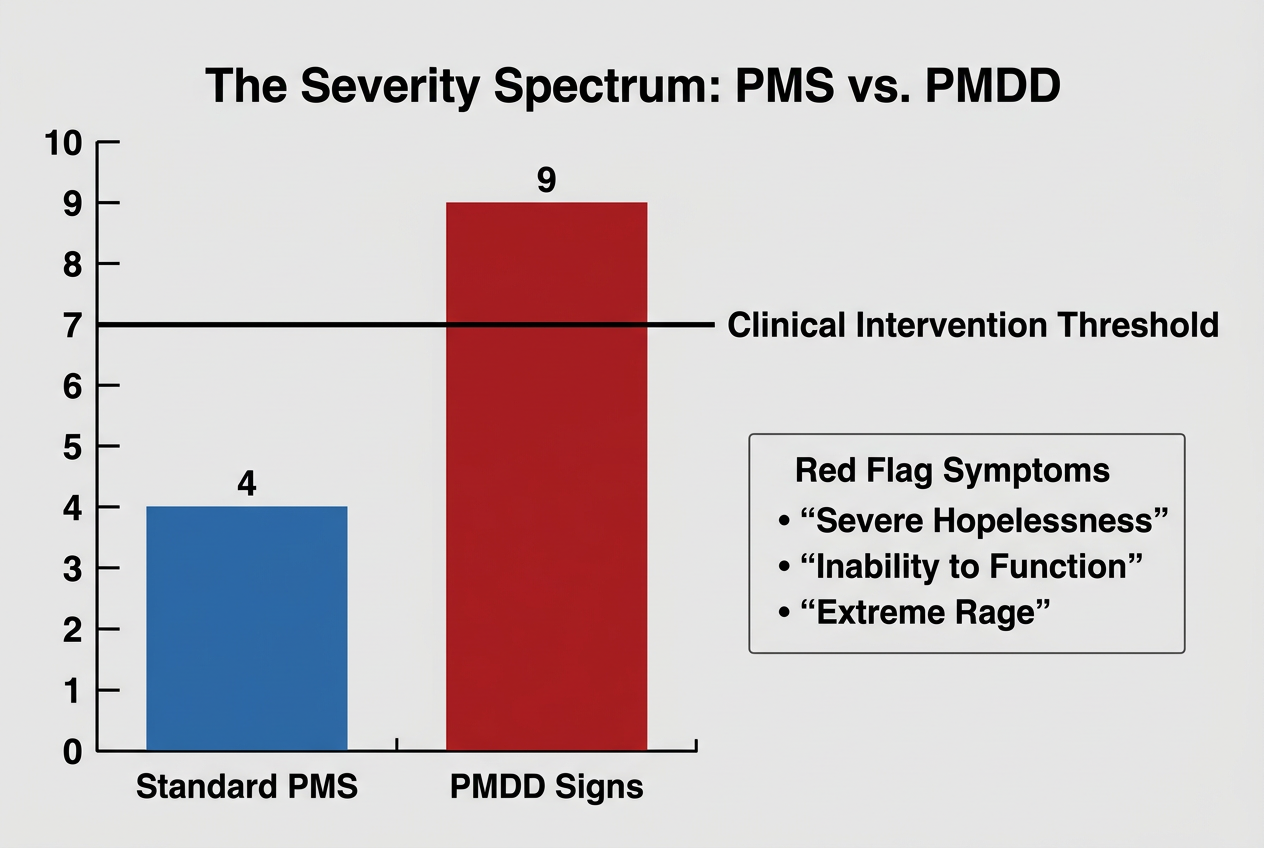 Differentiating between standard PMS and PMDD is essential for your partner’s health; extreme symptoms may require professional medical support rather than just home-based care.
The Warning Signs of PMDD
Standard PMS symptoms are uncomfortable. PMDD symptoms are debilitating.
PMS:
- Mild to moderate mood swings
- Some irritability or sadness
- Manageable fatigue
- Moderate cravings
- Symptoms don’t significantly interfere with work or relationships
PMDD:
- Severe depression, hopelessness, or suicidal thoughts
- Intense rage or anger that feels out of control
- Debilitating anxiety or panic attacks
- Complete loss of interest in activities she usually enjoys
- Symptoms that make it hard to function at work, school, or in relationships
- Feeling "not herself" to an extreme degree
If she’s experiencing five or more of these severe symptoms for most of her luteal phases over the past year, PMDD is likely.
How to Suggest She See a Doctor (Without Sounding Like You’re "Fixing" Her)
This conversation is delicate. If you approach it wrong, she’ll feel like you’re pathologizing her emotions or blaming her for her symptoms.
Don’t say:
- "I think you need to see someone about your mood swings."
- "This isn’t normal."
- "You should get medication."
Do say: "I’ve noticed that the week before your period is consistently really hard for you. I’ve been reading about PMDD, and some of what you’re experiencing sounds similar. Would you be open to talking to a doctor about it? I want you to feel better, and I think there might be treatment options that could help."
You’re framing it as concern for her well-being, not frustration with her behavior. You’re offering information, not a diagnosis. And you’re giving her agency to decide what to do next.
Treatment Options for PMDD
If she does get diagnosed with PMDD, treatment options include:
- SSRIs (antidepressants): Often prescribed intermittently (just during the luteal phase) or continuously
- Hormonal birth control: Can stabilize hormone fluctuations
- Cognitive behavioral therapy (CBT): Helps manage the emotional and behavioral symptoms
- Lifestyle interventions: Exercise, diet changes, and stress management (though these alone aren’t usually sufficient for PMDD)
Your role isn’t to manage her treatment. It’s to support her in seeking it and to understand that if she has PMDD, you’re not dealing with standard PMS - you’re dealing with a clinical condition that requires medical intervention.
For more on supporting your partner through hormonal challenges, see Supporting Girlfriend Hormonal Changes: A Boyfriend’s Guide.
The Partner Burnout Section: Taking Care of Yourself
Let’s talk about something nobody mentions in these guides: supporting a partner through the luteal phase (especially if her symptoms are severe) is exhausting. You’re walking on eggshells, managing conflict, suppressing your own reactions, and trying to be the emotional anchor while your own needs get pushed aside.
That’s not sustainable. And if you burn out, you won’t be able to support her at all.
Recognizing the Signs of Partner Burnout
You’re experiencing:
- Resentment toward her symptoms or the cycle itself
- Emotional numbness or detachment
- Anxiety leading up to her luteal phase
- Feeling like you’re constantly "on duty"
- Neglecting your own social life, hobbies, or self-care
- Physical symptoms like tension headaches, poor sleep, or digestive issues
If any of these sound familiar, you’re not failing as a partner. You’re experiencing compassion fatigue - the emotional toll of sustained caregiving.
How to Maintain Your Own Mental Health
1. Set Boundaries Around Your Own Needs
You can support her and still take time for yourself. In fact, you have to.
During her luteal phase, carve out time for:
- Exercise or physical activity (this regulates your own stress hormones)
- Time with friends (even if it’s just a quick phone call)
- Solo downtime (reading, gaming, whatever recharges you)
Tell her what you’re doing and why: "I’m going to the gym for an hour tonight. I need to move my body to stay grounded. I’ll be back to make dinner."
This isn’t selfish. It’s modeling healthy self-care. And it prevents resentment from building.
2. Don’t Absorb Her Emotions as Your Own
When she’s anxious or upset, your nervous system will want to match hers. You’ll feel the urge to fix everything immediately so both of you can feel better.
Resist this.
Her emotions are hers to process. Your job is to be present and supportive - not to take on her emotional state or solve all her problems. Practice this mental mantra: "I can care without carrying."
3. Talk to Someone
If you’re struggling, talk to a friend, therapist, or even an online community of guys dealing with the same thing. Reddit’s r/AskMen and r/PMDD have threads full of partners sharing strategies and venting frustrations.
You’re not alone in this. And normalizing the difficulty of supporting a partner through severe hormonal symptoms doesn’t make you a bad partner - it makes you human.
4. Use a Period Tracker for Men
One of the best tools for reducing partner burnout is predictability. When you know her luteal phase is coming, you can mentally prepare. You can plan lighter social calendars. You can stock the Luteal Kit. You’re not blindsided every month by the same pattern.
Apps like VibeCheck are built specifically for this. You sync with her cycle, get daily insights on what phase she’s in, and receive proactive reminders about what kind of support to offer. Instead of reacting to symptoms after they appear, you’re anticipating them.
For more on tracking tools that help you stay proactive, check out Period Tracker for Men | VibeCheck - Support Your Partner.
Ready to actually understand her?
Join thousands of men using VibeCheck to track her cycle and show up better every day.
Frequently Asked Questions
What is the luteal phase and how long does it last?
The luteal phase is the third phase of the menstrual cycle, starting immediately after ovulation (around day 15-16) and lasting until her period begins. It typically lasts 10-14 days. During this phase, progesterone rises and then crashes, which drives the mood, energy, and physical changes commonly associated with PMS.
How can I tell when my girlfriend is in her luteal phase without asking?
Track her cycle using a period calculator or a period tracker for couples. Count forward from the first day of her last period. Ovulation usually happens around day 14, and the luteal phase begins immediately after. You can also watch for physical signs: breast tenderness, bloating, fatigue, increased cravings, and shifts in mood or energy.
Is it okay to ask my girlfriend if she’s in her luteal phase?
Yes, but timing and framing matter. Don’t ask during a conflict or in a way that implies her feelings aren’t valid. Instead, use it as part of your regular check-ins: "Are we in your luteal window this week? I want to make sure I’m supporting you the right way." This shows you’re paying attention and trying to be proactive, not dismissive.
What’s the difference between PMS and PMDD?
PMS (Premenstrual Syndrome) involves mild to moderate symptoms like mood swings, irritability, fatigue, and cravings. These symptoms are uncomfortable but manageable. PMDD (Premenstrual Dysphoric Disorder) is a severe form of PMS that includes debilitating symptoms like intense depression, suicidal thoughts, rage, severe anxiety, and feelings of being completely out of control. PMDD interferes significantly with daily life and requires medical treatment.
What should I do if my girlfriend says she wants to break up during her luteal phase?
Don’t make any major relationship decisions during her luteal phase. Her brain’s threat-detection system is hyperactive right now, amplifying negative thoughts and catastrophic thinking. Acknowledge her feelings without dismissing them: "I hear you, and I take this seriously. Let’s talk about this again in a few days when we’re both in a clearer headspace. Right now, I just want to support you." If she insists, suggest writing down her concerns to revisit together after her period starts.
Can I use a period tracker app to support my girlfriend?
Absolutely. Apps designed for men - like VibeCheck - help you track her cycle, understand which phase she’s in, and get daily guidance on how to support her. You’ll receive proactive alerts before her luteal phase starts, mood insights, and communication scripts. It removes the guesswork and helps you stay ahead of the cycle instead of reacting to it. For a full comparison, see Best Period Tracker Apps for Men.
How can I support her during the luteal phase if we’re long distance?
Long-distance support requires extra intentionality. Send her a care package before her luteal phase starts: include her favorite snacks, tea, a heating pad, or a handwritten note. Schedule low-pressure video calls where you watch a show together or just hang out without needing deep conversation. Send her supportive texts that acknowledge what phase she’s in: "I know this week is tough. I’m thinking about you. Let me know if you want to talk or if you just need space." For more ideas, check out The Best Apps for Long Distance Relationships.
What foods or supplements help with luteal phase symptoms?
Magnesium-rich foods (dark chocolate, leafy greens, nuts, seeds) help regulate mood and reduce cramps. Complex carbs (sweet potatoes, oatmeal, whole grains) stabilize blood sugar and boost serotonin. Vitamin B6 and omega-3 fatty acids have also been shown to reduce PMS symptoms. Some women take magnesium glycinate supplements or evening primrose oil, but she should consult a doctor before starting any new supplement regimen.
Should I bring up the luteal phase if she doesn’t talk about it?
If she’s clearly struggling but hasn’t connected the dots to her cycle, it’s worth gently bringing it up outside of a conflict moment. You could say: "I’ve noticed a pattern where things feel harder for you around the same time each month. Have you ever tracked your cycle to see if there’s a connection?" Frame it as curiosity and concern, not criticism. If she’s already aware and managing it, follow her lead on how much she wants to discuss it.
The Bottom Line
The luteal phase isn’t a problem to solve - it’s a biological reality to navigate. Your partner’s brain chemistry changes during this window, making everything feel more intense. The same support strategies that work during her follicular phase won’t work here.
You need different tools: proactive preparation (the Luteal Kit), adaptive communication (the Three Support Settings), strategic avoidance (the Red Zone Rules), and awareness of when symptoms cross into PMDD territory.
But most importantly, you need to take care of yourself. Supporting a partner through recurring hormonal shifts is hard work. If you burn out, you can’t be there for her - or for yourself.
Use the frameworks in this guide. Track her cycle so you’re prepared instead of reactive. And remember: you’re not trying to fix her. You’re trying to be the kind of partner who understands that biology impacts behavior, and who shows up consistently even when things get hard.
That’s what separates reactive guys from strategic partners. And that’s what transforms the luteal phase from a monthly crisis into a manageable rhythm you both know how to navigate.
For daily cycle-based insights and proactive support strategies, try VibeCheck - the relationship app built specifically for men who want to stop guessing and start leading.
Tags

Related Articles
Continue reading to deepen your understanding

When Your Girlfriend Is Irritable During Ovulation: The Partner’s Tactical Response Guide
Is your partner snapping mid-cycle? Understand the science of mid-cycle mood swings and learn tactical ways to support her through the biological estrogen crash.

Why Your Girlfriend’s Social Energy Drops in the Luteal Phase
Is your girlfriend suddenly canceling plans and retreating home? It isn’t personal; it’s biology. Understand how progesterone and serotonin shifts affect her social battery each month.

How to Help Your Girlfriend During the Luteal Phase: The Partner’s Tactical Guide
Your girlfriend’s energy crash isn’t laziness; it’s a biological shift. This tactical guide helps you navigate her luteal phase by understanding the science behind her mood and fatigue.

Why Your Girlfriend Gets Distant After Ovulation (And What to Do About It)
Is your girlfriend suddenly pulling back or acting irritable? It might be her cycle. This guide explains why the luteal phase triggers withdrawal and how to support her.

Supporting Your Girlfriend Through the Luteal Phase
When hormone levels crash before her period, your partner’s brain enters a high-alert state. Learn how to provide the security she needs with tactical scripts and empathy.

How to Give Your Girlfriend Reassurance During Ovulation Week
Is your girlfriend suddenly questioning everything during her cycle? Understand the estrogen crash and learn how to provide the tactical support she needs to feel secure and loved.

When to Give Her Space vs. When to Stay Close: Your Phase-by-Phase Guide
Your girlfriend’s need for closeness isn’t random. Understanding how her 28-day biological rhythm affects her energy helps you time your support perfectly across all four phases.

Your Girlfriend’s 28-Day Relationship Manual: How to Support Her Through Every Phase
Understanding her menstrual cycle transforms you from a guy walking on eggshells into a strategic partner who knows exactly what support to offer and when.