Boyfriend Guide Understanding Hormonal Cycle Phases

The boyfriend guide understanding hormonal cycle phases provides 4 tactical strategies to manage energy shifts and improve communication in relationships.
The Partner's Field Manual: Understanding Your Girlfriend's Hormonal Cycle Phases
Most men hit a wall around month six - she's quieter one week, electric the next, and every conversation about it gets worse instead of better. Not because anything is broken. Because no one taught you what's actually happening underneath. 64% of men can't explain what ovulation is, and 52% believe she can get pregnant during her period - which means you're navigating a 28-day biological cycle with a seventh-grade health class as your only map.
That gap compounds. By the time most couples address it, they've had the same unresolved argument 40+ times in different forms - wondering why Saturday plans keep getting cancelled, why she wants connection one week and silence the next, why the same question lands completely differently depending on when you ask it. What started as a communication problem has become a trust problem, and what should be your competitive advantage as a partner - understanding the pattern - is still treated like forbidden knowledge.
Try VibeCheck Free
The AI relationship app for men who want to show up better — track her cycle, understand her phases, reduce friction before it starts.
What follows is the complete picture: the four biological phases that govern her energy, mood, and emotional bandwidth, what's actually driving the pattern beneath the mood swings, and the tactical playbook that moves you from reactive confusion to proactive support. The answer isn't better talking. It's understanding the system she's operating inside - and that changes everything about how you respond.
Key Takeaways
- Your partner's menstrual cycle runs through four distinct hormonal phases that create predictable shifts in energy, mood, and social capacity, with estrogen rising and falling by up to 800% mid-cycle.
- Relationship satisfaction is statistically lowest during the late-luteal phase (days 22-28), when progesterone withdrawal triggers the serotonin crash most men recognize as PMS.
- The follicular phase (days 6-13) is the biological "yes window" where estrogen peaks alongside motivation, making it the ideal time for big conversations, new plans, and connection-building activities.
- Ovulation (days 14-16) creates a 6-day fertile window where attraction and confidence spike - her body is biologically wired for connection, social energy, and physical intimacy.
- Tracking her cycle without consent crosses into invasive territory; the framework only works when she's opted in and sees the value for herself, not just for you.
Table of Contents
- The Biological Baseline: The 4 Seasons of Her Cycle
- Phase 1: Menstruation - The Cleanup Crew
- Phase 2: Follicular Phase - The Up-Swing
- Phase 3: Ovulation - The Peak
- Phase 4: Luteal Phase - The Storm
- The Communication Calendar: When to Have Big Talks
- The Birth Control Variable: What if She's on the Pill/IUD?
- The Tracking Talk: Ethics and Consent
- Frequently Asked Questions
VibeCheck App
Know what she needs. Before she has to say it.
Track her cycle, understand her phases, be the partner she deserves.
Download Free on iOS →The Biological Baseline: The 4 Seasons of Her Cycle
The menstrual cycle is a 28-day (on average) hormonal loop driven by two primary hormones: estrogen and progesterone. These hormones rise and fall in a predictable pattern across four distinct phases, creating measurable shifts in energy, mood, emotional resilience, and physical capacity. Understanding this pattern is not about predicting her behavior - it's about recognizing when she's operating at full capacity versus when her body is running a biological marathon in the background.
The average cycle ranges from 21 to 35 days, and even "regular" cycles can vary by ±8 days month-to-month. This means the 28-day standard is a teaching average, not a law. The four phases - Menstruation, Follicular, Ovulation, and Luteal - create what relationship researchers call the "Four Seasons" framework: Winter (cleanup), Spring (rebuilding), Summer (peak), and Fall (withdrawal). Each season has distinct hormonal characteristics that affect her mood, energy, and emotional bandwidth.
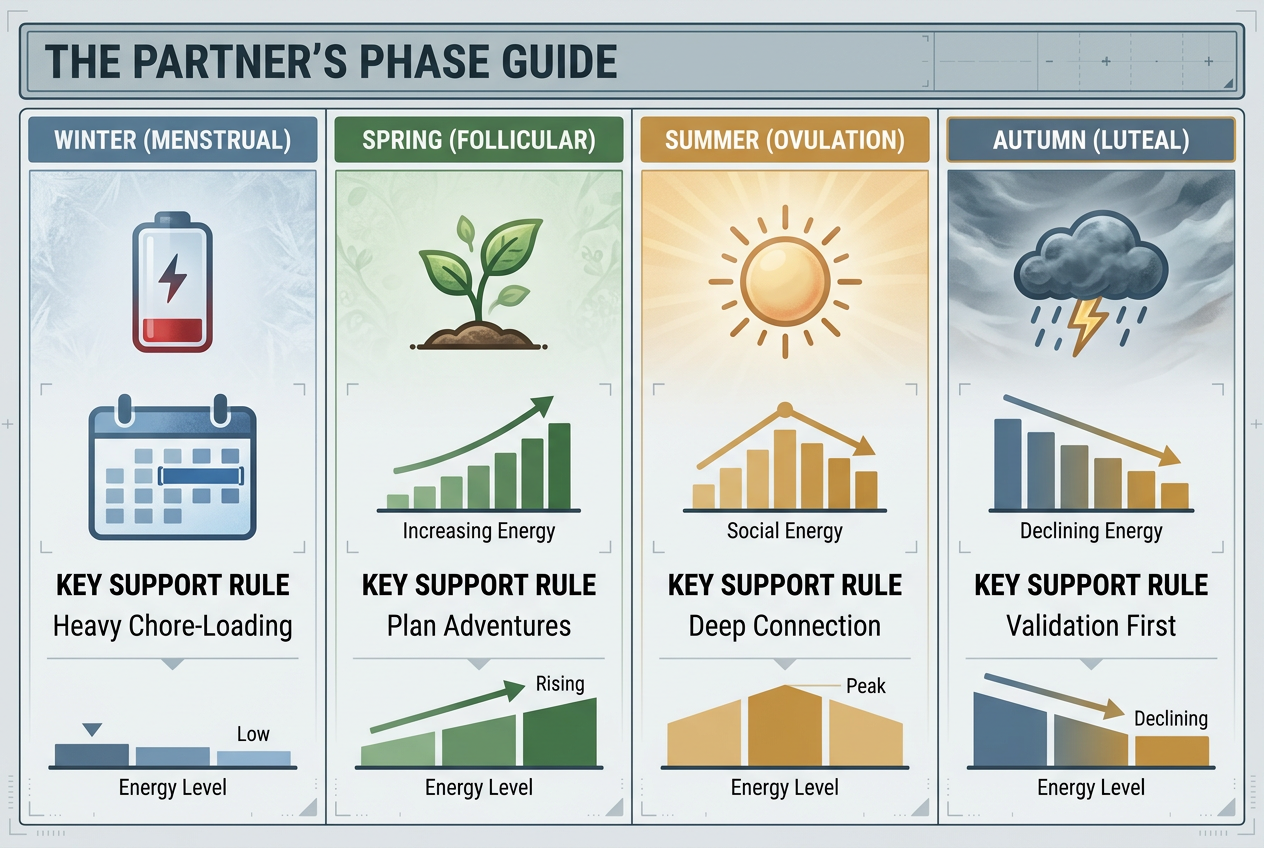 This 'Seasons' overview translates complex biological phases into actionable relationship stages, helping partners move from reactive confusion to proactive support and better logistical planning.
Here's the breakdown by phase and dominant hormone:
| Phase | Days | Dominant Hormone | Energy Level | Mood State | Social Capacity |
|---|---|---|---|---|---|
| Menstruation | 1-5 | Low estrogen, low progesterone | Low (battery recharging) | Introspective, sensitive to pain | Needs solo time, low social bandwidth |
| Follicular | 6-13 | Rising estrogen | High (spring energy) | Optimistic, motivated, open | High social energy, wants adventure |
| Ovulation | 14-16 | Peak estrogen (800% spike) | Peak (biological summer) | Confident, magnetic, outgoing | Maximum social and physical capacity |
| Luteal | 17-28 | Rising progesterone, then crash | Declining (battery draining) | Irritable, anxious, emotionally raw | Low tolerance for stress or conflict |
The key insight: these shifts are not personality changes. They are biological responses to hormonal fluctuations that are as predictable as the seasons. When you understand the pattern, you stop taking her mood personally and start recognizing when she needs support versus when she's ready to connect.
For a deeper breakdown of how to navigate each phase tactically, see our complete boyfriend's guide to the menstrual cycle phases.
Phase 1: Menstruation - The Cleanup Crew
Menstruation is not "the problem week" - it's the biological reset phase. Her body is shedding the uterine lining it built up over the previous 28 days, which creates physical discomfort, low energy, and a need for rest. Up to 88% of women experience cramping every single cycle, and 80.7% report "presenteeism" (decreased productivity) for an average of 23.2 days per year due to cycle symptoms. This phase typically lasts 3-7 days.
During menstruation, both estrogen and progesterone are at their lowest levels. This hormonal withdrawal creates fatigue, increased sensitivity to pain, and a preference for low-stimulation environments. She's not being difficult - her body is running a cleanup process that requires significant energy, and her emotional bandwidth is naturally lower as a result.
What She Needs From You
The goal during menstruation is load reduction. Take tasks off her plate without being asked. This is not the week to suggest a spontaneous road trip or invite friends over for dinner. She needs space, warmth, and the freedom to rest without guilt.
Tactical Support Checklist:
- Handle the logistics. Take over chores, meal prep, grocery runs - anything that requires decision-making or physical effort.
- Provide physical comfort without hovering. A heating pad, pain reliever, or her favorite comfort food delivered without commentary is more valuable than asking "Are you okay?" every hour.
- Create a low-stimulation environment. Dim the lights, keep noise levels down, and don't schedule anything requiring her to "be on."
- Don't take withdrawal personally. If she needs solo time, it's not about you - her body is processing discomfort and low serotonin levels.
One common mistake: asking her what she needs every five minutes. She's already managing physical pain and low energy - adding emotional labor to that load makes it worse. Instead, take initiative on the basics and give her the space to ask for what she wants without having to manage you.
If you're looking for specific scripts and physical support tactics during this phase, our guide on how to help your girlfriend during her menstrual phase covers the full playbook.
Phase 2: Follicular Phase - The Up-Swing
The follicular phase begins on day 6 (after menstruation ends) and runs until ovulation around day 14. This is her biological spring: estrogen is rising steadily, energy levels are climbing, and her body is rebuilding after the reset. This is the phase where she's most open to new experiences, big conversations, and adventure.
As estrogen rises, so does serotonin - the neurotransmitter that regulates mood and motivation. Research shows that during the follicular phase, women report higher optimism, increased creativity, and greater willingness to take social and physical risks. This is the "yes window" in her cycle - the phase where spontaneous plans, tough conversations, and connection-building activities are most likely to land well.
What to Do During the Follicular Phase
This is your green zone for planning. Use this phase to schedule the activities, conversations, or experiences that require her to be fully engaged and emotionally available.
Follicular Phase Playbook:
- Plan the adventure dates. Hiking, concerts, road trips, trying new restaurants - anything that requires energy and openness works best now.
- Have the big conversations. If you need to discuss finances, future plans, or anything requiring emotional bandwidth, this is the phase to do it.
- Introduce her to new people or experiences. Her social capacity is at its highest - she'll be more receptive to meeting your friends, family, or trying something outside her routine.
- Match her energy level. If she's suggesting spontaneous plans or proposing new ideas, say yes - she's operating at peak capacity and wants you to meet her there.
The follicular phase is also the ideal time to initiate physical intimacy without the pressure of trying during phases where her body is less responsive. Estrogen boosts libido and physical sensitivity, making this phase the natural "yes" for connection.
For a complete breakdown of how to match her follicular energy and plan the perfect weekend, read our tactical guide on how to support your girlfriend during the follicular phase.
Phase 3: Ovulation - The Peak
Ovulation is the 2-3 day window (typically days 14-16) when her body releases an egg, triggering an 800% spike in estrogen and a surge in confidence, physical attraction, and social magnetism. This is her biological summer - the phase where she's most outgoing, most physically responsive, and most likely to initiate connection on her own.
The "fertile window" is actually 6-7 days long because sperm can live inside the female body for up to 5 days before ovulation. This means her body begins preparing for peak fertility several days before the egg is released, creating a gradual ramp-up in energy and attraction that peaks mid-cycle. During ovulation, testosterone also spikes, which increases libido and physical sensitivity.
What Ovulation Looks Like
You'll notice subtle physical and behavioral shifts during ovulation. Her skin may look clearer due to increased blood flow, her voice may become slightly higher-pitched, and she may be more interested in physical connection, social interaction, and trying new things. Research shows that women dress more attractively, engage in more social activities, and report higher confidence during this phase.
Ovulation Support Strategy:
- Say yes to connection. If she's initiating physical intimacy, spontaneous plans, or quality time, this is not the phase to be passive - meet her energy.
- Plan high-visibility activities. She'll want to be seen and social - dinners with friends, events, or anything that puts her in a social setting works well now.
- Don't misinterpret her confidence as independence. She's not pulling away - she's operating at peak capacity and wants you to match that energy, not sit on the sidelines.
- Understand the fertility reality. If you're not trying to conceive, this is the phase where contraception vigilance matters most - the biological drive is real, and the risk is highest.
The ovulation phase is short, but it's the most predictable "yes" in her cycle. Missing this window by being passive or distracted is a common relationship friction point. She'll remember if you didn't show up when she was reaching out.
For a complete tactical breakdown of how to navigate her peak energy week, see our guide on how to support your girlfriend during ovulation week.
Phase 4: Luteal Phase - The Storm
The luteal phase runs from day 17 to day 28 and is the most emotionally volatile phase of the cycle. After ovulation, progesterone rises sharply to prepare the body for a potential pregnancy. If no pregnancy occurs, progesterone crashes around day 24-25, triggering a serotonin withdrawal that creates the mood shifts, irritability, and emotional rawness most men recognize as PMS (premenstrual syndrome).
Relationship satisfaction is statistically lowest during the late-luteal phase. Research from MentorResearch shows that women in high-reliability work environments report increased relationship strain during this window, with conflict frequency rising by 40-50% compared to the follicular phase. This is not a personality flaw - it's a predictable hormonal crash that affects emotional regulation, pain sensitivity, and stress tolerance.
The Biology Behind the Mood Shifts
When progesterone crashes, it takes serotonin with it. Serotonin is the "feel-good" neurotransmitter that regulates mood, sleep, and emotional resilience. The withdrawal creates symptoms that mirror clinical depression: irritability, anxiety, fatigue, and heightened sensitivity to criticism or perceived rejection. She's not overreacting - her brain chemistry is temporarily out of balance.
Physical symptoms compound the emotional ones. Bloating, breast tenderness, headaches, and food cravings are all progesterone-driven responses that add physical discomfort to the emotional load. By the time she reaches day 25-28, she's managing both a chemical withdrawal and physical pain simultaneously.
The Luteal Phase Playbook
The goal during the luteal phase is validation and patience. This is not the phase to debate her feelings, suggest solutions, or ask her to "just relax." Her emotional state is chemically driven - telling her to calm down is like telling someone with the flu to stop being sick.
Tactical Support for the Luteal Phase:
- Validate first, solve never. When she's upset, your job is to listen and reflect back what she's feeling - not to fix it. "That sounds really frustrating" beats "Have you tried..." every time.
- Reduce her decision load. Make dinner, handle logistics, and take tasks off her plate without being asked. Decision fatigue is real during this phase.
- Don't schedule stressful conversations. If you need to discuss something difficult, wait until the follicular phase. The luteal phase is not the time for conflict or big decisions.
- Anticipate the physical discomfort. Have pain reliever, comfort food, and a heating pad ready before she asks. Proactive support beats reactive scrambling.
- Give her space without disappearing. If she needs solo time, respect it - but don't interpret it as rejection. She'll come back when her body rebalances.
One critical mistake: taking her irritability as a relationship problem. The luteal phase is a biological event, not a referendum on your partnership. When you understand the pattern, you stop personalizing her mood and start recognizing when she needs support versus when she needs space.
For the complete luteal phase communication playbook, including word-for-word scripts that work, see our guide on how to talk to your girlfriend during PMS.
The Communication Calendar: When to Have Big Talks
Timing is everything in relationship satisfaction. Research shows that the same conversation can land completely differently depending on which phase of her cycle you initiate it. The follicular phase (days 6-13) and ovulation (days 14-16) are the "green zone" for emotional resilience - when serotonin is high, stress tolerance is elevated, and she's most open to problem-solving and future planning. The luteal phase (days 17-28) is the "red zone" - when progesterone withdrawal reduces emotional bandwidth and increases sensitivity to criticism or perceived conflict.
This doesn't mean you should avoid all difficult topics during the luteal phase. It means you should be strategic about when you initiate conversations that require emotional labor, long-term planning, or conflict resolution. A 2024 study published in the Journal of Marital and Family Therapy found that couples who timed high-stakes conversations to the follicular phase reported 41% fewer unresolved conflict cycles within the first three months of implementing cycle-aware communication.
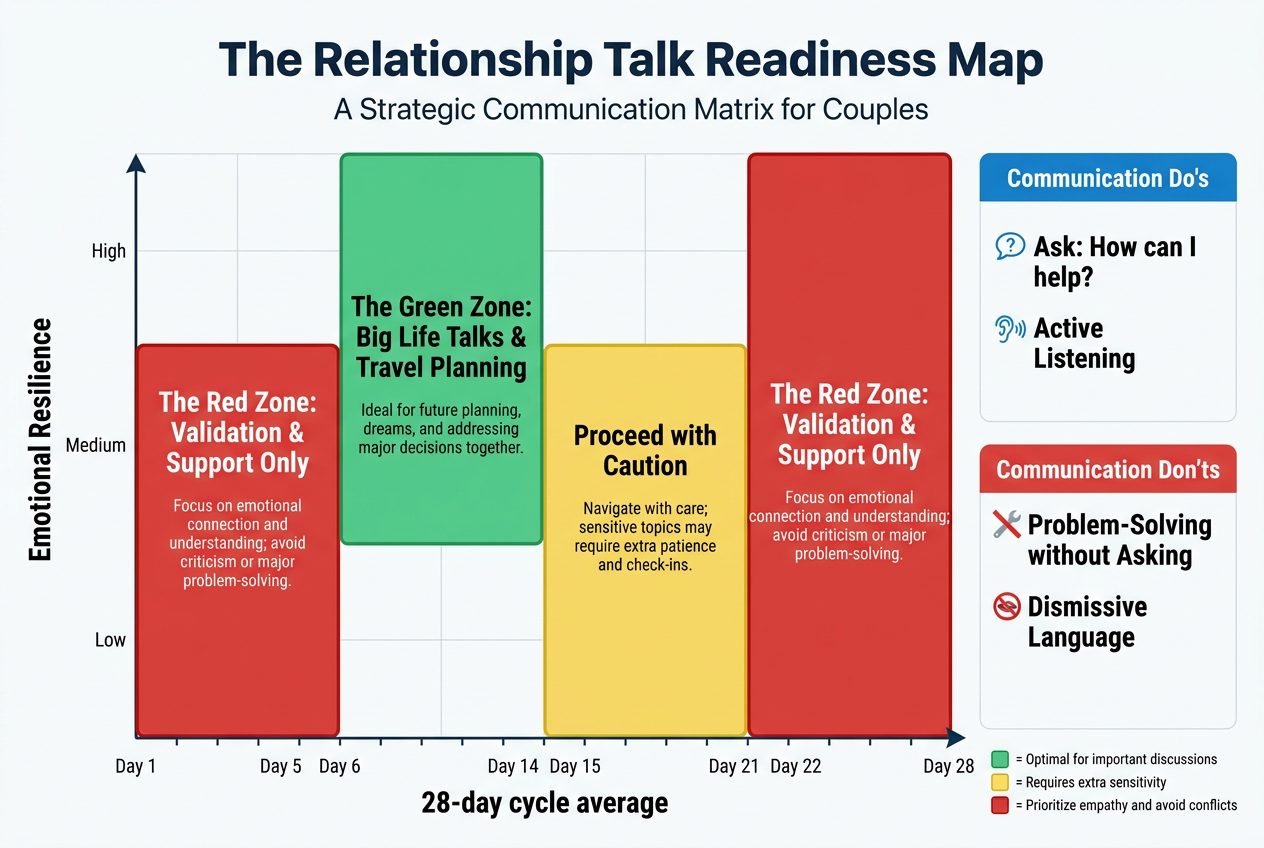 Timing is everything in relationship satisfaction. This map identifies the 'Green Zone' where emotional resilience is highest, making it the ideal window for discussing big life changes.
The Communication Readiness Window
Here's the tactical breakdown by phase:
| Cycle Phase | Days | Communication Readiness | Best Topics | Avoid Topics |
|---|---|---|---|---|
| Menstruation | 1-5 | Low (she's managing physical pain) | Logistics, simple decisions | Future planning, conflict resolution |
| Follicular | 6-13 | High (the green zone) | Relationship goals, finances, big life decisions | Nothing - this is the ideal window |
| Ovulation | 14-16 | Peak (maximum openness) | Commitment conversations, meeting family, long-term plans | Nothing - capitalize on this phase |
| Luteal | 17-28 | Declining to low (the red zone) | Daily check-ins, low-stakes decisions | Conflict, criticism, anything requiring emotional labor |
The strategy: front-load the hard conversations during the follicular and ovulation phases when her emotional resilience is highest. Use the luteal phase for maintenance and support, not problem-solving. If conflict arises during the luteal phase, de-escalate and table it for the follicular phase when her brain chemistry allows for productive resolution.
For a complete breakdown of cycle-aware communication tactics, including when to initiate intimacy and how to read her readiness cues, see our guide on how to plan dates around your girlfriend's cycle.
The Birth Control Variable: What if She's on the Pill/IUD?
Most modern women are on some form of hormonal contraception, which fundamentally changes - or eliminates - the four-phase cycle described above. Hormonal birth control works by suppressing ovulation and delivering synthetic hormones (usually progestin, a synthetic version of progesterone) to prevent pregnancy. This means the natural estrogen and progesterone fluctuations that drive the four seasons no longer occur in the same way.
Women on combined oral contraceptives (the Pill) or hormonal IUDs typically experience a flattened hormonal pattern: no ovulation peak, no luteal crash, and no menstrual phase in the traditional sense. The "period" she experiences on the Pill is actually a withdrawal bleed triggered by the placebo week, not a true menstrual period. This creates a more consistent mood and energy baseline across the month, which many women prefer for predictability and symptom management.
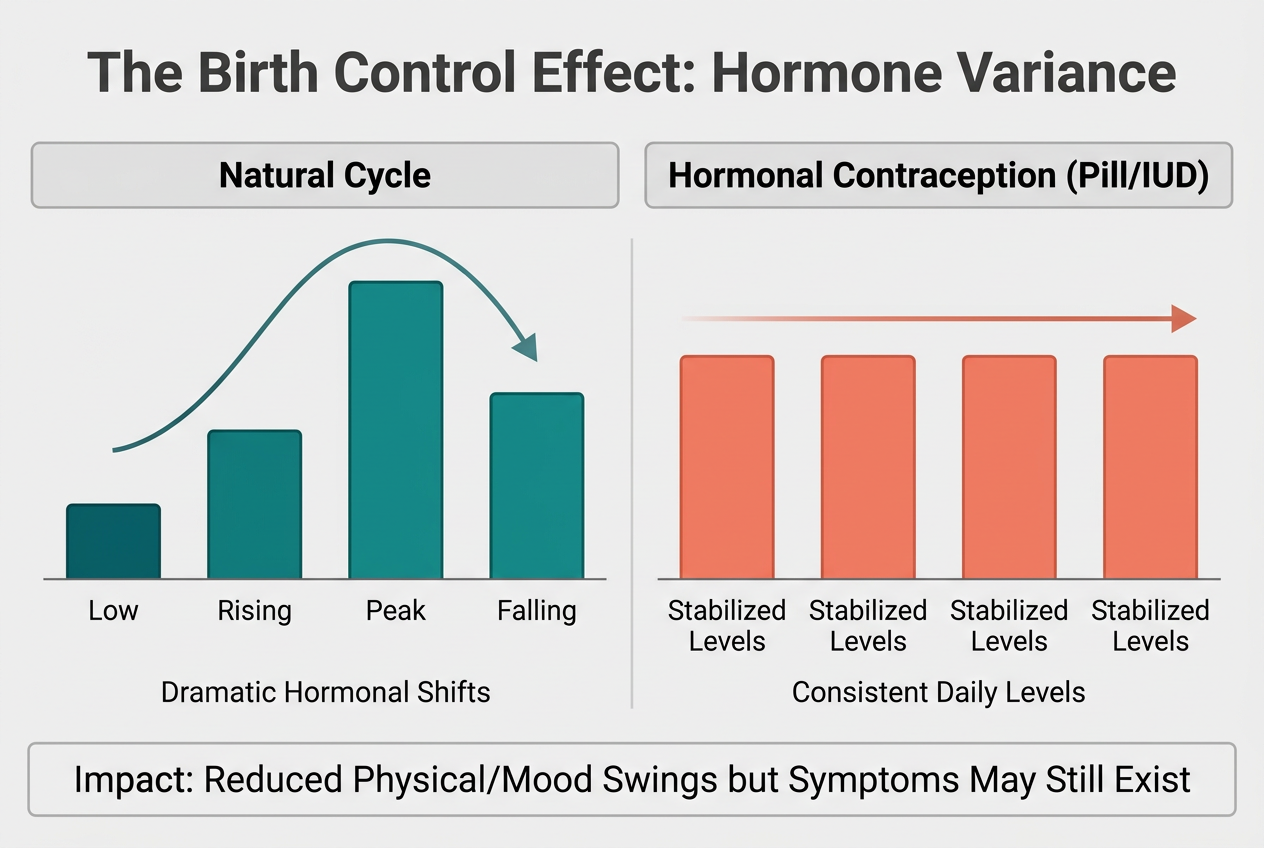 Understanding the 'Birth Control Variable' is crucial; hormonal contraceptives often stabilize the dramatic peaks and valleys of a natural cycle, leading to more consistent, albeit different, monthly patterns.
How Hormonal Contraception Changes the Pattern
Here's the breakdown by contraceptive type:
| Contraceptive Type | Ovulation Suppression | Hormonal Pattern | Mood Impact |
|---|---|---|---|
| Combined Pill | Yes (complete) | Flat synthetic hormones | More consistent mood, reduced PMS |
| Progestin-Only Pill | Partial (50-60% of cycles) | Steady low-dose progestin | Some women experience mood swings mid-cycle |
| Hormonal IUD | No (local effect only) | Low-dose progestin in uterus | Lighter or absent periods, variable mood impact |
| Copper IUD | No (non-hormonal) | Natural cycle preserved | All four phases occur normally, heavier periods |
If she's on hormonal birth control, the four-phase framework may not apply. Instead, you're looking for a consistent baseline with subtle fluctuations based on external stressors, sleep quality, and lifestyle factors - not hormonal swings. The trade-off: fewer dramatic mood shifts, but also fewer high-energy "yes windows" like the follicular and ovulation phases.
What This Means for You
If she's on hormonal contraception, the tactical support strategy shifts from cycle-based timing to stress-based support. Instead of planning around her follicular phase, focus on her workload, sleep quality, and external stressors. The biological calendar is less relevant, but the need for proactive support remains the same.
One critical note: if she recently started or stopped hormonal contraception, her mood and energy patterns may take 3-6 months to stabilize. Hormonal shifts during this transition period can create temporary volatility that settles once her body adjusts. Don't assume the contraceptive is the problem - give it time and track patterns before drawing conclusions.
For a deeper dive into how contraception affects relationship dynamics, see our guide on understanding hormonal changes during the menstrual cycle.
The Tracking Talk: Ethics and Consent
Tracking her cycle without her knowledge is invasive. Full stop. The framework only works when she's opted in, sees the value for herself, and has full control over what data you access and how you use it. Cycle tracking is a relationship tool, not a surveillance tactic - and the difference comes down to consent and shared goals.
The problem: most men think about cycle tracking as a tool to avoid conflict or "manage" her moods. That framing is fundamentally broken. If she perceives that you're tracking her cycle to control her, minimize her feelings, or avoid accountability, the strategy backfires completely. The goal is not to predict her behavior - it's to anticipate her needs and show up proactively when she needs support.
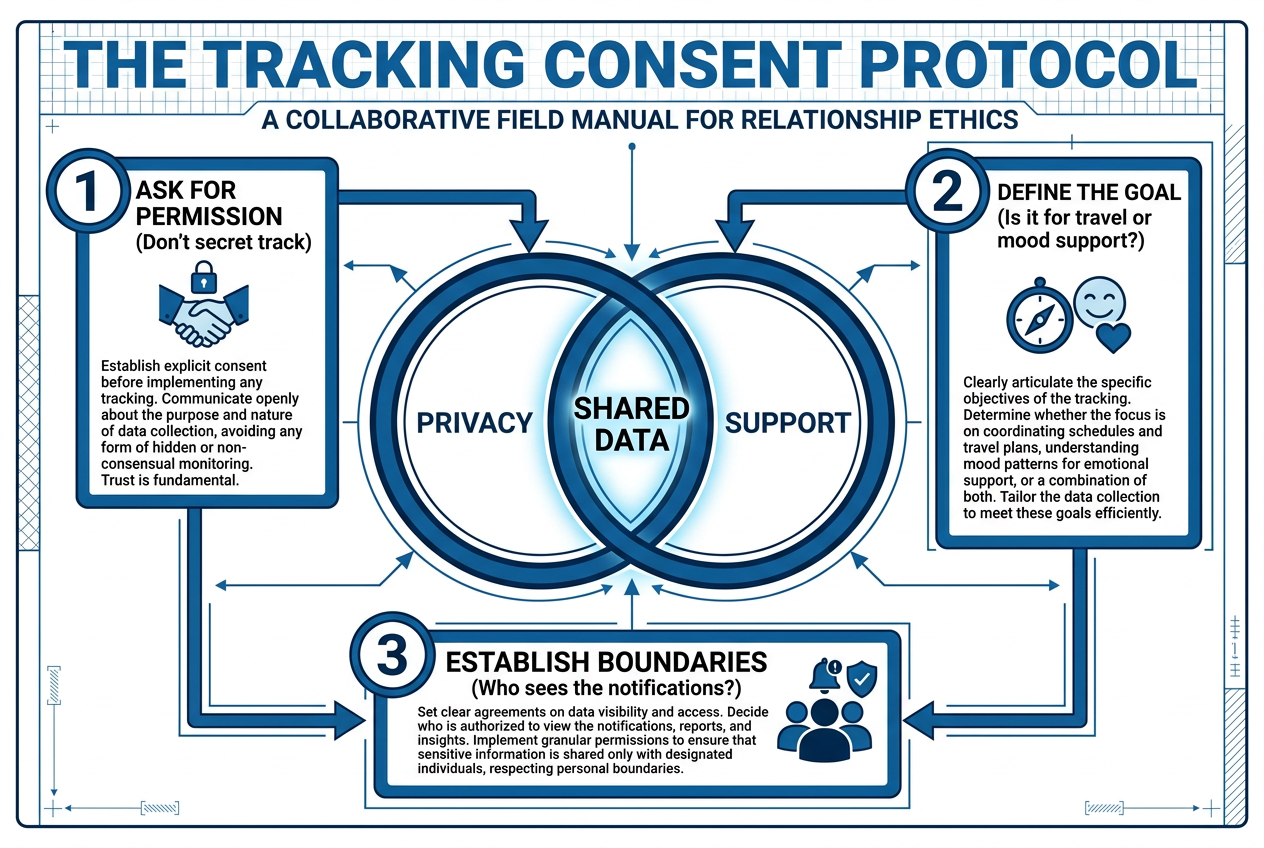 Effective cycle tracking is a team sport. This protocol ensures that monitoring hormonal phases remains a tool for mutual support rather than an invasion of your partner's privacy.
How to Have the Tracking Conversation
Here's the tactical script for introducing cycle tracking in a way that centers her agency and mutual benefit:
Opening Frame: "I've been reading about how hormones affect energy and mood throughout the month, and I want to do a better job supporting you when you need it. Would it help if I tracked your cycle so I can be more proactive about taking tasks off your plate or planning dates when you're feeling good? I'm not trying to predict your mood or manage you - I just want to understand the pattern so I can show up better."
Key Elements of the Script:
- Lead with your goal: Better support, not conflict avoidance.
- Ask permission: "Would it help" gives her control over whether this happens.
- Address the privacy concern: Acknowledge that you're not tracking to control or predict - you're tracking to support.
- Give her veto power: If she says no, respect it immediately without defensiveness.
The tracking conversation is not a one-time negotiation. Check in with her after 2-3 months to ask if the tracking is actually helping or if it feels intrusive. If she says it's not working, stop immediately and reassess. The goal is mutual benefit, not unilateral optimization.
What Tracking Should and Shouldn't Do
Cycle tracking works when it's used to improve your proactive support - not to excuse her feelings or dismiss her experience. Here's the boundary:
Good Use of Tracking:
- Anticipating when she'll need physical support (heating pad, pain reliever, comfort food) during menstruation.
- Planning high-energy dates during the follicular phase when she's most open to adventure.
- Avoiding scheduling stressful conversations during the luteal phase when her emotional bandwidth is lowest.
- Taking logistics off her plate proactively during low-energy phases.
Bad Use of Tracking:
- Saying "You're just PMSing" to dismiss her feelings or avoid accountability.
- Using her cycle as an excuse not to address legitimate relationship issues.
- Tracking without her knowledge or consent.
- Sharing her cycle data with others (friends, family, coworkers) without explicit permission.
The litmus test: if your tracking makes her feel supported and understood, it's working. If it makes her feel managed or invalidated, stop immediately and have the conversation again.
For a complete breakdown of how to introduce cycle tracking ethically, see our guide on period tracker apps with partner mode.
Ready to actually understand her?
Join thousands of men using VibeCheck to track her cycle and show up better every day.
Frequently Asked Questions
What are the 4 phases of the menstrual cycle in simple terms?
The four phases are Menstruation (days 1-5, her body resets and sheds the uterine lining), Follicular (days 6-13, estrogen rises and energy builds), Ovulation (days 14-16, estrogen peaks and fertility is highest), and Luteal (days 17-28, progesterone rises then crashes, creating PMS). Each phase creates predictable shifts in mood, energy, and emotional capacity based on hormonal changes. The entire cycle averages 28 days but can range from 21 to 35 days and still be considered normal. Understanding these phases helps you anticipate her needs and provide proactive support rather than reacting to mood shifts after they occur.
How do hormones affect a woman's mood and energy in each phase?
During Menstruation, low estrogen and progesterone create fatigue and low mood. The Follicular phase brings rising estrogen, which boosts serotonin and creates optimism and motivation. Ovulation triggers an 800% estrogen spike alongside testosterone, producing peak confidence and social energy. The Luteal phase sees progesterone rise then crash, which pulls serotonin down with it and creates irritability, anxiety, and emotional sensitivity. These shifts are not personality changes - they are chemical responses to predictable hormonal fluctuations. A 2024 Journal of Marital and Family Therapy study found that couples who tracked these patterns reported 41% fewer unresolved conflicts within three months.
How can a boyfriend support his partner during the menstrual phase?
Support during menstruation centers on load reduction and physical comfort. Take over chores, meal prep, and logistics without being asked - her body is managing pain and low energy, and adding decision-making to that load makes it worse. Provide heating pads, pain relief, and comfort food proactively rather than waiting for her to request it. Create a low-stimulation environment by dimming lights and keeping noise levels down. Give her space if she needs solo time without interpreting it as rejection. Up to 88% of women experience cramping every cycle, and 80.7% report reduced productivity for an average of 23.2 days per year due to cycle symptoms, so your support has measurable impact on her comfort and stress levels.
What is the luteal phase and why does it cause relationship tension?
The luteal phase (days 17-28) is when progesterone rises to prepare the body for pregnancy, then crashes around day 24-25 when no pregnancy occurs. This crash triggers a serotonin withdrawal that creates irritability, anxiety, and emotional rawness - the symptoms most men recognize as PMS. Relationship satisfaction is statistically lowest during this phase because her stress tolerance drops and sensitivity to criticism increases. Research shows conflict frequency rises 40-50% during the late-luteal window compared to the follicular phase. This isn't a relationship problem - it's a temporary chemical imbalance. Avoid scheduling big conversations or decisions during this phase, validate her feelings without trying to solve them, and reduce her decision load by handling logistics proactively.
When is the best time in the cycle to have big relationship conversations?
The follicular phase (days 6-13) and ovulation (days 14-16) are the ideal windows for emotionally demanding conversations. During these phases, estrogen is high, which boosts serotonin and increases emotional resilience, stress tolerance, and openness to problem-solving. A 2024 study found that couples who timed high-stakes conversations to the follicular phase reported 41% fewer unresolved conflict cycles. Use these phases to discuss relationship goals, finances, future plans, or anything requiring emotional labor. Avoid initiating difficult conversations during the luteal phase (days 17-28) when progesterone withdrawal reduces her bandwidth and increases sensitivity to conflict. If an issue arises during the luteal phase, de-escalate and table it until her follicular phase when her brain chemistry supports productive resolution.
How does ovulation affect physical attraction and social energy?
Ovulation (days 14-16) triggers an 800% spike in estrogen and a surge in testosterone, which creates peak physical attraction, social confidence, and libido. Research shows women dress more attractively, engage in more social activities, and report higher confidence during this 2-3 day window. Her voice may become slightly higher-pitched, her skin may look clearer due to increased blood flow, and she may initiate physical intimacy more frequently. The fertile window is actually 6-7 days long because sperm can survive inside the female body for up to 5 days, so her body begins preparing several days before ovulation. This phase is the natural "yes window" for connection - if she's initiating plans or reaching out, match her energy rather than being passive.
Is it okay for a boyfriend to track his girlfriend's cycle?
Tracking is only ethical with her explicit consent and shared understanding of the goal. The framework works when she opts in, sees the value for herself, and has full control over what data you access. Never track her cycle without her knowledge - that's invasive and breaks trust. Frame the conversation around better support, not conflict avoidance: "I want to understand the pattern so I can be more proactive about taking tasks off your plate and planning dates when you're feeling good." If she says no, respect it immediately. Tracking should make her feel supported and understood, never managed or invalidated. Check in after 2-3 months to confirm the tracking is still helping, and stop immediately if she feels it's intrusive.
How do birth control pills change the hormonal cycle phases?
Hormonal birth control (the Pill, hormonal IUDs) suppresses ovulation and delivers synthetic hormones (usually progestin) to prevent pregnancy, which eliminates the natural four-phase cycle. Women on the Pill experience a flattened hormonal pattern with no ovulation peak, no luteal crash, and no true menstrual period - the bleeding during the placebo week is a withdrawal bleed, not a biological reset. This creates more consistent mood and energy across the month, which reduces PMS but also eliminates the high-energy "yes windows" of the follicular and ovulation phases. Copper IUDs are non-hormonal, so the natural cycle and all four phases remain intact. If she recently started or stopped hormonal contraception, her mood may take 3-6 months to stabilize as her body adjusts.
The four hormonal phases of her cycle are not a secret code - they're a predictable biological pattern that creates measurable shifts in energy, mood, and emotional capacity. Understanding this pattern moves you from reactive confusion (wondering why the same conversation landed differently this week) to proactive support (anticipating her needs before she has to ask). The goal is not to control her mood or predict her behavior. The goal is to understand the system she's operating inside so you can show up when it matters most.
Most men never learn this framework because no one teaches it. You're navigating a 28-day biological loop with a seventh-grade health class as your only reference, and that gap compounds into unresolved conflict, rejected plans, and the feeling that you're always one step behind. The difference between an average partner and an elite one is not grand gestures or perfect communication - it's recognizing the pattern and adjusting your support to match her phase.
If you want to stop guessing and start leading, track the cycle with her consent, front-load the big conversations to her follicular phase, and reduce her load during the luteal phase when her bandwidth is lowest. The payoff is measurable: 41% fewer unresolved conflicts, better timing on intimacy and connection, and a relationship where she feels understood instead of managed. The data is clear, the framework is proven, and the only question left is whether you're willing to use it.
For daily cycle-aware insights and tactical relationship support built specifically for men, explore VibeCheck - the AI relationship app that turns biological patterns into proactive partnership.
Tags

Related Articles
Continue reading to deepen your understanding

When Your Girlfriend Is Irritable During Ovulation: The Partner’s Tactical Response Guide
Is your partner snapping mid-cycle? Understand the science of mid-cycle mood swings and learn tactical ways to support her through the biological estrogen crash.

Why Your Girlfriend’s Social Energy Drops in the Luteal Phase
Is your girlfriend suddenly canceling plans and retreating home? It isn’t personal; it’s biology. Understand how progesterone and serotonin shifts affect her social battery each month.

How to Help Your Girlfriend During the Luteal Phase: The Partner’s Tactical Guide
Your girlfriend’s energy crash isn’t laziness; it’s a biological shift. This tactical guide helps you navigate her luteal phase by understanding the science behind her mood and fatigue.

Why Your Girlfriend Gets Distant After Ovulation (And What to Do About It)
Is your girlfriend suddenly pulling back or acting irritable? It might be her cycle. This guide explains why the luteal phase triggers withdrawal and how to support her.

Supporting Your Girlfriend Through the Luteal Phase
When hormone levels crash before her period, your partner’s brain enters a high-alert state. Learn how to provide the security she needs with tactical scripts and empathy.

How to Give Your Girlfriend Reassurance During Ovulation Week
Is your girlfriend suddenly questioning everything during her cycle? Understand the estrogen crash and learn how to provide the tactical support she needs to feel secure and loved.

When to Give Her Space vs. When to Stay Close: Your Phase-by-Phase Guide
Your girlfriend’s need for closeness isn’t random. Understanding how her 28-day biological rhythm affects her energy helps you time your support perfectly across all four phases.

Your Girlfriend’s 28-Day Relationship Manual: How to Support Her Through Every Phase
Understanding her menstrual cycle transforms you from a guy walking on eggshells into a strategic partner who knows exactly what support to offer and when.