How to Support Your Partner During Her Period Without the Guesswork
Learn how to support your partner during period with practical, science backed tips. Go beyond the basics and build a stronger, more connected relationship.
If you really want to learn how to support your partner during her period, you need to look beyond the few days she’s actually bleeding. The real secret is understanding her entire menstrual cycle. It's the difference between reacting to a fire and knowing how to prevent one.
Think of it as a month-long rhythm of hormonal shifts that quietly influence everything from her mood and energy to her social battery. Knowing this rhythm is your key to offering support that’s not just reactive, but genuinely helpful. It’s about being proactive. It's about being the kind of partner she knows she can count on, no matter what day of the month it is. With a little understanding, you can turn a potentially stressful time into a moment of deeper connection.
Understanding Her Menstrual Cycle Beyond the Basics
To be the kind of partner she can truly lean on, you have to see the bigger picture. Her period is just one piece of a much larger, four-part puzzle. Seeing it as just "that time of the month" is like trying to understand a whole movie by only watching the final scene. You’re missing all the important context.
Her body goes through a predictable pattern of hormonal changes all month long. The main players, estrogen and progesterone, rise and fall. These shifts are what drive her energy levels, food cravings, and emotional state. It’s not random. It's science. And understanding that science is the first step to true empathy.
The Four Phases Explained Simply
Let’s break this down without getting bogged down in biology. A great way to think about it is like the four seasons, with each one having its own distinct energy and feel.
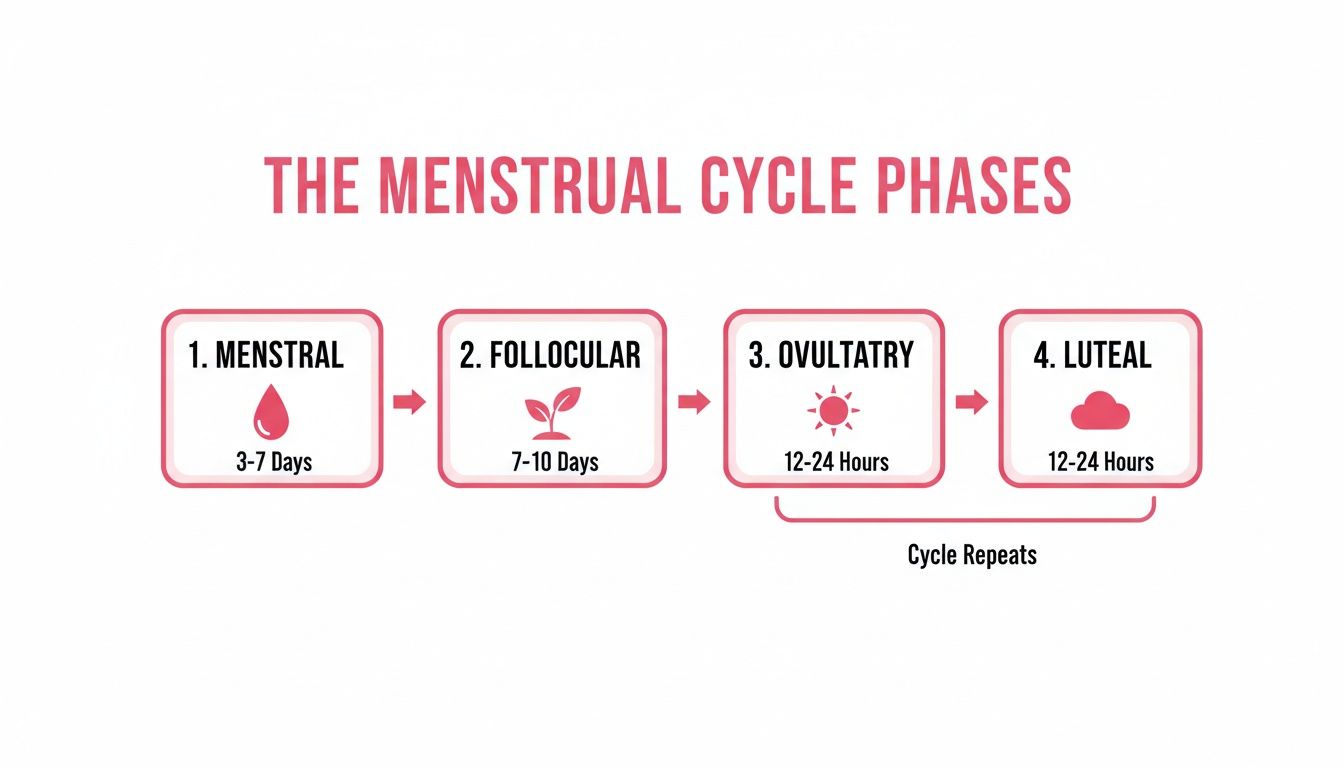
Here’s a simple breakdown of what’s happening hormonally and how she might feel during each part of her cycle.
A Quick Guide to the Four Menstrual Cycle Phases
| Phase and Typical Length | What Her Body Is Doing | How She Might Feel |
|---|---|---|
| Menstrual Phase (3-7 days) | Her “winter.” Uterine lining sheds, and hormones are at their lowest point. | Low energy, crampy, introverted, craving rest and comfort. |
| Follicular Phase (7-10 days) | Her “spring.” After her period, estrogen starts rising to prepare for ovulation. | Renewed energy and optimism, more creative, open to new things. |
| Ovulatory Phase (3-5 days) | Her “summer.” Estrogen and testosterone peak as an egg is released. | Confident, social, high energy, and feeling her most vibrant. |
| Luteal Phase (10-14 days) | Her “autumn.” Progesterone rises. Hormones drop late in this phase, triggering PMS. | Energy winding down, might feel irritable, anxious, or bloated. |
Seeing the phases laid out this way makes it much easier to understand why she might feel completely different from one week to the next. It’s a continuous flow, not just one single event.
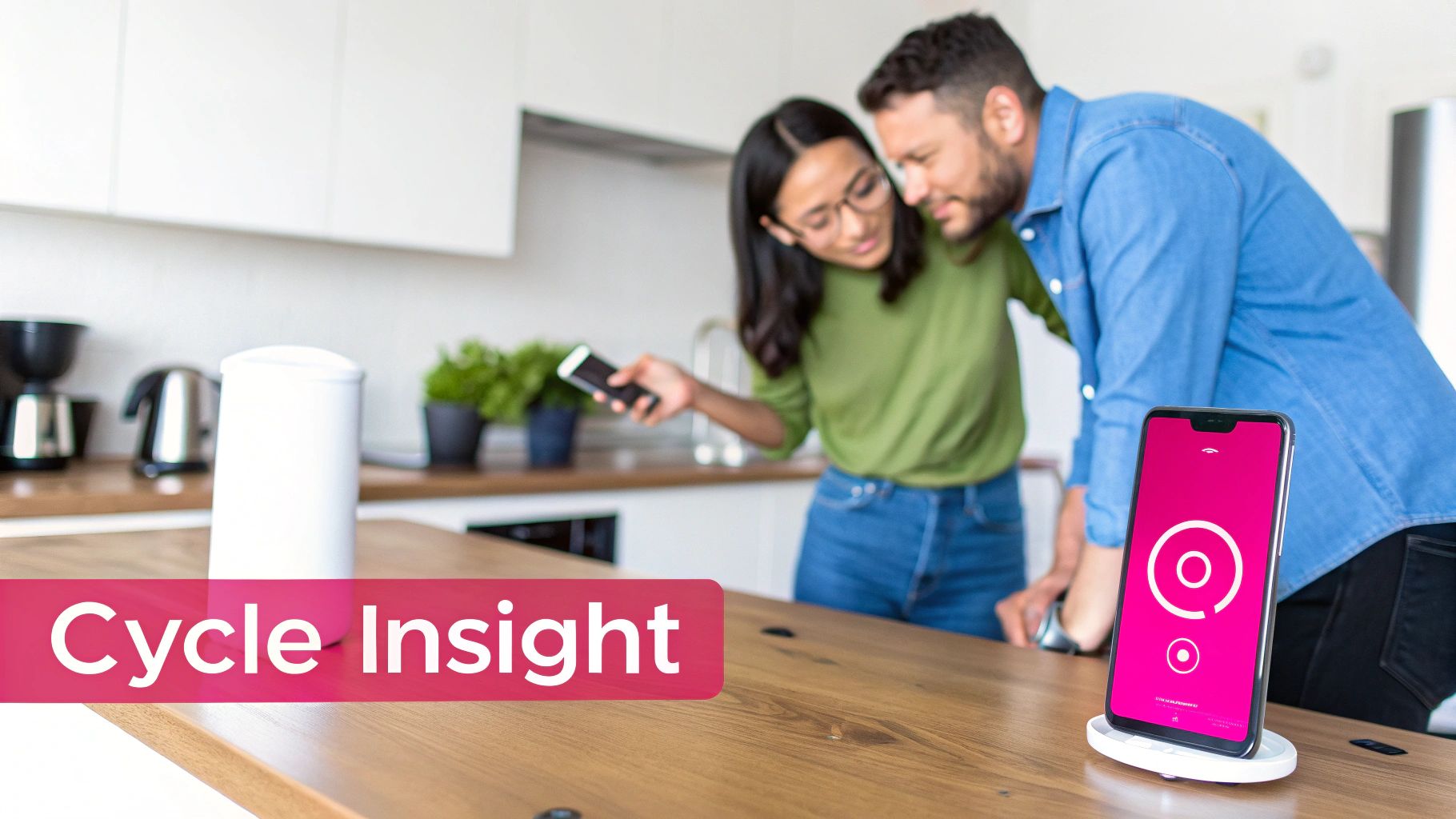
This is where a tool like a period tracker for men can be incredibly useful. It helps you see where she is in her cycle at a glance, so you can anticipate her needs instead of just reacting to them.
And this isn't just about managing moods. Studies have shown that relationship satisfaction can fluctuate right along with the menstrual cycle. The week before her period (the late luteal phase) is often a time when a little extra patience and support from you can make a huge difference.
It’s not about blaming hormones for everything. It's about gaining real empathy by learning to work with her natural rhythm instead of fighting against it. This knowledge empowers you to be a better partner.
Providing Practical Physical Comfort
Emotional support is crucial, but sometimes the most helpful thing you can do is just... do something. Actions often speak louder than words, and offering tangible, physical comfort can provide immediate relief. This is where you can show you’re really paying attention.
This isn't about grand, complicated gestures. It's about taking on some of her physical burdens so she can rest. It’s a simple, direct way to say, "I've got this. You just focus on feeling better." It's about showing up in a way she can physically feel.
Create a Comfort Kit
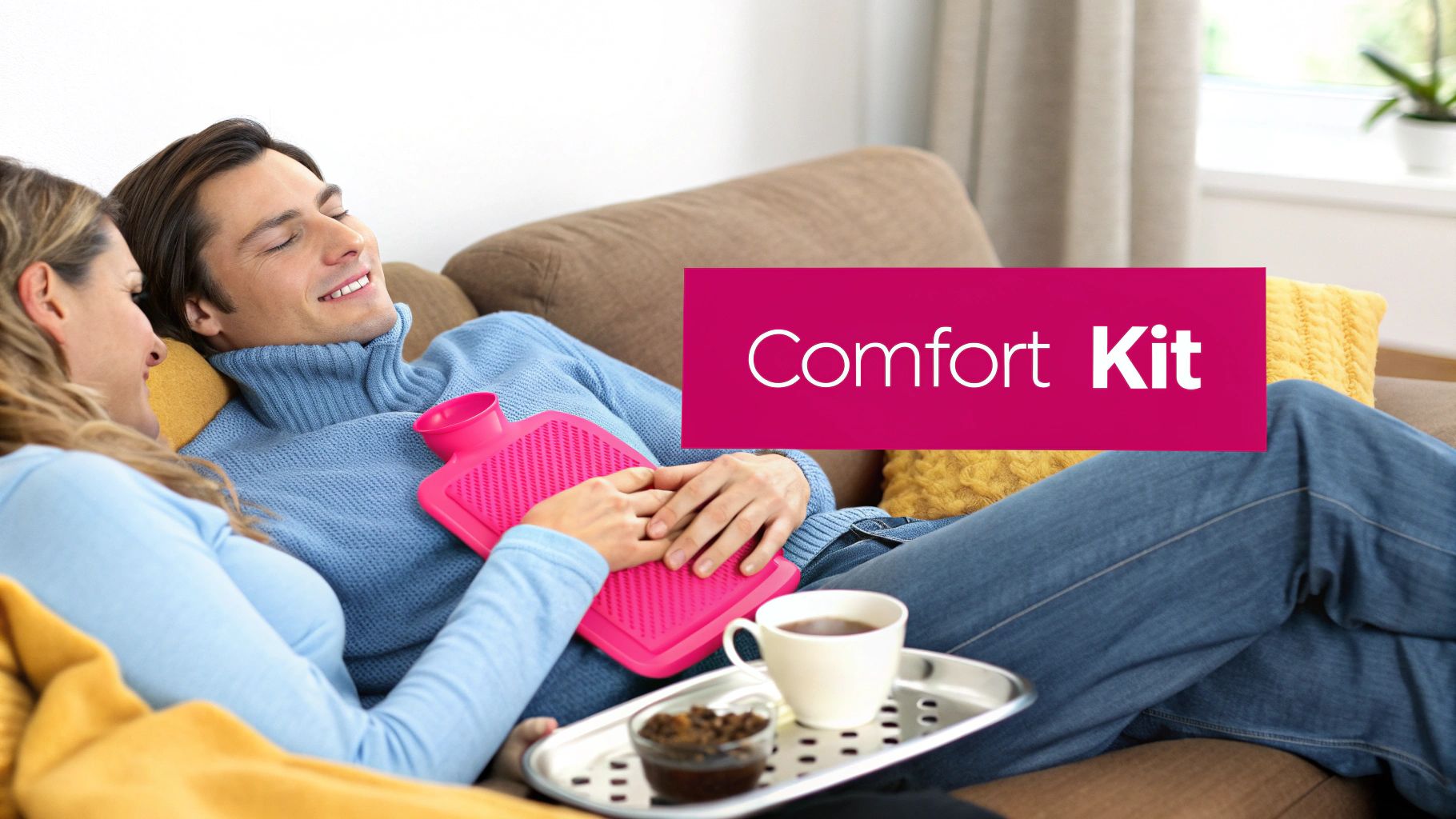
Think of this as her go-to stash for period relief, with you as the one who keeps it stocked and ready. Having these items on hand before she even has to ask is a game changer. It shows you’re not just reacting to her pain, you’re anticipating her needs. It proves you're listening and learning.
Here’s what a solid kit looks like:
- A good heating pad or hot water bottle. This is non negotiable. Heat is proven to relax uterine muscles and can be just as effective as over the counter pain relievers for cramps.
- Her favorite herbal tea. Something like chamomile or ginger tea can be incredibly soothing for an upset stomach and cramps.
- High quality dark chocolate. Look for something with at least 70% cacao. It's not just a cliché treat. Dark chocolate is rich in magnesium, which can genuinely help ease cramps.
- Epsom salts. A warm bath can do wonders for muscle aches, and adding Epsom salts helps reduce inflammation and tension throughout her body.
Pro Tip: Don't wait until she's doubled over in pain to pull this together. Have it ready in a basket or a specific drawer. When she starts feeling rough, you can just say, "Hey, I grabbed your comfort kit for you."
Master the Art of Comfort Food
Food can be a powerful tool for both comfort and relief. Her body is working overtime during her period, and certain foods can make a real difference. You don't need to become a Michelin star chef, but knowing how to make one or two simple, helpful meals is a huge win.
For example, you could whip up a simple salmon and spinach dish. Salmon is packed with anti inflammatory omega 3s, and spinach is loaded with magnesium. Both are great for fighting cramps and fatigue. Understanding how to support her through what she eats is a major plus. You can learn more about eating for your partner's cycle to really get ahead of her needs.
Take on the Physical Load
One of the most practical ways to provide comfort is to simply lighten her load. If she’s dealing with cramps, a sore back, or just feeling completely drained, even small chores can feel like climbing a mountain.
This is your cue to step up without being asked.
- Take over dinner and the cleanup that follows.
- Run the errands she usually handles for the day.
- Offer a gentle back or foot rub (but definitely ask first!).
- Make sure she has a cozy spot on the couch with a blanket and the remote.
These small acts might seem quiet, but they speak volumes. They show you see her discomfort and are willing to physically step in to make her life just a little bit easier.
Mastering Emotional Support and Communication
This is where you can make the biggest difference. While physical comfort is huge, knowing how to communicate and offer genuine emotional support during her period is what transforms a tough week into a moment of real closeness. It’s less about having the perfect script and more about creating a safe space for her to feel whatever she’s feeling, no judgment attached.
Your goal isn’t to solve anything. It's just to be a steady, reassuring presence, letting her know she’s not going through it alone. This is where connection is built.
Listen Without Trying to Fix
When she's venting about her day or how she feels, a guy’s natural instinct is often to jump into "fix it" mode. We want to find a solution, offer advice, or do something to make the problem vanish. But right now, that's probably the last thing she needs.
She needs you to listen. Just listen. It's called active listening, and it’s one of the most powerful things you can do in your relationship. It means actually hearing her out and acknowledging her feelings without immediately trying to engineer a solution.
For example, if she says, "I just feel so overwhelmed and exhausted today," fight the urge to say, "You should go take a nap."
Instead, try validating what she just said.
"That sounds really tough. I'm sorry you're feeling so drained. I'm here for you."
This simple shift changes the entire dynamic. It tells her that you get it and that her feelings are legitimate. You're sitting with her in the feeling, not trying to rush her out of it.
What to Say and What to Avoid
Knowing how to support your partner during her period often comes down to having a few go to phrases in your back pocket. These show you're on her team and ready to help.
- "What do you need from me right now?" This is the gold standard. It’s direct, loving, and puts her in charge.
- "I'm here for you, whatever you need." A simple, powerful reminder that she can count on you.
- "Your feelings are valid." This one is huge. It directly pushes back against any voice, internal or external, telling her she might be overreacting.
Just as important is knowing what not to say. Steer clear of anything that sounds dismissive. Comments like "Is it that time of the month again?" or "You're just being hormonal" are guaranteed to make things worse. They completely invalidate her experience and will absolutely create distance between you.
Your support isn’t just a nice to have. It has a real, measurable impact. A 2016 study found that when partners were taught how to provide better support, women experienced a 27% reduction in PMS symptom severity in just three months. Your empathy literally makes a difference.
Ultimately, being a true support system turns a difficult time into a shared experience, and that's what strengthens your bond.
Using VibeCheck to Become the Partner Who Gets It
Knowing all the right things to say and do is one thing. But knowing when to do them? That’s what separates a good partner from a great one. This is where you move from just reacting to her needs to actually anticipating them, which makes all the difference.
Instead of trying to memorize what the "luteal phase" means, you can use a tool designed to give you a simple heads up. It’s about turning complex cycle science into simple, actionable insights that you can actually use.

From Guesswork to Getting It Right
Imagine getting a notification in the morning that takes all the guesswork out of the day. VibeCheck is built to do just that. It translates her cycle data into practical suggestions tailored for you. It's not about spying on her. It's about getting on her team.
For example, you might get a tip that says:
- "Her energy is likely dipping today. A great time to offer to handle dinner or tidy up the living room."
- "She's probably feeling more social and connected right now. Perfect evening for a date night."
- "Communication might feel a bit sensitive today. Lead with extra patience and validation in your conversations."
These aren't just generic reminders. They’re personalized cues based on where she actually is in her cycle, helping you show up in the exact way she needs you, right when she needs it. This kind of proactive approach shows you're paying attention on a whole new level.
You’re not just remembering her period is coming. You’re becoming attuned to her entire monthly rhythm, which is the core of being a truly supportive partner.
Real Scenarios, Made Easier
Think about those moments of miscommunication that seem to come out of nowhere. Often, they’re rooted in a simple mismatch of energy or emotional capacity driven by hormonal shifts. VibeCheck helps bridge that gap.
Let’s say you were planning a big social outing for the weekend, but the app notes she’s entering her late luteal phase, a time when her social battery is often running on empty. You get a heads up and can pivot.
Instead of pushing for the party, you can say, "Hey, I was thinking maybe we could have a chill weekend instead. How does a movie night on the couch sound?"
You just avoided a potential conflict and showed her that her comfort is your priority. All because you had a little timely insight. The app helps you connect the dots between her cycle and her daily life. To see more examples, check out our guide on how VibeCheck provides relationship insights for men.
This is about more than just tracking a period. It's about building a deeper understanding and empathy that strengthens your connection every single day of the month. It’s your playbook for becoming the partner who truly gets it.
Common Mistakes to Avoid and What to Do Instead
Even with the best intentions, it's easy to say or do the wrong thing when your partner is on her period. We've all been there. This isn't about walking on eggshells. It's about learning a few simple shifts that can turn a potentially tense moment into one of real connection.
Learning how to support your partner during her period often means unlearning a few common, knee jerk reactions. The goal is always to make her feel seen and validated, not dismissed or misunderstood. It's about connection, not correction.
Ditching the "Fix It" Mindset
When your partner is in pain or feeling down, your first instinct is probably to offer solutions. It’s natural. But during this time, she’s usually looking for empathy, not a project manager. Rushing to "fix" her feelings can accidentally send the message that her emotions are an inconvenient problem to be solved.
Instead of jumping in with advice, start by simply validating what she's feeling. Let her know that it's okay to feel whatever she's feeling. This small shift from fixing to feeling with her is a massive step toward providing the support she actually needs.
The Problem with Period Jokes
You might think you’re lightening the mood by making a joke about her period or PMS, but it almost always backfires. These kinds of comments can make her feel stereotyped, and it trivializes the very real physical and emotional experience she's going through. It reduces her feelings to a punchline, which is the exact opposite of being supportive.
Even if you mean it playfully, it’s a risk that’s just not worth taking. Trust me, there are plenty of other ways to share a laugh together that don't involve her biology. Keep the humor, but aim it elsewhere.
Supportive Swaps for Better Communication
Sometimes, small changes in how you phrase things can make a huge difference in how supported your partner feels. It shows you're actually listening and trying to understand her experience from her perspective.
Here are a few simple swaps to try:
Supportive Swaps for Better Communication
| Instead of Saying This | Try Saying This Instead |
|---|---|
| "Are you on your period?" | "You seem a bit down today. How can I support you?" |
| "You're just being hormonal." | "It sounds like you're having a really tough time. I'm here for you." |
| "Just try to relax." | "What would feel most comforting to you right now?" |
These little changes are powerful because they shift the focus from diagnosing her to connecting with her. You're opening up a conversation instead of just making an assumption.
Your job isn't to be a mind reader or a doctor. It's to be a partner. Asking thoughtful, open ended questions is the most direct path to giving her what she actually needs in that moment.
By steering clear of these common missteps, you build trust and create a safe space for her to be vulnerable. That's the foundation of any strong, connected relationship. For more ideas, check out our guide on relationship advice for men.
Frequently Asked Questions
It's totally normal to have questions. In fact, it’s a good sign. It means you’re invested in getting this right. Let's tackle a few common scenarios you might run into.
What if she just wants to be left alone?
This one can feel counterintuitive. You want to help, but she’s pushing you away. The best thing you can do here? Actually listen and give her that space. Respecting her request shows you trust her to know what she needs, which is a powerful way to show support. It’s not about abandoning her. It's about honoring her boundaries. You can still be present without being in her space. A simple text can bridge that gap. Try something like, “Hey, just wanted you to know I’m thinking of you. I’m here whenever you need me.” It’s low pressure, shows you care, and keeps the door open.
Her symptoms seem way more intense than usual. What should I do?
If you're noticing that her pain is debilitating or her mood swings feel extreme and out of character, it’s worth paying attention. This isn't about you playing doctor, but about being a concerned partner. Serious conditions like PMDD (Premenstrual Dysphoric Disorder) or endometriosis are often dismissed as "just a bad period." They aren't. They require a real diagnosis from a medical professional. Here's how you can help: gently suggest she talk to a doctor. You could say, "I'm worried seeing you in so much pain. Maybe we could look into finding a specialist?" Offer to go with her to the appointment. Most importantly, validate what she’s going through. Saying, "Your pain is real, and we'll figure this out together," can mean the world.
How can I bring up using a cycle tracking app without being weird?
Yeah, this can feel like a delicate conversation. The key is to frame it as a tool for you to become a better partner, not as a way to "fix" or monitor her. Instead of putting the focus on her, put it on yourself. Try this approach: “I’ve been reading about how to be more in tune with your cycle so I can be a better partner. I found this app called VibeCheck that’s supposed to help guys like me understand what’s going on and how to show up better. Would you be open to trying it out with me?” This makes it about your initiative and desire to improve your relationship advice for men skills. It’s a team oriented suggestion, not a demand.
Should I just guess what she needs, or should I ask?
When in doubt, ask. Always ask. You might think a surprise chocolate bar is a surefire win, but what if she’s feeling nauseous and it’s the last thing she wants? Her needs can shift dramatically from one day to the next, so what worked last month might not work today. Don't try to be a mind reader. The most supportive question you can ask is often the simplest: “What’s one thing I could do that would make you feel even a little bit better right now?” This takes all the guesswork out of it. It empowers her to tell you exactly what she needs and ensures your efforts will actually land the way you want them to.
Is it normal for her sex drive to change during her period?
Yes, it's completely normal. Hormonal fluctuations throughout her cycle have a big impact on libido. For some women, it might decrease during her period due to discomfort, while for others, it might actually increase. There’s no single rule. The most important thing is to have an open conversation about it. Check in with her, respect her boundaries, and don't make assumptions. Communication is everything.
Ready to stop guessing and start getting it right? VibeCheck gives you the daily insights you need to be the partner who just gets it. Download VibeCheck today and turn cycle science into your relationship superpower.
Tags

Related Articles
Continue reading to deepen your understanding

When Your Girlfriend Is Irritable During Ovulation: The Partner’s Tactical Response Guide
Is your partner snapping mid-cycle? Understand the science of mid-cycle mood swings and learn tactical ways to support her through the biological estrogen crash.

Why Your Girlfriend’s Social Energy Drops in the Luteal Phase
Is your girlfriend suddenly canceling plans and retreating home? It isn’t personal; it’s biology. Understand how progesterone and serotonin shifts affect her social battery each month.

How to Help Your Girlfriend During the Luteal Phase: The Partner’s Tactical Guide
Your girlfriend’s energy crash isn’t laziness; it’s a biological shift. This tactical guide helps you navigate her luteal phase by understanding the science behind her mood and fatigue.

Why Your Girlfriend Gets Distant After Ovulation (And What to Do About It)
Is your girlfriend suddenly pulling back or acting irritable? It might be her cycle. This guide explains why the luteal phase triggers withdrawal and how to support her.

Supporting Your Girlfriend Through the Luteal Phase
When hormone levels crash before her period, your partner’s brain enters a high-alert state. Learn how to provide the security she needs with tactical scripts and empathy.

How to Give Your Girlfriend Reassurance During Ovulation Week
Is your girlfriend suddenly questioning everything during her cycle? Understand the estrogen crash and learn how to provide the tactical support she needs to feel secure and loved.

When to Give Her Space vs. When to Stay Close: Your Phase-by-Phase Guide
Your girlfriend’s need for closeness isn’t random. Understanding how her 28-day biological rhythm affects her energy helps you time your support perfectly across all four phases.

Your Girlfriend’s 28-Day Relationship Manual: How to Support Her Through Every Phase
Understanding her menstrual cycle transforms you from a guy walking on eggshells into a strategic partner who knows exactly what support to offer and when.