What Does Relatio Actually Teach Men? (Honest Breakdown)

Relatio gives men a framework for relationships — but how does it compare to how we designed VibeCheck? We break down exactly what it teaches, what it offers, and how it compares to our approach.
The Relatio Playbook: What Advice the App Actually Gives Men (And Whether It Works)
Editorial transparency disclosure
This article is published by VibeCheck. We make and sell VibeCheck, an AI relationship app for men that competes in the same market as Relatio. The article therefore reflects our own perspective and includes promotional links to VibeCheck. Comparative observations about Relatio reflect our team's review of publicly available information from Relatio's own website and app store listings as of the dates noted; readers should consult Relatio directly at getrelatio.com for current product information and pricing.
Last editorial review: 28 April 2026.
Table of Contents
- Introduction: The Viral "Relatio" Phenomenon
- The Relatio Core Philosophy: Emotional Independence
- The "4 Phases" Deep Dive: Your Tactical Roadmap
- The Relatio Approach: Subscription Model and Value Assessment
- Your Phase-by-Phase Cheat Sheet
- Frequently Asked Questions
Introduction: The Viral "Relatio" Phenomenon
BLUF: Relatio is an AI-powered app that teaches men to anticipate their partner's emotional needs by tracking the four phases of her menstrual cycle, positioning itself as a framework to help men translate hormonal patterns into relationship strategies.
If you're looking for a period tracker that's actually built for boyfriends (not a Relatio retread), see our pick.
You've seen the TikToks. A guy explains how he approaches his relationship by downloading an app that tracks different phases of his girlfriend's menstrual cycle and adjusts his approach accordingly. Another clip shows a man holding up his phone like it's a reference tool: "Phase 3, boys. This is the high-energy window."
The Relatio app has become notable among men who are interested in understanding the menstrual cycle's relationship impact. The pitch is straightforward: hormones drive mood and energy in patterns that follow the menstrual cycle. If you understand the four distinct phases, you can shift from reacting day-to-day to understanding the biological patterns underneath.
But what does Relatio actually tell men to do? In our view, how does Relatio's curriculum compare to how we designed VibeCheck's approach? And how does this knowledge actually translate into practice?
This guide breaks down the advice Relatio provides for each cycle phase, the psychological principles behind it, and what you should consider when evaluating whether this approach fits your relationship.
The Relatio Core Philosophy: Emotional Independence
BLUF: Before diving into phase-specific tactics, Relatio teaches men to develop emotional stability and self-regulation, positioning this as the foundation for supporting a partner through hormonal changes.
The real foundation of Relatio's approach isn't actually about tracking periods. It's about a fundamental shift in how men show up in relationships. The app's opening modules emphasize two interconnected concepts:
"Parent Yourself" Principle: When your partner is irritable during the luteal phase, your instinct might be to seek reassurance or get defensive. Relatio's core teaching is that you need to regulate your own emotions first. She's not responsible for managing your feelings about her feelings. This isn't about becoming an emotional robot; it's about developing enough internal stability that you don't need her validation to feel secure.
Think of it this way: if you're walking a tightrope and someone next to you starts wobbling, you don't help them by also starting to wobble. You plant your feet and offer a steady hand.
"Protect the Relationship, Not the Ego" Principle: Most relationship conflicts escalate because someone prioritizes being right over being connected. Relatio trains men to identify when their ego is driving a situation. When she expresses something critical during her premenstrual window, the app's advice is to recognize the biological sensitivity influencing the moment and choose not to escalate.
This doesn't mean becoming a doormat. It means understanding the difference between a genuine relationship issue that needs addressing and a moment of heightened sensitivity that will naturally shift in a few days.
The shift Relatio advocates for is from reactive response to proactive support. It's the difference between reacting to emotional fluctuations and understanding the biological patterns underneath them. For men exploring cycle-based relationship support, this emotional foundation is what shapes whether the approach becomes partnership or becomes about manipulation.
For men exploring relationship advice that focuses on cycle syncing, this emotional independence foundation is what separates effective support from problematic dynamics.
The "4 Phases" Deep Dive: Your Tactical Roadmap
BLUF: Relatio's framework divides the menstrual cycle into four distinct phases, each with distinct biological characteristics and corresponding relationship strategies that Relatio argues can help men shift from confusion to intentional support.
This is where Relatio's practical advice becomes specific and tactical. The app frames the menstrual cycle as four distinct phases, each with its own biological characteristics that Relatio argues shape relationship dynamics.
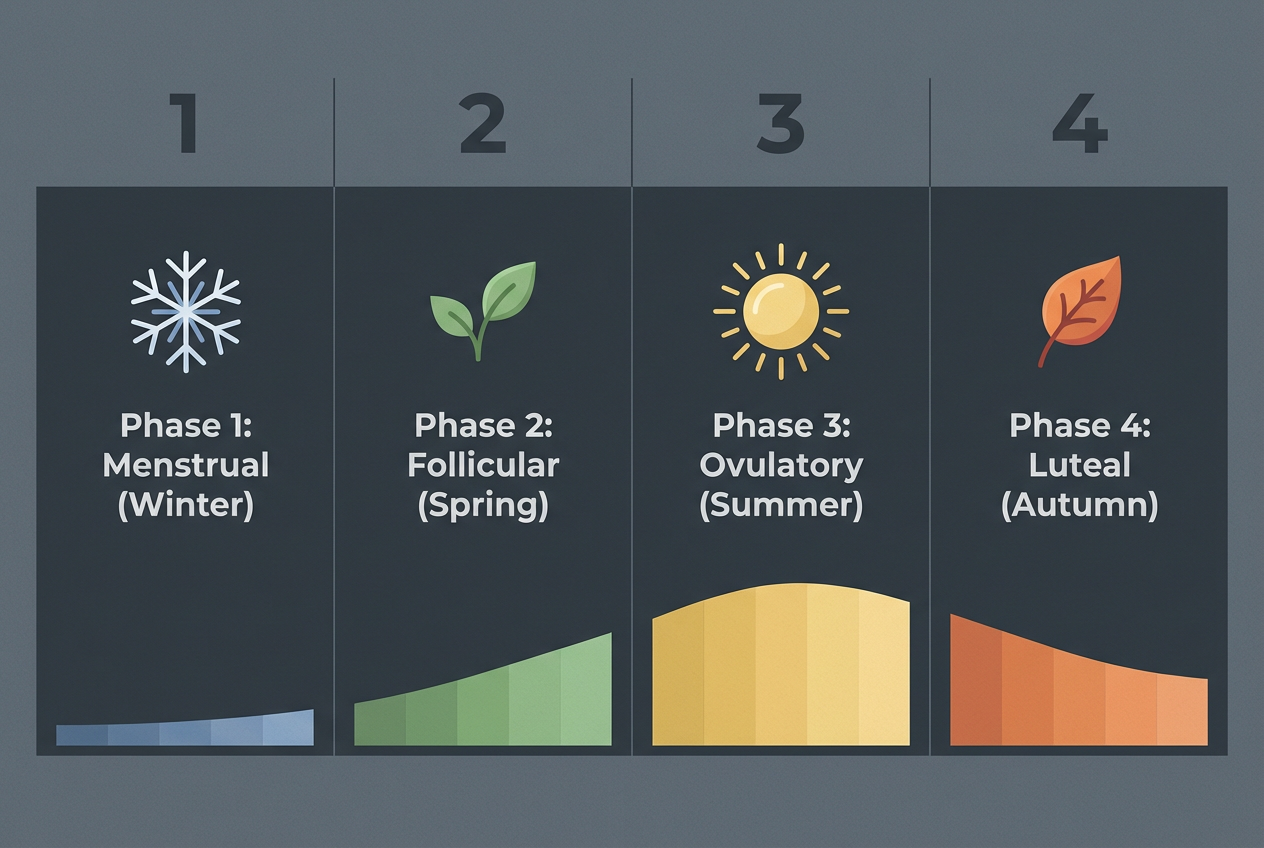
Relatio's framework groups the menstrual cycle into four phases, with distinct biological characteristics in each.
Phase 1: The Menstrual Phase (Winter - Days 1-5)
The Biology: Both estrogen and progesterone are at their lowest levels. This creates the biological equivalent of a battery running at 20%. Her body is literally shedding the uterine lining, which requires significant energy and often comes with physical discomfort ranging from mild cramping to debilitating pain.
What Relatio Tells You: Relatio frames this phase as a time for physical comfort and low-stakes presence. The app's advice centers on handling household logistics and creating space for her to manage physical discomfort without also managing emotional labor.
Specific Relatio recommendations include:
- Take over all decision-making for 3-5 days (what to eat, what to watch, weekend plans)
- Stock her preferred comfort items before she needs them (heating pad, specific snacks, pain relief)
- Minimize social obligations and cancel plans without making her the "bad guy"
- Keep physical intimacy to whatever she initiates; default assumption is no
The Critical Relatio Insight: Don't take her withdrawal personally. This isn't about you or the relationship. Her nervous system is in conservation mode. The advice specifically warns against interpreting her need for space as rejection or relationship dissatisfaction.
Pro-Tip from the App: If she seems distant or less communicative, the recommended script is simple acknowledgment: "I know you're not feeling great. I've got everything handled. Just rest." Then actually handle everything.
Phase 2: The Follicular Phase (Spring - Days 6-12)
The Biology: Estrogen begins its climb, bringing energy, optimism, and cognitive clarity. This is the biological rebound phase where she starts feeling like herself again after the menstrual low.
What Relatio Tells You: Relatio positions this as an opportunity window. She's open to new ideas, social activities, and forward-thinking conversations. The app calls this the "Yes Phase," suggesting that proposing a weekend trip, trying a new restaurant, or discussing bigger relationship topics will meet with more receptive response.
Specific Relatio recommendations include:
- Schedule date nights during this window for maximum engagement
- Introduce new activities or experiences you want to try together
- Have important conversations that require clear-headed discussion
- Collaborate on planning rather than executing alone
The Critical Relatio Insight: This phase creates opportunity for shared momentum. The energy is rising but not yet peaked, so it's ideal for building connection through shared experiences rather than just coexisting. The app argues that being passive during this window is leaving relationship capital on the table.
Pro-Tip from the App: Use the question "What sounds fun to you this week?" during the follicular phase. Her answer will reflect her genuine interests rather than hormonal constraints.
Men using period tracker apps specifically designed for boyfriends find that marking this phase helps them plan meaningful connection rather than leaving romance to chance.
Phase 3: The Ovulatory Phase (Summer - Days 13-16)
The Biology: Estrogen peaks and testosterone surges. This is the peak fertility window of the cycle. Energy, confidence, and sex drive are biologically at their highest point.
What Relatio Tells You: Relatio positions this as the peak intimacy window. The app teaches that if you're going to prioritize romantic gestures or physical connection, this is when receptivity is highest biologically. She's primed for confidence, social engagement, and physical intimacy.
Specific Relatio recommendations include:
- Prioritize quality time and physical connection
- Plan the most ambitious dates (nice dinners, special experiences)
- Compliment her appearance (she'll be most receptive)
- Take social opportunities (she'll be at her most outgoing)
The Critical Relatio Insight: This phase is brief, typically only 3-4 days. Relatio emphasizes that missing this window means waiting another 3-4 weeks for the next peak. The app frames ovulation as the "green light" phase where hesitation works against connection.
Pro-Tip from the App: The recommended mindset is "Show up boldly." This isn't the phase for tentative approaches. The biology supports connection.
For couples looking to understand connection patterns, Relatio's framework in this phase is about recognizing biological windows. Understanding this peak phase matters for relationship approaches that consider biological timing.
Phase 4: The Luteal Phase (Autumn - Days 17-28)
BLUF: The luteal phase, particularly the final 7-10 days, is where Relatio argues most relationship tension originates. The app's advice focuses on validation over problem-solving and maintaining your emotional stability when she's experiencing heightened sensitivity.
The Biology: Progesterone rises and then crashes. This hormonal drop creates heightened emotional sensitivity. Neurotransmitters like serotonin also dip, which can amplify emotional sensitivity and fatigue. The result is that things that feel manageable other weeks feel more overwhelming during this window.
What Relatio Tells You: Relatio's entire strategy here centers on one principle: validate, don't fix. When she expresses frustration, your instinct to offer solutions will likely backfire. What she often needs isn't a solution but acknowledgment that what she's feeling is real and difficult.
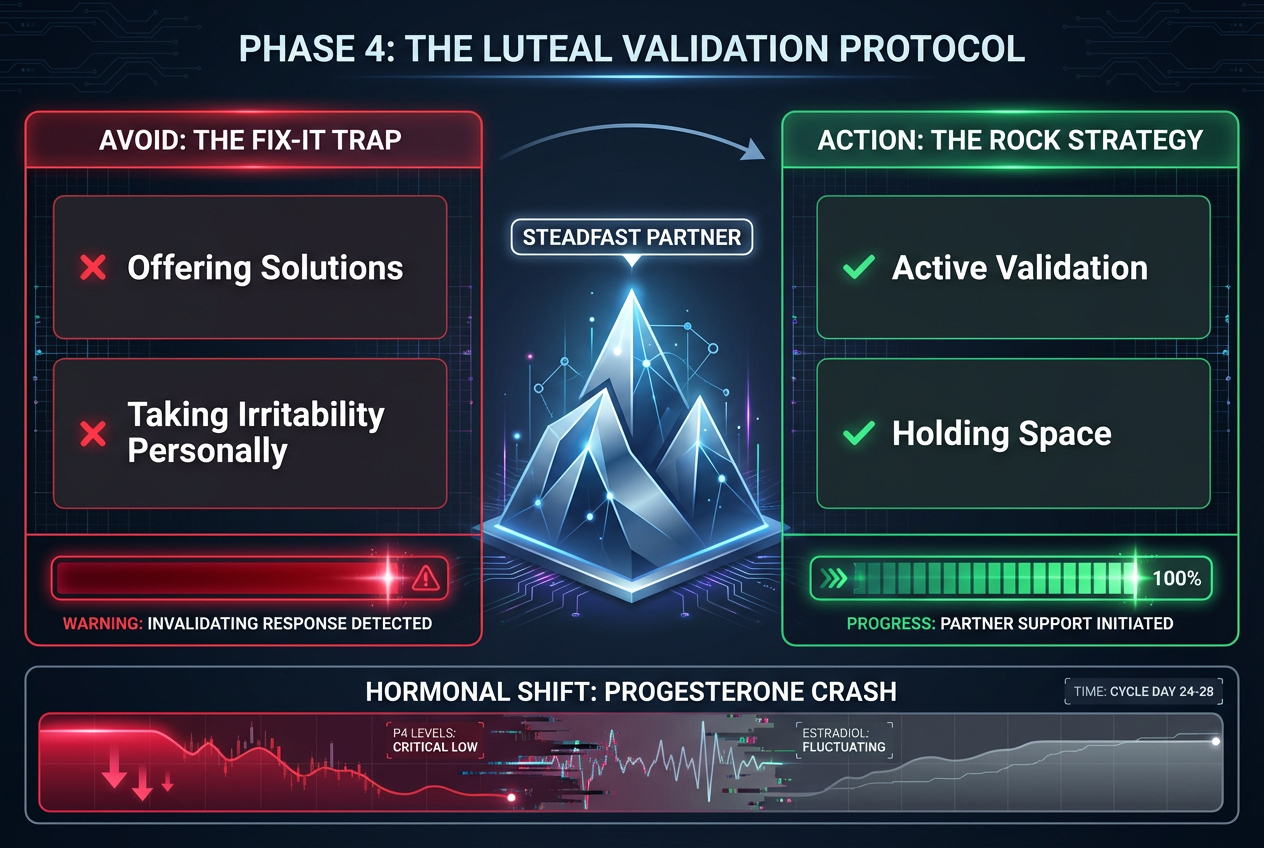
Relatio's framework for the luteal phase emphasizes validation and emotional grounding as primary strategies.
Specific Relatio recommendations include:
- Respond to complaints with "That sounds really frustrating" instead of "Here's how to fix it"
- Increase physical comfort offerings (back rubs, cooking her favorite meals) without being asked
- Avoid criticism of any kind, even constructive feedback
- Give extra space if she's withdrawn; don't demand connection
- Don't take irritability or criticism personally (heightened sensitivity is real, though temporary)
The Critical Relatio Insight: Relatio teaches that what feels like a relationship crisis during late luteal phase often shifts by day 3-4 of her next cycle. Arguments that happen in days 24-28 frequently lose their emotional charge once hormones reset. The strategic move is not to make permanent decisions or have high-stakes conversations during this window.
The app warns against conflating temporary hormonal sensitivity with permanent relationship issues. Relatio teaches men to address legitimate concerns during the follicular phase, after the hormonal window has shifted.
Pro-Tip from the App: If it feels like everything you do is wrong during this phase, you're probably in the late luteal window. The recommended mindset is "This is temporary biology, not permanent relationship reality." Stay steady without becoming defensive.
Understanding how to navigate this phase is relevant to approaches that address conflict patterns and communication timing. Relationship damage most often happens when men interpret heightened sensitivity as fundamental relationship failure.
The Relatio Approach: Subscription Model and Value Assessment
BLUF: Per Relatio's published materials as of 28 April 2026, Relatio costs $12-20/month and positions itself as structured coaching for cycle-aware relationship support. There is legitimate debate about whether you're paying for personalized guidance or standardized cycle information with subscription packaging.
Let's address the elephant in the room: Relatio receives varied feedback. Some users report significant relationship improvements. Others question the value proposition and subscription model.
The Pricing and Value Debate: The cycle awareness Relatio teaches is grounded in established endocrinology. The advice to be more present during menstruation and more romantic during ovulation isn't proprietary. Some users argue they're paying for information available through free cycle education.
The subscription model draws questions from some users. You're essentially paying monthly for access to tracking and daily coaching. If you discontinue, you lose access to the calendar and coaching features. For some, this feels like a significant cost for information that could be sourced elsewhere.
The Counter-Argument: Supporters argue that while cycle science is available freely, consistent implementation is where most men struggle. Knowing that progesterone drops during the luteal phase doesn't automatically translate to the emotional regulation needed to not take irritability personally. The value, they argue, is in the daily structure, specific frameworks, and real-time guidance.
The Middle Ground: Per Relatio's model, the subscription probably makes most sense as a structured learning tool for the first 3-6 months while you're learning patterns and internalizing principles. After tracking 2-3 full cycles, you may have internalized enough that you don't need daily coaching. The knowledge becomes intuitive.
For comparison, alternatives like VibeCheck offer different approaches to partner-focused relationship support with different pricing models.
Your Phase-by-Phase Cheat Sheet
BLUF: This reference table summarizes Relatio's core advice for each cycle phase, giving you a tactical roadmap without needing the app's daily notifications.
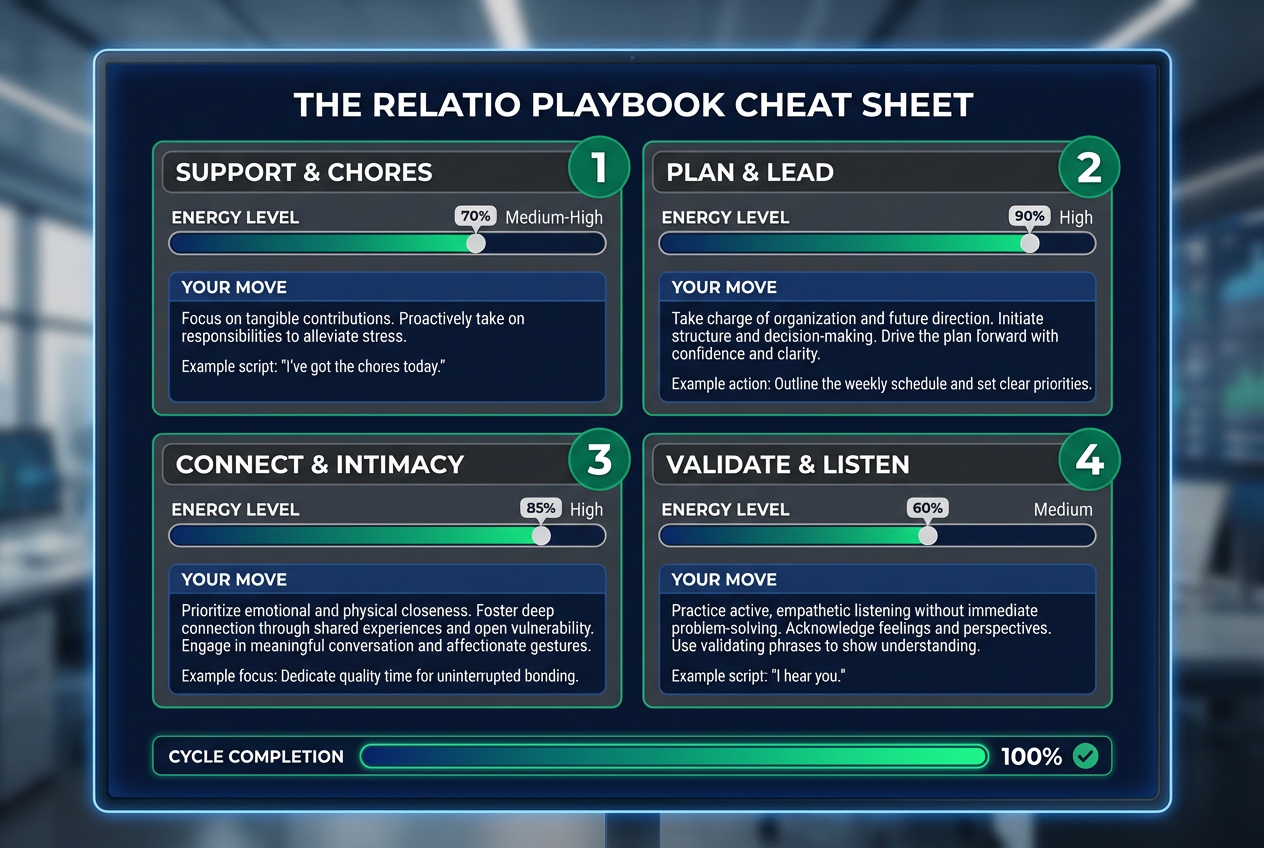
Relatio's phase-by-phase framework, summarized for reference.
| Phase | Duration | Her Energy State | Your Primary Move | What to Prioritize | What to Avoid |
|---|---|---|---|---|---|
| Menstrual (Winter) | Days 1-5 | Low, hibernating, physically uncomfortable | Handle all logistics and create comfort | Physical comfort, taking over decisions, quiet presence | Pressuring for social time, demanding emotional labor, initiating sex |
| Follicular (Spring) | Days 6-12 | Rising, optimistic, open to new experiences | Plan adventures and meaningful dates | Collaboration, new experiences, important conversations | Being passive, wasting the "yes" window, routine dates |
| Ovulatory (Summer) | Days 13-16 | Peak energy, confidence, and receptivity | Show up boldly with romance and intimacy | Physical connection, ambitious dates, big gestures | Hesitation, playing it safe, missing the narrow window |
| Luteal (Autumn) | Days 17-28 | Declining energy, increasing sensitivity (especially days 24-28) | Validate feelings without fixing, stay emotionally grounded | Listening, validation, physical comfort, patience | Offering solutions, taking irritability personally, having high-stakes talks |
How to Use This Cheat Sheet:
Track her cycle using either her app data (with permission) or by marking day 1 of each period on your calendar. Once you know day 1, you can roughly predict the phases.
Set calendar reminders for phase transitions. Even if you don't use Relatio, a simple phone reminder on days 6, 13, and 17 can prompt you to adjust your approach.
Review the "avoid" column during each phase. Relationship tension usually comes from doing the wrong thing at the wrong time, not from failing to do the perfect thing.
Adjust for individual variation. Not every woman experiences textbook cycles. Some have shorter follicular phases, others have longer luteal phases. The cheat sheet is a starting template; customize it based on what you observe over 2-3 months.
For men who want a structured approach to implementing this knowledge, apps specifically designed for male partners can provide tracking tools without requiring you to memorize cycle math.
Frequently Asked Questions
What is the Relatio app and who is it for?
Relatio is a subscription-based mobile app that provides men with AI-powered coaching on how to support their female partners through the menstrual cycle. It's designed for men in committed relationships who are interested in understanding how hormonal cycles shape their partner's experience. The app combines cycle tracking with daily coaching. It's particularly popular with men who want to understand why their partner's needs seem to vary across the month.
What is the scientific foundation of Relatio's advice?
The biological foundation of Relatio's advice is grounded in established endocrinology. The four-phase menstrual cycle model and the hormonal fluctuations that shape mood and energy are well-documented in scientific literature. Where reasonable debate exists is in how universally this applies, since individual women experience cycles differently. The practical effectiveness of Relatio's coaching seems to depend significantly on whether the man implements the advice with genuine intent to be supportive rather than transactional.
How much does Relatio cost, and is it worth the subscription?
Per Relatio's published pricing as of 28 April 2026, Relatio typically costs between $12-20 per month, depending on subscription length. Whether it's "worth it" depends on what you're comparing it to. If you're comparing it to couples therapy at $150-250 per session, the app is dramatically cheaper. If you're comparing it to reading free blogs about cycle awareness, you're paying for structure and ongoing guidance. Most users find the app most valuable as a learning tool during the first 3-6 months, with diminishing returns once the patterns become intuitive.
Can I use Relatio if my partner has irregular cycles or is on hormonal birth control?
Relatio is designed around natural menstrual cycles, so its framework is most applicable for women not using hormonal birth control, which suppresses the natural hormonal fluctuations the app tracks. Women on birth control often still experience the hormone-free interval, which creates a version of the menstrual phase. For irregular cycles, the app can still be useful if your partner logs actual period start dates, allowing you to track backward. Some men find that alternatives like VibeCheck or broader period tracker apps for couples handle irregular cycles with more flexibility.
What if my partner finds it uncomfortable that I'm tracking her cycle?
This is a legitimate concern. The key is transparency and authentic intent. Most women appreciate a partner who wants to understand their experience better, but they're rightfully cautious about a partner who's tracking cycles to predict behavior or avoid difficult conversations. The recommended approach is to be honest: "I've been learning about how the menstrual cycle affects energy and mood, and I want to be more supportive. Would you be comfortable if I tracked your cycle so I can be more aware of your needs?" Frame it as supporting her. Never use cycle knowledge as a weapon in arguments.
Does Relatio tell men not to ask for sex during certain phases?
Relatio's teaching is more nuanced than a blanket rule. What the app actually teaches is that your approach should shift based on what's happening biologically. During menstruation and late luteal phase, the advice is to let her initiate because receptivity is typically lower. During the ovulatory phase, the advice is that she's biologically more receptive, so initiating is more likely to be welcomed. The underlying principle is about matching your approach to her actual state rather than expecting constant availability.
What's the difference between Relatio and other period tracking apps?
Most period tracking apps are designed for women to track their own cycles for health or fertility purposes. Relatio is specifically designed for male partners and focuses on relationship strategy rather than medical tracking. Apps like Flo or Clue track cycle phases, but they don't provide relationship guidance for partners. Relatio translates cycle data into relationship strategies. Newer platforms like VibeCheck offer similar partner-focused features with different coaching approaches and pricing models.
How long does it take to see results from following this approach?
Most users report noticing shifts within one full cycle (approximately one month) if they're implementing the framework consistently. The first cycle is typically about observation and learning your partner's specific patterns. The second cycle is where the framework starts feeling more natural. The biggest mistake men make is expecting immediate change; sustainable relationship shifts typically take 2-3 cycles. Think of it like learning any new skill: you'll be awkward at first, make mistakes, and gradually develop intuition that makes it second nature.
The bottom line: Relatio's framework is built on established cycle biology and practical relationship psychology. The app teaches men to shift from reactive confusion to intentional support by understanding how hormonal phases shape their partner's experience. Whether you need to pay for an app to learn these principles is debatable; the principles themselves are grounded in sound biology and relationship psychology. The men who report success with this approach are the ones who use the knowledge to build genuine empathy and intentional support.
Understanding your partner's cycle is fundamentally about recognizing that Tuesday feels genuinely different from Friday because of real biological changes, not because she's unpredictable. It's about choosing to learn her patterns and matching your support to her actual state, consistently, over time.
The real foundation isn't an app. It's choosing to understand her biological rhythm and showing up thoughtfully with that understanding, even when it's inconvenient. That's what frameworks like Relatio try to teach. Whether you use a paid app or learn it elsewhere is up to you.
Tags

Related Articles
Continue reading to deepen your understanding

Understanding Why Your Girlfriend’s Communication Style Shifts Weekly
Ever wonder why your partner’s moods and energy levels shift so much? Understanding the four phases of her menstrual cycle helps you become a more supportive and proactive partner.

When Do Your Girlfriend’s Energy Levels Change During Her Cycle?
Your girlfriend’s mood and stamina follow a biological rhythm. Learn how her energy peaks and crashes throughout the month so you can plan better dates and provide better support.

Why Your Girlfriend Needs Different Attention Each Week: The Four Seasons Framework
Stop walking on eggshells and start understanding her cycle. This framework shows you exactly how to support your girlfriend through all four biological phases every month.

Why Your Girlfriend Wants Space the Week Before Her Period
Does your girlfriend suddenly pull away every month? Discover the biological reasons behind the pre-period space window and how to navigate this phase together.

Why Your Girlfriend Wants Different Kinds of Affection at Different Times in Her Cycle
Ever feel like your girlfriend’s needs change every week? It’s not random. Understand how the four phases of her cycle drive her desire for intimacy so you can support her better.

How to Plan Romantic Gestures by Cycle Timing: The Partner’s Tactical Guide
Stop guessing why your date night plans fell flat. This guide explains how to synchronize your romantic efforts with her biological cycle for better intimacy and connection.

How to Tell When Your Girlfriend Is Ovulating: Reading the Biological Signals Your Partner Sends
Understanding your partner’s cycle helps you anticipate her needs and time important conversations. Learn the behavioral signs of ovulation to improve your relationship and connection.

Understanding Your Girlfriend’s Words of Affirmation Cycle: A Partner’s Guide
Ever feel like your compliments land wrong? Her need for words of affirmation isn’t random—it follows a biological rhythm. Learn how to match your support to her internal hormonal seasons.