The Partner’s Guide to the Luteal Phase: What It Is and How to Support Her

Stop walking on eggshells. Understand the biological changes of the luteal phase so you can support your partner through mood shifts and fatigue with empathy.
The Partner's Guide to the Luteal Phase: What It Is and How to Support Her
You've noticed the pattern. Around the same time every month, your girlfriend goes from making plans and laughing at your jokes to suddenly needing space, getting irritable over small things, or seeming exhausted for no reason. You're not imagining it - and she's not making it up.
Welcome to the luteal phase, the 10-14 day stretch between ovulation and her period when her body undergoes a chemical shift that affects mood, energy, and sensitivity. For men who want to be supportive partners instead of walking on eggshells, understanding this phase isn't about excusing behavior - it's about recognizing biology and responding with intelligence instead of confusion.
This guide explains what's actually happening in her brain and body during the luteal phase, why it feels like a recurring storm, and what you can do to navigate it without escalating conflict or losing your own peace of mind.
Table of Contents
- What Is the Luteal Phase?
- How Long Does the Luteal Phase Last?
- What Happens to Her Body During the Luteal Phase?
- Why Does the Luteal Phase Affect Mood?
- Common Luteal Phase Symptoms (And What They Mean for You)
- The Partner Playbook: How to Support Her During the Luteal Phase
- Red Zone Rules: Conflict Prevention During the Late Luteal Phase
- When It's More Than Just PMS: Recognizing PMDD
- How to Track the Luteal Phase (Without Being Weird About It)
- Frequently Asked Questions
What Is the Luteal Phase?
The luteal phase is the third stage of the menstrual cycle, starting right after ovulation and ending when her period begins. After ovulation, the luteal phase begins: progesterone rises to help prepare the uterine lining for a possible pregnancy. If pregnancy doesn't happen, both progesterone and estrogen drop before the next period. Many women notice PMS-like symptoms in this phase - mood shifts, breast tenderness, bloating, acne, and appetite changes - though not everyone does.
Think of it as the hormonal "comedown" after the high-energy ovulation window. The menstrual cycle has four phases - menstrual (bleeding, ~day 1-5), follicular (day 1 through ovulation, estrogen rising), ovulation (around day 14 in a 28-day cycle, triggered by a surge in luteinizing hormone), and luteal (after ovulation to the next period, progesterone rising then falling). The luteal phase is when her body is chemically preparing for either pregnancy or the next cycle reset.
Here's what makes this phase relevant for partners: it's the biological window when emotional regulation becomes harder, energy drops, and small irritations feel bigger. It's not personal - it's neurochemical.
VibeCheck App
Download Free on iOS →How Long Does the Luteal Phase Last?
The average length of the luteal phase is between 12 and 14 days, with a normal range of 10 to 17 days. For most women, this means the luteal phase takes up roughly half of their cycle.
What does this mean for you? If you're trying to anticipate mood shifts or plan around her cycle, you'll need to track for a few months to identify her specific pattern. Generic "day 14 to day 28" advice won't account for her individual rhythm.
What Happens to Her Body During the Luteal Phase?
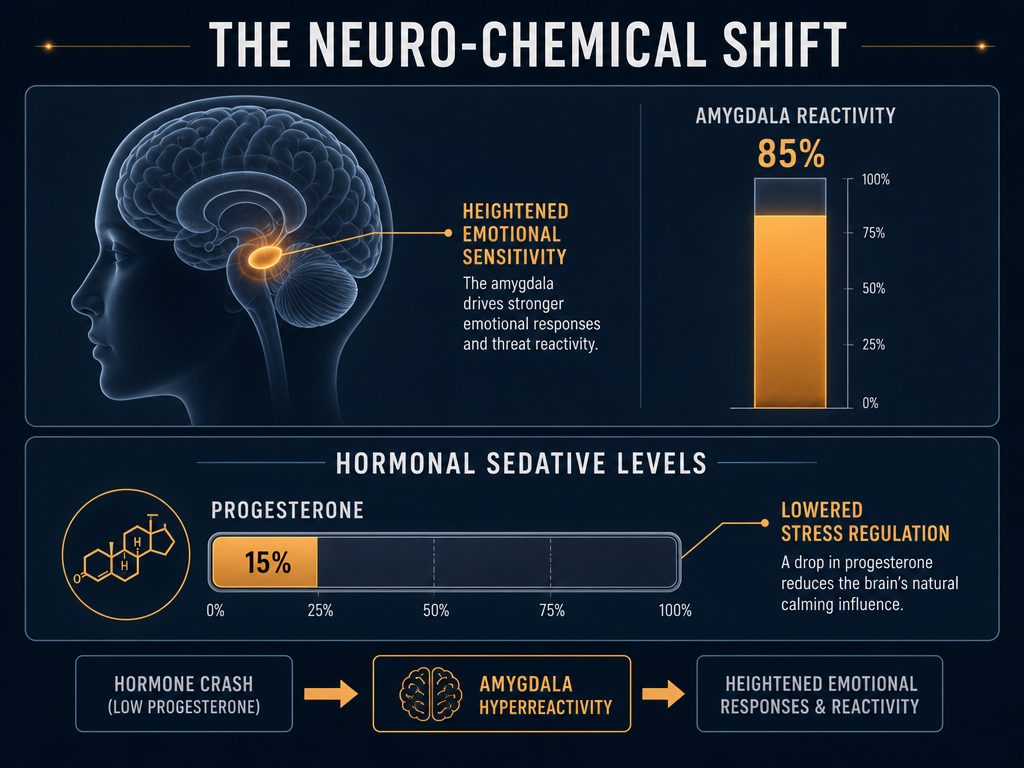
Understanding the biological 'why' behind mood shifts: as natural sedatives like progesterone drop, the brain's emotional center becomes significantly more sensitive to external stressors.
The luteal phase is defined by two major hormonal movements: progesterone rises sharply in the first half, then both progesterone and estrogen crash in the second half if pregnancy doesn't occur.
Here's the biological sequence:
Early luteal phase (days 1-7 post-ovulation): Progesterone rises as the corpus luteum (the structure left behind after the egg is released) produces it to support a potential pregnancy. This hormone has a calming, sedative-like effect on the brain.
Mid-luteal phase (days 8-10 post-ovulation): Progesterone peaks. During the mid-luteal phase, progesterone metabolites typically bind to GABA-A receptors, meaning a drop in these levels directly impacts the brain's ability to regulate stress. When these levels are stable, she may feel relatively balanced.
Late luteal phase (days 11-14 post-ovulation): If no pregnancy occurs, progesterone and estrogen both plummet. This is when the "storm" hits - the brain's natural anxiety regulators are running out of fuel, and emotional reactivity spikes.
Estrogen affects many body systems, including brain function and the ability to focus, and levels are highest in the days leading up to ovulation. When estrogen crashes in the late luteal phase, it takes serotonin - the neurotransmitter associated with mood stability - down with it.
This isn't just about hormones fluctuating. It's about the brain losing access to its chemical safety net.
Why Does the Luteal Phase Affect Mood?
The simple answer: her brain chemistry is changing, and the structures responsible for emotional regulation are under pressure.
The brain shows increased amygdala reactivity during the luteal phase, which is associated with heightened emotional processing. The amygdala is the part of the brain that processes threat and emotion. When progesterone metabolites drop, the amygdala becomes more sensitive - meaning things that wouldn't normally register as stressful suddenly feel overwhelming.
Think of progesterone as the brain's natural sedative. When it surges during the early luteal phase, it has a calming effect. But when it crashes in the late luteal phase, that safety net is gone. The result: heightened sensitivity to stress, reduced emotional buffer, and increased reactivity.
This also explains why sounds seem louder, lights seem harsher, and your normally patient girlfriend suddenly can't handle the noise from your video game. Her nervous system is genuinely more dysregulated during this phase.
Common Luteal Phase Symptoms (And What They Mean for You)
Understanding the symptoms helps you distinguish between "she's upset with me" and "her brain is chemically overwhelmed."
Physical symptoms:
- Breast tenderness
- Bloating
- Headaches
- Fatigue
- Food cravings (especially carbs and sweets)
- Acne
Emotional and cognitive symptoms:
- Mood swings
- Irritability
- Anxiety
- Feeling overwhelmed
- Difficulty concentrating
- Lower tolerance for noise, mess, or social demands
28.61% of women report that premenstrual symptoms interfere with their everyday life during every menstrual cycle. This is not a fringe experience - it's a predictable biological pattern affecting a significant portion of women.
What does this mean for you as a partner? When she snaps at you for leaving dishes in the sink or seems exhausted after a normal day, it's not always about the dishes or the day. Her tolerance for minor friction has genuinely decreased.
The Partner Playbook: How to Support Her During the Luteal Phase
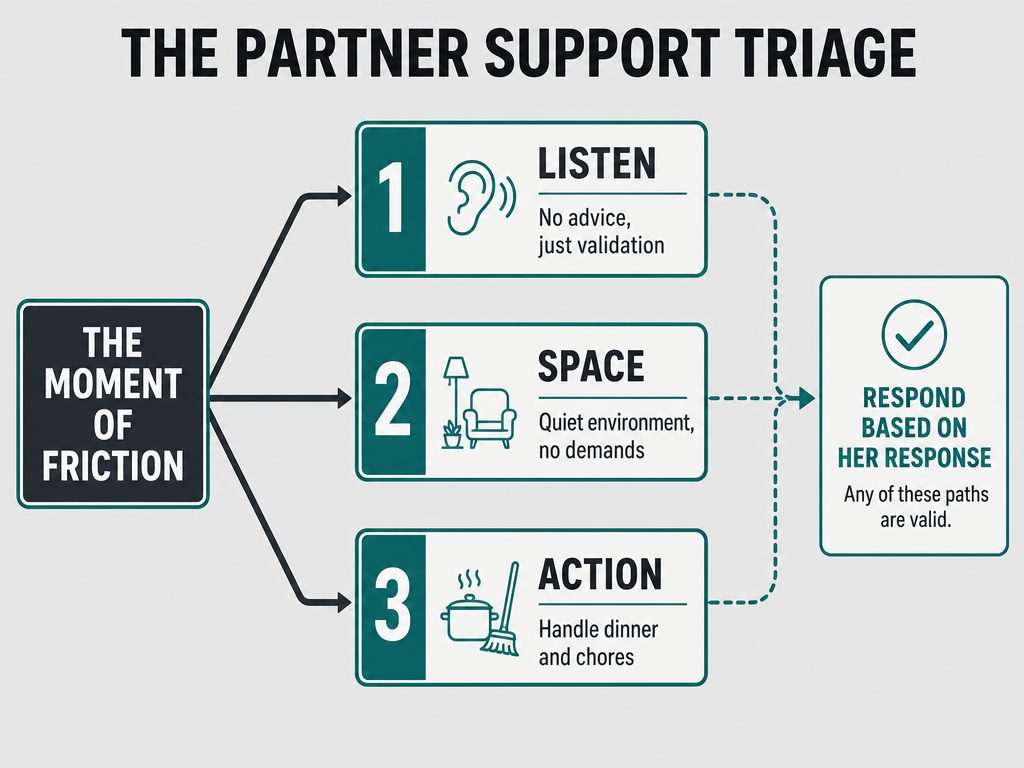
Use this triage framework to determine the best way to support your partner: sometimes she needs a listener, sometimes space, and sometimes proactive help with logistics.
Supporting your girlfriend during the luteal phase isn't about grand gestures or fixing everything. It's about reducing friction, proactively handling invisible labor, and giving her the space or support she actually needs.
The Triage Script: Listen, Space, or Action?
When she's visibly stressed or irritable, don't guess what she needs - ask directly:
"Do you want me to listen, give you space, or help find a solution?"
This simple question shifts the dynamic from you trying to mind-read to her clearly stating what would actually help. When a partner is struggling emotionally, responding with genuine empathy - listening without judgment, focusing on their feelings rather than debating facts, and validating that their reaction makes sense - tends to help more than trying to "fix" the problem or offer silver linings.
Take Over the Invisible Labor
The late luteal phase is when cognitive bandwidth drops and decision fatigue sets in. Small tasks that normally feel manageable - meal planning, responding to texts, tidying up - suddenly feel overwhelming.
Proactively handle these without being asked:
- Take over grocery shopping or meal prep
- Do the dishes before she has to mention them
- Handle logistics like scheduling or booking appointments
- Reduce visual clutter (tidy common spaces without making it a production)
This isn't about being her assistant. It's about recognizing that her mental energy is running on reserve and stepping in before resentment builds.
Create a Sensory Sanctuary
Her nervous system is more reactive during this phase. Sounds are actually louder. Lights are harsher. Chaos feels more chaotic.
Simple adjustments:
- Lower the volume on TV, music, or your phone
- Dim overhead lights or switch to lamps
- Reduce social obligations (cancel plans if she's not up for it)
- Minimize surprise disruptions
If you live together, treat the late luteal phase like she's recovering from a low-grade illness. The goal is to reduce sensory and emotional load, not pile on more stimulation.
Validate Without Fixing
When she vents about work, friends, or small frustrations, resist the urge to solve the problem or minimize her reaction. Her emotional processing is heightened - what might seem like an overreaction to you is a genuine stress response for her.
Instead of:
- "It's not that big a deal."
- "You're overreacting."
- "Just ignore it."
Try:
- "That sounds frustrating."
- "I get why you're upset."
- "What would help right now?"
Validation doesn't mean you agree with every reaction. It means you're acknowledging that her feelings are real, even if the trigger seems small to you.
Red Zone Rules: Conflict Prevention During the Late Luteal Phase
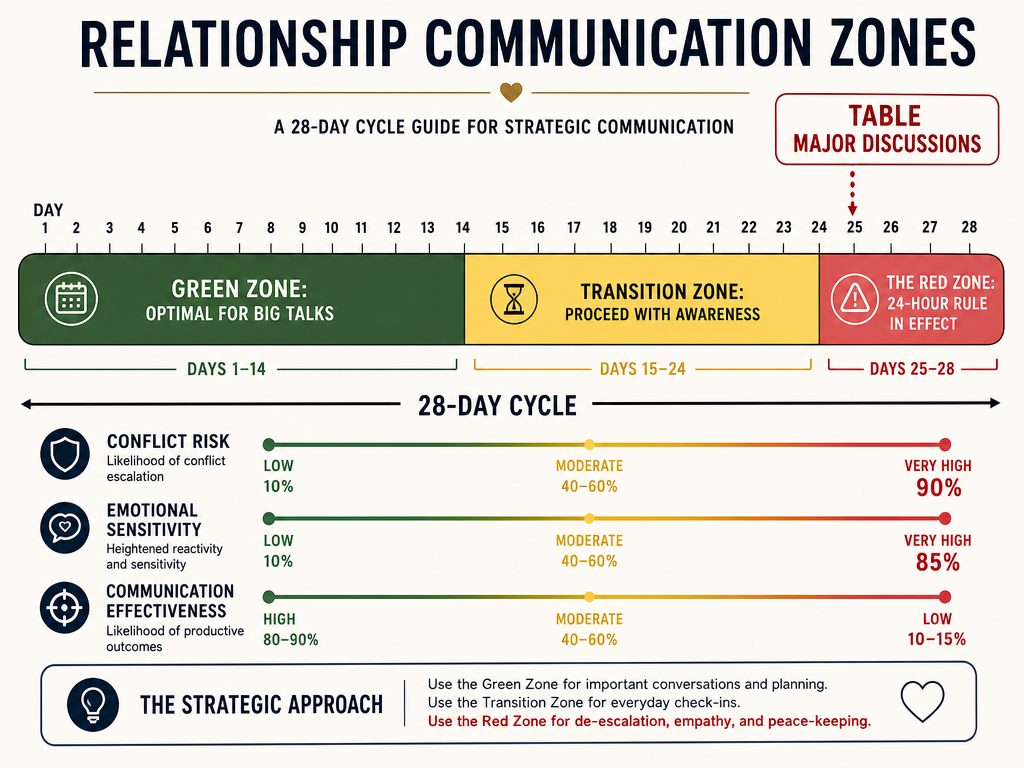
The 24-Hour Rule suggests tabling heavy relationship discussions during the high-sensitivity 'Red Zone' of the luteal phase to prevent unnecessary escalation and protect mutual peace.
The late luteal phase - roughly the 3-5 days before her period - is the highest-risk window for relationship conflict. Emotional reactivity is at its peak, and fights that start small can escalate quickly.
The 24-Hour Rule
Never initiate a "where is this relationship going?" conversation in the late luteal phase. If a serious discussion is necessary, table it until the follicular phase (the week after her period ends) when her mood and cognitive processing are more stable.
This doesn't mean avoiding all conflict. It means recognizing that her emotional floor is lower right now, and heavy topics will hit harder than usual.
If she initiates a serious conversation during this window, don't dismiss it - but recognize that the intensity of her reaction may be amplified by her hormonal state. Listen, validate, and revisit after her period if the issue persists.
Absorb the Friction
During the late luteal phase, you may need to absorb one hit without reacting defensively. If she snaps at you for something small, resist the urge to snap back or escalate into a meta-argument about her tone.
This doesn't mean becoming a doormat. It means recognizing that her irritability is chemically driven and choosing not to take it personally in the moment. If a pattern of disrespect emerges outside of the luteal phase, address it then - when both of you have full access to emotional regulation.
Protect Your Own Mental Peace
Supporting her through the luteal phase doesn't mean sacrificing your own well-being. If you're feeling emotionally drained, it's okay to:
- Take space for yourself (go to the gym, see friends, decompress alone)
- Set a boundary around tone or treatment ("I want to support you, but I need you to not yell at me")
- Recognize that her mood isn't a reflection of your worth as a partner
You're not responsible for fixing her hormones. You're responsible for being a supportive, emotionally intelligent partner who understands the biological context of her behavior.
When It's More Than Just PMS: Recognizing PMDD
Approximately 5% to 8% of women experience moderate-to-severe symptoms (PMDD) during the luteal phase. PMDD (premenstrual dysphoric disorder) is a real, clinically recognized condition - it's listed in the DSM-5 as a depressive disorder, not something people are "making up" or simply failing to cope with. It affects roughly 1 in 10 people who menstruate.
When to Encourage Professional Help
If your girlfriend experiences any of the following during the luteal phase, she may have PMDD and should see a healthcare provider:
- Suicidal thoughts or self-harm ideation
- Rage that feels uncontrollable or dangerous
- Severe depression or hopelessness
- Inability to function at work or in social settings
- Panic attacks
- Physical symptoms so severe they prevent daily activities
PMDD is treatable with medication (SSRIs, hormonal birth control) and therapy. If you suspect PMDD, approach the conversation with care:
"I've noticed the week before your period is really hard for you. Have you talked to a doctor about whether this could be PMDD? I want to support you, and I think getting help could make a real difference."
Don't frame it as "you're too emotional" or "you need to fix this." Frame it as a medical issue that has real, evidence-based solutions.
How to Track the Luteal Phase (Without Being Weird About It)
The key word here is with her participation. Tracking her cycle without her knowledge is invasive. Tracking it together, with transparency and mutual benefit, is strategic partnership.
Recommended Tools
- VibeCheck: Built for men who want tactical daily guidance based on their partner's cycle phase. Turns cycle data into actionable missions and mood insights.
- Flo (Partner Mode): Allows her to share cycle data with you. You get notifications about upcoming phases and can see predicted mood shifts.
- Clue (Partner Connect): Similar sharing model. Clean interface, no judgment.
The goal of tracking isn't to "predict when she'll be difficult." It's to give yourself a 7-day heads-up so you can adjust your behavior, plan proactively, and avoid scheduling high-stress events during her late luteal phase.
For more on cycle tracking tools, check out our period tracker for partners guide.
Frequently Asked Questions
What should boyfriends do during the luteal phase?
Be proactive, not reactive. Take over invisible labor (dishes, groceries, meal planning), create a low-stimulation environment, validate her emotions without trying to fix them, and avoid initiating heavy relationship conversations during the late luteal phase. Lifestyle approaches that can help ease PMS symptoms include regular aerobic exercise, smaller/more frequent meals, less salt/caffeine/alcohol, adequate sleep, and stress-reduction practices like deep breathing or yoga. A partner who understands these and is patient/supportive around them (rather than dismissive of symptoms) is aligning with medically recommended self-care.
Why is my girlfriend so mean during the luteal phase?
She's not "mean" - her brain's emotional regulation system is chemically compromised. During the mid-luteal phase, progesterone metabolites typically bind to GABA-A receptors, meaning a drop in these levels directly impacts the brain's ability to regulate stress. When progesterone crashes in the late luteal phase, her amygdala (the emotional processing center) becomes more reactive, and her tolerance for frustration drops. Small irritations feel bigger because her brain is genuinely more sensitive to stress.
What are the worst days of the luteal phase?
The late luteal phase - typically the 3-5 days immediately before her period starts - is when symptoms peak. This is when progesterone and estrogen are at their lowest, serotonin drops, and emotional reactivity is highest. If you're going to reduce friction, focus your efforts here.
How can I tell which luteal phase my girlfriend is in without asking?
Track behavioral cues across a few cycles. Early luteal: relatively stable mood, normal energy. Mid-luteal: possible increase in appetite, mild fatigue. Late luteal: irritability, low tolerance for noise/mess, fatigue, withdrawal from social plans. Roughly half of people who menstruate report having at least one PMS symptom, but only about 1 in 5 have symptoms severe enough to disrupt their daily life. Learning her specific pattern takes observation, not assumption.
Does the luteal phase affect sex drive?
Yes, but it varies by individual. Many women experience a drop in libido during the luteal phase as progesterone rises and estrogen falls. Others may notice increased sensitivity or desire in the early luteal phase before the crash. Don't assume - ask her what she's noticing and adjust your expectations accordingly.
Can I help reduce her PMS symptoms?
You can't fix her hormones, but you can create an environment that reduces symptom severity. Lifestyle approaches that can help ease PMS symptoms include regular aerobic exercise, smaller/more frequent meals, less salt/caffeine/alcohol, adequate sleep, and stress-reduction practices like deep breathing or yoga. Support her in maintaining these habits without being preachy or patronizing.
How long does the luteal phase last?
The average length of the luteal phase is between 12 and 14 days, with a normal range of 10 to 17 days. If her luteal phase is consistently shorter than 10 days or longer than 17, she should talk to a healthcare provider - it could indicate a hormonal imbalance.
What's the difference between PMS and PMDD?
PMDD is a more severe, sometimes disabling extension of PMS. Both happen on a similar timeline (about 7-10 days before a period) and can share physical symptoms like bloating and fatigue, but PMDD specifically involves extreme mood symptoms - such as marked irritability, anxiety, or hopelessness - intense enough to disrupt daily life and strain relationships. If her symptoms are severe enough to prevent her from functioning normally, encourage her to see a doctor.
Should I mention tracking her cycle to her?
Only if you frame it as a tool for mutual benefit, not surveillance. Approach it as: "I've noticed patterns in your energy and mood throughout the month. Would it help if we tracked your cycle together so I can be more supportive?" Let her control the data and the sharing. Never track her cycle without her knowledge - that's invasive and breaks trust.
Understanding the luteal phase isn't about making excuses for bad behavior or walking on eggshells forever. It's about recognizing that biology is real, mood shifts are chemically driven, and being a supportive partner means adjusting your behavior based on predictable patterns rather than reacting to each storm as if it's random.
If you want to go deeper, check out our guide to supporting your girlfriend during the luteal phase and learn how to use cycle tracking to reduce friction and improve connection.
Tags

Related Articles
Continue reading to deepen your understanding

Why Your Girlfriend Wants Space the Week Before Her Period
Does your girlfriend suddenly pull away every month? Discover the biological reasons behind the pre-period space window and how to navigate this phase together.

Why Your Girlfriend Wants Different Kinds of Affection at Different Times in Her Cycle
Ever feel like your girlfriend’s needs change every week? It’s not random. Understand how the four phases of her cycle drive her desire for intimacy so you can support her better.

How to Plan Romantic Gestures by Cycle Timing: The Partner’s Tactical Guide
Stop guessing why your date night plans fell flat. This guide explains how to synchronize your romantic efforts with her biological cycle for better intimacy and connection.

How to Tell When Your Girlfriend Is Ovulating: Reading the Biological Signals Your Partner Sends
Understanding your partner’s cycle helps you anticipate her needs and time important conversations. Learn the behavioral signs of ovulation to improve your relationship and connection.

Understanding Your Girlfriend’s Words of Affirmation Cycle: A Partner’s Guide
Ever feel like your compliments land wrong? Her need for words of affirmation isn’t random—it follows a biological rhythm. Learn how to match your support to her internal hormonal seasons.

How to Plan Valentine’s Day Around Your Girlfriend’s Cycle
Does your romantic plan clash with her biological rhythm? Learn how to adjust your date night to her specific cycle phase so she feels comfortable and truly cared for this year.

The Strategic Partner’s Guide to Planning an Engagement Around Her Cycle
Don’t leave your proposal to chance. Learn how her biological rhythm impacts emotional receptivity and how to align your big question with the phase where she feels her best.

How to Plan Weekend Trips Around Your Girlfriend’s Cycle: A Tactical Guide
Stop booking trips that end in friction. Learn how to map weekend travel to her biological phases to reduce friction by 41% and maximize your time together.