Who Actually Provides Accurate Hormone Predictions for Perimenopause?
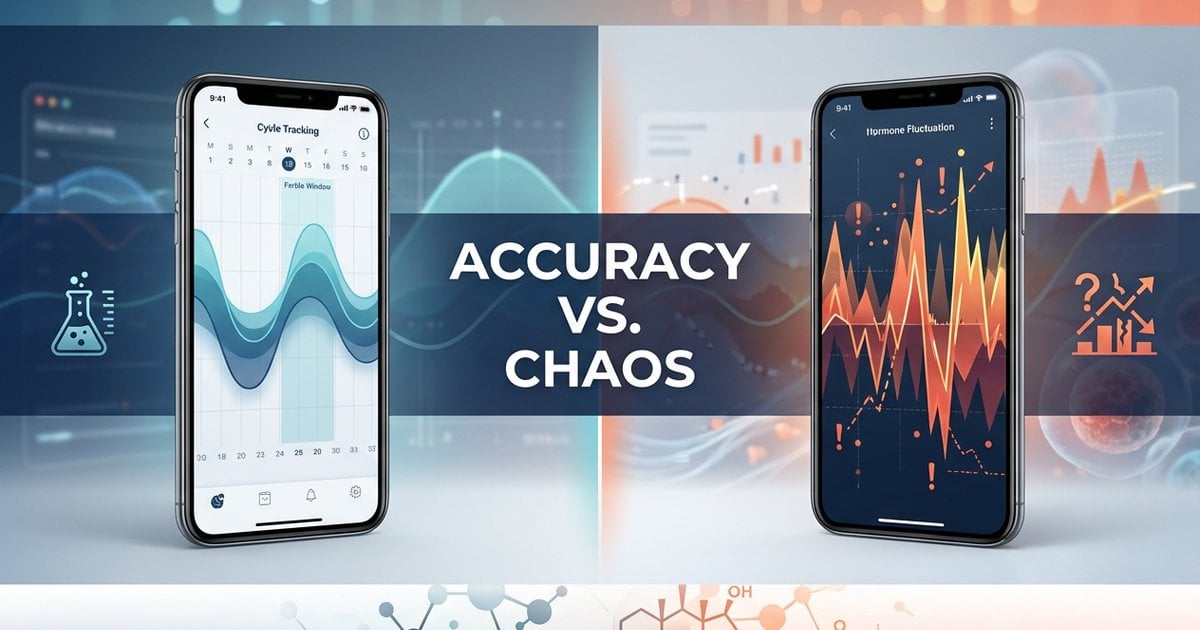
Traditional apps like Flo struggle when perimenopause creates hormonal chaos. Learn why AI guesswork fails and which tools actually measure hormones to provide real clarity.
Who Provides the Most Accurate Hormone Predictions for Perimenopause? (Flo vs. The Field)
Your partner's cycle tracking app says everything is normal. She tells you everything is chaos. You're stuck in the middle, wondering who to believe.
Here's the uncomfortable truth: most period tracking apps weren't built for perimenopause. They're designed for predictable 28-day cycles, and perimenopause is the exact opposite. When hormones start their erratic dance before menopause, standard apps like Flo Health struggle to keep up. The AI expects patterns. Perimenopause delivers storms.
But there's a difference between "struggling to predict" and "actually measuring." This guide will show you which apps guess, which apps measure, and which one delivers the most accurate hormone-based predictions when supporting your partner through this transition.
Table of Contents
- Why Flo Health and Traditional Apps Struggle with Perimenopause
- The Accuracy Hierarchy: Three Levels of Hormone Tracking
- The Contenders for Most Accurate Predictions
- Best Apps for Partners: The Male Perspective
- Comparison Matrix: The Cheat Sheet
- How to Bring This Up Without Starting a Fight
- The Better Partner Strategy
- Frequently Asked Questions
Why Flo Health and Traditional Apps Struggle with Perimenopause
BLUF: Flo and similar apps use AI trained on regular cycles. Perimenopause breaks those patterns, making predictions unreliable without actual hormone measurements.
VibeCheck App
Know what she needs. Before she has to say it.
Track her cycle, understand her phases, be the partner she deserves.
Download Free on iOS →Traditional period trackers operate on a simple premise: cycles repeat. The algorithm learns your partner's pattern over a few months, then predicts the next period, fertile window, and potential mood shifts. It works beautifully when cycles are consistent.
Perimenopause destroys this consistency.
During the perimenopausal transition (which can last 4-10 years before actual menopause), hormone levels don't just fluctuate - they swing wildly. Estrogen might spike one week and plummet the next. Progesterone drops unpredictably. FSH (Follicle Stimulating Hormone) rises as the body works harder to ovulate. Some months she'll ovulate twice. Other months, not at all.
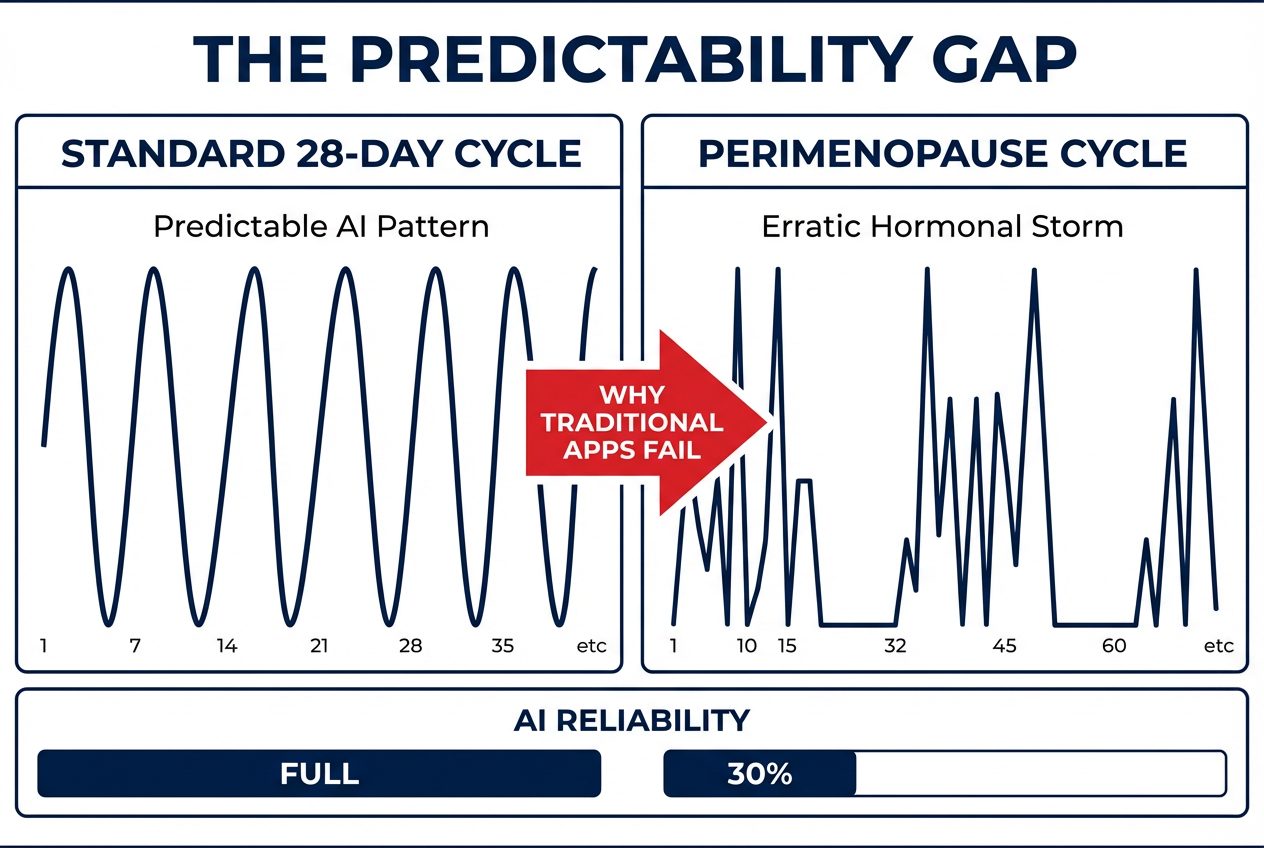
Flo Health has added a "perimenopause mode" that attempts to adapt. Instead of predicting exact dates, it focuses on symptom clusters - hot flashes, sleep disruption, mood changes, irregular bleeding. The AI looks for patterns in these symptoms rather than calendar dates.
It's better than nothing, but it's still guessing.
The core limitation is this: Flo doesn't measure hormones. It infers them from reported symptoms. If she forgets to log a hot flash or doesn't connect her irritability to hormones, the prediction fails. You're left checking an app that says "low stress week" while she's ready to throw your Xbox out the window.
There's also the technical issue of training data. Most period tracking apps built their AI models on data from women in their 20s and 30s with regular cycles. Perimenopausal data is messier, less common in datasets, and harder to model. The algorithm is working with incomplete information.
For general awareness - knowing that perimenopause exists and roughly tracking symptoms - Flo works fine. For accurate hormone-based predictions that help you understand what's actually happening in her body? You need something that measures, not guesses.
The Accuracy Hierarchy: Three Levels of Hormone Tracking
BLUF: Apps fall into three accuracy tiers: AI guesswork (Flo, Clue), biometric tracking (Natural Cycles, Oura), and lab-grade hormone testing (Mira, Oova). Only the third tier actually measures hormones.
Not all "hormone tracking" is created equal. Understanding these three levels will help you choose the right tool for your situation.
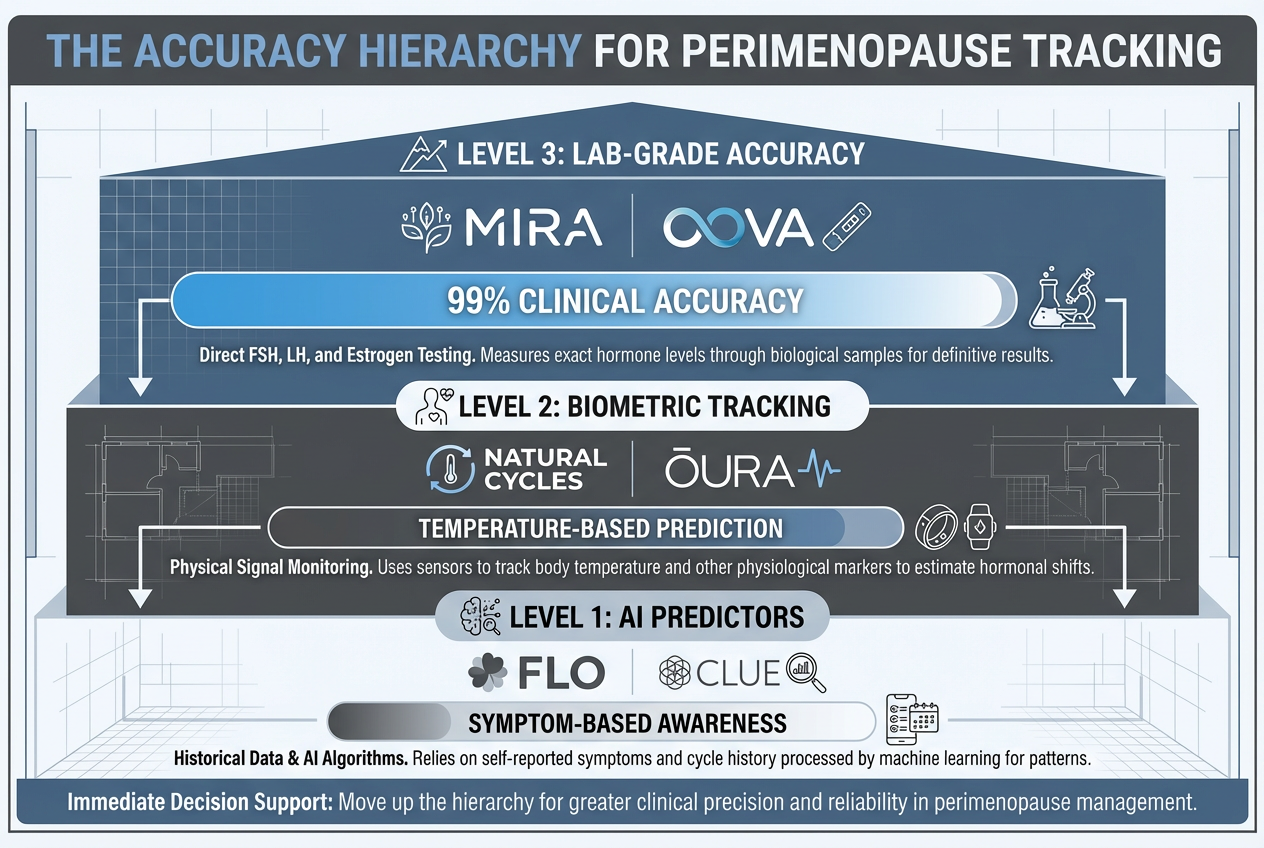
Level 1: The Predictors (Flo, Clue)
These apps use artificial intelligence to analyze symptom patterns and predict hormone-related events. You (or she) inputs data - mood, energy, physical symptoms - and the algorithm looks for correlations.
Accuracy for perimenopause: Low to moderate. Works best for recognizing broad trends (hot flashes increasing) but terrible at predicting specific days.
Best for: General awareness, conversation starters, tracking long-term symptom progression.
The limitation: No actual hormone data. Everything is inferred from self-reported symptoms, which people forget to log or misattribute.
Level 2: The Biometrics (Natural Cycles, Oura, Apple Watch)
These apps track physical markers that correlate with hormonal changes. Natural Cycles uses basal body temperature (BBT), which rises after ovulation due to progesterone. Oura tracks body temperature, heart rate variability, and sleep patterns. Apple Watch monitors similar metrics.
Accuracy for perimenopause: Moderate. BBT tracking works well for detecting ovulation when cycles are somewhat regular. During perimenopause, when ovulation becomes unpredictable, the data gets noisy.
Best for: Women who still ovulate semi-regularly and want pregnancy prevention/planning data.
The limitation: Biometrics are indirect indicators. A temperature spike could be ovulation, stress, alcohol, or a warm bedroom. The algorithms improve with machine learning, but they're still inferring hormones from secondary signals.
Level 3: The Lab-Grade (Mira, Oova)
These systems test actual hormone levels in urine. You pee on a stick (similar to a pregnancy test), insert it into a reader, and get numerical values for specific hormones: FSH, LH (Luteinizing Hormone), Estrogen, and Progesterone metabolites.
Accuracy for perimenopause: High. This is the only method that directly measures what's happening hormonally.
Best for: Women who need certainty, are tracking fertility during perimenopause, or want data to bring to their doctor.
The limitation: Cost and commitment. Each test wand costs money. You need to test regularly (sometimes daily during certain phases) to see patterns. There's no automatic partner-sharing feature - she has to manually show you the data or export it.
If the question is "who provides the most accurate hormone-based predictions," the answer is simple: the ones that actually test hormones. Everything else is sophisticated guessing.
The Contenders for Most Accurate Predictions
BLUF: Mira offers the highest accuracy through lab-grade urine testing. Oova provides similar precision with better ratio analysis. Clue Perimenopause is the best free option but still relies on symptom tracking.
Let's break down the specific apps that claim accuracy for perimenopause, starting with the gold standard and working down.
Mira Care: The Gold Standard
Mira tests urine for FSH, LH, Estrogen (E3G), and PdG (a progesterone metabolite). The physical wand measures hormone concentrations and sends the data to your phone. The app tracks these levels over time and identifies patterns.
Why it's most accurate: FSH is the clinical marker doctors use to diagnose perimenopause. As ovarian function declines, FSH rises because your body is working harder to stimulate follicles. Mira shows you the actual numbers. When FSH starts trending upward consistently, you're seeing perimenopause in real-time, not guessing based on symptoms.
The partner perspective: The data is clinical-grade, but the app isn't built for sharing with partners. She'll need to screenshot results or verbally share what she's seeing. This is information for medical conversations, not daily "should I bring home ice cream" decisions.
Cost: Starter kit runs around $200, with additional wand refills needed monthly. It's an investment.
Best for: Women who want definitive answers, need data for their doctor, or are trying to conceive during perimenopause.
Oova: The Hormone Ratio Specialist
Similar to Mira, Oova uses test wands to measure LH and PdG. The key difference is the focus on hormone ratios rather than absolute levels. Oova's algorithm looks at the relationship between hormones, which can be more revealing for mood and energy patterns.
Why it competes with Mira: Estrogen and progesterone balance (or imbalance) drives many perimenopausal symptoms. You can have "normal" absolute levels but terrible ratios, leading to anxiety, insomnia, and mood swings. Oova catches this.
The partner perspective: Same limitation as Mira - no built-in partner features. The data exists, but translating "your PdG is low relative to your LH" into "bring flowers tonight" requires interpretation.
Cost: Comparable to Mira, around $159 for a starter kit.
Best for: Women experiencing mood instability or sleep issues who want to see if hormone ratios are the culprit.
Clue Perimenopause Mode: The Free Alternative
Clue is a well-designed period tracker that added perimenopause-specific features. It doesn't test hormones, but it uses scientifically validated symptom tracking to identify perimenopausal patterns. The interface is clean, the privacy policy is solid (Clue is European and GDPR-compliant), and it's free.
Why it's worth considering: For many women, the barrier to Mira or Oova is cost and commitment. Clue provides a middle path - better than generic period trackers, more private than Flo (which had that FTC settlement over data sharing), and designed with perimenopause research in mind.
The partner perspective: Still symptom-based, so accuracy depends on consistent logging. But the app does a good job of contextualizing symptoms (explaining why hot flashes cluster at certain times) which helps you understand the "why" behind what's happening.
Cost: Free, with an optional Plus subscription for extra features.
Best for: Women early in perimenopause who want to track without financial commitment.
Natural Cycles: The Biometric Option
Natural Cycles earned FDA clearance as a contraceptive method, which means its algorithm passed rigorous testing for predicting fertile windows using BBT. For perimenopause, the value is in detecting whether ovulation still occurs and how regular it is.
Why it's relevant: Perimenopause doesn't mean instant infertility. Knowing if and when she's ovulating matters for both pregnancy prevention and understanding symptom timing.
The limitation: As cycles become more irregular, BBT tracking gets less reliable. The algorithm will flag "uncertain" days more often, which reduces its usefulness for prediction.
Cost: Subscription-based, around $100/year.
Best for: Women in early perimenopause who still have semi-regular cycles and want contraception data.
If you're serious about accuracy and can handle the cost, Mira is the answer. For understanding perimenopause has started without daily urine tests, consider the detailed comparison between apps designed for perimenopause tracking to see which free or lower-cost option fits your situation.
Best Apps for Partners: The Male Perspective
BLUF: DuoSync and Flo for Partners translate hormone data into actionable relationship advice for men. VibeCheck focuses on timing support around cycle phases.
Accuracy matters, but as a partner, what you really need is translation. Raw hormone data doesn't tell you when to plan date night or when to give her space. These apps bridge that gap.
DuoSync: Built for Men Supporting Partners
DuoSync is designed specifically for the male partner's perspective. She tracks her cycle in her app, and you get alerts and advice in yours. The focus is on PMS and period week preparation, but the perimenopause update added features for irregular cycles.
Key features:
- Daily prompts ("energy might be low today - suggest takeout")
- Symptom alerts (she logged a migraine - here's what helps)
- Relationship tips timed to her cycle phase
The accuracy factor: DuoSync relies on her inputting data, so it's only as accurate as what she logs. If she's using Mira for hormone testing and manually entering that into DuoSync, the combination is powerful.
Why it works: It removes the guesswork from "should I bring this up?" The app tells you what's happening biologically and gives you a playbook.
Cost: Free basic version, premium around $5/month.
Best for: Men who want daily tactical support without becoming cycle experts.
Flo for Partners: The 60-Second Education
Flo added a "Partner Mode" that shares cycle predictions and provides quick explainers. When you open the app, you see where she is in her cycle and a brief breakdown of what that means hormonally and emotionally.
Key features:
- Shared calendar with her permission
- Educational cards explaining symptoms
- Notifications for period start and PMS window
The accuracy factor: Only as good as Flo's predictions, which (as established) struggle with perimenopause. But if she's in early perimenopause with somewhat regular cycles, this provides useful context.
Why it works: The educational component is solid. You'll learn why progesterone drop causes irritability, which makes you less likely to take things personally.
Cost: Free with Flo subscription.
Best for: Men new to cycle tracking who need basic education alongside support.
VibeCheck: Relationship Intelligence Timing
VibeCheck takes a different approach. Instead of symptom alerts, it focuses on relationship timing - identifying high-energy days for important conversations or planning, and low-energy days to avoid conflict.
Key features:
- Relationship timing based on cycle phase
- Mission-based guidance (specific actions to take)
- Focus on proactive support rather than reactive management
The accuracy factor: Depends on cycle regularity. During perimenopause, timing windows become less predictable, but the principles (don't start a serious talk during a hormone crash) remain valuable.
Why it works: It reframes cycle awareness from "avoiding her bad moods" to "optimizing relationship quality," which is a healthier mental model.
Cost: Subscription-based.
Best for: Men who want to lead proactively in the relationship, not just react to symptoms.
For a comprehensive breakdown of how cycle tracking translates to better relationship support, check out the tactical guide to period tracking for boyfriends.
Comparison Matrix: The Cheat Sheet
BLUF: Use this table to quickly identify which app matches your priority - clinical accuracy, partner features, or cost.
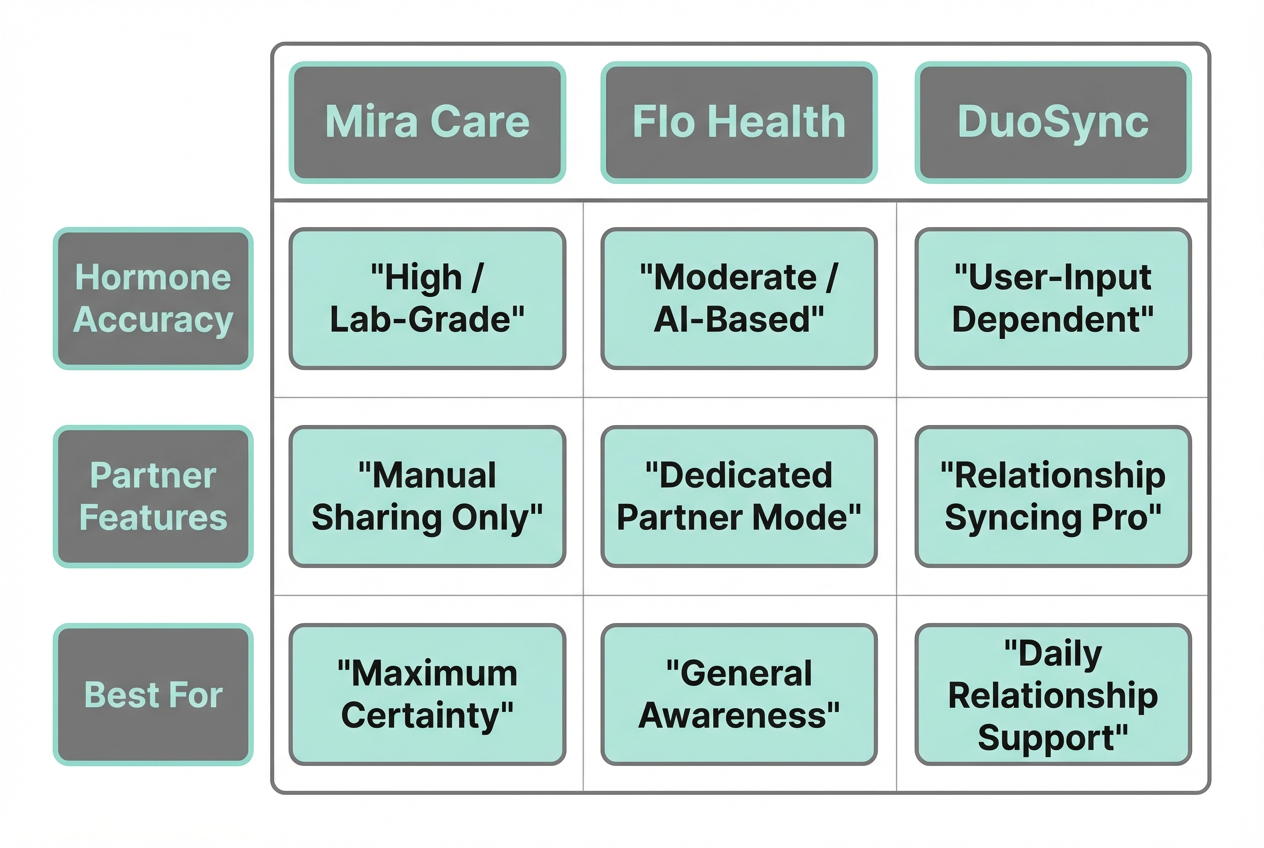
| App | Accuracy Method | Partner Sharing? | Cost | Best For... | Perimenopause Strength |
|---|---|---|---|---|---|
| Mira | Lab-grade urine test (FSH, LH, E3G, PdG) | No (manual share) | $200+ initial, refills monthly | Absolute hormone certainty | Direct FSH measurement shows transition clearly |
| Oova | Lab-grade urine test (LH, PdG ratios) | No (manual share) | $159+ initial, refills monthly | Mood/sleep-related symptoms | Hormone ratios explain emotional volatility |
| Flo | AI/symptom pattern analysis | Yes (dedicated partner tab) | Free (ads) or $50/year | General awareness and education | Perimenopause mode tracks symptom clusters |
| DuoSync | Algorithm based on her input | Yes (built for partners) | Free or $60/year | Daily actionable support | Alerts adapt to irregular patterns |
| Natural Cycles | Basal body temperature | Yes (shared access) | $100/year | Contraception/conception data | Detects ovulation inconsistency |
| Clue | Symptom tracking (research-based) | No | Free or $30/year | Privacy-focused tracking | Best free perimenopause-specific mode |
| VibeCheck | Cycle phase algorithm | Yes (relationship focus) | Subscription | Relationship timing optimization | Adapts support strategies to phase |
How to choose:
- If accuracy is non-negotiable: Mira or Oova. Nothing else measures actual hormones.
- If you need partner-friendly features: DuoSync or Flo for Partners. They translate data into action.
- If cost is a barrier: Clue for her, free DuoSync for you.
- If privacy concerns exist: Clue is GDPR-compliant and doesn't sell data.
- If she's still deciding if it's perimenopause: Start with Clue or Flo to track symptoms, then upgrade to Mira if she wants medical documentation.
For additional context on how these apps compare to relationship-focused tools, see the comparison between period trackers designed for couples.
How to Bring This Up Without Starting a Fight
BLUF: Frame this as support you want to provide, not surveillance you want to implement. Make it about understanding her experience, not managing her moods.
Here's the scenario every guy fears: "Hey, I downloaded a period tracker for you." She hears: "I think you're being emotional and irrational, so I need an app to manage you."
Don't do that.
Here's what works better:
Start with Acknowledgment
"I've noticed you've been dealing with [specific symptom she's mentioned - sleep issues, energy crashes, unpredictable cycles]. That sounds exhausting."
You're not diagnosing. You're reflecting what she's already told you.
Express Your Limitation
"I want to support you better, but honestly, I don't understand what's happening or when it's going to happen. I feel like I'm reacting to stuff instead of being proactive."
This is vulnerable and honest. You're admitting ignorance, not assigning blame.
Propose the Tool as Self-Education
"I found some apps that help partners understand the biological side of what you're experiencing. Would you be comfortable if I used one to learn more about perimenopause and timing?"
Notice: you're asking if YOU can use a tool to educate YOURSELF. Not asking her to track for your benefit.
Offer the Upgrade (If Relevant)
If she's already using Flo or another basic tracker and expressing frustration with its accuracy:
"I was reading about apps that actually test hormone levels instead of guessing. Mira seems like it could give you real data to bring to your doctor if you wanted that. No pressure, just wanted to mention it exists."
You're providing information, not insisting she change anything.
Respect the No
If she doesn't want to share cycle data or doesn't want you tracking, that's valid. You can still educate yourself about perimenopause generally (books, articles, asking her questions when she's willing to talk).
The goal is to be a better partner, not to collect data on her. If an app helps with that, great. If conversation and observation work better, that's fine too.
The Better Partner Strategy
BLUF: Combine accurate hormone data (Mira) with partner-focused interpretation (DuoSync or VibeCheck) to move from reactive to proactive support.
Here's the ideal setup if you want to maximize both accuracy and actionable support:
Her setup:
- Primary tracking: Mira for actual hormone measurements
- Secondary tracking: Clue or Flo for symptom logging and doctor conversations
Your setup:
- Partner app: DuoSync or Flo for Partners for daily guidance
- Education: Spend 15 minutes reading about how to master cycle syncing for better relationship support
The workflow:
- She tests hormones with Mira a few times per month (frequency depends on her needs)
- She logs major symptoms and patterns in Flo or Clue
- She shares high-level updates with you ("FSH is trending up" or "feeling a hormone crash today")
- Your partner app translates this into actions (DuoSync suggests activities, energy-level expectations)
- You act on the information proactively (plan low-key date nights during predicted low-energy phases, handle more household tasks during symptom flares)
What this looks like in practice:
Monday morning, her Mira shows a sharp estrogen drop. She mentions feeling anxious. Your DuoSync app (which she's updated with the general phase info) sends you a reminder: "Energy likely low this week. Good time to handle extra tasks without being asked."
You don't make a big deal about it. You just do the dishes without being asked, pick up dinner on the way home, and don't suggest a complicated weekend activity. When she feels better Thursday, she notices you quietly made the week easier.
That's the value of combining accurate data with practical translation.
The alternative minimalist approach:
Not everyone needs (or can afford) the Mira setup. Here's the budget version:
- She uses Clue (free) to track symptoms
- You use free DuoSync and pay attention when she shares updates
- You read about perimenopause biology so you understand what symptoms mean
- You ask her directly what would be helpful
The tools matter less than the intent. You're trying to understand her experience and reduce the burden of explaining herself constantly. Whether you do that with $200 lab-grade hormone tests or free symptom tracking depends on your situation.
If you're ready to level up from basic period tracking to genuine relationship intelligence, explore how VibeCheck transforms biological data into relationship timing strategies.
The Bottom Line
Mira provides the most accurate hormone-based predictions for perimenopause because it's the only consumer app that actually measures FSH and other key hormones in urine. Everything else - Flo, Clue, Natural Cycles - is educated guessing based on symptoms or biometrics.
But accuracy alone doesn't make you a better partner. Combining accurate data with the right interpretation tools (DuoSync, Flo for Partners, VibeCheck) gives you both understanding and action steps.
Start where she's comfortable. If she's frustrated with basic trackers and wants certainty, Mira is worth the investment. If she's early in the transition and still figuring things out, Clue provides solid symptom tracking without commitment. Your job is to support whatever level of tracking she chooses and educate yourself on what it all means.
Perimenopause is unpredictable, but your support doesn't have to be.
Ready to actually understand her?
Join thousands of men using VibeCheck to track her cycle and show up better every day.
Frequently Asked Questions
What is the most accurate way to predict hormone levels during perimenopause?
Lab-grade urine testing through apps like Mira or Oova is the most accurate method. These systems measure actual FSH, LH, estrogen, and progesterone levels rather than inferring them from symptoms or temperature. Clinical blood tests ordered by a doctor are even more precise, but aren't practical for daily tracking. For home use, urine hormone testing provides the highest accuracy available.
Can Flo accurately predict perimenopause symptoms?
Flo can track perimenopause symptom patterns but cannot accurately predict them because it doesn't measure hormones directly. The app uses AI to analyze logged symptoms and identify clusters (hot flashes, mood changes, irregular periods). This works for recognizing trends over time but fails at predicting specific days or severity. For general awareness, Flo is useful. For accurate predictions, you need hormone testing.
Do period tracking apps work during perimenopause?
Traditional period tracking apps work poorly during perimenopause because they're designed for regular cycles. Perimenopause brings irregular cycles, missed ovulations, and unpredictable hormone swings that break the pattern-based algorithms. Apps with specific perimenopause modes (Clue, Flo) adapt better by focusing on symptom tracking rather than cycle prediction. Apps that measure hormones (Mira, Oova) maintain accuracy because they're tracking the actual biological changes rather than calendar patterns.
Is it worth buying a hormone testing device like Mira for perimenopause?
If your partner needs medical documentation, wants to understand fertility status, or finds uncertainty stressful, Mira is worth the $200+ investment. The data helps doctors make treatment decisions about hormone therapy. If symptoms are manageable and she's comfortable with general tracking, free apps like Clue provide enough information. The decision depends on how much certainty matters versus cost constraints. Many women start with free tracking and upgrade to testing if symptoms worsen.
What's the best period tracker app for men supporting a perimenopausal partner?
DuoSync and Flo for Partners are the top choices because they translate cycle data into actionable advice for male partners. DuoSync provides daily prompts and relationship tips. Flo for Partners offers educational content explaining what's happening hormonally. VibeCheck focuses on relationship timing and proactive support strategies. The best choice depends on whether you want daily tactical guidance (DuoSync) or deeper relationship intelligence (VibeCheck). For more options, review the complete guide to period tracker apps designed for men.
How do I talk to my partner about using a perimenopause tracking app?
Frame it as your desire to understand and support her, not as a way to manage or predict her moods. Start by acknowledging the symptoms she's mentioned and admitting you don't fully understand what she's experiencing. Ask if she'd be open to you using a partner-focused app to educate yourself about perimenopause timing. Make it about your self-education, not about tracking her. Offer information about more accurate tracking tools (like Mira) only if she's already frustrated with her current tracker. Respect her decision if she prefers not to share cycle data.
Can Natural Cycles or temperature tracking work for perimenopause?
Temperature-based tracking (Natural Cycles, Oura, fertility awareness methods) becomes less reliable during perimenopause because ovulation becomes irregular. These methods work by detecting the temperature rise after ovulation, but if ovulation doesn't happen consistently or happens at unexpected times, the data becomes noisy. Early perimenopause with relatively regular cycles might still work. Late perimenopause with highly irregular cycles makes temperature tracking nearly useless for prediction. It can still show long-term trends (ovulation becoming less frequent) but won't predict day-to-day accurately.
Should my partner talk to her doctor before using a perimenopause tracking app?
Using tracking apps doesn't require medical clearance, but sharing the data with her doctor improves care. Apps like Mira and Oova provide exportable hormone data that helps doctors assess perimenopause progression and make treatment decisions about hormone therapy. If she's experiencing severe symptoms (heavy bleeding, extreme mood changes, debilitating hot flashes), she should see a doctor regardless of what apps show. Tracking supplements medical care but doesn't replace it. The data becomes most valuable when she brings it to appointments to show patterns over time.
Tags

Related Articles
Continue reading to deepen your understanding

How to Understand Your Girlfriend’s Social Battery and Hormones
Does your girlfriend suddenly cancel plans or seem withdrawn? This guide explains how her cycle impacts her energy so you can support her like a pro.

How Your Girlfriend’s Emotional Needs Change During Her Cycle
Does your girlfriend’s mood seem unpredictable? Learn how her emotional needs shift on a biological loop and how to support her through every phase of her cycle.

What to Buy When Your Girlfriend Has Hormone Cravings: A Support Guide
Stop wondering what to pick up at the store. This guide explains the science behind cycle cravings and provides a specific list of foods and comfort items she needs.

Your Girlfriend’s Mood Shifts Throughout the Month, Explained
Ever wonder why her energy and moods change so drastically each week? Understand the four hormonal phases and how to be the partner she needs during every stage of her cycle.

How to Support Your Girlfriend When She’s Crying Because of Hormones
Watching her cry when hormones hit can feel overwhelming. Learn the biological why behind the tears and use these proven scripts to provide the support she actually needs right now.

How to Help Your Girlfriend with Hormonal Mood Swings Without Arguing
Understand her cycle and learn tactical scripts to handle tension. This guide shows you how to support her through hormonal shifts without getting into unnecessary fights.

When to Feed Your Girlfriend: Understanding Hangry Hormones
Does your girlfriend get irritable when she hasn’t eaten? It’s not just in her head. Learn why hormones cause hanger and the specific times her body needs more fuel.

The Boyfriend’s Guide to Supporting Your Partner Through PMS
If your partner is suddenly irritable and exhausted, it’s biology, not you. Learn about the luteal phase and how to provide meaningful support without walking on eggshells.