What to Say When Your Girlfriend Has PMS: The Tactical Partner’s Guide

Stop walking on eggshells. When your partner’s hormones shift, your communication needs to adapt. Get the tactical scripts and biological context you need to support her through PMS.
What to Say When Your Girlfriend Has PMS: The Partner’s Tactical Guide
You’re not imagining it. The woman who was laughing at your jokes last week now gives you one-word answers. The partner who wanted to go out suddenly prefers staying in. And somehow, you’re walking on eggshells in your own home.
Here’s what most guys miss: PMS isn’t about her being "difficult." It’s about her body running a biological program that drops key hormones by up to 90% in a matter of days. The result? Lower energy, heightened emotions, physical discomfort, and a need for support that most men simply don’t know how to provide.
This guide gives you the tactical scripts, biological context, and specific actions to support your partner during the luteal phase without starting an argument, sounding patronizing, or making things worse.
Table of Contents
- The Biology Behind the Mood Shifts
- The What to Say Scripts: Your Tactical Playbook
- The Danger Zone: What Never to Say
- The 7-2-1 Medical Watch: When to Step Up as a Health Advocate
- The No-Ask Action List: Supporting Without Adding Mental Load
- Long-Distance and Digital Support Strategies
- Frequently Asked Questions
The Biology Behind the Mood Shifts
BLUF: Estrogen and progesterone drop by up to 90% during the luteal phase, causing real physical and emotional symptoms. It’s not a choice. It’s chemistry.
VibeCheck App
Know what she needs. Before she has to say it.
Track her cycle, understand her phases, be the partner she deserves.
Download Free on iOS →Understanding PMS starts with understanding the hormonal shift your partner experiences every month. Around day 14 of her cycle (ovulation), estrogen peaks. She likely feels energized, social, and confident. But in the days leading up to her period (the luteal phase), both estrogen and progesterone plummet dramatically.
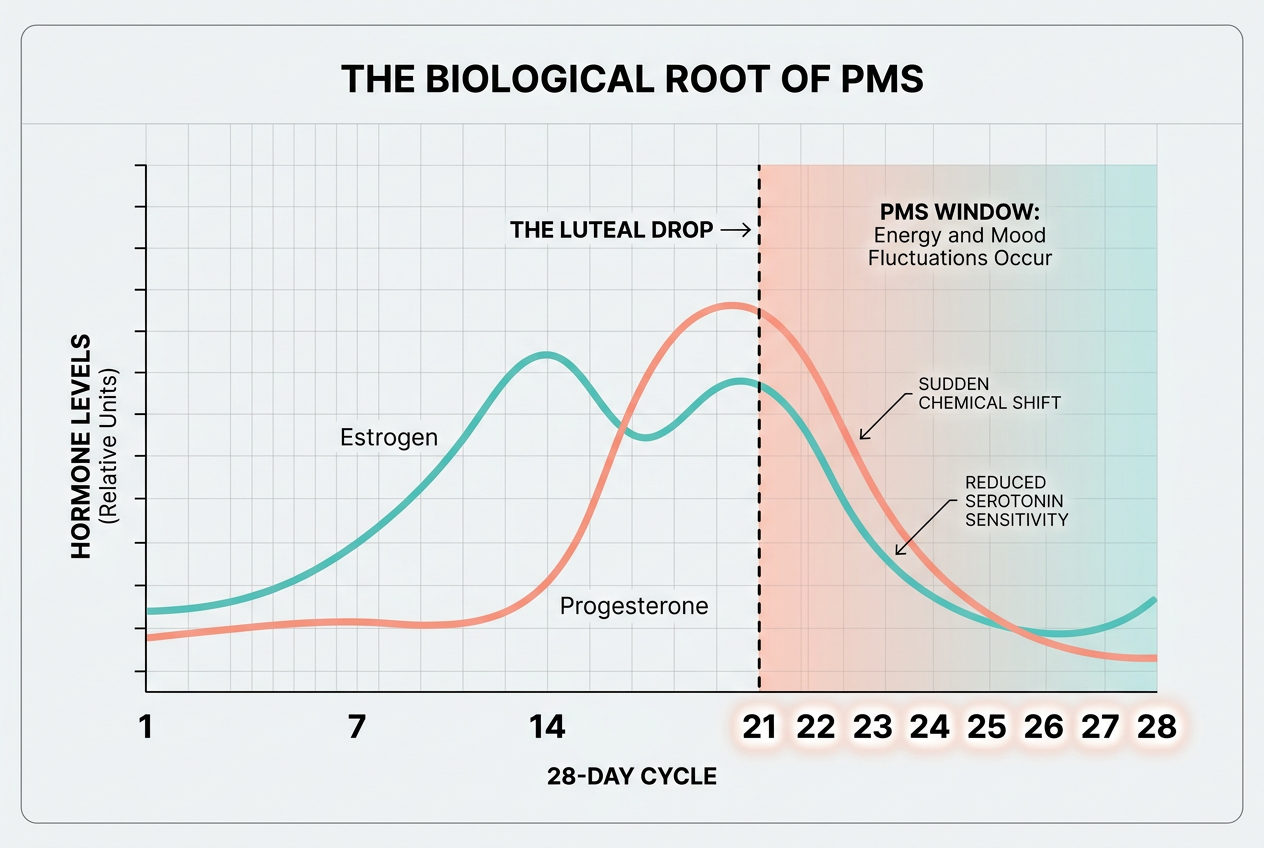
This isn’t a small dip. Progesterone can drop from 10-20 ng/mL to near zero. Estrogen follows a similar pattern. These hormones regulate serotonin (the mood stabilizer), dopamine (motivation and pleasure), and GABA (the calming neurotransmitter). When they crash, so does emotional regulation.
What this actually looks like:
- Mood volatility: She’s not choosing to be irritable. Her brain chemistry is literally different.
- Physical discomfort: Bloating, breast tenderness, headaches, and cramping are common.
- Energy depletion: Fatigue and brain fog make even simple tasks feel overwhelming.
- Sensory sensitivity: Sounds, lights, and smells can feel more intense.
- Appetite changes: Cravings for sugar, salt, or comfort foods are driven by blood sugar instability.
When you understand that these symptoms have a biological foundation, it changes everything. Your partner isn’t being unreasonable. She’s navigating a chemical shift that would challenge anyone. For more on how these hormones affect mood throughout the month, check out our guide on understanding your girlfriend’s hormonal cycle.
The What to Say Scripts: Your Tactical Playbook
BLUF: Validation first, action second. Use specific scripts that acknowledge her experience and offer tangible support without minimizing or questioning.
This is the section you’ll return to most. Here are real-world scenarios and the exact scripts that work.
Scenario 1: She Says "I Feel Bloated" or "I Feel Fat"
Wrong: "It’s just your period." or "You look fine to me."
Right: "I’m sorry you’re feeling uncomfortable. Can I get you your heating pad or make you some tea?"
Why this works: You’re validating the discomfort without trying to fix her perception. You’re offering a concrete action instead of dismissing the feeling.
Scenario 2: She’s Unusually Quiet or Withdrawn
Wrong: Asking "What’s wrong?" repeatedly or assuming she’s mad at you.
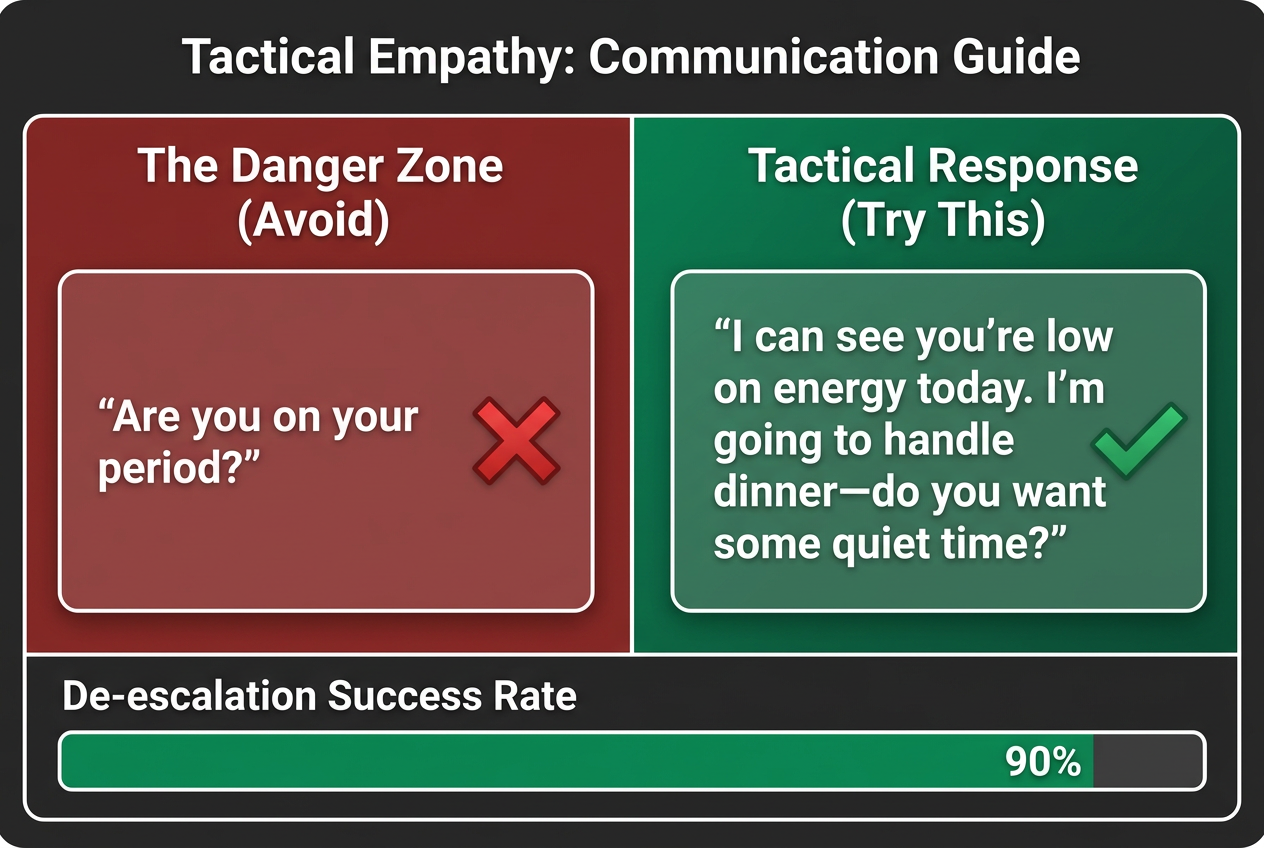
Right: "I can see you’re low on energy today. I’m going to handle dinner. Do you want some quiet time, or would you like to watch something together?"
Why this works: You’re reading the room and taking initiative. You’re not forcing her to explain herself or manage you emotionally.
Scenario 3: She’s More Emotional Than Usual (Crying at Commercials, Getting Upset Easily)
Wrong: "Why are you crying?" or "It’s not that serious."
Right: "I’m here if you want to talk. If you just need to feel what you’re feeling, that’s okay too."
Why this works: You’re giving her permission to be emotional without judgment. You’re not asking her to rationalize something driven by hormones.
Scenario 4: She Snaps at You or Seems Irritable
Wrong: "Calm down." or "Are you on your period?"
Right: "I can see you’re frustrated. I’m not taking it personally. Let me know if there’s anything I can do."
Why this works: You’re de-escalating by not matching her energy. You’re making it safe for her to be irritable without fear of starting a fight.
Scenario 5: She Mentions Physical Pain or Cramping
Wrong: "Take some Advil." (This sounds dismissive.)
Right: "That sounds painful. I’m grabbing you some ibuprofen and a heating pad. Do you want me to pick up anything else while I’m out?"
Why this works: You’re taking action immediately and offering additional support without waiting to be asked.
Scenario 6: She Cancels Plans or Wants to Stay Home
Wrong: "But we’ve been planning this for weeks!" or sighing in frustration.
Right: "No problem. Let’s reschedule. Do you want me to grab takeout so you don’t have to cook?"
Why this works: You’re prioritizing her comfort over the plan. You’re also removing a task (cooking) that might feel overwhelming.
Scenario 7: She’s Craving Specific Foods
Wrong: Commenting on her diet or suggesting healthier alternatives.
Right: "I’ll pick up some chocolate and those chips you like. Anything else?"
Why this works: Cravings during the luteal phase are often driven by blood sugar drops and hormonal shifts. Fighting them adds stress. Supporting them builds trust. If you want to understand more about her cycle phases and when these cravings typically happen, read our relationship manual on supporting your partner through every phase.
The pattern here is clear: validate first, act second, and never question the legitimacy of what she’s experiencing.
The Danger Zone: What Never to Say
BLUF: Certain phrases guarantee conflict. Avoid questioning, dismissing, or joking about her experience. Never make her period the punchline.
If the last section was your playbook for what to say, this is your minefield map for what to avoid.
The #1 Relationship Killer: "Are You on Your Period?"
This phrase does three things simultaneously:
- Dismisses her feelings as invalid
- Suggests she’s only upset because of hormones, not because of anything you did
- Makes her feel monitored and judged
Even if you’re right about the timing, saying this will make everything worse. If you’re genuinely curious about where she is in her cycle, track it privately using a period tracker for partners instead of interrogating her.
Other Phrases That Guarantee a Fight:
- "Calm down." This has never calmed anyone down in the history of relationships.
- "You’re overreacting." You’re telling her that her emotional response is wrong. Even if it feels disproportionate to you, it’s real to her.
- "It’s just hormones." Even if true, this minimizes her experience and suggests she has no control over herself.
- "Other women don’t act like this." Comparing her to other women is a fast track to resentment.
- "I can’t do anything right." This makes you the victim and forces her to comfort you during a time when she needs support.
- "Is that why you’re being [moody/sensitive/difficult]?" Labeling her behavior as a problem makes her the enemy.
- Any joke about PMS. Humor has its place. This isn’t it.
The Underlying Principle
All of these phrases share a common flaw: they position her experience as the problem rather than as something that deserves support. They make her feel like she’s on trial for having a body that follows a biological pattern.
When in doubt, return to the scripts in the previous section. They work because they validate, support, and act without judgment.
The 7-2-1 Medical Watch: When to Step Up as a Health Advocate
BLUF: PMS is normal. Heavy bleeding, debilitating pain, or symptoms lasting longer than a week aren’t. The 7-2-1 rule helps you know when to advocate for medical attention.
Supporting your partner during PMS is one thing. Knowing when her symptoms cross from normal to medical concern is another. This is where you stop being a supportive boyfriend and start being a health advocate.
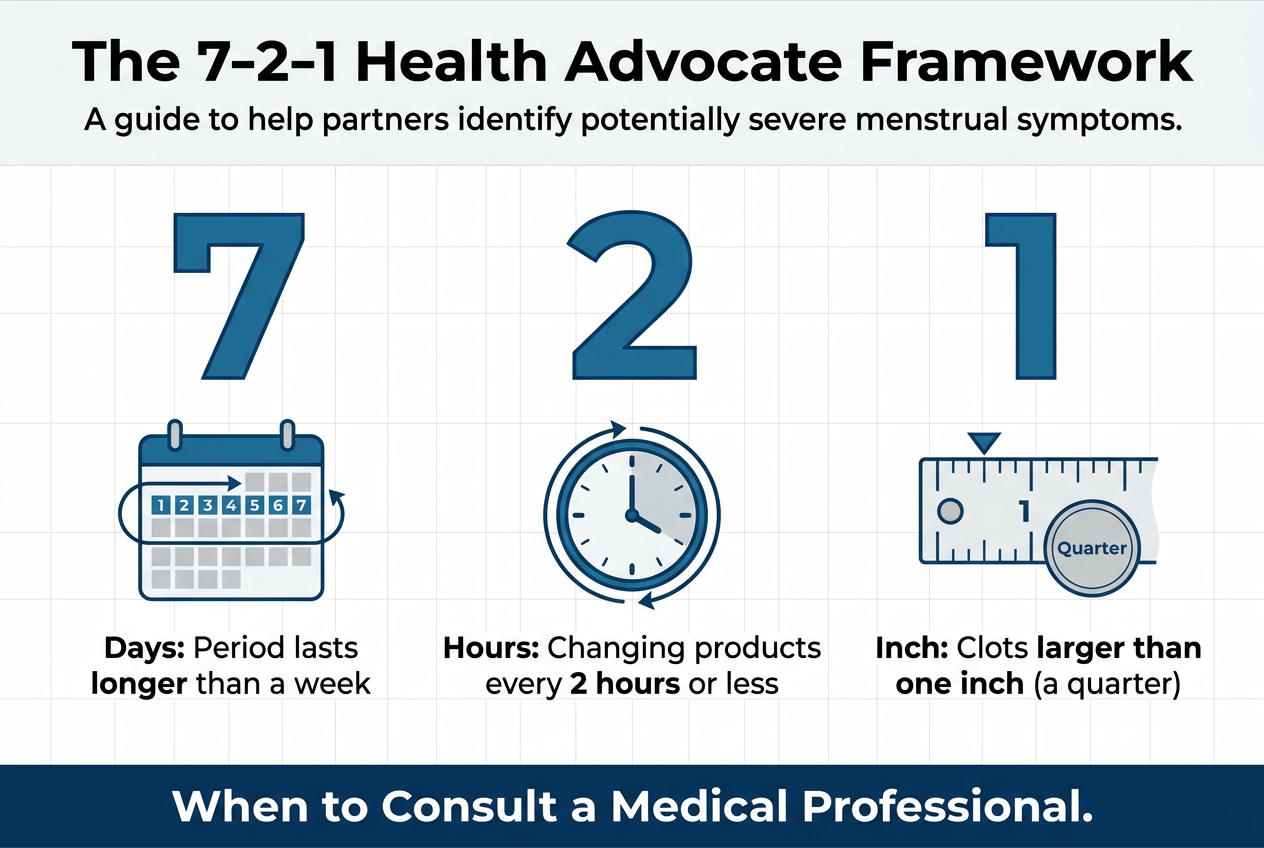
The 7-2-1 Framework
This simple rule helps you identify when something is off:
7 Days: If her period lasts longer than seven days, that’s a red flag. Normal periods last 3-7 days. Prolonged bleeding can indicate conditions like fibroids, polyps, or hormonal imbalances.
2 Hours: If she’s changing pads or tampons every two hours (or more frequently), that’s considered heavy bleeding (menorrhagia). This can lead to anemia and requires medical evaluation.
1 Inch: If she’s passing blood clots larger than a quarter (about one inch), this is abnormal and should be discussed with a healthcare provider.
Other Symptoms That Warrant Medical Attention
- Pain that doesn’t respond to over-the-counter medication: If ibuprofen or naproxen isn’t touching the pain, she might have endometriosis or another condition.
- Severe mood disturbances: If she’s experiencing depression, anxiety, or rage that significantly impacts daily functioning, she might have PMDD (Premenstrual Dysphoric Disorder), which affects 3-8% of menstruating women.
- Missed periods (when not pregnant): Irregular cycles can signal thyroid issues, PCOS, or other hormonal imbalances.
- Bleeding between periods: Spotting is common around ovulation, but frequent or heavy spotting needs evaluation.
How to Bring This Up Without Sounding Controlling
Timing matters. Don’t bring up medical concerns during the worst of her symptoms. Wait until she’s in her follicular phase (the week after her period ends), when energy and mood are higher. For more on supporting her during this phase, see our guide on helping your girlfriend during the follicular phase.
Script: "I’ve noticed that your cramps seem really intense lately, and you mentioned bleeding through pads faster than usual. I’m worried about you. Would you be open to talking to your doctor about it? I’ll go with you if that helps."
Why this works: You’re expressing concern from a place of care, not control. You’re offering support (going with her) without pressuring her.
Why This Matters
Many women normalize symptoms that aren’t actually normal because they’ve experienced them for years. By paying attention and gently advocating, you can help her get treatment that genuinely improves her quality of life.
The No-Ask Action List: Supporting Without Adding Mental Load
BLUF: Don’t ask "How can I help?" during PMS. Take action on known stressors without requiring her to manage you.
The phrase "How can I help?" sounds supportive, but during PMS it adds one more thing to her mental load. She has to think about what would help, articulate it, and direct you. That’s exhausting when her brain is already running on low resources.
Instead, use this list of actions you can take without asking:
The Baseline Actions (Do These By Default)
- Handle the dishes and kitchen cleanup. Don’t wait to be asked. Just do it.
- Restock her comfort items. Dark chocolate, salty snacks, herbal tea, heating pad charged and ready.
- Take over dinner. Cook something simple, order in, or meal prep for a few days. Remove this decision entirely.
- Walk the dog or handle pet care. Pets need attention regardless of how she feels. Take this off her plate.
- Lower the "decision tax." Don’t ask what she wants for dinner or what movie to watch. Have a plan and present it: "I’m ordering Thai food and we’re watching that show you mentioned."
The Elevated Actions (Go Further When You Have Bandwidth)
- Do a silent reset. Clean the bathroom, change the sheets, tidy shared spaces without announcing it. She’ll notice and appreciate it.
- Prep a "comfort station." Set up a spot on the couch with blankets, the heating pad, her water bottle filled, and the remote nearby.
- Handle the logistics. Reschedule anything she mentioned dreading. Cancel plans proactively if you know she’ll want to stay home.
- Run interference with social obligations. If family or friends are expecting her, take the lead on communication: "She’s not feeling well, we’re going to sit this one out."
What NOT to Do
- Don’t announce everything you do or seek validation. "I did the dishes!" makes it about you, not her.
- Don’t half-do tasks and expect credit. If you’re doing the dishes, do all of them, not just yours.
- Don’t wait for her to notice. She might not have the energy to express gratitude in the moment, and that’s okay.
The Long-Term Play
When you consistently take action without being asked, you build trust. She learns that she doesn’t have to manage you during difficult weeks. That security alone reduces stress. For more strategies on reducing the mental load in your relationship, check out our relationship advice for men.
Long-Distance and Digital Support Strategies
BLUF: Physical distance doesn’t mean you can’t provide meaningful support. Use technology strategically to show up without adding pressure.
Supporting your partner during PMS is harder when you’re not in the same location, but it’s far from impossible. The key is being proactive and using the tools available to you.
Text and Messaging Scripts
Timing and tone matter. Don’t send a wall of text asking how she’s doing. Keep it simple and supportive.
Good morning text: "Thinking of you today. I know this week is tough on your energy. No need to respond if you’re not up for it."
Mid-day check-in: "Taking anything off your plate today sounds impossible from here, but I sent you something. Should arrive around 3pm."
Evening text: "You’re on my mind. If you want to vent or just have a quiet video call, I’m here. If not, that’s fine too."
Why these work: They require no response. You’re making it clear that your support doesn’t come with an obligation.
Digital Care Packages
Use delivery services to send tangible support:
- DoorDash or Uber Eats: Send her favorite comfort food without asking. If you know she loves Thai or pizza, just send it.
- Snack delivery: Services like GoPuff, Instacart, or Amazon Prime can deliver chocolate, chips, or other cravings same-day.
- Heating pad and supplies: If she doesn’t have one or needs a replacement, send it via Amazon with a note.
- Flowers or a small gift: Keep it simple. A bouquet or a book she mentioned wanting shows you’re thinking about her without being over the top.
The Video Call Strategy
Don’t default to video calls if she’s low energy. Offer options:
Text: "Would you rather have a video call tonight or just trade voice messages? Or nothing at all and we reconnect tomorrow?"
If she does want to connect:
- Keep it low-pressure. No serious topics or planning conversations.
- Suggest watching a show or movie together using Netflix Party or Teleparty.
- Let her drive the conversation. If she wants to vent, listen. If she wants distraction, provide it.
Using a Period Tracker to Stay in Sync
If you’re in a long-distance relationship, using a period tracker for couples becomes even more valuable. Apps like VibeCheck let you track her cycle privately and get reminders when she’s likely in the luteal phase. This means you can be proactive with support even when you’re not there to see the physical cues.
What to Avoid Long-Distance
- Don’t make her PMS about your frustration with the distance. "I wish I could be there" once is fine. Repeating it makes her feel guilty.
- Don’t ask for constant updates on how she’s feeling. It adds pressure.
- Don’t schedule important relationship conversations during this week. Save them for her follicular phase when she has more bandwidth.
The Bottom Line
Long-distance support during PMS is about showing up consistently without requiring anything in return. When you get this right, you prove that distance doesn’t diminish your ability to be a reliable partner.
Ready to actually understand her?
Join thousands of men using VibeCheck to track her cycle and show up better every day.
Frequently Asked Questions
How do I know if my girlfriend has PMS or if she’s just upset with me?
Track her cycle patterns over a few months. PMS symptoms typically show up 5-10 days before her period and resolve within a day or two of bleeding starting. If her irritability or mood shifts are random and don’t follow this pattern, it might be relationship-specific and worth a conversation. Tools like period trackers for men can help you identify patterns without putting the burden on her to explain herself every month.
Is it okay to track my girlfriend’s period without telling her?
This depends on intent and relationship dynamics. If you’re tracking it to better support her and anticipate her needs, that’s generally positive. However, transparency builds trust. Consider saying something like: "I’ve been reading about how hormones affect mood and energy. Would you be okay with me tracking your cycle so I can be more supportive?" Most partners appreciate the effort. If she’s uncomfortable, respect that boundary and focus on recognizing patterns through her behavior instead.
What if she says she doesn’t want my help during PMS?
Respect that. Some women prefer to handle PMS independently and don’t want their partner treating them differently. In this case, your job is to not make things worse. Avoid the phrases in the danger zone section, stay consistent with your normal behavior, and don’t take mood shifts personally. You can still do baseline actions like handling chores without announcing them as "PMS support."
How do I bring up PMS without sounding like I’m blaming her mood on hormones?
Focus on your desire to support, not on her behavior. Instead of "I noticed you’re more irritable during this time," try: "I’ve been learning about how the menstrual cycle affects energy and mood. Is there anything I can do to make your life easier during the luteal phase?" This positions you as an ally, not a critic. For more guidance on having these conversations, see our article on understanding your partner’s cycle.
My girlfriend has really severe PMS. Should she see a doctor?
Yes. If her symptoms are severe enough to disrupt work, relationships, or daily functioning, she should talk to a healthcare provider about PMDD (Premenstrual Dysphoric Disorder). This is a more intense form of PMS that affects 3-8% of menstruating women and often responds well to treatment, including medication and lifestyle changes. Use the 7-2-1 rule in this article to help identify symptoms that warrant medical attention.
Can I do anything to prevent PMS symptoms in my girlfriend?
No. PMS is driven by hormonal shifts that are part of normal biological function. However, you can help create conditions that minimize severity: reduce stress, encourage regular exercise, support balanced nutrition, and ensure she’s getting enough sleep. Magnesium, vitamin B6, and omega-3 supplements have some evidence for reducing PMS symptoms, but she should discuss these with a healthcare provider first. Your role is to support, not to fix.
What’s the difference between PMS and PMDD?
PMS (Premenstrual Syndrome) involves physical and emotional symptoms that are uncomfortable but manageable. PMDD (Premenstrual Dysphoric Disorder) is a severe form characterized by intense mood disturbances like depression, anxiety, irritability, or rage that significantly impair daily life. If your partner experiences debilitating symptoms, encourage her to seek medical evaluation. PMDD is treatable with medication, therapy, and lifestyle modifications.
How can I support my girlfriend during PMS without treating her like she’s fragile?
Balance is key. Acknowledge the biological reality of PMS without making her feel incapable. The scripts in this article focus on validation and action, not pity. Don’t change your entire personality or walk on eggshells. Instead, adjust your expectations slightly (she might have less social energy), take initiative on tasks (so she doesn’t have to manage you), and don’t take mood shifts personally. You’re not treating her like she’s broken. You’re acknowledging that her body is running a demanding biological program and offering to lighten the load. For more on this balance, read our guide on how to support your partner during her period.
Final Thought: Supporting your girlfriend during PMS isn’t about becoming a perfect boyfriend who never makes mistakes. It’s about showing up consistently, learning from patterns, and treating her experience as valid rather than inconvenient. When you understand the biology, use the right scripts, and take action without being asked, you transform from a bystander into a partner she can rely on through every phase of her cycle.
If you want to stop guessing and start understanding the patterns in your relationship, check out VibeCheck, the relationship app built specifically for men who want to support their partners with science-backed insights and tactical guidance through every phase of her cycle.
Tags

Related Articles
Continue reading to deepen your understanding

How to Understand Your Girlfriend’s Social Battery and Hormones
Does your girlfriend suddenly cancel plans or seem withdrawn? This guide explains how her cycle impacts her energy so you can support her like a pro.

How Your Girlfriend’s Emotional Needs Change During Her Cycle
Does your girlfriend’s mood seem unpredictable? Learn how her emotional needs shift on a biological loop and how to support her through every phase of her cycle.

What to Buy When Your Girlfriend Has Hormone Cravings: A Support Guide
Stop wondering what to pick up at the store. This guide explains the science behind cycle cravings and provides a specific list of foods and comfort items she needs.

Your Girlfriend’s Mood Shifts Throughout the Month, Explained
Ever wonder why her energy and moods change so drastically each week? Understand the four hormonal phases and how to be the partner she needs during every stage of her cycle.

How to Support Your Girlfriend When She’s Crying Because of Hormones
Watching her cry when hormones hit can feel overwhelming. Learn the biological why behind the tears and use these proven scripts to provide the support she actually needs right now.

How to Help Your Girlfriend with Hormonal Mood Swings Without Arguing
Understand her cycle and learn tactical scripts to handle tension. This guide shows you how to support her through hormonal shifts without getting into unnecessary fights.

When to Feed Your Girlfriend: Understanding Hangry Hormones
Does your girlfriend get irritable when she hasn’t eaten? It’s not just in her head. Learn why hormones cause hanger and the specific times her body needs more fuel.

The Boyfriend’s Guide to Supporting Your Partner Through PMS
If your partner is suddenly irritable and exhausted, it’s biology, not you. Learn about the luteal phase and how to provide meaningful support without walking on eggshells.