What a Short Luteal Phase Means for Your Relationship

Is your partner dealing with a short luteal phase? Learn what it means, the symptoms to watch for, and how you can offer real support to strengthen your bond.
So, you've heard the term short luteal phase. What does it actually mean? It’s the stretch of time between ovulation and when her period starts. If this window is shorter than 11 days, it can have a real impact on everything from her mood to her energy levels. It’s not just a calendar thing. It’s a biological thing.
This is usually tied to lower levels of progesterone, a key hormone that pretty much runs the show during the second half of her cycle. Think of it like this: her body's final preparations for either pregnancy or her period get cut short. That sudden shift can throw her whole system a little off balance, and understanding that is your first step to being the partner who really gets it.
You're here because you want to understand her better. You're in the right place. Let's break down what's really going on, why it matters for your relationship, and how you can be the supportive partner she needs, without having to guess. VibeCheck can give you the daily insights to make it easier, but first, let's get the fundamentals down.
Breaking Down Her Monthly Cycle
To really get what a short luteal phase means, you need to see the bigger picture of her entire menstrual cycle. It’s so much more than just "that time of the month." Her cycle is a month long journey with four distinct stages, each one driven by a unique cocktail of hormones. Once you understand the playbook, you can anticipate what's coming next and why she might be feeling the way she does. It’s like knowing the game plan before kickoff.
Let's walk through the four phases. You'll see exactly where the luteal phase fits in and why its length is so critical.
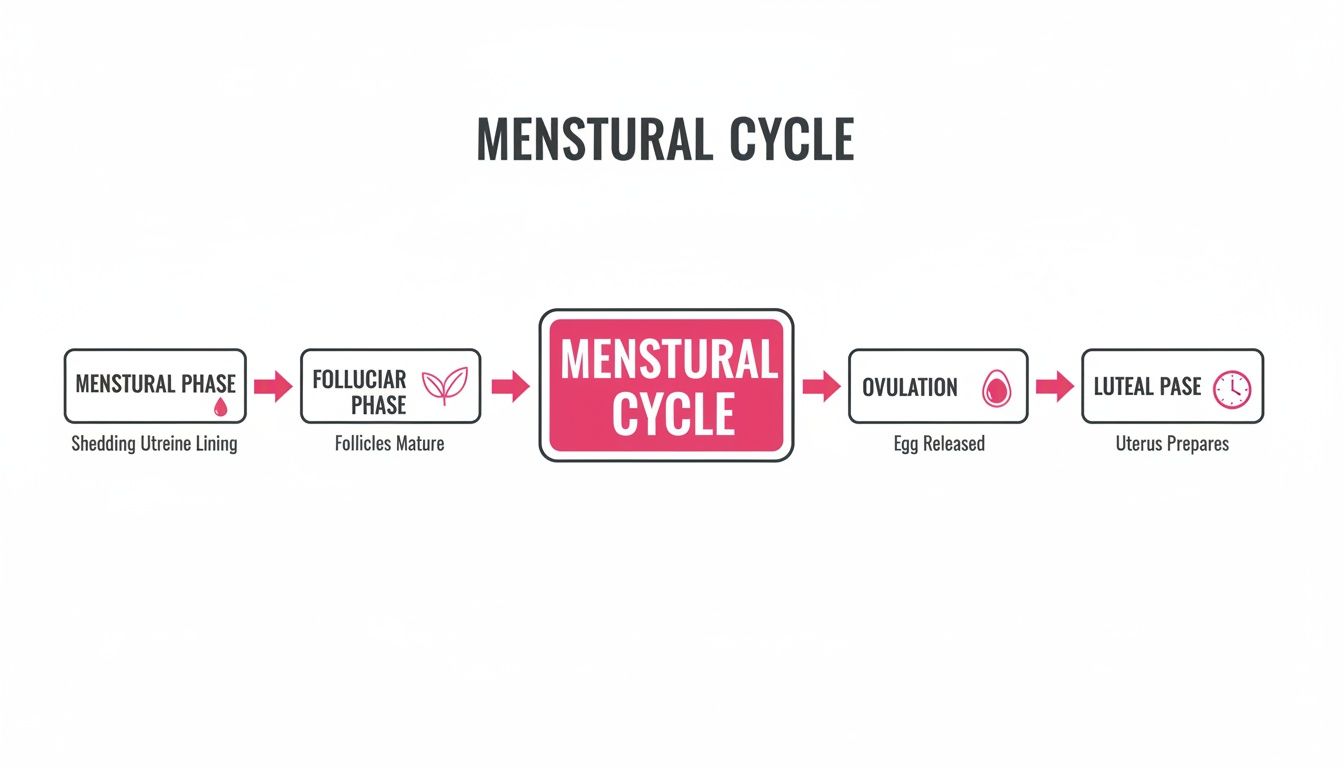
As you can see, the luteal phase is the final stage before her period. When it's short, this crucial phase wraps up in less than 11 days. That detail is the key to understanding its effects on her and on your relationship.
Phase 1: The Follicular Phase (The Build Up)
This is the first half of her cycle. It kicks off on day one of her period and runs all the way until ovulation. You can think of it as the prep stage, where her body is getting an egg ready for release.
During this time, the hormone estrogen is on a steady climb. This often translates to higher energy, a more positive mood, and feeling more social. For many women, it's the time of the month they feel their absolute best. It’s a great time to plan social events or tackle big projects together. You might notice she's more open to new ideas and generally has more pep in her step.
Phase 2: Ovulation (The Main Event)
Right around the middle of her cycle—often near day 14 in an average 28 day cycle—her body releases an egg. That’s ovulation. It’s an incredibly short window, usually just 24 to 48 hours. Hormonally, this is the peak of the month. Both testosterone and estrogen are high, which can supercharge her libido and her overall sense of well being. This is the pivot point where the cycle shifts gears, moving from preparation into the next critical stage.
Phase 3: The Luteal Phase (The Final Quarter)
After ovulation, we enter the luteal phase. In a typical cycle, this phase should last between 11 and 17 days. During this period, the follicle that released the egg morphs into something called the corpus luteum.
Its one and only job? Pump out progesterone.
Progesterone is the calming, stabilizing hormone of the cycle. It gets her body ready for a potential pregnancy, but it also has a massive effect on her mood and energy. When progesterone levels are healthy and stick around long enough, she’s more likely to feel relaxed and settled. This is when she might be more into cozy nights in than big nights out, and understanding the reason behind what to do when your girlfriend is on her period starts with knowing what happens right before it.
A normal luteal phase is the foundation for a smoother premenstrual experience. It’s when progesterone has enough time to do its job, keeping mood and energy levels more stable before her period arrives.
Why a Short Luteal Phase Matters
So, what happens when this phase gets cut short to less than 11 days? A short luteal phase means the corpus luteum gives up and stops producing progesterone too early. This premature hormonal drop is what can lead to a much rockier premenstrual experience.
Instead of a gradual, gentle decline in hormones, it’s more like falling off a cliff. This abrupt shift can trigger:
- Intensified PMS: Symptoms like irritability, anxiety, and deep fatigue can feel much stronger because the hormonal change is so sudden.
- Early Period: Her period shows up sooner than expected, which can make her whole cycle feel frustratingly unpredictable.
- Spotting: She might notice some light bleeding or spotting in the days leading up to her period.
- Fertility Challenges: For couples trying to conceive, a short luteal phase can be a major hurdle. According to experts at Healthline, it might not give a fertilized egg enough time to successfully implant in the uterine lining.
Understanding the luteal phase isn’t about playing doctor. It's about recognizing a common variation in her cycle that has very real, tangible effects. This knowledge helps connect what she's feeling to a biological reality. It turns confusion into genuine empathy. It’s the first step toward becoming a truly supportive partner who’s in sync with her rhythm.
Why It Happens and What It Feels Like for Her
So, what’s really going on when the luteal phase gets cut short? It’s not a choice she’s making or a sign she's done something wrong. The best way to think about it is that her body’s intricate hormonal symphony has been thrown slightly out of tune.
At its core, a short luteal phase almost always comes down to one thing: the corpus luteum isn't producing enough progesterone, or it stops producing it too soon. This can happen for a handful of common reasons that often overlap.
Common Triggers for a Short Luteal Phase
Understanding these triggers isn't about playing doctor or trying to "fix" her. It's about recognizing the very real pressures, both internal and external, that can knock her cycle off track. This awareness is key to building empathy because you start to see the direct line between life's stressors and how she's feeling.
Here are a few of the usual suspects:
- Stress: This is a huge one. When we're stressed, our bodies pump out cortisol. High cortisol levels can directly interfere with the production of crucial reproductive hormones like progesterone. If her body is constantly in fight or flight mode, it naturally prioritizes survival over reproduction. A shorter luteal phase can be the result.
- Intense Exercise: Pushing the body to its absolute physical limits is another form of stress. Overtraining without giving the body enough time to recover can send a signal that it's not a safe or ideal time for a potential pregnancy, which can disrupt her hormones.
- Age: As women move closer to perimenopause, their hormonal patterns naturally start to shift. Ovulation can become less consistent, and shorter luteal phases often become more common during this transition.
- Underlying Health Conditions: Sometimes, a short luteal phase is a red flag for something else going on under the hood. Conditions like Polycystic Ovary Syndrome (PCOS), endometriosis, or thyroid imbalances can all contribute.
It’s also surprisingly common, even for women who feel like their cycles are pretty regular. This isn't some rare anomaly. It's a frequent part of a woman's reproductive experience.
Translating Biology into Her Daily Experience
Okay, we've covered the why. But what does this actually feel like for her? This is where your understanding can completely change the game. That sudden nosedive in progesterone doesn’t just happen on a chart. It happens in her body, impacting her mood, her energy, and how she feels from one day to the next.
This isn't about her being "dramatic" or "overly sensitive." It's a direct biological response to a hormonal freefall. It’s real.
Imagine you're on a smooth, steady flight, and then the plane suddenly drops a few hundred feet. That jolt is what a premature progesterone drop can feel like for her system. The turbulence is more intense, and the landing feels much rougher.
Instead of a gradual wind down before her period, she might experience things like:
- Sudden Energy Crashes: One day she feels perfectly fine, and the next she's hit by a wave of fatigue that no amount of coffee can touch. That’s her body reacting to the abrupt loss of that stabilizing progesterone.
- Heightened Irritability: With progesterone out of the picture, the more stimulating effects of estrogen can feel more pronounced. Little things that she'd normally brush off might suddenly feel like a big deal.
- Increased Anxiety or Sadness: Progesterone has a natural calming, almost anti anxiety effect. When it vanishes too quickly, she can be left feeling more vulnerable, anxious, or just down for no clear reason.
- Intense Food Cravings: This hormonal shift can throw her blood sugar and brain chemistry for a loop, triggering powerful cravings for carbs or sugar. It’s often just her body’s attempt to get a quick mood and energy boost. You can learn more about how progesterone influences hunger and cravings in our guide.
- Physical Discomfort: Symptoms like headaches, bloating, and breast tenderness can feel much more severe because the hormonal change is so sharp and sudden.
When you notice these signs, try to connect them back to the science. Her sudden mood shift probably isn't about you. It’s a physiological event. Seeing it this way allows you to respond with support instead of defensiveness, turning a moment of potential friction into an opportunity for real connection. It’s one of the best ways to show signs you are a good boyfriend.
The Real Impact on Your Relationship Dynamics
Alright, we’ve covered the science of what a short luteal phase is and why it happens. Now, let's get into what that actually means for you and your partner. How this biological reality can ripple through your day to day life together.
This isn’t just about her cycle. It’s about how the two of you connect, communicate, and handle life’s curveballs as a team. The hormonal shifts from that premature progesterone drop can directly influence your relationship, often in ways that feel confusing or personal if you don't have the decoder ring.

From Biology to the Living Room
Think of progesterone as her body's natural shock absorber. It’s a calming hormone that helps her system manage stress and maintain a sense of equilibrium. When it dips out too early, it's like that shock absorber suddenly vanishes. Every little bump in the road feels a whole lot bigger.
This can show up in a few common ways that you’ve probably noticed but couldn’t quite put your finger on.
- Lower Tolerance for Stress: Everyday annoyances she might normally shrug off can suddenly feel like the end of the world. A messy kitchen or a last minute change of plans isn't just a minor hiccup. It feels like one more thing piled on an already overloaded plate.
- Reduced Patience: That mental buffer that allows for patience can wear incredibly thin. This might look like her getting frustrated more quickly in a conversation or having less capacity for a small mistake you made.
- Sudden Emotional Distance: She might pull away or go quiet for no obvious reason. This isn't necessarily about you. It's often an internal retreat as she tries to manage feeling overwhelmed or emotionally raw without progesterone’s calming influence.
Simply understanding this connection is your superpower. It shifts your perspective from, "Why is she so upset with me?" to "What's going on with her, and how can I show up for her right now?" This is the core of modern masculinity: strength through empathy.
Real World Scenarios You Might Recognize
Let's ground this in reality. Once you start connecting her cycle to your interactions, you can decode situations that used to feel like random, out of the blue conflicts.
Scenario 1: The Minor Disagreement That Explodes You casually mention you forgot to grab milk on the way home. On a good day, she’d say, "No big deal, I'll get it tomorrow." But today, during her luteal dip, her response is sharp. It quickly spirals into a bigger argument about feeling unsupported and having to do everything.
- The Old Reaction: You get defensive. You feel attacked over a simple mistake and fire back, escalating the whole thing.
- The Aware Reaction: You recognize this might be a hormonal flashpoint. Instead of reacting to the anger, you respond to the underlying feeling. You say, "You're right, I'm sorry. It sounds like you're feeling completely overwhelmed today. Let me run out and get that now."
Scenario 2: The Overwhelming Date Night You planned a fun, high energy date night. But when the time comes, she seems totally drained and uninterested. It feels like a personal rejection of the effort you put in.
- The Old Reaction: You feel hurt and disappointed. You might even push her to go, saying, "Come on, it'll be fun once we're there!"
- The Aware Reaction: You see the signs of a major energy crash. You pivot. "Hey, you seem really tired. How about we cancel our reservation and just order in and watch a movie on the couch instead? I just want to spend time with you."
Recognizing these moments isn't about making excuses for behavior. It's about adding crucial context that allows you to respond with empathy instead of confusion. It turns a potential fight into a moment of connection.
It’s also worth noting that when progesterone drops, estrogen can become more dominant by comparison, which can amplify certain symptoms. If this sounds familiar, you can learn more about the signs of estrogen dominance symptoms and see how they can overlap.
Ultimately, this awareness doesn't "fix" her cycle. What it does is transform your role from a confused bystander to an attuned, supportive partner. You learn to read the signals, anticipate her needs, and show up in a way that makes her feel seen and understood. That is one of the most powerful things you can do for your relationship.
How You Can Be the Partner Who Genuinely Gets It
Knowing the science behind a short luteal phase is one thing. But turning that knowledge into action? That’s where you go from being a supportive partner to being a true teammate. This is your practical playbook for showing up when she needs you most.
It’s about more than just being nice. It’s about being thoughtful and proactive. When you get this right, you make her feel seen and cared for, especially on those days when she’s struggling to find her footing. This is about building a better connection, not just getting through a tough week.
Time Your Hard Conversations
Ever tried to have a serious talk and watched it go completely off the rails? The timing was probably wrong. This is especially true during her luteal dip.
When her progesterone drops early, her resilience is at its lowest. This is absolutely not the moment to bring up stressful topics like finances, family drama, or other big relationship issues. Her system is already on high alert, and a heavy conversation can easily feel like an attack.
Think like a strategist instead:
- Flag it for later: If something important comes up, just make a note. You could say, "Hey, I want to talk about [topic] with you, but I don't think now's the best time. Can we set aside some time this weekend?"
- Wait for the shift: The week after her period, known as the follicular phase, is often a much better time for these conversations. Rising estrogen usually brings more energy, optimism, and emotional bandwidth for both of you.
This isn’t about avoiding tough conversations. It's about choosing a time when you can both show up as your best selves, ready to connect instead of clash.
Your Actions Speak Louder Than Your Fixes
Your first instinct might be to try and "fix" whatever is wrong. But during this phase, what she usually needs isn't a solution. It's support. It’s the feeling that she’s not going through it alone.
Your job isn't to solve the hormonal imbalance. Your job is to soften the landing.
The most powerful thing you can do is reduce the number of decisions she has to make and lower the amount of stress on her plate. This is proactive care in action.
Here’s a quick guide to simple but powerful gestures that can make a huge difference.
Your Supportive Action Plan During a Short Luteal Phase
This isn't about grand, sweeping gestures. Often, it's the small, consistent acts of service that feel like a lifeline when she's feeling adrift. They send a clear message: "I see you, I've got your back, and you can rest."
| What She Might Be Feeling | A Good Way To Respond | What To Avoid Saying or Doing |
|---|---|---|
| Completely Overwhelmed | Take something off her plate without being asked. "I'm ordering dinner tonight, what sounds good?" or "I've got the laundry, don't worry about it." | Asking, "What can I do to help?" This puts the burden back on her to come up with a task list. |
| Irritable and On Edge | Give her space and quiet. A simple, comforting gesture like making her a cup of tea or giving her a hug without saying anything can work wonders. | Taking it personally or getting defensive. Her reaction is likely amplified by hormones, not directed at you. |
| Exhausted and Drained | Create a low key, comforting environment. Suggest a cozy night in with a movie and her favorite snacks. Make the decision for her. | Pushing her to go out or stick to plans that require a lot of social energy. |
If you're looking to dive even deeper into building this kind of supportive partnership, our guide on relationship advice for men offers even more practical tips.
Master the Art of Supportive Language
The words you choose matter. A lot. During the luteal dip, she may be more sensitive to your tone and phrasing. Your goal is to be a source of calm, not another source of stress.
Focus on validating her feelings, not trying to solve them.
- Instead of: "You just need to relax."
- Try: "It sounds like you’re having a really tough day. I'm here with you."
Show her you're a team, not opponents.
- Instead of: "Why are you so upset?"
- Try: "We're in this together. How can we make today a little easier?"
Offer your presence, not pressure to fix things.
- Instead of: "Is there something I can do to fix this?"
- Try: "I'm right here if you want to talk or if you just want to sit in silence. No pressure."
This kind of communication de-escalates tension and reinforces that you're on her side. It shows you understand this is a physiological event, not a personal failing. Being this kind of partner, the one who truly gets it, is what builds an unshakeable foundation of trust and intimacy. That is how you can truly support your partner.
How VibeCheck Helps You Stay in Sync
So, understanding the short luteal phase is one thing, but actually remembering where your partner is in her cycle every single day? That’s a whole different ball game. This is where knowledge needs to become action. It’s exactly why we built VibeCheck: to be your relationship playbook.
Think of it as more than just a period tracker for men. VibeCheck was designed for you, the partner. It takes her cycle data and translates it into simple, actionable insights. It helps you show up as the thoughtful, in tune partner you want to be. It’s the bridge between knowing what’s happening in her body and knowing what to do about it.
From Data to Daily Action
VibeCheck translates the complex science of her cycle into a daily heads up, sent right to your phone each morning. The app learns her unique patterns over time, including the likelihood of a shorter luteal phase, and gives you personalized tips based on where she is.
Picture this: Instead of getting caught off guard by a sudden mood shift or energy dip, you get a notification that says, "Hormonal changes suggest her energy might be low today. A great night for takeout and a movie."
Just like that, you’re not just reacting anymore. You’re anticipating. You’re proactive. It’s a simple shift that can head off countless misunderstandings and turn moments of potential friction into real opportunities for connection.
Taking the Guesswork Out of Support
You want to be there for her, but sometimes it’s tough to know what "support" actually looks like in the moment. VibeCheck clears away that guesswork by giving you concrete suggestions that make a genuine impact.
Here’s how it helps you put everything we've talked about into practice:
- Timing Your Conversations: Get a heads up when she might be entering a phase with less patience for stressful topics. This helps you time important talks for when you can both connect without the extra tension.
- Planning the Perfect Date: The app provides date ideas tailored to her energy levels. It might suggest an adventurous hike during her high energy follicular phase or a quiet, cozy night in during her luteal phase.
- Offering Practical Help: Receive reminders to take things off her plate when she’s most likely to feel overwhelmed. Small gestures, like grabbing dinner or tackling a chore, mean so much more when they’re perfectly timed.
This isn't about walking on eggshells. It's about moving through life together with more awareness and empathy. The app is simply a tool to help you do that. It makes being a supportive partner easier and more intuitive.
Building a Stronger Team
When you start using VibeCheck, you send a powerful message: "I care enough to learn your rhythm, and I want to be a better partner for you." It transforms you from a spectator of her cycle into an active, engaged teammate.
This shared understanding builds a deep foundation of trust and intimacy. Arguments born from confusion start to fade, replaced by moments of support. She feels seen and understood, and your connection gets stronger. You can learn more about how VibeCheck offers personalized relationship insights for men to strengthen your partnership.
Ultimately, VibeCheck helps you turn empathy into a daily habit. It gives you the knowledge and the tools to be the partner who really, truly gets it. Day in and day out.
Your Questions, Answered
When you're trying to understand what’s going on with your partner’s cycle, a lot of questions can pop up. It's completely normal. Let’s walk through some of the most common ones we hear from guys, so you can get the clear, direct answers you need.
How Can I Tell if My Partner Has a Short Luteal Phase?
This is a great question, but the simple answer is: you can't. A short luteal phase isn't something you can eyeball from a calendar, even if you’re paying close attention. It’s a clinical diagnosis that requires a professional.
You might notice clues, like her period showing up a bit earlier than you both expected or her premenstrual symptoms hitting harder and faster. But these are just signals, not a diagnosis. To know for sure, she’ll need to track her cycles and talk to her doctor. They're the ones who can run blood tests to check hormone levels or use an ultrasound to see what’s happening with her uterine lining.
Your job here isn't to play doctor. It's to be the guy who says, "Hey, if you're worried about your cycle, I'm here for you, and maybe we should get a professional opinion."
Does a Short Luteal Phase Automatically Mean Infertility?
No, not necessarily, but it definitely can make things trickier if you're trying to conceive. The real problem is all about timing. A short luteal phase means the window of time for a fertilized egg to securely implant in the uterine wall might be too brief.
Think of it like trying to land a plane on a runway that's just a little too short. Everything has to be perfect. The body needs enough time for implantation to occur before her period starts and flushes the lining out. A short luteal phase shrinks that window, which can lower the odds of pregnancy each month.
But, and this is a big but, it doesn't mean it's impossible. Many women with shorter luteal phases get pregnant, especially once they address the root cause. It's a treatable condition.
Is This Some Kind of Rare Condition?
Not at all. It’s way more common than people realize. A short luteal phase isn’t some obscure medical mystery. It’s a natural variation that shows up in a surprising number of women.
For example, one major study found that nearly 8.9% of all ovulatory cycles had a luteal phase shorter than 10 days. Looking at individual women, 12.4% had at least one cycle with a luteal phase under 11 days. So, if you and your partner are dealing with this, you are far from alone. You can read more about these findings to see just how prevalent these cycle variations are.
What’s the Difference Between a Short Luteal Phase and PMS?
It's easy to confuse them, but they're two different things.
- A short luteal phase is about time. It’s a specific measurement: the phase between ovulation and her period is less than 11 days long.
- Premenstrual Syndrome (PMS) is about symptoms. It's the collection of physical and emotional feelings, like bloating, irritability, and cramps, that happen in the days before her period.
The two are definitely connected, though. A short luteal phase is often caused by progesterone dropping off too quickly. That sudden hormonal crash can make PMS symptoms feel like they come on like a freight train—more intense and abrupt. So, while they aren't the same, one can absolutely make the other feel a whole lot worse. Getting a handle on the basics of the menstrual cycle can help make this connection clearer.
Is There Anything I Can Actually Do to Help Fix It?
While you can't directly "fix" her hormones, your support can be a game changer in helping her body find its balance. One of the biggest culprits behind hormonal issues is stress, and that's where you come in. By actively helping to reduce the stress in her environment, you create the space for her body to regulate itself.
This isn't about grand gestures. It's about small, consistent actions:
- Take things off her plate: Handle dinner a few nights a week, manage that annoying bill payment, or just take over a chore she dreads.
- Champion her rest: Encourage a quiet night in. Plan a low key weekend where the only goal is to recharge.
- Just be a calm presence: Sometimes the best thing you can do is listen without trying to solve everything. A hug goes a long way.
Your support isn't a magic cure, but it is a powerful piece of the puzzle. It creates stability and safety, which has a real, tangible impact on her well being and, in turn, her hormonal health.
Ready to stop guessing and start connecting? VibeCheck gives you the daily insights you need to be the supportive, in tune partner she deserves. Join thousands of men who are building stronger, more empathetic relationships.
Download VibeCheck today and turn your good intentions into meaningful action.
Tags

Related Articles
Continue reading to deepen your understanding

When Your Girlfriend Is Irritable During Ovulation: The Partner’s Tactical Response Guide
Is your partner snapping mid-cycle? Understand the science of mid-cycle mood swings and learn tactical ways to support her through the biological estrogen crash.

Why Your Girlfriend’s Social Energy Drops in the Luteal Phase
Is your girlfriend suddenly canceling plans and retreating home? It isn’t personal; it’s biology. Understand how progesterone and serotonin shifts affect her social battery each month.

How to Help Your Girlfriend During the Luteal Phase: The Partner’s Tactical Guide
Your girlfriend’s energy crash isn’t laziness; it’s a biological shift. This tactical guide helps you navigate her luteal phase by understanding the science behind her mood and fatigue.

Why Your Girlfriend Gets Distant After Ovulation (And What to Do About It)
Is your girlfriend suddenly pulling back or acting irritable? It might be her cycle. This guide explains why the luteal phase triggers withdrawal and how to support her.

Supporting Your Girlfriend Through the Luteal Phase
When hormone levels crash before her period, your partner’s brain enters a high-alert state. Learn how to provide the security she needs with tactical scripts and empathy.

How to Give Your Girlfriend Reassurance During Ovulation Week
Is your girlfriend suddenly questioning everything during her cycle? Understand the estrogen crash and learn how to provide the tactical support she needs to feel secure and loved.

When to Give Her Space vs. When to Stay Close: Your Phase-by-Phase Guide
Your girlfriend’s need for closeness isn’t random. Understanding how her 28-day biological rhythm affects her energy helps you time your support perfectly across all four phases.

Your Girlfriend’s 28-Day Relationship Manual: How to Support Her Through Every Phase
Understanding her menstrual cycle transforms you from a guy walking on eggshells into a strategic partner who knows exactly what support to offer and when.