Spotting a Week Before Period: A Guide for Supportive Partners
Noticed spotting a week before period and wondering what it means? Get clear, simple answers on why it happens and how to be the most supportive partner.
You've noticed it. That little bit of light bleeding that shows up about a week before her period is due. Your first thought might be confusion. Is she okay? Is her period early? What's going on? More often than not, it's just a normal sign that her body is getting ready for menstruation. It looks quite different from a regular period and is usually just the result of hormone levels shifting around. Understanding spotting a week before period is the first step to being a great partner through it all.
This isn't about becoming a medical expert. It's about knowing enough to trade worry for confidence. When you get what her body is doing, you can show up with empathy and support, not anxiety. That simple shift can make all the difference in your relationship. Let's break it down.
What Is Pre-Period Spotting, Really?
So, you've noticed some light bleeding and you're trying to figure out what's happening. The most important thing to know is that seeing a little spotting a week before her period is incredibly common. It doesn't mean her period has decided to show up early. It’s more like a quiet heads up from her body.
Think of it as the opening act before the headliner comes on stage. It’s a preview, not the main event. You're just getting a small glimpse of what's to come, and knowing that can help you both feel more prepared and less surprised.
Spotting vs. Period: A Quick Comparison
The key is learning how to tell them apart. Spotting has its own unique characteristics that make it different from a full blown menstrual period. Getting a handle on these can give you some quick context and peace of mind.
Here’s a simple table to help you see the main differences at a glance.
| Characteristic | Spotting | Period |
|---|---|---|
| Amount | Very light, just a few drops. | A heavier flow requiring a pad, tampon, or cup. |
| Color | Typically light pink or brown (older blood). | Usually bright red, especially on heavier days. |
| Duration | Lasts for a short time, maybe a day or two. | Continues for several days (typically 3-7). |
Knowing these simple distinctions is a powerful tool. It means you can check in with your partner from a place of awareness, not worry. This isn't about diagnosing anything. It's about connecting with her and understanding her body's rhythm. You can learn more in our guide to supporting your partner through her cycle.
A Totally Normal Biological Event
For many people who menstruate, spotting is just another premenstrual symptom, plain and simple.
In fact, a recent global analysis found that nearly 48% of women of reproductive age experience premenstrual symptoms. For a good number of them, this includes a little spotting in the days leading up to their period. It’s just a normal part of the hormonal dance happening inside her body. You can dive deeper into the global prevalence of PMS and its wide range of symptoms.
The Hormonal Science Behind Spotting Before a Period
So, we’ve established that spotting can be totally normal. But why does it happen? Digging into the science isn't about getting a biology degree. It's about understanding the rhythm of her body so things feel less random and more predictable.
Her entire cycle is orchestrated by a handful of key hormones, but the main players we're looking at here are estrogen and progesterone. Think of them as the directors of her reproductive system's monthly show.
What Is The Luteal Phase?
The second half of her menstrual cycle, the part that kicks in right after ovulation, is called the luteal phase. This is when the hormone progesterone takes center stage. Its main job is to build up a thick, cushy uterine lining, essentially preparing a welcoming home in case of pregnancy.
But if a pregnancy doesn't occur, the body has to pivot and get ready for a period instead. That’s when the hormonal tides start to turn.
About a week before her period is due, progesterone levels naturally begin to fall. This drop is the signal that tells the body it's time to let go of that uterine lining.
Sometimes, as progesterone levels dip, a small part of that lining can break away a little prematurely. And that's all spotting a week before period usually is—a tiny preview of the main event, triggered by that hormonal shift. It’s simply a sign that her body is getting ready for what's next.
An Analogy to Make It Click
Imagine her hormones are a construction crew building a temporary structure (the uterine lining). Progesterone is the meticulous foreman, making sure everything is stable and secure.
As the project's end date (her period) gets closer, the foreman (progesterone) starts packing up his tools and heading off site. Without his constant oversight, a few bricks might tumble down before the full demolition crew arrives. Those few loose bricks? That's the spotting.
This simple infographic shows how spotting is typically lighter and much shorter than an actual period.
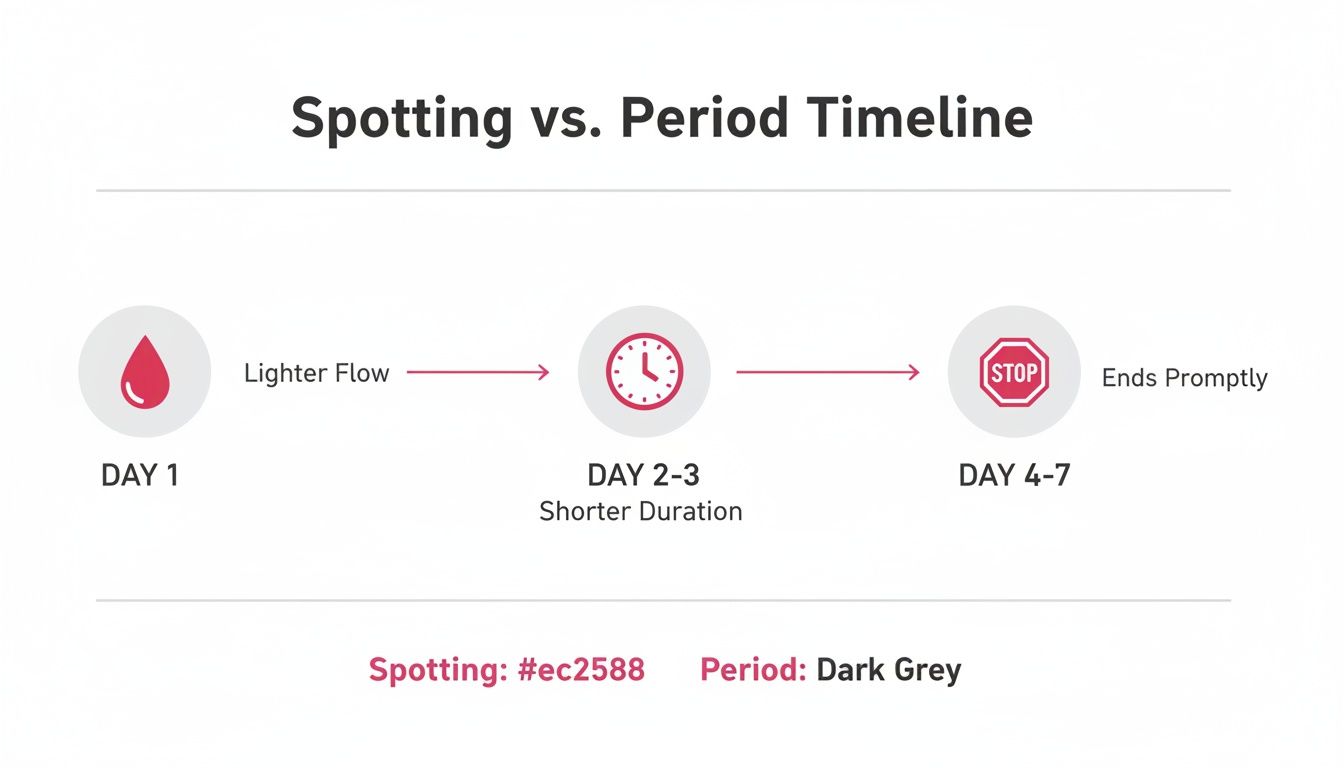
The key takeaway here is that spotting is a brief, minimal event. It's not the sustained flow of a real period. It’s a subtle but important difference.
Of course, these hormonal fluctuations don't just cause spotting. They can influence everything from her mood and energy levels to her digestion. In fact, these same kinds of hormonal shifts are also responsible for things like bloating during ovulation.
Once you see it as a predictable biological process, you can shift from feeling confused to feeling supportive and confident. It’s not a sign something is wrong. It’s just her body doing exactly what it's designed to do. Learn how VibeCheck can help you understand your partner better.
When Spotting Is Normal and When to Pay Attention
Alright, so your partner is spotting, and it’s not quite time for her period. The big question bouncing around in your head is probably, "Is this normal?" It's a great question to ask. Knowing the difference between "totally fine" and "maybe we should get this checked out" is a huge part of being a supportive partner.
The good news is that most of the time, a little bit of spotting a week before her period is just her body’s hormonal system doing its thing. It’s often predictable and just another part of her unique pattern.
What Normal Spotting Looks Like
When spotting is cyclical and expected, it’s generally nothing to worry about. Think of it as a little preview of what’s to come. Here’s what it typically looks like:
- Light Color: The blood is often a light pink or brownish hue. Don't let the brown color worry you. It's just older blood that took a bit longer to make its way out. Perfectly normal.
- Minimal Amount: We’re talking about a few drops. It’s usually not enough to even need a liner, let alone a pad or tampon.
- Short Duration: It typically only lasts for a day or two and then vanishes right before her actual period begins.
If this sounds like what she’s experiencing, it’s likely just a standard feature of her luteal phase. In fact, clinical reports show that spotting is a pretty common symptom in the week leading up to menstruation. You can learn more about the research behind premenstrual symptoms to see just how common these experiences are.
When to Suggest a Doctor Visit
Look, your job isn't to be a medical expert. It’s to be an attentive, caring partner. If you notice something seems different from her usual pattern, gently suggesting a chat with her doctor is one of the most supportive things you can do.
A partner's role is to be an extra set of eyes, not to provide a diagnosis. Simply noticing a change and encouraging a professional opinion is an act of deep care.
So, when should you be concerned? Here’s a simple checklist of signs that might warrant a conversation with a healthcare provider. If you see them, it's a good idea to bring it up gently.
- Unusually Heavy: Is it more like a light period, needing a pad or tampon?
- Accompanied by Pain: While mild cramps can be normal, significant or severe pain alongside spotting is worth looking into.
- Happening for the First Time: If she’s never spotted before, it’s a good reason to get it checked out just to be safe.
- Lasting for Several Days: If the spotting drags on for more than a couple of days, that's a change from the typical pattern.
- Consistently Happening After Sex: This is always something to mention to a doctor.
This isn’t about causing alarm. It's about being a team. When you understand her baseline, you can help notice when something is off, making you an invaluable part of her support system. Keeping track of these patterns together with a tool like the VibeCheck app can make it so much easier to see what’s normal for her and what’s not.
How to Be an Incredibly Supportive Partner
Knowing the science behind pre period spotting is one thing, but turning that knowledge into meaningful action is where you really shine as a partner. When you see signs like spotting a week before her period, how you react can make her feel either deeply supported or totally alone. This is about more than just saying the right thing. It's about showing up in small, consistent ways that matter.
Your goal is to be proactive, not reactive. It’s about anticipating her needs so she doesn't always have to be the one to ask. True support is found in the details.

Small Gestures That Make a Big Difference
You don't need to make a grand, sweeping gesture. More often than not, it's the simple, thoughtful actions that show you're paying attention and that you're in this together.
Here are a few practical ideas to get you started:
- Assemble a Comfort Kit: Have her favorite tea on hand or make sure the hot water bottle is easy to find. Having these things ready before she even mentions needing them shows you’re thinking ahead.
- Suggest a Low Key Night: Instead of putting the decision on her with "What do you want to do tonight?" try offering a gentle alternative. "Hey, how about we just order some food and chill with a movie?" takes the pressure off.
- Take Something Off Her Plate: Whether it's cooking dinner, walking the dog, or just tidying up the living room, taking one chore off her list can make a world of difference when she's feeling drained.
These kinds of actions say more than words ever could. They show you care, you're aware, and you genuinely want to make her life a little bit easier. Learning how to be a better boyfriend often just comes down to mastering these small, consistent acts of service.
Communication Is Everything
How you talk about what's going on is just as important as what you do. The idea is to open the door for a conversation without jumping to conclusions or making assumptions about how she feels.
Try a simple check in like, "Hey, I know it might be getting close to that time of the month. Just wanted to see how you're feeling today." It’s direct, it's caring, and it shows you're actually tuned in to her cycle.
This approach validates her experience without making it into a huge deal. It gives her a safe space to tell you what she needs. Whether that’s a little extra patience, a back rub, or just some space to herself.
What to Avoid at All Costs
Knowing what not to do is just as critical as knowing what to do. One insensitive comment can easily erase all of your good intentions.
- Don't Ever Make Jokes: Period or PMS jokes are never funny. They're dismissive and can make her feel like a real, physical experience is just a punchline.
- Never Dismiss Her Feelings: Don't chalk up every emotion to her cycle. That’s incredibly invalidating. Listen to what she's feeling first, separate from any hormonal context.
- Avoid Trying to "Fix" It: Your role isn't to solve a problem that can't be solved. It's simply to offer comfort and support. Listen far more than you advise.
Being an amazing partner means showing up with empathy and awareness. It’s about being a steady, reliable presence through every single part of her cycle, spotting and all.
How VibeCheck Helps You Stay Connected and Aware
Let's be honest. Trying to remember all the details of her cycle on your own is a tough ask. It's incredibly easy to lose track of where she is in her cycle, which is why things like spotting can feel like they come out of nowhere.
This is where an app like VibeCheck becomes your secret weapon for being a more tuned in partner. It completely takes the guesswork out of the equation. The app gives you a simple heads up about her pre period week, so spotting never has to catch you off guard again. Suddenly, you're not just reacting to what's happening. You're anticipating it with confidence and care.
From Confusion to Connection
Imagine getting a notification that says something like, "Her energy might be lower today due to hormonal shifts. A quiet night in could be perfect." Instantly, her desire to skip that social event makes perfect sense. It’s not about you. It's about her biology.
VibeCheck provides these kinds of insights to help you understand the 'why' behind her feelings and physical symptoms. That context is everything. It transforms a potentially confusing moment into a genuine opportunity for connection. Instead of wondering what’s wrong, you know exactly how to be supportive.
The experience of pre period symptoms also varies a lot from person to person, and even by location. Research shows that reports of symptoms like spotting differ widely across the globe, influenced by everything from study methods to cultural factors. To see how much these numbers can vary, you can read the full research on PMS prevalence.
Actionable Insights, Not Just Data
VibeCheck doesn't just dump raw data on you. It translates her cycle information into practical, actionable advice that’s designed for you. Think of it like having a coach in your pocket, guiding you on how to show up for her in the best way possible each day.
Here’s how it works in a real world scenario:
- The Heads Up: VibeCheck flags that she’s in her late luteal phase, the time when spotting a week before her period is most common.
- The Insight: The app explains that a dip in progesterone might be making her feel more tired or sensitive.
- The Action: You get a suggestion like, "Offer to handle dinner tonight," or "A warm blanket and her favorite show could be a game changer."
This system helps you build a track record of being thoughtful and aware. Over time, these small, consistent actions build a stronger, more resilient relationship. By using technology to foster empathy, you're not just tracking a cycle. You're actively deepening your bond. To learn more, check out our guide on how the VibeCheck app delivers relationship insights for men. Discover science backed relationship insights with VibeCheck.
Putting It All Together: Your Role as a Supportive Partner
So, what's the bottom line? Spotting a week before her period is usually just her body doing its thing, thanks to the normal ebb and flow of hormones. The key is knowing what's typical for her versus what might signal something more.
But your biggest takeaway shouldn't be about diagnosing anything. Far from it. This is about being an observant, caring partner who is genuinely tuned in.
Think of this knowledge less as a problem to solve and more as a way to deepen your connection. When you notice the small things, you're sending a powerful message: you see her, you care, and you're in this together.
Ultimately, the goal is simple: to be in sync. Being attuned to your partner's natural rhythms is one of the most profound ways you can strengthen your bond.
You don't have to rely on memory alone, either. Using a tool like VibeCheck, a period tracker designed for men, can give you the quiet confidence to be the partner she needs. It helps turn what might feel like a mystery into a shared understanding, day by day.
It's a straightforward way to learn the rhythm of her life so you can show up when it matters most.
A Few Common Questions About Spotting Before a Period
We get it. You've got questions, and you're looking for straight answers. Let's break down some of the most common things partners ask about spotting before a period.
Can Stress Cause Spotting a Week Before a Period?
Absolutely. When stress levels spike, the body pumps out more cortisol—the primary stress hormone. This can mess with the delicate hormonal balance that runs her cycle, sometimes causing a little bit of unexpected spotting.
Think about it. If she’s had a monster week at work, is cramming for exams, or is just dealing with a lot of pressure, that could be the culprit. It's one of her body’s ways of signaling that it's under a heavy load. This is a perfect time to offer some extra support.
Does Spotting Mean Her Period Is Coming Early?
Not usually. It’s more of a heads up than the main event arriving ahead of schedule. Think of it as the opening act. Her progesterone levels are starting to drop, which is the natural cue for her period to begin in the next few days.
So, even though spotting is related to her upcoming period, it’s not the same as her full flow starting early. It’s a separate, much lighter thing that happens in the lead up.
What Color Is Spotting Supposed to Be?
You'll typically see light pink or brown blood. This is one of the biggest differences between spotting and the bright red blood of an actual period.
Pinkish discharge just means there's a small amount of fresh blood mixing with her normal cervical fluid. Brown, on the other hand, is just older blood that took a bit longer to make its way out. Neither one is usually anything to worry about.
Is It Normal for Spotting to Happen Some Months But Not Others?
Yep, this is incredibly common. A woman's body isn't a Swiss watch, and minor fluctuations from month to month are completely normal. Small shifts in her diet, exercise routine, sleep quality, or stress levels can be just enough to trigger spotting one month and not the next.
When it comes to menstrual cycles, inconsistency is actually pretty consistent. Spotting that shows up occasionally doesn't automatically signal a problem.
The important thing is to look at the big picture. If spotting is suddenly a new and regular occurrence, or if it shows up with other unusual symptoms, that's a good time to encourage a conversation with her doctor. Getting familiar with her cycle using an app like VibeCheck can help you both get a clearer picture of what her unique "normal" really is.
Ready to stop guessing and start connecting? VibeCheck gives you the insights you need to be the supportive partner she deserves.
Tags

Related Articles
Continue reading to deepen your understanding

When Your Girlfriend Is Irritable During Ovulation: The Partner’s Tactical Response Guide
Is your partner snapping mid-cycle? Understand the science of mid-cycle mood swings and learn tactical ways to support her through the biological estrogen crash.

Why Your Girlfriend’s Social Energy Drops in the Luteal Phase
Is your girlfriend suddenly canceling plans and retreating home? It isn’t personal; it’s biology. Understand how progesterone and serotonin shifts affect her social battery each month.

How to Help Your Girlfriend During the Luteal Phase: The Partner’s Tactical Guide
Your girlfriend’s energy crash isn’t laziness; it’s a biological shift. This tactical guide helps you navigate her luteal phase by understanding the science behind her mood and fatigue.

Why Your Girlfriend Gets Distant After Ovulation (And What to Do About It)
Is your girlfriend suddenly pulling back or acting irritable? It might be her cycle. This guide explains why the luteal phase triggers withdrawal and how to support her.

Supporting Your Girlfriend Through the Luteal Phase
When hormone levels crash before her period, your partner’s brain enters a high-alert state. Learn how to provide the security she needs with tactical scripts and empathy.

How to Give Your Girlfriend Reassurance During Ovulation Week
Is your girlfriend suddenly questioning everything during her cycle? Understand the estrogen crash and learn how to provide the tactical support she needs to feel secure and loved.

When to Give Her Space vs. When to Stay Close: Your Phase-by-Phase Guide
Your girlfriend’s need for closeness isn’t random. Understanding how her 28-day biological rhythm affects her energy helps you time your support perfectly across all four phases.

Your Girlfriend’s 28-Day Relationship Manual: How to Support Her Through Every Phase
Understanding her menstrual cycle transforms you from a guy walking on eggshells into a strategic partner who knows exactly what support to offer and when.