How to Support Your Girlfriend During Ovulation Phase (2026)
Learn how to support your girlfriend during the ovulation phase. Use the Triple-A Strategy to match her peak energy, boost confidence, and improve connection.
How to Support Your Girlfriend During Ovulation Phase: The Tactical Guide for Partners
You’ve noticed she’s suddenly got twice the energy, she’s planning three weekend activities at once, and she looks incredible. Welcome to ovulation week. While most guys know about periods, the ovulation phase is the relationship window most men completely miss. This isn’t about surviving her cycle - it’s about maximizing the best days of the month for connection.
Here’s what you need to know: ovulation is the 3-5 day window when her estrogen peaks, her confidence soars, and her body is literally built for connection. Most relationship advice focuses on damage control during PMS or periods. This guide shows you how to match her energy when she’s at her best.
Table of Contents
- The Science Behind Her Ovulation Phase
- The Triple-A Strategy for Ovulation Support
- Communication Scripts: What to Actually Say
- Physical Signs You Should Know About
- The Post-Peak Warning: What Comes Next
- Common Mistakes Men Make During Ovulation
- Frequently Asked Questions
The Science Behind Her Ovulation Phase
BLUF: Ovulation happens mid-cycle (around day 14) when estrogen spikes create a 72-hour window of peak energy, confidence, and social connection. This is her biological "performance phase."
Ovulation is when her body releases an egg, typically 12-16 days before her next period. But the real story isn’t about reproduction - it’s about hormones. During this 3-5 day window, her estrogen levels surge to their monthly peak, and that surge changes everything about how she feels and shows up.
VibeCheck App
Know what she needs. Before she has to say it.
Track her cycle, understand her phases, be the partner she deserves.
Download Free on iOS →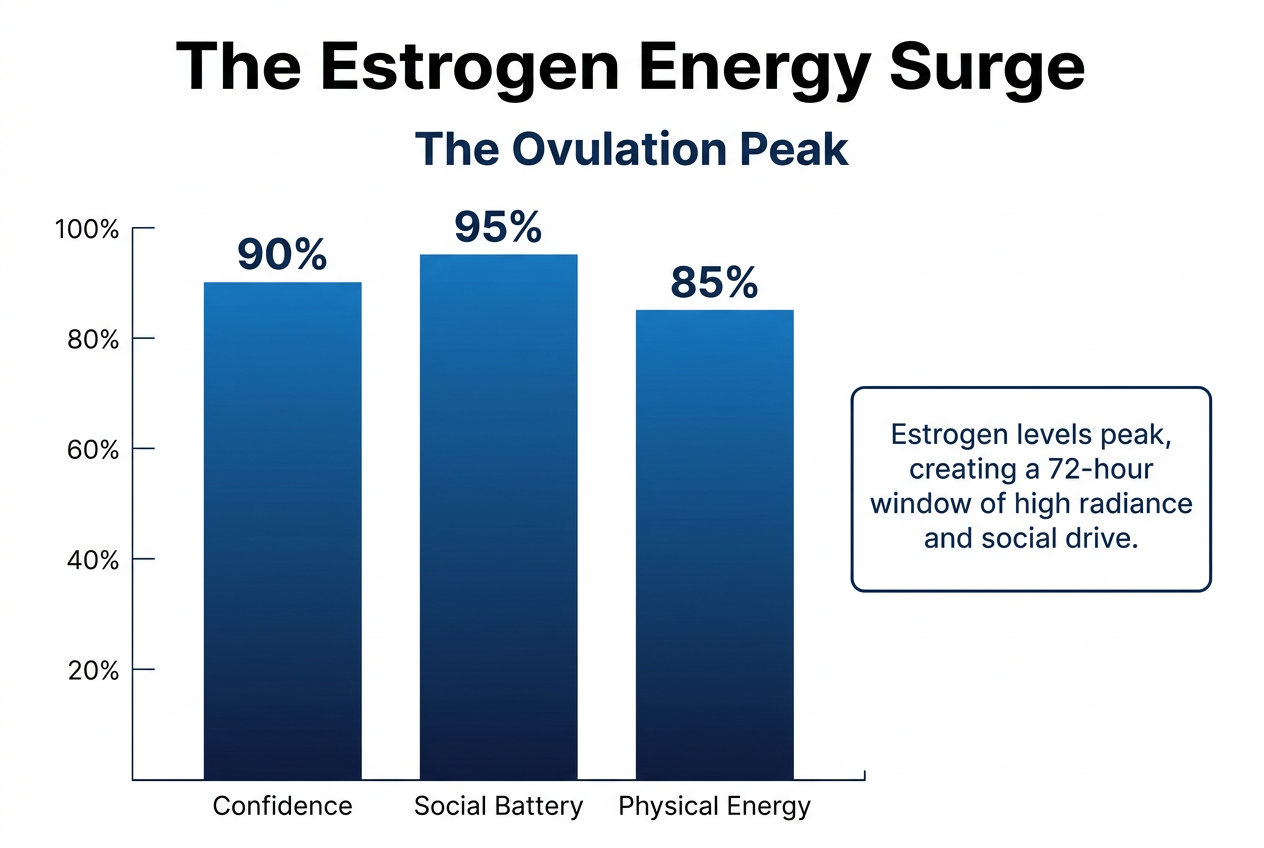
Scientific data shows that the estrogen spike during ovulation directly correlates with higher social energy and confidence, providing a unique window for relationship growth.
Think of estrogen as her body’s natural performance enhancer. When it peaks during ovulation:
- Energy levels increase - She’s got stamina she didn’t have last week
- Confidence soars - She feels attractive, capable, and socially magnetic
- Social battery expands - Plans that seemed exhausting before now sound exciting
- Communication flows easier - Her brain is primed for connection and collaboration
- Physical appearance shifts - Skin glows, facial symmetry increases slightly, voice pitch changes
Research shows women report feeling their best during this phase. One study found that women rated their own attractiveness 20% higher during ovulation compared to other cycle phases. Another found that cognitive performance on certain tasks peaks during this window.
For you, this means she’s not just "in a good mood." Her brain chemistry has fundamentally shifted. She’s more resilient to stress, more interested in social connection, and more receptive to physical intimacy. Understanding this helps you recognize what’s happening and adjust your approach accordingly.
The ovulation window typically lasts 3-5 days, with the actual egg release happening in a 24-hour period. Most women ovulate around day 14 of their cycle, but this varies. If you’re tracking her cycle using a period tracker designed for partners, you’ll get a heads-up before this window opens.
The Triple-A Strategy for Ovulation Support
BLUF: Match her elevated energy with Affirmation (verbal recognition), Activity (actual plans), and Awareness (knowing when pain signals something physical, not emotional).
Most guys fail during ovulation because they stay in "maintenance mode" when their partner actually needs a co-pilot. The Triple-A Strategy gives you a framework to shift your support style from passive to active.
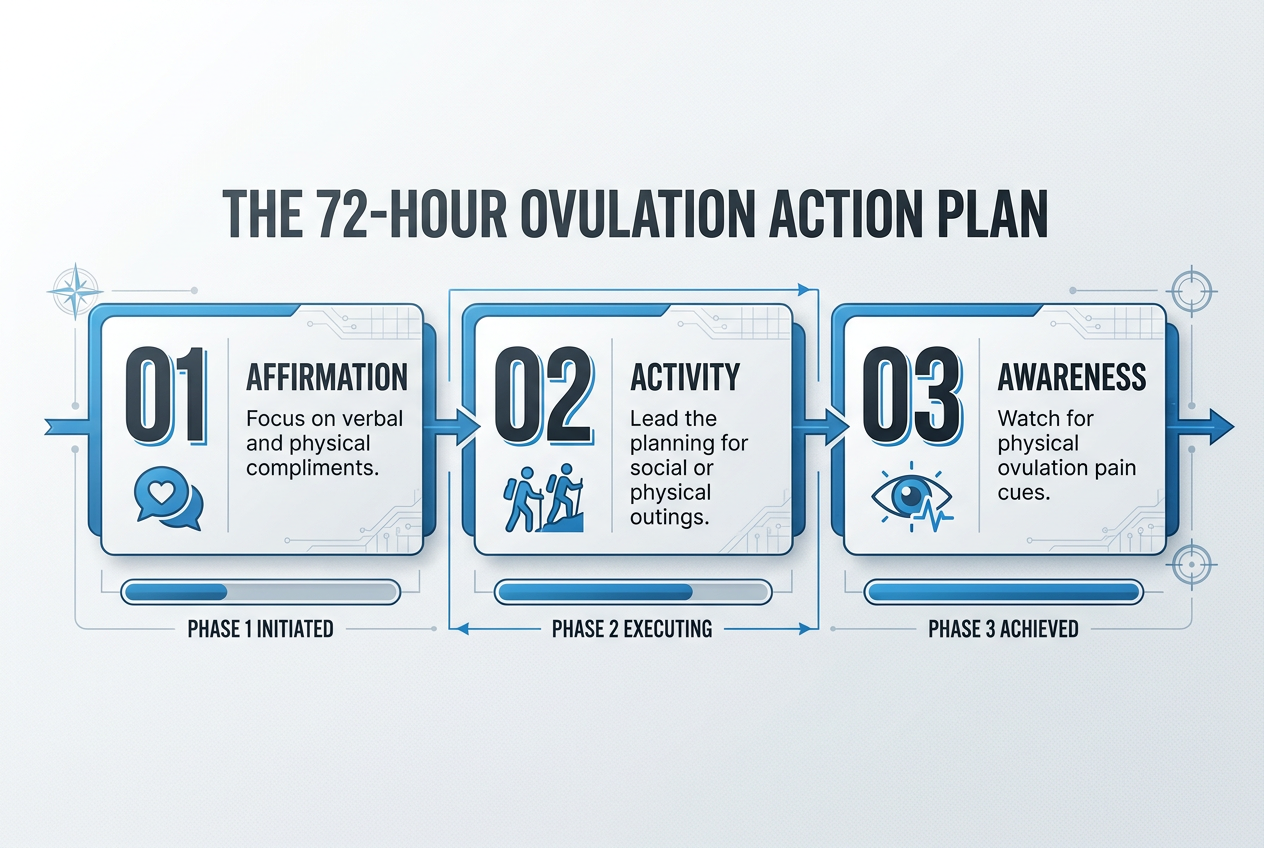
Use this 72-hour framework to move from passive observer to an active, supportive partner during her most energetic time of the month.
Affirmation: Words That Land Harder Now
During ovulation, compliments aren’t just nice - they’re amplified. Her brain is more receptive to positive reinforcement because her confidence is already elevated. This creates a compounding effect.
What to do:
- Be specific with compliments. "You look incredible" hits different than "You look nice."
- Notice the details. "That dress really works on you" shows you’re paying attention.
- Verbal recognition of her energy. "I love this version of you - you seem so in your element."
- Physical touch paired with words. A hand on her back while you tell her she’s amazing doubles the impact.
What NOT to do:
- Generic compliments feel hollow when her confidence is high. Avoid "You’re pretty."
- Don’t make it transactional. Compliments shouldn’t only happen when you want something.
Research shows that women experience heightened emotional responsiveness during ovulation. Your words carry more weight - use them strategically.
Activity: Be the Plan-Maker
She has the energy right now. You provide the structure. This is the perfect window for date nights, social plans, and physical activities she might say no to during other phases.
What to do:
- Plan something that matches her elevated energy. Concert? Hike? Dinner with friends? Now’s the time.
- Make the reservation, buy the tickets, or book the spot. Don’t make her do the mental labor.
- Suggest activities that make her feel attractive and social. She’s in her "peacock phase" - lean into it.
- Physical dates work better than Netflix. Her body wants to move.
What NOT to do:
- Don’t default to low-energy plans. "Want to stay in and watch TV?" wastes this window.
- Don’t overload her with decision-making. "What do you want to do?" puts the burden back on her.
Think of ovulation as your relationship’s "growth window." This is when you build emotional capital that carries you through the harder phases. The memories you create during these 3-5 days become the foundation for trust and connection later.
If you’re looking for more cycle-aware relationship strategies, understanding when to plan versus when to protect her bandwidth is critical.
Awareness: Spotting Mittelschmerz (Ovulation Pain)
About 20% of women experience "Mittelschmerz" - German for "middle pain." This is a sharp, one-sided cramp caused by the follicle rupturing to release the egg. It’s not a mood thing. It’s physical.
What to look for:
- Sharp pain on one side of her lower abdomen
- Pain that lasts a few minutes to a few hours
- Timing: happens mid-cycle, around day 14
- Sometimes accompanied by light spotting
What to do:
- Recognize it’s physical, not emotional. Don’t ask "Are you okay?" in a worried tone - that implies something’s wrong with her mood.
- Offer a heat pack or ibuprofen. "Is that ovulation pain? Want me to grab the heating pad?"
- Give her a minute. It usually passes quickly.
What NOT to do:
- Don’t confuse it with period cramps. Ovulation pain is shorter and more localized.
- Don’t treat her like she’s fragile. She’s not breaking - it’s just a temporary discomfort.
Knowing the difference between ovulation pain and other cycle symptoms shows you’re informed, not just guessing. It’s a subtle way to demonstrate you’re paying attention without being intrusive.
Communication Scripts: What to Actually Say
BLUF: Your words carry more weight during ovulation. Use specific scripts to validate her energy, acknowledge physical discomfort, and initiate connection without awkwardness.
Communication during ovulation isn’t about managing her mood - it’s about matching her elevated state and being present. Here are the exact scripts that work.
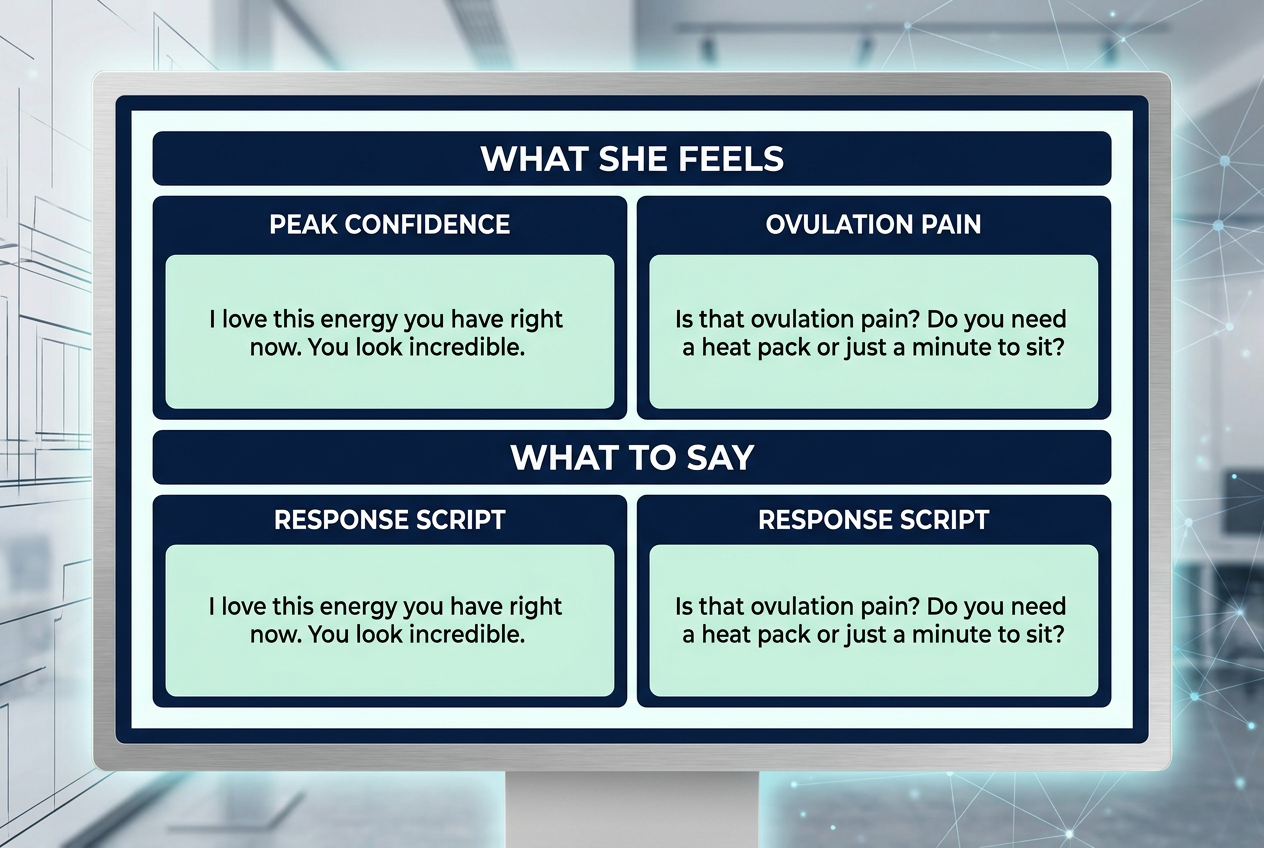
Communication is key during the cycle; use these specific scripts to validate her feelings and show you are attuned to her physical needs.
| Situation | What She’s Feeling | Use This Script |
|---|---|---|
| Peak Energy | Confidence, Radiance | "I love this energy you have right now. You look incredible." |
| She’s Making Plans | Social Momentum | "I’m in. What time works best?" (Don’t hesitate - match her pace.) |
| Ovulation Pain | Sharp, One-Sided Cramp | "Is that ovulation pain? Do you need a heat pack or just a minute to sit?" |
| High Libido | Physical Desire | Action-oriented initiation. Touch her waist, kiss her neck. Less talking, more doing. |
| She’s Glowing | Physical Confidence | "You’ve been turning heads all day. I noticed." |
| Mid-Activity Fatigue | Slight Energy Dip | "Want to take a break? We can pick this back up whenever." |
The "I See You" Script
During ovulation, she’s operating at a higher frequency. Acknowledging that explicitly makes her feel seen.
Use this: "You seem so in your element this week. It’s really attractive."
Not this: "You’re in a good mood today." (Too vague, sounds like you’re just relieved she’s not upset.)
The Physical Touch Script
Ovulation is when physical initiation works best - but only if you’re calibrated to her signals. Don’t overthink it. Be direct.
Use this: Walk up behind her while she’s doing something, put your hand on her waist, and kiss her neck. Say nothing. Let your actions communicate.
Not this: "So... are you in the mood?" (Kills the vibe. Too analytical.)
If you’re struggling with how to read her body language during different cycle phases, learning these cues prevents awkward moments.
The Pain Acknowledgment Script
If she mentions a cramp or sharp pain mid-cycle, don’t panic or overreact. Acknowledge it calmly.
Use this: "That sounds like ovulation. Does it usually hit you like this?"
Not this: "Are you sure you’re okay? Should we go to the doctor?" (Ovulation pain is normal. Don’t pathologize it.)
The Post-Peak Script (More on This Below)
When the estrogen drops and progesterone rises (24-48 hours post-ovulation), her energy can nosedive suddenly. Be ready to pivot.
Use this: "I know you were on fire this weekend, but if you need to recharge tonight, I’ve got dinner covered."
Not this: "Why are you tired now? You were fine yesterday." (Don’t question the shift. Expect it.)
For more on what to say when she’s upset or experiencing sudden mood changes, having these scripts ready prevents you from fumbling in the moment.
Physical Signs You Should Know About
BLUF: Ovulation comes with physical signs you can learn to recognize - cervical mucus changes, slight temperature increase, one-sided cramping, and subtle shifts in her appearance. Knowing these helps you anticipate, not just react.
Most men think ovulation is invisible. It’s not. Her body broadcasts subtle signals that something biological is happening. You don’t need to become a fertility expert, but knowing the basics makes you a more informed partner.
Cervical Mucus: The "Egg White" Sign
This is the most reliable physical sign of ovulation. Around ovulation, cervical mucus changes to a clear, stretchy consistency - similar to raw egg whites. This helps sperm travel and is nature’s way of signaling peak fertility.
What she might say: "I feel more... wet than usual."
Your response: "That’s probably ovulation. Makes sense with your energy this week."
You don’t need to inspect anything. Just knowing this is normal helps you contextualize comments she might make.
Basal Body Temperature Shift
Her body temperature increases slightly (0.5-1°F) after ovulation due to the progesterone surge. Some women track this with a basal thermometer to predict ovulation.
What this means for you: If she mentions checking her temperature or says she "feels warm," this could be a post-ovulation indicator, not a fever.
One-Sided Pain (Mittelschmerz)
We covered this earlier, but it’s worth repeating: ovulation pain is real, temporary, and usually one-sided. About 1 in 5 women experience it.
What to remember: It’s not her period. It’s not a medical emergency. It’s just a follicle releasing an egg. If the pain is severe or lasts longer than a day, that’s when you suggest she check in with a doctor.
Understanding hormonal changes during the menstrual cycle helps you distinguish between normal fluctuations and something that needs attention.
Subtle Appearance Changes
Research shows that during ovulation, women’s faces become slightly more symmetrical, their skin appears clearer, and their voices shift to a higher pitch. These are evolutionary adaptations designed to signal peak fertility.
What you might notice: She looks exceptionally good, even if she didn’t do anything different with her hair or makeup.
Your response: Tell her. "You look amazing today." Don’t overthink why - just say it.
Libido Increase
Ovulation is when her sex drive peaks. Testosterone (yes, women have it too) spikes alongside estrogen, creating a perfect storm for physical desire.
What this means: She’s more likely to initiate, respond positively to your advances, and be more adventurous. Don’t waste the window.
If you’re tracking her cycle, you’ll start to see these patterns repeat month after month. That predictability is powerful. If you want to understand your partner on a deeper level, learning these physical cues is foundational.
The Post-Peak Warning: What Comes Next
BLUF: Within 24-48 hours after ovulation, her estrogen crashes and progesterone rises. This sudden shift can feel jarring - her energy plummets, her mood shifts inward, and the "party" abruptly ends. Be ready to pivot back to caretaker mode.
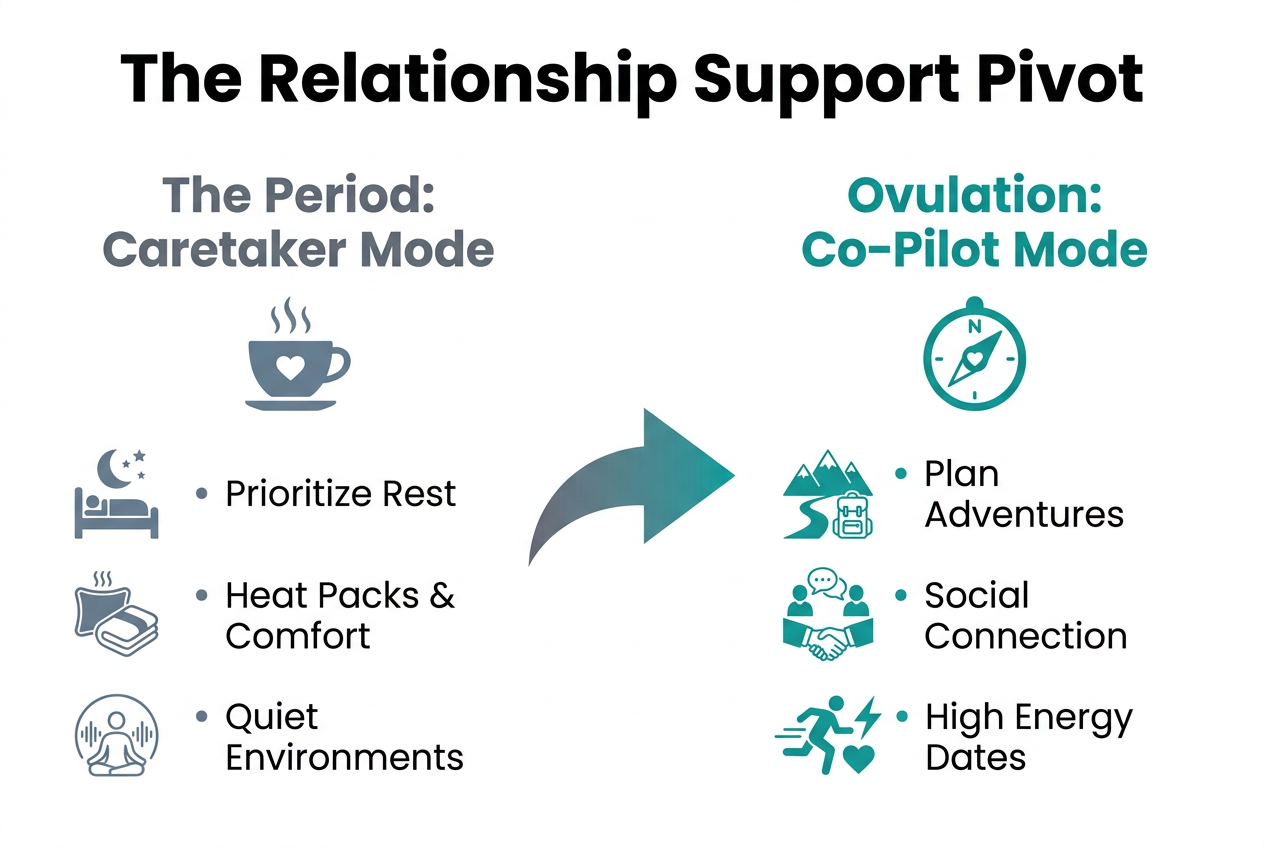
Understanding how to pivot your support style from caretaking to active connection is the secret to maximizing the ovulation window in your relationship.
Here’s what most guides won’t tell you: the ovulation high doesn’t fade gradually. It drops off a cliff.
After the egg is released, her body shifts into "wait and see" mode. Estrogen plummets, progesterone takes over, and her brain chemistry fundamentally changes again. This is the beginning of the luteal phase, and it’s where most guys get blindsided.
What the Progesterone Surge Looks Like
Progesterone is the "calming" hormone. It prepares her body for a potential pregnancy by:
- Slowing her metabolism
- Increasing her need for rest
- Turning her focus inward
- Making her more sensitive to stress
- Lowering her social battery
If estrogen is the "go" hormone, progesterone is the "slow down" hormone. The shift happens fast - sometimes within hours.
What you’ll notice:
- She cancels plans she was excited about two days ago
- She wants to stay in instead of going out
- Her energy drops suddenly
- She seems quieter, more withdrawn
- Cravings kick in (hello, carbs)
Understanding progesterone’s effects on mood helps you recognize this isn’t rejection or disinterest - it’s biology.
How to Pivot Your Support Style
The key is anticipating the shift, not being surprised by it. If you know the ovulation window is ending, you can adjust your approach before she has to spell it out.
When you sense the shift:
- Stop planning high-energy activities. The window has closed.
- Offer comfort over adventure. "Want me to order in and we can watch something?"
- Don’t take her withdrawal personally. It’s not about you.
- Give her space if she needs it, but stay present.
What NOT to do:
- Don’t ask, "Why are you tired now? You were fine yesterday." The shift is biological, not voluntary.
- Don’t push her to maintain the ovulation pace. She can’t.
- Don’t interpret her need for rest as a sign something’s wrong with your relationship.
This is why understanding her cycle phases matters. It’s not about managing her moods - it’s about adjusting your expectations and support style based on what her body is doing.
The 48-Hour Buffer Zone
The 48 hours immediately post-ovulation are the trickiest. She might not have fully transitioned yet, so her energy could fluctuate. One hour she’s fine, the next she’s exhausted.
Your strategy: Build in flexibility. If you have plans, make them low-stakes and easy to adjust. "We can go to that thing tonight, but if you’re not feeling it, we’ll order pizza instead."
This adaptability shows you’re paying attention. It’s one of the most underrated relationship skills.
Common Mistakes Men Make During Ovulation
BLUF: Most men either ignore ovulation entirely, over-explain it like a biology teacher, or treat their partner like a completely different person. Avoid these pitfalls by being informed but not invasive.
Even when guys know about ovulation, they still mess it up. Here’s what not to do.
Mistake 1: Treating Her Like a Science Experiment
Just because you’ve read about ovulation doesn’t mean you should narrate it back to her.
Bad approach: "Well, according to my research, you’re ovulating right now, so that’s why you’re acting this way."
Why it fails: She’s not a case study. Explaining her own body to her comes off as condescending.
Better approach: Demonstrate your understanding through actions, not lectures. Match her energy, plan dates, and be present. She’ll notice you’re attuned without you needing to announce it.
Mistake 2: Assuming Ovulation = Automatic Sex
Yes, her libido peaks during ovulation. No, that doesn’t mean she’s obligated to have sex with you.
Bad approach: "You’re ovulating, so we should definitely have sex tonight."
Why it fails: It sounds transactional and strips away her agency. Desire is influenced by hormones, but it’s not automatic.
Better approach: Create the conditions for intimacy - plan a date, make her feel desired, and let the moment build naturally. Don’t treat ovulation like a free pass.
Mistake 3: Ignoring Ovulation Entirely
The opposite mistake: pretending the cycle doesn’t exist and treating every week the same.
Bad approach: Suggesting a high-energy hike during her period because "we did that last month and you loved it."
Why it fails: What worked during ovulation won’t work during menstruation. The context matters.
Better approach: Track her cycle (with her consent) so you can adapt your plans to her energy levels. If you’re using a period tracker app for boyfriends, you’ll get reminders before each phase shifts.
Mistake 4: Making the Cycle "Weird"
Some guys bring up tracking or cycle awareness in a way that feels invasive or creepy.
Bad approach: "So, are you ovulating right now? I’ve been tracking your cycle."
Why it fails: Unless she explicitly invited you to track, this sounds like surveillance.
Better approach: Have a conversation first. "I’ve been reading about how the menstrual cycle affects energy and mood. Would it help if I tracked it too, so I can support you better?" Frame it as support, not monitoring.
For more on how to approach these conversations without making them awkward, starting with permission is key.
Mistake 5: Not Preparing for the Post-Peak Drop
You matched her energy perfectly during ovulation, but when she crashes into the luteal phase, you’re confused and frustrated.
Bad approach: "Why don’t you want to do anything anymore? You were so fun this weekend."
Why it fails: It frames her hormonal shift as a personality flaw.
Better approach: Expect the drop. Build in recovery time after high-energy weekends. "That was a great weekend - let’s take it easy this week."
The men who succeed in relationships aren’t the ones who demand consistency. They’re the ones who adapt their support style based on what their partner needs in the moment.
Ready to actually understand her?
Join thousands of men using VibeCheck to track her cycle and show up better every day.
Frequently Asked Questions
How do I know when my girlfriend is ovulating?
Ovulation typically occurs 12-16 days before her next period, usually around day 14 of a 28-day cycle. Physical signs include cervical mucus that resembles egg whites, a slight increase in body temperature, and sometimes one-sided cramping (Mittelschmerz). Behavioral signs include increased energy, elevated mood, and higher libido. The most reliable way to track ovulation is by using a cycle tracking app that predicts fertile windows based on her period dates.
Can I track my girlfriend’s cycle without being creepy?
Yes, but only with her consent and clear communication. Start by asking: "I’ve been learning about how the menstrual cycle affects energy and mood. Would it be helpful if I tracked it too, so I can support you better?" Frame it as a tool for understanding and support, not surveillance. Use a tracking app designed for partners that gives you insights without making her feel monitored. The key is transparency - she should always know you’re tracking and why.
What should I do if she has ovulation pain?
Recognize that ovulation pain (Mittelschmerz) is physical, not emotional. It’s a sharp, one-sided cramp caused by the egg being released. Offer a heating pad or ibuprofen, and give her a few minutes to let it pass. Say something like, "Is that ovulation pain? Want me to grab the heat pack?" Don’t overreact or treat her like something’s seriously wrong - this is normal for about 20% of women. If the pain is severe or lasts more than a day, suggest she check in with a doctor.
Why does her mood change so suddenly after ovulation?
After ovulation, estrogen drops sharply and progesterone rises. This hormonal shift moves her from the high-energy ovulation phase into the calmer, more introspective luteal phase. Progesterone slows her metabolism, lowers her social battery, and makes her more sensitive to stress. The transition can feel abrupt because it often happens within 24-48 hours. Don’t take it personally - it’s not about you or the relationship. Adjust your expectations and shift back into a more supportive, low-key mode.
Should I bring up ovulation in conversation?
Only if it’s relevant and she’s open to the topic. Don’t lecture her about her own cycle or explain what’s happening to her body - that comes off as condescending. Instead, demonstrate your understanding through actions: plan dates during her high-energy window, offer support when she’s tired, and show up consistently. If she brings up cycle-related topics, engage thoughtfully. If she doesn’t, don’t force it. Your goal is to be informed and adaptive, not to become the "cycle expert" in the relationship.
How do I support her if she doesn’t want to talk about her cycle?
Respect her boundaries. Not every woman wants to discuss her cycle in detail, and that’s okay. You can still be supportive by observing patterns and adjusting your behavior accordingly. Notice when she has more energy versus when she seems more withdrawn. Track her cycle privately (if she’s comfortable with that) to anticipate phase shifts. Focus on being present, responsive, and empathetic without making the cycle a topic of constant discussion. The best support often happens quietly.
What’s the difference between ovulation pain and period cramps?
Ovulation pain (Mittelschmerz) is typically a sharp, one-sided cramp that lasts a few minutes to a few hours. It happens mid-cycle when the follicle releases an egg. Period cramps (dysmenorrhea) are usually duller, more generalized across the lower abdomen, and last for several days at the start of her period. Ovulation pain is shorter, more localized, and happens about two weeks before her period. Knowing the difference helps you offer the right kind of support at the right time.
Can stress affect when she ovulates?
Yes. High stress can delay or suppress ovulation by disrupting the hormonal signals between her brain and ovaries. If she’s under significant stress, her cycle can become irregular, and ovulation might occur later than usual - or not at all in extreme cases. This is why tracking becomes less predictable during stressful periods. The best way to support her is to reduce external stressors where possible, encourage self-care, and avoid adding relationship stress during these times. If her cycle becomes consistently irregular, she should talk to a healthcare provider.
Ovulation isn’t just a biological event - it’s a relationship opportunity. These 3-5 days offer a unique window to deepen your connection, build emotional capital, and show up as a partner who truly understands what’s happening beneath the surface. Most men focus all their cycle awareness on the period, but the guys who succeed pay attention to every phase, especially the ones where she’s thriving.
If you want to stop guessing and start anticipating, consider using a tool built specifically for this. VibeCheck gives you personalized insights, real-time phase tracking, and actionable guidance so you’re never caught off guard. It’s the difference between reacting to her needs and meeting them before she even has to ask.
Your relationship isn’t a mystery. It’s a pattern. Learn the rhythm, and you’ll transform how you support her - not just during ovulation, but every single day.
Tags

Related Articles
Continue reading to deepen your understanding

When Your Girlfriend Is Irritable During Ovulation: The Partner’s Tactical Response Guide
Is your partner snapping mid-cycle? Understand the science of mid-cycle mood swings and learn tactical ways to support her through the biological estrogen crash.

Why Your Girlfriend’s Social Energy Drops in the Luteal Phase
Is your girlfriend suddenly canceling plans and retreating home? It isn’t personal; it’s biology. Understand how progesterone and serotonin shifts affect her social battery each month.

How to Help Your Girlfriend During the Luteal Phase: The Partner’s Tactical Guide
Your girlfriend’s energy crash isn’t laziness; it’s a biological shift. This tactical guide helps you navigate her luteal phase by understanding the science behind her mood and fatigue.

Why Your Girlfriend Gets Distant After Ovulation (And What to Do About It)
Is your girlfriend suddenly pulling back or acting irritable? It might be her cycle. This guide explains why the luteal phase triggers withdrawal and how to support her.

Supporting Your Girlfriend Through the Luteal Phase
When hormone levels crash before her period, your partner’s brain enters a high-alert state. Learn how to provide the security she needs with tactical scripts and empathy.

How to Give Your Girlfriend Reassurance During Ovulation Week
Is your girlfriend suddenly questioning everything during her cycle? Understand the estrogen crash and learn how to provide the tactical support she needs to feel secure and loved.

When to Give Her Space vs. When to Stay Close: Your Phase-by-Phase Guide
Your girlfriend’s need for closeness isn’t random. Understanding how her 28-day biological rhythm affects her energy helps you time your support perfectly across all four phases.

Your Girlfriend’s 28-Day Relationship Manual: How to Support Her Through Every Phase
Understanding her menstrual cycle transforms you from a guy walking on eggshells into a strategic partner who knows exactly what support to offer and when.