How to Tell If Your Girlfriend Is Ovulating: The Partner’s Recognition Guide

Ever notice a sudden glow or shift in your partner’s behavior? Learn to recognize the biological and social signals that occur during her fertile window to become a more supportive partner.
How to Tell If Your Girlfriend Is Ovulating: The Partner's Recognition Guide
Most men notice something different about their partner around mid-cycle - she's suddenly more social, her skin looks different, her energy spikes - but can't name what changed or why. Not because the signs aren't there. Because no one taught you what ovulation actually looks like from the outside.
That mid-cycle shift isn't random. Research shows that lap dancers in their fertile phase earned an average of $335 per 5-hour shift, compared to $260 during non-fertile phases - a 29% increase attributed to subconscious behavioral and physical cues men picked up on without realizing it. Your brain is wired to detect these signals. The question isn't whether you notice - it's whether you understand what you're noticing.
Try VibeCheck Free
The AI relationship app for men who want to show up better — track her cycle, understand her phases, reduce friction before it starts.
Download Free →What follows is the complete picture: the biological changes driving her mid-cycle transformation, the specific external signs you can observe, and what those signals mean for your relationship. This isn't about tracking her for pregnancy purposes or being invasive - it's about understanding a natural pattern that affects her mood, energy, and needs so you can be a more attuned partner.
Key Takeaways
- Women in their fertile window show measurable increases in physical attractiveness, with men correctly identifying ovulation-phase scent samples 56% of the time in blind tests, indicating biological signals you can detect subconsciously.
- The observable "glow" during ovulation includes rosier cheeks, plumper lips, higher voice pitch, and increased energy - all driven by an 800% spike in estrogen levels.
- Behavioral shifts during the 6-day fertile window include increased social confidence, higher libido (for 60% of women), and subtle changes in attraction preferences documented in UCLA relationship studies.
- Physical signs like clear, stretchy cervical mucus ("egg white" consistency) and a 0.4°F to 1.0°F basal body temperature rise serve as the most reliable biological markers your partner may be tracking.
- Approximately 20% of women experience mittelschmerz (ovulation pain) and 50% of migraine sufferers report cycle-linked headaches during this phase, making pain a key recognition signal for many couples.
Table of Contents
- The Biological "Glow": Why Your Brain Knows Before You Do
- The Observable Clues: A Partner's Checklist
- Can Men Smell When a Woman Is Ovulating?
- The "Relationship Shift": Navigating Attraction Fluctuations
- The "Shadow" Signs: Ovulation Pain & Migraines
- The Technical Markers: Understanding What She's Tracking
- How to Support Her During Ovulation (Without Being "The Science Guy")
- How Birth Control Changes Everything
- Frequently Asked Questions
The Biological "Glow": Why Your Brain Knows Before You Do
The human brain contains specialized neural circuits that subconsciously track fertility markers in potential partners. This isn't pseudoscience or pickup artist theory - it's evolutionary biology that's been documented across dozens of peer-reviewed studies. Your subconscious is already noticing changes in your girlfriend's scent, voice, facial symmetry, and behavior during her fertile window. You just haven't been taught to interpret the signals consciously.
The fertile window spans 6 days: the 5 days leading up to ovulation plus ovulation day itself. During this period, estrogen levels spike by up to 800%, triggering a cascade of physical and behavioral changes designed to maximize reproductive success. Even in committed relationships where pregnancy isn't the goal, these biological shifts still occur because they're hardwired into female physiology.
VibeCheck App
Know what she needs. Before she has to say it.
Track her cycle, understand her phases, be the partner she deserves.
Download Free on iOS →
In a 2009 behavioral study, women in their fertile phase accepted dance requests from male actors 60% of the time, compared to 35% during other cycle phases. Men picking up on these cues didn't consciously know why certain women seemed more receptive - they just registered them as more approachable. This pattern repeats in your relationship. When she's ovulating, you're likely noticing micro-signals you can't articulate: she holds eye contact slightly longer, her body language is more open, her laugh is different.
The recognition happens in your limbic system before it reaches conscious awareness. One study using functional MRI scans found that men's reward centers lit up more intensely when viewing photos of ovulating women versus the same women during non-fertile phases, even when the men couldn't consciously identify which photos were which. Your brain knows. The goal here is to bring that subconscious knowledge into conscious understanding so you can respond appropriately rather than being confused by her shifting energy.
Research from UCLA's relationship lab provides the framework: your girlfriend's body is broadcasting fertility signals through multiple channels simultaneously - scent, visual cues, vocal pitch, and behavioral confidence. The next sections break down each channel into specific, observable markers you can learn to recognize.
The Observable Clues: A Partner's Checklist
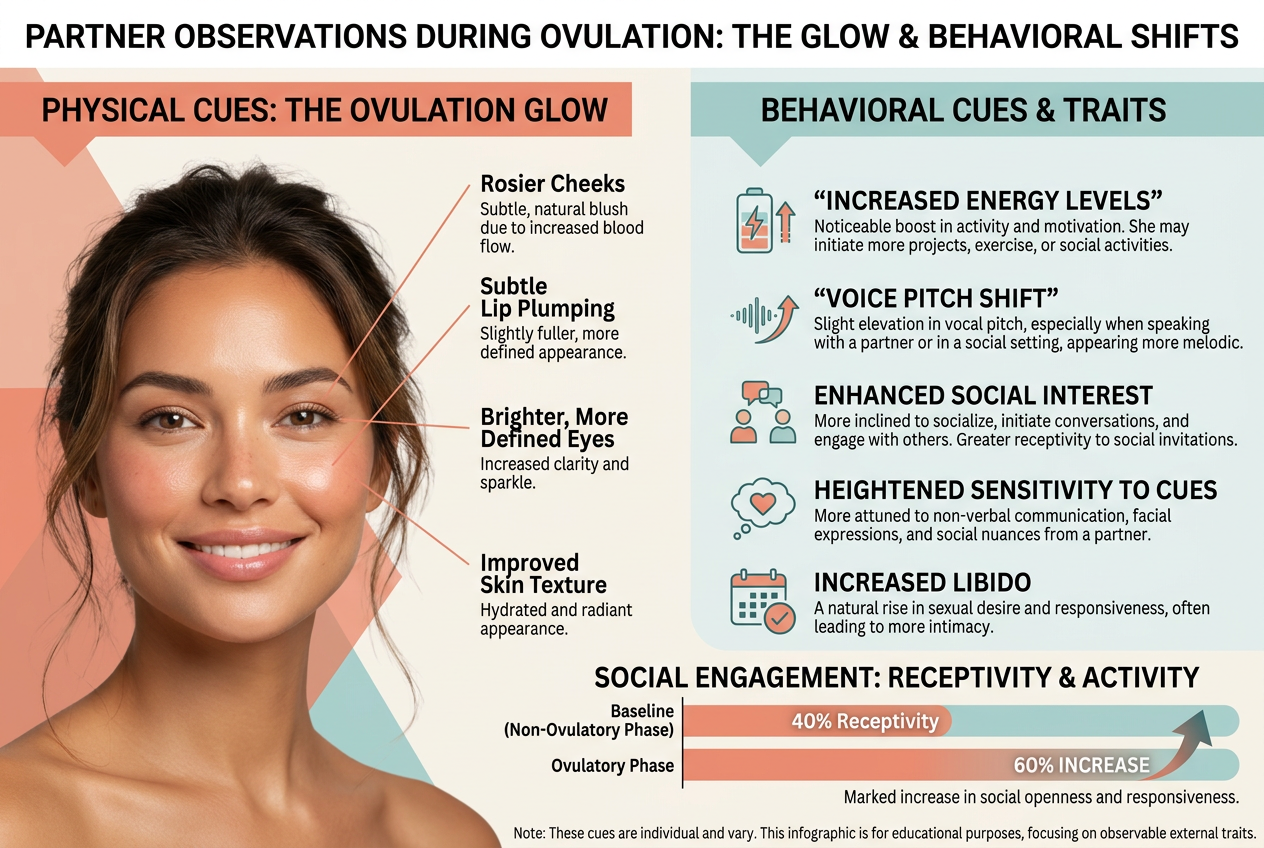
The physical changes during ovulation are driven by estrogen peaking at levels 3-4 times higher than baseline. This hormonal surge produces visible, measurable effects you can observe without needing a medical degree or access to her tracking apps. Here's what to look for in the 3-4 days surrounding her mid-cycle window.
Physical Changes You Can See
The Skin Radiance Effect: Elevated estrogen increases blood flow to the skin and boosts collagen production. This creates a genuine "glow" - rosier cheeks, plumper lips, and a subtle brightness to her complexion. It's not makeup or lighting. One facial analysis study found that cheek redness increased by 12% and lip fullness by 8% during the fertile window compared to menstruation. If she suddenly looks more vibrant without changing her routine, estrogen is peaking.
Facial Symmetry Enhancement: High estrogen temporarily reduces facial puffiness and enhances bone structure visibility. Photographers and makeup artists have documented this for decades - the same person photographed across their cycle will show measurably different facial proportions. During ovulation, her face appears more sculpted and symmetrical. You might notice this as "she looks really good today" without being able to pinpoint why.
Voice Pitch Changes: Her voice becomes slightly higher and more melodic during ovulation due to estrogen's effects on vocal cord tension. Research published in Evolution and Human Behavior found that men rated recorded voices from ovulating women as significantly more attractive than voices from the same women during menstruation. The pitch shift is subtle - about 3-5% higher - but consistently detectable to male listeners in blind tests. If she suddenly sounds different on the phone, you're picking up on a real acoustic change.
Behavioral and Energy Shifts
Peak Social Confidence: Estrogen and testosterone (which also rises during ovulation) drive increased extraversion and reduced social anxiety. This manifests as her being more talkative, more willing to make plans with friends, more likely to initiate conversations with strangers. She's operating at maximum social bandwidth. Studies of women's self-reported confidence show a 23% increase during the fertile window compared to the luteal phase.
Elevated Physical Energy: The metabolic rate increases during ovulation, providing a legitimate energy boost. She's more likely to suggest active dates, hit the gym harder, stay up later without feeling drained. This isn't random - her body is optimized for peak performance. If she goes from wanting quiet Netflix nights to suggesting hiking or dancing, her cycle is likely driving the shift.
Style and Grooming Attention: Multiple studies have documented that women unconsciously adjust their appearance behavior during ovulation - wearing more revealing clothing, applying makeup more carefully, choosing brighter colors. One retail study found that purchases of red and pink clothing increased by 40% during women's fertile windows compared to other cycle phases. If she's suddenly more particular about her outfit or spends extra time on her appearance, it's not vanity - it's biological signaling.
Libido and Attraction Patterns
For approximately 60% of women, libido peaks during the fertile window due to rising testosterone and estrogen. She may initiate sex more frequently, respond more positively to your advances, or simply seem more physically affectionate. However - and this is critical - 40% of women don't experience a noticeable libido shift during ovulation, especially if they're on hormonal birth control. The presence or absence of this pattern doesn't indicate anything is wrong with her or your relationship.
Women who do experience heightened desire during ovulation report it as qualitatively different from other phases: more spontaneous, more physically driven, less dependent on romantic context. Understanding this pattern helps you distinguish between "she's not interested in me" and "she's in a different hormonal phase."
Can Men Smell When a Woman Is Ovulating?
Yes - but not consciously. In a landmark 2004 study published in Science, men were asked to smell T-shirts worn by women at different cycle phases and rate them for attractiveness. Men correctly identified the "more attractive" scent (collected during ovulation) 56% of the time, significantly above chance. However, when asked to describe what made one scent more appealing, men couldn't articulate it. The detection happened below conscious awareness.
Ovulation triggers changes in female pheromone production, specifically in compounds called copulins. These compounds peak during the fertile window and decline during menstruation. Male brains are wired to detect these chemical signals through the vomeronasal organ - a specialized sensory structure that processes pheromones separately from regular smell.
The practical implication: you might find yourself more physically drawn to your girlfriend during her mid-cycle without understanding why. She doesn't smell "different" in the way that perfume smells different - the shift is subtle and subconscious. Men in relationships often report feeling more attracted to their partner around ovulation but attribute it to random fluctuation rather than recognizing the pattern.
Research from UCLA found that men in committed relationships showed increased protective and possessive behavior when their partners were ovulating, measured by increased frequency of calls/texts and more mate-guarding behavior in social settings. This suggests that even men who aren't consciously tracking ovulation respond to the chemical and behavioral signals.
If you've ever noticed a pattern where you feel more drawn to her at certain times of the month, you're not imagining it. Your olfactory system is doing exactly what evolution designed it to do. The key is recognizing this as a normal biological rhythm rather than treating every week as identical and getting confused when your baseline attraction fluctuates.
The "Relationship Shift": Navigating Attraction Fluctuations
A 2012 UCLA study published in Hormones and Behavior documented something uncomfortable but important: women's attraction preferences shift during ovulation in ways that affect how they perceive their long-term partners. Women in relationships with men they rated as having "stable" traits (kind, reliable, financially secure) showed a 1-point drop on a 7-point relationship closeness scale during their fertile window. This wasn't random - it's a documented pattern called dual mating strategy theory.
During ovulation, rising testosterone and estrogen drive an unconscious preference shift toward markers of genetic fitness: masculine facial features, dominant social behavior, physical risk-taking. If your girlfriend perceives you as primarily offering stability and emotional support rather than raw masculinity, she may experience a subtle, temporary distance during her fertile phase. This doesn't mean she loves you less or wants to cheat - it means her hormones are temporarily prioritizing different traits than usual.
The same study found that women whose partners displayed more masculine, dominant traits showed no drop in closeness during ovulation - and in some cases, reported increased attraction. The practical implication: during her fertile window, she may unconsciously crave you to lead more decisively, show physical confidence, demonstrate protective instincts, or display social dominance.
How to Navigate This Phase
This isn't advice to fake a personality you don't have. It's recognition that the traits she values most fluctuate across her cycle. During ovulation:
Lead with decisiveness: Make the plan for dinner rather than asking "what do you want to do?" Choose the restaurant, pick the movie, decide the hiking trail. Her biological state makes indecisiveness less attractive during this phase.
Show physical capability: Suggest the active date option. Carry the heavy groceries. Fix something that's broken. Display competence in physical domains. Estrogen makes her more attracted to demonstrations of strength and skill.
Take social risks: Be willing to speak up in group settings, handle a confrontation with a difficult waiter, or take charge when plans fall apart. The masculine energy she's drawn to during ovulation includes social confidence.
Reduce emotional processing conversations: Save the heavy "where is this relationship going" talk for her luteal phase when progesterone makes her more bonding-oriented. During ovulation, she's less interested in emotional analysis and more responsive to action and presence.
This pattern reverses during menstruation and the luteal phase (the week before her period), when progesterone dominates and she craves emotional connection, verbal reassurance, and nest-building behavior. The UCLA research isn't telling you to change who you are - it's showing you that the version of yourself she's most drawn to shifts predictably across 28 days. Understanding the pattern lets you emphasize different strengths at different times.
If you notice her seeming slightly distant or more critical during mid-cycle, don't panic. It's a temporary hormonal preference shift, not evidence your relationship is failing. It ends when estrogen drops post-ovulation and progesterone takes over, usually within 2-3 days.
The "Shadow" Signs: Ovulation Pain & Migraines
Not every woman experiences ovulation as a glow and an energy spike. For a significant minority, the fertile window brings physical pain severe enough to disrupt daily function. Understanding these "shadow signs" helps you recognize ovulation even when she's not experiencing the stereotypical positive symptoms.
Mittelschmerz (Middle Pain)
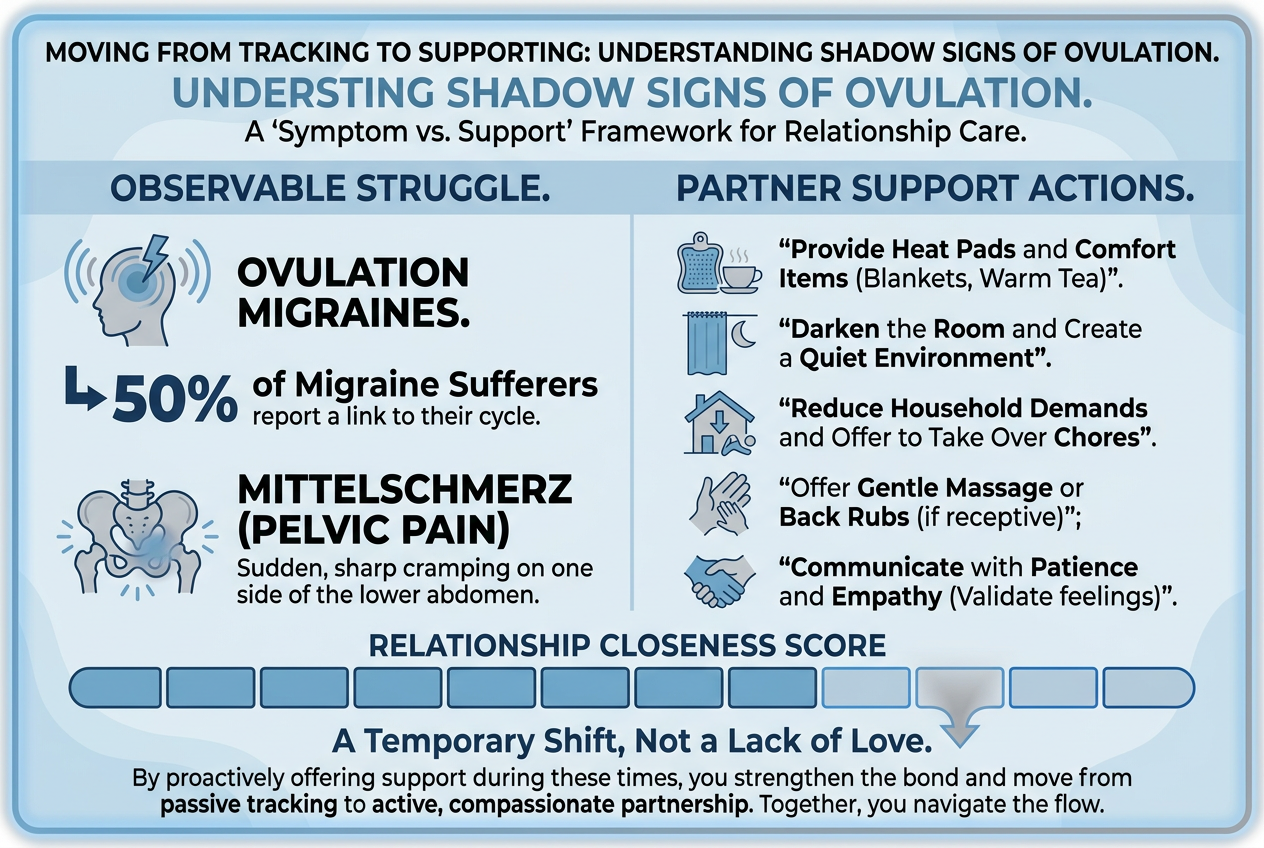
Approximately 20% of women experience mittelschmerz - sharp, cramping pain on one side of the lower abdomen during ovulation. The pain occurs when the ovarian follicle ruptures to release the egg, and it can last anywhere from a few minutes to 48 hours. For some women, it's a mild twinge. For others, it's debilitating enough to require pain medication and rest.
The pain typically appears 12-24 hours before ovulation completes. If your girlfriend suddenly complains of sharp, one-sided abdominal pain around day 12-16 of her cycle (counting from the first day of her last period), mittelschmerz is the likely culprit. The location alternates between left and right abdomen depending on which ovary released an egg that month.
Ovulation Migraines
A 2021 study in Frontiers in Neurology found that approximately 50% of women of childbearing age with recurring migraines experience them specifically during ovulation. These aren't regular headaches - they're vascular migraines triggered by the rapid estrogen spike and subsequent drop that occurs mid-cycle.
Ovulation migraines present differently than menstrual migraines. They hit suddenly (often within hours), feature intense light sensitivity and nausea, and respond poorly to standard pain relievers. If your girlfriend has a history of migraines and suddenly develops one around mid-cycle with no obvious trigger (stress, lack of sleep, food), her ovulatory estrogen surge is the likely cause.
The biological mechanism: estrogen causes blood vessels in the brain to dilate rapidly. For migraine-prone women, this vasodilation triggers a cascade of inflammatory responses that produce the characteristic throbbing pain. The migraine typically resolves within 24-48 hours as estrogen stabilizes post-ovulation.
How to Support Her Through Pain
When she's experiencing mittelschmerz or ovulation migraines, she needs practical support, not problem-solving conversations:
Heat therapy: A heating pad on her lower abdomen or lower back can reduce cramping pain by 40-60% according to pain management studies. Keep one accessible and offer it proactively when she mentions pain.
Dark, quiet environment: If she has a migraine, light and noise make it exponentially worse. Close the curtains, turn off screens, keep conversation to a minimum. Your presence matters, but silence is more valuable than talking.
Reduce demand: This isn't the day to ask her to run errands, host dinner, or handle emotionally complex decisions. Take tasks off her plate without making her ask. The pain is real and temporary - she'll be back to baseline in 1-3 days.
Don't minimize: "It's just ovulation" or "at least it's not your period" are phrases that create distance. Acknowledge that pain is pain, regardless of the biological cause. A better response: "That sounds brutal. What do you need right now?"
Ovulation symptoms (both positive and painful) are predictable once you know her pattern. If she tracks her cycle using an app like VibeCheck's period calculator, you can anticipate these windows and adjust your expectations accordingly. The goal isn't to treat her differently every day - it's to recognize when her biological state requires different support than usual.
The Technical Markers: Understanding What She's Tracking
If your girlfriend uses a period tracking app or mentions cervical mucus and basal body temperature, she's monitoring technical markers that confirm ovulation with medical accuracy. Understanding what she's tracking helps you interpret her data and support her fertility awareness without needing to become an expert yourself.
Cervical Mucus Changes
Cervical mucus changes consistency across the menstrual cycle in response to estrogen. During menstruation and the early follicular phase, mucus is minimal or absent. As estrogen rises approaching ovulation, mucus becomes abundant, clear, stretchy, and slippery - often compared to raw egg whites.
This "fertile-quality" mucus serves a biological function: it creates an alkaline environment that protects sperm and helps them travel through the cervix. The change is dramatic and noticeable. Many women check mucus daily by wiping with toilet paper or inserting a clean finger to assess texture. The peak mucus day (the last day of egg-white consistency) typically occurs 1-2 days before ovulation.
If she mentions "egg white mucus" or "EWCM," she's observing her most fertile sign. This is the biological equivalent of a green light for conception if that's the goal - or a high-awareness period if avoiding pregnancy. Cervical mucus tracking has a 96% accuracy rate for identifying the fertile window when done consistently.
Basal Body Temperature (BBT) and the "3 Over 6" Rule
Basal body temperature is the body's resting temperature measured immediately upon waking, before any physical activity. BBT remains relatively stable during the follicular phase (typically 97.0-97.7°F), then rises by 0.4°F to 1.0°F immediately after ovulation due to progesterone's thermogenic effect.
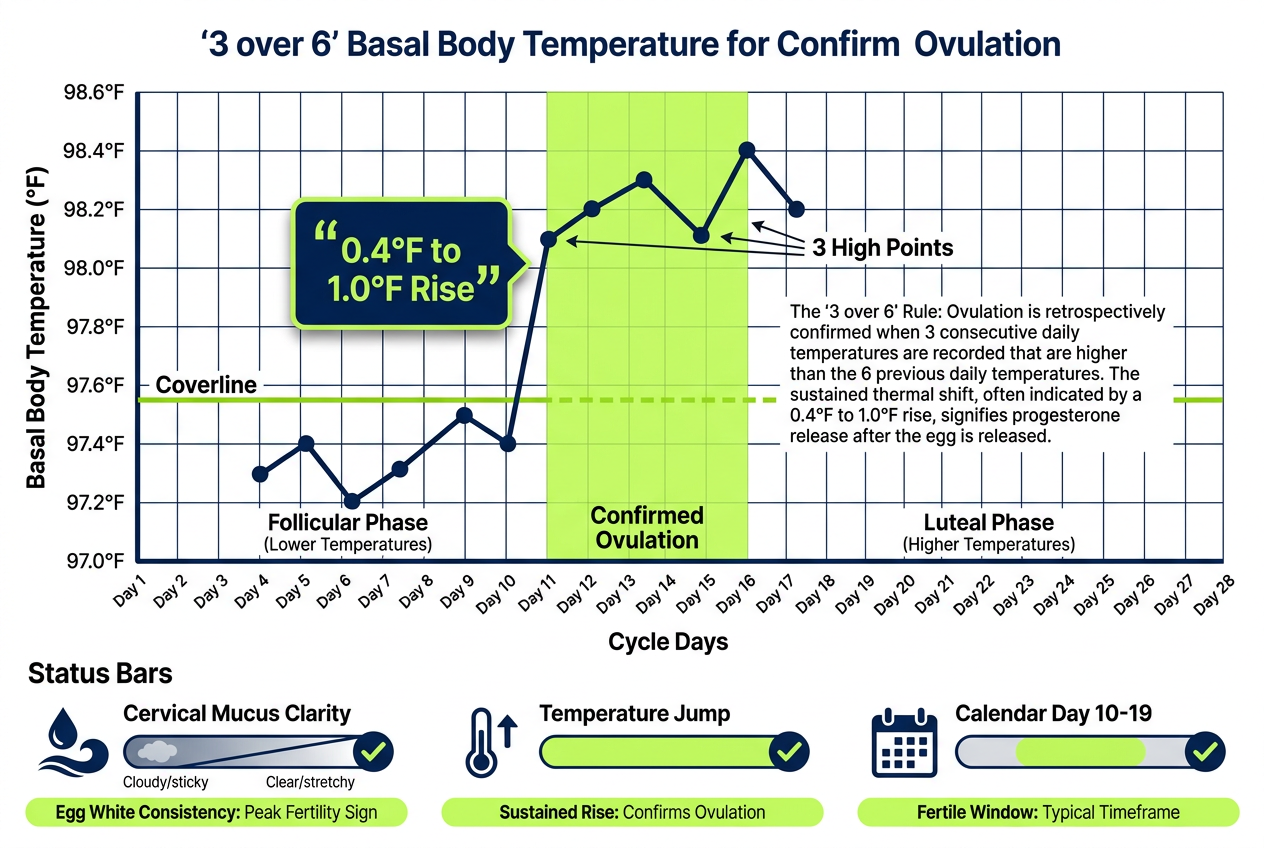
The temperature shift doesn't predict ovulation - it confirms it happened. This is where the "3 over 6" rule comes in. Ovulation is confirmed when three consecutive daily temperatures are at least 0.2°F higher than the previous six days' temperatures. This pattern is the gold standard for retrospectively identifying ovulation in fertility awareness methods.
For example:
- Days 1-6: 97.2, 97.3, 97.4, 97.3, 97.2, 97.3°F (pre-ovulation baseline)
- Days 7-9: 97.6, 97.7, 97.8°F (ovulation confirmed - three temps above the six-day average)
If your girlfriend takes her temperature every morning and references "temp rise" or "thermal shift," she's confirming ovulation happened 1-2 days prior. BBT tracking requires consistency (same time every morning, before getting out of bed) and a specialized basal thermometer accurate to 0.1°F. Women serious about fertility awareness often combine mucus tracking (which predicts ovulation) with BBT (which confirms it) for maximum accuracy.
The 6-Day Fertile Window
Medical consensus defines the fertile window as 6 days: the 5 days before ovulation plus ovulation day itself. Sperm can survive in fertile-quality cervical mucus for up to 5 days, but the egg only remains viable for 12-24 hours post-ovulation. This asymmetry creates the 6-day window.
For couples trying to conceive, the highest-probability days are the 2 days before ovulation and ovulation day itself. For couples avoiding pregnancy, the entire 6-day window requires either abstinence or barrier methods if using fertility awareness.
If your girlfriend mentions being "in her fertile window," she's referring to this 6-day period identified either through app predictions, mucus observations, or BBT patterns. Most period tracker apps designed for partners will flag this window and explain what it means in practical terms.
How to Support Her During Ovulation (Without Being "The Science Guy")
Knowing the biology is useful. Making her feel studied or treated like a lab experiment is counterproductive. The goal isn't to announce "I can tell you're ovulating" every month - it's to intuitively adjust your behavior to match her shifting needs without making it weird.
Match Her Energy Level
During ovulation, her energy is at its peak. This is not the week to suggest staying in or choosing the low-key option by default. She's biologically primed for social engagement, physical activity, and new experiences. Suggest the hiking date, the group hangout, the new restaurant across town. Her body wants stimulation and novelty during this phase.
Research shows that women rate novel experiences as more enjoyable during their fertile window compared to routine activities. A study of couples' date satisfaction found that ovulating women rated adventurous dates (new restaurants, physical activities, social events) 31% higher than during menstruation, while ratings for routine dates (movie nights, familiar restaurants) showed no cycle-phase difference.
Practical application: front-load your month with the dates that require energy and planning. Save the quiet Netflix nights for the week before her period when progesterone makes her prefer nesting and low-stimulation activities.
Use Shared Cycle Tracking
The least awkward way to understand her pattern is to ask if she's open to sharing her cycle tracking data with you. Apps like VibeCheck, Flo, and Clue offer partner modes that give you read-only access to her cycle predictions, mood patterns, and symptom logs.
This removes the guesswork. Instead of inferring her phase from behavior, you see it clearly: "Ovulation expected in 2 days." You can adjust your approach proactively rather than reacting after she's already frustrated that you suggested a quiet weekend when she wanted adventure.
Frame the request around support, not surveillance: "I want to be better at understanding when you need different things from me. Would it help if I could see your cycle calendar so I'm not constantly guessing?" Most women find this question disarming because it demonstrates awareness that her needs shift rather than expecting her to be the same person every day.
Validate Without Making Assumptions
Even with tracking, you'll misread situations. Maybe you assume she wants to go out because she's ovulating, but she's actually exhausted from work that week. The cycle provides a framework - not a script. Always check in: "You seemed pretty energized this week - want to do something active, or would you rather just decompress?"
The worst approach is saying "You must be ovulating" when she acts a certain way. It's reductive, it removes her agency, and it makes her feel like you're reducing her to hormones. The goal is silent awareness that informs your behavior, not overt commentary that makes her self-conscious.
If she does mention ovulation explicitly - "I'm probably ovulating this week, my energy is insane" - that's your green light to reference it directly and plan accordingly. Otherwise, let your adjusted behavior speak for itself.
Reduce Conflict During Ovulation
The estrogen spike makes women more sensitive to relationship threats and more likely to notice inconsistencies between what you say and what you do. Studies show that women's emotional memory consolidation increases during the fertile window, meaning arguments and disappointments during this phase get encoded more strongly than identical conflicts during other phases.
Practical implication: this isn't the week to flake on plans, make promises you're unsure about, or avoid difficult conversations you said you'd have. Testosterone's influence during ovulation makes her more confrontational and less willing to let things slide. If there's a pattern of her bringing up issues mid-cycle, it's not random - her hormones make relationship integrity feel more urgent.
Instead of getting defensive when she raises concerns during this phase, recognize it as a biologically-driven need for clarity and follow-through. Address the issue directly rather than dismissing it as "hormones." Her concerns are valid whether or not estrogen is amplifying them.
How Birth Control Changes Everything
Hormonal birth control - including pills, patches, implants, and hormonal IUDs - works by suppressing ovulation. If she's on hormonal contraception, most of the signs discussed in this article won't apply. No ovulation means no estrogen spike, no fertile window, no mid-cycle behavioral shifts.
A 2007 study published in Psychological Science found that women on hormonal birth control showed no significant difference in attractiveness ratings across their "cycle" (technically a pill-driven hormone schedule, not a natural cycle), while naturally cycling women showed the expected mid-cycle attractiveness peak. The researchers concluded that hormonal contraception "wipes out" the ovulatory signals men detect subconsciously.
If your girlfriend is on birth control, you won't notice the patterns described here because they're driven by hormones her body isn't producing. She may still experience mood fluctuations due to synthetic progesterone in the pill, but they follow a different pattern (usually week 4 of the pill pack when placebo pills trigger withdrawal bleeding).
This creates an interesting dynamic: men in relationships with women on hormonal birth control report more stable, predictable interactions across the month because the hormonal rollercoaster is flattened. However, some women report feeling emotionally "flatter" overall on hormonal contraception, which can affect relationship satisfaction in different ways.
If she recently stopped taking birth control, expect it to take 3-6 months for her natural cycle to fully reestablish. During this transition period, ovulation may be irregular or absent, and the signs discussed in this guide may be inconsistent. Full fertility typically returns within 3 months of stopping pills, though individual variation exists.
For couples using fertility awareness as birth control or for conception planning, understanding these signs becomes critical. The stakes are higher, and the biological literacy needs to be deeper. If that's your situation, consider working with a fertility awareness educator rather than relying solely on apps and self-teaching.
Ready to actually understand her?
Join thousands of men using VibeCheck to track her cycle and show up better every day.
Get VibeCheck FreeFrequently Asked Questions
How to tell if a girl is ovulating as a man?
Look for a cluster of signs occurring together around day 12-16 of her cycle: the skin "glow" (rosier cheeks, plumper lips), increased energy and social confidence, voice pitch slightly higher, and peak physical vitality. She may also mention clearer cervical mucus or show increased interest in sex. No single sign confirms ovulation - the pattern of multiple changes appearing simultaneously is the reliable indicator. In scent-blind tests, men correctly identified ovulation-phase samples 56% of the time, so trust your subconscious if she seems more attractive mid-cycle.
Can men sense when a woman is ovulating?
Yes, but primarily subconsciously. Research shows men respond to pheromone changes, facial symmetry improvements, and behavioral cues without conscious awareness. Studies using functional MRI scans found that men's reward centers activated more strongly viewing photos of ovulating women versus the same women at other phases, even when men couldn't consciously identify which photos were which. You might notice feeling more drawn to your partner mid-cycle - that's your limbic system detecting legitimate fertility signals through scent, visual cues, and behavior patterns evolution designed you to recognize.
What are the 7 signs of ovulation physically?
The seven most reliable physical signs are: (1) clear, stretchy, egg-white cervical mucus; (2) basal body temperature rise of 0.4-1.0°F lasting at least 3 days; (3) increased skin radiance with rosier cheeks; (4) mild one-sided abdominal pain (mittelschmerz) in 20% of women; (5) breast tenderness or fullness; (6) heightened sense of smell; and (7) increased energy and reduced need for sleep. Not every woman experiences all seven - cervical mucus and BBT rise are the most universal and medically reliable markers.
What is the best time to approach your partner for intimacy during her cycle?
The 2-3 days before ovulation and ovulation day itself represent the highest natural libido window for approximately 60% of women due to testosterone peaking alongside estrogen. However, individual variation is significant - some women experience peak desire during menstruation when pelvic blood flow increases, while others prefer the week after their period when progesterone is lowest. The best approach is tracking her pattern over 2-3 months rather than assuming a universal answer. Apps with partner mode can help identify her personal peak desire window based on logged mood and intimacy data.
How do you know if your girlfriend is in her fertile window?
If she tracks her cycle, the fertile window occurs approximately 5 days before ovulation through ovulation day - typically days 10-16 of a 28-day cycle (counting from the first day of her period). Observable signs include peak energy, increased social confidence, clearer skin with a visible glow, and mentions of "egg white" cervical mucus. Many women use apps that predict this window based on cycle length patterns. If she's sharing cycle data with you through a period tracker for partners, the app will explicitly flag these days. The fertile window is the 6 consecutive days when pregnancy is possible.
Can stress affect when ovulation happens?
Yes. Severe stress can delay or completely suppress ovulation through the hypothalamic-pituitary-ovarian axis. When the body perceives a threat (physical or psychological), cortisol disrupts the hormonal cascade that triggers ovulation, potentially pushing it back by days or weeks. This is why women experience irregular cycles during high-stress periods - job changes, relationship conflict, financial crisis. Moderate stress typically delays ovulation by 1-3 days. Chronic high stress can cause anovulatory cycles (no ovulation occurs at all). If your partner's cycle suddenly becomes irregular, stress is among the most common causes alongside illness, significant weight change, and thyroid dysfunction.
What should a man do during his partner's ovulation?
Match her peak energy with active, social, and novel experiences rather than defaulting to low-key routines. Suggest the hiking date, the new restaurant, the group hangout - her body is primed for stimulation during this phase. Lead decisively on plans rather than deferring to "whatever you want" - testosterone's influence during ovulation makes indecisiveness less attractive. Show physical capability and social confidence. This is also the best time for important conversations requiring mental clarity, as estrogen enhances cognitive function and verbal fluency. Avoid scheduling emotionally heavy or conflict-prone discussions for the week before her period when progesterone makes her more emotionally vulnerable.
How does ovulation affect long-term relationships?
UCLA research found that women's attraction preferences temporarily shift during ovulation toward masculine traits (dominance, physical risk-taking, genetic fitness markers), which can create subtle relationship tension if her partner is perceived primarily as stable and supportive. Women in relationships with men they rated as "stable" showed decreased closeness scores during their fertile window, while women whose partners displayed masculine traits showed no decrease or even increased attraction. This doesn't indicate relationship failure - it's a predictable hormonal pattern. Understanding it helps partners avoid misinterpreting mid-cycle distance as loss of love rather than temporary preference recalibration that reverses post-ovulation.
Do all women experience noticeable ovulation symptoms?
No. Approximately 40% of women report minimal or no noticeable symptoms during ovulation. The presence or absence of symptoms doesn't indicate fertility health or cycle regularity. Some women have clear signs (mucus, pain, energy shifts); others ovulate "silently" with no external indicators. Hormonal birth control suppresses ovulation entirely, eliminating these signals. Even among naturally cycling women, symptom intensity varies dramatically by individual. The absence of obvious signs doesn't mean ovulation isn't occurring - confirmation requires either BBT tracking showing a sustained temperature rise or medical monitoring via ultrasound or ovulation predictor kits.
Understanding when your girlfriend is ovulating isn't about surveillance or reducing her to biology. It's about recognizing a natural pattern that affects 25% of her month so you can adjust your approach accordingly. Her cycle creates four distinct phases with different energy levels, emotional needs, and attraction preferences. Ovulation is the phase where she's operating at peak capacity - physically, socially, and cognitively.
The men who build the strongest relationships aren't the ones who treat every day identically. They're the ones who learn to read the signals, anticipate shifting needs, and provide the right type of support at the right time. That starts with understanding her biological rhythm instead of being confused by it.
If you want a clearer framework for navigating all four cycle phases - not just ovulation - VibeCheck's partner guide breaks down the complete 28-day pattern with specific tactics for each phase. Understanding her cycle transforms you from a reactive partner into a proactive one.
Tags

Related Articles
Continue reading to deepen your understanding

How to Tell if Girlfriend is Ovulating Signs: 10 Best Clues
Recognize how to tell if girlfriend is ovulating signs using 10 biological markers including an 800% estrogen spike. These signals improve partner support.

Clue Subscription Price 2026: Is Clue Plus Worth It for Couples?
Understanding the Clue subscription price is the first step toward better relationship harmony. See how the $39.99 annual plan helps couples track cycles and reduce stress.

The Partner’s Guide to the Period Cycle: How to Be a Hero
Stop walking on eggshells and start understanding the biological rhythm of your relationship. Master the four phases of her cycle to become a more supportive, proactive partner.

When to Plan the Perfect Date: Syncing Your Plans with Her Cycle
Stop guessing why she isn’t in the mood for dinner. Learn how to sync your date nights with her biological rhythm to increase energy, connection, and success every single month.

How to Tell What Phase Your Girlfriend Is In Without Asking
Stop guessing why her mood shifts. Learn how to recognize the four biological phases of your girlfriend’s cycle using simple behavioral cues to improve communication and reduce conflict.

What to Do When Your Girlfriend Is Ovulating: The Power Phase Playbook
Most partners notice a sudden energy spike mid-month but don’t know why. Learn how to navigate her cycle’s Power Phase to build lasting relationship connection and support.

The GF Text Message Playbook: How to Support Her Through Every Cycle Phase
Stop walking on eggshells and start sending the right message at the right time. This guide helps you master gf text messages by syncing your communication with her biological cycle.

How to Plan Dates Around Your Girlfriend’s Cycle: The Partner’s Playbook
Stop guessing why your plans flop. Learn how to use your partner’s biological rhythm to plan dates she actually wants to go on, from high-energy outings to cozy nights in.