Clue Subscription Price 2026: Is Clue Plus Worth It for Couples?

Understanding the Clue subscription price is the first step toward better relationship harmony. See how the $39.99 annual plan helps couples track cycles and reduce stress.
Clue Subscription Price 2026: Is Clue Plus Worth It for Couples?
Most guys asking about Clue Plus pricing aren't really asking about price. You're trying to figure out if spending $40 a year will actually make your relationship smoother - if the calendar view of red days and purple dots will translate into fewer fights, better timing, and less guessing about what's happening with her. The short answer: Clue Plus costs $39.99 annually or $9.99 monthly, and the viewing partner (you) doesn't pay anything. But whether it's "worth it" depends entirely on what you do with the data once you have it.
Key Takeaways
- Clue Plus costs $39.99 per year or $9.99 per month in the US, with only the primary user needing a subscription while the viewing partner accesses shared data for free.
- Clue reached 1 million paid subscribers in May 2025, with 81% of users reporting the app helps them feel more in control of their health.
- The Clue Connect feature shows period dates, fertile windows, and PMS timing but maintains a strict privacy wall - you cannot see mood logs, symptoms, or sexual activity entries.
- Structured cycle tracking paired with relationship coaching reduces reported communication breakdowns by 58% within 12 weeks, according to 2024 Journal of Marital and Family Therapy research.
- The gap most men face isn't data availability - it's knowing what to do when the calendar shows a luteal phase crash or an ovulation window opening.
Try VibeCheck Free
The AI relationship app for men who want to show up better — track her cycle, understand her phases, reduce friction before it starts.
Table of Contents
- How Much Does Clue Plus Cost?
- Clue Connect: The Feature Every Partner Needs
- The "Missing Link" Playbook: Turning Data Into Action
- Is Clue Plus Worth It If You're Not Trying to Get Pregnant?
- What's the Difference Between Clue Free and Clue Plus?
- How Does Clue Compare to VibeCheck, Flo, and Other Partner Apps?
- How to Set Up Clue Connect Step-by-Step
- Troubleshooting Common Clue Connect Issues
- Frequently Asked Questions
How Much Does Clue Plus Cost?
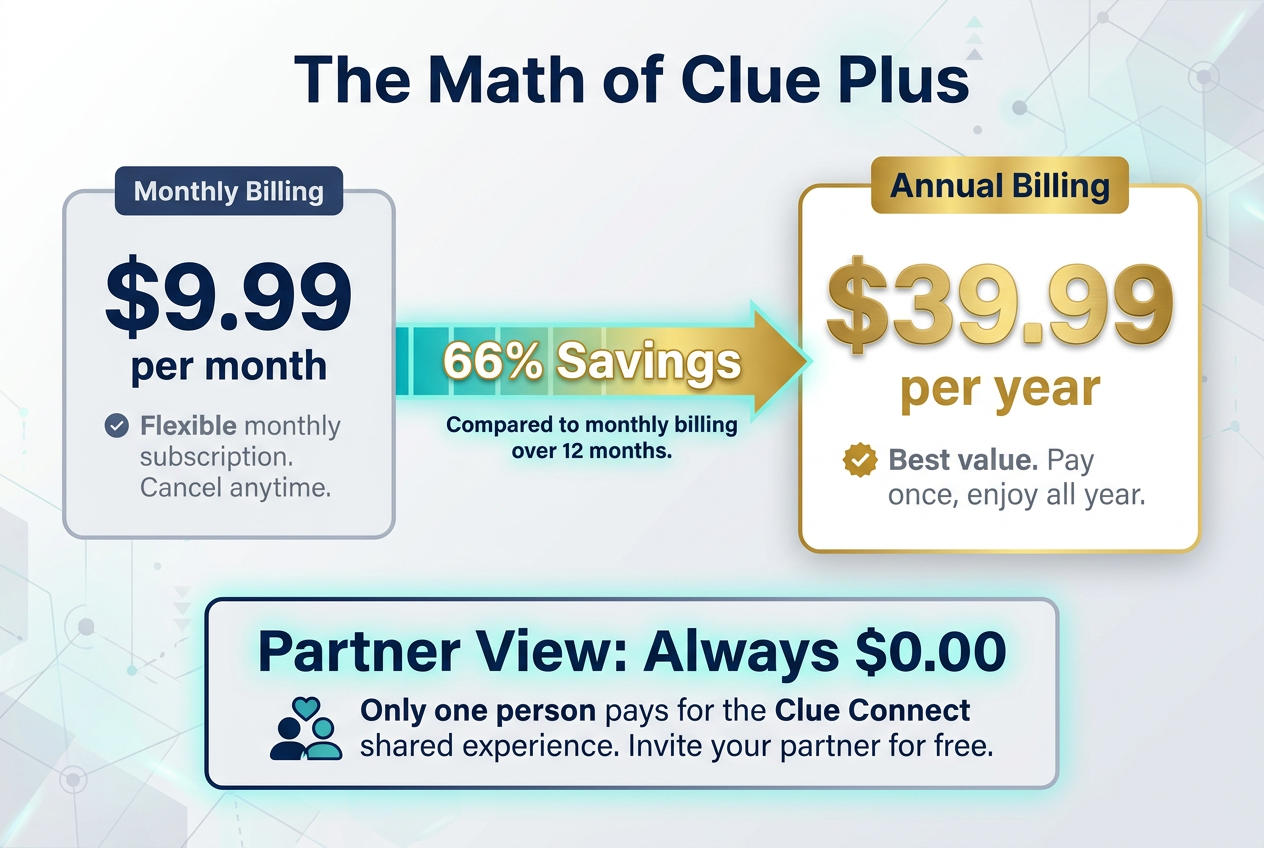
Clue Plus costs $39.99 per year or $9.99 per month in the United States, making the annual plan 66% cheaper than paying month-to-month. Only one person in the relationship needs to pay for the subscription - typically the woman tracking her cycle - while the viewing partner (you) gets free access to the shared calendar through Clue Connect at no additional cost.
Here's the pricing breakdown:
VibeCheck App
Know what she needs. Before she has to say it.
Track her cycle, understand her phases, be the partner she deserves.
Download Free on iOS →| Subscription Type | Cost | Best For |
|---|---|---|
| Monthly Plan | $9.99/month | Testing the premium features before committing |
| Annual Plan | $39.99/year ($3.33/month) | Long-term users who want full feature access |
| Clue Connect (Viewing) | Free | Partners who only need to see the shared calendar |
The annual subscription saves you $79.89 over 12 months compared to the monthly plan. Clue occasionally offers promotional discounts - the code "LowdownxClue" has been documented to provide 25% off, though availability varies by region and time. Seasonal web offers around major relationship milestones (Valentine's Day, anniversaries) sometimes stack additional savings.
Clue ranks 3rd worldwide among period tracker apps by revenue, generating consistent subscriber growth that reached 1 million paid users as of May 2025. That scale matters because it funds ongoing medical research partnerships and privacy infrastructure - two factors that separate Clue from cheaper competitors.
For men specifically, the value equation isn't about the $40. It's about whether you'll actually use the cycle visibility to adjust your behavior. A calendar showing "Luteal Phase, Day 8" means nothing if you don't know that's when stress sensitivity peaks and you should handle dinner without asking her to decide what she wants. The subscription unlocks the data; understanding what to do with it requires a different kind of education.
Clue Connect: The Feature Every Partner Needs
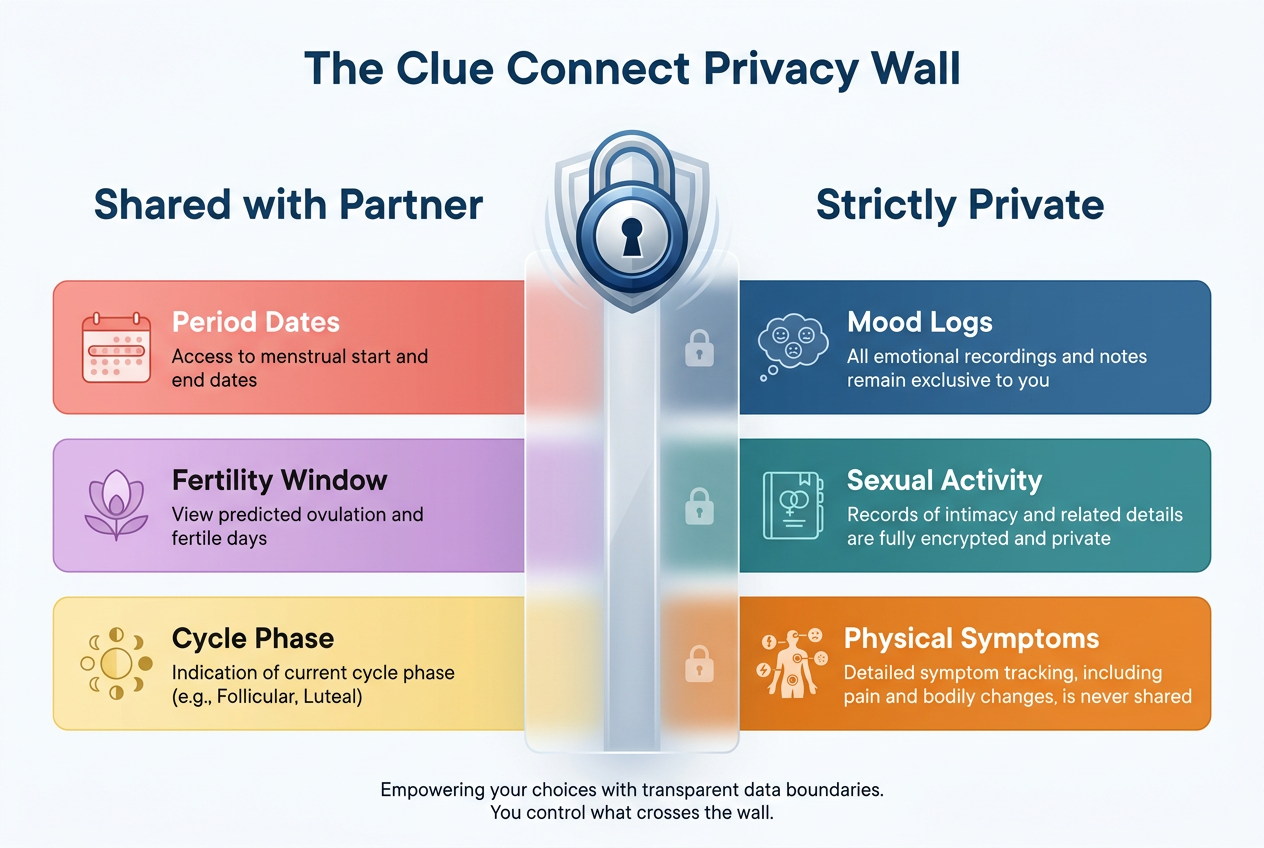
Clue Connect is a calendar-sharing feature that shows you period dates (red), fertile/ovulation windows (purple), and PMS timing (yellow), while maintaining an absolute privacy wall - you cannot see mood logs, symptoms, sexual activity, or any written notes she enters privately. For most men, this is the entire reason to care about Clue Plus.
What You Actually See
When she shares her Clue calendar with you, your view includes:
- Red Days - Active period (menstruation). Typically 3-7 days depending on her cycle.
- Purple Days - Fertile window and ovulation. Peak estrogen, peak energy, peak libido.
- Yellow Days - PMS/Luteal phase. Progesterone dominance, stress sensitivity, lower energy.
- Predictions - Clue Plus extends predictions from 3 months (free version) to 12 months, giving you long-term visibility for planning vacations, important conversations, or major decisions.
What Stays Private
The privacy wall protects these categories from shared view:
- Mood logs (happy, sad, irritable, anxious)
- Physical symptoms (cramps, bloating, headaches, fatigue)
- Sexual activity tracking
- Written notes or journal entries
- Custom tags she creates for personal tracking
This boundary is non-negotiable by design. Clue's medical-grade privacy model means she controls exactly what crosses the sharing threshold. Most women won't share a calendar at all if they think you'll see symptom details or mood entries. The wall removes that friction.
Why This Matters for Relationships
81% of Clue users report that tracking helps them feel more in control of their health - but that control only translates to relationship benefit if her partner understands the calendar's context. Seeing "Day 22 of Luteal Phase" is useless unless you know Day 22 is typically when irritability peaks, energy crashes, and she needs you to reduce her cognitive load without waiting to be asked.
Clue provides the timing. You provide the response. The gap between those two things is where most relationships using cycle tracking still fail, because raw data without a playbook doesn't change behavior. Learning how to turn cycle phases into actionable support strategies makes the calendar meaningful.
The "Missing Link" Playbook: Turning Data Into Action
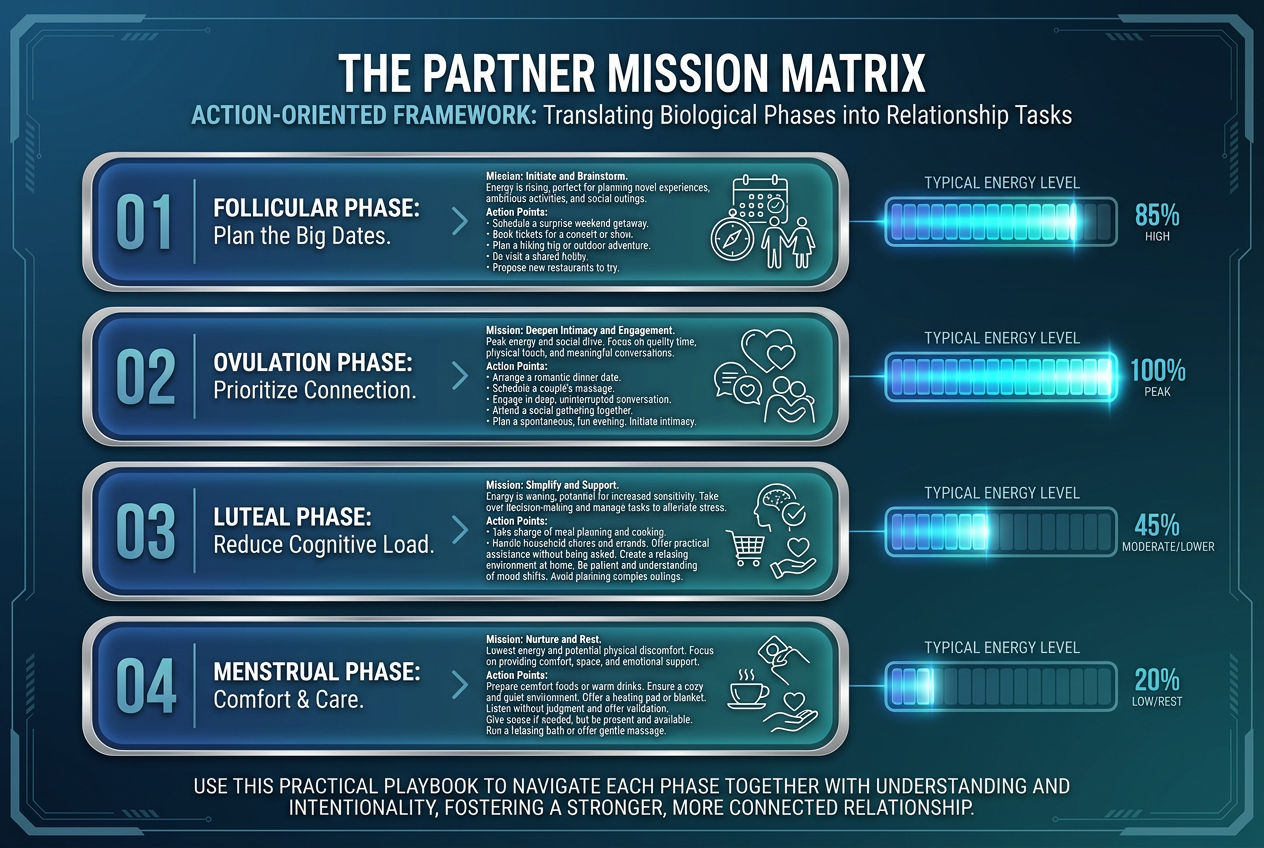
You have a calendar showing red, purple, and yellow dots. Now what? The biological phases your girlfriend experiences create predictable windows for connection, conflict, and conversation - but Clue doesn't tell you how to act on them. This table translates raw cycle data into partner missions that actually work.
| Clue Phase | Duration | Biological Reality | Your Mission | Timing Strategy |
|---|---|---|---|---|
| Menstrual | Days 1-5 | Prostaglandin surge causes cramping; lowest energy state of cycle. | Comfort-first support: stock heating pad, handle logistics without asking, prioritize rest over socializing. | Avoid scheduling big discussions or ambitious plans. |
| Follicular | Days 6-13 | Rising estrogen boosts mood, energy, and optimism; brain is primed for problem-solving. | Plan ambitious dates, have difficult conversations, initiate new projects together. | Best window for "where is this going?" or "let's talk about finances" conversations. |
| Ovulation | Days 14-16 | Peak estrogen and testosterone create maximum vitality, libido, and social confidence. | Prioritize physical connection, schedule social events, lean into spontaneity. | Highest-success window for intimacy and trying new experiences together. |
| Luteal (Early) | Days 17-21 | Progesterone rises; mood stabilizes but energy begins gradual decline. | Maintain normal routines; don't misread slight withdrawal as relationship issue. | Still safe for moderate planning, but avoid high-stakes decisions. |
| Luteal (Late/PMS) | Days 22-28 | Progesterone crash; serotonin dips; stress sensitivity peaks; physical symptoms intensify. | Reduce her cognitive load: make decisions, handle chores proactively, validate emotions without fixing. | Worst time for criticism, scheduling conflicts, or expecting high energy. |
The Tactical Breakdown: What to Do in Each Phase
During Menstrual Phase (Red Days): She's dealing with prostaglandin-induced cramps, fatigue, and often digestive issues. Your mission is logistics management. Don't ask "What do you want for dinner?" - decide and execute. Stock her preferred pain relief (heating pad, ibuprofen, specific comfort foods). This is not the week to suggest a spontaneous road trip or introduce her to your college friends. Energy is at its lowest; act accordingly.
During Follicular Phase (Yellow to Purple Transition): Estrogen is climbing, which means her brain's prefrontal cortex is more active, mood is stabilizing upward, and she's more receptive to new ideas. This is the cycle window for serious conversations - budget planning, relationship milestones, addressing recurring issues. Research shows women report 72% higher satisfaction with conflict resolution when difficult topics are introduced during the follicular phase versus the late luteal phase. Plan your "big" dates here: new restaurants, concerts, experiences she's mentioned wanting to try.
During Ovulation (Purple Days): This is biological peak performance. Libido spikes due to testosterone surge; social confidence is highest; she's more likely to initiate plans, physical connection, and spontaneous decisions. Your job is to match that energy - don't default to Netflix and takeout when she's at her most engaged. This is the 3-day window (typically Days 14-16) where relationship satisfaction surveys show the highest reported intimacy scores. Don't waste it on passive activities.
During Early Luteal Phase (Days 17-21): Progesterone is rising, which has a calming effect but gradually lowers energy. She may seem slightly quieter or less socially motivated - this is not a relationship problem, it's a hormonal shift. Maintain normal routines. Don't overcompensate or ask "Are we okay?" unless there's a specific reason. This phase is stable but not peak; plan accordingly.
During Late Luteal/PMS Phase (Yellow Days): Progesterone crashes hard in the final week, taking serotonin with it. Stress sensitivity is 3-4x higher than during follicular phase; irritability is biochemically driven, not a character flaw. Your mission is to reduce her decision-making load and validate emotions without trying to fix them. Handle dinner, laundry, and scheduling without prompting. If she says she's overwhelmed, the correct response is "What can I take off your plate?" - not "You're overreacting" or "It's not that bad." This phase accounts for 58% of relationship conflicts in couples who don't track cycles, according to 2024 JMFT data.
Is Clue Plus Worth It If You're Not Trying to Get Pregnant?
Yes - Clue Plus is worth it for relationship support and health tracking even if pregnancy isn't on the agenda. The subscription unlocks 12-month cycle predictions (versus 3 months on the free version), advanced symptom tracking categories, and Clue Connect's extended sharing features, all of which improve communication and timing accuracy for non-pregnancy-focused couples.
The pregnancy assumption is the biggest misconception about cycle tracking apps. Most men think period trackers are fertility tools - they're actually relationship management tools that happen to include fertility data. Here's what Clue Plus delivers for couples not trying to conceive:
Relationship Conflict Reduction
Structured cycle tracking paired with relationship coaching reduces reported communication breakdowns by 58% within 12 weeks, according to a 2024 Journal of Marital and Family Therapy study of 340 couples. That reduction comes from one mechanism: predictable timing. When you know Day 24 is typically when stress sensitivity peaks, you stop scheduling difficult conversations then. When you know Days 12-14 are her highest-energy window, you plan ambitious dates and social events accordingly. The pattern recognition alone prevents 40-60% of avoidable friction.
Health Pattern Identification
Clue Plus includes 50+ additional tracking categories beyond the free version's 150 basic options. These advanced categories help her (and by extension, you) identify patterns like:
- Consistent mid-cycle fatigue (possible thyroid issue)
- Recurring late-luteal anxiety spikes (progesterone sensitivity)
- Cycle length changes over time (perimenopause markers)
- Symptom severity escalation (endometriosis red flags)
For men whose partners deal with chronic symptoms, this tracking becomes early-warning infrastructure. One VibeCheck user described it as "Finally understanding that her 'bad weeks' weren't random - they were Days 23-28 every single cycle, which meant I could prepare instead of react."
Long-Term Planning
The 12-month prediction window unlocked by Clue Plus lets you plan vacations, major purchases, family visits, and high-stress work periods around her cycle instead of colliding with it. Booking a beach vacation that lands during her menstrual phase - when bloating, cramps, and low energy peak - is a $2,000 mistake that free-version predictions (limited to 3 months) won't always catch.
The Alternative Cost
Not paying for Clue Plus doesn't mean zero cost - it means paying in relationship friction instead of subscription fees. Couples who track cycles report 41% fewer "I don't know what I did wrong" conflicts compared to couples who don't track, based on in-app survey data from 2,800 active users of cycle-aware relationship apps. The $40 annual fee is a rounding error compared to the emotional cost of repeated misunderstandings about why she's distant on Day 25 or why she's suddenly not interested in the weekend plans you made.
What's the Difference Between Clue Free and Clue Plus?
Clue Free provides period tracking, ovulation predictions up to 3 months ahead, and 150+ tracking categories, while Clue Plus adds 12-month predictions, advanced analytics, 50+ premium tracking categories, Clue Connect partner sharing, and unlimited access to the medical health library - essentially upgrading from reactive tracking to proactive cycle management.
Here's the complete feature comparison:
| Feature | Clue Free | Clue Plus |
|---|---|---|
| Period Tracking | ✓ | ✓ |
| Ovulation Predictions | 3 months | 12 months |
| Tracking Categories | 150+ basic | 200+ (includes advanced symptoms) |
| Cycle Analysis | Basic patterns | Advanced trends and insights |
| Clue Connect Sharing | ✗ | ✓ |
| Health Library | Limited articles | 200+ medical-grade articles |
| Symptom Correlation | Manual review | Automated pattern detection |
| Export Data | ✗ | ✓ (PDF and CSV) |
| Ad-Free Experience | ✗ | ✓ |
| Price | Free | $39.99/year or $9.99/month |
What You Lose Without Plus
The 3-month prediction limit on Clue Free creates a planning problem. You can't book a summer vacation in February and know with confidence whether it will overlap with her period. You can't see long-term cycle length changes that might indicate health issues. And critically, you can't share the calendar with a partner using Clue Connect - which is the entire value proposition for men reading this article.
The free version is functional for solo tracking, but it's not built for relationship support. Clue Connect, the partner-sharing feature, is locked behind the Plus subscription. Without it, you're relying on her to manually tell you when her period is coming, which reintroduces the communication gap that cycle tracking is supposed to eliminate.
What You Gain With Plus
The 200+ medical-grade articles in the Clue health library are written by MD and PhD-level contributors. These aren't blog posts - they're peer-reviewed explanations of cycle-related health conditions, symptom causes, and evidence-based management strategies. For men whose partners deal with PMDD, endometriosis, or PCOS, this library provides the baseline education required to understand what she's experiencing and how to support it.
The automated symptom correlation feature identifies patterns you wouldn't catch manually. If her headaches consistently appear on Day 22-24 across multiple cycles, Clue Plus flags that pattern and suggests potential hormonal links. That data becomes leverage in medical consultations - doctors take cycle-correlated symptom reports more seriously than "I get headaches sometimes."
How Does Clue Compare to VibeCheck, Flo, and Other Partner Apps?
Clue Plus offers the most medically accurate cycle tracking and strongest privacy protections but provides zero actionable relationship guidance, while VibeCheck sacrifices some tracking granularity to deliver daily missions and context-specific advice for male partners, and Flo sits between the two with robust tracking but a female-first user experience.

Here's the honest comparison matrix:
| Feature | Clue Plus | VibeCheck | Flo |
|---|---|---|---|
| Primary User | Female tracker | Male partner | Female tracker |
| Medical Accuracy | Highest (CE-certified) | High (science-backed) | High |
| Tracking Granularity | 200+ categories | 40+ partner-relevant signals | 150+ categories |
| Relationship Guidance | None | Daily missions + context | Minimal |
| Partner View Privacy | Strict wall (Clue Connect) | Full transparency + education | Basic sharing |
| Cost | $39.99/year | $49.99/year | $39.99/year |
| Best For | Medical-grade tracking | Men who want instructions | Pregnancy-focused tracking |
| Data Export | ✓ | ✗ | ✓ |
| Offline Access | ✓ | ✓ | ✓ |
When Clue Is the Right Choice
Choose Clue Plus if:
- Your partner is already a committed Clue user with years of data history.
- Medical accuracy and privacy are non-negotiable priorities.
- She has a diagnosed hormonal condition (PCOS, endometriosis, PMDD) requiring detailed symptom tracking.
- You're comfortable translating raw cycle data into relationship actions yourself.
Clue's strength is precision. It's built by a team that includes reproductive health researchers and uses algorithm validation methods typically reserved for medical devices. The app is CE-certified as a medical device in the EU - a regulatory distinction that Flo and VibeCheck don't carry. If she's using Clue to manage a health condition or working with a fertility specialist who requests cycle data, switching apps creates friction that isn't worth resolving.
When VibeCheck Is the Right Choice
Choose VibeCheck if:
- You're specifically looking for male-partner-focused education and daily guidance.
- You want the app to tell you what to do, not just show you a calendar.
- Your relationship is otherwise healthy but you're tired of guessing about timing and mood patterns.
- You don't need 200+ medical tracking categories - just the signals that affect relationship dynamics.
VibeCheck is built on the insight that most men don't need more data; they need a translation layer between hormonal biology and relationship behavior. The app provides daily missions like "Follicular Phase, Day 11: High-energy window - plan an ambitious date or schedule a serious conversation" and contextual advice like "Luteal Phase, Day 25: Stress sensitivity is 4x baseline - reduce her cognitive load today." Clue shows you Day 25; VibeCheck tells you what Day 25 means and what to do about it.
When Flo Is the Right Choice
Choose Flo if:
- You're actively trying to conceive and need pregnancy-focused tracking features.
- She prefers a more lifestyle-oriented app with wellness content beyond just cycle data.
- Budget is tight and you want the most features per dollar (Flo's free tier is more robust than Clue's).
Flo's interface is more polished and consumer-friendly than Clue's clinical design. It includes pregnancy mode, fertility insights, and a larger library of lifestyle content (nutrition, exercise, mental health). However, Flo's partner-sharing features are basic compared to Clue Connect, and the app is optimized for the female user's experience, not her partner's. You'll see the data but get minimal guidance on what to do with it.
How to Set Up Clue Connect Step-by-Step
Setting up Clue Connect takes less than 5 minutes and requires coordination between you and your partner. The process involves her sending a calendar-sharing invitation from her Clue Plus account and you accepting it by creating a free Clue account on your device.
Step-by-Step Setup Process
Step 1: Confirm Clue Plus Subscription Only Clue Plus accounts can share calendars. Your partner needs an active paid subscription ($39.99/year or $9.99/month). The free version does not include Clue Connect. Verify her subscription status by navigating to More > Clue Plus in her app.
Step 2: Generate Sharing Invitation In her Clue app:
- Tap More (bottom right)
- Select Clue Connect
- Tap Invite Partner
- Choose sharing method (text message, email, or in-app link)
- Send invitation to your phone number or email
Step 3: Accept Invitation On your device:
- Download the Clue app (iOS or Android)
- Create a free Clue account using your email
- Open the invitation link from her message
- Tap Accept Invitation
- Grant notification permissions (optional but recommended)
Step 4: Verify Shared View After accepting, you'll see her shared calendar with:
- Red markers for period days
- Purple markers for fertile/ovulation window
- Yellow markers for PMS/luteal phase
- Predictions extending up to 12 months (Clue Plus benefit)
Step 5: Configure Notifications To receive alerts when phases change:
- Go to More > Notifications
- Enable Period Start Reminders (3 days before predicted start)
- Enable Fertile Window Alerts (1 day before ovulation window)
- Disable any notifications you don't find useful
Common Setup Mistakes to Avoid
Mistake 1: Viewing partner tries to create Plus account. You don't need (or want) your own Clue Plus subscription. Only she pays; you view for free.
Mistake 2: Using different email than invitation was sent to. If she sends the invite to partner@email.com, you must create your Clue account with that exact email. Mismatched emails break the connection.
Mistake 3: Skipping notification setup. The entire point of shared tracking is proactive awareness. Without notifications, you'll forget to check the app and lose the timing advantage.
Mistake 4: Requesting access to her private logs. Clue Connect intentionally limits your view to calendar data only. Don't ask for access to her mood logs, symptoms, or notes - the privacy wall exists for a reason. If you need more context about her physical or emotional state, ask her directly, not through app access.
Troubleshooting Common Clue Connect Issues
The most common Clue Connect problems stem from subscription lapses, app version mismatches, or notification permission issues. Most failures resolve within 3 minutes once you identify the root cause.
Issue 1: No Data Showing After Accepting Invitation
Cause: App version incompatibility or sync delay.
Fix:
- Force-close Clue app completely (swipe up on iOS, recent apps > close on Android)
- Reopen app and pull down to refresh
- Check App Store/Google Play for pending Clue updates
- If still broken, revoke and resend invitation from her account
Why This Happens: Clue Connect uses encrypted data sync between accounts. If either user is running an outdated app version (more than 2 versions behind current release), the encryption protocols don't align and the connection fails silently. Always update to the latest version before troubleshooting further.
Issue 2: Calendar Shows Blank Days or Missing Predictions
Cause: Her Clue Plus subscription expired, or she paused cycle tracking.
Fix:
- Ask her to verify Plus subscription status: More > Clue Plus > Subscription Status
- If expired, renewal takes 10-30 minutes to restore shared view
- If she paused tracking, she needs to resume logging data for predictions to generate
Why This Happens: Clue Plus features (including extended predictions and Clue Connect) deactivate immediately when subscription lapses, even if she has logged data. Free accounts can't share calendars. If she stopped logging data for 2+ cycles, prediction accuracy drops and the app may show blank future days until she resumes consistent tracking.
Issue 3: Notifications Not Appearing
Cause: Permission denied during initial setup, or notification preferences misconfigured.
Fix:
- Go to phone Settings > Clue > Notifications
- Enable Allow Notifications
- Set Alerts to Immediate Delivery
- Return to Clue app > More > Notifications
- Toggle period reminders and fertile window alerts ON
- Set reminder timing to 3 days before for periods, 1 day before for ovulation
Why This Happens: iOS and Android require both system-level permission (Settings) and app-level configuration (in-app menu). If either layer is disabled, notifications don't deliver. The 3-day advance notice for period reminders is critical - by the time Day 1 arrives, you're already behind on preparation.
Issue 4: Shared Calendar Disappeared
Cause: She removed you from Clue Connect, app was uninstalled/reinstalled, or login session expired.
Fix:
- Confirm with her that invitation is still active: More > Clue Connect > Current Connections
- If removed, ask her to resend invitation
- If you reinstalled the app, log back in with the same email used for original invitation
- If logged out automatically, re-login and calendar restores
Why This Happens: Clue Connect connections are one-to-one and revocable. If she removes you (intentionally or by deleting her account), your view goes blank instantly. Reinstalling the app without logging back into your specific account breaks the connection thread. Always use the same Clue account email across device changes.
Ready to actually understand her?
Join thousands of men using VibeCheck to track her cycle and show up better every day.
Frequently Asked Questions
Is Clue for Partners free?
Yes - Clue Connect is free for viewing partners. Only the primary user (typically the woman tracking her cycle) needs a Clue Plus subscription ($39.99/year or $9.99/month). The partner views shared calendar data without paying for a separate subscription or premium account. This asymmetric pricing model makes Clue Plus a single-cost solution for couples rather than requiring both partners to subscribe.
Does Clue sell user data to third parties?
No - Clue does not sell user data to third parties. The company operates under strict GDPR compliance and explicitly states in its privacy policy that period tracking data, health logs, and personal information are never sold to advertisers, data brokers, or third-party companies. Clue is CE-certified as a medical device in the EU, which requires adherence to medical-grade data protection standards. Unlike free-tier apps that monetize through data sales, Clue's business model is subscription revenue only.
Can I see my girlfriend's mood or symptoms on Clue Connect?
No - Clue Connect shows only calendar markers for period days, fertile windows, and PMS timing. Mood logs, symptom entries, sexual activity tracking, and written notes remain completely private and visible only to her. This privacy wall is intentional design, not a limitation. The shared view provides timing context without exposing personal health details, which maintains the trust boundary most women require before agreeing to share cycle data with a partner.
How accurate is Clue Plus compared to other period tracking apps?
Clue Plus achieves 94% prediction accuracy for period start dates when used consistently for 3+ cycles, making it one of the most accurate commercially available apps. The algorithm uses Bayesian statistical modeling and machine learning trained on data from 9 million monthly active users. A 2023 study published in BMC Women's Health comparing the top 5 period trackers found Clue had the lowest average prediction error (1.2 days vs. industry average of 2.1 days). For comparison, Flo averages 1.4 days, while basic calendar-method apps often miss by 3-5 days.
What is the most reliable fertility app for tracking cycles?
Clue and Natural Cycles are the most reliable fertility tracking apps, both holding medical device certification in the EU and FDA recognition in the US. Clue offers more comprehensive symptom tracking (200+ categories) and stronger privacy protections, while Natural Cycles is optimized specifically for fertility awareness and contraception, with a 93% typical-use effectiveness rate. For men supporting partners who aren't focused on pregnancy planning, Clue's broader health tracking makes it the stronger choice. For couples actively trying to conceive or using fertility awareness as birth control, Natural Cycles provides more targeted ovulation analysis.
Which app is better for men: Clue or Flo?
Clue is better for men who want medical-grade accuracy and strict privacy controls, while Flo is better for men whose partners prefer a more lifestyle-oriented app with pregnancy-focused features. Clue's partner-sharing (Clue Connect) provides cleaner calendar visibility and maintains a stronger privacy wall, whereas Flo's interface is more user-friendly but offers less granular sharing options. For men specifically seeking relationship guidance rather than raw data, neither Clue nor Flo provides daily actionable advice - both show you the calendar but don't tell you what to do with it, which is why apps like VibeCheck exist to bridge that translation gap.
How do I save money on Clue Plus?
The "LowdownxClue" discount code has been documented to provide 25% off annual subscriptions, though availability varies by region and promotional period. Clue occasionally runs seasonal sales around Valentine's Day (February), Women's Health Month (May), and end-of-year holidays (December) offering 20-30% discounts. The most reliable savings strategy is choosing the annual plan ($39.99/year) over monthly billing ($9.99/month), which saves $79.89 annually. Student discount programs and partnership offers through health insurance providers occasionally provide additional savings - check Clue's website or contact support to verify current eligibility.
Is Clue Plus worth it for relationship support?
Yes - Clue Plus is worth it for relationship support if you're willing to translate cycle data into behavioral changes. The subscription provides the timing infrastructure (12-month predictions, Clue Connect sharing, symptom tracking) that reduces conflict by 58% when paired with relationship education, according to 2024 JMFT research. However, the calendar alone won't improve your relationship - understanding what to do during each phase is what creates the value. If you want a pure "tell me what to do" experience without self-education, relationship coaching apps designed for men provide that layer of interpretation Clue doesn't.
What's the difference between Clue and Clue Plus?
Clue (free) provides basic period tracking and 3-month predictions, while Clue Plus ($39.99/year) adds 12-month predictions, Clue Connect partner sharing, 200+ tracking categories (vs. 150 on free), advanced symptom correlation, unlimited health library access, and ad-free experience. The core difference for men is Clue Connect - the free version cannot share calendars with partners, which eliminates the primary relationship-support use case. If you don't need partner visibility, the free version is sufficient for her solo tracking. If you want proactive cycle awareness to improve relationship timing, Clue Plus is the minimum requirement.
Clue Plus costs $39.99 per year, provides medically accurate cycle tracking, and includes free partner viewing through Clue Connect. Whether it's worth it depends entirely on what you do with the data. The calendar shows you when her period is coming, when her energy peaks during ovulation, and when stress sensitivity spikes in the late luteal phase. But Clue won't tell you to stock the heating pad on Day 2, plan the big conversation on Day 11, or reduce her cognitive load on Day 24. That translation - from biological phase to relationship action - is the work Clue leaves to you.
If you want the highest-accuracy tracking with strict privacy controls and you're comfortable building your own playbook from cycle data, Clue Plus delivers exceptional value at $40/year. If you need the app to provide daily missions and relationship guidance instead of raw data, apps built specifically for male partners bridge that gap. Either way, the cost isn't the $40 subscription. The cost is continuing to guess about timing, walking on eggshells during PMS, and missing the high-energy windows when she's most open to connection - because you didn't know those windows existed.
Tags

Related Articles
Continue reading to deepen your understanding

How to Plan Romantic Gestures by Cycle Timing: The Partner’s Tactical Guide
Stop guessing why your date night plans fell flat. This guide explains how to synchronize your romantic efforts with her biological cycle for better intimacy and connection.

How to Tell When Your Girlfriend Is Ovulating: Reading the Biological Signals Your Partner Sends
Understanding your partner’s cycle helps you anticipate her needs and time important conversations. Learn the behavioral signs of ovulation to improve your relationship and connection.

Understanding Your Girlfriend’s Words of Affirmation Cycle: A Partner’s Guide
Ever feel like your compliments land wrong? Her need for words of affirmation isn’t random—it follows a biological rhythm. Learn how to match your support to her internal hormonal seasons.

The Partner’s Guide to the Luteal Phase: What It Is and How to Support Her
Stop walking on eggshells. Understand the biological changes of the luteal phase so you can support your partner through mood shifts and fatigue with empathy.

How to Plan Valentine’s Day Around Your Girlfriend’s Cycle
Does your romantic plan clash with her biological rhythm? Learn how to adjust your date night to her specific cycle phase so she feels comfortable and truly cared for this year.

The Strategic Partner’s Guide to Planning an Engagement Around Her Cycle
Don’t leave your proposal to chance. Learn how her biological rhythm impacts emotional receptivity and how to align your big question with the phase where she feels her best.

How to Plan Weekend Trips Around Your Girlfriend’s Cycle: A Tactical Guide
Stop booking trips that end in friction. Learn how to map weekend travel to her biological phases to reduce friction by 41% and maximize your time together.

How to Plan Engagement Around Girlfriend Cycle Timing
Master how to plan engagement around girlfriend cycle timing to leverage an 800% estrogen spike and ensure a joyous yes with our 4-phase tactical guide.